New York Court Holds Stun Gun Ban is Not Unconstitutional, in Contravention of Caetano

Herschel Smith · 30 Mar 2025 · 2 Comments

Dean Weingarten has a good find at Ammoland. Judge Eduardo Ramos, the U.S. District Judge for the Southern District of New York,  has issued an Opinion & Order that a ban on stun guns is constitutional. A New York State law prohibits the private possession of stun guns and tasers; a New York City law prohibits the possession and selling of stun guns. Judge Ramos has ruled these laws do not infringe on rights protected by the Second Amendment of the United States Constitution. Let's briefly…… [read more]

Urban Warfare Simulator

BY Herschel Smith
18 years, 8 months ago

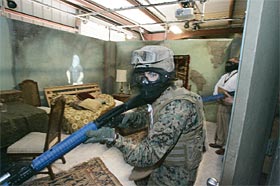
The U.S. Marines have commissioned an Infantry Immersion Trainer system for the purpose of training in MOUT prior to deployment.

infantry_immersion_trainer.jpg

The Marine Corps is embracing breakthrough holographic technology to teach combat tactics and battlefield ethics at Camp Pendleton as troops there begin another major round of deployments to Iraq.

Marine officials yesterday unveiled the Infantry Immersion Trainer, a high-tech prototype simulator that resides in a former – and decidedly low-tech – tomato-packing plant that still bears directions for truck drivers.

Marines trained yesterday in Camp Pendleton’s high-tech prototype simulator, designed to evoke the conditions that U.S. troops face in Iraq.

The 32,000-square-foot, $2.5 million training ground became reality after a request from Gen. James Mattis, former commander of the 1st Marine Expeditionary Force at Camp Pendleton. The program capitalizes on 15 years of Navy and Marine research on everything from body movements to urban warfare, coupled with the latest advancements in simulation from defense companies such as Lockheed Martin.

The new training area is “a pretty big deal . . . that’s expected to save lives,” said Col. Clarke Lethin, chief of staff for the 1st Marine Expeditionary Force.

He added that it also could help guide Marines through the tough process of making split-second battle decisions involving morality and legality.

“As we go through the war, it’s changing out there. There are more no-shoots than shoots,” Lethin said. “We want to make sure that we are shooting the right people.”

It takes its inspiration from a city block in Iraq that U.S. troops typically would patrol, complete with a warren of shops and houses. Hardly a detail is overlooked among the props, modeled with Hollywood set-design techniques: Laundry hangs on the clotheslines. A grill sits against a wall. Propane tanks are placed here and there amid the musky scent of unpaved streets and alleys.

Perched in the rafters are projectors that cast life-size images of civilians and insurgents on wall after wall in the building. Live actors and pyrotechnics round out the integration of sight, sound and smell.

There is an argument to be made that this is two to three years later than needed.  Additionally, the system isn’t perfect.

One of the Marines showing how the troops react in the various scenarios was Lance Cpl. Jason Trehan, a 24-year-old Ohio native who returned from his fourth Iraq assignment in November.

“It’s pretty realistic and a lot like what we do face,” Trehan said. “It could be bigger, though. Bigger is always better,” he said, in reference to the somewhat cramped series of rooms and low ceilings.

Trehan said a higher ceiling that would accommodate rooftops would more accurately depict a typical Iraqi village.

There is always justification for including Lance Corporals in the design review of all training and combat systems.  Lance Corporals are the core of the Corps, but like our friends at OpFor, we are huge fans of General James Mattis, and this brainchild of Mattis will evolve.

Col. Lethin said the Camp Pendleton virtual trainer was in part the brainchild of Gen. James Mattis, who until recently was head of the I Marine Expeditionary Force and commander of Marine Corps Forces Central Command.

Mattis is now working with NATO and as head of the Joint Forces Command based at Norfolk, Va.

“General Mattis said that if we can train a pilot to fly a 747 in a simulator, we owe that same kind of training to our ground forces that are bearing the brunt of the casualties today,” Lethin said.

The local troops now deploying are finding a much more stable and calm environment in the former insurgent stronghold west of Baghdad along the Syrian and Jordanian border, Lethin said. But it remains a dangerous place.

“It’s a lot better today than it was, but there’s still bad guys to be killed,” Lethin said. “The training we now can offer here is good, but I want it to get even better.”

And get better it will.  While no simulator can duplicate the reality of combat, all attempts to train warriors better should be met with appreciation as well as constructive criticism.

Iraq: For Ten Years

BY Herschel Smith
18 years, 8 months ago

I have previously predicted that Iraq would not only be a protectorate of the U.S. for another decade, but pseudo-permanent bases would eventually be constructed and garrisoned in Iraq – most likely in Northern Iraq – at some point, sooner rather than later.  Coupled with this, I have argued, would be a stand-down in constabulary operations, along with a focus on kinetic operations resulting from intelligence-driven raids.  I had also predicted that the chest butts and posturing by Iraq about U.S. forces standing down in a year was all show, and that sooner rather than later a longer term deal would be struck between the U.S. and Iraq to ensure the national security of Iraq.

Lo and behold, the Iraqi Defense Minister sees the need for U.S. help in Iraq until 2018.

The Iraqi defense minister said Monday that his nation would not be able to take full responsibility for its internal security until 2012, nor be able on its own to defend Iraq’s borders from external threat until at least 2018.

Those comments from the minister, Abdul Qadir, were among the most specific public projections of a timeline for the American commitment in Iraq by officials in either Washington or Baghdad. And they suggested a longer commitment than either government had previously indicated.

Pentagon officials expressed no surprise at Mr. Qadir’s projections, which were even less optimistic than those he made last year.

President Bush has never given a date for a military withdrawal from Iraq but has repeatedly said that American forces would stand down as Iraqi forces stand up. Given Mr. Qadir’s assessment of Iraq’s military capabilities on Monday, such a withdrawal appeared to be quite distant, and further away than any American officials have previously stated in public.

This level of commitment should force a view to the larger picture.  The U.S. is requesting that NATO send more forces to Afghanistan, forces that cannot fire a weapon due to restrictive rules of engagement, while the U.S. garrisons forces in Germany.  This backwards, cold war mentality is a drain on resources and an artifact of half century old thinking.  It has got to go if the West is to survive.

Pakistan in Turmoil and Still a Springboard for Terror

BY Herschel Smith
18 years, 8 months ago

The Strategy Page trends far too positive in their assessment of the situation in Pakistan, one example being the recent publication of Pakistan Turns on Its Islamic Radicals.  The same day, the New York Times published an insightful article entitled Next-Gen Taliban.  Portions of it are given below.

“The religious forces are very divided right now,” I was told by Abdul Hakim Akbari, a childhood friend of Rehman’s and lifelong member of the J.U.I. (Jamiat Ulema-e-Islam) I met Akbari in Dera Ismail Khan, Rehman’s hometown, which is situated in the North-West Frontier Province. According to this past summer’s U.S. National Intelligence Estimate, approved by all 16 official intelligence agencies, Al Qaeda has regrouped in the Tribal Areas adjoining the province and may be planning an attack on the American homeland. “Everyone is afraid,” Akbari told me. “These mujahedeen don’t respect anyone anymore. They don’t even listen to each other. Maulana Fazlur Rehman is a moderate. He wants dialogue. But the Taliban see him as a hurdle to their ambitions. ”

Rehman doesn’t pretend to be a liberal; he wants to see Pakistan become a truly Islamic state. But the moral vigilantism and the proliferation of Taliban-inspired militias along the border with Afghanistan is not how he saw it happening. The emergence of Taliban-inspired groups in Pakistan has placed immense strain on the country’s Islamist community, a strain that may only increase with the assassination of Bhutto. As the rocket attack on Rehman’s house illustrates, the militant jihadis have even lashed out against the same Islamist parties who have coddled them in the past … For now, it is Islamist violence that seems to have the political upper hand rather than the accommodation of Islamist currents within a democratic society …

Rehman’s critics blame him and his party for facilitating the local Taliban, an allegation he resents. “We are politicians, and we will have to go to our constituencies to get votes in an election,” he told me, as we sat together in the drawing room of his home in Dera Ismail Khan. “If there is a war going on, no one can vote.” Halogen spotlights dotted the ceiling, and soft leather couches lined the walls. Rehman wore a pinstripe waistcoat over a shalwar kameez. The room smelled of strong cologne. He added, in a rare moment of candor, “But even we are now afraid of the young men fighting.”

During Pakistan’s 2002 election campaign, Rehman played up his links with the Taliban, and the Islamist coalition did well. In retrospect, that may have been his high point. The divide between the pro-Taliban leaders of yesterday and those of today was fully exposed by the insurrection at the Red Mosque in Islamabad, which began last January under the leadership of Abdul Rashid Ghazi and his brother. As the weeks and months passed, the rebels kidnapped a brothel madam, some police officers and, finally, six Chinese masseuses. They made a bonfire of CDs and DVDs and demanded that Musharraf implement Shariah. Defenders paced the outer walls of the mosque holding guns and sharpened garden tools.

Rehman tried to talk the Ghazi brothers out of their reckless adventure, but his influence inside the mosque was limited. “They are simply beyond me,” he said at one point.

The much vaunted Pakistan military is said to be the anchor of Pakistan, that glue that holds the country together and provides stability from one coup to the next, from one administration to the next.  However, this view is dated and dangerously naive.  Angry Pakistanis are turning against their own army.

Amid nationwide anger over the killing of the opposition leader Benazir Bhutto and a widespread belief that the country’s military or intelligence may have been involved, the population is turning against the army for the first time.

From the wailing rice-pickers at Bhutto’s grave in the dusty village of Garhi Khuda Bakhsh in the southern province of Sindh to the western-educated elite sipping whisky and soda in the drawing rooms of Lahore, the message is the same: General Pervez Musharraf, the president, must go and the army must return to its barracks.

Feelings are running so high that officers have been advised not to venture into the bazaar in uniform for fear of reprisals.

Worse still, the Pakistani army is losing its nerve and will to engage the radical elements (Taliban, al Qaeda and other militants along the border).

More than 700 Pakistani soldiers have been killed in the fight in the tribal areas against militants said to be linked to Al-Qaeda, and officers admit that morale has not been so low since they lost Bangladesh in 1971.

“We’re being asked to bomb our own people and shrug it off as collateral damage,” said a Mirage pilot. “I call it killing women and children.”

It has also recently been brought to light that not only has Pakistani intelligence given free reign to these radical groups, these groups are in fact their own creation, this creature now attacking its creator.

Pakistan’s premier military intelligence agency has lost control of some of the networks of Pakistani militants it has nurtured since the 1980s, and is now suffering the violent blowback of that policy, two former senior intelligence officials and other officials close to the agency say.

As the military has moved against them, the militants have turned on their former handlers, the officials said. Joining with other extremist groups, they have battled Pakistani security forces and helped militants carry out a record number of suicide attacks last year, including some aimed directly at army and intelligence units as well as prominent political figures, possibly even Benazir Bhutto.

The growing strength of the militants, many of whom now express support for Al Qaeda’s global jihad, presents a grave threat to Pakistan’s security, as well as NATO efforts to push back the Taliban in Afghanistan. American officials have begun to weigh more robust covert operations to go after Al Qaeda in the lawless border areas because they are so concerned that the Pakistani government is unable to do so.

Covert and special forces operations is an impoverished answer to a big and growing problem which badly needs significant force projection before it is too late to engage in any kind of operation.  I have previously stated that “In the end, there is no replacement for force projection.  Our commitment to Iraq cannot waiver, not even in the long term, but a reduction in force presence there must also be accompanied by a rapid increase at the front of the counterinsurgency campaign in Pakistan, i.e., Afghanistan, as soon as possible.”

All roads lead to Pakistan as the springboard for Islamic radicalism, it has been said.  But if all roads lead to Pakistan, they begin in Afghanistan.  The venue for counterinsurgency in Pakistan is along the Pakistan-Afghanistan border, and the opportunity to wage this counterinsurgency is upon us, never to be repeated in our lifetime.  Stabilization of Pakistan and Afghanistan stand in the balance, as well as the safety of nuclear weapons.

Myth Telling

BY Herschel Smith
18 years, 8 months ago

The Captain’s Journal will not endorse any particular political candidate for President, at least not during the primaries.  However, as absurd things come up in the context of the debates, we will address them.  One such absurd thing was promulgated by Ron Paul during the latest GOP debate.  It is a variant of one which I have addressed before in Attacking the Enemy’s Strategy in Iraq.  Kevin Drum sets out the scenario for us in his exercise in strategy-bashing.

I’ve mentioned a few times before that our “bottoms up” strategy of supporting Sunni tribes in the provinces surrounding Baghdad carries a number of risks. The biggest risk, I suppose, is that once the tribes finally feel safe from the threat of al-Qaeda in Iraq, they’ll relaunch their insurgency and start shooting at American soldiers again. The second biggest risk is that the Shiite central government understands perfectly well that “competing armed interest groups” in the provinces are — well, competing armed interest groups.

In response to Drum’s criticism of the strategy, I stated:

Having been militarily defeated by U.S. forces, we consider it to be unlikely that the Sunnis would take up the fight once again with the U.S.  More likely, however, is an escalation in the low intensity civil war that was ongoing for much of the previous two years.  This all makes it critical that political progress take root in the wake of the military successes.  But Kevin Drum’s concluding comment is absurd: ” … a year from now, if the Iraqi civil war is raging once again, this is where it will have started.”

Rather than an observation of the necessity for political progress, this statement follows the template of criticism set out by the left, and it has been followed with religious fervor.  Note carefully what Drum charges.  Rather than the seeds of violence being one thousand years of religious bigotry between Shi’a and Sunni, or recent history under Saddam’s rule, or the temptations of oil revenue in a land that has not ever seen the largesse of its natural resources due to corruption, the cause is said to be the “concerned local citizens” groups, i.e., U.S. strategy.

This outlandish claim betrays the presuppositions behind it – specifically, that it would be somehow better to continue the fighting than to, as they charge, buy peace with money.  But for the hundreds of thousands of disaffected Sunni workers who have no means to support their families, this criticism is impotent and offers no alternative to working for the insurgency to feed their children.  It ignores basic daily needs, and thus is a barren and unworkable view when considering the human condition.

So Drum’s charge is that if a large scale civil war emerges in Iraq, then the U.S. strategy is to blame.  Ron Paul offers a variant of this criticism.  It is that “we are arming the Sunnis,” and the Sunnis will then be able to carry on the fight against … perhaps the U.S., or perhaps the Shi’a … he didn’t say.  He just said that it isn’t over, something we can all observe for ourselves.

Regarding this charge of “arming the Sunnis,” Ron Paul ignores basic data that is quickly available to any motivated researcher.  I wouldn’t expect him to have recalled the long discussions I have had over this blog, or the Small Wars Journal folks had, over disarming the population as recommended by the Small Wars Manual.  Many observations emerged during this tête-à-tête, from the nation and population being too large for this solution to be effected, to it being culturally anathema, and so on.  But even if Paul is not a student of this blog or the Small Wars Manual, he can perform a Google search with relative ease, or so I assume.

There are too many hits in a Google search of this kind to mention, but just a few should suffice.  This Department of Defense article (and this one too), along with this Stars and Stripes article and this Telegraph article all go to remind us of what we have all known for four or more years.  The Multinational Force has continued to allow each home to have an AK-47 for self protection.  Arming the Sunnis is not something we did or had to do.  They were already armed.  This is how they carried on an insurgency since 2004.  The strategy had nothing to do with arming the Sunnis.  It pertained to settling differences with them, proving that the U.S. was the stronger tribe in Anbar, and in the end remembering that most of them never fought for religious reasons (as did al Qaeda and Ansar al Sunna).  This allowed the coalition to consider the issues of livelihood, income-earning, and support for families, basic anthropological issues that should be considered in any counterinsurgency.

But if Ron Paul has a childlike understanding of the issues, John Robb’s detailed understanding boggles the mind.  He charges the following:

The best explanation for the spike in violence between February 2006 and June 2007 is that the Askariya bombings initiated a process that was leading the conflict towards total war. Total war (Ludendorf) is a form of non-trinitarian conflict that ignores moral, political, cultural, etc rules in favor of complete mobilization to achieve total victory (global thermonuclear warfare is the ultimate example of total war). In Iraq, total war means religious cleansing via militias. Up until February 2006, Iraq was a limited conflict where US and Iraqi forces under strict modern rules of engagement, kept a lid on the scale of conflict (although they were unable to win). The Askariya bombing changed that dynamic. It so completely sundered the domestic social system in Iraq that the conflict lurched towards total war.

By early 2007, Sunni forces were suffering defeat after defeat as large Shiite militias violently cleansed towns and neighborhoods across Iraq (if measured in terms of Johnson’s coefficient, we would have seen a move towards 1.8, the coefficient of conventional warfare). This put the open source insurgency in a crisis. Sunni insurgents weren’t able to form the large local militias needed to defend themselves as long as they were in conflict with the US (these formations would be easy targets). The US military saw this opportunity and enabled the Sunnis for form local militias under the protection of the US (putting 60,000 on a US/Saudi payroll) as long as they sacrificed jihadi groups associated with al Qaeda. The US also began to target Shiite militias. The result was that the onrush to total war in Iraq was averted as the Sunnis began to develop conventional forces. The return to limited war also means that the open source insurgency can now thrive again.

Robb is a very smart analyst.  But his basic problem is one of presuppositions.  His axiomatic starting point is always that there is no solution to the problem of insurgency.  No counterinsurgency strategy can win, rather like the Kobayashi Maru.  But even a basic rendering of history proves this wrong.  The Romans successfully put down a Jewish insurgency for many years while occupying Jerusalem.  A more modern example is Vietnam.  The insurgency was basically defeated, and the South Vietnamese government fell only when NVA regulars came across the border en masse and the U.S. Congress cut funding for the war.

All of this isn’t to say that Iraq is a paradise right now.  The Sunni awakening leader Sheikh Ahmed Abu Reesha has said that the U.S. must stay in Iraq.

“Right now, any quick withdrawal will be disastrous because the Iraqi army is incapable of taking over,” Sheikh Ahmed said in an interview. “Any withdrawal must happen only when the Iraqi army is 100 percent ready to protect the country.

“The government and the country cannot afford to be without help from the Americans.”

Sheikh Ahmed took over as head of the Anbar Awakening in September after the murder of his celebrated brother Sheikh Abdul Sattar Abu Reesha, the pioneer of the Sunni groups that switched allegiance from Al-Qaeda to US forces.

The movement has been a prime factor behind a sharp drop in violence across Anbar and especially in its capital Ramadi, which was reduced to ruins as US forces battled with Iraqi nationalists and tribes allied with Al-Qaeda.

Over the past year, attacks in Ramadi have dropped from 25-30 a day to fewer than one a week, and the numbers of roadside bombs have declined by 90 percent, according to latest US military figures.

Low grade or large scale civil war may indeed break out upon the decrease of U.S. forces, or in fact this may not happen.  If Robb is right about a return to an insurgency, he is so spuriously.  There is no necessity for this to happen, and since none of us can claim omniscience, we’ll wait on history to tell us whether Iraq will continue down the road to stability.  The point is that childlike objections like we are “arming the Sunnis,” and high-brow objections like Robb suggests are all variants of the same gripe.  In the end, they are just gripes; and myths die hard.

Our Deal With Mullah Abdul Salaam

BY Herschel Smith
18 years, 8 months ago

In British Negotiations with Taliban, I covered the secret negotiations between British MI6 agents and mid-level Taliban commanders aimed at splintering the leadership the Taliban.  We covered how there was an effort underway by Hamid Karzai to obtain the loyalties of the lieutenants of Mullah Omar and thus split the organization.  The price for this loyalty is a place at the table in the new Afghanistan.

But the British bypassed Karzai in their effort to make peace with the Taliban, and for this secrecy were ejected from the country.  Yet the deed had been done, and the price for realignment of one specific Taliban mid-level commander was governorship of Musa Qala, that fated city which once was handed over to local leaders, retaken by the Taliban, and then retaken again by NATO forces months later, costing both lives and blood of NATO forces.  Mullah Abdul Salaam switched sides, and was rewarded with rule over the region.
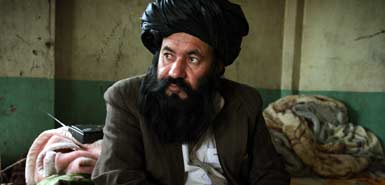
mullah_abdul_salaam.jpg

Matt Dupee at Afgha.com waxes positive about the deal, even suggesting that Salaam enabled the victory to retake Musa Qala, or at least caused it to be more timely.

Musa Qala district in southern Helmand province was the secluded epicenter of Taliban activity throughout 2007, a symbolic “crown jewel” in the Taliban’s jet-black turban, before Afghan and Coalition forces launched Operation Snake Pit last month and reestablished government rule. The highly touted operation lasted nearly a week with the heaviest fighting occurring on the outskirts of the city and areas further south. The operation’s speed and relatively tidy conclusion is due in large part from a back-door political deal hammered out between the Afghan government and a local Taliban strongman, Mullah Abdul Salaam Alizai, last October.

Mullah Abdul Salaam is a powerful and influential cleric of the Alizai tribe, Helmand’s largest Pashtun tribe, and holds sway over hundreds, if not thousands of armed loyalists throughout Musa Qala. His defection was secured after several secret meetings with Afghan and British officials during October and November. Rival Taliban factions attempted to assassinate him with a suicide-bomber, but British media reveal his body guard contingent of over 200 armed men helped foil the bomber’s plans.

The government’s deal with Mullah Abdul Salaam included his future position as Musa Qala’s governor, which he was appointed to on January 7, and allowed him to pick and choose other local authorities such as the new police chief. Afghan officials hope his prestige and influence over the locals will perk up their image in the south where many residents are sympathetic to the Taliban and deeply mistrustful of the central government. Officials also expressed optimism in bringing other “moderate Taliban,” meaning less ideologically driven fighters, into the fold of the government. For those fighters unwilling to cooperate, Salaam and his men have vowed to fight them.

But is this assessment too positive?  In a somewhat more desperate tone, The Times gives us a picture of what really happened prior to and during the battle for Musa Qala.

Britain’s last chance of securing this treacherous corner of Afghanistan lies in the hands of a piratical, black-turbaned figure with long beard, white cloak and silver-sequinned slippers with curled toes.

Mullah Abdul Salaam may not look much like a white knight. He served as a commander in the Taleban and even today his true loyalties remain suspect. The 45-year-old former Mujahidin guerrilla could, however, decide the fate of the British mission to stabilise the lawless province of Helmand, where this week he was put in charge of the key district of Musa Qala.

“He’s not just the best show in town,” one British officer remarked. “He’s the only show in town.”

Mullah Salaam’s rise to power in Musa Qala, the test case for British efforts to evict the Taleban and install central authority, is a classic Afghan tale of intrigue, bloodshed, farce and fate. In an interview with The Times the former warlord explained how last year he had severed relations with the Taleban, was courted secretly by a foreign diplomat and eventually swapped sides to join the British-led effort.

“The Taleban called a shurah [council] to attack the district centre and coalition forces there but though invited I did not attend nor fight,” he said. “It was not a good thing.”

He was then approached by Michael Semple, an Irish diplomat working for the European Union in Kabul. Mr Semple, a fluent Pashto-speaking veteran of Afghanistan, was expelled last month by the Government in Kabul for his back-channel contacts with the Taleban.

Before being ordered out he managed to put together a deal with the former Taleban commander. “We discussed reconciliation and unity in Afghanistan,” Mullah Salaam said of the first of his several meetings with Mr Semple. “I was surprised to hear of his recent expulsion.”

Mullah Salaam went to Kabul for a meeting with President Karzai last autumn. He caught the Afghan leader’s imagination with the promise of a tribal uprising against the Taleban, which could, potentially, deliver Musa Qala into government hands with barely a shot being fired. The idea led to a War Cabinet meeting in Kabul, which included the British and American ambassadors, President Karzai and General Dan McNeill, the commander of Nato forces in Afghanistan.

The result was operation Mar Karadad, which had to be accelerated at the end of November when Kabul heard news that Mullah Salaam, now back in Musa Qala, had attracted the attention of the Taleban and the uprising was imminent.

There was no uprising. When Afghan, British and US units closed in on Musa Qala last month, Mullah Salaam stayed in his compound in Shakahraz, ten miles east, with a small cortège of fighters, where he made increasingly desperate pleas for help.

“He said that he would bring all the tribes with him but they never materialised,” recalled one British officer at the forefront of the operation. “Instead, all that happened was a series of increasingly fraught and frantic calls from him for help to Karzai.”

In spite of his broken promises Mullah Salaam was still one of the few credible local leaders prepared to work with the British. He also proved to be a skilled orator. This week he took his antiTaleban campaign to elders in the rainswept village of Chaghali, ten miles from Musa Qala.

“It is enough now,” he urged the 30 men huddled around him. “Our dead have been eaten by the dogs.” He gestured at a small group of British and American officers. “You can see around you these people from noble nations have come to build you streets and schools. If they should ask you to leave your religion then you have a right to fight them, but not because they come to bring you streets and schools.”

The village was in an area roamed by Taleban led by Mullah Abdul Bari, who remains at large. Mullah Salaam wasted little time in using his own past connection with the militant commander in his address.

“Abdul Bari is our brother,” he said. “He can come and sit among us . . . He is from this land. Speak with him. But don’t let him be stupid. If he is not on the right path then don’t let yourself be sacrificed for him. Tell him to take his jihad somewhere else.”

His eloquence and leadership have impressed the British, who reconsidered him for the job of district governor, not least because there were few volunteers for the post.

“The first time we heard Mullah Salaam speak he spoke bloody well,” said Major Guy Bartle-Jones, the head of the British Military Stabilisation Team. “In fact, he dominated the whole show. He gave the government message: antiTaleban, counter-narcotics, interspersed with Koranic verses. He came across as an accomplished politician, far away from the reports from Kabul, where he had been pilloried as a fraught and frantic man. So we reported back up the chain that he was a charismatic, good orator. And the question was suddenly: ‘Is this a credible governor?’.”

Today the new governor’s challenge is to navigate the dark waters of Helmand’s politics, unite warring clans and reconcile his erstwhile Taleban comrades into the political process. His very survival will be an issue in itself: he claimed that two suicide bombers have already been sent to kill him. He remains, however, Musa Qala’s best hope, and has certainly won the backing of the British, albeit with a small caveat.

“We have in him a credible governor who is making an impression upon us and the people,” an officer in Musa Qala concluded. “He is a compelling individual. But we still don’t know what his ulterior motives are.”

Because of his skills at oratory and his having spoken “bloody well” to the locals, he was given governorship of Musa Qala, despite the fact that he could not assist with any significant military presence during the battle for the very area he now rules.  It is a pitiful substitute for the “awakening” in Western Iraq, where the Anbaris vowed to fight al Qaeda to the last child of Anbar.

Mullah Abdul Salaam has talked a good game for the moment, and perhaps he means what he says.  Who knows?  But proper counterinsurgency requires force projection.  The strong horse wins in counterinsurgency because the population bets on proven winners.  Cheap imitations of the Anbar awakening won’t work in this region of the world.  In Anbar, commitment by Marines and other U.S. forces over time won the battle for the region, this battle consisting not only of kinetic operations, but also in good governance, increased water and electricity supplies, repaired infrastructure, and other amenities associated with modernity.  Al Qaeda had nothing to offer except violence.  The Anbaris made their choice.

The road in Afghanistan will be just as hard or even harder, given that the Anbaris are somewhat more secular than the Afghans, but the counterinsurgency can be won (despite the ridiculous and highly emotional British claim that Mullah Abdul Salaam is the ‘last hope’ of civilization).  It will take U.S. commitment, not artificial props to be successful.  No ostensible harm to the COIN campaign in Afghanistan has been done, but a great deal can be learned from this silly and unfortunate episode.

Prior:

Musa Qala: The Argument for Force Projection

Clarifying Expectations in Afghanistan

Review and Analysis of Afghanistan Counterinsurgency Campaign

Gates Sets Pretext for Review of Afghanistan Campaign

British in Negotiations with Taliban

Fates of Afghanistan and Pakistan Inextricably Tied

The British-American War Continues: MI-6 Agents Expelled from Afghanistan

Commitment to Iraq and Recommitment to Afghanistan

Taliban Now Govern Musa Qala

Tribute to Readers

BY Herschel Smith
18 years, 8 months ago

Reader and thinker Dominique Poirier, a long time friend of The Captain’s Journal and contributor to learned comments, has released a tribute to us via YouTube.  I am not only flattered by this video, but also struck at his American patriotism.  I recall one specific e-mail to me in which this citizen of France recited the pledge of allegiance – the U.S. pledge of allegiance – while making glowing observations about American culture and heritage.  But I am also struck at what a good video this is.  It is good to the extent that it shows our fighting man and his surroundings, his toil, and his emotions.  I have been deeply rooted in thinking and praying over our warriors for quite a long time now. I thank Dominique for this video, and it shows how committed he is to the campaign, to freedom around the globe, and to living in peace with fellow man.  It is well worth the three minutes it took to view it.

WSJ Interviews Marine Corps Commandant James T. Conway

BY Herschel Smith
18 years, 8 months ago

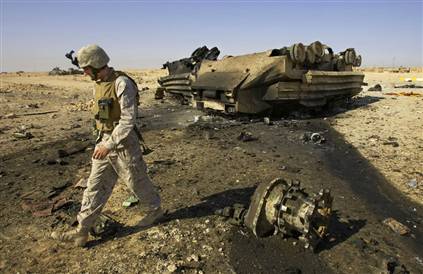
The Wall Street Journal has an outstanding interview with Marine Corps Commandant James T. Conway.  The subjects are far ranging and weighty, one such subject being the current ‘heaviness’ of the Marines today.  Planning for Operation Iraqi Freedom II and III didn’t consider the costs and equipment requirements of counterinsurgency, and consequently, 14 force recon Marines were lost in the summer of 2005 due to operating an Amphibious Assault Vehicle on a desert road.

amphibious_assault_vehicle.jpg

So Commandant Conway takes on the issue of transport and protection.

One way the Marines are clearly changing is in the vehicles troops use to patrol in Iraq. “If you look at the table of equipment that a Marine battalion is operating with right now in Iraq,” Gen. Conway explains, “it is dramatically different than the table of equipment the battalion used when it went over the berm in Kuwait in ’03, and it is remarkably heavier. Heavier, particularly in terms of vehicles.

“I mean the Humvees were canvas at that point for the most part. Today they are up-armored and we’re looking at vehicles even heavier than that. We’ve got a whole new type of vehicle that we’re patrolling in, conducting operations in, that’s the MRAP [Mine Resistant Ambush Protected], a 48,000 pound vehicle. . . . these type of things, make us look more like a land army than it does a fast, hard-hitting expeditionary force.”

Gen. Conway commends the MRAP’s performance: “[W]e had over 300 attacks against the MRAP without losing a Marine or sailor.” And, he says, “We always have to be concerned about protecting our Marines. We owe that to the parents of America.”

“But,” he adds, “first we have to be able to accomplish our mission. And I think there are a lot of instances where a lighter, faster, harder-hitting force that gets to a scene quickly is more effective than a heavier, more armored force that gets there weeks or months later.”

It is clear that the MRAP can make it more difficult to maneuver in a battle zone. “We saw some problems with the vehicle once it went off of the roadways,” Gen. Conway says. “Its cross-country mobility, particularly in western Iraq where you have wadis [dry riverbeds] and small bridges and that type of thing was not what we hoped it would be.”

And it is something Gen. Conway has decided to have fewer of. He recently announced that the Marines are halting orders for these vehicles. The Corps will take delivery of a total of 2,300 new MRAPs by the end of the year, which it will use to conduct missions in Iraq. But Gen. Conway is canceling orders for 1,400 additional MRAPs that he and his advisors believe they will not need in the coming years. In the process, Gen. Conway is saving Uncle Sam $1.7 billion. “Yeah. I mean, that to me was a common sense kind of determination.”

The Multinational Force has addressed the issue of IEDs with interdiction, increased detection and armor, and targeting the networks of those who traffic in and emplace IEDs.  However, the issue with AAVs and MRAPs is a symptom of the problem, as Conway expands into his real issue with the long-term constabulary role in Iraq.

“If you accept a generation of officers is four years,” Gen. Conway says, “that’s what an officer signs on for, we now have that generation of officers — and arguably troops — that have come and gone, that are combat hardened, but that will never have stepped foot aboard ship. . . . an amphibious operation is by its very nature the most complicated of military operations; and that we have junior officers and senior officers who understand the planning dimensions associated with something like that, that have sufficient number of exercises over time to really have sharpened their skills to work with other services to accomplish a common goal — these are the things that concern me with the atrophying of those skills and the ability to go out and do those things.”

Conway ends his interview saying that COIN operations in Iraq are exactly what the Marines need to support because of the compelling national interests.  I have argued for commitment to completion of OIF, although reduced civil affairs missions and an eventual end to constabulary operations in favor of assistance to the Iraqi army and police for kinetic operations and border security.  However, the corollary to this argument is a re-commitment to the COIN campaign in Afghanistan.  Not only would this be a change from urban warfare (MOUT), but from the perspective of the future of Afghanistan, increased force projection is required.

The entire interview of well worth the time to read, and we support not only Conway’s commitment to the campaign in Iraq, but the upcoming deployment of Marines to Afghanistan.  This commitment to Afghanistan should increase over 2008 and 2009.  However, in the end, Conway is right to be concerned about maintaining the capabilities of the Corps.  This will require commitment to MEUs, rapid assault and deployment, amphibious training and retaining the expeditionary flavor of the Corps.

The War on Terror Should Know No Borders

BY Herschel Smith
18 years, 8 months ago

Following up on the recommendation we have made here at The Captain’s Journal to deploy Marines to the counterinsurgency campaign in Afghanistan, the Pentagon is preparing to bring a recommendation to Secretary of Defense Robert Gates to send up to 3000 Marines to Afghanistan.

The Pentagon is preparing to send at least 3,000 Marines to Afghanistan in April to bolster efforts to hold off another expected Taliban offensive in the spring, military officials.

The move Wednesday represents a shift in Pentagon thinking that has been slowly developing after months of repeated insistence that the U.S. was not inclined to fill the need for as many as 7,500 more troops that commanders have asked for there. Instead, Defense Secretary Robert Gates pressed NATO allies to contribute the extra forces.

Pentagon Press Secretary Geoff Morrell said Wednesday that a proposal will go before Gates on Friday that would send a ground and air Marine contingent as well as a Marine battalion — together totaling more than 3,000 forces — to southern Afghanistan for a “one-time, seven-month deployment.”

Gates, he said, will want to review the request, and is not likely to make a final decision on Friday.

“He will take it and consider it thoroughly before approving it,” said Morrell. “I just want to get people away from the idea that this is going to be imminently approved by the secretary.”

He said Gates “has some more thinking to do on this matter because it’s a serious allocation of forces.”

Morrell added that Gates’ thinking on the issue has “progressed a bit” over time as it became clear that it was politically untenable for many of the NATO nations to contribute more combat troops to the fight.

“The commanders need more forces there. Our allies are not in the position to provide them. So we are now looking at perhaps carrying a bit of that additional load,” the spokesman said.

Morrell said the move, first reported Wednesday by ABC News, was aimed at beating back “another Taliban offensive” that is expected this spring — as has occurred in previous years.

When Gates was in Afghanistan last month, commanders made it clear they needed the additional forces.

The Marines would likely come out of Camp LeJeune.

Sources said the Camp Lejeune, N.C.-based 24th Marine Expeditionary Unit — scheduled to deploy in mid-February — went into high gear this week, laying plans for an accelerated deployment schedule that could have the unit departing for Afghanistan on Feb. 1 and staying out past its traditional 180-day rotation. However, unit officials would not confirm that the group is planning to leave early.

The themes of force size and force projection are well known in our previous articles, and the campaign has languished in Afghanistan due to inadequate forces.  However, there is a hint in this report of the remaining paucity of vision that afflicts the strategic planning at the Pentagon.  It is found in the words “one time .. deployment.”  The stated goal of this small addition is to forestall or prevent a spring offensive by the Taliban.  The Pentagon still doesn’t see Aghanistan as the key to Pakistan as we have previously recommended.

The Afghans understand.  They welcome the addition of troops.  But they see more clearly than to refer to a mere temporary addition of troops.  Afghan officials believe that the war on terror should know no borders.

Al Qaeda and Taliban leaders operate “outside the country.”  The war on terror “should know no borders.”

Afghan officials’ are hinting that Afghanistan would be more than happy for US forces to attack Taliban and Al Qaeda safe havens in Pakistan.

Some analysts say the US and NATO won’t make lasting progress in Afghanistan unless the militants’ ability to command and control the insurgency from across the border is tackled.

“Terrorism is like a spring. It is better to go to the main source than to fight the water’s flow,” said Defence Ministry Spokesman Gen Muhammad Zahir Azim.

Afghanistan’s Intelligence Service Chief Amrullah Saleh said recently “We believe the war on terror should know no borders.”

President Hamid Karzai’s spokesman Humayun Hamidzada said on Tuesday “I’m not going to comment about the specifics about operations inside Pakistan. All I’m going to say is that we should address the sources, the root causes of terrorism wherever they are,” Hamidzada said, hinting heavily that Afghanistan believes that to be in Pakistan.

We have pointed out that counterinsurgency inside Pakistan proper, with U.S. troops actually deployed en masse in the country, would be impossible.  Yet the border region of Afghanistan and Pakistan is amorphous, ripe territory for kinetic operations to capture and kill Taliban.  The U.S. has a once in a generation opportunity in being allowed to traffic freely along the border region of the country from which the enemy springs forth.  The key to dealing with the Taliban in both Afghanistan and Pakistan is still the border region.  Force projection is required.  And there is still paucity of vision at the highest levels of leadership.

Prior:

Musa Qala: The Argument for Force Projection

Clarifying Expectations in Afghanistan

Review and Analysis of Afghanistan Counterinsurgency Campaign

Gates Sets Pretext for Review of Afghanistan Campaign

British in Negotiations with Taliban

Fates of Afghanistan and Pakistan Inextricably Tied

The British-American War Continues: MI-6 Agents Expelled from Afghanistan

Commitment to Iraq and Recommitment to Afghanistan

Taliban Now Govern Musa Qala

Iraqi Jihadis Analyze Coalition Strategy

BY Herschel Smith
18 years, 8 months ago

Pretext and Thesis

Abdul Hameed Bakier of The Jamestown Foundation gives us an interesting review of Iraqi jihadis and their analysis of the surge and security plan in Iraq.  The analysis is posted over jihadi web sites and forums from multiple individuals, but the focus of the analysis is what they find to be three strategic phases.

Preliminary phase—Intelligence

This phase started three to four months before the actual implementation of the plan. Because a lack of intelligence was the major reason for U.S. failures in previous operations, this phase concentrated on collecting intelligence on different jihadi factions. The rivalry between various jihadi factions compromised jihadi security and secrecy, denying the resistance the element of surprise in their operations. U.S. forces succeeded in penetrating the secrecy shield of the jihadis, allowing intelligence units to analyze jihadi groups in different operational sectors and “hot spots.” The behavior and relations between the people of Iraq were examined and comprehensive intelligence situation reports were prepared.

Defensive operations phase

The objective of this phase was an all-out confrontation with various jihadi detachments, characterized by sustained direct contact by U.S. forces and Iraqi police units. This phase included defining areas of confrontation with jihadis, confining and isolating these areas, constructing camps and control points in these areas and setting up ambushes along routes frequented by jihadis.

Interception phase

Using military and control points, U.S. and Iraqi forces launched search and interception operations. The size of the search operations in Iraqi cities was unprecedented. Consequently hundreds of jihadis were detained in a matter of weeks and a significant number of arms caches were uncovered. Finally, the U.S. military command inflicted serious damage to the morale of the jihadis by turning its military personnel loose on the cities and villages of Iraq, bombing at leisure any target they deemed hostile.

In a related subject, another jihadi website calls upon the leaders of different jihadi detachments to unite in order to recover from U.S. and Iraqi military operations (, December 26, 2007). The writer, using the alias “Jabhat al-Iraq” (Iraqi Front), says: “Dare I say that we, in the turmoil of the war, concentrated on attacking the enemy and forgot to strengthen our lines of defense against penetrations which led to contentions among us. We must unite all jihadi groups under one jihadi project.” Jabhat al-Iraq reminds jihadis how Baghdadis defeated Persian besiegers in 1732 without any help from the Ottoman Empire by uniting ranks and improving the training of their troops.

The call to unite all Iraqi jihadis may have a short-term positive effect on some Sunni insurgency groups with mutual religious, social or political inclinations, such as the Iraqi Sunni tribes and former Baathists. On the other hand, the Salafi-Jihadi extremists of al-Qaeda are unlikely to practice the religious tolerance needed to form a long-term Coalition with moderate Muslim tribesmen, much less with the despised Baathists.

Analysis and Commentary 

It is true that U.S. intelligence has been compiling data on individuals for at least three years, the most recent innovations in use being biometrics (including retinal scans and finger prints).  It is also true that there have been intelligence-driven kinetic operations, e.g., kinetic operations against the insurgency yields a catch of people or data and information, which leads to further kinetic operations due to the intelligence yield, and so on.  Finally, it is true that U.S. troops have been more proactive in the field, have conducted more kinetic operations, and have created greater force projection than in the past.  All of these observations could have easily come from a study of Milblogs or other reports.  Here the usefulness of the jihadi analysis ends.

The call to unite insurgent groups is no different than Osama bin Laden’s recent call to do the same.  While the U.S. has successfully implemented the strategy of breaking away the indigenous insurgency in Iraq by payments to concerned citizens, work programs and potential incorporation into the security forces or police, the indigenous insurgents were never fighting for religious motivation as were the jihadis.  As to the real reason for the self-destruction of the insurgency, the tribal sheikhs answered bin Laden’s call to align with al Qaeda by responding that their torture and brutality was rejected by the tribes.  The jihadi analysis of their failure is flawed, in that they still don’t understand their blunders.  They gratuitously ascribe to the U.S. forces what only they could do – lose the hearts and minds of the people.  Major General Gaskin has stated that the coalition gains in Anbar are permanent.

Their call for uniting the jihadi groups will go unheeded, but a more recent tactic has been the increase in spectacular suicide and car bomb attacks.

A US commander on Wednesday said the number of “spectacular” assaults by Al-Qaeda in Iraq has increased although the overall number of attacks was down and 20 key militants have been killed or caught.

Major General Mark Hertling, commanding general of coalition forces in northern Iraq, gave no specific examples of what he termed “spectacular” attacks, referring only to big car bombs and to suicide attacks.

“These spectacular events and intimidation are designed to incite fear in the population,” Hertling told a news conference in Baghdad.

Suicide bombers have continued to carry out bloody attacks in recent weeks, with one killing 25 people and wounding 85 on Christmas Day, when he slammed his vehicle into a truck carrying gas cylinders at a checkpoint in the northern oil town of Baiji.

The same month, a woman suicide bomber killed 16 people in the offices of a local anti-Qaeda front in Muqdadiyah, in Diyala province, while another bomber killed 13 people inside a cafe near the Diyala provincial capital Baquba.

To be precise, this is not insurgency; it is terrorism.  I exactly predicted the use of these high visibility flash-bang events (in lieu of more traditional insurgency operations among the population or in direct confrontation of U.S. troops) in an interview by Jim Vicevich of WTIC Newstalk 1080 out of Hartford, Connecticut almost two months ago.

Taliban Now Govern Musa Qala

BY Herschel Smith
18 years, 8 months ago

Following closely on the heels of British negotiations with mid-level Taliban, the governorship of Musa Qala has been handed over to a Taliban commander.

A Taliban commander who defected hours before British and Afghan forces retook the Taliban stronghold of Musa Qala has been rewarded with the governorship of the town.

Mullah Abdul Salaam switched sides after months of delicate secret negotiations with the Afghan government, as part of a programme of reconciliation backed by British commanders in Helmand.

In a move clearly intended to send a message to other potential Taliban defectors, the Afghan government has announced that he had become the new district governor with the backing of local tribes.

An Afghan government spokesman, Humayun Hamidzada, said that the move was consistent with the policy of President Hamid Karzai’s government.

“The president has said before that all those former Taliban who come and accept the constitution and who want to participate in the political process through non-violent means … they are welcome.”

He added that Mullah Salaam had provided crucial intelligence to the Afghan government.

Mullah Salaam is a leader of one of the three sub-tribes of the Alizai, the dominant tribal group in Musa Qala.

As The Daily Telegraph reported in November, Mullah Salaam opened channels of communication with the government after a violent rift emerged in the Taliban around Musa Qala, during which he survived an assassination attempt.

Mullah Salaam told The Daily Telegraph: “There are two groups of Taliban fighters in Musa Qala and I have the backing of the major one. The Taliban who are against peace and prosperity in Afghanistan – I will fight them.”

Local people confirmed that he enjoyed the backing of a large swathe of the inhabitants of the town.

The issue of Taliban defections remains a highly sensitive one, following the expulsion of a British and an Irish diplomat from Kabul last month on charges of having “inappropriate contacts” with militants.

Afghan government officials accused the two men of holding meetings with Taliban leaders in Helmand without authorisation.

The British Prime Minister, Gordon Brown, has ruled out direct talks with the Taliban leadership, but it is well known in Kabul that both the British and Afghan intelligence agencies are devoting considerable resources to trying to “turn” Taliban-aligned tribal leaders.

As we have discussed before, this is the British version of the Anbar awakening combined with payment for concerned citizens who protect the people and fight al Qaeda.  But the problem with this analogy is that it is no analogy at all.  It has nothing at all in common with a true awakening such as occurred in Anbar.  It is true that the last decade of rule by Saddam saw the birth of a small element of youth who were motivated by religious radicalism.

By the late 1980s it had become clear that secular pan-Arabism fused with socialist ideas was no longer a source of inspiration for some Ba’th Party activists. Many young Sunni Arabs adopted an alternative ideology, namely, fundamentalist Islam based essentially on the thought of the Egyptian Muslim Brotherhood. A minority even moved toward the more extreme Salafi, and even Wahhabi, interpretation of Islam. The regime was reluctant to repress such trends violently, even when it came to Wahhabis, for the simple reason that these Iraqi Wahhabis were anti-Saudi: much like the ultraradical Islamist opposition in Saudi Arabia, they, too, saw the Saudi regime as deviating from its original Wahhabi convictions by succumbing to Western cultural influences and aligning itself with the Christian imperialist United States. This anti-Saudi trend served the Iraqi regime’s political purposes.

But this proves the bifurcation that was inherent in the Anbaris which led to the awakening.  These radical youth were an insignificant fraction of the population and were not ever fair game in the strategy to win hearts and minds.  They were the enemy, and there was never a time when they weren’t the enemy.  They quickly aligned with al Qaeda, and the less radical citizens were really the ones in play in the overall strategy.  Al Qaeda and those with whom they were aligned have been essentially defeated in Anbar and are losing in Diyala.  Peace was sought with those from the indigenous insurgency who saw themselves as something other than jihadis.  In Afghanistan, the Taliban are by very definition religiously defined.  Even the casual reader might consider Afghanistan seven years ago (Taliban in charge) and compare it to the Afghanistan of today (with the Taliban in charge if the British strategy plays out) and recall that the only real change is that Hamid Karzai is at the helm, a tenuous charge and precarious perch to be sure.

While the MI6 agents who were negotiating with the Taliban have been ejected from the country, the strategy of acquiescence to the Taliban continues to be implemented by British military command.  After their failed military campaign in and pullout from Basra, the British are actively negotiating the turnover of the Afghanistan government to the very enemy defeated upon the initial invasion of Afghanistan in order to end the campaign.  This strategy has at least the tacit approval of Hamid Karzai, as U.S. troop presence and strategy is not sufficient to allow him to object.  U.S. and NATO lack of force projection gives him no other choice.

Prior:

Musa Qala: The Argument for Force Projection

Clarifying Expectations in Afghanistan

Review and Analysis of Afghanistan Counterinsurgency Campaign

Gates Sets Pretext for Review of Afghanistan Campaign

British in Negotiations with Taliban

Fates of Afghanistan and Pakistan Inextricably Tied

The British-American War Continues: MI-6 Agents Expelled from Afghanistan

Commitment to Iraq and Recommitment to Afghanistan


26th MEU (10)
Abu Muqawama (12)
ACOG (2)
ACOGs (1)
Afghan National Army (36)
Afghan National Police (17)
Afghanistan (704)
Afghanistan SOFA (4)
Agriculture in COIN (3)
AGW (1)
Air Force (42)
Air Power (10)
al Qaeda (83)
Ali al-Sistani (1)
America (23)
Ammunition (305)
Animals (340)
Ansar al Sunna (15)
Anthropology (3)
Antonin Scalia (1)
AR-15s (398)
Arghandab River Valley (1)
Arlington Cemetery (2)
Army (91)
Assassinations (2)
Assault Weapon Ban (29)
Australian Army (7)
Azerbaijan (4)
Backpacking (4)
Badr Organization (8)
Baitullah Mehsud (21)
Basra (17)
BATFE (248)
Battle of Bari Alai (2)
Battle of Wanat (18)
Battle Space Weight (3)
Bin Laden (7)
Blogroll (3)
Blogs (24)
Body Armor (23)
Books (3)
Border War (18)
Brady Campaign (1)
Britain (39)
British Army (36)
Camping (5)
Canada (20)
Castle Doctrine (1)
Caucasus (6)
CENTCOM (7)
Center For a New American Security (8)
Charity (3)
China (20)
Christmas (18)
CIA (30)
Civilian National Security Force (3)
Col. Gian Gentile (9)
Combat Outposts (3)
Combat Video (2)
Concerned Citizens (6)
Constabulary Actions (3)
Coolness Factor (3)
COP Keating (4)
Corruption in COIN (4)
Council on Foreign Relations (1)
Counterinsurgency (218)
DADT (2)
David Rohde (1)
Defense Contractors (2)
Department of Defense (220)
Department of Homeland Security (26)
Disaster Preparedness (5)
Distributed Operations (5)
Dogs (15)
Donald Trump (27)
Drone Campaign (4)
EFV (3)
Egypt (12)
El Salvador (1)
Embassy Security (1)
Enemy Spotters (1)
Expeditionary Warfare (18)
F-22 (2)
F-35 (1)
Fallujah (17)
Far East (3)
Fathers and Sons (2)
Favorite (1)
Fazlullah (3)
FBI (39)
Featured (192)
Federal Firearms Laws (18)
Financing the Taliban (2)
Firearms (1,878)
Football (1)
Force Projection (35)
Force Protection (4)
Force Transformation (1)
Foreign Policy (27)
Fukushima Reactor Accident (6)
Ganjgal (1)
Garmsir (1)
general (15)
General Amos (1)
General James Mattis (1)
General McChrystal (44)
General McKiernan (6)
General Rodriguez (3)
General Suleimani (9)
Georgia (19)
GITMO (2)
Google (1)
Gulbuddin Hekmatyar (1)
Gun Control (1,736)
Guns (2,418)
Guns In National Parks (3)
Haditha Roundup (10)
Haiti (2)
HAMAS (7)
Haqqani Network (9)
Hate Mail (8)
Hekmatyar (1)
Heroism (5)
Hezbollah (12)
High Capacity Magazines (16)
High Value Targets (9)
Homecoming (1)
Homeland Security (3)
Horses (2)
Humor (72)
Hunting (66)
ICOS (1)
IEDs (7)
Immigration (123)
India (10)
Infantry (4)
Information Warfare (4)
Infrastructure (4)
Intelligence (23)
Intelligence Bulletin (6)
Iran (171)
Iraq (379)
Iraq SOFA (23)
Islamic Facism (64)
Islamists (98)
Israel (19)
Jaish al Mahdi (21)
Jalalabad (1)
Japan (3)
Jihadists (82)
John Nagl (5)
Joint Intelligence Centers (1)
JRTN (1)
Kabul (1)
Kajaki Dam (1)
Kamdesh (9)
Kandahar (12)
Karachi (7)
Kashmir (2)
Khost Province (1)
Khyber (11)
Knife Blogging (7)
Korea (4)
Korengal Valley (3)
Kunar Province (20)
Kurdistan (3)
Language in COIN (5)
Language in Statecraft (1)
Language Interpreters (2)
Lashkar-e-Taiba (2)
Law Enforcement (6)
Lawfare (14)
Leadership (6)
Lebanon (6)
Leon Panetta (2)
Let Them Fight (2)
Libya (14)
Lines of Effort (3)
Littoral Combat (8)
Logistics (50)
Long Guns (1)
Lt. Col. Allen West (2)
Marine Corps (281)
Marines in Bakwa (1)
Marines in Helmand (67)
Marjah (4)
MEDEVAC (2)
Media (68)
Medical (146)
Memorial Day (6)
Mexican Cartels (48)
Mexico (72)
Michael Yon (6)
Micromanaging the Military (7)
Middle East (1)
Military Blogging (26)
Military Contractors (5)
Military Equipment (25)
Militia (9)
Mitt Romney (3)
Monetary Policy (1)
Moqtada al Sadr (2)
Mosul (4)
Mountains (25)
MRAPs (1)
Mullah Baradar (1)
Mullah Fazlullah (1)
Mullah Omar (3)
Musa Qala (4)
Music (25)
Muslim Brotherhood (6)
Nation Building (2)
National Internet IDs (1)
National Rifle Association (97)
NATO (15)
Navy (31)
Navy Corpsman (1)
NCOs (3)
News (1)
NGOs (3)
Nicholas Schmidle (2)
Now Zad (19)
NSA (3)
NSA James L. Jones (6)
Nuclear (63)
Nuristan (8)
Obama Administration (222)
Offshore Balancing (1)
Operation Alljah (7)
Operation Khanjar (14)
Ossetia (7)
Pakistan (165)
Paktya Province (1)
Palestine (5)
Patriotism (7)
Patrolling (1)
Pech River Valley (11)
Personal (77)
Petraeus (14)
Pictures (1)
Piracy (13)
Pistol (4)
Pizzagate (21)
Police (673)
Police in COIN (3)
Policy (15)
Politics (999)
Poppy (2)
PPEs (1)
Prisons in Counterinsurgency (12)
Project Gunrunner (20)
PRTs (1)
Qatar (1)
Quadrennial Defense Review (2)
Quds Force (13)
Quetta Shura (1)
RAND (3)
Recommended Reading (14)
Refueling Tanker (1)
Religion (501)
Religion and Insurgency (19)
Reuters (1)
Rick Perry (4)
Rifles (1)
Roads (4)
Rolling Stone (1)
Ron Paul (1)
ROTC (1)
Rules of Engagement (76)
Rumsfeld (1)
Russia (37)
Sabbatical (1)
Sangin (1)
Saqlawiyah (1)
Satellite Patrols (2)
Saudi Arabia (4)
Scenes from Iraq (1)
Second Amendment (715)
Second Amendment Quick Hits (2)
Secretary Gates (9)
Sharia Law (3)
Shura Ittehad-ul-Mujahiden (1)
SIIC (2)
Sirajuddin Haqqani (1)
Small Wars (72)
Snipers (9)
Sniveling Lackeys (2)
Soft Power (4)
Somalia (8)
Sons of Afghanistan (1)
Sons of Iraq (2)
Special Forces (28)
Squad Rushes (1)
State Department (23)
Statistics (1)
Sunni Insurgency (10)
Support to Infantry Ratio (1)
Supreme Court (85)
Survival (216)
SWAT Raids (58)
Syria (38)
Tactical Drills (38)
Tactical Gear (17)
Taliban (168)
Taliban Massing of Forces (4)
Tarmiyah (1)
TBI (1)
Technology (21)
Tehrik-i-Taliban (78)
Terrain in Combat (1)
Terrorism (96)
Thanksgiving (13)
The Anbar Narrative (23)
The Art of War (5)
The Fallen (1)
The Long War (20)
The Surge (3)
The Wounded (13)
Thomas Barnett (1)
Transnational Insurgencies (5)
Tribes (5)
TSA (25)
TSA Ineptitude (14)
TTPs (4)
U.S. Border Patrol (8)
U.S. Border Security (22)
U.S. Sovereignty (29)
UAVs (2)
UBL (4)
Ukraine (10)
Uncategorized (107)
Universal Background Check (3)
Unrestricted Warfare (4)
USS Iwo Jima (2)
USS San Antonio (1)
Uzbekistan (1)
V-22 Osprey (4)
Veterans (3)
Vietnam (1)
War & Warfare (436)
War & Warfare (41)
War Movies (4)
War Reporting (21)
Wardak Province (1)
Warriors (6)
Waziristan (1)
Weapons and Tactics (80)
West Point (1)
Winter Operations (1)
Women in Combat (21)
WTF? (1)
Yemen (1)

September 2026
August 2026
July 2026
June 2026
May 2026
April 2026
March 2026
February 2026
January 2026
December 2025
November 2025
October 2025
September 2025
August 2025
July 2025
June 2025
May 2025
April 2025
March 2025
February 2025
January 2025
December 2024
November 2024
October 2024
September 2024
August 2024
July 2024
June 2024
May 2024
April 2024
March 2024
February 2024
January 2024
December 2023
November 2023
October 2023
September 2023
August 2023
July 2023
June 2023
May 2023
April 2023
March 2023
February 2023
January 2023
December 2022
November 2022
October 2022
September 2022
August 2022
July 2022
June 2022
May 2022
April 2022
March 2022
February 2022
January 2022
December 2021
November 2021
October 2021
September 2021
August 2021
July 2021
June 2021
May 2021
April 2021
March 2021
February 2021
January 2021
December 2020
November 2020
October 2020
September 2020
August 2020
July 2020
June 2020
May 2020
April 2020
March 2020
February 2020
January 2020
December 2019
November 2019
October 2019
September 2019
August 2019
July 2019
June 2019
May 2019
April 2019
March 2019
February 2019
January 2019
December 2018
November 2018
October 2018
September 2018
August 2018
July 2018
June 2018
May 2018
April 2018
March 2018
February 2018
January 2018
December 2017
November 2017
October 2017
September 2017
August 2017
July 2017
June 2017
May 2017
April 2017
March 2017
February 2017
January 2017
December 2016
November 2016
October 2016
September 2016
August 2016
July 2016
June 2016
May 2016
April 2016
March 2016
February 2016
January 2016
December 2015
November 2015
October 2015
September 2015
August 2015
July 2015
June 2015
May 2015
April 2015
March 2015
February 2015
January 2015
December 2014
November 2014
October 2014
September 2014
August 2014
July 2014
June 2014
May 2014
April 2014
March 2014
February 2014
January 2014
December 2013
November 2013
October 2013
September 2013
August 2013
July 2013
June 2013
May 2013
April 2013
March 2013
February 2013
January 2013
December 2012
November 2012
October 2012
September 2012
August 2012
July 2012
June 2012
May 2012
April 2012
March 2012
February 2012
January 2012
December 2011
November 2011
October 2011
September 2011
August 2011
July 2011
June 2011
May 2011
April 2011
March 2011
February 2011
January 2011
December 2010
November 2010
October 2010
September 2010
August 2010
July 2010
June 2010
May 2010
April 2010
March 2010
February 2010
January 2010
December 2009
November 2009
October 2009
September 2009
August 2009
July 2009
June 2009
May 2009
April 2009
March 2009
February 2009
January 2009
December 2008
November 2008
October 2008
September 2008
August 2008
July 2008
June 2008
May 2008
April 2008
March 2008
February 2008
January 2008
December 2007
November 2007
October 2007
September 2007
August 2007
July 2007
June 2007
May 2007
April 2007
March 2007
February 2007
January 2007
December 2006
November 2006
October 2006
September 2006
August 2006
July 2006
June 2006
May 2006

about · archives · contact · register

Copyright © 2006-2026 Captain's Journal. All rights reserved.