New York Court Holds Stun Gun Ban is Not Unconstitutional, in Contravention of Caetano

Herschel Smith · 30 Mar 2025 · 2 Comments

Dean Weingarten has a good find at Ammoland. Judge Eduardo Ramos, the U.S. District Judge for the Southern District of New York,  has issued an Opinion & Order that a ban on stun guns is constitutional. A New York State law prohibits the private possession of stun guns and tasers; a New York City law prohibits the possession and selling of stun guns. Judge Ramos has ruled these laws do not infringe on rights protected by the Second Amendment of the United States Constitution. Let's briefly…… [read more]

Nawa, Marjah and Kandahar: A Tale of Three Cities

BY Herschel Smith
16 years ago

Rajiv Chandrasekaran with The Washington Post addresses the question why counterinsurgency works in some places but not others.

MARJA, AFGHANISTAN — The distance from here to success is only 15 miles.

There, in the community of Nawa, a comprehensive U.S. civilian-military counterinsurgency strategy has achieved what seems to be a miracle cure. Most Taliban fighters have retreated. The district center is so quiescent that U.S. Marines regularly walk around without their body armor and helmets. The local economy is so prosperous, fueled by more than $10 million in American agriculture aid, that the main bazaar has never been busier. Now for sale: shiny, Chinese-made motorcycles and mobile phones. There’s even a new ice cream shop.

But here in Marja, the same counterinsurgency strategy has not suppressed the insurgent infection. Dozens of Taliban fighters have stayed in the area, and despite aggressive Marine operations to root them out, they have succeeded in seeding the roads with homemade bombs and sniping at patrols. The insurgent presence has foiled efforts to help and protect the civilian population: Taliban threats — and a few targeted murders — have dissuaded many residents from availing themselves of U.S. reconstruction assistance.

In my five trips to the area over the past year, Nawa has felt like progress, while Marja still feels like a war zone. Together, they illustrate the promise and limits of counterinsurgency in Afghanistan and the central challenge facing the new U.S. and NATO commander in Kabul, Gen. David H. Petraeus.

Marja and Nawa have much in common. Both are home to about 80,000 people, almost all of them ethnic Pashtuns. Both are farming communities where opium-producing poppies have been the cash crop of choice. Both are socially conservative southern Afghan backwaters, where tribal chiefs hold sway and women are rarely seen in public, even in head-to-toe burqas.

Both were stricken by the Taliban insurgency four years ago. And over the past year, both have been treated with America’s new counterinsurgency formula: Each community has been flooded with U.S. Marines and Afghan security forces, at troop levels that meet or exceed what counterinsurgency theorists prescribe. Each has received a surge of cash and civilian experts in an effort to provide public services, rebuild infrastructure and dole out basic economic assistance. Each has been described as a priority by the central government in Kabul.

So why did all this work in one but not the other?

Rajiv then poses some answers from the ISAF, as well as a few of his own.

U.S. military officials contend that Marja needs more time to resemble Nawa. The Nawa operation began last July; efforts in Marja didn’t start until February. But when the Nawa campaign was five months old — where the Marja mission is now — the district was just as quiet as it is today. The improvements in Nawa occurred quickly, and they seem to have lasted.

By now, Marja was supposed to be a success story as well, demonstrating to a skeptical public in America and Afghanistan that countering the insurgency with more troops, more money and a new strategy could resuscitate a foundering war. Perhaps more important, counterinsurgency proponents in the Pentagon and the State Department hoped to use both towns to make the case to President Obama that counterinsurgency works in Afghanistan and that he should attenuate — or postpone outright — his planned drawdown of troops starting next July …

It is tempting, and perhaps fair, to view Marja as an outlier with unique tribal and geographic challenges. A patch of desert in Helmand province that was transformed into farmland by canals designed by American engineers in the 1950s, Marja was populated from scratch by the country’s late king with settlers from a variety of tribes. The rank and file moved to Marja, but the chiefs didn’t. This decades-old experiment in Afghan social engineering has now complicated efforts to find the same sorts of tribal leaders who influence the population in other Afghan communities. They simply don’t exist in Marja.

Although there were poppy fields and bomb facilities in Nawa, too, they did not match what existed in Marja; as a result, Nawa may have been easier for the Taliban to abandon. Timing further complicated the Marja mission. When the Marines landed in Nawa, last year’s poppy harvest was finished; they arrived in Marja two months before this year’s harvest. “Our presence in Marja created an economic catastrophe for the Taliban that led them to fight back,” said a senior Marine officer involved in both operations. “The guys in Nawa had a full belly when we showed up.”

Marja also served as a retreating ground for insurgents in Nawa who did not forsake the Taliban. It is only a short drive away. For insurgents in Marja, there’s no similar sanctuary. To the south and west, it’s open desert all the way to the borders with Pakistan and Iran. “For the Taliban, Marja was a case of fight, or drop your weapon and pretend you’re a civilian,” the officer said. “There was no place for them to go.”

Rajiv interviewed residents of Nawa who emphasized that the insurgents simply chose to flee Nawa, while they decided to stay and fight in Marjah.  He sums this point up by observing:

In that sense, the insurgents themselves possess the power to give us more Nawas. That may not mean Marja is a lost cause, but it does mean it will take much longer to achieve similar results.

Consider Garmsir, the district south of Nawa. It, too, was infested with insurgents, some of whom chose to stay and fight. The Marines arrived there in the summer of 2008 to begin counterinsurgency operations, and it was not until earlier this year — about 18 months later — that the area was deemed by Marine commanders to have been cleared of the Taliban. “Garmsir is a better model for what will happen in Marja,” the senior Marine officer said. “Nawa is the gold standard, not the example.”

By this point in his analysis, Rajiv has invoked geography, tribes (or lack thereof), lack of adequate forces, poppy, Taliban permission, and thirty year old social engineering experiments.  What is otherwise an interesting commentary becomes befuddled by lack of focus.  Moreover, the narrative on Garmsir is badly off.  The Marines of the 24th MEU did indeed show up in Garmsir in 2008, but after killing some 400 insurgents and bringing stability to Garmsir, they left and turned over to the British.  The notion that it took the U.S. Marines 18 months to secure Garmsir is just factually mistaken.

But Rajiv’s pointer to time is more to the point.  In the Anbar Province, Ramadi was heavily influenced by tribal affiliation and yet Fallujah was not.  Different tactics, techniques and procedures were used, but the Marines were successful in both instances.  Tribes are not necessary for the proper practice of counterinsurgency.  Every city, district, hamlet and township will be different, and the timing will vary, but the singular nexus between all of these locations and counterinsurgency is adequate time to properly conduct the campaign.

The British strongly believe in the idea of government in a box, or so I am told.  The U.S. Marines know better, and should have warned Generals McChrystal and Rodriguez that their “presto the magic COIN” ideas wouldn’t work, at least not on a timetable consistent with Obama’s targets for withdrawal.  But if we look confused in Helmand, Kandahar seems no better.

Security experts and officials said that a full-scale military encirclement and invasion – as American troops had done in Iraq’s Fallujah – was not an appropriate model to tackle the Taliban in the southern capital. All elements of the campaign were being adjusted in response to conditions encountered by the Nato-led coalition.

Gen Petraeus’s decision to revise the entire strategy comes just weeks after he arrived in Afghanistan following the abrupt dismissal of Gen Stanley McChrystal for insubordination.

Gen McChrystal had planned a summer conquest of the Taliban in Kandahar to reinvigorate the battle against the Taliban.

But the operation has been repeatedly delayed by concerns that it would not adequately restore the confidence of city residents in the security forces.

Gen Petraeus is reported to believe that the operation must be a broad-ranging counter-insurgency campaign, involving more troops working with local militias.

The plan he inherited was criticised for placing too much emphasis on targeted assassinations of key insurgent leaders and not enough on winning over local residents.

Richard Holbrooke, the US special envoy to Afghanistan and Pakistan, rejected speculation that the Kandahar operation had been derailed during a visit to London but said that preparations were ongoing across a broad range of areas. He refused to subscribe to suggestions that the operation was being delayed but that efforts were being upgraded.

“Kandahar is not a military operation like Fallujah,” Mr Holbrooke said. “Its a different kind of thing. And with David Petraeus on the ground, he’s scrubbing it down, he’s looking at it again.“

Kandahar is no Fallujah, huh?  Holbrooke has no idea what he’s talking about, and he also has no idea what “kind of thing” awaits Kandahar.  The McChrystal plan for Kandahar wasn’t anything near the Marine conquest of Fallujah in operations Fajr or Alljah, and the comparison is clownish and ludicrous.  McChrystal had planned for a series of checkpoints to control entry and exit, with Afghan National Police aligning with troops, and with ANP taking the lead in all home entry and other operations.  There was never to be any “invasion” in McChrystal’s plan.

That he couldn’t get Karzai’s buy-in to the plan and that the population feared Taliban reprisal more than they trusted ISAF ability to defeat them, is the reason for the tactical pause, well known among troops in Afghanistan and almost unheard of stateside.  McChrystal’s plan would never have worked anyway.  The consummate SOF man, his plan relied too heavily on a program of high value target hits and arrests (as has his entire campaign in Afghanistan).

With the thugs and criminal gangs controlling Kandahar (led by Hamid Karzai’s brother Ahmed Wali Karzai), it’s doubtful that a soft approach will work.  It’s also doubtful that Petraeus has enough troops to implement anything other than a soft approach.  Finally, it isn’t clear that Petraeus has enough time to implement any approach at all in Kandahar.  The tactical pause has wasted most of the summer months, and the end of the year (the target for showing progress in Afghanistan) is only half a year away.

Undisciplined Gun Play by ANA Troops

BY Herschel Smith
16 years ago

The CBS News article is titled Wild Gun Battle, but that doesn’t even begin to describe what this video depicts.

KANDAHAR, Afghanistan — A frontline U.S. military base in southwest Afghanistan was the scene of a wild gun battle Saturday morning, initiated by Taliban insurgents against a private Afghan security convoy, but which quickly drew in Afghan National Army troops and U.S. soldiers from the 101st Airborne Division.

The gun battle lasted nearly an hour-and-a-half with Afghan National Army soldiers and armed contractors from the private Afghan security firm known as Compass, shooting light machines guns from the hip, Rambo-style and indiscriminately, across a wide open field where the initial Taliban attack began.

The fighting started when insurgents fired a rocket-propelled grenade into what appeared to be a large sports utility vehicle belonging to Compass. The destroyed vehicle was left burning about a quarter mile from the front gate of Forward Operating Base Howz-e-Madad, a rapidly expanding, U.S. military compound in the Zhari District of Kandahar in southern Afghanistan.

Compass, which is contracted to protect trucks transporting materials to U.S. military installations in the region, is routinely targeted by Taliban insurgents, even more so than U.S. and Afghan troops, according to Lt. Col. Peter Benchoff, commander of the 2-502nd, part of the 101st Airborne Division.

Because of the indiscriminate firing by both Compass security personnel and Afghan army soldiers, some of which in several instances nearly hit passing civilian vehicles, Benchoff, concerned about potential civilian casualties, sent a quick reaction force out of the base in heavily armored vehicles to try to diffuse the situation.

But when the base itself was targeted by the Taliban, U.S. soldiers had to return fire.

No American soldiers were killed or wounded in the attack, but at least one Compass contractor was injured.

I have written extensively on the Afghan National Army: the incompetence, the drug abuse, the undisciplined behavior, etc.  But the behavior is a good followup to that depicted below.

We are in the very best of hands when we turn over to the ANA on Obama’s time table.

White House Shifts Afghanistan Strategy Towards Talks with the Taliban

BY Herschel Smith
16 years ago

From The Guardian (The report is fairly lengthy, but it’s important to read it all.  Stay tuned until the end for a very special surprise!):

The White House is revising its Afghanistan strategy to embrace the idea of negotiating with senior members of the Taliban through third parties – a policy to which it had previously been lukewarm.

Negotiating with the Taliban has long been advocated by Hamid Karzai, the Afghan president, and the British and Pakistani governments, but resisted by Washington.

The Guardian has learned that while the American government is still officially resistant to the idea of talks with Taliban leaders, behind the scenes a shift is under way and Washington is encouraging Karzai to take a lead in such negotiations.

“There is a change of mindset in DC,” a senior official in Washington said. “There is no military solution. That means you have to find something else. There was something missing.”

That missing element was talks with the Taliban leadership, the official added.

Barack Obama, apparently frustrated at the way the war is going, has reminded his national security advisers that while he was on the election campaign trail in 2008, he had advocated talking to America’s enemies.

America is reviewing its Afghanistan policy which is due for completion in December, but officials in Washington, Kabul and Islamabad with knowledge of internal discussions said feelers had been put out to the Taliban. Negotiations would be conducted largely in secret, through a web of contacts, possibly involving Pakistan and Saudi Arabia or organisations with back-channel links to the Taliban.

“It will be messy and could take years,” said a diplomatic source.

Earlier this year Richard Holbrooke, Obama’s special envoy to Afghanistan and Pakistan, distinguished between “reintegration”, which the US supported, and “reconciliation” or negotiating with senior Taliban. Holbrooke said: “Let me be clear. There is no American involvement in any reconciliation process.”

The US has no agreed position on who among the leaders of the insurgency should be wooed and who would be beyond the pale. The Taliban leader, Mullah Omar, would be a problem as he provided Osama bin Laden with bases before the 9/11 attacks.

The US would also find it problematic to deal with the Pakistan-based insurgents led by Sirajuddin Haqqani, whose group pioneered suicide attacks in Afghanistan. The third main element in the insurgency is Gulbuddin Hekmatyar, who has hinted he is ready to break ranks.

A source with knowledge of the process said: “There is no agreed US position, but there is agreement that Karzai should lead on this. They would expect the Pakistanis to deliver the Haqqani network in any internal settlement.”

The US has laid down basic conditions for any group seeking negotiations. They are: end all ties to al-Qaida, end violence, and accept the Afghan constitution.

A senior Pakistani diplomat said: “The US needs to be negotiating with the Taliban; those Taliban with no links to al-Qaida. We need a power-sharing agreement in Afghanistan, and it will have to be negotiated with all the parties.

“The Afghan government is already talking to all the shareholders‚ the Taliban, the Haqqani network, Gulbuddin Hekmatyar, and Mullah Omar. The Americans have been setting ridiculous preconditions for talks. You can’t lay down such preconditions when you are losing.”

Some Afghan policy specialists are sceptical about whether negotiations would succeed. Peter Bergen, a specialist on Afghanistan and al-Qaida, told a US Institute of Peace seminar in Washington last week that there were a host of problems with such a strategy, not least why the Taliban should enter negotiations “when they think they are winning”.

Audrey Kurth Cronin, a member of the US National War College faculty in Washington, and the author of How Terrorism Ends, said talks with Mullah Omar and the Haqqani network were pointless because there would be no negotiable terms.

She said there could be talks with Hekmatyar, but these would be conducted through back channels, potentially by a third party. Given his support for jihad, she said, “it would be unreasonable to expect the US and the UK to do so”.

Asked how Obama’s Afghan strategy was progressing, a senior former US government official familiar with the latest Pentagon thinking said: “In a word, poorly. We seriously need to be developing a revised plan of action that will allow us a chance to achieve sufficient security in a more sustainable manner.”

Officials have mentioned possible roles in negotiation for the UN and figures such as the veteran UN negotiator, the Algerian Lakhdar Brahimi, who heads, along with the retired US ambassador Thomas Pickering, a New York-based international panel which is looking at such a reconciliation.

Another name mentioned is Michael Semple, an Irishman based in Boston at Harvard’s Kennedy School who has extensive contacts with the Taliban.

Michael Semple?  Bwaaaaaahahahaha … gasp … Bwaaaaaaahahahahahaha … (gasp, tries to catch breath, snortle, gasp) … Bwaaaaaahahaha.  Remember Michael Semple’s involvement in Musa Qala?  Let’s rehearse just a bit.  Semple was expelled from Afghanistan for back-channel negotiations with supposed mid-level Taliban commanders in an attempt to cause an uprising against hard core Taliban back in late-2007 and early-2008.

He was negotiating with one Mullah Abdul Salaam.  He promised to bring the tribes along with him in his revolt against the Taliban, and retake Musa Qala from the Taliban without so much as a shot being fired.  In reality, he and a few of his men cried like little girls and ran for cover.

There was no uprising. When Afghan, British and US units closed in on Musa Qala last month, Mullah Salaam stayed in his compound in Shakahraz, ten miles east, with a small cortège of fighters, where he made increasingly desperate pleas for help.

“He said that he would bring all the tribes with him but they never materialised,” recalled one British officer at the forefront of the operation. “Instead, all that happened was a series of increasingly fraught and frantic calls from him for help to Karzai.”

Instead of the peaceful, serene transition to a Taliban-free area, the battle for Musa Qala caused the loss of two NATO lives along with seven Soldiers from the 82nd Airborne being wounded.  Even after that, Musa Qala has been problematic, with the Taliban not going completely away.  The British are mostly hated around the Musa Qala area for the grand bargain, and are blamed for the lack of security.

Note the observations of the Pakistani diplomat.  We are “losing.”  We are losing because we lack a clear strategy, are looking for the exit, and lack the will to project force.  This strategy of reintegrating the Taliban is absurd because there is no reason to reintegrate if they are winning (or if they have the perception that they are).  Furthermore, none of the main actors mentioned in the report above are going to reintegrate or accept the conditions necessary for a government that is free of alignment with globalist Islamists.

This strategy is only further indication of the depths to which the morale of this administration has sunk.  That Michael Semple’s name has come up is a depressing landmark for the trail of confusion down which we are stumbling.  The desire to disengage from Afghanistan has become desperate, and this desperation will only further hurt military morale.  No one wants to die on the way out of a war.

Prior reading on Musa Qala:

One Kilometer Outside of Musa Qala

British Hated Because of Musa Qala

The Example of Musa Qala

Our Deal with Mullah Abdul Salaam

Musa Qala: The Argument for Force Projection

Update:

For more reading, Joshua Foust deals with Michael Semple in:

A Children’s Treasure of Worthless Experts

Talking About Negotiations First is Exactly Backwards

Update #2: Jules Crittenden finds himself in agreement with Taliban propaganda.  I think he’s right.

Marines on Patrol in Haditha

BY Herschel Smith
16 years ago

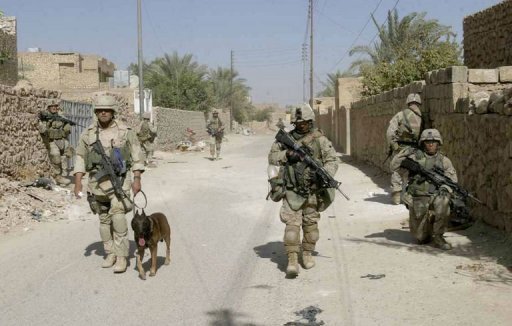
A photograph from 2005.

Good Counterinsurgency, Bad Counterinsurgency and Tribes

BY Herschel Smith
16 years ago

I linked and commented on Ralph Peters’ commentary Pick Your Tribes in Winning in Afghanistan, and since then so did the Small Wars Journal blog.  Indeed, there has been quite a discussion of late on the issue of tribal engagement as a solution to the insurgency in Afghanistan.  One commenter asks whether I support Peters’ rejection of the necessity to implement Western style government in Afghanistan.

I do not support the necessity of building Western style democracies in Afghanistan or anywhere else, but weighing in as an expert in the human and cultural terrain in Afghanistan would make a liar out of me.  The reader should consult the many writings of my friend Joshua Foust (his most recent discussion of the engagement of the tribes can be found here).  Christian Bleuer is also a wonderful resource.  I think it’s remarkably silly for folks to weigh in on human, cultural and anthropological terrain unless they are studied in that field.  I am not, and they are.  So don’t consult me on that issue.

My fundamental point was that understanding the exigencies of the human terrain is not a prerequisite for killing insurgents, and the initial stages of the campaign can be accomplished – in fact, must be accomplished – without reference to the human terrain.  Let me explain further.

I have weighed in before concerning The Anbar Narrative, in which I challenge (and reject out of hand) the populist myth that has been built up around the tribes in Anbar (while also acknowledging that the tribes were important in Ramadi).  Concerning Fallujah 2007, a part of the campaign with which I am familiar, I have written (among other things):

By early 2007 both foreign fighters and indigenous insurgents had been driven from Al Qaim, Ramadi and Haditha, and they had landed squarely in Fallujah.  When the 2/6 Marines arrived in Fallujah in April of 2007, they had to construct some of Forward Operating Base Reaper while laying on their backs and passing sand bags over their bodies (to eventually be used for walls) because of the constant fire coming their way.  The previous unit had begin patrolling only at night because of snipers, and because they didn’t own the daytime, IEDs controlled their night time patrols, thus relegating them to sitting in their FOBs for the last three weeks of their deployment awaiting relief.  The population was so allied with AQI that their children were sent out with black balloons to demarcate patrol locations so that insurgent mortars could target the U.S. Marines (even at grave risk to the children).

Operation Alljah was started, and the Marines went in hard (I am not linking the Wikipedia link on Operation Alljah because of know with certainty that much of the data is simply erroneous or mistaken and incomplete.  The link is essentially worthless).  HMMWVs with loud speakers were deployed to every Mosque in the city bellowing U.S. positions and propaganda.  Heavy and aggressive patrols were conducted, and heavy fires were employed any time any insurgent used weapons against the Marines, including everything from fire team and squad level weapons to combined arms.

Policing of the population was aggressive, ubiquitous and around the clock.  In order to address the vehicle-borne IED problem, the use of automobiles was prohibited within Fallujah proper until such time as security was established.  Concrete barricades were set up throughout the city, and census data was taken on the entire population, much of it at night so that the population was awakened to Marine presence in their homes.

Many local insurgents were killed, and also even more foreign fighters.  Insurgents from Chechnya, men with skin “as black as night,” and even “men with slanted eyes” were killed in Fallujah in the summer of 2007.  The city was locked down and the atmosphere made very uncomfortable for the population – until, that is, they began cooperating with the U.S. Marines Corps.  I know many more things that I simply cannot share concerning this operation, but things that I have communicated to Colonel Gian Gentile …

I am not at liberty to discuss the balance of the TTPs employed by the Marines in Fallujah 2007.  But if you think that I am over-reaching, consider Schmedlap’s comments (while not specific to Anbar, still representative of the reality versus the myth that has developed around the campaign in Iraq).

One thing that I think many people forget about Iraq (or maybe it wasn’t reported?) is that in 2007 and 2008 we were killing and capturing lots of people on a nightly basis. Protecting the populace was A priority. When speaking to the folks back home, in order to sell the war, perhaps we said that it was the priority. But on the ground, I do not recall a single Commander’s Update Brief spending any time at all discussing what we had done to protect anyone. We were focused on punching al-Qaeda in the nuts at every opportunity and dismantling their networks. The reconcilables got the message loud and clear that they could take money and jobs in return for cooperation, or they would die a swift death when we came knocking down their doors in the middle of the night. The rest of the populace made it clear to them that they should take the offer. The only protection that the population got from us was good fire discipline so that we did not kill non-combatants. We made it clear that the government intended to win this thing and we did not send that message by delivering governance or digging wells. We shot motherf******s in the face.  Pop-COIN blasphemers, your scripture is false teaching. Here is some truth:

To every thing there is a season, and a time to every purpose under the heaven: A time to be born, and a time to die; a time to plant, and a time to pluck up that which is planted; A time to kill, and a time to heal; a time to break down, and a time to build up; – Ecclesiastes 3:1-3 (KJV)

It’s time to kill.

Who wins in the long run is something the Afghans themselves will have to work out.  We shouldn’t be siding with anyone right now.  All politics is local, and in Fallujah 2007, the ISF was told to go home.  They weren’ wanted, weren’t needed, and weren’t welcome.  The Marines didn’t trust them, and only slept around them with a Marine awake and standing duty, along with concertina wire between Marines and ISF.  On the other hand, the Marines worked seamlessly with the IPs.

I have exchanged e-mail with Tom Ricks, one of the priests of COIN, who also sees every event in Iraq as proof that AQ is coming back and Iraq is falling apart, explaining that Fallujah will never again accept AQ in their city.  Maybe the Diyala Province, maybe Mosul, but not Fallujah.  The IPs won’t allow it to happen.  It’s a local thing, and you would just have to know what the 2/6 Marines set into motion in order to understand why AQ can never go back there.  Ever.

Speaking of local, Tim Lynch explains for us in simple yet elegant terms what’s so problematic with this policy of engagement.

This “inspired” idea of using locals to provide security will fail because nobody responsible for it will get off the FOB to provide daily detailed supervision. I can’t stress enough the importance of daily, full time, supervision. The Skipper’s EOD program works because he provides daily, detailed supervision, while EOD programs elsewhere in the country languish.  CPT America is re-building the entire Provincial irrigation system because he provides daily, detailed supervision, while the same projects elsewhere in the country barely break ground.  If we can’t get the various government agencies to operate off of the FOB then there is only one viable option. Armed, outside the wire, experienced, contractors.

I just don’t know how else to say it.  There are some in Afghanistan who are doing COIN.  The boys in the Korengal Valley did (they are gone now, unfortunately).  The Marines in Helmand are.  But confinement to FOBs is death to the campaign.  And that means the “special” SOF boys who ride helicopters to direct action kinetics for the night, and then back to the FOB for a warm meal and a bed for the night.  They aren’t contributing to the campaign.  They are a drain and drag on the national treasury. Period.  The Marines in Fallujah in 2007 spent weeks at a time in distributed operations, in units as small as a fire team, embedded with IPs at local Police Precincts, killing insurgents, taking note of the human terrain, and ensuring that their AO was locked down.  The SOF needs to figure out a way to contribute like this.

Tim is also in the news in The Star for recommending just such a program.  Go read it.  Now, as for a good example of COIN, The New York Times had just such a gem.

American troops in Afghanistan’s Paktika Province called in a helicopter strike against Taliban fighters who ambushed them here Tuesday night, killing several. The missile strike narrowly avoided doing serious damage to a mosque where some of the fighters were hiding, underlining both the risks and the potential benefits of using air power to support ground troops.

Under rules of engagement strictly enforced by Gen. Stanley A. McChrystal that have provoked resentment among troops, American forces are required to exercise extreme caution when calling in airstrikes, and generally avoid mosques entirely. But in this case, American commanders defended the action, saying that they believed no civilians had been killed and that there was no way of knowing the building was a mosque.

If Afghanistan is getting a reputation as a war in which the “soft” side of counterinsurgency is driving out the use of force — and that is certainly the perception among some soldiers in the south — this is an instance of the “hard” side being brought to bear in the way familiar to any officer who fought in Iraq during the surge.

The American patrol set out from a base in Yahya Khel district center at 6 p.m. Tuesday, planning to provoke a fight with a team of Taliban sharpshooters suspected to be operating around the village of Palau. The troops, from Angel Company, 3rd Battalion, 187th Infantry Regiment, dropped off a team at a small Afghan army outpost and then moved by foot toward the village.

Just before dusk, the patrol was ambushed, not by the expected long-range marksmen, but by a team of gunmen who attacked with rifles and grenades from as close as 50 feet away. Two American soldiers were wounded. Half an hour later, at the outpost, Angel Company’s commander, Capt. Joshua Powers, received permission over the radio from Col. David Fivecoat, the battalion commander, to call in fire from attack helicopters. The pilots had watched a group of fighters move from the area of the gun battle to a courtyard in a small village north of Palau. They told Captain Powers that they could make out a machine gun and several rifles. At 8:38 p.m., one of the helicopters fired a Hellfire missile into the cluster, then shot another man who was on the roof of the building abutting the courtyard. Over the next half hour the helicopters attacked two more groups of suspected fighters in the area with cannon fire.

In the dark, Angel Company walked north from the outpost to assess the damage. In the courtyard, the corpses of two men were illuminated by burning weapons and motorcycles. While his medic tended to a third man, severely wounded and clad in camouflage, Captain Powers radioed his battalion with bad news: The building by the courtyard was a mosque. The pilots had not known, since no loudspeakers were visible and identifying writing was visible only from the ground. There was shrapnel damage to the walls, and the roof had a hole in it from cannon rounds.

The patrol, along with a group of Afghan soldiers and their commander, Lt. Col. Mir Wais, stayed the night outside the mosque. The Taliban would undoubtedly claim that civilians had been killed, Captain Powers explained, and he wanted to be there when the villagers woke up to show them the weapons and combat gear. “If we hold this ground, we can show them the evidence right away,” he said. “The first story is usually the one that sticks.”

The pilots thought they had killed half a dozen fighters at a second site the helicopters had attacked, but the bodies were already gone when the patrol arrived. Captain Powers acknowledged that this meant there was no way to know for sure whether civilians had been killed, but thought it unlikely: the site was secluded, and among charred motorcycles there were rocket-propelled grenades and camouflage vests with rifle magazines. At the first site, all four bodies — the two in the courtyard, the one on the roof, and the wounded man, who later died — wore camouflage fatigues and similar vests, containing grenades, ammunition, makeshift handcuffs and a manual on making homemade explosives.

Around 5 a.m., the men of the village started to congregate by the mosque. Captain Powers and Colonel Mir Wais addressed them, telling their story of what had happened. The men complained that the strike had frightened their wives and children and damaged the mosque, and that they were trapped between the pressures of the Americans and the Taliban. But they did not suggest that any residents of the village had been wounded or killed, and did not claim the bodies. Later in the morning, the district subgovernor, Ali Muhammad, described the night’s events to citizens gathered in the Yahya Khel bazaar. He also signed, along with Captain Powers, a letter about the attack  that would be distributed in the area after dark: a counterpoint to the Taliban’s infamous “night letters.”

The same people who ordered the strike were there to explain it in the morning, just as I suggested should happen.  The same people who fight by night are there for the locals to look at in the morning.  And look into their eyes.  If they see cut and run, they will side with the insurgents, or someone else, whomever that may be.  If they see victory and determination, they will side with the stronger horse.  We need to be the stronger horse.  Understanding the tribes, people, human terrain and other complicated aspects of the culture can come next.  In a tip of the hat to a withdrawal deadline, we are trying to get the cart before the horse.

Force projection … force projection … force projection.  It comes first.

Update:

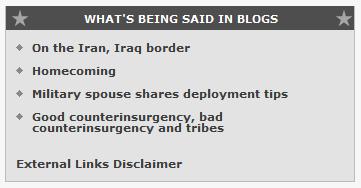
I appreciate the attention given to this article at the U.S. Army’s site Stand-To.  A screen shot (with MWSnap) is shown below.
Winning in Afghanistan

BY Herschel Smith
16 years ago

Ralph Peters penned a piece entitle Pick Your Tribes with the New York Post.  But more on Ralph’s views in a minute.  In our walkabout today, let’s first visit Bruce Rolston.  Contrasts and compares, he does.

Two respected Afghan bloggers, talking past each other. MK at the Inkspots, arguing for focussing (sic) on improving local justice systems instead of services:

Despite knowing this, and nearly a decade into the effort, we still struggle to set up even the simplest credible dispute resolution mechanisms. I don’t mean an elaborate and fully developed national justice system: I mean local adjudicative bodies that have local legitimacy that need to be backed by our (or where, possible, GIRoA) firepower to enforce their decisions and protect them from being assassinated.

This isn’t to suggest that military control of territory and population, building effective local security forces, or tackling corruption aren’t just as important (or more, depending phase of operations in a given area). But it seems that as we’ve come to realize that development assistance is of limited utility in winning Afghans over to our side, we’re a bit stymied as to what ‘effective governance’ means in concrete terms. Seems like solving local land disputes would be an excellent place to start.

In the other corner, Tim Lynch on staying away from dispute resolution and focussing on services instead:

The local people have every right to upset about the performance of the government in Kabul. But they have no interest in seeing any kind of central government which is strong enough to meddle in their affairs. An example, Afghans will go to great lengths to avoid having their problems brought into the legal system. Regardless of the crime be it murder or little boys stealing apples from a neighbor the Afghans know how to handle it and feel personally disgraced when the authorities step in to apply the rule of law. Their family business them becomes public and their problems known to people outside their clan which brings disgrace upon the sons of the family. They are going to bitch about the central government no matter who is in charge and how effective it becomes. The best we can do is concentrate on making regional government functional at basic things like irrigation, sanitation, health care delivery and other municipal services.

I’ll side with Tim any day, and I don’t think it’s so much a matter of talking past each other as it is they simply have different views.  We don’t all have to agree all of the time.  We’ll come back to this in a moment in our walkabout.  Next, let’s visit Bruce’s discussion of Kandahar in its present state.

Carl Forsberg and the Kagans sort out the tangle of armed Afghans working in and around Kandahar, and how the Karzai clan continues to tighten their grip independent of official government forces in the area.

The formation of a powerful conglomerate of PSCs under the political control of local powerbrokers like Ahmed Wali Karzai would undermine the long-term stability of southern Afghanistan and the strength of Afghanistan’s legitimate security institutions. There is a very real risk that these institutions will be relied on by the Karzais and their allies as the guarantors of Kandahar’s security. If the Kandahar Security Company were in fact to grow to 2,500 armed men as Ruhullah suggests (and this is certainly feasible) it would be more than twice the current size of the Afghan Uniformed Police in Kandahar, and would exceed the size of the expanded police force that ISAF and the MOI are planning to add to the city.

Ah.  There we see the thug and criminal Ahmed Wali Karzai again.  Recall next in our walkabout that I have discussed this bastard before.

In order to win Kandahar, we must not run from fights; we must destroy the drug rings (not the local farmers), and especially destroy the crime families, including killing the heads of the crime families; we must make it so uncomfortable for people to give them cuts of their money that they fear us more than they fear Karzai’s criminal brother; we must make it so dangerous to be associated with crime rings, criminal organizations, and insurgents that no one wants even to be remotely associated with them; and we must marginalize Karzai’s brother …

Anyone associated with drug rings, criminal activity or the insurgency must be a target, from the highest to the lowest levels of the organization, and this without mercy.  Completely without mercy.  There should be no knee-jerk reversion to prisons, because the corrupt judicial system in Afghanistan will only release the worst actors to perpetrate the worst on their opponents.  This robust force projection must be conducted by not only the SOF, but so-called general purpose forces (GPF).  The population needs to see the very same people conducting patrols and talking with locals that they see killing criminals and insurgents.  This is imperative.

Ah.  There is the issue of prisons, one that has proven problematic just as I said it would.  And Ahmed Karzai is someone to be marginalized, and whose fighters must be disarmed or killed.  Now for the home stretch in our walkabout.  Ralph Peters has some observations concerning picking tribes and exploiting the existing culture that may interest you.  But as I said above, I will side with Tim before anyone.  Ralph and I don’t always agree on everything, but I want to pick up on a few points he made.

Aid those already on your side, not your enemies: Our attempts to bribe our enemies with wells, make-work and welfare are doomed to failure. Reward your allies with aid projects; let the hostiles envy them — and figure it out on their own.

Unconditional aid to tribesmen who just want your butt gone won’t buy you lasting gratitude (that rarest human sentiment). Your generosity’s read as weakness, not goodness.

Which leads us to:

Your enemies must seek negotiations first: Olive branches are worthless against fanatics convinced they can win. If negotiations are to play a role, it can only be after you’ve pounded the insurgents so ferociously that they seek talks. If you move first, it’s read as desperation. Your enemies will act accordingly.

Finally, recall my warnings:

We can revert to the softer side of counterinsurgency if all of this seems too barbaric.  We can run from fights with the insurgents, we can continue to pour tens of millions of dollars into a failing and corrupt system, and we can continue to prop up a parasitic government.  But in the end, we must count the costs in lives, lost limbs, lost reputation, and national wealth.

Mark my words, do it clearly, and do it now.  We will go in and stay in as the strong horse, and we will force the conclusion that suits our interest, or we will lose the campaign.  If this is too brutal for some, then withdraw, but don’t send our warriors on a fool’s errand.  The leftist web sites will call me a war mongering, barbaric brute and sociopath who wants our Soldiers to violate the rules of war.  All manner of venom may come my way.  I don’t care.  I really don’t care.

Rarely are things so clear cut and measurable by metrics as this.  Again, count the costs.  Start now, and keep the data.  Count the men who die, the men who lose arms, legs, hearing and brain function due to IEDs, and take measure of the situation in Kandahar in the future (how “legitimate” is the government after our costly efforts in Kandahar?).  I will be proven right or wrong, but the best thing about putting prose down on paper is that it can be judged in the future.

Has Ralph been reading The Captain’s Journal?  Our current COIN strategy closely follows our international policy as of late.  Heap praise and largesse on your enemies, and pour derision and scorn on your “friends.”  This is exactly backwards.  Force projection requires that the hard aspects of COIN take place first, and the enemy will want to befriend you.  Don’t ever be first out of the gate to do this.  This is the way it works.  Any attempt to speed up or circumvent the process by making it seem more gentle and cultured than it really is will redound to defeat.  The tribes are a necessary but secondary aspect of the campaign.  Force projection comes first.

Heading for Haiti

BY Herschel Smith
16 years ago

My daughter is headed for Haiti with The Samaritan’s Purse, and I am happy to give my readers a chance to donate to her “deployment.”

My name is Devon Smith. I am twenty-two years old, and originally from Charlotte, North Carolina. I have lived in the upstate of South Carolina for the past four years while attending college. I am the youngest of four children, with two wonderful parents who raised us. Having three older brothers was an adventure growing up, and there was seldom a dull moment!

I recently graduated from the University of South Carolina Upstate in May of 2010 with a Bachelor’s of Science Degree in Nursing. Shortly thereafter, I obtained my Registered Nursing license to practice nursing in the United States. Sometime late this fall, after October, I will be joining the Navy as an Officer in the Navy Nurse Corps, and will have the great privilege of serving the men and women of the Armed Forces. Until then, I am headed for Haiti!!!

Many NGOs can’t be trusted, and governmental organizations bury their assistance in bureaucracy.  Samaritan’s Purse is the best thing going, and you have a chance to participate via PayPal.  Visit Heading for Haiti.

Sustainable Defense Task Force

BY Herschel Smith
16 years ago

To be fair concerning the brief things I am about to say (and quote), you may go directly to the Sustainable Defense Task Force Report and read the analysis and recommendations yourself.  For now, the summary report at the Marine Corps Times will suffice.

An independent team has made a series of recommendations to Congress to reduce future Defense Department budgets, in light of the country’s growing deficit — including big cuts to the Corps.

The team, dubbed, The Sustainable Defense Task Force, was tapped for the project by a bipartisan group of lawmakers. Their suggestions could reduce defense spending by $960 billion from 2011 to 2020.

Ideas include:

• Roll back the size of the Army and Marine Corps as the wars in Iraq and Afghanistan wind down. The U.S. could save $147 billion over the next decade by reducing the Army’s end strength from 547,400 to 482,400 and the Corps’ from 202,000 to 175,000, the task force says.

• Reduce the number of maneuver units in the Army and Marine Corps. The task force suggests reducing the number of Army brigades from 45 to 42 and the number of Marine infantry battalions from 27 to 24. Doing so would contribute to the $147 billion in savings as the services reduce their end strengths.

• Delay or cancel development of Navy variants of the F-35 Joint Strike Fighter. The U.S. could save $9.85 billion from 2011 to 2020 by canceling the purchase of JSF jets for the Navy and Marine Corps and buying more affordable F/A-18 jets instead. Doing so would leave the Corps without jump jets once the AV-8 Harrier leaves the service, but the task force argues that capability “has not proved critical to operations in recent wars.”

• End the fielding of new MV-22 Ospreys. The Corps could save $10 billion to $12 billion over the next 10 years by buying new MH-60S and CH-53K helicopters, analysts say. The K variant of the CH-53 is not expected to hit the fleet until at least 2015, but the Navy began replacing outdated CH-46 helicopters early this century with the MH-60 on amphibious assault ships.

• Kill the Expeditionary Fighting Vehicle program and field cheaper alternatives. The Corps could save at least $8 billion in the next decade by refurbishing cheaper, existing amphibious assault vehicles instead of continuing development of the yet-to-be-fielded EFV, the task force says.

• Reduce military recruiting budgets. The task force does not provide a service-specific breakdown, but says that with a military drawdown underway, the U.S. will not need to spend as much money finding new recruits. Recruiting budgets could be reduced by $5 billion over the next decade.

Some of the proposals — killing the EFV to save money, for example — are hardly new. But the report also includes a second set of proposals authored by Benjamin Friedman and Christopher Preble, analysts at the conservative Cato Institute in Washington.

In a five-page section at the back of the task force’s 56-page report, the two analysts propose a “strategy of restraint — one that reacts to danger rather than going out in search of it.” If adopted — a big “if” — it would result in deep cuts to the Army and Marine Corps, with the Army reduced from about 560,000 soldiers to 360,000, a 36 percent reduction, and the Corps reduced from 202,000 Marines to 145,000, a 28 percent decrease. The cuts would make the Corps smaller than it has been at any time since 1950, when there were about 74,300 Marines on active duty before the U.S. took an active role in the Korean War.

[ … ]

“We are spending more on our military than we have at any point since World War II,” Preble said. “It’s absurd to think that the type of threats that we‘re dealing with today in 2010 are greater than what we dealt with in 1950 or 1960 or 1970. It’s absolutely absurd.”

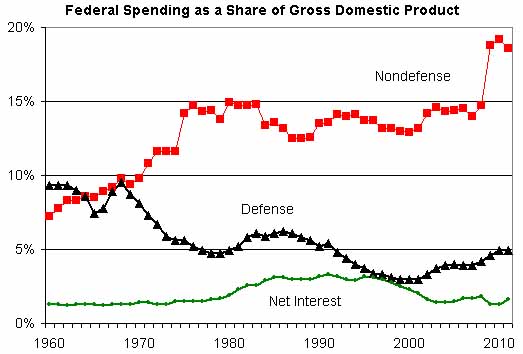
No, here is what’s absurd.  Pretending that this has anything to do with saving any significant amount of money via defense cuts.  Recall that we have discussed this depiction of defense spending as a function of GDP (via Instapundit).

This graph also comes from the Cato Institute.  Maybe the analysts at the Cato Institute should talk to each other a little more.  You know, maybe some staff meetings or hallway discussions or something.  Maybe they should do lunch.  With the Obama administration having thrown several trillion dollars into toilet to be flushed away without doing any good whatsoever, the focus on defense spending is disingenuous and hypocritical.  Right before the executive summary, the following quote is strategically placed.

Conservatives needs to hearken back to the Eisenhower heritage, and develop a defense leadership that understands military power is fundamentally premised on the solvency of the American government and vibrancy of the U.S. economy,” Kori Schake, Hoover Institution Fellow and former McCain-Palin Foreign Policy Advisor.

Nice try.  Let’s cut billions out of defense spending in order to counterbalance the trillions we throw away on social engineering programs so that if we ever really do need defense again after we have managed to control ourselves and stay out of fights with the enemy, maybe we will have spent so much on non-defense we will have curtailed our drunken appetite for throwing money away and we can get down to business defending ourselves.

The problem is that the enemy gets the majority vote.  Say what you want about the expeditionary warfare concept, the 100 or so nations in which we currently have troops deployed and based, and the supposed meddling we do in the affairs of others.  It keeps the fight abroad instead of at home.  For those who wish to wait for the fight to come to our doorstep, be careful what you wish for and consider just what it would be like.

I have been as hard on the big plans for the Marine Corps as anyone.  I dominate Google rankings for expeditionary warfare and the Expeditionary Fighting Vehicle.  I oppose it (the EFV) in all its manifestations.  I have advocated a much lighter, and more air-mobile Corps, with reliance on forcible entry via air (a new helicopter fleet) rather than via sea, to allow the Navy to set up shop after the Marines have secured a beachhead.  Relying on the hugely expensive and very heavy EFV is profoundly unwise.  I have also opposed the money for the F-35 because it isn’t half the aircraft that the F-22 is, and it has had halting production efficiency.

But the authors have crossed the Rubicon.  They’re talking about massive reductions in infantry battalions.  Don’t be fooled.  Good Infantry Battalions can’t be stood up easy, cheap or fast.  We are left with our pants down if we follow the advice of this report sanctioned by this group of bipartisan lawmakers.  And for the record, while I like the generally libertarian approach to domestic lawmaking, Ron Paul’s views of national defense are naive and childish.  Any study co-sponsored by Barney Frank and Ron Paul should immediately raise your hackles.

In the future, I have a better idea for saving money.  Rather than pay these analysts to reiterate this same claptrap, next time pay me ten percent of what you would otherwise spend and I’ll cut through the crap in one tenth of the words.  One tenth the words for one tenth the cost.  If Congress doesn’t recognize that as a deal, they can’t be trusted with our money.

Jirgas and Release of Taliban Prisoners

BY Herschel Smith
16 years ago

The pitiful Hamid Karzai had a peace jirga in June.  Astonishingly, it appears that it wasn’t very successful.

Afghan President Hamid Karzai’s peace jirga earlier this month was pretty close to a bust. Powerful northern rivals were conspicuously absent, as were the Taliban, who instead dispatched a pair of suicide bombers to disturb the proceedings, detonating not far from where the conference took place. The violence, however, overshadowed a rare moment of unity among influential lawmakers and elders: a full-throated call to release of hundreds of prisoners, possibly even including Taliban, languishing in Afghan and U.S. military jails.

In yet another affirmation of his will to end the Taliban-led insurgency through compromise rather than the end of a gun, the President said the jirga’s demand compelled him to act quickly to free those prisoners who might oppose his government but have not been convicted of alleged crimes. The goal, he went on, was to build goodwill with “disenchanted people” in league with the Taliban.

Shortly after the jirga, Amrullah Saleh, the head of Afghan intelligence agency NDS, resigned. It was widely believed that he had been browbeaten by Karzai for the security lapse that allowed the suicide bombers to be so close to the jirga. But Saleh had long bristled at what he viewed as Karzai’s tendency to appease the Taliban for political gain; in fact, he had called the prisoner-release idea a “disgrace” that amounts to “negotiating with suicide bombers.”

Later in June, fourteen Taliban prisoners were released as part of this agreement, and another twenty eight have been released just in the last several days.  In fact, this is only the beginning.  The flood gates could soon open, culminating in the release of as many as a thousand Taliban.

The head of Afghanistan’s most notorious prison says nearly 1,000 Taliban inmates could be freed from Pul-e-Charki prison as part of an amnesty deal offered by Hamid Karzai’s government.

The figure, revealed by General Abdulbakhi Behsudi, the warden of Afghanistan’s largest prison, in an interview with The Globe And Mail, suggests the potential breath of the prisoner release ordered under the terms of a controversial resolution issued by Afghanistan’s peace jirga, an assembly of tribal elders convened last week to pave the path for negotiations with the Taliban.

On Sunday, President Hamid Karzai ordered the creation of a special delegation to review the cases of Taliban inmates “imprisoned without sufficient evidence,” the first move toward a widespread prisoner release that could involve amnesty for thousands of jailed insurgents across Afghanistan …

Mr. Behsudi keeps a collection of evidence confiscated from these inmates in a locked glass cabinet, proof, he said, of their intractable criminal minds.

There are dozens of battered cellphones used to issue orders for suicide bombings; $1-million worth of heroin and hash buried inside the soles of shoes, stuffed inside a hairbrush, and lining a false-bottomed cooking pot. There is a braided rubber whip seized from cellblock D, used by the insurgents to punish any inmate who crossed them.

“These people will never be loyal to the government because they are dark thinkers, they think dark things,” said Mr. Behsudi, a heavy-set man dressed in crisp army fatigues, brandishing a sword confiscated from a prisoner’s bed.

Pul-e-Charki has about 4,620 inmates, he said, with the Taliban forming the most cohesive category of prisoners. Only a small fraction of those – the ones caught with “a smoking gun” – would be exempt from Mr. Karzai’s proposed amnesty.

While we are attempting to separate the insurgents from the population, go to great (and deadly) lengths to avoid collateral damage when fighting the insurgents, and have many thousands of American warriors deployed in theater to protect the population and kill the insurgents, Karzai is releasing them back into the population to start all over again.

With “friends” like this, who needs enemies?

More Rules of Engagement Examples from Afghanistan II

BY Herschel Smith
16 years ago

Via CBS News:

To the U.S. soldiers getting pounded with thunderous mortar rounds in their combat outpost near Kandahar, it seemed like a legitimate request: allow them to launch retaliatory mortar shells or summon an airstrike against their attackers. The incoming fire was landing perilously close to a guard station, and the soldiers, using a high-powered camera, could clearly see the insurgents shooting.

The response from headquarters — more than 20 miles away — was terse. Permission denied. Battalion-level officers deemed the insurgents too close to a cluster of mud-brick houses, perhaps with civilians inside.

Although the insurgents stopped firing before anybody was wounded, the troops were left seething.

“This is not how you fight a war, at least not in Kandahar,” said a soldier at the outpost who described the incident, which occurred last month, on the condition of anonymity. “We’ve been handcuffed by our chain of command.”

[ … ]

Despite claims from some relatives of military personnel killed in Afghanistan that the directive has limited the ability of troops to defend themselves, the officials said a review by the U.S. military of every combat fatality over the past year has found no evidence that the rules restricted the use of lifesaving firepower.

“We have not found a single situation where a soldier has lost his life because he was not allowed to protect himself,” one of the officials said.

If troops are in imminent danger, there is no restriction on the use of airstrikes or mortars. “The rules of engagement provide an absolute right of self-defense,” the official said.

For troops on the ground … the directive has lowered their morale and limited their ability to pursue insurgents. They note that Taliban fighters seem to understand the new rules and have taken to sniping at troops from inside homes or retreating inside houses after staging attacks.

“Minimizing civilian casualties is a fine goal, but should it be the be-all and end-all of the policy?” said a junior Army officer in southern Afghanistan. “If we allow soldiers to die in Afghanistan at the hands of a leader who says, ‘We’re going to protect civilians rather than soldiers,’ what’s going to happen on the ground? The soldiers are not going to execute the mission to the best of their ability. They won’t put their hearts into the mission. That’s the kind of atmosphere we’re building.”

The principal problem, senior officials say, is that U.S. and allied units across Afghanistan have carried out the directive in ways that are more restrictive than McChrystal intended. Fearful of career-ending sanctions if they violate the order, commanders at every subordinate level down the chain have tightened the rules themselves, often adding their own stipulations to the use of air and mortar strikes.

Less than six hours before Marines commenced a major helicopter-borne assault in the town of Marja in February, Rodriguez’s headquarters issued an order requiring that his operations center clear any airstrike that was on a housing compound in the area but not sought in self-defense. But before the order was given to the Marines, the British-run regional headquarters in southern Afghanistan amended the language to include any strikes “near” houses, according to two U.S. sources familiar with the incident.

The issue of divergent and overly-restrictive “interpretations” of the ROE being given down the chain of command is a red herring.  The issue is a diversion from the real issue of overly restrictive rules and micromanagement of the campaign at the highest levels of command.

In More Rules of Engagement Examples from Afghanistan, I observed:

McChrystal’s advocates argue that McChrystal’s tactical directive was misunderstood and applied too restrictively at lower levels of command (the rules have been distorted as they pass down the chain of command).  But that dog won’t hunt.  His tactical directive remains available for viewing, and his words set the context for its application: “If you are in a situation where you are under fire from the enemy… if there is any chance of creating civilian casualties or if you don’t know whether you will create civilian casualties, if you can withdraw from that situation without firing, then you must do so.”  The reader can make up his own mind.

As for warriors who have lost their lives to the rules of engagement, I give you three Marines and a Navy Corpsman, and for me, General McChrystal will always be responsible for their deaths.  Others may have participated by their incompetence, but it all began with McChrystal.

But the real addition to the knowledge base for ROE in this example comes by way of prissy excuse and demur.  Note that the report attempts to exonerate McChrystal’s direct report, General Rodriguez by explaining how the rules got revised after issuance.  But here is the real question.  Why the hell is General Rodriguez second guessing Marines in the field in combat operations?

The real problem is not that the rules got twisted.  The real problem is that General Rodriguez took it upon himself to micromanage Marines who have successful combat experience from Iraq.  The Marines no more needed General Rodriguez at any point during this operation than they needed a business secretary in corporate America issuing orders to them.  Instead of providing logistics, materiel, equipment and resources, General Rodriguez made himself a nuisance to the operation.

This micromanagement is an increasing problem in the U.S. military, and it follows the American corporate model.  But it seems to have taken on gigantic proportions with General McChrystal, an aspect that needs to change now that he is gone.  Unfortunately, General Rodriguez is still around to meddle in affairs where he is not needed and is serving no useful purpose.

Postscript: General Rodriguez has been the subject of previous articles, specifically where he trotted out Army intelligence to decidedly inform us that there would be no 2008 spring offensive in Afghanistan, while I said that there would be, and it would be directed at logistics, both in Pakistan and Afghanistan.  The reader can decide for himself who hit the target and who didn’t.


26th MEU (10)
Abu Muqawama (12)
ACOG (2)
ACOGs (1)
Afghan National Army (36)
Afghan National Police (17)
Afghanistan (704)
Afghanistan SOFA (4)
Agriculture in COIN (3)
AGW (1)
Air Force (42)
Air Power (10)
al Qaeda (83)
Ali al-Sistani (1)
America (23)
Ammunition (305)
Animals (336)
Ansar al Sunna (15)
Anthropology (3)
Antonin Scalia (1)
AR-15s (397)
Arghandab River Valley (1)
Arlington Cemetery (2)
Army (91)
Assassinations (2)
Assault Weapon Ban (29)
Australian Army (7)
Azerbaijan (4)
Backpacking (4)
Badr Organization (8)
Baitullah Mehsud (21)
Basra (17)
BATFE (247)
Battle of Bari Alai (2)
Battle of Wanat (18)
Battle Space Weight (3)
Bin Laden (7)
Blogroll (3)
Blogs (24)
Body Armor (23)
Books (3)
Border War (18)
Brady Campaign (1)
Britain (39)
British Army (36)
Camping (5)
Canada (20)
Castle Doctrine (1)
Caucasus (6)
CENTCOM (7)
Center For a New American Security (8)
Charity (3)
China (19)
Christmas (18)
CIA (30)
Civilian National Security Force (3)
Col. Gian Gentile (9)
Combat Outposts (3)
Combat Video (2)
Concerned Citizens (6)
Constabulary Actions (3)
Coolness Factor (3)
COP Keating (4)
Corruption in COIN (4)
Council on Foreign Relations (1)
Counterinsurgency (218)
DADT (2)
David Rohde (1)
Defense Contractors (2)
Department of Defense (220)
Department of Homeland Security (26)
Disaster Preparedness (5)
Distributed Operations (5)
Dogs (15)
Donald Trump (27)
Drone Campaign (4)
EFV (3)
Egypt (12)
El Salvador (1)
Embassy Security (1)
Enemy Spotters (1)
Expeditionary Warfare (18)
F-22 (2)
F-35 (1)
Fallujah (17)
Far East (3)
Fathers and Sons (2)
Favorite (1)
Fazlullah (3)
FBI (39)
Featured (192)
Federal Firearms Laws (18)
Financing the Taliban (2)
Firearms (1,876)
Football (1)
Force Projection (35)
Force Protection (4)
Force Transformation (1)
Foreign Policy (27)
Fukushima Reactor Accident (6)
Ganjgal (1)
Garmsir (1)
general (15)
General Amos (1)
General James Mattis (1)
General McChrystal (44)
General McKiernan (6)
General Rodriguez (3)
General Suleimani (9)
Georgia (19)
GITMO (2)
Google (1)
Gulbuddin Hekmatyar (1)
Gun Control (1,730)
Guns (2,416)
Guns In National Parks (3)
Haditha Roundup (10)
Haiti (2)
HAMAS (7)
Haqqani Network (9)
Hate Mail (8)
Hekmatyar (1)
Heroism (5)
Hezbollah (12)
High Capacity Magazines (16)
High Value Targets (9)
Homecoming (1)
Homeland Security (3)
Horses (2)
Humor (72)
Hunting (65)
ICOS (1)
IEDs (7)
Immigration (123)
India (10)
Infantry (4)
Information Warfare (4)
Infrastructure (4)
Intelligence (23)
Intelligence Bulletin (6)
Iran (171)
Iraq (379)
Iraq SOFA (23)
Islamic Facism (64)
Islamists (98)
Israel (19)
Jaish al Mahdi (21)
Jalalabad (1)
Japan (3)
Jihadists (82)
John Nagl (5)
Joint Intelligence Centers (1)
JRTN (1)
Kabul (1)
Kajaki Dam (1)
Kamdesh (9)
Kandahar (12)
Karachi (7)
Kashmir (2)
Khost Province (1)
Khyber (11)
Knife Blogging (7)
Korea (4)
Korengal Valley (3)
Kunar Province (20)
Kurdistan (3)
Language in COIN (5)
Language in Statecraft (1)
Language Interpreters (2)
Lashkar-e-Taiba (2)
Law Enforcement (6)
Lawfare (14)
Leadership (6)
Lebanon (6)
Leon Panetta (2)
Let Them Fight (2)
Libya (14)
Lines of Effort (3)
Littoral Combat (8)
Logistics (50)
Long Guns (1)
Lt. Col. Allen West (2)
Marine Corps (281)
Marines in Bakwa (1)
Marines in Helmand (67)
Marjah (4)
MEDEVAC (2)
Media (68)
Medical (146)
Memorial Day (6)
Mexican Cartels (48)
Mexico (72)
Michael Yon (6)
Micromanaging the Military (7)
Middle East (1)
Military Blogging (26)
Military Contractors (5)
Military Equipment (25)
Militia (9)
Mitt Romney (3)
Monetary Policy (1)
Moqtada al Sadr (2)
Mosul (4)
Mountains (25)
MRAPs (1)
Mullah Baradar (1)
Mullah Fazlullah (1)
Mullah Omar (3)
Musa Qala (4)
Music (25)
Muslim Brotherhood (6)
Nation Building (2)
National Internet IDs (1)
National Rifle Association (97)
NATO (15)
Navy (31)
Navy Corpsman (1)
NCOs (3)
News (1)
NGOs (3)
Nicholas Schmidle (2)
Now Zad (19)
NSA (3)
NSA James L. Jones (6)
Nuclear (63)
Nuristan (8)
Obama Administration (222)
Offshore Balancing (1)
Operation Alljah (7)
Operation Khanjar (14)
Ossetia (7)
Pakistan (165)
Paktya Province (1)
Palestine (5)
Patriotism (7)
Patrolling (1)
Pech River Valley (11)
Personal (77)
Petraeus (14)
Pictures (1)
Piracy (13)
Pistol (4)
Pizzagate (21)
Police (673)
Police in COIN (3)
Policy (15)
Politics (999)
Poppy (2)
PPEs (1)
Prisons in Counterinsurgency (12)
Project Gunrunner (20)
PRTs (1)
Qatar (1)
Quadrennial Defense Review (2)
Quds Force (13)
Quetta Shura (1)
RAND (3)
Recommended Reading (14)
Refueling Tanker (1)
Religion (501)
Religion and Insurgency (19)
Reuters (1)
Rick Perry (4)
Rifles (1)
Roads (4)
Rolling Stone (1)
Ron Paul (1)
ROTC (1)
Rules of Engagement (76)
Rumsfeld (1)
Russia (37)
Sabbatical (1)
Sangin (1)
Saqlawiyah (1)
Satellite Patrols (2)
Saudi Arabia (4)
Scenes from Iraq (1)
Second Amendment (715)
Second Amendment Quick Hits (2)
Secretary Gates (9)
Sharia Law (3)
Shura Ittehad-ul-Mujahiden (1)
SIIC (2)
Sirajuddin Haqqani (1)
Small Wars (72)
Snipers (9)
Sniveling Lackeys (2)
Soft Power (4)
Somalia (8)
Sons of Afghanistan (1)
Sons of Iraq (2)
Special Forces (28)
Squad Rushes (1)
State Department (23)
Statistics (1)
Sunni Insurgency (10)
Support to Infantry Ratio (1)
Supreme Court (84)
Survival (216)
SWAT Raids (58)
Syria (38)
Tactical Drills (38)
Tactical Gear (17)
Taliban (168)
Taliban Massing of Forces (4)
Tarmiyah (1)
TBI (1)
Technology (21)
Tehrik-i-Taliban (78)
Terrain in Combat (1)
Terrorism (96)
Thanksgiving (13)
The Anbar Narrative (23)
The Art of War (5)
The Fallen (1)
The Long War (20)
The Surge (3)
The Wounded (13)
Thomas Barnett (1)
Transnational Insurgencies (5)
Tribes (5)
TSA (25)
TSA Ineptitude (14)
TTPs (4)
U.S. Border Patrol (8)
U.S. Border Security (22)
U.S. Sovereignty (29)
UAVs (2)
UBL (4)
Ukraine (10)
Uncategorized (107)
Universal Background Check (3)
Unrestricted Warfare (4)
USS Iwo Jima (2)
USS San Antonio (1)
Uzbekistan (1)
V-22 Osprey (4)
Veterans (3)
Vietnam (1)
War & Warfare (435)
War & Warfare (41)
War Movies (4)
War Reporting (21)
Wardak Province (1)
Warriors (6)
Waziristan (1)
Weapons and Tactics (80)
West Point (1)
Winter Operations (1)
Women in Combat (21)
WTF? (1)
Yemen (1)

August 2026
July 2026
June 2026
May 2026
April 2026
March 2026
February 2026
January 2026
December 2025
November 2025
October 2025
September 2025
August 2025
July 2025
June 2025
May 2025
April 2025
March 2025
February 2025
January 2025
December 2024
November 2024
October 2024
September 2024
August 2024
July 2024
June 2024
May 2024
April 2024
March 2024
February 2024
January 2024
December 2023
November 2023
October 2023
September 2023
August 2023
July 2023
June 2023
May 2023
April 2023
March 2023
February 2023
January 2023
December 2022
November 2022
October 2022
September 2022
August 2022
July 2022
June 2022
May 2022
April 2022
March 2022
February 2022
January 2022
December 2021
November 2021
October 2021
September 2021
August 2021
July 2021
June 2021
May 2021
April 2021
March 2021
February 2021
January 2021
December 2020
November 2020
October 2020
September 2020
August 2020
July 2020
June 2020
May 2020
April 2020
March 2020
February 2020
January 2020
December 2019
November 2019
October 2019
September 2019
August 2019
July 2019
June 2019
May 2019
April 2019
March 2019
February 2019
January 2019
December 2018
November 2018
October 2018
September 2018
August 2018
July 2018
June 2018
May 2018
April 2018
March 2018
February 2018
January 2018
December 2017
November 2017
October 2017
September 2017
August 2017
July 2017
June 2017
May 2017
April 2017
March 2017
February 2017
January 2017
December 2016
November 2016
October 2016
September 2016
August 2016
July 2016
June 2016
May 2016
April 2016
March 2016
February 2016
January 2016
December 2015
November 2015
October 2015
September 2015
August 2015
July 2015
June 2015
May 2015
April 2015
March 2015
February 2015
January 2015
December 2014
November 2014
October 2014
September 2014
August 2014
July 2014
June 2014
May 2014
April 2014
March 2014
February 2014
January 2014
December 2013
November 2013
October 2013
September 2013
August 2013
July 2013
June 2013
May 2013
April 2013
March 2013
February 2013
January 2013
December 2012
November 2012
October 2012
September 2012
August 2012
July 2012
June 2012
May 2012
April 2012
March 2012
February 2012
January 2012
December 2011
November 2011
October 2011
September 2011
August 2011
July 2011
June 2011
May 2011
April 2011
March 2011
February 2011
January 2011
December 2010
November 2010
October 2010
September 2010
August 2010
July 2010
June 2010
May 2010
April 2010
March 2010
February 2010
January 2010
December 2009
November 2009
October 2009
September 2009
August 2009
July 2009
June 2009
May 2009
April 2009
March 2009
February 2009
January 2009
December 2008
November 2008
October 2008
September 2008
August 2008
July 2008
June 2008
May 2008
April 2008
March 2008
February 2008
January 2008
December 2007
November 2007
October 2007
September 2007
August 2007
July 2007
June 2007
May 2007
April 2007
March 2007
February 2007
January 2007
December 2006
November 2006
October 2006
September 2006
August 2006
July 2006
June 2006
May 2006

about · archives · contact · register

Copyright © 2006-2026 Captain's Journal. All rights reserved.