
Archive for the 'Politics' Category


Standing Up the Iraqi Army

BY Herschel Smith
18 years, 3 months ago

” … the evidence indicates that the Iraqi Security Forces will not be able to secure Iraqi borders against conventional military threats in the near term … the ISF will be unable to fulfil their essential security responsibilities independently over the next 12-18 months,” Independent Commission on the Security Forces of Iraq [1].

“Restoring Iraq to military self-sufficiency will require at least a decade.  For that alone, Iraq will remain an American protectorate well into the next decade …”  John Pike, Globalsecurity.org [2].

If only the issues with the Iraqi Security Forces (ISF) could be summed up by saying that they needed to learn to do calisthenics better or target with their rifles, training the ISF would take several months.  Undoubtedly, this is what the uninitiated think when the administration talks of “standing down when the Iraqis stand up.”  How long can it take to train a soldier?  Even if one includes consideration beyond individual training to unit level tactics such as satellite patrols, squads rushes, flanking maneuvers, room clearing, and so forth, this would add months – maybe a year at the most.

But the almost insurmountable problems with the ISF present themselves under three rubrics.  The first has to do with the nation-state of Iraq, and the degree to which it can function without the sectarian divides that have hindered the progress of the government thus far.  After all, the military is not immune from society’s ills any more than other institutions.

These sectarian divides have actually evolved not only to sectarian taunts but to shooting between various units in the ISF.  In summer of 2006, Kurdish fighters who had joined the ISF were targets of Shi’a members of the ISF.

Early this year, a 700-strong Kurdish Iraqi army battalion, originally from the northern city of Sulaymaniyah, deployed to Balad, 50 miles northwest of Baghdad, to bolster a single Shi’ite battalion mustered from local residents.

The large Sunni minority living around Balad protested the Kurdish unit’s presence, according to U.S. Army Lt. Col. David Coffey, a member of an ad-hoc Military Transition Team that was helping train the Kurdish battalion. Residents including some Iraqi military personnel fired at patrolling Kurdish troops, and on at least one occasion, the Kurds fired back — one of the few recorded incidents of fighting within Iraqi Army ranks.

Yet by the summer of 2007 this had all been turned on this head.  Kurdish fighters were seen as savior for at least one Sunni family.

Bristling with weapons, the men arrived on the back of three pick-up trucks, then surrounded the modest house in the once “mixed” suburb of al-Amel, in western Baghdad. A black-clad gunman jumped down and hammered on the thin metal gate. There were “bad people” on the loose, he shouted to the residents cowering inside. They should pack up and go and live “among your own people—for your own protection”. He and his men would helpfully put their belongings on the back of the trucks. For safety’s sake, the family should go immediately. As this ultimatum was being given to the terrified Sunni Arab family by the Shia gunmen, a group of Iraqi policemen, also Shias, leant on a police car and idly puffed away on their cigarettes, just 50 yards up the street, indifferent to the crime of sectarian cleansing being perpetrated under their noses.

That scene has become all too common in al-Amel—and in many other mixed districts. Since the bombing of the Shias’ shrine in Samarra, north of Baghdad, in February last year, many mixed and middle-class areas have become either mostly Shia or mostly Sunni, depending on which side of the main road you live.

Yet on the occasion described above the Sunni family managed to sit tight, in the house they had built some 30 years ago in what was then a palm grove. They were saved by the arrival, in the nick of time, of a contingent of about 100 Kurdish soldiers, some of the 3,000-odd former Peshmerga fighters (literally, “those who face death”) who have joined Iraq’s national army and have been controversially deployed in Baghdad as part of the “surge” of troops, mainly American ones, to beef up security in the bloody capital.

As they neared the besieged house, the Kurdish soldiers shot over the heads of the Shia gunmen, identified by locals as members of the Mahdi militia loyal to a Shia firebrand, Muqtada al-Sadr, and told them to leave the area. They swiftly complied. There was no American soldier in sight.
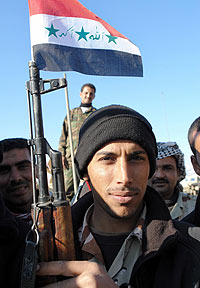
The Shi’a within the ISF have increasingly caused problems with the Sunni population, failing to engender trust.  The surge also allowed U.S. troops to provide adequate coverage when this had been missing from earlier in the campaign.  U.S. troops are now also seen as protectors against Shi’a ISF members in areas in which they previously didn’t have the manpower to patrol.

As the Americans patrol the Sunni Arab neighborhood of Azamiyah, people keep turning to them for help. One man asks them to bring in a fuel truck stopped by Iraqi troops. Another complains that Iraqi soldiers just beat up his brother.

The Americans used to be loathed in Azamiyah, a longtime stronghold of insurgents and the last place where Saddam Hussein appeared in public. Now the animosity has given way to a grudging acceptance, because the people of this northern neighborhood want American protection from a foe they hate and fear even more: the mainly Shiite Iraqi army.

“We feel safe when the Americans are around,” says a computer engineer who gave his name only as Abu Fahd. He stopped going to work because of his fear of militiamen at the Shiite-dominated Health Ministry and now makes a living selling clothes.

“When we see the Iraqi army, we just stay home or close our shops.”

The altercations and lack of trust doesn’t just affect the population.  In Western Iraq – Sunni territory between Baghdad and Fallujah, the ISF have had altercations with not only the Sunni “awakening” (e.g., 1920s Brigade), but U.S. forces as well.  Lt. Col. Kurt Pinkerton, a 41-year-old California native who has spent the previous months cultivating his relationship with Abu Azzam (an “awakening” leader), managed to de-escalate just such an encounter in June of 2007 between his friend the Sunni leader and an ISF Brigade.

… the Iraqi brigade, which is predominantly Shiite, was assigned a new area and instructed to stay away from Nasr Wa Salam, Colonel Pinkerton said. But he said he believed that the Iraqi soldiers remain intent on preventing Sunni Arabs, a majority here, from controlling the area. He cites a pattern of aggression by Iraqi troops toward Abu Azzam’s men and other Sunnis, who he believes are often detained for no reason.

Recently, and without warning, Colonel Pinkerton said, 80 Iraqi soldiers in armored vehicles charged out of their sector toward Nasr Wa Salam but were blocked by an American platoon. The Iraqis refused to say where they were going and threatened to drive right through the American soldiers, whom they greatly outnumbered.

Eventually, with Apache helicopter gunships circling overhead and American gunners aiming their weapons at them, the Iraqi soldiers retreated. “It hasn’t come to firing bullets yet,” Colonel Pinkerton said … Pinkerton’s experiences here, he said, have inverted the usual American instincts born of years of hard fighting against Sunni insurgents.

“I could stand among 1,800 Sunnis in Abu Ghraib,” he said, “and feel more comfortable than standing in a formation of Iraqi soldiers.”

The second problematic area has to do with broad, general corruption across the entire ISF.  Earlier in the 2007, “American units that patrolled with Iraqi forces in west and east Baghdad found that Iraqi officers sold new uniforms meant for their troops, and that their soldiers wore plastic shower sandals while manning checkpoints, abused prisoners and solicited bribes to free suspects they’d captured.”

Interviews with U.S. soldiers, and reporting from accompanying them on patrols, made it clear that there are profound problems with the Iraqi troops, ranging from worries that they’re operating on behalf of Shiite death squads to aggravation with their refusal to carry out basic tasks such as wearing flak vests.

In a west Baghdad neighborhood where bodies often turn up beside the road, facedown on the pavement with bullets in their heads, U.S. Army 1st Lt. Brendan Griswold looked on last week as Iraqi soldiers patted down three men at a checkpoint and thumbed through their documents. The Iraqi soldiers found a fake Iraqi passport on one of the men, whom they suspected was Jordanian and possibly an insurgent.

Griswold didn’t stir, determined to let the Iraqis conduct the search on their own.

“I like going out with some of them. But some of the others are hard to control; they run away when things happen,” said the 24-year-old 1st Cavalry Division platoon commander from Leavenworth, Kan.

An Iraqi soldier approached him. “Where do we put them?” he asked.

Griswold pointed to the Iraqi army Humvees in front of him. Iraqi soldiers grabbed the three men, opened the back trunks of their Humvees and started to stuff them inside.

“No, not in there,” Griswold yelled, as he cussed under his breath and walked over to supervise.

After he made sure the detainees were seated in the Humvees, the convoy drove to an Iraqi army intelligence office. The Iraqi troops led the three men into what looked like a darkened closet. Griswold asked the Iraqis not to abuse the detainees, then shook hands and said goodbye. As he left the intelligence building, he asked his interpreter what the Iraqi troops would do to the detainees.

“They were asking them how much they would pay to be released,” the interpreter replied with a grin.

The third problematic area has to do with Middle Eastern culture and what it brings (and doesn’t bring) to its armed forces.  Norvell B. De Atkine has written an analysis entitled “Why Arabs Lose Wars” that should be required reading for every field grade officer who deploys to Iraq, and perhaps Non-commissioned officers as well [3].  The problems are numerous, but De Atkine focuses in on officers and the cultural tendency for over-centralization, discouraging initiative, lack of flexibility, manipulation of information, and the discouragement of leadership at the junior officer level.  Stepping down in the chain of command, De Atkine then focuses in on one major difference that separates Western armed forces from the rest of the world.

The social and professional gap between officers and enlisted men is present in all armies, but in the United States and other Western forces, the non-commissioned officer (NCO) corps bridges it. Indeed, a professional NCO corps has been critical for the American military to work at its best; as the primary trainers in a professional army, NCOs are critical to training programs and to the enlisted men’s sense of unit esprit. Most of the Arab world either has no NCO corps or it is non-functional, severely handicapping the military’s effectiveness. With some exceptions, NCOs are considered in the same low category as enlisted men and so do not serve as a bridge between enlisted men and officers. Officers instruct but the wide social gap between enlisted man and officer tends to make the learning process perfunctory, formalized, and ineffective.

De Atkine summarizes the perceptive analysis with this sobering comment.

It would be difficult to exaggerate the cultural gulf separating American and Arab military cultures. In every significant area, American military advisors find students who enthusiastically take in their lessons and then resolutely fail to apply them. The culture they return to — the culture of their own armies in their own countries — defeats the intentions with which they took leave of their American instructors. Arab officers are not concerned about the welfare and safety of their men. The Arab military mind does not encourage initiative on the part of junior officers, or any officers for that matter. Responsibility is avoided and deflected, not sought and assumed. Political paranoia and operational hermeticism, rather than openness and team effort, are the rules of advancement (and survival) in the Arab military establishments. These are not issues of genetics, of course, but matters of historical and political culture.

An interesting and more personal account of the nature of the society and how it impacts the ISF is given to us by David J. Danelo [4].

When jundis sign up to serve in the Iraqi Army, they do not enlist for any length of time. There’s no such thing as a one-, two- or four-year commitment, because it would be both impractical and unenforceable, given the current state of Iraq … An accurate count of Iraqi soldiers is almost impossible. “When they go home on leave, we have no idea how many are going to come back,” says one U.S. military adviser to the Iraqi Army. “Some are kidnapped or killed. Some just run away” … Lieutenant Muhammad: “I Haven’t Been Paid In 10 Months” … Warrant Officer Omar: “No One in My Family Knows I’m in the Army” …

And so the story goes, from corruption, to desertion, to lack of family support for ISF members, to poor or no pay, to sectarian differences, to poor training, to the lack of an NCO corps.  The story is about cultural differences and sectarian divides rather than the ability to perform with a firearm.  The project in which the United States is engaged with respect to the ISF is no less than one of cultural transition – a change of paradigm.

Going forward, it is in the interest of the United States to have an “enduring strategic partnership … one of the follow-up items that both the Iraqis and the Americans need to work on to make sure that we can have a presence there that helps continue to support the region and helps the burgeoning democracy in the heart of the Middle East,” as stated in the White House press release.  But the Iraqi government is prepared to allow the US a long-term troop presence in the country and preferential treatment for American investments in return for a guarantee of security including defence against internal coups.  Due in no small part to the state of the ISF, a strategic relationship is in the interests of the Iraqi people as well.

References:

1. The Report of the Independent Commission on the Security Forces of Iraq, General James L. Jones, USMC (Ret.), Chairman.
2. Experts Say Iraqi Forces Not Ready, Military.com.
3. Why Arabs Lose Wars, Norvell B. De Atkine, Middle East Quarterly, Dec. 1999, Vol. 6, No. 2
4. Is the Iraqi Army Ready?, Parade.com, David J. Danelo.

The “Willing Suspension of Honor”

BY Herschel Smith
18 years, 5 months ago

The Senate voted today on the General Betray Us add sponsored by MoveOn.

The Senate voted Thursday to condemn an advertisement by the liberal anti-war group MoveOn.org that accused the top military commander in Iraq of betrayal.

The 72-25 vote condemned the full-page ad that appeared in The New York Times last week as Gen. David Petraeus, the top military commander in Iraq, testified on Capitol Hill. The ad was headlined: “General Petraeus or General Betray Us? Cooking the books for the White House.”

The ad became a life raft for the Republican party as the war debate kicked into high gear. With several Republicans opposed to President Bush’s war strategy, GOP members were able to put aside their differences and rally around their disapproval of the ad.

Sen. Gordon Smith, one of the few Republican senators who supports legislation ordering troop withdrawals, told reporters Thursday he thought Petraeus’ testimony and the MoveOn.org ad were the two biggest factors in keeping Republicans from breaking ranks with the president: Petraeus’ testimony because it was persuasive and the MoveOn add because it went too far by attacking a popular uniformed officer.

“It was stupid on their part and disgraceful,” said Smith, R-Ore.

The resolution condemning the ad was sponsored by conservative Republican John Cornyn of Texas. Voting against it were Democratic presidential hopefuls Sen. Hillary Rodham Clinton of New York and Christopher Dodd of Connecticut.

Sen. Barack Obama of Illinois, another contender for the Democratic nomination, did not vote, although he voted minutes earlier for an alternative resolution by Sen. Barbara Boxer, D-Calif. That resolution condemned the MoveOn ad as an “unwarranted personal attack,” but also condemned political attack ads that questioned the patriotism of Sen. John Kerry, D-Mass., and former Sen. Max Cleland, D-Ga., both Vietnam veterans.

So there you have it.  After accusing General Petraeus of being a liar (“the willing suspension of disbelief”), Senator Clinton voted against a resolution condemning the slanderous add by MoveOn.  Senator Obama was too cowardly to vote.  A slanderer and a coward, both enjoying remarkable success as candidates for President.  These are indeed proud days for the republic.

The “Willing Suspension of Honor”

BY Herschel Smith
18 years, 5 months ago

The Senate voted today on the General Betray Us add sponsored by MoveOn.

The Senate voted Thursday to condemn an advertisement by the liberal anti-war group MoveOn.org that accused the top military commander in Iraq of betrayal.

The 72-25 vote condemned the full-page ad that appeared in The New York Times last week as Gen. David Petraeus, the top military commander in Iraq, testified on Capitol Hill. The ad was headlined: “General Petraeus or General Betray Us? Cooking the books for the White House.”

The ad became a life raft for the Republican party as the war debate kicked into high gear. With several Republicans opposed to President Bush’s war strategy, GOP members were able to put aside their differences and rally around their disapproval of the ad.

Sen. Gordon Smith, one of the few Republican senators who supports legislation ordering troop withdrawals, told reporters Thursday he thought Petraeus’ testimony and the MoveOn.org ad were the two biggest factors in keeping Republicans from breaking ranks with the president: Petraeus’ testimony because it was persuasive and the MoveOn add because it went too far by attacking a popular uniformed officer.

“It was stupid on their part and disgraceful,” said Smith, R-Ore.

The resolution condemning the ad was sponsored by conservative Republican John Cornyn of Texas. Voting against it were Democratic presidential hopefuls Sen. Hillary Rodham Clinton of New York and Christopher Dodd of Connecticut.

Sen. Barack Obama of Illinois, another contender for the Democratic nomination, did not vote, although he voted minutes earlier for an alternative resolution by Sen. Barbara Boxer, D-Calif. That resolution condemned the MoveOn ad as an “unwarranted personal attack,” but also condemned political attack ads that questioned the patriotism of Sen. John Kerry, D-Mass., and former Sen. Max Cleland, D-Ga., both Vietnam veterans.

So there you have it.  After accusing General Petraeus of being a liar (“the willing suspension of disbelief”), Senator Clinton voted against a resolution condemning the slanderous add by MoveOn.  Senator Obama was too cowardly to vote.  A slanderer and a coward, both enjoying remarkable success as candidates for President.  These are indeed proud days for the republic.

Rightosphere Blogger’s Poll

BY Herschel Smith
18 years, 5 months ago

John Hawkins of Right Wing News has a new blogger’s poll up: The Rightosphere Temperature Check for SeptemberThe Captain’s Journal participated in the poll.  Go check it out for some interesting results.

Rightosphere Blogger’s Poll

BY Herschel Smith
18 years, 5 months ago

John Hawkins of Right Wing News has a new blogger’s poll up: The Rightosphere Temperature Check for SeptemberThe Captain’s Journal participated in the poll.  Go check it out for some interesting results.

Doraville ain’t what it used to be!

BY Herschel Smith
18 years, 7 months ago

In 1974 the Atlanta Rhythm Section (known to fans as ARS) released a cut called “Doraville.”  Do you remember ARS — the sophisticated southern rock style, up tempo tunes and silky smooth vocals?  Do you remember Doraville?  “… touch o’ country in the city, Doraville, it ain’t much but its home.  Friends of mine, say I oughta move to New York.  Well New York’s fine, but it ain’t Doraville.”  If not, here is a teaser:

Doraville

It appears that Doraville ain’t New York, and it also ain’t what it used to be.

A small-town Georgia police chief who left to face enemy fire in Iraq only to return and be fired by town officials got his job back Wednesday, thanks to an angry mayor.

Doraville Mayor Ray Jenkins deemed his council’s recent vote to oust Police Chief John King contrary to state and federal laws and put the chief back on the job.

“I support him 100 percent,” Jenkins told FOXNews.com. “The community is really upset and disturbed. I am trying to get it under control.”

King, a colonel with the Army National Guard, came under fire by council members who were upset after he was sent to Iraq, calling him a part-time police chief. Doraville is about 16 miles outside of Atlanta with about 15,000 residents, King said.

“Apparently they feel it takes away from my effectiveness as police chief,” King said. “I think my service to my country has made me a better chief.”

One of the three members who voted to fire King, Bob Spangler, said his vote was not personal. Ed Lowe and Tom Hart also voted against King.

“The City of Doraville must have a fair, honest and present Chief of Police. As a City Council Representative, it is my responsibility to ensure that happens. While some are attempting to spin our decision as personal, I assure you it was based on solid facts,

Doraville ain’t what it used to be!

BY Herschel Smith
18 years, 7 months ago

In 1974 the Atlanta Rhythm Section (known to fans as ARS) released a cut called “Doraville.”  Do you remember ARS — the sophisticated southern rock style, up tempo tunes and silky smooth vocals?  Do you remember Doraville?  “… touch o’ country in the city, Doraville, it ain’t much but its home.  Friends of mine, say I oughta move to New York.  Well New York’s fine, but it ain’t Doraville.”  If not, here is a teaser:

Doraville

It appears that Doraville ain’t New York, and it also ain’t what it used to be.

A small-town Georgia police chief who left to face enemy fire in Iraq only to return and be fired by town officials got his job back Wednesday, thanks to an angry mayor.

Doraville Mayor Ray Jenkins deemed his council’s recent vote to oust Police Chief John King contrary to state and federal laws and put the chief back on the job.

“I support him 100 percent,” Jenkins told FOXNews.com. “The community is really upset and disturbed. I am trying to get it under control.”

King, a colonel with the Army National Guard, came under fire by council members who were upset after he was sent to Iraq, calling him a part-time police chief. Doraville is about 16 miles outside of Atlanta with about 15,000 residents, King said.

“Apparently they feel it takes away from my effectiveness as police chief,” King said. “I think my service to my country has made me a better chief.”

One of the three members who voted to fire King, Bob Spangler, said his vote was not personal. Ed Lowe and Tom Hart also voted against King.

“The City of Doraville must have a fair, honest and present Chief of Police. As a City Council Representative, it is my responsibility to ensure that happens. While some are attempting to spin our decision as personal, I assure you it was based on solid facts,

Is it all just Iraqi politics?

BY Herschel Smith
18 years, 7 months ago

Sunnis in Iraq deal not only with the violence perpetrated by Shia death sqauds, but also the day to day living difficulties associated with being in the minority and out of power.  In Baghdad, the search for ice has become a deadly struggle.

Each day before the midsummer sun rises high enough to bake blood on concrete, Baghdad’s underclass lines up outside Dickensian ice factories.

With electricity reaching most homes for just a couple of hours each day, the poor hand over soiled brown dinars for what has become a symbol of Iraq’s steady descent into a more primitive era and its broken covenant with leaders, domestic and foreign. In a capital that was once the seat of the Islamic Caliphate and a center of Arab worldliness, ice is now a currency of last resort for the poor, subject to sectarian horrors and gangland rules.

In Shiite-majority Topci, icemakers say that Moktada al-Sadr’s Mahdi army militia issued a diktat on the first day of summer ordering vendors to set a price ceiling of 4,000 dinars, or $3, per 25-kilogram, or 55-pound, block of ice – 30 percent less than they charge in areas outside Mahdi army control.

Everyone complied, delivering an instant subsidy to the veiled women and poor laborers who are the radical Shiite cleric’s natural constituency. The same price is enforced in his other power bases, like Sadr City.

Some suppliers are horrified.

“They are trying to improve their image, and gain favor,” grumbled one merchant, as a sickle-wielding colleague chopped the hollow crystalline blocks in half for black-robed women to cram into shopping bags. “But it won’t do much good. We all know what the Mahdi army are.”

We have repeatedly called for the disappearance of Moqtada al Sadr from the political and military scene in Iraq, as has Omar Fadhil of Iraq The Model, who observed that “While Al-Qaeda poses a serious security challenge in some provinces, Sadr threatens the future of the whole country. He can paralyze or disrupt the proper functioning of whole ministries and provinces.”  But it appears that Sadr will remain unmolested, and perhaps for good reason (in Maliki’s eyes).  Maliki’s party remains secretive, suspicious, and obsessesed with survival.

As the U.S. military attempts to pacify Iraq so its leaders can pursue political reconciliation, Iraqi and Western observers say Prime Minister Nouri al-Maliki and his inner circle appear increasingly unable to pull the government out of its paralysis.

At times consumed by conspiracy theories, Maliki and his Dawa party elite operate much as they did when they plotted to overthrow Saddam Hussein — covertly and concerned more about their community’s survival than with building consensus among Iraq’s warring groups, say Iraqi politicians and analysts and Western diplomats.

In recent weeks, those suspicions have deepened as U.S. military commanders have begun to work with Sunni insurgents, longtime foes of the Shiite-led government, who have agreed to battle the group al-Qaeda in Iraq.

“The level of mutual trust is so low that you really have to not just rebuild trust, you have to build trust in the first place, and that is still very much a work in progress right now,” said Ashraf Jehangir Qazi, the top U.N. envoy to Iraq.

The prime minister’s close aides counter that Maliki can lead and that party leaders are committed to building a broad-based government.

“The Dawa party has no special request that Maliki must listen to us,” said Hassan Suneid, a Dawa legislator and close adviser to the prime minister. “We do not want to impose a government different than what everybody else wants. Trust me, the Dawa party is the one who pushes Maliki to be open-minded to other voices.”

There are many reasons for Iraq’s political stagnation. In the fifth year of war, Iraq’s politicians remain more loyal to their sect, clan, tribe and region than they are to the nation. A culture of fear, inherited from Hussein’s reign, remains entrenched.

“Some of the coterie of Maliki fear their friends more than they fear their enemies,” said Ahmed Chalabi, a Shiite who heads Iraq’s Supreme National Commission for De-Baathification. “You can’t separate people from their backgrounds. Most of them were used to secret-society politics, not open politics.”

A moderately different take on this might be that Maliki and his party distrusts, and because of this doesn’t want a strong central government or institutions to develop.  It is seen as contrary to his own survival.

Not surprisingly, insurgencies have become a topic of considerable interest among military analysts, with experts studying the life cycles of insurgencies around the world. In that work, they’ve found that as an insurgency matures, the motivation of its leaders often changes. Rebels who start out fighting for what they see as a noble cause or to achieve a goal in time come to enjoy the power and money that insurgency brings them. Analysts describe that transition as “grievance to greed.”

In a new paper, Steven Metz, a professor at the U.S. Army War College, makes a point with considerable relevance to Iraq. He argues that government leaders fighting an insurgency undergo that same transformation. They too find the insurgency a convenient way to accumulate power and money, and they don’t really mind if it continues. In their world, the considerable personal risks they would have to take to make peace vastly outweigh the minor risks of letting the insurgency continue.

For example, Metz points out, building an effective military is essential if a government is to defeat an insurgency. Yet government leaders also understand that a powerful military can also become a threat to their own existence. As Metz notes, “more regimes have been overthrown by coups than by insurgencies.” Government leaders are more secure with a weak military and continuing insurgency than with a strong military and no insurgency.

Then there is another view.  The always interesting and compelling Nibras Kazimi calls the Sunni withdrawal from the government a miscalculation, and points to the hardship of learning democratic politics as the root cause of the problems.  After dealing with a significant amount of detail on the personalities and political machinations involved, he concludes:

Maliki may be secure for now in the fact that no one can agree on his replacement in such a confused, yet healthy, atmosphere of political jockeying. The sectarian-based coalitions that emerged from the last elections are breaking down as the threat of sectarian warfare diminishes further and further, and the Sunni insurgency grinds down to an allowable baseline of violence. But Maliki must act quickly and confidently to put his own stamp on a new cabinet of his own choosing, something that many doubt that he has the personal stamina and brain-power to do.

For now, it’s great for me to watch the Islamist parties fumble, with no dominant ‘leader’ emerging. Everyone is being forced to play politics within the rules of the game; no more military coups, no more ‘Great Leaders’. The Sadrists have shown themselves to be as inept and corrupt as all the rest, and the shrill Sunni voices are being supplanted by new political forces that can live with the huge cascade of change begun on April 9, 2003.

But Iraqis are still suffering from the ineptness of their public servants, and new and empowered managerial talent must be harnessed to improve basic services and revive the economy, and it’s immoral to keep Iraqis waiting much longer.

The best case scenario would be early parliamentary elections in six months, with Maliki acting as a care-taker. But all the parties understand that this may greatly diminish their gains and will work to prevent it from happening; the Shiites will probably be unable to depend on a blessing from Grand Ayatollah Sistani this time around given their poor performance in power. An even-better scenario would be to turn parliamentary seats into district representations rather than slate-backed, but again, the current lack-lustre MPs would refuse that.

Congressional critics and the western media may want to play up this political confusion as a sign that Bush is not making progress in Iraq, and they predictably will. But a fairer analysis would conclude that these are all healthy signs of the re-introduction of politics into Iraqi life. It may not even be as pretty as sausage-making, yet it puts to rest the Middle Eastern instinctual impulse for a short-cut to power through violence and tyranny.

These are two radically different views of the events transpiring before our eyes.  From politics to the daily needs of ice to prevent food from spoiling, every element of Iraqi society is in a struggle.  Is this a struggle to prevent a strong central government from developing and keep a party in power, or is this a picture of the reintroduction of politics into a society which hasn’t seen it in decades?  Which view is correct will become apparent in good time.

Body Armor Goes Political

BY Herschel Smith
18 years, 9 months ago

**** SCROLL FOR UPDATES **** 

Discussions on body armor for Soldiers and Marines can be highly technical, and most of them have been, right up until recently.  Senators are now winning political points by talking about body armor that will never be deployed because it is too heavy to wear on the battlefield; the Government Accountability Office is performing investigations that fail to address government accountability; the Army refuses even to consider assistance to its testing program by an independent engineering consultant; and all the while Marines are still being denied the equipment that they need.  Body armor has gone political.

Introduction & Background

In Body Armor Wars: The Way Forward, we gave a primer on the features and characteristics of the currently deployed body armor (the Interceptor Body Armor and the Modular Tactical Vest, or Spartan 2 Assault Vest), and expanded the investigation into the claims and counterclaims of Pinnacle, and the Army, respectively, concerning the Dragon Skin body armor.  Finally, we outlined a way forward for all concerned parties, this way being the best solution for the Soldier and Marine irrespective of how other parties feel about it.  The recommendations included but were not limited to the development of analytical models of the body armor types, a re-examination of the testing protocol, a review of the test data and more testing as deemed appropriate, and real world input from Soldiers and Marines concerning ‘wearability’ and heavy battlefield weight.  This was to be led by an independent engineering consultant to the Department of Defense.

There were political machinations at work prior to our article on body armor wars, but these wars are becoming increasingly political and less oriented towards technical substance and reviewer independence.  Shrill voices who have never put on body armor are now weighing in, clearly attempting to gain political points.

Survey of the Debate

Below we catalog recent articles which bear on the issue of body armor and the Dragon Skin versus the IBA (Interceptor Body Armor) / MTV (Modular Tactical Vest, or Spartan 2).

On April 26, 2007, the Government Accountability Office published their preliminary findings in Defense Logistics: Army and Marine Corps’s Individual Body Armor System Issues, as GAO-07-662R.  Other than standardization of test protocol for soft ballistic panels, the GAO reported a substantial amount of detail to Congress concerning their findings, none of which were worthy of mention as problems.  The study and report focused on meeting theater requirements and body armor availability, testing protocol, post-deployment inspections and information sharing between the Army and Marine Corps.  A comparison of the IBA/MTV with the Dragon Skin (or an assessment of claims made by Pinnacle) was not within the scope of the study.

On May 2, 2007, OpFor published the summary of the GAO’s investigation into the body armor testing, and reported “sorry Pinnacle, no government conspiracy.”  OpFor followed up this article with two more articles: May 21, 2007 and May 22, 2007, both of which were extremely critical of the Dragon Skin and the claims by Pinnacle.

On May 18, 2007, Senators Clinton and Webb issued a press release in which they “called on Comptroller General of the United States David M. Walker to initiate a Government Accountability Office (GAO) investigation to reassess the body armor systems currently being issued by all the military services and the Special Operations Command for effectiveness and reliability against the threats facing U.S. troops in combat.”  Note that this press release recommends a different GAO investigation, one that focuses on the currently deployed systems versus the Dragon Skin.

On May 20, 2007, two days after Senators Clinton and Webb issued their press release, NBC published an article on the Dragon Skin body armor entitled Are U.S. Soldiers Wearing the Best Body Armor?  In addition to conducting their own tests after which they call into question the Army test results, they NBC slips in their summary statement up front, saying that “the Army’s Interceptor uses four rigid plates to stop the most lethal bullets, leaving some vital organs unprotected. Dragon Skin — with discs that interconnect like Medieval chainmail — can wrap most of a soldier’s torso, providing a greater area of maximum protection.”

Also on May 20, 2007, Jeff Huber of Pen and Sword published an article that was highly critical of the Army’s handling of the body armor situation.  The article at Pen and Sword presupposes the superiority of the Dragon Skin to the IBA/MTV.

On May 28, 2007, The Captain’s Journal published Body Armor Wars: The Way Forward.  In this article we sided with OpFor concerning battlefield weight, although we decidedly favored completely independent testing and analysis by a mechanical and forensic engineering firm, as well as review of all DoD testing protocols of body armor.  We provided a list of ten recommendations for such a project.  On the same day, Blackfive published a list of useful links to the body armor controversy, and concurred with our opinion regarding independent testing and analysis.

On June 5, 2007, DefenseTech published an article entitled The Dragon Skin Circus Begins.  Defense Tech received an advance copy of testimony before congress and supplied some technical analysis and criticism, and using an extensive history of coverage of this body armor issue, raised a number of technical issues associated with both the Dragon Skin testing and the testimony before Congress.

On June 6, the House Armed Services Committee held a hearing on the controversy, and ranking member Duncan Hunter, whose son is a Marine who has served in both Iraq and Afghanistan, issued a statement both warning on the one hand of the necessity to test in high temperature conditions, and on the other of the need for retesting of the body armor systems.  Despite the requests, Army officials declined to retest the body armor systems under any other protocol than a new contract.  On June 7, 2007, DefenseTech published a post-mortem on the Dragon Skin Congressional hearing.

On June 7, 2007, Daily Kos weighed in with the most vitriolic and shrill article yet on body armor.  The article sees an evil administration at every turn, refusing to consider the safety of the troops.  This insightful comment sits at the end of the responses to the article for those readers patient enough to endure the beating: “Dragon Skin’s attempt to disguise lobbying as concern for the troops isn’t terribly creative.”

On June 11, Air Force contracting officials sought to prohibit Pinnacle Armor from signing new contracts with the U.S. Government, alleging false claims by Pinnacle to have met ballistic standards that in fact they did not.  On June 14, the Navy issued the same order that the Marines did, banning personally purchased body armor.

Even more recently, American Legion Post 735, which spent $6000 for Spartan 2 Vests (commercial equivalent to the Modular Tactical Vest) for Marines soon to be deployed to the Anbar province, have had their equipment retired and denied use by Marines due to Marine administrative order MARADMIN 262/07 that we discussed in Gear and Equipment Problems for the Marines.  Be careful not to confuse this with the debate about Dragon Skin body armor, since New York Congressman Brian Higgins, albeit with the best of intentions, has made this mistake and issued a press release asking for the same independent probe that Senators Clinton and Webb have requested.

Assessment & Evaluation

The chorus of voices discussing body armor has become so loud that clarity and precision are languishing … and body armor has gone political.  Senator Clinton, while standing to gain political points, is at least ignorant of body armor issues.  Senator Webb is not ignorant of body armor issues, and knows full well that the U.S. cannot put Soldiers and Marines in the Dragon Skin’s 48 lbs. of weight (compared to 32 for the Interceptor or MTV).  It must be remembered that the warrior carries not only his body armor, but a hydration system, weapon, ammunition, sometimes communication gear, and often other supplies.  The heavy battlefield weight has led to ankle and knee injuries that incapacitate fighters on the battlefield, thus endangering their lives.  There is currently a push by the Army and Marines to decrease battlefield weight, not increase it.  “Anecdotal evidence is streaming back from the battlefield about Marines breaking their ankles while jumping off of trucks because of the weight they are carrying … Maj. Gen. William D. Catto, commanding officer, Marine Corps Systems Command, during the Navy League’s Sea-Air-Space Exhibition April 6, 2006, said that the “current body armor system is ‘too heavy’.  Catto went on to call for industry “pinheads

China Supplies Weapons to Insurgencies in Iraq and Afghanistan

BY Herschel Smith
18 years, 9 months ago

From Bill Gertz of The Washington Times:

New intelligence reveals China is covertly supplying large quantities of small arms and weapons to insurgents in Iraq and the Taliban militia in Afghanistan, through Iran.

U.S. government appeals to China to check some of the arms shipments in advance were met with stonewalling by Beijing, which insisted it knew nothing about the shipments and asked for additional intelligence on the transfers. The ploy has been used in the past by China to hide its arms-proliferation activities from the United States, according to U.S. officials with access to the intelligence reports.

Some arms were sent by aircraft directly from Chinese factories to Afghanistan and included large-caliber sniper rifles, millions of rounds of ammunition, rocket-propelled grenades and components for roadside bombs, as well as other small arms.

The Washington Times reported June 5 that Chinese-made HN-5 anti-aircraft missiles were being used by the Taliban.

According to the officials, the Iranians, in buying the arms, asked Chinese state-run suppliers to expedite the transfers and to remove serial numbers to prevent tracing their origin. China, for its part, offered to transport the weapons in order to prevent the weapons from being interdicted.

The weapons were described as “late-model” arms that have not been seen in the field before and were not left over from Saddam Hussein’s rule in Iraq.

U.S. Army specialists suspect the weapons were transferred within the past three months.

The Bush administration has been trying to hide or downplay the intelligence reports to protect its pro-business policies toward China, and to continue to claim that China is helping the United States in the war on terrorism. U.S. officials have openly criticized Iran for the arms transfers but so far there has been no mention that China is a main supplier.

Defense Secretary Robert M. Gates said Wednesday that the flow of Iranian arms to Afghanistan is “fairly substantial” and that it is likely taking place with the help of the Iranian government.

Defense officials are upset that Chinese weapons are being used to kill Americans. “Americans are being killed by Chinese-supplied weapons, with the full knowledge and understanding of Beijing where these weapons are going,” one official said.

The arms shipments show that the idea that China is helping the United States in the war on terrorism is “utter nonsense,” the official said.

John Tkacik, a former State Department official now with the Heritage Foundation, said the Chinese arms influx “continues 10 years of willful blindness in both Republican and Democrat administrations to China’s contribution to severe instability in the Middle East and South Asia.”

Mr. Tkacik said the administration should be candid with the American people about China’s arms shipments, including Beijing’s provision of man-portable air-defense missiles through Iran and Syria to warring factions in Lebanon and Gaza.

The Bush administration hides the destabilizing influence of China in the Middle East because they are “pro-business.”  In China, anyone – Chinese citizen or visitor to the country – can legally purchase any piece of software for $5 or less because of the pirating being done in China, with the full approval of the Chinese government.  There is China’s pro-business policy for you.  It costs U.S. software developers and code writers billions of dollars each year.  China has always been and is currently a nation run by a band of criminals.

With each passing day, new evidence emerges that indicates that this administration doesn’t want to win the war.


26th MEU (10)
Abu Muqawama (12)
ACOG (2)
ACOGs (1)
Afghan National Army (36)
Afghan National Police (17)
Afghanistan (704)
Afghanistan SOFA (4)
Agriculture in COIN (3)
AGW (1)
Air Force (41)
Air Power (10)
al Qaeda (83)
Ali al-Sistani (1)
America (22)
Ammunition (304)
Animals (324)
Ansar al Sunna (15)
Anthropology (3)
Antonin Scalia (1)
AR-15s (393)
Arghandab River Valley (1)
Arlington Cemetery (2)
Army (91)
Assassinations (2)
Assault Weapon Ban (29)
Australian Army (7)
Azerbaijan (4)
Backpacking (4)
Badr Organization (8)
Baitullah Mehsud (21)
Basra (17)
BATFE (246)
Battle of Bari Alai (2)
Battle of Wanat (18)
Battle Space Weight (3)
Bin Laden (7)
Blogroll (3)
Blogs (24)
Body Armor (23)
Books (3)
Border War (18)
Brady Campaign (1)
Britain (39)
British Army (36)
Camping (5)
Canada (19)
Castle Doctrine (1)
Caucasus (6)
CENTCOM (7)
Center For a New American Security (8)
Charity (3)
China (19)
Christmas (18)
CIA (30)
Civilian National Security Force (3)
Col. Gian Gentile (9)
Combat Outposts (3)
Combat Video (2)
Concerned Citizens (6)
Constabulary Actions (3)
Coolness Factor (3)
COP Keating (4)
Corruption in COIN (4)
Council on Foreign Relations (1)
Counterinsurgency (218)
DADT (2)
David Rohde (1)
Defense Contractors (2)
Department of Defense (220)
Department of Homeland Security (26)
Disaster Preparedness (5)
Distributed Operations (5)
Dogs (15)
Donald Trump (27)
Drone Campaign (4)
EFV (3)
Egypt (12)
El Salvador (1)
Embassy Security (1)
Enemy Spotters (1)
Expeditionary Warfare (18)
F-22 (2)
F-35 (1)
Fallujah (17)
Far East (3)
Fathers and Sons (2)
Favorite (1)
Fazlullah (3)
FBI (39)
Featured (192)
Federal Firearms Laws (18)
Financing the Taliban (2)
Firearms (1,870)
Football (1)
Force Projection (35)
Force Protection (4)
Force Transformation (1)
Foreign Policy (27)
Fukushima Reactor Accident (6)
Ganjgal (1)
Garmsir (1)
general (15)
General Amos (1)
General James Mattis (1)
General McChrystal (44)
General McKiernan (6)
General Rodriguez (3)
General Suleimani (9)
Georgia (19)
GITMO (2)
Google (1)
Gulbuddin Hekmatyar (1)
Gun Control (1,717)
Guns (2,409)
Guns In National Parks (3)
Haditha Roundup (10)
Haiti (2)
HAMAS (7)
Haqqani Network (9)
Hate Mail (8)
Hekmatyar (1)
Heroism (5)
Hezbollah (12)
High Capacity Magazines (16)
High Value Targets (9)
Homecoming (1)
Homeland Security (3)
Horses (2)
Humor (72)
Hunting (61)
ICOS (1)
IEDs (7)
Immigration (123)
India (10)
Infantry (4)
Information Warfare (4)
Infrastructure (4)
Intelligence (23)
Intelligence Bulletin (6)
Iran (171)
Iraq (379)
Iraq SOFA (23)
Islamic Facism (64)
Islamists (98)
Israel (19)
Jaish al Mahdi (21)
Jalalabad (1)
Japan (3)
Jihadists (82)
John Nagl (5)
Joint Intelligence Centers (1)
JRTN (1)
Kabul (1)
Kajaki Dam (1)
Kamdesh (9)
Kandahar (12)
Karachi (7)
Kashmir (2)
Khost Province (1)
Khyber (11)
Knife Blogging (7)
Korea (4)
Korengal Valley (3)
Kunar Province (20)
Kurdistan (3)
Language in COIN (5)
Language in Statecraft (1)
Language Interpreters (2)
Lashkar-e-Taiba (2)
Law Enforcement (6)
Lawfare (14)
Leadership (6)
Lebanon (6)
Leon Panetta (2)
Let Them Fight (2)
Libya (14)
Lines of Effort (3)
Littoral Combat (8)
Logistics (50)
Long Guns (1)
Lt. Col. Allen West (2)
Marine Corps (281)
Marines in Bakwa (1)
Marines in Helmand (67)
Marjah (4)
MEDEVAC (2)
Media (68)
Medical (146)
Memorial Day (6)
Mexican Cartels (47)
Mexico (71)
Michael Yon (6)
Micromanaging the Military (7)
Middle East (1)
Military Blogging (26)
Military Contractors (5)
Military Equipment (25)
Militia (9)
Mitt Romney (3)
Monetary Policy (1)
Moqtada al Sadr (2)
Mosul (4)
Mountains (25)
MRAPs (1)
Mullah Baradar (1)
Mullah Fazlullah (1)
Mullah Omar (3)
Musa Qala (4)
Music (25)
Muslim Brotherhood (6)
Nation Building (2)
National Internet IDs (1)
National Rifle Association (97)
NATO (15)
Navy (31)
Navy Corpsman (1)
NCOs (3)
News (1)
NGOs (3)
Nicholas Schmidle (2)
Now Zad (19)
NSA (3)
NSA James L. Jones (6)
Nuclear (63)
Nuristan (8)
Obama Administration (222)
Offshore Balancing (1)
Operation Alljah (7)
Operation Khanjar (14)
Ossetia (7)
Pakistan (165)
Paktya Province (1)
Palestine (5)
Patriotism (7)
Patrolling (1)
Pech River Valley (11)
Personal (76)
Petraeus (14)
Pictures (1)
Piracy (13)
Pistol (4)
Pizzagate (21)
Police (672)
Police in COIN (3)
Policy (15)
Politics (998)
Poppy (2)
PPEs (1)
Prisons in Counterinsurgency (12)
Project Gunrunner (20)
PRTs (1)
Qatar (1)
Quadrennial Defense Review (2)
Quds Force (13)
Quetta Shura (1)
RAND (3)
Recommended Reading (14)
Refueling Tanker (1)
Religion (499)
Religion and Insurgency (19)
Reuters (1)
Rick Perry (4)
Rifles (1)
Roads (4)
Rolling Stone (1)
Ron Paul (1)
ROTC (1)
Rules of Engagement (75)
Rumsfeld (1)
Russia (37)
Sabbatical (1)
Sangin (1)
Saqlawiyah (1)
Satellite Patrols (2)
Saudi Arabia (4)
Scenes from Iraq (1)
Second Amendment (711)
Second Amendment Quick Hits (2)
Secretary Gates (9)
Sharia Law (3)
Shura Ittehad-ul-Mujahiden (1)
SIIC (2)
Sirajuddin Haqqani (1)
Small Wars (72)
Snipers (9)
Sniveling Lackeys (2)
Soft Power (4)
Somalia (8)
Sons of Afghanistan (1)
Sons of Iraq (2)
Special Forces (28)
Squad Rushes (1)
State Department (23)
Statistics (1)
Sunni Insurgency (10)
Support to Infantry Ratio (1)
Supreme Court (80)
Survival (214)
SWAT Raids (58)
Syria (38)
Tactical Drills (38)
Tactical Gear (17)
Taliban (168)
Taliban Massing of Forces (4)
Tarmiyah (1)
TBI (1)
Technology (21)
Tehrik-i-Taliban (78)
Terrain in Combat (1)
Terrorism (96)
Thanksgiving (13)
The Anbar Narrative (23)
The Art of War (5)
The Fallen (1)
The Long War (20)
The Surge (3)
The Wounded (13)
Thomas Barnett (1)
Transnational Insurgencies (5)
Tribes (5)
TSA (25)
TSA Ineptitude (14)
TTPs (4)
U.S. Border Patrol (8)
U.S. Border Security (22)
U.S. Sovereignty (29)
UAVs (2)
UBL (4)
Ukraine (10)
Uncategorized (105)
Universal Background Check (3)
Unrestricted Warfare (4)
USS Iwo Jima (2)
USS San Antonio (1)
Uzbekistan (1)
V-22 Osprey (4)
Veterans (3)
Vietnam (1)
War & Warfare (432)
War & Warfare (41)
War Movies (4)
War Reporting (21)
Wardak Province (1)
Warriors (6)
Waziristan (1)
Weapons and Tactics (80)
West Point (1)
Winter Operations (1)
Women in Combat (21)
WTF? (1)
Yemen (1)

March 2026
February 2026
January 2026
December 2025
November 2025
October 2025
September 2025
August 2025
July 2025
June 2025
May 2025
April 2025
March 2025
February 2025
January 2025
December 2024
November 2024
October 2024
September 2024
August 2024
July 2024
June 2024
May 2024
April 2024
March 2024
February 2024
January 2024
December 2023
November 2023
October 2023
September 2023
August 2023
July 2023
June 2023
May 2023
April 2023
March 2023
February 2023
January 2023
December 2022
November 2022
October 2022
September 2022
August 2022
July 2022
June 2022
May 2022
April 2022
March 2022
February 2022
January 2022
December 2021
November 2021
October 2021
September 2021
August 2021
July 2021
June 2021
May 2021
April 2021
March 2021
February 2021
January 2021
December 2020
November 2020
October 2020
September 2020
August 2020
July 2020
June 2020
May 2020
April 2020
March 2020
February 2020
January 2020
December 2019
November 2019
October 2019
September 2019
August 2019
July 2019
June 2019
May 2019
April 2019
March 2019
February 2019
January 2019
December 2018
November 2018
October 2018
September 2018
August 2018
July 2018
June 2018
May 2018
April 2018
March 2018
February 2018
January 2018
December 2017
November 2017
October 2017
September 2017
August 2017
July 2017
June 2017
May 2017
April 2017
March 2017
February 2017
January 2017
December 2016
November 2016
October 2016
September 2016
August 2016
July 2016
June 2016
May 2016
April 2016
March 2016
February 2016
January 2016
December 2015
November 2015
October 2015
September 2015
August 2015
July 2015
June 2015
May 2015
April 2015
March 2015
February 2015
January 2015
December 2014
November 2014
October 2014
September 2014
August 2014
July 2014
June 2014
May 2014
April 2014
March 2014
February 2014
January 2014
December 2013
November 2013
October 2013
September 2013
August 2013
July 2013
June 2013
May 2013
April 2013
March 2013
February 2013
January 2013
December 2012
November 2012
October 2012
September 2012
August 2012
July 2012
June 2012
May 2012
April 2012
March 2012
February 2012
January 2012
December 2011
November 2011
October 2011
September 2011
August 2011
July 2011
June 2011
May 2011
April 2011
March 2011
February 2011
January 2011
December 2010
November 2010
October 2010
September 2010
August 2010
July 2010
June 2010
May 2010
April 2010
March 2010
February 2010
January 2010
December 2009
November 2009
October 2009
September 2009
August 2009
July 2009
June 2009
May 2009
April 2009
March 2009
February 2009
January 2009
December 2008
November 2008
October 2008
September 2008
August 2008
July 2008
June 2008
May 2008
April 2008
March 2008
February 2008
January 2008
December 2007
November 2007
October 2007
September 2007
August 2007
July 2007
June 2007
May 2007
April 2007
March 2007
February 2007
January 2007
December 2006
November 2006
October 2006
September 2006
August 2006
July 2006
June 2006
May 2006

about · archives · contact · register

Copyright © 2006-2026 Captain's Journal. All rights reserved.



