Articles by Herschel Smith


The “Captain” is Herschel Smith, who hails from Charlotte, NC. Smith offers news and commentary on warfare, policy and counterterrorism.


Maliki Seeks Iranian Approval of SOFA

17 years, 3 months ago

In Iran and the Iraq Status of Forces Agreement we outlined our position that the best way to ensure the appearances of Iraqi sovereignty was to actually effect it. But Maliki seems to be doing just the opposite. He is seeking Iranian approval of the draft Status of Forces Agreement.

Iraqi Prime Minister Nuri al-Maliki said on Friday he will submit the text of the controversial security pact with the United States to all of his country’s neighbours.

He would do so after Baghdad receives a US reply to five proposed amendments made by Iraq, a statement from his office said.

Maliki “will dispatch delegations to Iraq’s neighbours, including Turkey, to show them the security agreement after receiving the American replies to the proposed modifications,” he was quoted as telling Turkish President Abdullah Gul in a telephone conversation …

Iraq’s neighbours include Iran, Syria, Saudi Arabia, Kuwait and Jordan.

Saudi Arabia, Kuwait and Jordan are pro forma reviews. These countries are on the list for show. The real approval Maliki seeks is from Iran, since Syria is merely an apparatchik of Iran. Before the objection is lodged that Maliki is merely being a good neighbor by his regional kowtowing, we should recall the example of Qatar, a regional base of CENTCOM. It’s important to rehearse just how Qatar came to be this strong ally of the U.S.

In recent years, the ruler of Qatar, Shaikh Hamad bin Khalifa Al-Thani, has embarked upon a limited course of political liberalization and aligned Qatar firmly with the United States. In 1992, Qatar and the United States concluded a Defense Cooperation Agreement that has been progressively expanded. In April 2003, the Bush Administration announced that the U.S. Combat Air Operations Center for the Middle East will be moved from Prince Sultan Airbase in Saudi Arabia to Qatar’s Al-Udeid airbase, which served as a logistics hub for U.S. operations in Afghanistan under Operation Enduring Freedom, as well as a key center for Operation Iraqi Freedom. Camp As-Sayliyah, the largest pre-positioning facility of U.S. equipment in the world, served as the forward command center for CENTCOM personnel during Operation Iraqi Freedom. Qatar also has assisted the United States in the war on terrorism by stepping up its efforts to prevent Al Qaeda from engaging in money laundering. With the third largest proven gas reserves in the world, U.S. companies, such as ExxonMobil, have worked to increase trade and economic ties with Qatar. Qatar has the highest per capita income of any country in the Middle East.

Shaikh Al-Thani didn’t lick any regional boots to secure the agreement with CENTCOM. Maliki also wants details of the recent U.S. attack at the Syrian border, and since this operation was conducted by Special Operations Forces, its details will be OPSEC. It would be interesting to see if the U.S. divulges these details to Maliki (and if in turn he divulges them to any of his neighbors). Unfortunately we will never know this information, but what we do know is that it is immoral in the superlative to give an enemy of the U.S. the honor of weighing in on the Status of Forces Agreement. But such is the disposition of our “ally,” Prime Minister Maliki.

Is Obama Proposing Leviathan and Sysadmin?

17 years, 3 months ago

After publication of Civilian National Security Force, a number of interesting reactions occurred in reader e-mail, links and trackbacks. One such reaction bears a little more discussion. New Wars asks the question whether Obama proposes something like Thomas P.M. Barnett’s bifurcation of Leviathan and Sysadmin responsibilities.

The video below serves as an introduction to Barnett’s philosophy of Department of War and Department of “Everything else.” As a warning to readers, the video contains profanity.

To begin with, Barnett’s proposal shows an ignorance of the counterinsurgency campaign in Iraq. His notion that the Leviathan deploys, goes home, and then is recalled if insurgents begin killing the Sysadmin forces is ridiculous. The Marines were engaged in constant contact with the population of Anbar for three years or more in order to win the campaign. His statement that “if you shoot at us the Marines will come and kill you” is mere dreaming. The Marines will be at Camps Lejeune and Pendleton under Barnett’s model.

Further, if the Marines (or Special Operations Forces which he also places in the category of Leviathan) are located in proximity of the Sysadmin forces in order to provide protection, then there is no point to the bifurcation of responsibilities. Nothing is saved and no efficiency is gained. One also wonders why, if both the Leviathan and Sysadmin forces are deployed to support a counterinsurgency and/or peacekeeping effort, the Leviathan would be sitting on a FOB and the Sysadmin would be contacting the population.

Barnett clearly isn’t thinking about the highly successful Marine operations in Anbar with his recommendations. And if most of the U.S. Army joins in order to engage in operations other than war (as Barnett claims), this should probably change. Eventually, U.S. forces will suffer from the same fate as the Australian infantry. Finally, Barnett’s graph of decreasing expenditure for kinetic capabilities and increasing expenditure for peacekeeping and rebuilding is laughable. No General, despite Barnett’s claims, has told him that they can get by with a much lower budget (at least not one worth anything).

We have noted many programs that need funding, including lighter body armor that has the same area coverage, F-22s (prior to the F-35 joint strike fighter), increasing the size of both the Army and Marines, rebuilding the sad state of naval ship building in America, and on the list goes. A vision into the future of a diminished military budget was put before us with the Russian invasion of Georgia with their dilapidated equipment. Many more casualties were suffered than was necessary (4:1 kill ratio).

Barnett makes a good show, but struts a bit too much given the lack of substance in his model. This must suffice as a short critique in lieu of a longer one (which we might offer in the future). As for Obama, if he is advocating Barnett’s position, then he is advocating a fairytale in never land. The philosphy is self-defeating. Without a constantly refurbished, experienced and increasingly lethal military, what Barnett calls the Sysadmin forces would be killed within hours of deployment to a location. It is precisely the huge budget, the lethality of the forces, and capability at force projection that gives the U.S. the edge that he wants to exploit and put to work doing other things.

If Obama means simply to cut the budget of the military, then this will have the same effect, and we most certaintly oppose this. But it stands to reason that Obama doesn’t see the same function for the military as even Barnett. Whether the current organizational structure or the one Barnett envisions, the existing paradigm for defeating the transnational insurgency we now face is to fight them in a battle space other than the U.S. Obama’s philosopy appears to be diametrically opposed to this paradigm.

What Basra can teach us about Counterinsurgency

17 years, 3 months ago

We have previously discussed the bravery of British troops in kinetic engagements in Afghanistan, so there is no question of either the capabilities or courage of UK Army and Marines, or the position of The Captain’s Journal concerning the same. But we have covered British operations in the past for the purpose of understanding what the population and culture can teach us about counterinsurgency. Just such a report was recently published, and it confirms our previous positions on the campaign in Basra.

“The situation in Basra is much better than before when this was a terrorised city controlled by car-loads of militiamen,” the doctor said. “The offices of these armed men were like the security offices under Saddam Hussein, not to mention the empty houses that were used to torture anyone who dared to criticise their practices.”

He praised the conduct of soldiers from the 1st Division of the Iraqi Army, the fledgling military’s best-trained unit, who took part in the Basra offensive to boost the numbers of the homegrown 14th Division.

“We noticed the fighting ability of the 1st Division. They were well equipped, had professional training and worked well with local citizens to ensure success and defy the gangsters,” Dr Muhiddeen said.

He had less of a glowing impression of the British military, which had control of security in Basra from March 2003 until December 2007, a period that saw the al-Mehdi Army militia grow in strength and influence.

“British forces did not make an impression on the people of Basra. They let the militia control the city and stayed away from events.”

Ms Ali was also unimpressed, describing the British troops as lodgers.

“As we know, people who rent stay away from trouble even if it is harming the house he has rented,” she said.

“In my personal opinion, although I have no expertise, the US forces always want to appear strong and able to succeed in any battle. They will never allow militias to ruin the reputation of the US army.

The British troops were only “lodgers” because their strategy was misinformed, and their strategy was misinformed because of senior leadership. A whole host of problems contributed to the British failure in Basra, including rules of engagement, British Army leadership, and a reflexive belief that the lessons of Northern Ireland could be applied directly to Iraq. What the U.S. Marines knew upon takeover of operations in the Anbar Province is that the population must immediately respect them, and any loss of confidence in the ability to trust their security to them or loss of respect because of a any signs of weakness, spelled the doom of the campaign.

Going forward in Afghanistan, U.S. and British military thinkers must be of a single mind. There can be no more natural partners than the U.S. and U.K. in the global war in which we are now engaged.

Civilian National Security Force

17 years, 3 months ago

So Obama wants to quit relying on the U.S. military alone to implement U.S. national security objectives. Okay, in contemporary slang, The Captain’s Journal is “down with that.” So he’s going to get the State Department playing on the same side as the military? Er … maybe not.

“Just as powerful, just as strong, and just as well funded.” So the astute observer and deep thinker might reflect for a minute and be compelled to pose several questions (although the MSM won’t).

  1. How will this Civilian National Security Force (hereafter CNSF) be just as powerful as men with guns, artillery, ordnance, war ships and aircraft?
  2. What will make the CNSF “just as strong” as the U.S. Marine Corps?
  3. How will this CNSF implement national security policy?
  4. Since the 2009 budget includes just over half a trillion dollars for defense spending (The Captain’s Journal supports this, and calls for even more), and since it is judged that this CNSF be “just as well funded” as the military, where will this half a trillion dollars come from?
  5. Finally, if he didn’t really mean that this CNSF would be the beneficiary of half a trillion dollars (to do with we don’t know what), then why did he say so?

At any rate, these questions seem to be compelled by the proposal. The best bet, however, is that the MSM won’t pose a single one of them (but we do get to add another snappy sounding category to our stable of articles – Civilian National Defense Force).

Iran and the Iraq Status of Forces Agreement

17 years, 4 months ago

Nibras Kazimi, who by his own insistent claims is an Iraqi expert, has written an analysis of the status of the SOFA (Status of Forces Agreement).

After months of wrangling and getting the Americans to make all sorts of compromises on the Status of Forces Agreement (SOFA), Iraq’s Shia Islamists suddenly found that they are unable to agree to the very same terms that they themselves had negotiated. This conundrum became abundantly clear on Sunday, October 19th, when the luminaries of the United Iraqi Alliance (UIA) parliamentary bloc–much diminished by sizable defections–met and failed to sign onto the agreement as presented to them by Prime Minister Nouri al-Maliki, whose Da’awa Party is a leading component of the UIA.

The Iraqi political class is adrift as it tries to find its political center, delaying an agreement with the United States about when and how to pull its forces out of Iraq.

This has much less to with the Americans than it does with local politics. The Islamists, both Sunni and Shia, are at a grave disadvantage as Iraq’s political discourse turns patriotic, rather than sectarian. In an odd twist, secular Shias have adopted the talking points of Sunnis when denouncing Islamist Shias, namely that they are agents of Iran, while secular Sunnis have adopted the talking points of Shias when denouncing Islamist Sunnis–they’re too close to the terrorists.

To confuse matters further, America’s top general in Iraq has recently accused Iran of sabotaging the SOFA agreement, provoking a sharp rebuke from Maliki who is at pains to demonstrate, to his detractors among the secular opposition, that he is not an Iranian stooge.

Only a creepy and twisted world view can see General Odierno’s charge – specifically, that Iranian agents were trying to buy votes in the parliament to reject the SOFA – as having confused matters. It is this attitude that has sabotaged the campagin from the beginning, i.e., this failure to see Operation Iraqi Freedom from within the context of the regional conflict that it is.

If Maliki wants to convince his people that he isn’t a stooge, then he shouldn’t act like one.  Charging General Odierno with instigating a problem because he pointed out the truth is like charging the homeowner for sedition because he points out that his taxes are too high.  We have laid out options in the past making it clear that Iraqi forces and their commanders weren’t Iranian stooges.  The first step might be arresting all special forces, Quds, and IRG in Iraq (and this, not by U.S. forces, but by Iraqi forces).  Other steps could follow.

Kazimi has a blind spot concerning Iraqi politics – Iran.  He didn’t always have this weakness. Before he was the staunch admirer and advocate for Maliki, he saw things more clearly. Immediately after the Iraqi elections of 2005, he was understandably disheartened at the horrible loss suffered by Chalabi. Said Kazimi of the results: “Which leaves us, incidentally, with all the people Iran has been cultivating for decades as the soon-to-be-crowned heads of the Shia community.”

We agree with this assessment rather than his later ones, and believe that most, if not all, of the elected officials and even the current Shi’a administration are in the service Iran (including Maliki,  Abdul Aziz al-Hakim, Moqtada al-Sadr, and religious leader Grand Ayatollah Ali al-Sistani, who has a following in Iran as well as Iraq and some minor theological disagreements with the Mullahs in Iran, and may not rise to the level of stooge, but at least has very close ties with Iran).

Sistani has recently said of the SOFA:

… the security pact being negotiated with Washington must not harm Iraq’s sovereignty, his office said on Wednesday.

“Ayatollah Ali Sistani insists that the sovereignty of Iraq not be touched and he is closely following developments until the final accord has been clarified,” said his office in the holy city of Najaf, AFP reported.

The statement was issued after a visit by two Shiite MPs.

Grand Ayatollah Ali Sistani wields vast influence among the Iraqis and his explicit opposition could scuttle the deal.

Iraq wants a security agreement with the U.S. to include a clear ban on U.S. troops using Iraqi territory to attack Iraq’s neighbors, the government spokesman said Wednesday, three days after a dramatic U.S. raid on Syria.

The Captain’s Journal weighed in saying that the SOFA already prohibits raids like the one at the Syrian border under Article 4 [3]. Apparently, Sistani insists that it be made even clearer than it is now. Thus does Iran get their way, at least in part. If they cannot rid Iraq of U.S. troops, then they intend to ensure that the U.S. cannot effect operations against Iran or their boy-worshipers in Syria.

As for the good General Odierno, in addition to engaging in truth-telling concerning Iran’s influence in Iraq (The Captain’s Journal likes truth-telling), he has weighed in quantitatively concerning the SOFA.

In a blunt assessment, the commander of U.S. forces in Iraq, Army Gen. Raymond Odierno, said Thursday that there is a 20 percent to 30 percent chance that the United States and Iraq won’t reach a deal to allow U.S. troops to operate in Iraq past Dec. 31.

On a scale of one to 10, “I’m probably a seven or eight that something is going to be worked out,” Gen. Odierno told The Washington Times during a visit to the 101st Airborne Division in Samarra, about 120 miles north of Baghdad. “I think it’s important for the government of Iraq. I think it’s important for security and stability here.”

Massoud Barzani, the president of the Kurdish Regional Government, told The Times on Wednesday evening that he would be happy to host U.S. troops if the central government in Baghdad refuses to do so.

“The people of Kurdistan highly appreciate the sacrifices American forces have made for our freedom,” Mr. Barzani said at a reception in Washington after meetings with President Bush and Secretary of State Condoleezza Rice.

And if the Kurds threaten to undermine the Iraqi Parliament and cut a deal with U.S. troops, that’s what they will do and Iraq won’t be able to stop them. And there is no love in Kurdistan for Iran or the brutal Iranian treatment of the Kurdish people in Iran.

But it would be an odd solution given the enormous mega-bases constructed for the balance of U.S. time in Iraq.   Whatever the outcome of the political machinations in Iraq, if U.S. troops are prohibited from interdicting, arresting and interrogating Iranian forces and destroying terrorist cells across the border in Syria, then the next several years in Iraq will suffer from the same lack of vision that has plagued it thus far.

Prior:

Analysis of U.S. Attack on Syrian Border

U.S. Combat Action Across the Syrian Border

Concerning Turning Over Afghanistan to Special Operations Forces

17 years, 4 months ago

Riddle me this. Is the following statement by a tribal elder in the town of Garmser, Helmand Province, Afghanistan, fabricated or real?

Before the Marines came to Garmser we all believed good things about Americans. There were no Taliban here, and it was the Marines who brought them to us. Since the Marines have been here there has been nothing but killing and destruction, and we all wish they would leave us. We don’t need the Marines here, we don’t need their security. We have no problems with the Taliban, and the Taliban will leave when the Marines go.

The answer comes later. Turning our attention to a valuable report from the Telegraph entitled Troops Face a Wall of Silence from Terrified Villagers, its lessons are timely for the campaign in Afghanistan.

The American patrol had found the dusty streets of Sahak bazaar unusually quiet that morning. Most people were distant and unwilling to talk. Those who did speak insisted there were no Taliban fighters nearby.

Barely two hours later, the first mortar round was fired at US soldiers from inside the village. A few seconds passed before a machine gun opened fire from a mud-walled compound the patrol had walked past only that morning.

In south-eastern Afghanistan, thinly stretched US forces are not only hunting down Taliban gunmen. They are also fighting a counter-insurgency war among terrified civilians, who are caught between them and the insurgents and are deeply reluctant to risk death by helping the coalition.

When the men of the 1st Squadron, 61st Cavalry, part of the 101st Airborne Division, first heard they were going to Sahak, they took bets on how long it would take the Taliban to fire rockets at them. In this patch of Paktia province, Sahak has a reputation as a “bad part of town”. In May, it was the scene of an ambush and a separate attack by three roadside bombs, which injured several American soldiers …

The soldiers from 1st Platoon in Alpha Troop, popularly known as the “Hooligans”, were given the task of capturing and holding a barren hillside until an armoured convoy of engineers could arrive to build the outpost.

As they waited for the 80-vehicle convoy to crawl along the booby trap-riddled road from the town of Gardez, the Taliban duly fired as many rockets at them as possible …

… it soon became clear that the Taliban’s hold on the area around Sahak ran deeper than their ability to launch inaccurate 107mm rockets.

When questioned, not one villager had seen where the rockets had come from, nor who had launched them. Each swore they had been too busy visiting relatives, working or praying to notice anything unusual.

One or two reluctantly revealed glimpses of the brutal punishment that faces anyone caught helping the Afghan army or foreign forces.

Abdul Kadir, a 52-year-old minibus driver, said that insurgents had murdered his son for being a police officer and his body had lain undiscovered in a field for three days.

Mohammed Rahim, a 20-year-old truck driver who fidgeted with nerves, said Taliban gunmen had arrived in his village after dark, going from house to house seeking anyone helping President Hamid Karzai’s government.

We have discussed the tendency to treat Operation Enduring Freedom as a special forces campaign, mostly directed at high value targets. In fact, in the current review of the strategic approach in Afghanistan undertaken by General David Petraeus, one option being floated is a turnover of more of the campaign to special forces, with an increase in the number of SOF teams. A recent veteran of OEF comments about this proposal that it’s the only approach that will work, cites Seth Jones of RAND (in saying that the only way to defeat an insurgency is to ensure that it has no state sponsorship), and ends with this imperative:

The only way things change in A-stan is if GEN Petraeus increases SOF presence along the borders by a large amount, to include bumping SOF teams from the current number of ODA and CAT-A to a more robust package and have the entire CJSOTF focus on the border region.

The conventional guys can handle Helmand, Herat, Mez and elsewhere, including the urban areas – but totally agree with the post above that the “surge” will not work if replicated like they did things in Iraq.

The Captain’s Journal respects active duty military and gives the benefit of the doubt to their studied opinions, but several problems become apparent with this analysis. First, we are in receipt of other studied opinions from SOF in Afghanistan who claim to us that the only way to push OEF forward is to make it a “big Army” operation, since the HVT program can only carry us so far, and the operation is too large for the Marines alone.

Second, Seth Jones, who has become the author of one disappointing counterinsurgency study after another at RAND, has given one requirement for defeating an insurgency, but certainly this cannot be the only one. Otherwise the indigenous Sunni insurgency would have been defeated much more easily in Anbar since they didn’t have the backing of the government of Iraq. If the lessons of Anbar are too easily and quickly forgotten, then Colonel Sean MacFarland reminds us.

“The prize in the counterinsurgency fight is not terrain,” he says. “It’s the people. When you’ve secured the people, you have won the war. The sheiks lead the people.”

But the sheiks were sitting on the fence.

They were not sympathetic to al-Qaeda, but they tolerated its members, MacFarland says.

The sheiks’ outlook had been shaped by watching an earlier clash between Iraqi nationalists — primarily former members of Saddam Hussein’s ruling Baath Party — and hard-core al-Qaeda operatives who were a mix of foreign fighters and Iraqis. Al-Qaeda beat the nationalists. That rattled the sheiks.

“Al-Qaeda just mopped up the floor with those guys,” he says.

“We get there in late May and early June 2006, and the tribes are on the sidelines. They’d seen the insurgents take a beating. After watching that, they’re like, ‘Let’s see which way this is going to go.’ ”

MacFarland’s brigade initially struggled to build an Iraqi police force, a critical step in establishing order in the city.

“We said to the sheiks, ‘What’s it going to take to get you guys off the fence?’ ” MacFarland says.

The sheiks said their main concern was protecting their own tribes and families.

Our advocate of the SOF campaign for Afghanistan has told us that an Iraq-style surge won’t work in Afghanistan, but if the considered and studied summary of the surge and its accompanying tactics involves getting troops into contact with the population, intelligence-driven raids, and most of all providing security for the population with the increase in forces, then the advocate hasn’t given us a single reason to believe that providing security for the population won’t work to enable the population to turn against the Taliban. In fact, the report cited above from the Telegraph (in addition to MacFarland’s report) supplies us with yet another anecdotal justification for believing that the population wants security.

The reflexive tendency to deny the obvious is a skill mastered by “experts.” Many of the “experts” apparently don’t see the need for an increase in troop presence, and yet the two most recent Commanding Generals, McNeill and McKiernan, both have demanded and even begged for more troops, saying that the campaign was under-resourced.

An Iraq-style surge won’t work in Afghanistan, or so some of the “experts” say. But the recent Marine Corps operations in the Helmand Province by the 24th MEU have given us a literal laboratory of counterinsurgency, implementing the same approach they used in Anbar. Much of the combat has been heavy, with “full bore reloading” against Taliban in kinetic engagements. The Marines sustained 170 engagements over 35 days of maneuver warfare. But the Taliban sustained these same engagements, and more than 400 of them died. Following the kinetic part of the campaign the Marines transitioned immediately into security operations, payments to citizens for damage to property, constant contact, and all of the other aspects of successful long-term counterinsurgency.

As for the quote by the tribal elder in Garmser? If you guessed that it was fabricated, you might know enough to qualify as a counterinsurgency “expert.” The real exchange between the tribal elder and the Marines went somewhat different, and it was between the Marines and multiple elders who communicated the same thing to the Marines. “The next day, at a meeting of Marines and Afghan elders, the bearded, turban-wearing men told Marine Capt. Charles O’Neill that the two sides could “join together” to fight the Taliban. “When you protect us, we will be able to protect you,” the leader of the elders said.” Indeed, similar words were spoken at a meeting in Ghazni with the U.S. Ambassador to Afghanistan: ““We don’t want food, we don’t want schools, we want security!” said one woman council member.”

Special Operations Forces are a wonderful asset, with specialized billets that will always be required in any campaign, counterinsurgency, counterterrorism or conventional. But SOF cannot supply this security for the population, as there aren’t enough of them, and the HVT program is designed for counterterrorism rather than counterinsurgency.

Our SOF contact from Afghanistan has lamented the lack of long term effect of the HVT program, commenting that the next mid-level Taliban commander killed will cause a week or two delay and scurrying about until the next commander rises to the challenge, and then it’s the same thing all over again. Thus goes the HVT program.

With history as our guide, we can see that both the campaign in Anbar and the seven months that the 24th MEU was in Afghanistan demonstrate the same thing. Security must be implemented as a precondition for the population to turn against the insurgency. This is true regardless of what the “experts” say or how many times they reflexively contradict the commanding Generals.


Analysis of U.S. Attack on Syrian Border

17 years, 4 months ago

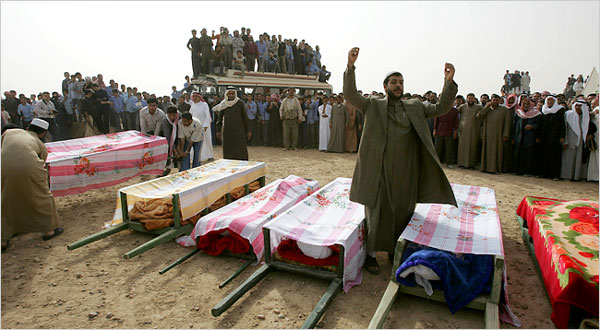
Villagers in Syria gathered Monday near the coffins of people who died during an American Special Operations raid aimed at Iraqi militants on Sunday (Hussein Malla/Associated Press).

In U.S. Combat Action Across the Syrian Border we puzzled over why the attack on the suicide bomber network at the Syrian border had come now and not later (or not at all). The Captain’s Journal had recommended more than one year ago that these actions be taken. In a recent report it has been claimed that Syrian intelligence knew and approved of the raid.

Publicly America is still saying nothing but US officials are making intriguing claims off the record.

Now, a respected Israeli intelligence expert says he has been told the operation was carried out with the knowledge and co-operation of Syrian intelligence.

Ronen Bergman, author of The Secret War with Iran, makes the claim in the Yediot Ahronoth newspaper, based on briefings with two senior American officials, one of whom he says until recently “held a very high ranking in the Pentagon”.

Mr Bergman told Sky News the raid happened after America had lobbied Syria intensely to deal with an al Qaeda group conducting activity on the border.

The Syrians were unwilling to be seen publicly bowing to US pressure to tackle the group, he says, but in the end gave the Americans the green light to do so themselves.

He claims the Syrian government told the Americans: “If you want to do this, do it. We are going to give you a corridor and carte blanche. We will not harm your troops.”

Syria is still an apparatchik of the radical Iranian Mullahs, and we doubt this report (it sounds like something that DEBKAfile would publish, along with seeing pigs fly and green Martians landing). Damascus gets its orders from Tehran. It’s more likely that Syrian complaints before the U.N. are representative of its government’s position (and certainly of the Iranian position).

DAMASCUS (AFP) — Syria on Tuesday protested to the UN Security Council over what it branded a barbarous US helicopter raid on a village near the Iraqi border and decided to close two American institutions in Damascus.

The government also indicated Sunday’s deadly raid, launched from Iraq, could have repercussions on ties with Baghdad by postponing a November 12-13 meeting of the Syrian-Iraqi high commission.

Baghdad initially appeared to condone the raid by US troops as aimed against insurgents who infiltrate Iraq, before joining in condemnation of the assault on Tuesday.

In a letter to UN chief Ban Ki-moon, Syria protested “this aggressive act and expects the UN Security Council and member countries to assume their responsibility by preventing a repetition of this dangerous violation.”

It called for the Security Council “to hold the aggressor responsible for the deaths of the innocent Syrian nationals,” state news agency SANA reported, quoting the letter.

In New York, Syria’s ambassador to the United Nations, Bashar Jaafari, said the letters asked Ban and the Security Council “to assume their responsibility” to prevent any repeat of “such aggressive and terrorist acts against a sovereign member of the United Nations.”

The next few paragraphs of this report are not only interesting, but very important moving forward with U.S. force presence in Iraq.

In Baghdad, the government slammed the assault, which an unnamed official in Washington said was believed to have killed Abu Ghadiya, “one of the most prominent foreign fighter facilitators in the region.”

“The Iraqi government rejects the US helicopter strike on Syrian territory, considering that Iraq’s constitution does not allow its land to be a base for launching attacks on neighbouring countries,” spokesman Ali al-Dabbagh said.

“We call upon American forces not to repeat such activities and Baghdad has launched an investigation into the strike.”

On Monday, Dabbagh said the raid targeted a border area used by insurgents to launch attacks on Iraq.

Iraq’s parliament said it regretted that “the operation took place at a time when relations between Iraq and its neighbours are progressing.”

According to the draft Status of Forces Agreement for U.S. forces in Iraq, Article 4 [3], this strike would not be allowed or legal. This hasn’t stopped U.S. officials from anonymously claiming that they may happen again.

There has been continued official silence from the Pentagon and the State Department regarding the raid on Sunday … Despite Syrian outrage and the threat of retaliation by Syrian troops, officials did not rule out mounting such a raid again.

The official silence of DoD and the State Department precisely comports with counsel given here at The Captain’s Journal. As for the “anonymous officials” who go on record with the main stream media, they are cowards for not giving their names and should be fired for divulging any information at all. They are undermining the war effort. But that’s a different problem, one the DoD should be working to solve.

We don’t wish for a cease and desist order on U.S. operations across the Syrian border. In fact, this analysis calls into question the viability of the Iraq SOFA if it doesn’t allow raids such as this one (we have recommended seeing the long war as one without territorial borders). But the administration may have waited about four years too late to conduct cross border raids against Syria (for Sunni insurgents and terrorists) and Iran (for IRG, Quds and “special groups”). While a hard fought and bloody victory in Iraq has been essentially won by U.S. forces, our hands are tied under the new SOFA. Unfortunately, it’s a lame duck administration that is ordering the raids, and General Odierno, for all of the admiration that The Captain’s Journal has for him, might have been dealt a bad hand in the SOFA.

Logistical Difficulties in Afghanistan

17 years, 4 months ago

“Clearly, logistics is the hard part of fighting a war.”
– Lt. Gen. E. T. Cook, USMC, November 1990

“Gentlemen, the officer who doesn’t know his communications and supply as well as his tactics is totally useless.”
– Gen. George S. Patton, USA

“Bitter experience in war has taught the maxim that the art of war is the art of the logistically feasible.”
– ADM Hyman Rickover, USN

“There is nothing more common than to find considerations of supply affecting the strategic lines of a campaign and a war.”
– Carl von Clausevitz

“The line between disorder and order lies in logistics…”
– Sun Tzu

From Logistics quotes.

When considering U.S. and ISAF casualties in Afghanistan it’s too easy to miss the private security contractors – indigenous Afghans – who are working for NATO to ensure lines of supply to the forces. The contractors killed while on duty protecting supply lines numbers at least in the hundreds, and possibly into the thousands (when considering the unlicensed contractors).

In his compound, a stack of empty coffins sits ready for the next victims.

“Every day, we have seen our men wounded and killed,” the teenager said.

Mr. Mohammed does not belong to any military or police organization. He is part of Afghanistan’s growing private army: security contractors who fill the gaps in the foreign military and development mission here, protecting diplomats, aid workers, outposts and the all-important convoys.

To satisfy the voracious appetite of thousands of NATO troops for food, fuel and other supplies, hundreds of trucks a week must traverse highways that more and more are rife with insurgents.

Afghans, often unable to make a decent living any other way, are paying a hefty price to try to ensure the goods arrive intact, regularly living out scenes straight out of a Mad Max movie.

“Since I took this job four or five years ago, I have lost 500 men,” said Mohammed Salim, a leader with Rozi Mohammed’s employer, Commando Security.

The legions of untrained, largely unregulated hired guns also have been accused of adding to the country’s lawlessness, an issue that recently hit home for Canada. Before a partial government crackdown a year or so ago, private soldiers were often involved in kidnappings and robberies, said a Kandahar-based security expert with an international agency.

This August, a detail of guards with a logistics convoy started shooting wildly when they came under Taliban fire west of Kandahar city, and a Canadian soldier on patrol in between was killed.

The Canadian Forces, which hires private security to guard some of its own bases, later cleared the contractors of any blame in the death, saying the fatal shot was from the Taliban. Private guards are a necessity of life here, a spokesman says.

“We do consider them to be part of the environment we operate in,” said Major Jay Janzen, a Forces spokesman. “They do provide an important contribution to the mission.”

Regular readers of The Captain’s Journal already know our position on the exclusive use of special operations forces (see The Cult of Special Forces) and high value targets (see High Value Target Initiative). The U.S. has treated the effort as a counterterrorism campaign rather than a counterinsurgency, and thus we have failed for more than six years to bring security to the Afghan countryside.

The malaise can be blamed on anything or any group – drug lords, Taliban, Tehrik-i-Taliban, criminals, tribes – it makes no difference. Regardless of the reasons for it, without the presence of forces security will not be brought to the population.

In response to the malaise of the campaign, one potential solution being weighed is making it more of a special operations forces high value target initiative. But it is jackass-ery in the superlative to believe that more of the same failed approach will bring anything but more failure.

In fact, the problem as we have discussed above now goes beyond security for the population. The situation is degrading to the point that the very strategy may turn on itself and prevent progress. An Army cannot wage war without logistics, and the lack of security along Highway 1 in Afghanistan (what Asia Times calls the Highway to Hell) means that the entire countryside is the territory of the Taliban.

AFP gives us another look at French troops who struggle with the same problems in their AO.

FORWARD BASE NIJRAB, Afghanistan (AFP) — A logistics convoy has just pulled into Forward Base Nijrab, the latest of about 700 since June to make the perilous three-hour journey from the Afghan capital.

The road that snakes through the mountains from Kabul is a rude test of both truck axles and the soldiers’ mettle.

“This is nothing like Bosnia, Kosovo, Lebanon or Chad. In Afghanistan, the danger is constant,” says the French sergeant major who led the mission and is only permitted by the military to give his first name, Pascal.

About 60 kilometres (37 miles) of treacherous road separates NATO’s Camp Warehouse in Kabul from this fortified base in Kapisa to the northeast. Not far from here, 10 French soldiers were killed in an insurgent ambush in August.

Convoys supplying the more than 60,000 international troops in Afghanistan, helping in the fight against the Taliban, are regularly attacked, looted and torched.

“The main danger for a logistics convoy is the IEDs (improvised explosive devices),” Pascal says.

Most of the roughly 230 international soldiers killed in Afghanistan this year have died in bombings.

Nineteen vehicles in a convoy for US troops were torched in southern Zabul province at the weekend by men who claimed to be from the Taliban, police said. The guards escaped and there were reports they had assisted in the attack.

“In Bosnia, we would leave with 35 or 40 lorries with four or five armoured vehicles. Here it is the opposite — we have four lorries for 16 armoured vehicles,” says the sergeant major.

At the end of August, a logistics convoy was hit between Nijrab and Tagab, another French forward base in Kapisa province.

Not only does logistics dictate what can and can’t be done, it is the surest indicator of security, better than any SITREP. Pushing more SOF into a campaign that has thus far spent its efforts on finding high value targets only to find more high value targets will come to an end when supplies can no longer get to the SOF because the high value target initiative doesn’t work. Hopefully, we’ll figure it out before then.

Prior:

Taliban Control of Supply Routes to Kabul

Degrading Security in Afghanistan Causes Supply and Contractor Problems

Postscript: To the great dismay and surprise of The Captain’s Journal, until now there is no Logistics category. This will be the inaugural post.

An Aging Nuclear Weapons Stockpile

17 years, 4 months ago

Glenn Reynolds linked a report that the Secretary of Defense and Chairman of the Joint Chiefs of Staff are calling for refurbishment of the existing nuclear weapons in the U.S.  Good find by Glenn.  A brief word of explanation.

It has always been true that we can’t sit on the nuclear weapons stockpile without working to maintain the purity of the materials.  Uranium and transuranics (e.g., Plutonium) do decay, albeit most isotopes with very long decay half lives (e.g., Pu-239 has a half life of 24,100 years).  Decay introduces impurities into the material, and purity is a requirement for miniturization of nuclear weapons, something the Chinese have not yet learned like the U.S. (this means that weapon delivery is made easier).

But by far the larger effect of decay is tritium, which is used as material for fussion in thermonuclear weapons in conjuction with the fission to enhance their power.  The half life for tritium is 12.32 years.  In other words, as the stockpile sits, its effectiveness decays away.  This must be considered in thinking about national security as we move forward into the twenty first century.  In the ongoing work to maintain the effectiveness of the stockpile, TVA won a bid for a government program to produce Tritium (this is done by activation of Lithium) at their Watts Bar Nuclear Power Plant.

How does Obama stack up against the nuclear stockpile?  Opposed.

Senator Barack Obama will propose on Tuesday setting a goal of eliminating all nuclear weapons in the world, saying the United States should greatly reduce its stockpiles to lower the threat of nuclear terrorism, aides say.

In a speech at DePaul University in Chicago, Mr. Obama will add his voice to a plan endorsed earlier this year by a bipartisan group of former government officials from the cold war era who say the United States must begin building a global consensus to reverse a reliance on nuclear weapons that have become “increasingly hazardous and decreasingly effective.”

Mr. Obama, according to details provided by his campaign Monday, also will call for pursuing vigorous diplomatic efforts aimed at a global ban on the development, production and deployment of intermediate-range missiles.

“In 2009, we will have a window of opportunity to renew our global leadership and bring our nation together,” Mr. Obama is planning to say, according to an excerpt of remarks provided by his aides. “If we don’t seize that moment, we may not get another.”

This places Obama and current military leadership (Gates and Mullen) on a direct collision course over national security and the need for maintenance of nuclear weapons.

U.S. Combat Action Across the Syrian Border

17 years, 4 months ago

The U.S. has launched limited kinetic operations inside the Syrian border to help destroy part of a foreign fighter logistics network.

U.S. military helicopters launched a rare attack Sunday on Syrian territory close to the border with Iraq, killing eight people in a strike the government in Damascus condemned as “serious aggression.”

A U.S. military official told the Associated Press the attack included a raid by special forces targeting a foreign-fighter network that travels through Syria into Iraq. The Americans have been unable to shut the network down in the area because Syria was out of the military’s reach.

“We are taking matters into our own hands,” the official told the AP on the condition of anonymity because of the political sensitivity of cross-border raids.

The attack came just days after the commander of U.S. forces in western Iraq said American troops were redoubling efforts to secure the Syrian border, which he called an “uncontrolled” gateway for fighters entering Iraq …

On Thursday, U.S. Maj. Gen. John Kelly said Iraq’s western borders with Saudi Arabia and Jordan were fairly tight as a result of good policing by security forces in those countries, but that Syria was a “different story.”

“The Syrian side is, I guess, uncontrolled by their side,” Gen. Kelly said. “We still have a certain level of foreign-fighter movement.”

He added that the U.S. was helping construct a sand berm and ditches along the border.

“There hasn’t been much, in the way of a physical barrier, along that border for years,” Gen. Kelly said.

The foreign-fighters network sends militants from North Africa, the Persian Gulf states and elsewhere in the Middle East to Syria, where elements of the Syrian military are in league with al Qaeda and loyalists of Saddam Hussein’s Ba’ath Party, the U.S. military official told the AP.

Sand Berms were an effective tool for isolating Haditha from foreign fighters, but such a concept will be difficult to implement along an entire border, and probably not nearly as effective. The strike directly against the logistics network, in fact, closely follows an approach recommended by The Captains Journal more than one year ago in Sun Tzu and the Art of Border Security.

The solution is not for Iraq to seal the borders. The solution involves intimidation of Iraq’s neighbors into sealing the borders. While the U.S. and Iraq are involved in talks with Iran and other neighbors, tried and tested military strategy suggests that bullying is the order of the day.

This bullying and intimidation might take the form of financial pressure (or conversely rewards for good behavior), market sanctions, air assets used against foreign fighters flowing in from across the borders, small incursions across the borders to destroy the sanctuaries of foreign fighters, or even larger air power involvement to destroy those sanctuaries and other supporting infrastructure.

The alternative is leaving these sanctuaries and flow paths in place, with no hope of the Iraqi security forces or U.S. forces being able to stop them (due to force size). Tested military strategy aims for the right target. In the case of the borders, the target is the offending country, not the Iraqi border proper. At the moment, the offending countries know that U.S. forces have restricted the battle space to Iraq proper. Either this changes — causing confusion and disaggregation among the foreign elements who wish to destabilize Iraq — or the borders will remain porous.

The question is why now? General David Petraeus has moved on to head up CENTCOM, and General Odierno is in charge of Operation Iraqi Freedom. Is this a sign of a shift in strategy to incorporate cross-border operations solely because Odierno is in charge? It’s possible, but not likely. Since this represents a fairly significant change in strategic approach with potential international repercussions, Petraeus would certainly have been involved in the decision-making, and likely the CJCS.

While it has been claimed in the past that Syria was doing a better job of deconstructing the terrorist networks inside her borders, this has mostly been theater, much as the Pakistani military operations in the FATA and NWFP are intended to be a show to keep U.S. dollars rolling in. The Iraqi insurgency was in many ways born in Damascus, and the constant flow of suicide bombers across the Syrian border has killed or injured at least 4000 Iraqis.

Since cross-border operations have been initiated, follow-through is absolutely necessary. Any capitulation by the Multinational Force, any show of weakness by the State Department, and any reluctance to continue with these operations in the future will spell the death of this strategy, and little if anything will have been gained.

With over 4000 American warriors having perished in Operation Iraqi Freedom, this approach should have been implemented long before now. Nothing needs to be said by the Administration or the State Department about this incident. In fact, nothing needs to be said by the Multinational Force. All spokesmen should respond to inquiries with “no comment.” Everything that needs to be communicated has been. The U.S. is willing to conduct kinetic operations inside Syrian territory. Silence is golden. Let the guns do the talking, as Sun Tzu smiles upon the plan.


26th MEU (10)
Abu Muqawama (12)
ACOG (2)
ACOGs (1)
Afghan National Army (36)
Afghan National Police (17)
Afghanistan (704)
Afghanistan SOFA (4)
Agriculture in COIN (3)
AGW (1)
Air Force (41)
Air Power (10)
al Qaeda (83)
Ali al-Sistani (1)
America (22)
Ammunition (304)
Animals (323)
Ansar al Sunna (15)
Anthropology (3)
Antonin Scalia (1)
AR-15s (393)
Arghandab River Valley (1)
Arlington Cemetery (2)
Army (91)
Assassinations (2)
Assault Weapon Ban (29)
Australian Army (7)
Azerbaijan (4)
Backpacking (4)
Badr Organization (8)
Baitullah Mehsud (21)
Basra (17)
BATFE (246)
Battle of Bari Alai (2)
Battle of Wanat (18)
Battle Space Weight (3)
Bin Laden (7)
Blogroll (3)
Blogs (24)
Body Armor (23)
Books (3)
Border War (18)
Brady Campaign (1)
Britain (39)
British Army (36)
Camping (5)
Canada (19)
Castle Doctrine (1)
Caucasus (6)
CENTCOM (7)
Center For a New American Security (8)
Charity (3)
China (19)
Christmas (18)
CIA (30)
Civilian National Security Force (3)
Col. Gian Gentile (9)
Combat Outposts (3)
Combat Video (2)
Concerned Citizens (6)
Constabulary Actions (3)
Coolness Factor (3)
COP Keating (4)
Corruption in COIN (4)
Council on Foreign Relations (1)
Counterinsurgency (218)
DADT (2)
David Rohde (1)
Defense Contractors (2)
Department of Defense (220)
Department of Homeland Security (26)
Disaster Preparedness (5)
Distributed Operations (5)
Dogs (15)
Donald Trump (27)
Drone Campaign (4)
EFV (3)
Egypt (12)
El Salvador (1)
Embassy Security (1)
Enemy Spotters (1)
Expeditionary Warfare (18)
F-22 (2)
F-35 (1)
Fallujah (17)
Far East (3)
Fathers and Sons (2)
Favorite (1)
Fazlullah (3)
FBI (39)
Featured (192)
Federal Firearms Laws (18)
Financing the Taliban (2)
Firearms (1,867)
Football (1)
Force Projection (35)
Force Protection (4)
Force Transformation (1)
Foreign Policy (27)
Fukushima Reactor Accident (6)
Ganjgal (1)
Garmsir (1)
general (15)
General Amos (1)
General James Mattis (1)
General McChrystal (44)
General McKiernan (6)
General Rodriguez (3)
General Suleimani (9)
Georgia (19)
GITMO (2)
Google (1)
Gulbuddin Hekmatyar (1)
Gun Control (1,717)
Guns (2,406)
Guns In National Parks (3)
Haditha Roundup (10)
Haiti (2)
HAMAS (7)
Haqqani Network (9)
Hate Mail (8)
Hekmatyar (1)
Heroism (5)
Hezbollah (12)
High Capacity Magazines (16)
High Value Targets (9)
Homecoming (1)
Homeland Security (3)
Horses (2)
Humor (72)
Hunting (61)
ICOS (1)
IEDs (7)
Immigration (123)
India (10)
Infantry (4)
Information Warfare (4)
Infrastructure (4)
Intelligence (23)
Intelligence Bulletin (6)
Iran (171)
Iraq (379)
Iraq SOFA (23)
Islamic Facism (64)
Islamists (98)
Israel (19)
Jaish al Mahdi (21)
Jalalabad (1)
Japan (3)
Jihadists (82)
John Nagl (5)
Joint Intelligence Centers (1)
JRTN (1)
Kabul (1)
Kajaki Dam (1)
Kamdesh (9)
Kandahar (12)
Karachi (7)
Kashmir (2)
Khost Province (1)
Khyber (11)
Knife Blogging (7)
Korea (4)
Korengal Valley (3)
Kunar Province (20)
Kurdistan (3)
Language in COIN (5)
Language in Statecraft (1)
Language Interpreters (2)
Lashkar-e-Taiba (2)
Law Enforcement (6)
Lawfare (14)
Leadership (6)
Lebanon (6)
Leon Panetta (2)
Let Them Fight (2)
Libya (14)
Lines of Effort (3)
Littoral Combat (8)
Logistics (50)
Long Guns (1)
Lt. Col. Allen West (2)
Marine Corps (281)
Marines in Bakwa (1)
Marines in Helmand (67)
Marjah (4)
MEDEVAC (2)
Media (68)
Medical (146)
Memorial Day (6)
Mexican Cartels (47)
Mexico (71)
Michael Yon (6)
Micromanaging the Military (7)
Middle East (1)
Military Blogging (26)
Military Contractors (5)
Military Equipment (25)
Militia (9)
Mitt Romney (3)
Monetary Policy (1)
Moqtada al Sadr (2)
Mosul (4)
Mountains (25)
MRAPs (1)
Mullah Baradar (1)
Mullah Fazlullah (1)
Mullah Omar (3)
Musa Qala (4)
Music (25)
Muslim Brotherhood (6)
Nation Building (2)
National Internet IDs (1)
National Rifle Association (97)
NATO (15)
Navy (31)
Navy Corpsman (1)
NCOs (3)
News (1)
NGOs (3)
Nicholas Schmidle (2)
Now Zad (19)
NSA (3)
NSA James L. Jones (6)
Nuclear (63)
Nuristan (8)
Obama Administration (222)
Offshore Balancing (1)
Operation Alljah (7)
Operation Khanjar (14)
Ossetia (7)
Pakistan (165)
Paktya Province (1)
Palestine (5)
Patriotism (7)
Patrolling (1)
Pech River Valley (11)
Personal (76)
Petraeus (14)
Pictures (1)
Piracy (13)
Pistol (4)
Pizzagate (21)
Police (672)
Police in COIN (3)
Policy (15)
Politics (998)
Poppy (2)
PPEs (1)
Prisons in Counterinsurgency (12)
Project Gunrunner (20)
PRTs (1)
Qatar (1)
Quadrennial Defense Review (2)
Quds Force (13)
Quetta Shura (1)
RAND (3)
Recommended Reading (14)
Refueling Tanker (1)
Religion (499)
Religion and Insurgency (19)
Reuters (1)
Rick Perry (4)
Rifles (1)
Roads (4)
Rolling Stone (1)
Ron Paul (1)
ROTC (1)
Rules of Engagement (75)
Rumsfeld (1)
Russia (37)
Sabbatical (1)
Sangin (1)
Saqlawiyah (1)
Satellite Patrols (2)
Saudi Arabia (4)
Scenes from Iraq (1)
Second Amendment (708)
Second Amendment Quick Hits (2)
Secretary Gates (9)
Sharia Law (3)
Shura Ittehad-ul-Mujahiden (1)
SIIC (2)
Sirajuddin Haqqani (1)
Small Wars (72)
Snipers (9)
Sniveling Lackeys (2)
Soft Power (4)
Somalia (8)
Sons of Afghanistan (1)
Sons of Iraq (2)
Special Forces (28)
Squad Rushes (1)
State Department (23)
Statistics (1)
Sunni Insurgency (10)
Support to Infantry Ratio (1)
Supreme Court (79)
Survival (214)
SWAT Raids (58)
Syria (38)
Tactical Drills (38)
Tactical Gear (17)
Taliban (168)
Taliban Massing of Forces (4)
Tarmiyah (1)
TBI (1)
Technology (21)
Tehrik-i-Taliban (78)
Terrain in Combat (1)
Terrorism (96)
Thanksgiving (13)
The Anbar Narrative (23)
The Art of War (5)
The Fallen (1)
The Long War (20)
The Surge (3)
The Wounded (13)
Thomas Barnett (1)
Transnational Insurgencies (5)
Tribes (5)
TSA (25)
TSA Ineptitude (14)
TTPs (4)
U.S. Border Patrol (8)
U.S. Border Security (22)
U.S. Sovereignty (29)
UAVs (2)
UBL (4)
Ukraine (10)
Uncategorized (105)
Universal Background Check (3)
Unrestricted Warfare (4)
USS Iwo Jima (2)
USS San Antonio (1)
Uzbekistan (1)
V-22 Osprey (4)
Veterans (3)
Vietnam (1)
War & Warfare (432)
War & Warfare (41)
War Movies (4)
War Reporting (21)
Wardak Province (1)
Warriors (6)
Waziristan (1)
Weapons and Tactics (80)
West Point (1)
Winter Operations (1)
Women in Combat (21)
WTF? (1)
Yemen (1)

February 2026
January 2026
December 2025
November 2025
October 2025
September 2025
August 2025
July 2025
June 2025
May 2025
April 2025
March 2025
February 2025
January 2025
December 2024
November 2024
October 2024
September 2024
August 2024
July 2024
June 2024
May 2024
April 2024
March 2024
February 2024
January 2024
December 2023
November 2023
October 2023
September 2023
August 2023
July 2023
June 2023
May 2023
April 2023
March 2023
February 2023
January 2023
December 2022
November 2022
October 2022
September 2022
August 2022
July 2022
June 2022
May 2022
April 2022
March 2022
February 2022
January 2022
December 2021
November 2021
October 2021
September 2021
August 2021
July 2021
June 2021
May 2021
April 2021
March 2021
February 2021
January 2021
December 2020
November 2020
October 2020
September 2020
August 2020
July 2020
June 2020
May 2020
April 2020
March 2020
February 2020
January 2020
December 2019
November 2019
October 2019
September 2019
August 2019
July 2019
June 2019
May 2019
April 2019
March 2019
February 2019
January 2019
December 2018
November 2018
October 2018
September 2018
August 2018
July 2018
June 2018
May 2018
April 2018
March 2018
February 2018
January 2018
December 2017
November 2017
October 2017
September 2017
August 2017
July 2017
June 2017
May 2017
April 2017
March 2017
February 2017
January 2017
December 2016
November 2016
October 2016
September 2016
August 2016
July 2016
June 2016
May 2016
April 2016
March 2016
February 2016
January 2016
December 2015
November 2015
October 2015
September 2015
August 2015
July 2015
June 2015
May 2015
April 2015
March 2015
February 2015
January 2015
December 2014
November 2014
October 2014
September 2014
August 2014
July 2014
June 2014
May 2014
April 2014
March 2014
February 2014
January 2014
December 2013
November 2013
October 2013
September 2013
August 2013
July 2013
June 2013
May 2013
April 2013
March 2013
February 2013
January 2013
December 2012
November 2012
October 2012
September 2012
August 2012
July 2012
June 2012
May 2012
April 2012
March 2012
February 2012
January 2012
December 2011
November 2011
October 2011
September 2011
August 2011
July 2011
June 2011
May 2011
April 2011
March 2011
February 2011
January 2011
December 2010
November 2010
October 2010
September 2010
August 2010
July 2010
June 2010
May 2010
April 2010
March 2010
February 2010
January 2010
December 2009
November 2009
October 2009
September 2009
August 2009
July 2009
June 2009
May 2009
April 2009
March 2009
February 2009
January 2009
December 2008
November 2008
October 2008
September 2008
August 2008
July 2008
June 2008
May 2008
April 2008
March 2008
February 2008
January 2008
December 2007
November 2007
October 2007
September 2007
August 2007
July 2007
June 2007
May 2007
April 2007
March 2007
February 2007
January 2007
December 2006
November 2006
October 2006
September 2006
August 2006
July 2006
June 2006
May 2006

about · archives · contact · register

Copyright © 2006-2026 Captain's Journal. All rights reserved.