Articles by Herschel Smith


The “Captain” is Herschel Smith, who hails from Charlotte, NC. Smith offers news and commentary on warfare, policy and counterterrorism.


The Anbar Narrative: Part III

17 years, 2 months ago

In our effort to catalogue the history of the counterinsurgency campaign in Anbar, we began the The Anbar Narrative and have since added many articles to this category.  Bing West, author of The Strongest Tribe: War, Politics and the Endgame in Iraq, weighed in with our friend Rich Lowry at The National Review on an article he wrote.  The specifics of the statements Rich made will not be included here because of length, but can be found at the link above.  However, Bing’s comments on the Anbar awakening will be fully included below.

There is a cult movement in a few circles to create a myth re Iraq, a myth that is quite dangerous if applied to Afghanistan. The myth is that the U.S. can create tribal awakenings by “proper” counterinsurgency techniques.

You wrote: “A key element was the Anbar Awakening: They (the tribes) didn’t fight for an abstract notion of freedom, but to defend their way of life and their homes against foreign Islamic extremists. They fought for their honor and their traditions.”

Umm. For two years, I have struggled to find the reasons why the Awakening occurred. Dammed if I know. I do know it was the third such effort; we Americans rejected the first tribal offer in late 2004, and it’s unclear how sincere that offer was; AQI slaughtered the Sunnis who tried a genuine effort at the end of 2005; and the third effort (fall of 2006) succeeded not because the Sunni tribes fought—there was very, very little actual fighting—but because the Americans protected the tribes, and used them as informers. Sattar was protected by a Marine platoon that camped out on his front lawn with a tank. He was betrayed by his own cousin. To me, the Awakening was as much due to three years of small unit American persistence in Anbar, tough fighters forbearing of those who didn’t fight them, as to any other cause.

“Talk to the American military officers involved in the surge’s success and they will tell you how important it was to be immersed in Iraqi culture and know the key tribal players in their particulars — who really has influence, who hates whom and why, etc.”

— This was the case from 2004 on; we all knew the tribes. Dialogue among hundreds of Americans and tribal members was an everyday affair in ’05 and ’06. But before mid-2006, the tribes weren’t buying the American line. There wasn’t a special set of colonels who “got it” with the surge in 2007, while the others didn’t.

 “Bush saved Iraq post-2006 — in a culturally attuned counterinsurgency campaign with the minimalist goal of ousting al-Qaeda while accommodating traditional local players.”

— This is the myth that is rewriting history. The Sunnis came over in Anbar half a year before the surge in Baghdad began. So the Americans in Anbar were practicing a culturally attuned counterinsurgency campaign long before it became conventional wisdom in the mainstream press. 

There were always two fronts in the war. Anbar and Baghdad. Each accounted for about 33% of all US fatalities over the course of the war. The Awakening occurred in Anbar in September of ’06. The war was over in Anbar before Petraeus arrived in Baghdad in Feb of ’07. U.S. deaths were over 350 in Anbar in ’06—44% of all U.S. losses for that year. In ’07, U.S. deaths in Anbar were a little over 100—17% of total. The war was over in ’06, and all of us out there knew it. Mattis congratulated the troops in Ramadi for winning the war on 4 Feb; the next day, Petraeus took over in Baghdad. 

Baghdad was a tough fight in ’07, because the Americans left the bases and repeated the tactics used in Anbar. Had those tactics not been used in ’05 and ’06 in Anbar, there would have been no change in Sunni attitude. That change was the critical independent variable—the Sunnis in Anbar led the Sunnis in Baghdad and elsewhere and to this day are the leaders—that set the essential condition allowing Dave Petraeus to succeed in Baghdad. Had the Sunnis persisted in supporting the insurgency and al Qaeda, as they had in 2004, Baghdad would have remained a mess in 2007, despite Dave’s efforts. 

Why the Awakening happened in the fall of ’06 has a large element of mystery. I pressed Sattar on this, asking why it didn’t happen two years earlier, and save both the Americans and Sunnis many casualties and grief. He was a thoughtful guy. He chewed on that and then said, “You Americans could not convince us. We Sunnis had to convince ourselves.”

We Americans should not take credit for something we did not do! The Chairman of the Joint Chiefs says we are now changing our strategy in Afghanistan. Hmm. What has it been for seven years?? The Command and Control has been an unfathomable mess—created by the military and not attributable to a lack of troops.

We have to be careful not to design a strategy that is based on a theory created from myths. If you look at Anbar prior to the Sunnis coming over, you see that the Americans were persisting in very small unit (squads) dismounted patrolling, day and night. If you transfer that model to Afghanistan, you are increasing the risk and assuring many more U.S. casualties. It may Americanize yet further a war that should be quite limited, and focused on how to get to al Qaeda in western Pakistan. Above all, we shouldn’t do it because we believe it worked first in Baghdad in 2007 and became the key to bringing over the Sunnis in a short period of time. That’s not what happened.

As we have pointed out in The Surge, the U.S. Marines were doing counterinsurgency in Anbar long before Petraeus applied the same tactics in Baghdad.  But Bing appears to be truncating the Anbar campaign short of completion.  The war was not over in Anbar in 2006.  Period.  The war was over in Ramadi in 2006.  Upon completion of the hard work in Western Anbar, foreign fighters, mostly affiliated with al Qaeda in Iraq, moved Eastward.

Fallujah became the stronghold of the remaining foreign fighters in 2007, and even though prior Marine units had declared Fallujah unwinnable,  Operation Alljah ended their presence in Fallujah for all practical purposes (see our coverage and analysis of Fallujah).  Some casualties were taken by the U.S. Marines in Fallujah in 2007, but the kinetic operations were very aggressive and many foreign fighters died there.  From there, AQI fled North to Mosul.  But there is a reason that they didn’t flee to Baghdad, and it has to do with the surge.

Friend of The Captain’s Journal Major Neil Smith previously weighed in on the reason that this came to pass.

As a personal opinion, I doubt that we would have had the flexibility to break Baghdad’s “cycle of violence” without the addition of extra troops, combined with a coherent and synchronized operational plan based off of organizational learning. The Awakening probably would have occurred in Anbar regardless, but I doubt it could have spread into the “Sons of Iraq” movement without the addition of troops to mitigate the sectarian cycle of violence combined with evolved COIN practices (the above plus things like gated communities in B’Dad).

Gated communities and biometrics came into vogue after successfully applied in Fallujah in 2007.  The Anbar narrative is a complex and intricate affair which is not amenable to simplistic or truncated accounts – all things which Bing knows full well.  The campaign in Anbar didn’t end in 2006, and the surge was an absolutely necessary component of the full spectrum of operations necessary to end the influence of foreign fighters in Iraq, albeit in conjunction with other elements of the campaign which were already underway.

Is a Nuclear Iran Inevitable?

17 years, 2 months ago

Richard Fernandez writing for Pajamas Media latches onto a significant report about the thinking of President-elect Obama and his team of advisers concerning Iran’s nuclear ambitions.

President-elect Barack Obama will offer Israel a strategic pact designed to fend off any nuclear attack on the Jewish state by Iran, an Israeli newspaper reported on Thursday.

Haaretz, quoting an unnamed source, said the Obama administration would pledge under the proposed “nuclear umbrella” to respond to any Iranian strike on Israel with a “devastating U.S. nuclear response.”

Granting Israel a nuclear guarantee would essentially suggest the U.S. is willing to come to terms with a nuclear Iran, the paper reported.

According to the paper’s source, Obama’s nuclear guarantee would be backed by a new and improved Israeli anti-ballistic missile system. The Bush administration took the first step by deploying an early-warning radar system, which enhances the ability to detect Iranian ballistic missiles.

No immediate comment from Israeli officials or the U.S. embassy in Tel Aviv was offered.

Iran denies its nuclear program has military designs. But tough anti-Israel rhetoric from Tehran has spread fears that the Israelis, who are believed to have the Middle East’s only atomic arsenal, could attack their arch-foe pre-emptively.

The source, according to Haaretz, noted that the discussion of the possibility of a nuclear Iran undermines efforts to prevent Tehran from acquiring such arms.

A senior Bush administration source reportedly said the nuclear umbrella was ridiculous and lacked credibility.

“Who will convince the citizen in Kansas that the U.S. needs to get mixed up in a nuclear war because Haifa was bombed? And what is the point of an American response, after Israel’s cities are destroyed in an Iranian nuclear strike?,” he said.

Richard then goes on to consider a possible U.S. response to an Iranian strike, and then concludes:

A combination of tacitly accepting an nuclear-armed Iran and reposing deterrence in Washington could make the Ayatollahs more willing to run the risk. What are the odds that the West can bring itself to enter into a nuclear exchange with Iran if it could not muster the will to prevent Teheran’s acquisition of those weapons in the first place?

Michael Ledeen also weighs in with his always educational and interesting prose.  I agree with both Richard and Michael, but would add a significant forecast to the discussion.  It won’t happen this way.

Iran will not entrust the deployment of a nuclear warhead to an air delivery system (since achieving enrichment doesn’t mean achieving miniturization of nuclear weapons to decrease overall mass) – nor will it be that overt.  Instead, acceptance of a nuclear Iran will mean the turnover of a nuclear weapon to Hezbollah or some allied group, and detonation somewhere around Tel Aviv (with its metropolitan population of more than three million people).

Since IAEA inspectors have been effectively booted from Iran for months, it won’t be possible early on to ascertain, even with gamma spectrographic analysis, the fission product and actinide composition and thus the initial mixture of high enriched Uranium.  Another way of saying it is that we have no “signature” for Iranian weapons.

By the time it has been determined through intelligence that the weapon came from Iran, the spin machine will have been active for weeks convincing the world community that the weapon fell into the hands of rogue elements, and that any attack on Iran would mean the deaths of innocent civilians.  World pressure will build for Israel to refuse to retaliate.  Even if Israel retaliates, the military forces and authorities will have relocated to unknown locations.

Hundreds of thousands of Israelis will be dead and much of the surrounding land will be uninhabitable for years.  The toll on the medical care system will be so enormous that it won’t be able to keep up, and the seat of power – the government – will effectively cease to exist.  At this time Hezbollah will attack from the North and Hamas and allied groups will attack from Gaza.

Given this scenario, i.e., the delivery of a weapon by means other than air delivery, the notion of a “nuclear umbrella” is ridiculous and irrelevant.  Team Obama is naive to the point of childish if this is their level of analysis of the situation.

Further, acquiescence to a nuclear Iran will mean a certain nuclear arms race in the Middle East.  Just recently Egyptian President Hosni Mubarak explained how most if not all Middle Easterners see Iran.

Egyptian President Hosni Mubarak spoke out against Iran during a meeting with members of the Egyptian ruling party, according to a report in the Kuwaiti newspaper Al-Jarida on Thursday, cited by Israel Radio.

Mubarak accused the Islamic Republic of trying to subsume its Muslim neighbors, telling the forum that “the Persians are trying to devour the Arab states.”

Mubarak’s comments came after the Egyptian leader recalled the country’s diplomatic envoy from the Iranian capital earlier this week following an increase in tension between the two countries.

Recent strain between Cairo and Teheran has grown as several demonstrations in Iran called for the hanging of the Egyptian leader. The Iranian FARS news service reported that participants in recent student demonstrations outside the Egyptian diplomatic mission in Teheran also chanted “Death to Israel” and “Death to America” and burned an Israeli flag.

On Wednesday the Egyptian ministry was quoted as criticizing some Iranian newspapers that have repeatedly insulted Egyptian policies and leadership recently. Teheran media, for example, broadcast incitement against Cairo’s policy allegedly preventing aid from reaching Palestinians in the Gaza Strip.

Democratic revolution and regime change remain the best options, but the State Department effectively killed the last such remaining program and no politician has shown any interest in the easy solution.  They are all seeking the hard ones.

For team-Obama, it’s three strikes and an out the first time at bat.

Pakistan Turns Attention to India, Ignores Radicalization Within

17 years, 2 months ago

In Pakistan Declares Baitullah Mehsud Patriot we warned that the Taliban and even the power structure within the Army might use the Mumbai attack in India to turn attention away from the Taliban and towards India.

While the new Pakistan administration sees the need for the war against the Taliban and al Qaeda, the Pakistan Army mostly doesn’t and wishes not to be fighting their own people. The Army also has an almost pathological preoccupation with India, and the rumblings in India over the Mumbai attacks have given both the Pakistan Army and the Tehrik-i-Taliban the perfect cover to end their cooperation with the U.S. and NATO over the Taliban safe haven in the Pakistan FATA and NWFP.

The cultural milieu is amenable to this persuasion to distrust India.

Fateh Khan doesn’t know much about the fight against terrorism. He doesn’t know much about the attacks that killed more than 170 people in Mumbai last week, either. But if there is one thing the Pakistani taxi driver feels sure about, it’s that after three wars, India — not terrorism — remains the No. 1 threat to his country.

“Every Pakistani is clear that India is the enemy state,” Khan said. “Pakistan has always tried to live at peace with India. But India has not tried for peace.”

As we forecast, the Taliban are indeed using the Mumbai incident as a means to turn attention away from themselves and towards India, even offering to assist the Pakistan Army in a fight with India.

Taliban fighters battling Pakistani soldiers near the Afghan border volunteered Tuesday to fight alongside the army if war breaks out with traditional foe India over the Mumbai attacks.

Analysts say the offer is meant to fan the flames of anti-Hindu sentiment and draw support away from Islamabad’s fight against al-Qaida and Taliban militants in the tribal regions close to Afghanistan.

The government, which is appealing for calm, has not responded to it.

“That is what they would love, to see the attention of the Pakistan army shift from the tribal areas to the eastern border with India,” said defense analyst Hasan Askari Rizvi.

The Taliban’s offer came in a video recording by its deputy chief, Maulvi Faqir Mohammad, that was made available to reporters Tuesday.

“If India launches a war on Pakistan, we will divide the fight into two parts. The air defense will be the responsibility of the military, and the Tehrik-e-Taliban Pakistan will fight the war on ground,” he said. “If it makes a mistake to attack Pakistan, Tehrik-e-Taliban will defend Pakistan and Islam.”

Pakistan still doesn’t understand the internal threat posed by the Tehrik-i-Taliban.  Brothers in religious persuasion – maybe or maybe not.  But they are certainly not interested in Pakistan staying status quo in the future.

We have discussed and detailed the Talibanization of Karachi, and Peshawar was essentially Talibanized a half year ago.  The extent of Taliban influence is now even expanding to Lahore.  But a vivid indication of just how deep the dark underworld goes into the Pakistan power structure is seen in the recent execution of a former Pakistani General.

A top former Pakistani army officer, who was the brother-in-law of Indian-origin novelist and Nobel laureate V S Naipaul, was murdered after he “threatened” to expose Pakistani Generals for ‘deals’ with Taliban militants, a media report said today.

Major-General Faisal Alavi, a former head of Pakistan’s special forces who was murdered last month in Islamabad, had named two generals in a letter to the Pakistani army chief Ashfaq Kayani and had said he would “furnish all relevant proof,” the report said.

Alavi, brother of Naipaul’s wife Nadira, did not live to fulfil it. Aware that he was risking his life, Alavi gave a copy of the proof to a Sunday Times correspondent and asked him to publish it if he was killed.

Four days later, he was driving through Islamabad when his car was ambushed by another vehicle. At least two gunmen opened fire from either side, shooting him eight times killing him and his driver, the paper said.

The letter from Major-General Faisal Alavi is available in PDF format.  The rot runs deep within Pakistan, and yet the attention of the country, much like that of the taxi driver, is squarely on India.  Pakistan is currently in dire danger and may cease to exist as a viable democracy, and yet the Pakistan Army wants to fight with India and the population is, generally speaking, willing to suffer the Taliban and acquiesce to their rule.  It is a dark day in Pakistan, and while very few signs of real resistance to the Taliban are forthcoming, time is short to stem the tide of radicalization of an entire nation.

Prior: Games of Duplicity in Pakistan

The Logistical Battle: New Lines of Supply to Afghanistan

17 years, 2 months ago

Following up on the recent attack on NATO supply lines through Khyber, another attack was recently launched, only this time the attackers didn’t need the winding passes of Khyber to conduct the mission.

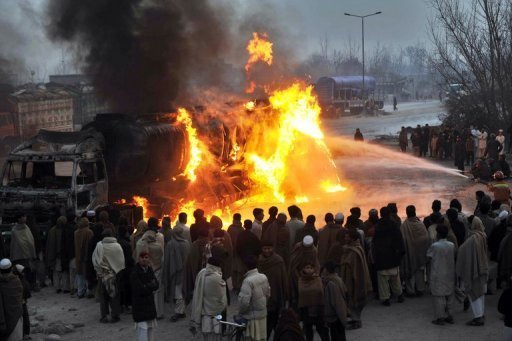
Suspected Taliban militants early Saturday staged another attack against cargo terminals in northwestern Pakistan in the country’s restive tribal areas, destroying NATO supplies bound for neighboring Afghanistan, police said.

Military vehicles and food in 13 containers were thought to have been destroyed in the attacks outside the frontier city of Peshawar.

It follows at least five other attacks against NATO and U.S. supply lines in recent weeks.

Militants threw petrol bombs into the city’s World Logistic Terminal and the Al Faisal Terminal, police said. The terminal holds hundreds of supply containers as well as Hummer transport vehicles bound for Afghanistan.

Several containers were still burning by Saturday afternoon.

The Tehrik-i-Taliban have claimed credit for the attack and warned of more to come.  The recent work to find another line of supply into Afghanistan has yielded some significant fruit.

Nato plans to open a new supply route to Afghanistan through Russia and Central Asia in the next eight weeks following a spate of attacks on its main lifeline through Pakistan this year, Nato and Russian sources have told The Times.

Kazakhstan and Uzbekistan, the former Soviet Central Asian states that lie between Russia and Afghanistan, have agreed in principle to the railway route and are working out the small print with Nato, the sources said.

“It’ll be weeks rather than months,” said one Nato official. “Two months max.”

The “Northern Corridor” is expected to be discussed at an informal meeting next week between Dmitri Rogozin, Russia’s ambassador to Nato, and Jaap de Hoop Scheffer, Nato’s Secretary-General.

The breakthrough reflects Nato and US commanders’ growing concern about the attacks on their main supply line, which runs from the Pakistani port of Karachi via the Khyber Pass to Kabul and brings in 70 per cent of their supplies. The rest is either driven from Karachi via the border town of Chaman to southern Afghanistan – the Taleban’s heartland – or flown in at enormous expense in transport planes that are in short supply.

“We’re all increasingly concerned,” Admiral Mike Mullen, Chairman of the US Joint Chiefs of Staff, told reporters on Wednesday. “But in that concern, we’ve worked pretty hard to develop options.”

The opening of the Northern Corridor also mirrors a gradual thaw in relations between Moscow and Nato, which plunged to their lowest level since the end of the Cold War after Russia’s brief war with Georgia in August.

However, Nato and the United States are simultaneously in talks on opening a third supply route through the secretive Central Asian state of Turkmenistan to prevent Russia from gaining a stranglehold on supplies to Afghanistan, the sources said. Non-lethal supplies, including fuel, would be shipped across the Black Sea to Georgia, driven to neighbouring Azerbaijan, shipped across the Caspian Sea to Turkmenistan and then driven to the Afghan border.

The week-long journey along this “central route” would be longer and more expensive than those through Pakistan or Russia and would leave supplies vulnerable to political volatility in the Caucasus and Turkmenistan.

Yet, this alternative to direct reliance on Russia is smart and may prove to be quite attractive in the future should these “relations” we now have with Russia again turn sour.  Vladimir Putin and Dimitri Medvedev likely intend to push forward with engagement of what they consider to be their “near abroad,” including Georgia, the Ukraine, and other regional countries.

However, interestingly, this leaves us vulnerable yet again to Russian dispositions, even with the alternative supply route.  Georgia is the center of gravity in this plan, and our willingness to defend her and come to her aid might just be the one thing that a) kills the option of Russia as a logistical supply into Afghanistan, and b) saves Georgia as a supply route.  Thus far, we have maneuvered ourselves into the position of reliance on Russian good will.  These “thawed relations” might just turn critical should Russia decide again to flex its muscle in the region, making the U.S. decisions concerning Georgia determinative concerning our ability to supply our troops in Afghanistan.

Are we willing to turn over Georgia (and maybe the Ukraine) to Russia in exchange for a line of supply into Afghanistan, or are we willing to defend and support Georgia for the preservation of democracy in the region and – paradoxically – the preservation of a line of supply to Afghanistan?  The upcoming administration has some hard choices, and it’s unlikely that negotiations will make much difference.  The burden will rest on decisions rather than talks.

Prior:

The Search for Alternate Supply Routes to Afghanistan

Large Scale Taliban Operations to Interdict Supply Lines

More on Lines of Logistics for Afghanistan

How Many Troops Can We Logistically Support in Afghanistan?

Targeting of NATO Supply Lines Through Pakistan Expands

Logistical Difficulties in Afghanistan

Taliban Control of Supply Routes to Kabul

Interdiction of U.S. Supplies in Khyber Pass

The Torkham Crossing

Taliban and al Qaeda Strategy in Pakistan and Afghanistan

Pirates? Call the Marines … Er, the Lawyers

17 years, 2 months ago

Pirates?  Call the U.S. Marines … er, the lawyers.

Piracy off Somalia’s coast has plagued shipping companies for years, but the number and boldness of attacks has increased in recent months. While that has given fits to shipowners, cruise operators and navies, it also has kept a relatively obscure set of lawyers busy.

London’s Holman Fenwick has received more work as pirate attacks have increased off Somalia, where a French Navy frigate patrolled Saturday.

Among the most prominent is London maritime firm Holman Fenwick Willan. Partner Toby Stephens says lawyers at the firm have been awakened “at all hours” by ship owners calling the firm’s 24-hour hot line. “They’re often quite panicked, and understandably so,” he says.

Over the past three months, the rise in piracy has kept about a half-dozen lawyers at Holman Fenwick working nearly full-time for clients with potentially dozens of lives and tens of millions of dollars at stake in hijackings. To some degree, the work has helped Holman Fenwick offset other maritime practices hurt by the global economic slowdown.

Through the end of last month, the waters off Somalia had been the site of 96 pirate attacks this year, 40 of which had led to pirates boarding a ship, taking control and demanding a ransom, according to the International Maritime Bureau in London. World-wide there were 83 reported pirate attacks in the third quarter, up from 53 and 63 in the first and second quarters, respectively, the bureau says. In recent months, pirates have broadened their targets to include bigger vessels, including oil tankers and, so far unsuccessfully, cruise ships. In most cases ransom demands have been in the $1 million-$2 million range. But lawyers say hijackers have demanded as much as $25 million for the release of the Sirius Star, a Saudi oil tanker captured 450 miles off the Somali coast carrying cargo valued at more than $100 million.

On Tuesday several cruise-ship operators said they would shift or cancel tours or reroute passengers by plane to avoid the Gulf of Aden off Somalia. Also, the European Union said it would station armed guards on cargo ships in the area.

Mr. Stephens says his firm is working on “over a dozen” of the roughly 20 Somalia-area attacks in which the ships haven’t been freed.

“This year we’ve seen a definite uptick in piracy work,” says James Huckle, who is in charge of business development for the firm.

Business in Holman Fenwick’s casualty practice, usually dealing with shipping collisions, and its ship-financing practice have slipped as the world economy has slowed. Mr. Huckle says piracy cases have helped “counterbalance” that downturn but he is unable to provide specific figures.

Stephen Askins, a maritime lawyer at London’s Ince & Co. says he is handling “a few” piracy cases, but that Holman Fenwick “is really leading the way” in representing shipowners in piracy matters.

Piracy expertise at Holman Fenwick, which was founded in 1883, grew out of the firm’s history representing clients following shipwrecks and collisions. The firm represented the salvage companies that cleaned up after the oil tanker Prestige broke up off the coast of Spain in 2002. The firm also represents the owners and insurers of the MSC Napoli, a container ship severely damaged in an English Channel storm last year. In addition to about 290 lawyers, the firm employs about 30 nonlawyer experts, such as former ship captains, marine engineers and naval architects.

A firm’s initial role after a hijacking often is to ease a client’s fears. “No one’s been hurt, and the ransoms have so far been small enough for shipowners to pay,” says Duncan McDonald, a lawyer at London-based Stephenson Harwood. His firm represents owners of two ships hijacked and released earlier this year.

Then, a firm moves to determining where a ship is registered and the location of the hijacking. These factors affect the laws that will govern the case and the haggling over liability that often follows. A U.N. resolution passed in June allows a navy to enter Somalia’s territorial waters to repress an attack.

Shipowners and insurance underwriters are reluctant to speak publicly about their hijacking situations. But the managing director of a large insurance syndicate in London says that when a ship partly underwritten by his firm was hijacked several weeks ago, his first question to lawyers at Holman Fenwick was whether the payment of ransom was even legal. It was under U.K. law, Mr. Stephens says, which typically applies because that’s where insurance underwriters are usually based. If a ransom payment is illegal, the firm might have to negotiate with the country exercising jurisdiction.

The insurance-syndicate executive says the negotiations, which are continuing, have been stressful. “I know we’re in good hands…but there are still times when you feel like you have no control at all,” he says.

“The lawyer’s pen and the swashbluckling pirate’s sword met with a mighty crash as all the children heard and watched the brave battle ensue” … actually, scratch that.  We’re only on good hands if the Marines are killing pirates.  The Captain’s Journal has made it known what needs to be done.

TCJ has weighed in saying:

This is easy. We tell the LOAC and ROE lawyers that they’re special and that they should go to their rooms and write high-sounding platitudes about compassion in war so that they’re out of the way, we land the Marines on the ship, and we kill every last pirate. Then we hunt down his domiciles in Somali and destroy them, and then we find his financiers and buyers and kill them. Regardless of the unfortunate potential loss of Ukrainian or Russian civilian life upon assaulting the ship, this weaponry and ordnance should never have been shipped in this part of the world without escort (and perhaps it shouldn’t have been shipped even with escort). Negotiations will only serve to confirm the pirates in their methods. It’s killing time. It’s time to turn the United States Marines loose.

Ralph Peters has weighed in saying:

Piracy must be exterminated. Pirates aren’t folk heroes or champions of the oppressed. They’re terrorists and violent criminals whose ransom demands start at a million bucks. And they’re not impressed by the prospect of trials in a velvet-gloved Western court. The response to piracy must be the same as it was when the British brought an end to the profession’s “golden age:” Sink them or board them, kill them or hang them.

Lt. Col. P at OpFor has weighed in saying:

Kill all of the pirates.

Seriously. Why do we allow a handful of khat-addled assholes to dominate one of the world’s most important sea lanes? We, the western powers, have sufficient naval units in the area to take care of the problem in very quick order. What we lack is the will. We apply an idiotically high standard of judicial due process to a situation that doesn’t lend itself well to a judicial solution. Anyone who has dealt with Somalis can tell you that they laugh at western legalisms, and what they perceive as western weaknesses. And then they redouble their violent efforts to take what they want from you. They do react very well to a boot on their necks, and a gun to their heads. Then they tend to wise up quickly.

Here’s how it needs to be done. Oil tanker sends distress call, takes evasive actions insofar as it is capable. (Or better yet, armed men aboard oil tanker defend by fire.) Coalition forces despatch (sic) vessels and boarding parties. Pirates who survive ensuing gun battle are lined up by the rail and shot in the head, then dumped overboard. Pirate boats are burned. If their bases or villages on the coast can be identified, said bases are raided and destroyed. No fuss no muss, no ransom, no hostages, no skyrocketing costs.

So who has the trust?  The lawyers or U.S. Marines?  Should we pay ransom or kill the pirates?  We have a poll where the reader can weigh in on this question.

Counterinsurgency on the Southern U.S. Border

17 years, 2 months ago

Friend of The Captain’s Journal David Danelo has a must read concerning the situation at the Southern U.S. border.  Here is the full commentary followed by our own analysis.

On Nov. 3, the day before Americans elected Barack Obama president, drug cartel henchmen murdered 58 people in Mexico. It was the highest number killed in one day since President Felipe Calderon took office in December 2006. By comparison, on average 26 people — Americans and Iraqis combined — died daily in Iraq in 2008. Mexico’s casualty list on Nov. 3 included a man beheaded in Ciudad Juarez whose bloody corpse was suspended along an overpass for hours. No one had the courage to remove the body until dark.

The death toll from terrorist attacks in Mumbai two weeks ago, although horrible, approaches the average weekly body count in Mexico’s war. Three weeks ago in Juarez, which is just across the Rio Grande from El Paso, Texas, telephone messages and banners threatened teachers that if they failed to pay protection money to cartels, their students would suffer brutal consequences. Local authorities responded by assigning 350 teenage police cadets to the city’s 900 schools. If organized criminals wish to extract tribute from teachers, businessmen, tourists or anyone else, there is nothing the Mexican government can do to stop them. For its part, the United States has become numb to this norm.

As part of my ongoing research into border issues, I have visited Juarez six times over the last two years. Each time I return, I see a populace under greater siege. Residents possess a mentality that increasingly resembles the one I witnessed as a Marine officer in Baghdad, Fallouja and Ramadi.

“The police are nothing,” a forlorn cab driver told me in September. “They cannot protect anyone. We can go nowhere else. We live in fear.”

An official in El Paso estimated that up to 100,000 dual U.S.-Mexican citizens, mostly upper middle class, have fled north from Juarez to his city this year. Only those lacking means to escape remain.

At the same time, with the U.S. economy in free fall, many illegal immigrants are returning south. So illegal immigration — the only border issue that seems to stir the masses — made no splash in this year’s elections. Mexico’s chaos never surfaced as a topic in either the foreign or domestic policy presidential debates.

Despite the gravity of the crisis, our closest neighbor has fallen off our political radar. Heaven help you if you bring up the border violence at a Washington dinner party. Nobody — Republican or Democrat — wants to approach this thorny discussion.

Mexico, our second-largest trading partner, is a fragmenting state that may spiral toward failure as the recession and drug violence worsen. Remittances to Mexico from immigrant labor have fallen almost 20% in 2008. Following oil, tourism and remittances, drugs are the leading income stream in the Mexican economy.

While the bottom is dropping out of the oil and tourism markets, the American street price of every narcotic has skyrocketed, in part because of recent drug interdiction successes along the U.S. border.

Unfortunately, this toxic economic cocktail also stuffs the cartels’ coffers. Substitute tribal clans for drug cartels, and Mexico starts to look disturbingly similar to Afghanistan, whose economy is fueled by the heroin-based poppy trade.

Arizona Gov. Janet Napolitano, Obama’s pick for Homeland Security director, has argued for permanently stationing National Guard troops along the border. That response alone will do little to assuage American border citizens. To them, talk of “violence bleeding over” is political pabulum while they watch their southern neighbors bleed.

If Napolitano wishes to stabilize the border, she will have to persuade the Pentagon and the State Department to take a greater interest in Mexico. Despite Calderon’s commendable efforts to fight both the cartels and police corruption, this struggle shows no signs of slowing. When 45,000 federal troops are outgunned and outspent by opponents of uncertain but robust size, the state’s legitimacy quickly deteriorates.

The Mexican state has not faced this grave a challenge to its authority since the Mexican revolution nearly a century ago.

If you want to see what Mexico will look like if this pattern continues, visit a border city like Tijuana, where nine beheaded bodies were discovered in plastic bags 10 days ago. Inhale the stench of decay. Inspect the fear on the faces. And then ask yourself how the United States is prepared to respond as Mexico’s crisis increasingly becomes our own.

David J. Danelo is the author of “The Border: Exploring the U.S.-Mexican Divide” and “Blood Stripes: The Grunt’s View of the War in Iraq.”

To set background in place for the analysis below, see the following video.  Mexican labor has become the new slave class for Corporate America.

The situation at the border with Mexico has become as classical an insurgency as anywhere in the world, and because of the complicity of American business fishing for cheap labor, lack of traceability of employment records, no health insurance payments, no retirement payments, and no social security payments, we are now relegated to the solution to militarize the Southern border.

Further, even militarization of the border won’t fully solve the issue unless massive changes are made to both the rules under which the military would operate and our understanding of the seriousness of the situation.  In Guardsmen Attacked and Overrun at U.S. Border we discussed the horribly failed attempt to use the National Guard to secure the border.  The National Guard had no ammunition in their weapons, could only put themselves at mortal risk in order to apprehend suspects, and weren’t even allowed to fire warning shots.

Unlike the citizens of New Orleans after Katrina who usually stopped for armed police (not realizing that the police are not allowed to use deadly force to stop a fleeing suspect), the border is infested with rogue elements who know better.  Militarization of the border would mean full scale implementation of the rules associated with the SCOTUS decision Tennessee v. Garner 471 U.S. 1 (1985) on criminals who wouldn’t respect the military and would use the rules against them.

The intrusiveness of a seizure by means of deadly force is unmatched. The suspect’s fundamental interest in his own life need not be elaborated upon. The use of deadly force also frustrates the interest of the individual, and of society, in judicial determination of guilt and punishment. Against these interests are ranged governmental interests in effective law enforcement.  It is argued that overall violence will be reduced by encouraging the peaceful submission of suspects who know that they may be shot if they flee.

Without in any way disparaging the importance of these goals, we are not convinced that the use of deadly force is a sufficiently productive means of accomplishing them to justify the killing of nonviolent suspects. Cf. Delaware v. Prouse, supra, at 659. The use of deadly force is a self-defeating way of apprehending a suspect and so setting the criminal justice mechanism in motion. If successful, it guarantees that that mechanism will not be set in motion. And while the meaningful threat of deadly force might be thought to lead to the arrest of more live suspects by discouraging escape attempts, the presently available evidence does not support this thesis.

Whether MS 13, other criminals and drug runners, or foreign terrorists who enter the U.S. via the Southern border, the U.S. is in real trouble concerning national sovereignty.  David has done important work in informing us of the scope of the risk at the border.

Prior:

Danger at the Border

Guardsmen Attacked and Overrun at the U.S. Border

The Search for Alternate Supply Routes to Afghanistan

17 years, 2 months ago

Nine months ago in Plan B for Supplying Troops in Afghanistan The Captain’s Journal addressed alternatives to the highly dangerous and unreliable passage through the Khyber pass and Torkham Crossing.  Since then our coverage and analysis of the issue of logistics has been unmatched in open source literature, including the forecasting of this very strategy almost one year ago.  If the testing for alternative means of supply have not been studied seriously for the last nine months, the studies are serious now.

.

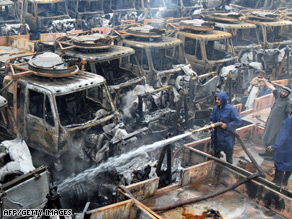
Perhaps the Taliban are observing the old military axiom that amateurs study tactics, while professionals study logistics. In a pair of attacks over the weekend in northwest Pakistan, militants destroyed more than 150 Humvees and other vehicles bound for U.S. troops and allies fighting in Afghanistan — the third attack on NATO supply lines inside a month. Those attacks have highlighted an ongoing vulnerability along the overland routes through mountain passes along the Afghanistan-Pakistan frontier that are used to transport more than 75% of the supplies sent by the U.S. to its 32,000 troops in Afghanistan. So, as President-elect Barack Obama prepares to send more troops to join the fight in Afghanistan, Pentagon planners are scrambling to figure out how to keep those already there — and the anticipated reinforcements — supplied with food, fuel, bullets and everything else a modern army needs.

“Without adequate sustainment, the operational deployment cannot maintain constant pressure on the enemy,” Lieutenant Christopher Manganaro, a young U.S. officer in Afghanistan, has written in the professional journal Army Logistics. And the Pentagon can’t do it all with airplanes. “Few airfields in Afghanistan can support aircraft larger than a C-130,” Manganaro added, “limiting the number of high-value items that U.S. Army units can transport by air.”

Militants hijacked a convoy of more than a dozen vehicles nearly a month ago, and last week 22 trucks were destroyed by fire at a truck stop. U.S. military officials downplay the impact of recent attacks, noting that about 350 supply vehicles travel the route every day. Still, they’re nervous enough to have begun looking for alternatives.

That’s because the choke point in the Khyber Pass is an attractive target for the enemy. Marine General James Cartwright, vice chairman of the Joint Chiefs, was asked in September how much trouble his forces in Afghanistan would be in if Islamabad shut down supply lines through Pakistan. “It would be challenging to sustain our presence,” he answered. “It is very difficult then to get to this landlocked nation in a way that would provide the quantity of resources that we need, particularly as we see ourselves growing.” Bearing in mind projected future deployments, the U.S. will need to deliver up to 70,000 shipping containers (15% of them refrigerated) a year to its troops in Afghanistan.

The U.S. has recently tested alternate supply lines, and “we’re working our way through to understand rail, pipelines, customs, what would it take, are they there in a sufficient scale to allow us to do this? And so we’re working this one pretty hard,” Cartwright added. The impact of a shutdown triggered by Taliban attacks would have the same result.

The alternatives earlier included routes such as through Uzbekistan, which is problematic in its own right since there is no means of transit of supplies to the points of dispatch in Uzbekistan except via air from Germany (Russia is not likely to allow significant supplies through its territory given the recent tensions over Georgia and the Ukraine).

Since the force projection and force size must increase if Operation Enduring Freedom is to succeed, and since logistics is problematic no matter the force size (but more problematic given a larger force size), the recommendations of The Captain’s Journal nine months ago were prescient then and even more important now.  Logistical alternatives must be found, but the surest way to pressure the Taliban in Pakistan is to engage in kinetic operations against them in Afghanistan.  Pakistan must be part of the equation for logistical supply to NATO, but they cannot be the only variable in the equation.

Prior:

Large Scale Taliban Operations to Interdict Supply Lines

More on Lines of Logistics for Afghanistan

How Many Troops Can We Logistically Support in Afghanistan?

Targeting of NATO Supply Lines Through Pakistan Expands

Logistical Difficulties in Afghanistan

Taliban Control of Supply Routes to Kabul

Interdiction of U.S. Supplies in Khyber Pass

The Torkham Crossing

Taliban and al Qaeda Strategy in Pakistan and Afghanistan

Struggle for Kabul: The Taliban Advance

17 years, 2 months ago

The International Council on Security and Development (formerly the Senlis Council) has issued an important update to their outstanding coverage and analysis of the security situation in Afghanistan, entitled Struggle for Kabul: The Taliban Advance.

The full report is required reading for military and anyone interested in Afghanistan, but selected citations from the situation update are provided below.

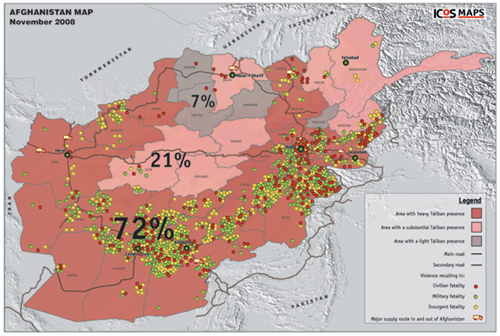
… as seven years of missed opportunity have rolled by, the Taliban has rooted itself across increasing swathes of Afghan territory. According to research undertaken by ICOS throughout 2008, the Taliban now has a permanent presence in 72% of the country. Moreover, it is now seen as the de facto governing power in a number of southern towns and villages. This figure is up from 54% in November 2007, as outlined in the ICOS report Stumbling into Chaos: Afghanistan on the Brink. The increase in their geographic spread illustrates that the Taliban’s political, military and economic strategies are now more successful than the West’s in Afghanistan. Confident in their expansion beyond the rural south, the Taliban are at the gates of the capital and infiltrating the city at will.

Of the four doors leading out of Kabul, three are now compromised by Taliban activity. The roads to the west, towards the Afghan National Ring Road through Wardak to Kandahar become unsafe for Afghan or international travel by the time travellers reach the entrance to Wardak province, which is about thirty minutes from the city limits. The road south to Logar is no longer safe for Afghan or international travel. The road east to Jalalabad is not safe for Afghan or international travel once travellers reach the Sarobi Junction which is about an hour outside of the city. Of the two roads leaving the city to the north only one – the road towards the Panjshir valley, Salang tunnel and Mazar – is considered safe for Afghan and international travel. The second road towards the north which leads to the Bagram Air Base is frequently used by foreign and military convoys and subject to insurgent attacks.

By blocking the doors to the city in this way, the Taliban insurgents are closing a noose around the city and establishing bases close to the city from which to launch attacks inside it. Using these bases, the Taliban and insurgent attacks in Kabul have increased dramatically – including kidnapping of Afghans and foreigners, various bomb attacks and assassinations. This dynamic has created a fertile environment for criminal activity, and the links between the Taliban and criminals are increasing and the lines between the various violent actors becoming blurred. All of these Taliban successes are forcing the Afghan government and the West to the negotiating table.

There are themes throughout the report consistent with those at The Captain’s Journal, such as the conduct of counter-terrorism rather than counterinsurgency (page 19 of the report, see The Captain’s Journal, Concerning Turning Over Afghanistan to Special Operations Forces and The Cult of Special Forces).

Furthermore, the concern over Kabul happens to coincide exactly with Twenty Minutes from Kabul, which we published just one day prior to ICOS study.  The security situation in and around Kabul is degrading, as the visual below shows.

Finally, as if to put the exclamation point on the concern over Kabul, it has been announced that the upcoming additional troop deployments to Afghanistan will go to the Kabul area of operations.

Most of the additional American troops arriving in Afghanistan early next year will be deployed near the capital, Kabul, American military commanders here say, in a measure of how precarious the war effort has become.

It will be the first time that American or coalition forces have been deployed in large numbers on the southern flank of the city, a decision that reflects the rising concerns among military officers, diplomats and government officials about the increasing vulnerability of the capital and the surrounding area.

It also underscores the difficult choices confronting American military commanders as they try to apportion a limited number of forces not only within Afghanistan, but also between Afghanistan and Iraq …

The new Army brigade, the Third Brigade of the 10th Mountain Division from Fort Drum, N.Y., is scheduled to arrive in Afghanistan in January and will consist of 3,500 to 4,000 soldiers. The “vast majority” of them will be sent to Logar and Wardak Provinces, adjacent to Kabul, said Lt. Col. Rumi Nielson-Green, a spokeswoman for the American units in eastern Afghanistan. A battalion of at least several hundred soldiers from that brigade will go to the border region in the east, where American forces have been locked in some of the fiercest fighting this year.

It doesn’t bode well for the campaign when the seat of government – such as it is – is in danger of collapse, and it is yet another sign of the need for additional troops in Afghanistan, as well as transition from the high value target counter-terrorism campaign to one of full-orbed counterinsurgency.

Large Scale Taliban Operations to Interdict Supply Lines

17 years, 2 months ago

There has recently been significant combat by the Taliban to interdict lines of supply through the Khyber pass.

PESHAWAR, Pakistan (Reuters) – Pakistani militants attacked a parked convoy of trucks carrying military vehicles for Western forces in Afghanistan near Peshawar early on Sunday, destroying 96 trucks, police said.

Security guards said they were overpowered by more than 200 militants who attacked two terminals on the ring road round the northwestern city of Peshawar, where the trucks carrying Humvees and other military vehicles were parked.

“It happened at around 2.30 a.m. They fired rockets, hurled hand grenades and then set ablaze 96 trucks,” senior police officer Azeem Khan told Reuters.

Most of the fuel and other supplies for U.S. and NATO forces in landlocked Afghanistan are trucked through Pakistan, much of it through the mountainous Khyber Pass between Peshawar, capital of North-West Frontier Province and the border town of Torkham.

Khan said one private security guard was killed in an exchange of fire between police and the militants.

“They were shouting Allah-o-Akbar (God is Great) and Down With America. They broke into the terminals after snatching our guns,” said Mohammad Rafiullah, security guard at one terminal.

Militants destroyed 22 trucks carrying food supplies in the same area a week ago.

Last month the government closed the main supply route to Western forces in Afghanistan for a week after militants hijacked more than a dozen trucks on the road through the Khyber Pass.

The Captain’s Journal has weighed in on this issue beginning almost one year ago, and there isn’t much more than can be said about the difficulties except that only when the pressure of kinetic operations is put on the Taliban will the trouble on the lines of logistical supply ease.

But there is one troubling aspect to this recent attack.  Note the number of Taliban engaged in the operations, i.e., 200.  This is similar to the number engaged in the Battle of Wanat, and it shows a confidence in large scale operations that doesn’t bode well for the campaign.

Twenty Minutes from Kabul

17 years, 2 months ago

The Asia Times has an important article on the security situation near Kabul, Afghanistan.

If there is an exact location marking the West’s failures in Afghanistan, it is the modest police checkpoint that sits on the main highway 20 minutes south of Kabul. The post signals the edge of the capital, a city of spectacular tension, blast walls, and standstill traffic. Beyond this point, Kabul’s gritty, low-slung buildings and narrow streets give way to a vast plain of serene farmland hemmed in by sandy mountains. In this valley in Logar province, the American-backed government of Afghanistan no longer exists.

Instead of government officials, men in muddied black turbans with assault rifles slung over their shoulders patrol the highway, checking for thieves and “spies”. The charred carcass of a tanker, meant to deliver fuel to international forces further south, sits belly up on the roadside.

The police say they don’t dare enter these districts, especially at night when the guerrillas rule the roads. In some parts of the country’s south and east, these insurgents have even set up their own government, which they call the Islamic Emirate of Afghanistan (the name of the former Taliban government). They mete out justice in makeshift sharia courts. They settle land disputes between villagers. They dictate the curricula in schools.

Just three years ago, the central government still controlled the provinces near Kabul. But years of mismanagement, rampant criminality, and mounting civilian casualties have led to a spectacular resurgence of the Taliban and other related groups. Today, the Islamic Emirate enjoys de facto control in large parts of the country’s south and east. According to ACBAR, an umbrella organization representing more than 100 aid agencies, insurgent attacks have increased by 50% over the past year. Foreign soldiers are now dying at a higher rate here than in Iraq.

The burgeoning disaster is prompting the Afghan government of President Hamid Karzai and international players to speak openly of negotiations with sections of the insurgency.

Who exactly are the Afghan insurgents? Every suicide attack and kidnapping is usually attributed to “the Taliban”. In reality, however, the insurgency is far from monolithic. There are the shadowy, kohl-eyed mullahs and head-bobbing religious students, of course, but there are also erudite university students, poor, illiterate farmers, and veteran anti-Soviet commanders. The movement is a melange of nationalists, Islamists, and bandits that fall uneasily into three or four main factions. The factions themselves are made up of competing commanders with differing ideologies and strategies, who nonetheless agree on one essential goal: kicking out the foreigners.

Analysis

It isn’t surprising that this hodgepodge of rogues would only have one thing that holds them together. After all, NATO forces – and in particular – U.S. troops, are the main barrier between them and their other goals, whether it be wealth, control, power or Islamic rule.  The indigenous Sunni insurgency and al Qaeda initially had the goal of ousting U.S. forces too, and the Sunni tribes eventually turned on al Qaeda.

The assessment that the “Taliban” is not a monolithic group is also tired and rather passe. It is neither new information nor valuable analysis. Coverage and commentary at The Captain’s Journal has focused over the past months on the cloistering of NATO forces onto FOBs and in urban centers (except for some U.S. and British forces), as well as the focus on the high value target initiative rather than the application of counterinsurgency tactics.

The countryside has been left to the Taliban because, quite simply, there aren’t enough troops to conduct counterinsurgency. This had thus far led to the logistical problems we have faced with supplies to NATO forces, but more important than this is the situational milieu for which the lack of security had been a catalyst. The mistakes are not new, and we have had the benefit of learned wisdom if not the wisdom to hear the learned words.

Mr. Kabulov, 54, is no ordinary ambassador, having served as a K.G.B. agent in Kabul — and eventually as the K.G.B. resident, Moscow’s top spy — in the 1980s and 1990s, during and after the nine-year Soviet military occupation. He also worked as an adviser to the United Nations’ peacekeeping envoy during the turbulent period in the mid-1990s that led to the Taliban’s seizing power.

Now he is back as Moscow’s top man, suave and engaging, happy to talk of a time when the old Soviet Embassy compound was the command center for an invasion that ended in disaster and speeded the collapse of the great power that undertook it …

“They’ve already repeated all of our mistakes,” he said, speaking of what the United States has done — and failed to do — since the Taliban were toppled from power in November 2001 and American troops began moving into old Soviet bases like the one at Bagram, north of Kabul.

“Now, they’re making mistakes of their own, ones for which we do not own the copyright.”

The list of American failures comes quickly. Like the Soviets, Mr. Kabulov said, the Americans “underestimated the resistance,” thinking that because they swept into Kabul easily, the occupation would be untroubled. “Because we deployed very easily into the major cities, we didn’t give much thought to what was happening in the countryside,” where the stirrings of opposition that grew into a full-fledged insurgency began, he said.

Mr. Kabulov goes on to say that the real problem is the irritant that is a foreign occupation, and that the solution is to leave as quickly as possible. Not all of his counsel is sensible, and the absence of U.S. troops would mean the fall of Kabul to the Taliban within a week.

However much Western sensibilities might feel revulsion at the treatment of women under radical Islam, or disgust at the corruption of the government, the goal of the campaign cannot and should not be the implementation of democracy or perfect governance. Further, the population is only a key to the extent that the are the interstitial tissue upon which the cancer of the insurgency feeds.

The goal should not be ending Islamic rule, for this would surely fail. The goal is to isolate and kill the globalist elements among them, those elements which gave safe haven to al Qaeda and which would no doubt be allied with the Tehrik-i-Taliban in the future. Every tactic should be oriented towards this end as one of many lines of effort.

There is robust debate in professional military community as to how we must implement a surge, with the admonition common to these debates that Afghanistan is not Iraq and the precise strategy used in the Middle East will not necessarily work in the far East. Those who give this admonition are wasting words by repeating the obvious.

But it is a non sequitur to claim that the necessary difference in strategy means that more troops are neither needed nor appropriate. No strategy can be implemented without troops, and the notion that the countryside can be left to the Taliban but Afghanistan converted into a location that doesn’t give safe haven to globalists is preposterous, no matter how many experienced and wise souls declare it to be true.

There is no magic, no special incantation to utter, and no learned discourse to speak. Troops are needed no matter what strategy is implemented, for in order to effect an end, there has to be an effect.  Proper Counterinsurgency is “Plan A.”  There is no “Plan B.”

Prior:

Logistical Difficulties in Afghanistan

Taliban Control of Supply Routes to Kabul

Degrading Security in Afghanistan Causes Supply and Contractor Problems


26th MEU (10)
Abu Muqawama (12)
ACOG (2)
ACOGs (1)
Afghan National Army (36)
Afghan National Police (17)
Afghanistan (704)
Afghanistan SOFA (4)
Agriculture in COIN (3)
AGW (1)
Air Force (41)
Air Power (10)
al Qaeda (83)
Ali al-Sistani (1)
America (22)
Ammunition (304)
Animals (323)
Ansar al Sunna (15)
Anthropology (3)
Antonin Scalia (1)
AR-15s (393)
Arghandab River Valley (1)
Arlington Cemetery (2)
Army (91)
Assassinations (2)
Assault Weapon Ban (29)
Australian Army (7)
Azerbaijan (4)
Backpacking (4)
Badr Organization (8)
Baitullah Mehsud (21)
Basra (17)
BATFE (246)
Battle of Bari Alai (2)
Battle of Wanat (18)
Battle Space Weight (3)
Bin Laden (7)
Blogroll (3)
Blogs (24)
Body Armor (23)
Books (3)
Border War (18)
Brady Campaign (1)
Britain (39)
British Army (36)
Camping (5)
Canada (19)
Castle Doctrine (1)
Caucasus (6)
CENTCOM (7)
Center For a New American Security (8)
Charity (3)
China (19)
Christmas (18)
CIA (30)
Civilian National Security Force (3)
Col. Gian Gentile (9)
Combat Outposts (3)
Combat Video (2)
Concerned Citizens (6)
Constabulary Actions (3)
Coolness Factor (3)
COP Keating (4)
Corruption in COIN (4)
Council on Foreign Relations (1)
Counterinsurgency (218)
DADT (2)
David Rohde (1)
Defense Contractors (2)
Department of Defense (220)
Department of Homeland Security (26)
Disaster Preparedness (5)
Distributed Operations (5)
Dogs (15)
Donald Trump (27)
Drone Campaign (4)
EFV (3)
Egypt (12)
El Salvador (1)
Embassy Security (1)
Enemy Spotters (1)
Expeditionary Warfare (18)
F-22 (2)
F-35 (1)
Fallujah (17)
Far East (3)
Fathers and Sons (2)
Favorite (1)
Fazlullah (3)
FBI (39)
Featured (192)
Federal Firearms Laws (18)
Financing the Taliban (2)
Firearms (1,867)
Football (1)
Force Projection (35)
Force Protection (4)
Force Transformation (1)
Foreign Policy (27)
Fukushima Reactor Accident (6)
Ganjgal (1)
Garmsir (1)
general (15)
General Amos (1)
General James Mattis (1)
General McChrystal (44)
General McKiernan (6)
General Rodriguez (3)
General Suleimani (9)
Georgia (19)
GITMO (2)
Google (1)
Gulbuddin Hekmatyar (1)
Gun Control (1,717)
Guns (2,406)
Guns In National Parks (3)
Haditha Roundup (10)
Haiti (2)
HAMAS (7)
Haqqani Network (9)
Hate Mail (8)
Hekmatyar (1)
Heroism (5)
Hezbollah (12)
High Capacity Magazines (16)
High Value Targets (9)
Homecoming (1)
Homeland Security (3)
Horses (2)
Humor (72)
Hunting (61)
ICOS (1)
IEDs (7)
Immigration (123)
India (10)
Infantry (4)
Information Warfare (4)
Infrastructure (4)
Intelligence (23)
Intelligence Bulletin (6)
Iran (171)
Iraq (379)
Iraq SOFA (23)
Islamic Facism (64)
Islamists (98)
Israel (19)
Jaish al Mahdi (21)
Jalalabad (1)
Japan (3)
Jihadists (82)
John Nagl (5)
Joint Intelligence Centers (1)
JRTN (1)
Kabul (1)
Kajaki Dam (1)
Kamdesh (9)
Kandahar (12)
Karachi (7)
Kashmir (2)
Khost Province (1)
Khyber (11)
Knife Blogging (7)
Korea (4)
Korengal Valley (3)
Kunar Province (20)
Kurdistan (3)
Language in COIN (5)
Language in Statecraft (1)
Language Interpreters (2)
Lashkar-e-Taiba (2)
Law Enforcement (6)
Lawfare (14)
Leadership (6)
Lebanon (6)
Leon Panetta (2)
Let Them Fight (2)
Libya (14)
Lines of Effort (3)
Littoral Combat (8)
Logistics (50)
Long Guns (1)
Lt. Col. Allen West (2)
Marine Corps (281)
Marines in Bakwa (1)
Marines in Helmand (67)
Marjah (4)
MEDEVAC (2)
Media (68)
Medical (146)
Memorial Day (6)
Mexican Cartels (47)
Mexico (71)
Michael Yon (6)
Micromanaging the Military (7)
Middle East (1)
Military Blogging (26)
Military Contractors (5)
Military Equipment (25)
Militia (9)
Mitt Romney (3)
Monetary Policy (1)
Moqtada al Sadr (2)
Mosul (4)
Mountains (25)
MRAPs (1)
Mullah Baradar (1)
Mullah Fazlullah (1)
Mullah Omar (3)
Musa Qala (4)
Music (25)
Muslim Brotherhood (6)
Nation Building (2)
National Internet IDs (1)
National Rifle Association (97)
NATO (15)
Navy (31)
Navy Corpsman (1)
NCOs (3)
News (1)
NGOs (3)
Nicholas Schmidle (2)
Now Zad (19)
NSA (3)
NSA James L. Jones (6)
Nuclear (63)
Nuristan (8)
Obama Administration (222)
Offshore Balancing (1)
Operation Alljah (7)
Operation Khanjar (14)
Ossetia (7)
Pakistan (165)
Paktya Province (1)
Palestine (5)
Patriotism (7)
Patrolling (1)
Pech River Valley (11)
Personal (76)
Petraeus (14)
Pictures (1)
Piracy (13)
Pistol (4)
Pizzagate (21)
Police (672)
Police in COIN (3)
Policy (15)
Politics (998)
Poppy (2)
PPEs (1)
Prisons in Counterinsurgency (12)
Project Gunrunner (20)
PRTs (1)
Qatar (1)
Quadrennial Defense Review (2)
Quds Force (13)
Quetta Shura (1)
RAND (3)
Recommended Reading (14)
Refueling Tanker (1)
Religion (499)
Religion and Insurgency (19)
Reuters (1)
Rick Perry (4)
Rifles (1)
Roads (4)
Rolling Stone (1)
Ron Paul (1)
ROTC (1)
Rules of Engagement (75)
Rumsfeld (1)
Russia (37)
Sabbatical (1)
Sangin (1)
Saqlawiyah (1)
Satellite Patrols (2)
Saudi Arabia (4)
Scenes from Iraq (1)
Second Amendment (708)
Second Amendment Quick Hits (2)
Secretary Gates (9)
Sharia Law (3)
Shura Ittehad-ul-Mujahiden (1)
SIIC (2)
Sirajuddin Haqqani (1)
Small Wars (72)
Snipers (9)
Sniveling Lackeys (2)
Soft Power (4)
Somalia (8)
Sons of Afghanistan (1)
Sons of Iraq (2)
Special Forces (28)
Squad Rushes (1)
State Department (23)
Statistics (1)
Sunni Insurgency (10)
Support to Infantry Ratio (1)
Supreme Court (79)
Survival (214)
SWAT Raids (58)
Syria (38)
Tactical Drills (38)
Tactical Gear (17)
Taliban (168)
Taliban Massing of Forces (4)
Tarmiyah (1)
TBI (1)
Technology (21)
Tehrik-i-Taliban (78)
Terrain in Combat (1)
Terrorism (96)
Thanksgiving (13)
The Anbar Narrative (23)
The Art of War (5)
The Fallen (1)
The Long War (20)
The Surge (3)
The Wounded (13)
Thomas Barnett (1)
Transnational Insurgencies (5)
Tribes (5)
TSA (25)
TSA Ineptitude (14)
TTPs (4)
U.S. Border Patrol (8)
U.S. Border Security (22)
U.S. Sovereignty (29)
UAVs (2)
UBL (4)
Ukraine (10)
Uncategorized (105)
Universal Background Check (3)
Unrestricted Warfare (4)
USS Iwo Jima (2)
USS San Antonio (1)
Uzbekistan (1)
V-22 Osprey (4)
Veterans (3)
Vietnam (1)
War & Warfare (432)
War & Warfare (41)
War Movies (4)
War Reporting (21)
Wardak Province (1)
Warriors (6)
Waziristan (1)
Weapons and Tactics (80)
West Point (1)
Winter Operations (1)
Women in Combat (21)
WTF? (1)
Yemen (1)

February 2026
January 2026
December 2025
November 2025
October 2025
September 2025
August 2025
July 2025
June 2025
May 2025
April 2025
March 2025
February 2025
January 2025
December 2024
November 2024
October 2024
September 2024
August 2024
July 2024
June 2024
May 2024
April 2024
March 2024
February 2024
January 2024
December 2023
November 2023
October 2023
September 2023
August 2023
July 2023
June 2023
May 2023
April 2023
March 2023
February 2023
January 2023
December 2022
November 2022
October 2022
September 2022
August 2022
July 2022
June 2022
May 2022
April 2022
March 2022
February 2022
January 2022
December 2021
November 2021
October 2021
September 2021
August 2021
July 2021
June 2021
May 2021
April 2021
March 2021
February 2021
January 2021
December 2020
November 2020
October 2020
September 2020
August 2020
July 2020
June 2020
May 2020
April 2020
March 2020
February 2020
January 2020
December 2019
November 2019
October 2019
September 2019
August 2019
July 2019
June 2019
May 2019
April 2019
March 2019
February 2019
January 2019
December 2018
November 2018
October 2018
September 2018
August 2018
July 2018
June 2018
May 2018
April 2018
March 2018
February 2018
January 2018
December 2017
November 2017
October 2017
September 2017
August 2017
July 2017
June 2017
May 2017
April 2017
March 2017
February 2017
January 2017
December 2016
November 2016
October 2016
September 2016
August 2016
July 2016
June 2016
May 2016
April 2016
March 2016
February 2016
January 2016
December 2015
November 2015
October 2015
September 2015
August 2015
July 2015
June 2015
May 2015
April 2015
March 2015
February 2015
January 2015
December 2014
November 2014
October 2014
September 2014
August 2014
July 2014
June 2014
May 2014
April 2014
March 2014
February 2014
January 2014
December 2013
November 2013
October 2013
September 2013
August 2013
July 2013
June 2013
May 2013
April 2013
March 2013
February 2013
January 2013
December 2012
November 2012
October 2012
September 2012
August 2012
July 2012
June 2012
May 2012
April 2012
March 2012
February 2012
January 2012
December 2011
November 2011
October 2011
September 2011
August 2011
July 2011
June 2011
May 2011
April 2011
March 2011
February 2011
January 2011
December 2010
November 2010
October 2010
September 2010
August 2010
July 2010
June 2010
May 2010
April 2010
March 2010
February 2010
January 2010
December 2009
November 2009
October 2009
September 2009
August 2009
July 2009
June 2009
May 2009
April 2009
March 2009
February 2009
January 2009
December 2008
November 2008
October 2008
September 2008
August 2008
July 2008
June 2008
May 2008
April 2008
March 2008
February 2008
January 2008
December 2007
November 2007
October 2007
September 2007
August 2007
July 2007
June 2007
May 2007
April 2007
March 2007
February 2007
January 2007
December 2006
November 2006
October 2006
September 2006
August 2006
July 2006
June 2006
May 2006

about · archives · contact · register

Copyright © 2006-2026 Captain's Journal. All rights reserved.