Archive for the 'Fallujah' Category


Remembrances of Fallujah #1

BY Herschel Smith
6 months, 2 weeks ago

Hmmm … that Marine second from the left at 5:35 looks very familiar.

Leaving Fallujah Better?

BY Herschel Smith
8 months, 2 weeks ago

Graeme Wood at The Atlantic pens a piece that questions what Fallujah will be like when the Marines leave Anbar.

A dispatch by Rod Nordland of the New York Times asks whether the violence in Fallujah — lately viewed as a model of an Anbar city pacified and handed over to the Iraqis — is really in remission. His excellent report, filed from Fallujah and from the even more restive nearby town of Karmah, where I just spent two days, leaves the question unanswered but suggests a reality darker than the version the Marines describe.

Stop there.  Let’s go take a look at the New York Times article.

Falluja was supposed to be a success story, not a cautionary tale.

After all, by last year the city, a former insurgent stronghold, was considered one of the safest places in the country. Local Sunni sheiks had driven out the insurgent group Al Qaeda in Mesopotamia and held successful elections, and American engineers were hard at work on a showcase reconstruction project: a $100 million wastewater treatment plant meant to be a model for civilian advances in Iraq.

Then a series of troubling attacks began cropping up this year. One in particular, at the end of May, seemed to drive home the possibility that things were changing for the worse. On a heavily patrolled military road between a Marine camp and the wastewater plant, a huge buried bomb tore through an armored American convoy, killing three prominent reconstruction officials and striking at hopes that the way was completely clear for peacetime projects.

We covered some of this in The Violence Belongs to Iraq Now.  But dissecting the NYT article a little further, even the initial part stumbles into problems.  Local Sunni sheiks didn’t drive anyone from Fallujah.  The author is confusing what happened in Ramadi, where a combination of tribes and Marines drove al Qaeda from there, and in Fallujah, where al Qaeda went after they were driven from Ramadi.

Tribe had little affect in Fallujah, and the notion of Muktars held much more sway.  When the 2/6 Marines deployed to Fallujah in April of 2007, the population was so afraid of al Qaeda that they would send their children out to surround Marines on patrol, waving black balloons so that al Qaeda mortars could target the Marines.  The children were at risk as much as the Marines, but this speaks volumes about the condition of Fallujah early in 2007.

Forward Operating Base Reaper was constructed, at least in part, with Marines lying on their back passing sand bags over their heads from Marine to Marine to avoid sniper fire.  The U.S. Marines drove al Qaeda from Fallujah, not the tribes.  There is no tribe in Fallujah.  So even the background of the NYT article is mistaken.  Returning to the Atlantic article:

On my first afternoon, I spoke with the base’s senior Marine, Lt. Peter Brooks, about the chagrin his men felt at having to serve as a withdrawal force, rather than a high-intensity killing force like the more fortunate Marines currently machine-gunning Taliban in Afghanistan. They spent their days working out, conducting mock exercises with scale models in the sand next to their hut, and guarding their static and rather sleepy position.

Midway through our chat, we heard small-arms fire, full automatic and not a thousand meters from where we stood. I expected a reflex dash into response mode: a quick reaction force, sets of eyes and weapons scanning the horizon for threats. In fact the response was orderly but serene. Rather than scramble into action, Iraqi police looked around unhurriedly, eventually spied a convoy of vehicles, and determined that the automatic bursts were “probably” just a wedding party. The alarm was canceled before being sounded.

By now few foreigners in Iraq have failed to register that blasting the sky with machine-gun fire is the Iraqi chivaree, and that weddings are wonderful events — symbols of peace and unleashed merry-making — at which normal rules of social decorum don’t apply. But if I were an Iraqi best man, I think I would probably have refrained from firing wildly into the air until my convoy traveled at least a few hundred meters past the station filled with ill-trained Iraqi cops and tightly coiled US Marines. The atmosphere seemed not so much one of safety or celebration but of impunity. Whatever the base’s function, it was not for community policing, and certainly not for aggressive patrols by Marines preserving the peace from carloads of young men with weapons.

Several thoughts come to mind. First, a police force that does not respond to unexplained gunfire is not a police force.

Okay.  Stop again.  The gunfire could have been anything, including shooting dogs.  A breed of wild dogs has taken to residing in Fallujah, and each block has its own pack that relies on food it can get from the area to survive.  Residents of Fallujah routinely have to defend themselves against these dogs.  These are not domesticated animals.  These are several-generation wild dog packs that have no inhibitions regarding humans.

The narrative is that the Marines leaving will cause problems for security and that the Iraqi Police are not up to the job.  True or not, the Marines must leave.  It isn’t within the Marines’ mission to remain a large, heavy land based occupation force.  Rapid deployment strike troops must return to their primary mission.  Anbar is better for having the Marines there, but even if security degrades, it will recover.  The Iraqi Police are up to the task, or shortly will be.

A more sophisticated understanding is given to us in the comments section of the Atlantic article by Jon Schroden.

I have several words of caution for anyone who reads this article:

- This piece fails (as does the NYT piece) to paint a truly comprehensive picture of the security situation in Al Anbar because it presents but a single data point. To get a truly balanced sense of security there, the author should have also traveled to Ramadi, Hadithah, and Al Qaim, at a minimum. Each of these cities is different in multiple ways, so reporting on those differences and how they translate into the varying security situations amongst the cities would have been much more enlightening and comprehensive.

- No one who has seriously studied the situation in Al Anbar or spent significant time there would hold up Fallujah as the shining example of a city that has been turned around. Ramadi is typically the example cited, and for good reasons – it truly was a hot-bed of insurgent activity that was pacified through sound counterinsurgency methods, changes in local attitudes and working with the tribes (to wit, Ramadi was once the declared capital of AQI’s “Islamic State of Iraq,” but was also where the Awakening began). Fallujah has always been trouble. Even after two full-on, line-em-up and knock-em-down clearings of the city, it was still rough-and-tumble, so in late 2007 the Marines began a district-by-district clearing of the city again, using the types of less-kinetic techniques that worked in Ramadi (this was called Operation Alljah). That worked to a large extent, and the city was better for it, but the fact remains that the people in Fallujah have always viewed themselves as a special case (in part b/c Saddam treated them that way) and as such they will always be hard to deal with. They feel that Fallujah, not Ramadi, should be the capital of Anbar, and are disgruntled because of it. Also, Fallujah is a lot “less tribal” than Ramadi, so it’s more difficult for local power-brokers to control the people there.

- As for the Karmah region, the description in this article shows a lack of understanding of the tribal dynamics there. Karmah, and its surrounding areas to the east of Fallujah, sit astride the boundary between two tribal confederations – the Dulaimi Confederation to the west (which includes almost all of the Al Anbar tribes), and the Zobai Confederation to the east (which stretches into and around Baghdad). The main tribe in Karmah belongs to the Zobai Confederation. As such, Karmah represents a “special case” when it comes to dealing with tribal alliances, because the people there don’t really fit in to the rest of Anbar and so feel they aren’t represented well in the provincial government. The main sheikh in Karmah is also a coward, who fled Anbar and would only return in 2007 after heavy lobbying by the Marines and with guaranteed security measures in place. Hence he is of little utility in helping to control the situation there.

- Finally, to the line “a police force that does not respond to unexplained gunfire is not a police force,” I would simply respond that we need to be very careful in our tendencies to apply western standards when it comes to things like quality of police, levels of security, etc. Iraq is not America. Our goal in Iraq is not to build Fallujah into a shining example of a modern city. As long as it’s reasonably peaceful and isn’t serving as a safehaven for AQI (which it isn’t), then we’ve accomplished our mission and the Marines should come home. And they are.

This comment might have been left by Dr. Jonathan Schroden of CNA, who has also penned an interesting article entitled What Went Right in Iraq.  It is an interesting read and requires our attention.

The Marines have a vested interest in the Anbar Province, having lost more than 1000 warriors to the fight.  Much blood has been spilled on Anbari soil.  But other fights and other missions beckon the Marines.  May the Anbaris find their peace and security.  We will pray that the security infrastructure is up to the task of providing it.

Prior: Operation Alljah and the Marines of the 2nd Battalion, 6th Regiment

U.S. Marines Prepare to Leave Fallujah

BY Herschel Smith
1 year, 2 months ago

The final preparations are underway for the U.S. Marines to leave Fallujah.

As part of the reduction of United States troops from Iraq, by Thursday there will be few marines left in or around this mostly Sunni city of about 300,000 people. The closing of Camp Falluja is one of the most prominent symbols yet that America’s presence in the country, which at times had seemed all encompassing, is diminishing.

As recently as a year ago, the base closing was cause for alarm. The calm that seemed to have taken hold here was fragile enough that both Iraqi and American officials feared the potential consequences of the marines’ departure.

Today they look forward to it.

“That will make our job easier,” said Colonel Dowad Muhammad Suliyman, commander of the Falluja Police Department. “The existence of the American forces is an excuse for the insurgents to attack. They consider us spies for the Americans.”

To be sure, the threat of violence has not vanished. But the police said they were proud that a place that suffered a major attack a week just a few years ago has had only two in the last six months.

The view that the town is better off taking care of itself was echoed by residents, even in the neighborhood hit by the most recent big attack, in early December, when suicide truck bombers linked to Al Qaeda in Mesopotamia killed 19 people, wounded dozens of others, and leveled nine houses and two police stations.

“Our sons will take care of the security issue,” said Khalil Abrahim, 50, a resident of the neighborhood, as he walked over the rubble of his house, wondering aloud how he could afford to rebuild. “They can do a better job.”

Camp Falluja will be handed over to the Iraqi Army, with most of its marines relocated to Al Asad Air Base, about 90 miles to the west. A smaller contingent will remain at nearby Camp Baharia.

The move reflects the confidence of the American command that major violence will not return here.

“It won’t happen again because the Iraqis don’t want it to happen again,” said Colonel George Bristol, the bald, heavily muscled commanding officer of the First Marine Expeditionary Force Headquarters Group at Camp Falluja.

“We’ve certainly turned a page,” he said. “The conditions are now there where we can close it and turn it over to the people who fought beside us. It’s a great thing. If you look at the city, it has really come to life” …

At Camp Falluja, Major James Gladden and Master Gunnery Sergeant Ray SiFuentes are overseeing the dismantling of a base that had once been home to 14,000 marines and contractors.

The 2,000-acre post had its own fire department, water treatment plant, scrap yard, voter registration booth, ice-making factory, weather station, prison (for insurgents), beauty shop, power plant, Internet café, Turkish bazaar and dog catcher.

Its chapel could fit 800 marines for religious services, a Toby Keith concert or a performance by the Philadelphia Eagles cheerleaders, all of which were held there.

“We had basically everything a small town had,” said Gladden, 34, who is known by other marines as the mayor of Camp Falluja. “Everything except fast-food outlets,” he said, which were deemed too unhealthy.

There are only 200 marines left now, and about 170 truckloads a day leave the base, most headed for other United States military installations.

Even the gaggle of geese from the camp’s artificial pond, which some marines had adopted as pets, has been taken away. One by one, they were trapped and set loose at a larger pond at Camp Baharia.

A good deal of packing up involves making sure nothing is left behind that later could be used against American forces. Obsolete armor for trucks, ballistic glass plates for Humvees and concertina wire are cut to pieces. Thousands of mammoth concrete barriers are being trucked to other military bases.

First of all, this is a testimony to the difficulty of movement of military materiel and relocation of forces.  Logistics rules, and we have long said that the logistics officers will determine when the U.S. withdraws from Iraq rather than the politicians.

Second, it is even more a testimony to the bravery of the Marines in Operation Al Fajr, the follow-on operations, and then finally the Marines of 2/6 who conducted Operation Alljah.  Three years of blood, sweat and tears have brought Fallujah to this point.  The bravery of the Marines has enabled the process to move forward.  It’s now time to turn over, and continued presence by the Marines in Anbar would be an improper extension of the the final phase of counterinsurgency.  It is finished in Anbar.

Separately from another Marine stationed elsewhere in Iraq (perhaps to the North), The Captain’s Journal has received word that they are engaged only in force protection.  There is no combat.  It’s time to move on, since the victory has been won.

Time to Make a Statement in Fallujah

BY Herschel Smith
1 year, 11 months ago

The Multinational Force is reporting that Marine Major William G. Hall, 38 of Seattle, died of wounds suffered in combat in Anbar.  He was assigned to 3rd Low Altitude Air Defense Battalion, Marine Air Control Group 38, 3rd Marine Aircraft Wing, I Marine Expeditionary Force, Camp Pendleton, California.  Actually, the Multinational Force appears to have his rank wrong.

Marine Lt. Col. William G. Hall, a Garfield High School and Washington State University graduate, was killed Saturday in Iraq, according to his family.

Hall, 38, who grew up in Skyway south of Seattle, is one of the highest-ranking U.S. military officers killed in the war.

Hall’s family said the husband and father of four died while riding in Fallujah in a vehicle that struck a roadside bomb. He was on his third deployment there, having arrived in February, and had been promoted to his new rank a month ago.

Hall’s wife and mother first learned in a phone call from the Marine Corps that he was in surgery after being injured. Later, two supportive Marine casualty-notification officers arrived at their door and they knew.

My heart goes out to the Hall family.  This visit by casualty-notification officers is one I awaited late at night for many sleepless nights, and thankfully didn’t get.  My thoughts frequently run to Fallujah – a place I have never been.

While Lt. Col. Hall cannot be brought back, the Marines can do something to prevent this from happening again.  Only a single IED exploded in Fallujah during the deployment of the 2/6 Marines, early in the summer of 2007.  After that … no more.

It’s time for the Marines in Anbar to make a statement in Fallujah and reinforce the idea that such things will not be tolerated.  Ever.

Exporting the Anbar Model: An Exercise in Nuance

BY Herschel Smith
2 years, 4 months ago

James Janega with the Chicago Tribune follows up the reporting that I and Bill Ardolino have done on the campaign in and around Fallujah area of operations.

The last car bomb in Fallujah exploded in May.

On that warm evening, insurgents drove a vehicle packed with explosives into mourners for a slain local tribal leader as they wound through a ramshackle corner of the city, killing 20. The next day, Fallujah’s mayor banned all vehicles from city streets.

If there were no cars, reasoned Mayor Saad Awad Rashid, there could be no car bombs.

“It stopped,” said Lt. Col. William Mullen, commander of a shrinking force of U.S. Marines in the city who have watched the insurgency melt into the encircling countryside. “The ’significant events’ in the city stopped. I think a lot of [the insurgents] left.”

The Americans are not far behind: After surrounding the city with walls and improving security on its streets, the Marines are pulling back from the one-time insurgent bastion of Fallujah. They are redeploying to surrounding areas as the U.S. troop “surge” allows them to consolidate progress made largely by tribal leaders and local officials in security and civil works.

They leave behind a city devastated by years of fighting and starved for reconstruction, as well as questions about whether Fallujah — a place infamous for the 2004 mob killings of four American contractors and two resulting U.S. offensives — can now serve as a model of stability for a wider American troop withdrawal from Iraq in the months and years to come.

It has been a workable but messy solution, with successes like the reduction in car bombings coming as much from the mayor’s spur-of-the-moment decisions as any military planning.

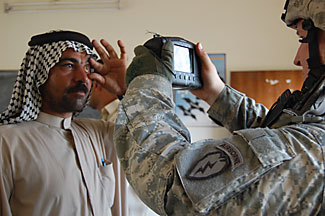
A partially trained Iraqi police force and bands of armed volunteers now work under American supervision, carefully preserving peace on streets covered by years of trash and rubble. To live under this new protection, most of Fallujah’s 250,000 residents submitted fingerprints and retina scans to get identification cards that let them stay in the city.

As a point of fact, Lt. Col. Mullen is now a Colonel, one of thirty two promoted to Colonel effective October 1, 2007, prior to the publication of the Tribune article.  Also, there aren’t a quarter of a million residents left in Fallujah.  The article does go to show that the Marines in the Fallujah area of operations are currently primarily engaged in reconstruction, rebuilding and public affairs.  The article also reminds the reader that more work needs to be done.

It is a place under 24-hour lockdown, surrounded by berms and barbed wire. But that’s a price Fallujah’s war-weary residents say they are willing to pay for now.

“The last four months, things have been going better,” said Khamis Auda Najim, a 38-year-old cabinet-maker in Fallujah’s Andalus neighborhood. “But the changes are just on the security side. The street surfaces, the sewage, the electricity, the water? Those aren’t as good.”

U.S. forces promise those services are coming, along with U.S.-funded reconstruction projects and more money from the federal and provincial governments. But nothing in Fallujah moves quickly. As they face impatient city residents, the Americans are learning that everything is important now.

“I’ve been an infantry officer for 10 years. Since I’ve been here, I’ve learned more about water treatment and sewage than I’ve ever wanted to know,” said Marine Capt. Jeff Scott McCormack, 32, a company commander from Oak Forest, Ill.

Quick transitions have been made from the U.S. forces that established security to civilian Iraqi forces deployed to preserve it. The last Iraqi army troops left a month ago; the streets are now in the hands of 1,500 volunteers and police officers, some of whom have completed abbreviated training courses.

Heavy kinetic operations in May and June of 2007 were followed on by gated communities and biometrics, and involvement of the local Iraqi police along with paid individuals engaged in community watch.  Marines filled sand bags and constructed joint combat outposts – Police Precincts, and patrolled with Iraqi Police in order to give them confidence.  With the comparative irrelevance of tribal leaders in the Fallujah area, Muktars were engaged to provide leadership of and communication with the communities.

Upon pacification of Hit, Haditha, and Ramadi (all by different means, Haditha with sand berms, curfew and a ban on vehicular  traffic, Ramadi with tribal engagement), the insurgency fled to Fallujah, where kinetic operations routed them from the area in the second quarter of 2007.  Many of them left and went home to Lt. Col. Bohm’s area of operation, where they are being carefully assimilated back into society.

Col. Richard Simcock who commands Regimental Combat Team 6 is measured and careful, yet honest with where he believes Anbar currently stands.

U.S. Marine Colonel Richard Simcock, who commands the 6th Marine Regiment, says his forces have successfully routed the insurgents in Anbar province.

“There are still attacks in Fallujah and surrounding areas,” said Colonel Simcock. “We have not killed or captured every single al-Qaida member that is here. But their capabilities are greatly diminished. I would characterize them as a defeated force from my perspective.”

Speaking to reporters in Washington via satellite from Iraq, Colonel Simcock says the surge of more U.S. forces in Anbar and Baghdad has allowed Marines to stay in areas where al-Qaida in Iraq terrorists have fled to prevent insurgents from returning.

He also credits the cooperation of the Iraqi army and police, as well as local tribal leaders in the effort to defeat al-Qaida in Iraq and bring security to Anbar.

“That has been the building block that has allowed the people to come out and participate in governance,” he said. “But, probably more importantly, it allows them to come out and do the things that a lot of the citizens here in al-Anbar have not been able to do because of murder and intimidation that al-Qaida was doing. We have made great strides in regards to that, and we are very, very pleased with the progress that we are making.”

Measured, careful and honest.  There are still attacks – we have not killed or captured every single AQI member – but they are a defeated force.  Exporting this model is complicated and nuanced, and involves more than just the participation and approval of tribal shiekhs, no matter what the current narrative says.  Nibras Kazimi has crafted a smart analysis of tribes and their saliency in Iraq for the New York Sun.

Does it really matter, whether tribes were the primary factor in defeating Al Qaeda or not, given that the story coming out of Iraq is more and more hopeful? Yes it does: the implication is that if you don’t know why and how you’ve won, then you won’t be able to replicate victory. The tribes, like the American troop surge, were catalysts that sped up the demise of the insurgency, but they did not trigger the process the insurgency’s failure predated the surge and any tribal strategies.

I believe the insurgency failed because it had bad ideas and unrealistic expectations. When the price paid by the local population for these ideas and expectations — fighting the Shiites and re-establishing Sunni hegemony — became too steep, Sunnis turned against the insurgents and tried to find shelter, yet again, under the central government This latter trend is the one that should be reinforced: Sunnis should be encouraged to throw in their lot with the New Iraq, rather than falling back into the tribal identities of Iraq’s past.

Once tribal leaders realized that Al Qaeda was losing, they turned towards Baghdad for guidance. As one Iraq observer put it to me, “Tribes are a barometer of power; they swarm around whoever has the upper hand.” The danger now is that Americans are trying to resuscitate a clannish social system that had withered away in Iraq, and turning it into a power in of itself.

We agree with Kazimi.  Nonetheless, the U.S. has worked with tribes where it suited our needs, and community Muktars where it suited our needs.  Given the constricted time frame that the U.S. public will allow for this counterinsurgency campaign, efficacy and expediency is the order of the day.  Thus, following the model in Fallujah, do we see retinal scans being taken by Army troopers south of Baghdad.

troopers_taking_scan.jpg

The Christian Science Monitor has an article in which they examine the export of the Anbar model to Shi’ite parts of Iraq.

Forward Operating Base Iskan, Iraq – The violence has dropped dramatically, say US commanders, in the towns surrounding this base in northern Babil Province, south of Baghdad.

In May, four improvised explosive device (IED) attacks targeted the battalion; none in August, says Maj. Craig Whiteside, executive officer of the 1st Battalion of the 501st Infantry Regiment. Fewer undetonated IEDs have been found – five in May and two in August. Indirect fire and small-arms violence have also dropped from about a dozen incidents in May to less than three in August.

The reason, they say, is that the same approach that won success in Anbar Province, where the Marines gained support of Sunni tribesmen against Al Qaeda, is taking hold in mixed-sectarian areas. But here, Americans have enlisted Shiites frustrated with extremists from such groups as the Mahdi Army, run by Moqtada al-Sadr.

Across the Euphrates River Valley, known to the military as the southern belts of Baghdad, about 14,000 Shiite and Sunni “concerned citizens” are being paid to man checkpoints and patrol roads in an effort to prevent attacks from violent extremism of either sect.

Largely untrained and armed with weapons they already own, the citizens wear armbands and monitor traffic along the roads, keeping watch to ensure no outsiders or other extremist elements come through to bury roadside bombs. If they fail to keep violence out, they could lose their monthly paycheck. Ultimately, the idea is that they will become members of the Iraq security forces.

“They are making their community safe,” says Army Capt. Charles Levine, one of the company commanders here. His battalion has recruited more than 1,300 participants since mid-September. A little less than half of them are Shiite.

Concerned citizens and turnover to the local communities is the key to the current counterinsurgency strategy in Iraq.  If the hope is that people are taking responsibility for reasons other than their tribal Shiekh says to do so, this strategy is seeing some success.

A 72-year-old man stopped a suspected suicide bomber from detonating himself at a checkpoint in Arab Jabour Oct. 14.

The man approached a checkpoint where Mudhehr Fayadh Baresh was standing guard, but did not make it very far.

Baresh, a tribal commissioner and member of the Arab Jabour Concerned Citizens program, said he ordered the man to lift his shirt – using training received from Coalition Forces – when he did not recognize him as a local villager. 

The suspect refused to lift his shirt.  Baresh repeated the command again, and the suspect exposed his suicide vest, running toward the checkpoint.

Baresh opened fire which caused the vest to detonate, killing the suspect.

“I did it for the honor of my family and the honor of my country,� said Baresh, when he met with Col. Terry Ferrell, commander of the 2nd Brigade Combat Team, 3rd Infantry Division.

All counterinsurgency is local, and whether it is for family, tribe, remuneration or simply for personal safety, the enemy is being defeated in Iraq.  There are fights remaining, and a precipitous departure of U.S. forces might turn a positive situation into a negative one.  Yet it is impossible to ignore the gains on the ground in Iraq.

Other sources:

TCJ, Payment to Concerned Citizens: Strategy of Genius or Shame.

TCJ, Reorganizations and Defections Within the Insurgency in Iraq.

TCJ, Iraq: Al Qaeda’s Quagmire.

TCJ, Al Qaeda’s Miscalculation.

TCJ, Operation Alljah and the Marines of 2nd Battalion, 6th Regiment.

Bill Ardolino, Operation Alljah: The Swarm.

Bill Ardolino, Confidence is Key: The Evolution of the Fallujah Police Department.

Bill Ardolino: Shuffling Paperwork to Victory: The Evolution of the Fallujah Police Department.


26th MEU (10)
Abu Muqawama (12)
ACOG (1)
Afghan National Army (22)
Afghan National Police (9)
Afghanistan (459)
Afghanistan SOFA (3)
Agriculture in COIN (3)
Air Force (27)
Air Power (7)
al Qaeda (73)
America (1)
Animals in War (3)
Ansar al Sunna (15)
Anthropology (3)
Arlington Cemetery (2)
Army (25)
Australian Army (3)
Azerbaijan (2)
Backpacking (1)
Badr Organization (8)
Baitullah Mehsud (21)
Basra (17)
Battle of Bari Alai (1)
Battle of Wanat (9)
Battle Space Weight (2)
Blogroll (2)
Blogs (1)
Body Armor (14)
Books (1)
Britain (17)
British Army (28)
Caucasus (2)
CENTCOM (5)
Center For a New American Security (4)
Charity (3)
China (6)
Christmas (1)
CIA (6)
Civilian National Security Force (3)
Col. Gian Gentile (6)
Combat Outposts (3)
Combat Video (1)
Concerned Citizens (6)
Constabulary Actions (3)
COP Keating (4)
Corruption in COIN (1)
Council on Foreign Relations (1)
Counterinsurgency (164)
DADT (2)
Defense Contractors (1)
Department of Defense (92)
Distributed Operations (3)
Dogs (2)
EFV (1)
Egypt (1)
Expeditionary Warfare (4)
F-22 (2)
F-35 (1)
Fallujah (16)
Far East (3)
Fathers and Sons (1)
Favorite (1)
Fazlullah (3)
Featured (112)
Financing the Taliban (2)
Force Projection (27)
Force Protection (2)
Force Transformation (1)
general (14)
General McChrystal (21)
General McKiernan (5)
General Suleimani (3)
Georgia (16)
GITMO (2)
Google (1)
Gulbuddin Hekmatyar (1)
Haditha Roundup (10)
Haiti (1)
HAMAS (5)
Hate Mail (7)
Hekmatyar (1)
Heroism (2)
Hezbollah (6)
Homecoming (1)
Humor (6)
ICOS (1)
IEDs (4)
Immigration (17)
India (7)
Infantry (3)
Information Warfare (2)
Infrastructure (2)
Intelligence (15)
Intelligence Bulletin (6)
Iran (131)
Iraq (344)
Iraq SOFA (18)
Islamic Facism (24)
Islamists (14)
Israel (10)
Jaish al Mahdi (21)
Japan (1)
Jihadists (63)
John Nagl (4)
Joint Intelligence Centers (1)
Kabul (1)
Kajaki Dam (1)
Kamdesh (6)
Kandahar (4)
Karachi (7)
Kashmir (2)
Khyber (11)
Knife Blogging (1)
Korea (3)
Korengal Valley (1)
Kunar Province (6)
Language in COIN (3)
Language in Statecraft (1)
Language Interpreters (2)
Lawfare (6)
Leadership (3)
Lebanon (5)
Let Them Fight (2)
Lines of Effort (1)
Littoral Combat (7)
Logistics (34)
Lt. Col. Allen West (1)
Marine Corps (177)
Marines in Bakwa (1)
Marines in Helmand (48)
Marjah (4)
Media (10)
Memorial Day (2)
Micromanaging the Military (4)
Military Blogging (20)
Military Equipment (22)
Mosul (4)
Mountains (4)
MRAPs (1)
Mullah Baradar (1)
Mullah Fazlullah (1)
Mullah Omar (2)
Musa Qala (2)
Music (13)
NATO (14)
Navy (14)
Navy Corpsman (1)
NCOs (2)
NGOs (1)
Nicholas Schmidle (2)
Now Zad (18)
NSA James L. Jones (5)
Nuclear (29)
Nuristan (4)
Obama Administration (36)
Offshore Balancing (1)
Operation Alljah (7)
Operation Khanjar (14)
Ossetia (7)
Pakistan (140)
Palestine (3)
Patriotism (3)
Patrolling (1)
Personal (7)
Petraeus (6)
Philip Smucker (2)
Pictures (1)
Piracy (11)
Police in COIN (2)
Policy (6)
Politics (65)
Poppy (2)
Prisons in Counterinsurgency (1)
Qatar (1)
Quadrennial Defense Review (1)
Quds Force (12)
Quetta Shura (1)
RAND (2)
Recommended Reading (5)
Refueling Tanker (1)
Religion (36)
Religion and Insurgency (14)
Reuters (1)
Roads (4)
Rules of Engagement (49)
Rumsfeld (1)
Russia (21)
Sabbatical (1)
Saqlawiyah (1)
Satellite Patrols (2)
Saudi Arabia (2)
Scenes from Iraq (1)
Secretary Gates (6)
Shura Ittehad-ul-Mujahiden (1)
SIIC (2)
Small Wars (72)
Snipers (9)
Soft Power (4)
Somalia (7)
Sons of Afghanistan (1)
Sons of Iraq (2)
Special Forces (11)
Squad Rushes (1)
State Department (8)
Statistics (1)
Sunni Insurgency (10)
Syria (25)
Taliban (138)
Tarmiyah (1)
TBI (1)
Technology (16)
Tehrik-i-Taliban (74)
Terrain in Combat (1)
Terrorism (76)
Thanksgiving (2)
The Anbar Narrative (22)
The Art of War (5)
The Fallen (1)
The Long War (16)
The Surge (2)
The Wounded (10)
Thomas Barnett (1)
Transnational Insurgencies (5)
Tribes (4)
TSA Ineptitude (1)
U.S. Sovereignty (4)
UAVs (1)
UBL (1)
Ukraine (2)
Uncategorized (14)
Unrestricted Warfare (4)
USS Iwo Jima (2)
USS San Antonio (1)
Uzbekistan (1)
V-22 Osprey (4)
Veterans (2)
War & Warfare (199)
War & Warfare (37)
War Movies (1)
War Reporting (14)
Wardak Province (1)
Warriors (4)
Waziristan (1)
Weapons and Tactics (46)
West Point (1)
Winter Operations (1)
Women in Combat (8)
WTF? (1)
Yemen (1)


Prev | List | Random | Next · Join Powered by RingSurf!

Featured in Alltop

about · archives · contact · register

Copyright © 2006-2010 Captain's Journal. All rights reserved.