Daniel Hannan
Is it possible to get Mr. Daniel Hannan to change citizenship to the U.S. and run for President? We need leadership like this because we currently have none of our own. Moral character, nerves of steel, and persuasive oratory.
Regular readers of The Captain’s Journal know what we believe regarding negotiations with the Taliban. Some indigenous poor may be stripped away from the hard core Taliban, but the hard core Taliban cannot be reconciled. We needn’t rehearse this issue again. But there is a recent analysis on negotiating with the Taliban that has both an important and related observation.
The premise underlying negotiations is that the insurgency can be short-circuited by splitting commanders who are fighting because of grievances like the civilian deaths in U.S. military operations away from true believers loyal to Taliban founder and Osama bin Laden ally Mullah Mohammad Omar.
Other experts have serious doubts. They say Omar and the leaders of associated militant groups believe that President Hamid Karzai’s government has lost popular support and they are winning against U.S.-led military forces. So long as they are of that view, there can be no peace, these experts say.
“Afghanistan was created by God for this kind of guerrilla fighting. It has high mountains and long valleys and narrow trails,” said Wahid Mughzdah, a former anti-Soviet fighter-turned-political analyst who worked in the Foreign Ministry during the former Taliban regime. “Al-Qaida and the Taliban understand that America doesn’t have a chance of success in this country.”
Further, he said, the Taliban are no longer only concerned with imposing Islamic rule on Afghanistan, but have adopted al-Qaida’s aim of staging Islamist revolutions throughout Asia and the Middle East.
We’ve already dealt with the evolution of the thinking of the Tehrik-i-Taliban to a much more global perspective in Resurgence of Taliban and al Qaeda, something Nicholas Schmidle calls the next-gen Taliban. Until now The Captain’s Journal has always been careful to distinguish between the Tehrik-i-Taliban of Pakistan and the Afghan Taliban led by Mullah Omar, emphasizing that the globalist perspective had thoroughly set in to the TTP world view, but somewhat less so for the Afghan Taliban.
Some may object that Wahid Mughzdah is exaggerating, but if so, for what purpose? In either case, this data point suggests that there is less difference between the Tehrik-i-Taliban and the Afghan Taliban than we thought. It is only a single data point, but it is an important one. File this away with the label “very important” and tag it to make it easily search-able for instant recall.
Another nonsense Strategy Page article.
The U.S. believes that many al Qaeda leaders have fled to southwest Pakistan (Baluchistan) to escape the increasing number of U.S. UAV missile attacks in the Pushtun tribal areas along the Afghan border. The UAV attacks are apparently following al Qaeda into Baluchistan. Both Britain and the U.S. are sending more trainers to Pakistan, to show the paramilitary Frontier Corps better techniques for dealing with the Taliban. The Frontier Corps recruits from the local tribes and normally acts as a rural constabulary. Fighting the heavily armed and fanatical Taliban is often more than the Frontier Corps troopers can handle.
The Baluchi tribes are not as violently opposed to the government as the Pushtun ones. While the Pushtun tribes want independence, the Baluchis mainly want more autonomy (and a larger share of the money from the oil and gas fields on their territory.) The Pushtun tribes (15 percent of the population, in the north and east, along the Afghan border) and the Baluchi tribes (four percent, in the southwest) do not get along with the majority Punjabis (45 percent of the population) or Sindhis (14 percent) in the eastern lowlands. The resulting violence has been going for over a thousand years.
Many Indians are coming to regard Pakistan as a failed state. Politically and economically unstable, with far more factional violence than India, the Pakistani leaders seem unable to agree among themselves, or act in concert, to solve fundamental problems. Not a lot of change since the nation was created 60 years ago, and many aspects of Pakistani society have gotten worse. Prospects are not good.
The big problem with Pakistan is that the many factions are more into themselves than they are “Pakistan.” The military, the Pushtun tribes, the Baluchi tribes, various religious factions and the few hundred families that own most of the country, all see themselves as more important than Pakistan. For the country to survive, there has to be more “civil society” (lots of Pakistanis of put the needs of the country above their partisan goals.) The Taliban are basically another faction, combining conservative tribal and extremist religious elements. The Taliban solve nothing, and just cause a lot of violence. Most Pakistanis realize this, and are willing to fight against the Taliban, but less enthusiastic about fighting for Pakistan.
In Indian controlled Kashmir, about twenty soldiers, civilians and terrorists were killed in the last few days. While the Islamic radicals have lost much of their capabilities there, the intense hostility between Kashmiri Moslems and Indian police remains.
In the Swat Valley, the Taliban have ordered all aid or advocacy groups out of the area. The Taliban plan to impose a strict Islamic lifestyle, which won’t work. Just like it didn’t work in Afghanistan in the 1990s. But the idea lives on.
Sometimes I wonder what those guys are smoking over at the Strategy Page. So much of their analysis is interesting and timely, but they don’t do a good job of staying between the ditches.
Where to begin. First of all, the Taliban are more than just troubling folk who cause violence. They are taking over much of Pakistan, and their leaders, Baitullah Mehsud and others, have communicated a global ambition and vision.
Second, the Pakistanis have done nothing to cause us to believe that most of them are willing to fight the Taliban. “Settlement” after “ceasefire” after “settlement” with the Tehrik-i-Taliban has allowed the continuing strengthening of the Taliban and the diminution of the writ of state in the NWFP and FATA.
Third, a strict, Islamic lifestyle has worked in the NWFP and FATA because of the threat of death to those who oppose it. It also worked in Afghanistan until the Taliban were overthrown during the initial stages of Operation Enduring Freedom. Have the analysts at the Strategy Page forgotten that the Taliban were still in charge of Afghanistan during 9/11?
Finally, while the Pakistani political leadership has certainly shown the factious nature and incompetence in governing, that hasn’t caused the Taliban extremism in the NWFP and FATA. Pakistan may be an almost failed-state, as are many nations in the world. Not all of them have al Qaeda or the Taliban. Poverty doesn’t lead to militant, Islamic radicalism, and militant, Islamic radicalism isn’t just another brand of insurgency seeking more influence and governmental legitimacy.
It appears that details of the administration’s plan for Afghanistan is leaking out piece by piece.
President Barack Obama has been given a new Afghan war strategy that calls for linking aid to Pakistan to its willingness to fight extremists and narrowing the U.S. mission to preventing attacks on American soil from there or Afghanistan, said people familiar with the plan.
The strategy will entail increasing Afghan security forces and strengthening crop substitution to deny opium revenue to the Taliban, Obama’s special representative for Afghanistan and Pakistan, Richard Holbrooke, said March 21 …
Previewing the new strategy, Holbrooke said the U.S. favors greater investment in agriculture to wean Afghanistan away from the opium poppy production that finances the Taliban insurgency. Opium is the raw ingredient in heroin …
The draft plan suggests raising U.S. non-military assistance to Pakistan, especially for job creation aimed at those drawn to militant action for money, while conditioning military help on measurable cooperation against extremists in the border province of Baluchistan and the Federally Administered Tribal Areas, where the Taliban has regrouped.
Measurable cooperation against extremists. This sounds nice, but is naive in the superlative. Regular readers of The Captain’s Journal know about the games of duplicity in Pakistan.
ONE SWELTERING AFTERNOON in July, I ventured into the elegant home of a former Pakistani official who recently retired after several years of serving in senior government posts. We sat in his book-lined study. A servant brought us tea and biscuits.
Was it the obsession with India that led the Pakistani military to support the Taliban? I asked him.
“Yes,” he said.
Or is it the anti-Americanism and pro-Islamic feelings in the army?
“Yes,” he said, that too.
And then the retired Pakistani official offered another explanation — one that he said could never be discussed in public. The reason the Pakistani security services support the Taliban, he said, is for money: after the 9/11 attacks, the Pakistani military concluded that keeping the Taliban alive was the surest way to win billions of dollars in aid that Pakistan needed to survive. The military’s complicated relationship with the Taliban is part of what the official called the Pakistani military’s “strategic games.” Like other Pakistanis, this former senior official spoke on the condition of anonymity because of the sensitivity of what he was telling me.
“Pakistan is dependent on the American money that these games with the Taliban generate,” the official told me. “The Pakistani economy would collapse without it. This is how the game works.”
Read the whole thing. If Holbrooke thinks that the games are finished because his contacts tell him so, then his is sadly mistaken. Further, we have dealt with this issue of poppy and opium being the sole contribution to Taliban wealth. The Taliban are able to turn a profit from kidnapping, mining operations, taxes on small businesses, and even pomegranates. Stopping opium production only means that the Taliban turn to other means. It doesn’t make them go away.
On another front, Rich Lowry of the National Review weighs in with prose on what hasn’t worked in Afghanistan.
If Afghanistan is far from lost, it isn’t susceptible to quick fixes, either. Scaling back our commitment to focus on only counter-terrorism operations — targeted strikes against high-value targets — risks a generalized collapse that would make much of the country a safe haven for terrorists and empower the extremists across the border threatening the Pakistani government. A regional meltdown would become all too possible. Reconciling with elements of the Taliban is another fantasy, since there aren’t moderate Taliban with whom to reconcile. Less-committed local fighters can be pulled away from the insurgency, but only if the insurgency is first beaten back.
No, the only way we can succeed in Afghanistan — i.e., create a government minimally competent and decent enough to sustain itself — is by undertaking the hard work of counter-insurgency, as we did in Iraq with the surge.
So has someone been reading The Captain’s Journal, we asked Rich? Rich responded:
I’m with you hersch! How can we leave huge chunks of hemand prov open and uncontested to the insurgents and then conclude the war’s not working?? (I don’t think the development piece has been really been tried either)
Right. Helmand Province, Khost, and all of the rest in Eastern and Southern Afghanistan.
So we’re here on beautiful Emerald Isle, N.C., right outside of Camp Lejeune, to welcome my son back from his second deployment. His first was in Fallujah, 2007, and this one was with the 26th MEU functioning as ready-reserve for CENTCOM.
I’ve been pondering and worrying over the whole idea of MEUs held in ready-reserve aboard Amphibious Assault Docks when there is such a heavy need for troops in Afghanistan, while Somalia turns headlong towards jihadi militancy, and when there is a need for force projection in the Caucasus in order to hedge against Russian hegemony and ensure logistics supply to Afghanistan. Yet there is also a need for force projection in the Persian Gulf and in the Middle East generally.
Really. I have pondered these and related issues until it hurts. I have also been clear in my advocacy for responsible budgetary and engineering decisions. The Captain’s Journal has been clear concerning our disapproval of the poor engineering and cost overruns of the Expeditionary Fighting Vehicle. We even recommended against continuation of the program. After all, if cuts are coming to the Department of Defense, then we must do our part.
No more. As it turns out, the current administration is planning to make drastic cuts in everything from nuclear weapons refurbisment to the F-22 program. Because the DoD is filled mostly with responsible people who implement policy, it has been targeted for cuts, while we throw away multiple trillions of dollars on only God knows what for only God knows what reason.
So to the extent that I am read in the circles of power, I have helped to justify the jettisoning of an important element in the Marine Corps’ expeditionary program. I feel that I have sinned against God and the Commandant of the Marine Corps. After this post I will engage in protracted prayer and then drop and give the Commandant 100 pushups.
If it’s okay for a sniveling lackey like Timothy Geithner to print a trillion dollars and throw it down the drain, then it’s okay for the Marines to have their EFV. They deserve it more than any other recipient of Geithner’s money.
In fact, in addition to repenting of the responsibility that I feel towards the fiduciary fidelity of the U.S. economy, I have adopted a new slogan. “Show me the money!” I want to see every weapons system currently in the design or manufacture stage followed through to completion, and then I want to see a two or threefold expansion in the weapons systems being planned and funded. I want to see the number of MEUs increased at least threefold, and the size of the Marine Corps increased similarly or greater. No more worrying for me.
So as I receive my son back from his hard work overseas and Mr. Obama ponders his NCAA bracket picks, my having agonized over the hard decisions has made the coming years easy for this administration. No fuss, no trouble and no looking back. Build the weapons and swear in the boys. If anyone asks how we’re going to pay for it all, just tell them we’ll print the money.
In More on Battle Space Weight we covered the almost frantic search for pounds as the fact became increasingly clear that the weight Soldiers and Marines carried in Iraq was heavy, but perhaps even prohibitive in Afghanistan. Exhaustion, lower extremity injuries and lack of mobility mark the heavy weight our warriors carry today. One possible remedy is the Big Dog, the otherwise cool machine that sounds like a million angry bees. Here it is one more time.
To our observation that the warrior today carries at least 32 more pounds than in WWII due exclusively to body armor, commenter mwc33 responded:
Isn’t the other big difference between World War II and today the load our enemies are carrying? German and Japanese troops carried comparable combat loads; insurgents in Iraq or Afghanistan don’t – and the disparity in mobility in Iraq’s urban environment has to be multiplied in mountainous and other difficult terrain.
Those 32 pounds of body armor are a big pain in the a$$ and everything possible should be done to lighten them. But while “big dog” may be kinda dumb, even with the lightest possible armor we’re still carrying 40 -70 more pounds than the bad guys; something has to be figured out to lighten the load – not just because of the weight itself, but because our combat loads can straitjacket us with TTPs and can make us predictable in the eyes of the enemy.
Outstanding point! It’s not just that we’re carrying heavier loads, it’s also that the insurgent isn’t carrying any at all due to the fact that he lives among the population. So even if the Big Dog works, what to do?
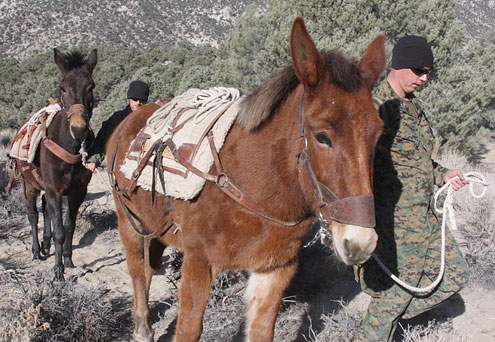
The taxpayer has spent billions to make sure America’s fighting forces have the most high-tech modes of transportation.
But in a country like Afghanistan where the enemy hides in mountain lairs, where there are few foot paths, and no roads at all, sometimes a more primitive conveyance makes more sense.
And so soldiers and Marines possibly headed to Afghanistan were at the Animal Packers Course at the Hawthorne (Calif.) Army Ammunition Depot learning how to use mules, donkeys and horses to pack water, ammunition, weapons and medical supplies.
“With vehicles, you have to worry about things like lubrication, tires and fuel,” said Marine Staff. Sgt. Tyler McDaniel. “With animals, you have to think about stuff like shoes and grooming.”
True enough, there may be a call for Farriers in the Marines. Wonder if that will become a billet? At any rate, having trained them before, I am partial to quarter horses, and while on their back I have put them in some precarious and dangerous places and positions on the trail. They are sure-footed and reliable.
But whether horses or mules, the solution may be a millennium old. Well now. It looks as if all of that discussion about the health of transport animals in the Small Wars Manual isn’t so dated and irrelevant after all.
The tactical brother of the highly strategic Field Manual FM 3-24 has been released, entitled Tactics in Counterinsurgency, FM 3-24.2. There are certain Milblogs that are known as the beer drinkers in the outer room, raucous and loud. You know who they are. Then there are the more sophisticated guys smoking cigars and drinking Bourbon in a more secluded room. The Captain’s Journal likes to think of itself in the later category. From time to time the loud boys break into the back room and want to throw down, and we can do that too. But soon enough we go back to our high brow thoughts and pedantic ways while we draw on a Macanudo.
But our grunt ties come through all of the time, truth be told. We just can’t hide it. That’s why we are more of a logistics, weapons and tactics blog rather than a strategy blog, and we secretly break into the outer room to throw down with the boys from time to time. And so FM 3-24.2 interests us much more than its predecessor, all things being equal.
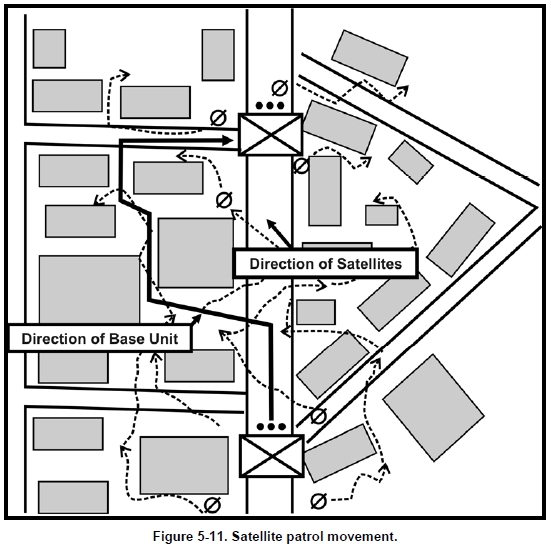
There will be many opportunities to mine the depths of this magnificent document, and so don’t hold it against us that we start with a seeming random bit of detail. Satellite patrols.
The field manual says (page 166, Section 5-216):
All units must know the overall route and if possible, left and right boundaries. Both the base unit and the satellite units move in ways to confuse the enemy as to the patrol’s actual axis of advance. Standard movement techniques are still used. Satellites move away from the base unit for limited periods of time to inspect potential ambush sites, dead spaces, parallel roads, or other assigned missions. The time that the satellite is separated from the base unit should be prescribed by the patrol leader prior to departure.
It’s a wonderful and effective tactic, the notion of smaller units connected to the larger unit patrolling in diagonal, circular and perpendicular patterns to the main unit, all with the intention of providing force protection for not only the larger unit but itself and the other smaller units as well by confusing the enemy as to the axis of advance.
I have long known about this tactic, as well as some of the finer details not shown or discussed here, but been reluctant to discuss it over the blog since it was unknown whether this should be considered FOUO, OPSEC or something that otherwise shouldn’t be divulged to the enemy.
Think I’m paranoid? In Marines, Taliban, Tactics Techniques and Procedures, using a Powerpoint presentation I obtained from Michael Yon, I outlined a number of lessons learned from Marine Recon battling the Taliban in highly conventional fights recently in Afghanistan with close to Battalion-sized units of enemy, from their understanding of the use of combined arms, to interlocking fields of fire, to fire discipline, massing forces and other problematic issues stemming from the fact that the Taliban are more skilled than the insurgents in Iraq. The presentation also had a discussion of Marine tactics to counter the Taliban, some of which had been highly successful.
No sooner did this post go up than I received a note from the Marine officer in Afghanistan (a Small Wars Council member as am I) who authored the presentation. This officer complained about the release of the document and its presence on this web site, saying that not all Taliban are as skilled as these were and the presence of the presentation on this web site could lead to the education of other Taliban.
Sure, if they had access to electricity, a laptop, Powerpoint and the time to read it, along with a total absence of communication with their colleagues to teach them about these tactics. Not likely. But the officer hung his hat on the fact that the document was FOUO, which in reality means that whomever released it in Afghanistan should have been the target of this officer’s complaint, not me. The term FOUO means nothing to me, since I am the official owner and founder of this web site.
So what do the readers think? What about revealing the tactics of the Taliban and our counter-tactics, and satellite patrols as applied in urban areas? Problematic, or not?
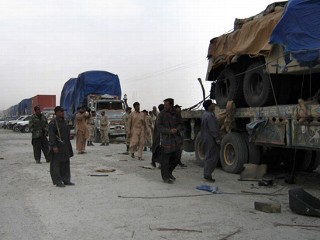
In Caucasus Talks on Logistical Transit Routes for Afghanistan we discussed the recent attack on NATO supplies in Baluchistan province’s Soorab, noting that this seemed to be a new front in the Taliban campaign against logistics. Now comes a second attack within eight days, this time near the town of Chaman.
Two men on a motorcycle threw a bomb at a truck carrying an excavating machine to NATO troops in Afghanistan, halting traffic Wednesday along a supply route through Pakistan’s southwest, officials said.
No one was injured in the blast near the Pakistani frontier town of Chaman, but the machine was damaged, area police chief Gul Mohammed said.
U.S. and NATO forces in Afghanistan rely heavily on two major supply routes running through Pakistan. The main one goes through the Khyber Pass in the northwest, and trucks that use it have frequently been attacked.
The smaller route through Chaman has attracted less attention from militants, but has not been exempt from violence.
This developing trend to expand the targeting of NATO supplies into the South makes all the more important the trial runs of supplies through the Caucasus and the need to engage that region. Faster, please.
Continuing with our compulsive interest in battle space weight, we learn some interesting things about the potential future use of technology to help reduce battle space injuries and carry more weight.
Assistant Commandant Gen. James F. Amos told a House committee Wednesday about “Big Dog,” a robotic quadruped that can carry 300 to 500 pounds of gear.
Gen. Peter W. Chiarelli, the Army’s vice chief of staff, joined Amos to testify before the House Appropriations subcommittee on defense. He said Big Dog and other alternatives might reduce injuries that have contributed to an increase in “non-deployable” men and women.
The number of soldiers who can’t be deployed rose from 17,000 or 18,000 to 20,000 over three years . Half have less serious injuries, including those caused by heavy loads. That has led to research in lightweight body armor, lightweight machineguns and lighter food rations.
According to an Army statement, soldiers may carry loads that start at 63 pounds and exceed 130 pounds. Extra protective gear or body armor can weigh 41 pounds. The typical combat load increased from 93 pounds in 2001 to 95.1 pounds in 2009.
The statement cited a study that proved “cumbersome” individual body armor caused pain, reduced performance and increased fatigue. Soldiers carrying 101 pounds for 12.5 miles had a 26 percent decrease in marksmanship.
“We are working very hard to lighten the load,” Chiarelli said. “One of the things we are looking at is civilian off-the-shelf solutions.”
Big Dog is one of many projects from the Defense Advance Research Projects Agency started in June 2007. A small, remote-control helicopter might deliver loads to soldiers. Another alternative is to use an “organic load-carrying asset,” or leaving some gear in soldiers’ Humvees or amphibious assault vehicles.
Ah, those DARPA dollars. Here is one thing those dollars have bought. The Big Dog.
Now if we can just get it not to sound like a million angry Africanized bees, we’d be much better off since we don’t want to telegraph our location to the enemy. Seriously though, it seems that it would be a much better solution to invest dollars into lighter weight body armor SAPI plates.
The biggest difference in the weight carried by the Soldier or Marine today versus in WWII is from body armor. The total weight of the soft panel ballistic armor, SAPI plates and carrier vest is around 32 pounds. This is 32 extra pounds that the Soldier or Marine in WWII didn’t have to carry. Body armor is the low hanging fruit. But it seems that we’d rather design cool robots that sound like a million angry bees.
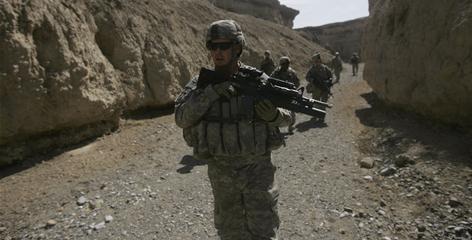
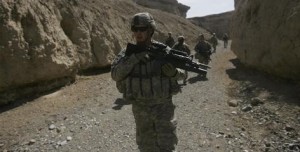
The 101st Airborne on patrol near Bagram Air Base, North of Kabul.
Regular readers of The Captain’s Journal know that we haven’t covered the missile strikes or supposed hits on high value targets (HVT) in either Afghanistan or Pakistan. This strategy, i.e., attacking mid- to high-level commanders in the hopes that the organization or ideology will disintegrate, is wasteful of time and resources.
Note that our objection has nothing to do with collateral damage, or the alleged benefit of these strikes to Taliban recruitment. We simply believe that the strategy will fail. And fail it has indeed, at least thus far. But it appears as if not only will the U.S. continue to engage in strikes to HVT, the program is set to expand into Quetta, Pakistan.
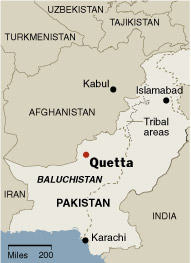
President Obama and his national security advisers are considering expanding the American covert war in Pakistan far beyond the unruly tribal areas to strike at a different center of Taliban power in Baluchistan, where top Taliban leaders are orchestrating attacks into southern Afghanistan.
According to senior administration officials, two of the high-level reports on Pakistan and Afghanistan that have been forwarded to the White House in recent weeks have called for broadening the target area to include a major insurgent sanctuary in and around the city of Quetta.
Mullah Muhammad Omar, who led the Taliban government that was ousted in the American-led invasion in 2001, has operated with near impunity out of the region for years, along with many of his deputies.
The extensive missile strikes being carried out by Central Intelligence Agency-operated drones have until now been limited to the tribal areas, and have never been extended into Baluchistan, a sprawling province that is under the authority of the central government, and which abuts the parts of southern Afghanistan where recent fighting has been the fiercest. Fear remains within the American government that extending the raids would worsen tensions. Pakistan complains that the strikes violate its sovereignty.
But some American officials say the missile strikes in the tribal areas have forced some leaders of the Taliban and Al Qaeda to flee south toward Quetta, making them more vulnerable. In separate reports, groups led by both Gen. David H. Petraeus, commander of American forces in the region, and Lt. Gen. Douglas E. Lute, a top White House official on Afghanistan, have recommended expanding American operations outside the tribal areas if Pakistan cannot root out the strengthening insurgency.
Many of Mr. Obama’s advisers are also urging him to sustain orders issued last summer by President George W. Bush to continue Predator drone attacks against a wider range of targets in the tribal areas. They also are recommending preserving the option to conduct cross-border ground actions, using C.I.A. and Special Operations commandos, as was done in September. Mr. Bush’s orders also named as targets a wide variety of insurgents seeking to topple Pakistan’s government. Mr. Obama has said little in public about how broadly he wants to pursue those groups.
Just to be clear because the New York Times is not, when they refer to the Taliban, they mean the original Afghanistan Taliban under the command of Mullah Mohammed Omar, not the Tehrik-i-Taliban (TTP) under various commands, most specifically Baitullah Mehsud. The TTP resides mostly in the FATA and NWFP (while they also send fighters into Afghanistan), while the Afghan Taliban fight in Afghanistan and seek safe haven and rest in and around Quetta, Pakistan.
We have previously discussed our principled objection to the centerpiece of the Afghanistan / Pakistan operation being cloak and dagger raids and missile strikes against HVT. It isn’t counterinsurgency; it’s counterterrorism. But a much more pragmatic objection is that it simply doesn’t work. It has been tried and failed now for more than six years. The new strategy of “more of the same” won’t work.
One reason that it has failed – although not by any stretch the only reason – is that it doesn’t really put the enemy on the defensive. That’s also the problem with the so-called negotiations that the current administration wants to pursue with the Taliban. The deluge of noise on negotiations convinces no one that the Taliban are actually being compelled to negotiate, and everyone that the U.S. is pining for the end of the fight.
Gareth Porter with the Asia Times succinctly explains why this strategy won’t work. “Jonathan Landay of McClatchy newspapers reported from Kabul on Sunday that experts on the Taliban express “serious doubts” about the splitting strategy, because insurgent leaders believe they are winning and the Hamid Karzai government is growing weaker.”
Recall that we’ve already discussed our opinion (The Coming Battle for Afghanistan) that Biden’s position that only 5% of the Taliban are incorrigible is simply daydreaming, and that in reality it is the indigenous poor that can be targeted for turning against the Taliban. But simply put, the switching of sides is not something that can be engineered. Force projection is necessary, and that for a protracted duration. The Afghans must see the U.S. as the stronger horse in the race.
As for Pakistan, there is happy talk about the reinstatement of previously sacked Supreme Court judges in Pakistan to their posts and what this means about the rule of law. The rule of law is disintegrating in Pakistan with the erstwhile Talibanization of the FATA and NWFP, and the ongoing Talibanization of Karachi, Lahore and Islamabad. Supreme Court judges are a side show.
Regarding the objection that the Taliban cannot be defeated unless their safe havens are ended in Pakistan, this complaint rings empty when the forces have not been committed to win the campaign in Afghanistan. The field is ripe for counterinsurgency in Afghanistan, and no HVT campaign in Pakistan will replace the need to do COIN in Afghanistan. Afghanistan first, then Pakistan as the campaign proceeds – and after the Pakistani Army and the Taliban see that we’re serious about the campaign.