New York Sun on Nuclear Iran
Nuclear yield within six to twelve months.
McNeill ties length to Pakistan tribal region, likely to be protracted anyway.
Multinational force press release on Sadr City operations and seizure of weapons and munitions.
"We will fight them to the end."
War on terror not popular with Pakistani population.
U.S. presence expanding Southward in Iraq.
Its full steam ahead for Iran.
And SECDEF Gates continues to press this issue.
Pajamas Media exclusive: how your tax dollars fund terror.
Southwestern Baptist Theological Seminary Graduate executed in Afghanistan.
Nearly 1000 dead from harshest Afghan winter in 30 years.
Attacks in Baghdad down 80% according to Iraqi Army.
Lack of appropriate defense spending a grave situation.
Olmert claims Iran still on target to construct nuclear weapon.
Promoted to Army Vice Chief of Staff. Well deserved.
Must read on Israeli Army shame and lawyer happiness with war against Hezbollah.
Libyans joining jihad in increasing numbers.
How relevant will Maliki be to Iraq's future?
Maj. Gen. Gaskin: "The positive trends are permanent."
Abizaid questions whether Maliki can bring unity to Iraq.
From the Multinational Force, more on Operation Lion Pounce.
An important ally in Iraq has been assassinated.
Israel to show Chairman of Joint Chiefs of Staff nuclear intelligence on Iran.
Cabinet approves proposed agreement with U.S.
Prof. Kingsley Browne on his new book.
Major General Robert Scales: "Outcome is irreversible"
Mullen says military needs larger slice of GNP to modernize.
For siding with the U.S. against al Qaeda.
Terrorist poses as bride. Ugh!
Legislation in trouble.
Al Qaeda documents discovered near Syrian border.
Shameful people jeer disabled veterans in swimming pool.
Saudi jihadist in Iraq tells his personal story.
Concerning Iranian meddling and Quds.
Michael Yon breaks bread with General Petraeus.
Ralph Peters on the advancements in Iraq.
War between al Qaeda and Hezbollah.
Traumatic brain injury not recognized.
Ballistic Sensor Fused Munition.
High intensity electronic warfare.
Iranian weapons are a sign of continued Iranian meddling in Iraq.
U.S. forces in Iraq are using a high-resolution, thermal/infrared sensor system.
Washington Post profiles AQI (al Qaeda in Iraq, or al Qaeda in Mesopotamia).
Taiwan may not be as secure as we would like to think.
Be thankful your daughter isn't be raised in Basra.
Pastor discusses rules of engagement and sacrificial U.S. deaths.
In counterinsurgency (COIN), patience is a virtue. But violence has decreased so fast in
We covered the surrender plea from David Miliband, and while pusillanimous and pitiful, at least Miliband was either duplicitous or didn’t know what he was talking about. Specifically, he advocated “negotiations between Pakistan’s new civilian government and Pashtun leaders in the Federally Administered Tribal Areas (Fata).”
If he was referring to tribal elders in FATA, then he was merely confused, as there are no negotiations with “Pashtun leaders.” Further, they would be irrelevant if these talks existed, as the tribal elders do not control FATA. They have no security from the Taliban, and thus hard core Taliban fighters control FATA and NWFP. If he is referring to the Taliban as “Pashtun leaders,” then he is intentionally avoiding naming the enemy and stating that we should negotiate with them. He is either stupid or a liar.
As for Des Browne, no such charge can be made. He is a coward and specifically advocates surrender to the enemy.
Defence Secretary Des Browne endorsed peace talks between Pakistan and Taliban militants on Wednesday despite concerns from Afghanistan that the talks will allow the Taliban to regroup and launch more attacks.
Browne said Britain supported any moves that would encourage militants to put down their weapons and stop violence, and said Pakistan and Afghanistan needed to work together on problems with their border, much of which is controlled by Taliban insurgents.
He said reconciliation should be a part of any strategy, although it was clear some militants had no intention of putting down their weapons.
“But you can’t kill your way out of these sorts of campaigns,” Browne told journalists at Australia’s National Press Club on Wednesday.
Faced with a wave of suicide attacks, Pakistan has begun talks with Taliban militants who control much of the country’s 2,700 km (1,670 miles) mountain border with Afghanistan.
The Taliban, however, said it would fight in Afghanistan until all foreign troops were driven out of the country, and Afghanistan has expressed concerns about any peace deals.
Browne, in Australia for talks with Australian Defence Minister Joel Fitzgibbon, said sovereign countries had the right to welcome insurgents back into society if they agreed to obey the rule of law and recognise democratic governments.
“If people are prepared to give up violence, put down their weapons, accept and recognise legitimate and democratic government … then the sovereign governments from both countries are entitled to say we will welcome you to become part of our society,” he said.
But the British sensibilities are offended and shout out “How is it that Browne is advocating surrender when all he is really doing is offering the chance to put down their weapons? Have we not been too hard on our man in London?”
The Taliban in South Afghanistan (and coming from Quetta) are hard core fighters who didn’t relent when fighting the Soviet Union, and will not suddenly decide that the fight should be over. They fight for religious reasons, and thus laying down weapons would be seen as irreligious. As for the Pakistani Taliban, Tehrik-i-Taliban, they are in many ways just as brutal as the original Taliban, but without the strictures against suicide bombings and other such tactics. They are a new breed of enemy whom Nicholas Schmidle calls Next-Gen Taliban.
This brand of fighter is in large measure controlled by the Tehrik-i-Taliban, and ultimately by Baitullah Mehsud. As for what Mehsud thinks about this idea of a cease and desist order on his operations, let’s hear him in his own words.
The ceasefire, it seems, is already starting to take effect.
But will it last, or go the way other deals have gone before?
In our garden meeting, “Amir Sahib” (honoured leader) - as Baitullah Mehsud is affectionately called by his men - smiles and shakes his head when this query is raised.
Around us, dozens of militants armed to the teeth listen intently to their leader.
“The Taleban are committed to their word,” he says.
“The onus is now on the government - whether they hold to their word, or remain in the alliance with the US.”
If that persists, Commander Mehsud says, the militants will have no choice but return to their path of resistance.
“We do not want to fight Pakistan or the army. But if they continue to be slaves to US demands, then we our hands will be forced.
“There can be no deal with the US.”
The idea is that NATO and the U.S. leave Afghanistan or violence will continue against the Pakistani government. As for Afghanistan, Baitullah intends to send in more fighters to help in the insurgency effort, regardless of and unrelated to the negotiations. In other words, the most powerful man in Waziristan has said that the insurgency in Afghanistan will continue unabated no matter what, while it will resume in Pakistan unless the U.S. leaves.
Browne is smart enough to know that the Taliban will not surrender their weapons or aspirations. He is advocating negotiations in spite of the fact that he knows that NATO and the U.S. cannot win concessions. Given this level of bravery and commitment by the British, it’s a wonder that the Taliban don’t march up Whitehall and into the MOD Headquarters. It may not be very tough.

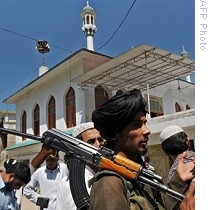
Pakistan’s top Taliban leader, Baitullah Mehsud, left with cap, tells reporters on Saturday he is sending fighters to battle U.S. troops in Afghanistan as he seeks a peace deal with the Pakistani government (NPR).
In featured article Taliban and al Qaeda Strategy in Pakistan and Afghanistan we discussed the dual pronged approach of the Taliban, one aimed directly at Pakistan and led by Baitullah Mehsud, the other aimed at Afghanistan led by Mullah Omar. The Taliban in Afghanistan are more disaggregated than they were even a year or two ago, but there is still at least loosely coupled leadership, even if not immediate communication for fear of cell phone tracking. The Pakistani Taliban are not loosely coupled. They are well led and tightly controlled.
This loosely coupled leadership has charted the exact course that The Captain’s Journal predicted. Not all of the kinetic encounters in Afghanistan have been with Taliban, but the presence of rogue elements other than the Taliban make the security situation even more difficult. As for the Taliban, they have used guerrilla tactics (fire and melt away), suicide bombings, intimidation tactics directed at the population, and standoff weapons such as VBIEDs and roadside bombs.
Baitullah Mehsud has also directed the Taliban campaign inside Pakistan. Baitullah Mehsud has recently reached an agreement with the Pakistani government (the text of which can be found at Pakistan’s Daily Times). It is doubtful that any of the stipulations of the agreement can be verified, since the Pakistani Army will be withdrawing. The Pakistani people and Army are tired of the violence, but Baitullah Mehsud is talking as if a man who has won his sought-after prize.
The leader of the Pakistani Taliban vowed on Saturday to carry on fighting NATO and U.S.-led forces in Afghanistan regardless of negotiations for a peace deal with the government of Pakistan.
Baitullah Mehsud told a group of journalists, invited to his stronghold in the tribal lands of South Waziristan, that he wanted to stop fighting the Pakistan army.
“Fighting between the Taliban and Pakistan is harming Islam and Pakistan. This fighting should come to an end immediately,” Mehsud said.
But he made no commitment about halting attacks in Afghanistan, and said the jihad, or holy war, would carry on.
“Islam does not recognize frontiers and boundaries. Jihad in Afghanistan will continue,” Mehsud said, as guards carrying Kalashnikov assault rifles looked on.
Mark Laity, NATO spokesman in Kabul, said: Such comments come as no surprise to us. Mehsud is a very dangerous man and everybody knows that.”
Just as we discussed in Why is there Jihad?, Mehsud reiterates that they do not recognize boundary lines (or even they thing they represent, nation-states) as legitimate. If the Pakistan Taliban, or Tehrik-i-Taliban, can accomplish their mission by capitulation of Pakistan rather than costly military operations, then they will take advantage of that.
The “agreements” are already having their intended affect.
In Afghanistan, NATO-led troops say recent peace agreements between the Taliban and the government of neighboring Pakistan are already having a negative impact on security on the Afghan side of the border.
NATO officials say over the past three to four weeks, Taliban attacks along Afghanistan’s eastern border have jumped from 60 to 100 incidents a week.
A spokesman for the NATO-led coalition in Kabul says the spike in insurgent attacks is the result of decreased activity by the Pakistani army on the Pakistan side of the border.
Whenever force projection is implemented and the small footprint model for counterinsurgency is rejected, U.S. forces have had success. The Marines have recently had such success in and around Garmser. The initial phases of Taliban operations are complete. Pakistan has succombed to Taliban pressure. Tehrik-i-Taliban will soon be turning their attention more fully to Afghanistan. Will we reciprocate?
A common misunderstanding among some on the far right or of the libertarian stripe (e.g., Patrick Buchanan, Ron Paul) is that the sole reason for the existence of the global jihad is the presence of U.S. troops on holy soil, i.e., Saudi Arabia. It is, after all, the stated raison d’etre for 9/11 hijackers. But this myth becomes muddled when it is pointed out that the Hamburg cell initially intended to wage jihad elsewhere.
Bin Ladin canceled the East Asia part of the planes operation in the spring of 2000. He evidently decided it would be too difficult to coordinate this attack with the operation in the United States. As for Hazmi and Mihdhar, they had left Bangkok a few days before Khallad and arrived in Los Angeles on January 15, 2000.
Meanwhile, the next group of al Qaeda operatives destined for the planes operation had just surfaced in Afghanistan. As Hazmi and Mihdhar were deploying from Asia to the United States, al Qaeda’s leadership was recruiting and training four Western-educated men who had recently arrived in Kanda-har. Though they hailed from four different countries-Egypt, the United Arab Emirates, Lebanon, and Yemen-they had formed a close-knit group as students in Hamburg, Germany. The new recruits had come to Afghanistan aspiring to wage jihad in Chechnya. But al Qaeda quickly recognized their potential and enlisted them in its anti-U.S. jihad.
Even further research proves that rather than U.S. presence in the Middle East being the raison d’etre for 9/11, it was merely the raison du jour that Bin Laden found convenient for his purposes. A far different vision is being offered at the moment.
Osama bin Laden vowed in an audio tape to mark Israel’s 60th anniversary to continue to fight the Jewish state and its allies in the West.
The al Qaedaleader, who has placed growing emphasis on the Israeli-Palestinian conflict, said it was at the heart of the Muslim battle with the West and an inspiration to the 19 bombers who carried out the attacks on U.S. cities on September 11, 2001.
“We will continue, God permitting, the fight against the Israelis and their allies … and will not give up a single inch of Palestine as long as there is one true Muslim on Earth,” he said in the message, posted on an Islamist website on Friday.
Bin Laden said Israel’s anniversary celebrations were a reminder that it did not exist 60 years ago, and had been established on land seized from Palestinians by force.
“This is evidence that Palestine is our land, and the Israelis are invaders and occupiers who should be fought,” he said in the tape, which was addressed to the Western public.
The Saudi-born militant also said that decades of peace initiatives had failed to establish a Palestinian state, and the West had proved time and again that it sided with Israel.
“The participation of Western leaders with the Jews in this celebration confirms that the West backs this Jewish occupation of our land, and that they stand in the Israeli corner against us,” he said. “They proved this in practice by sending their forces to southern Lebanon.”
An important (but mostly ignored) event occurred recently in which Ayman al-Zawahiri took questions from global jihadists concerning the future of the movement.
Zawahiri highlights several specific injustices that he feels effectively demonstrate the stark contrast between Qaradawi’s decision to postpone fighting and the Jihadist movement, which advocates violence immediately. They include Arab peace accords and trade with Israel, Israel’s blockade of Palestinians in Gaza, Arab military courts for trying Muslims, Arab hosting of U.S. military forces, particularly in Egypt, the prevalence of Western “vulgar media” and the secular constitution and laws of Arab countries.
Later, he gives us yet another justification for the jihad.
Zawahiri last discussed Lebanon in his public rhetoric in January and February 2007, when he twice condemned the presence of United Nations Peacekeeping forces in Southern Lebanon.
Zawahiri has given us a list of at least nine reasons for violent jihad, only one of which has anything to do with Arab hosting of U.S. military forces. One significant issue Zawahiri addresses pertains to the strong differences between al Qaeda and HAMAS. One reason they will never see eye to eye is the lack of global vision within HAMAS.
Over the past year, Zawahiri and other senior al-Qa’ida figures have been waging a vigorous propaganda campaign against the Palestinian organization HAMAS. Although Jihadists unanimously denounce Israel they continue to disagree over whether HAMAS should be considered a legitimate Islamic movement. For Zawahiri, HAMAS’ embrace of nationalism, democracy, and its legacy in the Muslim Brotherhood—arguably the three things al-Qa’ida hates most—delegitimizes the group.
Nationalism is evil and out of accord with the global aspirations of al Qaeda. Nation-states are not just not helpful, or even a necessary evil. They are quite literally an obstacle to jihad, not because they share the loyalties of jihadists, but rather, because they fundamentally don’t acquiesce to the vision of world conquest in the name of Islam and the forcible implementation of Sharia law. What we see as a transnational insurgency is to the jihadists simply a world wide struggle. They don’t recognize nation-states as legitimate.
It doesn’t stop with al Qaeda. The most powerful man in Waziristan, Baitullah Mehsud, head of the Tehrik-e-Taliban, has global aspirations as well.
“We want to eradicate Britain and America, and to shatter the arrogance and tyranny of the infidels. We pray that Allah will enable us to destroy the White House, New York, and London.”
There are other significant revelations in this question and answer session by Zawahiri, including much discussion over the jihadist fear that Iraq is a lost cause for them; they have been defeated. The entire source document at the Combatting Terrorism Center, West Point, is worth the time to study and analyze in detail.
There is a not so fine line between trying to understand the motivations of the enemy and naively regurgitating their propaganda. Repeating the myth that U.S. presence on foreign soil caused the 9/11 hijackers ignores the other very real objection that, according to other jihadists, the U.S. was far too slow to react to protect Muslim people from the Serbs. Whether the U.S. is deployed across the globe or the U.S. didn’t deploy quickly enough, it’s all propaganda - convenient excuses used to brainwash young jihadists. It is yet another step into the danger zone to mold foreign policy based on enemy propaganda and talking points.
Enemy activity appears to be increasing in Afghanistan according to ISAF medical personnel.
U.S. commanders have been braced for a “spring offensive”, a pick-up in violence tied to the season, when warmer weather allows the Taliban to work their way over the mountains from hideouts in north-western Pakistan and into Afghanistan.
In the first few weeks of this spring, there was little change in the level of violence compared with last year, officers say. But in recent days, at least in one key region along the border, that picture has shifted, even if it may be still too early to say that a renewed Taliban offensive has started.
“A lot of things are starting to happen in the area,” Lieutenant-Colonel Kathy Ponder, the chief nurse at the combat support hospital, which put out the call for more blood to treat the wounded from a roadside bomb, told Reuters on Thursday.
“The Taliban seem to be picking up on the IED (improvised explosive device) blasts and we’re getting a lot of gunshot wounds. The intel we’re getting is that they are targeting our area, so we’re ready. We’re making sure we’re overstocked on what we need.”
Wednesday afternoon’s attack, just north of the city of Khost, near the Pakistan border, targeted a U.S. military patrol. Two U.S. soldiers and one U.S. civilian were killed, and two U.S. soldiers were wounded. The wounded pair lost both of their legs, hence the call for large amounts of blood.
But according to U.S. personnel, its all just a myth.
“There is no such thing as a spring offensive,” Colonel Pete Johnson, the commander of a taskforce from the 101st Airborne Division that is responsible for security in six Afghan provinces along the border with Pakistan, told Reuters.
“I think this year this myth is finally going to be debunked. Last year was the same thing — it never materialised. This year it has not materialised and it won’t materialise.”
“Will there be increases in fighting and insurgent activity. Absolutely. But it’s a weather-based construct, a seasonal construct, not a deliberate execution of an offensive. Increased activity is not a coordinated offensive.”
But what difference does this make? This argument has become rather passé. The Taliban know that any “fire and maneuver” engagement of U.S. forces brings a disadvantageous kill ratio. They tried it again in Garmser with the Marines, and lost. This is why The Captain’s Journal had previously clarified the issue of a “spring offensive” in the context of distributed operations and what it does or doesn’t mean. “When NATO speaks of a spring offensive, they are talking tactical maneuvers and larger scale kinetic fights. When we speak of a spring offensive, we are talking about guerrilla tactics - small teams, fire and melt away, etc.”
There has been a disaggreagation of the Taliban into smaller groups of tribal and commander affiliation, fighting for different causes (with the only common goal being the overthrow of the Karzai government), sometimes competing with each other. This makes the notion of a Taliban command and control quaint, but fairly useless (During questioning of the Presidential candidates Bill O’Reilly flatly stated that Taliban command and control was Quetta, and while this might have been true a year ago, it is doubtful that a literal command and control exists for Taliban).
So the supposed spring offensive to which U.S. commanders have so sardonically referred is not applicable to the current scene. We have suggested that the tactics will rely on fire and melt away rather than fire and maneuver, IEDs, suicide tactics, guerrilla tactics and intimidation of the population. In this way, the disaggregation of the enemy along with his focus on terror tactics make Afghanistan look somewhat more like the Anbar Province than it did a year ago.
In Pakistan, Baitullah Mehsud is playing the Pakistani officials for fools as he repeatedly enjoins negotiations, then withdraws from the same, and then hints at them again. Mehsud’s forces, rather than fight the Pakistan Army in fire and maneuver, simply set up a series of checkpoints and road blocks in South Waziristan. The Pakistani Army responded with one of their own. The population tires of this, the Pakistani Army tires of this and agrees to withdraw troops from South Waziristan, and Tehrik-e-Taliban gains their objective.
While Quetta cannot be said to be a literal command and control, as we observed earlier, there are dual Taliban campaigns, one in Pakistan (focused in Waziristan against the Pakistani government, led by Baitullah Mehsud) and the other focused on Afghanistan (focused on Southern Afghanistan where Quetta serves as a rallying point for fighters crossing the border).
Mapping the route the cross-border militants take, Mr Walsh said the insurgents crossed from Balochistan, whose capital Quetta was considered to be the Taliban headquarters by Nato commanders.
“They muster in remote refugee camps west of Quetta — Girdi Jungle is most frequently mentioned — before slipping across the border in four-wheel drive convoys that split up to avoid detection. Sometimes sympathetic border guards help them on their way.
“Inside Afghanistan the fighters thunder across the Dasht-i-Margo — a harsh expanse of ancient smuggling trails which means “desert of death” — before reaching the River Helmand. Here, the sand turns to lush fields of poppy and wheat, and they reach Garmser, home to the most southerly British base in Helmand.”
British officers told Mr Walsh that they had ample evidence that many of the enemy were Pakistani. While remaining coy about their sources of intelligence, they spoke of hearing Punjabi accents and of finding Pakistani papers and telephone contacts on dead fighters.
Four months ago, Den-McKay said, British Gurkhas shot dead a Taliban militant near a small outpost known as Hamburger Hill. Searching the fighter’s body, they discovered a Pakistani identity card and handwritten notes in Punjabi.
There are dual fronts in the campaign, one in Afghanistan and the other in Pakistan. These two fronts are part of the same insurgency / counterinsurgency campaign. The expensive UAVs that fly overhead are merely further testimony to the necessity for force projection on the gound when reports arrive of more young sons of America who have had their legs blown off from IEDs.
Since Afghanistan may more closely resemble Anbar in terms of its reliance on terror tactics, the pretext for success in Anbar becomes all the more important. Al Qaeda terror would have won the day without extreme force projection by the U.S. The Taliban will not engage in fire and maneuver, and arguments about whether a “spring offensive” will materialize are childish, wasteful and irrelevant. The Taliban will engage in fire and melt away, and the chase must ensue to hunt them down and kill them with the utmost violence.
In The Disaggregation of the Taliban we noted that the analysis by David Ignatius concerning the diminution of al Qaeda and the Taliban was likely overly optimistic. The Taliban insurgency has strengthened. But if The Captain’s Journal is quick to point out overly optimistic assessments, we are equally quick to claim the successes when they exist. Take careful note of the assessment offered by Ignatius concerning al Qaeda.
The most interesting discovery during a visit to this city where Osama bin Laden planted his flag in 1996 is that al-Qaeda seems to have all but disappeared. The group is on the run, too, in Iraq, and that raises some interesting questions about how to pursue this terrorist enemy.
“Al-Qaeda is not a topic of conversation here,” says Col. Mark Johnstone, the deputy commander of Task Force Bayonet, which oversees four provinces surrounding Jalalabad in eastern Afghanistan. Lt. Col. Pete Benchoff agrees: “We’re not seeing a lot of al-Qaeda fighters. They’ve shifted here to facilitation and support.”
You hear the same story farther north from the officers who oversee the provinces along the Pakistan border. A survey conducted last November and December in Nuristan, once an al-Qaeda stronghold, found that the group barely registered as a security concern among the population.
Al Qaeda is defeated in Anbar, and is taking a beating in Tarmiyah, Mosul, and throughout the balance of Northern Iraq. But if the assessment Ignatius gives us is correct, the power of al Qaeda is waning in the tribal areas of Afghanistan and Pakistan as well.
The Asia Times must be read with caution due to the exaggeration in which this source sometimes engages, and so we sat on this report for several days while waiting for confirmatory analysis. The assessment by David Ignatius serves as this confirmation. Some (Asia Times) reports attempt to give excuses for al Qaeda and Taliban failures while they accidentally divulge important truths about the same. There was recently such a report, humorously entitled Al Qaeda adds muscle to the Taliban fight.
From many hundreds, al-Qaeda now has fewer than 75 Arabs involved in the Afghan “war on terror” theater, but the group is more lethal in that it has successfully established a local franchise of warriors who have fully embraced al-Qaeda’s ideology and who are capable of conducting a war of attrition against the coalition in Afghanistan.
In the years following the United States-led invasion of Afghanistan in 2001, al-Qaeda lost hundreds of members, either killed or arrested or departed to other regions. These included diehard Arab ideologues such as Mustapha Seth Marium (arrested) and commanders Abu Laith al-Libbi (killed) and Abdul Hadi al-Iraqi (arrested) .
And this month, news of the death in January of Abdul Hameed, alias Abu Obaida al-Misri, from Hepatitis B, was released to Western intelligence. He was a most-trusted aide of al-Qaeda deputy Dr Ayman al-Zawahiri and had been appointed by Osama bin Laden as the head of the khuruj (revolt) in Pakistan. He was in his mid-50s.
While al-Qaedawas suffering losses, Pakistan’s tribal areas became increasingly radicalized, which al-Qaedawas able to tap into to reinvigorate the Afghan insurgency. When military operations chopped off its vertical growth, it grew horizontally.
This defied intelligence estimates, polls, analysis and strategic opinions. Former US secretary of defense Donald Rumsfeld was of the opinion that by 2003, as a result of US military operations in Afghanistan, al-Qaeda had been destroyed as an organization and it was unable to strike against US interests.
However, the US National Intelligence Estimate report in July 2007 said al-Qaeda had regrouped and posed a threat to the US homeland. Recently, US President George W Bush also said al-Qaeda was a serious threat.
The year 2007 was important for al-Qaeda’s development as severalstand-alone Arab groups operating in Pakistan’s tribal areas, including Libyans and Egyptians, either merged into al-Qaeda or made an alliance in which they would be subservient to al-Qaeda’s command.
With al-Qaeda losing key members, a vacuum should have been created, but that did not happen, and another figure has emerged - Maulana Ilyas Kashmiri. He is a veteran fighter of the Kashmir struggle, groomed by Pakistan’s Inter-Service Intelligence’s India cell.
Islamabad’s clampdown on activities in Kashmir and being arrested a few times disheartened Kashmiri, and he moved to the North Waziristan tribal area. He was soon followed by his diehard Punjabi colleagues and they made Afghanistan their new battlefield.
This year, a “crossbreed” of fighters - a combination of Arab command and that of Kashmiri, as well as an alliance with tribal warlord Baitullah Mehsud - is expected to spring some surprises in Afghanistan.
There is no reason to discuss the fact that Arab fighters have almost disappeared from the scene unless intelligence has already seen signs of this. The public relations arm of al Qaeda jumped into action with the Asia Times, as they have many times before, since it is customary for them to regurgitate what they’re told without much critical analysis.
To be sure, Taliban leader Baitullah Mehsud is a very real threat, and has in fact actually made very real threats. “Allah willing, Musharraf will suffer great pain, along with all his aides. The Muslims will never forgive Musharraf for the sin he committed. We want to eradicate Britain and America, and to shatter the arrogance and tyranny of the infidels. We pray that Allah will enable us to destroy the White House, New York, and London.” Note that Mehsud doesn’t make our destruction contingent upon our presence in Afghanistan or Pakistan. He threatens to destroy the U.S. because we are “infidels.” This is not a local insurgency. It is a transnational insurgency.
The global jihad is not finished, and will be carried forward by the new breed of Taliban that has aspirations beyond the borders of Pakistan. The Afghanistan campaign will proceed forward against primarily the Taliban (with perhaps also some Kashmiris), indigenous both to Afghanistan and Pakistan. But despite the attempt by the Asia Times to put a good face on al Qaeda, they are diminishing in both numbers and effectiveness. Despite their recruitment efforts, they are losing their global jihad to U.S. forces, and their very propaganda efforts tell us so.
Prev | List | Random | Next · Join Powered by RingSurf! |