Articles by Herschel Smith


The “Captain” is Herschel Smith, who hails from Charlotte, NC. Smith offers news and commentary on warfare, policy and counterterrorism.


Has Swat Fallen to the Taliban?

17 years, 1 month ago

The Captain’s Journal has kept close watch over the Talibanization of the FATA.  Amir Mir gives us reason to believe that Taliban control over the FATA and NWFP is almost complete.

Fifteen months after the launching of a military operation in the lush-green picturesque valley of Swat by the Pakistan army to dismantle the militant network of Maulana Fazalullah, a major part of the mountainous region seems to have fallen to the Tehrik-e-Taliban Pakistan and Swat apparently lives under the Sharia of Fazalullah.

Not too long ago, the idyll Swat valley, with its rolling hills, gushing streams and scenic vistas, was described as Pakistan’s Switzerland. However, ever since the beginning of the military operation in 2007 the law and order situation in Swat has gone from bad to worse, converting this paradise on earth into a valley of death and destruction. Around 10,000 militants of the Tehrik-e-Taliban have been pitted against 15,000 Pakistan army troops since October 22, 2007 when the operation was officially launched. Leading the charge against the Pakistan army is Maulana Fazalullah, who is also known as Mullah Radio for the illegal FM radio channel he operates. Through his FM broadcast that is still operational despite being banned by the NWFP government, Fazalullah keeps inspiring his followers to implement Islamic Shariat, fight the Pakistan army, and establish his authority in the area …

While following in the footsteps of the former Taliban regime of Afghanistan, the militants of Fazalullah are also pursuing a rigid agenda of religious beliefs which is based on a violent jehadi doctrine. Barbers in Swat and its adjoining districts under have been ordered not to shave beards and shops selling CDs and music cassettes ordered to close down. In some places, just a handful of the militants control a village since they rule by fear – beheading government sympathizers, blowing up bridges and asking women to wear all-encompassing burqas. Similarly, the army is manning several police stations in Swat because the police force there had been decimated by desertions and militant killings. The gravity of the law and order situation can be gauged from the fact that one of the busiest squares in Mingora has been renamed by the shopkeepers as ’Khooni Chowk’ because every morning, as they come to their shops, they would find four or five dead bodies hung over the poles or the trees.

Mir also points to the larger organization to which Fazlullah belongs – the Tehrik-i-Taliban, which he decided to join in 2007.

Soon after the Lal Masjid operation, Fazalullah decided to join hands with the Tehrik-e-Taliban Pakistan led by Commander Baitullah Mehsud, in a bid to provide an umbrella to all insurgent movements operating in several tribal agencies and settled areas of the NWFP. Since then, Fazalullah and his followers are toeing Baitullah’s line, whether they are issuing a decree, signing a peace deal with the government or scrapping the same. Therefore, it appears by all accounts that the small coterie of Fazalullah-led militants is working in the same mould as the fanatic clerics of the Lal Masjid did, to make the Swat district hostage to its rigid vision of militant Islam. And remember, the valley is hardly 160 kilometers from Islamabad.

Mir inexplicably calls Fazlulah’s followers a “small coterie” of militants.  If this was true, the Pakistan Army would have been successful in its operations in the FATA and NWFP.  In fact, there is reason to believe that the Tehrik-i-Taliban has as many as a division of fighters in Swat.

The governor of Pakistan’s North West Frontier Province has been quoted as saying that there are 15,000 militants in the Federally Administered Tribal Areas (FATA).

The fighters, who would very nearly constitute a small army division, “have no dearth of rations, ammunition, equipment, even anti-tank mines,”  Owais Ahmad Ghani told a team from the Human Rights Commission of Pakistan led by Asma Jahangir, according to newspaper reports. A militant or a foot soldier earned between  6,000 ($75) to 8000 rupees a month while commanders took home 20,000 rupees to 30,000 rupees, the governor said.

The TTP is apparently so confident in its power and de facto authority in Swat that they have summoned Swat valley political leaders and dignitaries before Sharia courts.

A radical Pakistani Taliban cleric is demanding that a group of more than 50 Swat Valley dignitaries appear in his Islamic “court,” local media says.

Maulana Fazullah (sic), commander of the local Taliban militia in the northwestern Pakistan region, wants its provincial and federal lawmakers, dignitaries, elders and their families to present themselves in his sharia court within a week or be hunted down, the Press Trust of India, quoting local media, reported Sunday.

There are too many media reports to mention that indicate that the organization of al Qaeda is staggering under the heavy load of targeted UAV strikes against its leadership in the tribal areas of Pakistan.  True or not, it should be remembered about the TTP that while they were spawned by the Taliban of Afghanistan and aid them in the struggle against U.S. forces there, they have evolved into a much more radical organization than the original Taliban bent on global engagement, what Nicholas Schmidle calls the Next-Gen Taliban.

The TTP shout to passersby in Khyber “We are Taliban! We are mujahedin! “We are al-Qaida!”  There is no distinction.  A Pakistan interior ministry official has even said that the TTP and al Qaeda are one and the same.  As for their global vision, Baitullah Mehsud has said “We want to eradicate Britain and America, and to shatter the arrogance and tyranny of the infidels. We pray that Allah will enable us to destroy the White House, New York, and London.”

The celebration of the demise of al Qaeda should be a short one, with full knowledge that something just as bad, bigger and more powerful is replacing it in the FATA and NWFP region of Pakistan.  Our attention should return to the global counterinsurgency in which we are engaged, with full commitment to the defeat of militant jihad wherever it becomes manifest.

British Hated Because of Musa Qala

17 years, 1 month ago

The Captain’s Journal has made it clear before concerning the British that our gripe is not with the enlisted man who has been heroic and hard fighting, but with the officers and strategy-makers of the British Army who have let their experiences in Northern Ireland cloud their judgment in Iraq and Afghanistan.

We have also covered the deal the British struck with one Mullah Abdul Salaam, a so-called mid-level Taliban commander who allegedly sided with the British, with the British thinking that Salaam would field fighters when the British and U.S. attacked Musa Qala to retake it from hard core Taliban fighters.  As it turns out, Salaam was pretty much just a despicable and cowardly weasel.

There was no uprising. When Afghan, British and US units closed in on Musa Qala last month, Mullah Salaam stayed in his compound in Shakahraz, ten miles east, with a small cortège of fighters, where he made increasingly desperate pleas for help.

“He said that he would bring all the tribes with him but they never materialised,” recalled one British officer at the forefront of the operation. “Instead, all that happened was a series of increasingly fraught and frantic calls from him for help to Karzai.”

So instead of fighting the Taliban, he and his men stayed home and screamed like school girls.  Some deal the British made – a pig in a poke.  But yet, he was the “only game in town” and spoke “bloody well,” so he was rewarded with governorship of Musa Qala by the British.

The British have since accused him of corruption, while Salaam has leveled counter-accusations of the British undermining his authority in testimony to how bad the relations have become.  Security is still problematic in Musa Qala, and Dexter Filkins at the New York Times gives us a little glimpse into the current state of affairs of Musa Qala.  Many themes here at The Captain’s Journal appear in the Filkins article, including the notion that the countryside is being turned over to the Taliban because there aren’t enough troops to protect the population.  But one exchange occurs regarding Musa Qala that is instructive for all such future tactics employed by either the British or U.S.

Mr. Hediat said he had no great gripes with the British soldiers who were occupying the town — for one thing, he said, they do not raid houses and peer at the women. But the biggest complaint, he said, was the Afghan the British installed as the district governor, Mullah Salam. The governor is unpopular and corrupt, demanding bribes and tributes from anyone who needs something.

“This is why people hate the British, because they put Mullah Salam in power, and they keep him there,” he said.

The CTC Sentinel at the Combating Terrorism Center at West Point, July 2008, has an important article by David C. Isby entitled “The High Stakes Battle for the Future of Musa Qala.”  Isby made several key conclusions.

Since the initial withdrawal from Musa Qala in 2006, the British image for military capability in general and counter-insurgency competence in particular has suffered a number of setbacks, by no means all in Afghanistan. The success of Iraqi forces in Basra in 2008 was widely seen as them doing a job that the British had left unfinished for political reasons. Britain’s relations with Kabul have suffered a number of setbacks, from the removal of diplomats following direct negotiations (bypassing Kabul) with the Taliban at Musa Qala in 2006 to Kabul’s rejection of Lord Paddy Ashdown to be the new UN envoy in Afghanistan. British differences with the government in Kabul have increased, and Britain has become the focus of much of the frustration with coalition efforts [page 12].

For the United Kingdom, it is a chance to show that the second largest coalition member in terms of troops in Afghanistan can demonstrate results on the ground commensurate with their status in bilateral and multilateral security relationships. As British policy is to channel aid through Kabul where feasible, this provides an opportunity for aid to be directed in Musa Qala in order to show a long-term commitment at preventing the Taliban from returning to burn schools and kill Afghans. If the United Kingdom fails in Musa Qala, its relations with coalition partners and Afghans alike is likely to be harmed, and it may have a further impact on its international standing.

The Musa Qala tactic stands out as one that should never be repeated.  It should also be noted that the Afghan population has very little confidence in tribal militias versus the Afghan National Army and Afghan National Police (i.e., in spite of the corruption in the police and ineptitude in the Army, they are seen as better than the alternatives).  In the mean time, the British must find a way to dismember Salaam’s network of corruption in Musa Qala in order to restore confidence in their counterinsurgency capabilities.  Thus far they have failed – miserably.

Prior:

The Example of Musa Qala

Musa Qala and the Argument for Force Projection

Our Deal with Mullah Abdul Salaam

The Failure of Talking with the Taliban

A Blunder of Colossal Proportions in Afghanistan

17 years, 1 month ago

One error made in the phase of Operation Iraqi Freedom following the invasion was the foisting of a democratic form of government on the country, and even more specifically, a parliamentary form of government.  It led to the ineptitude and intransigence of the government for a protracted period of time.  The position of Prime Minister, held now by Maliki, was used as much to prevent U.S. operations against rogue Shi’a elements as it was to serve the country.  Indeed, while performing a defensive political operation for Moqtada al Sadr, Abdul Aziz al-Hakim and the SIIC and others, he had no problem allowing the U.S. to go after Sunni insurgents in Anbar and in and around Baghdad.  Even recently Marine Maj. Gen John Kelly has complained about the lack of funding flowing from Baghdad to Anbar.  Having a political authority and structure to which the U.S. was reportable hindered the progress of counterinsurgency, even if in the end a political authority was necessary for turnover of control.

Hamid Karzai wants the U.S. to make the same mistake in Afghanistan.  Even worse, he wants operational and strategic control over U.S. forces.

The Afghan government has sent NATO headquarters a draft agreement that would give Afghanistan more control over future NATO deployments in the country — including the positioning of some U.S. troops, officials said Tuesday.

The draft technical agreement would put into place rules of conduct for NATO-led troops in Afghanistan and the number of additional NATO troops and their location would have to be approved by the Afghan government.

The agreement — an attempt by Afghanistan to gain more control over international military operations — would also prohibit NATO troops from conducting any searches of Afghan homes, according to a copy of the draft obtained by The Associated Press.

Afghan President Hamid Karzai, who met with Gen. David Petraeus on Tuesday and discussed how to prevent civilian deaths and the role of Afghan forces in U.S. missions, told legislators that his government sent the draft agreement to NATO about two weeks ago. As the head of U.S. Central Command, Petraeus oversees the wars in Iraq and Afghanistan.

Addressing parliament at its opening session, a frustrated Karzai said the U.S. and other Western military allies have not heeded his calls to stop airstrikes in civilian areas in Afghanistan. He warned that the fight against militants cannot be won without popular support from Afghans.

The Afghan president urged the U.S. and NATO to follow a new military strategy in Afghanistan that would increase cooperation with Afghan forces and officials to prevent the killing and maiming of civilians.

“We will not accept civilian casualties on our soil during the fight against terrorism and we cannot tolerate it,” Karzai told parliament.

In addition to strategic control, he wants tactical control over the actions of U.S. troops.

“The president has said there is a need to review our relationship and the way we move forward and we need to make sure that Afghans, particularly on the issue of searches and arrest, are in the forefront,” Hamidzada told The Associated Press during an interview at the heavily fortified presidential palace.

“We have to make sure that in the villages we don’t burst into people’s houses, we don’t arrest people arbitrarily and we don’t act on intelligence that is not verifiable,” he said.

He blames many of the problems on air power, and while it’s true that The Captain’s Journal has advocated increased troop presence with the population in Afghanistan (which should lead to more accuracy in the application of air power), this would most certainly mean an increase in intelligence-driven raids.  U.S. troops don’t need the hindrance of the ineptitude of the Afghan Army during such raids.  More correctly, the Afghan troops are still learning and being mentored.  In the battle of Wanat, of the nine dead and twenty seven wounded, all casualties were U.S. Army.  None were Afghan troops.

This is all from one Karzai who prostrated himself before Mullah Omar, beseeching him to return to the fold. On the first day of Id al-Fitr, President Hamid Karzai had a great treat in store for his people. In a speech he said: “A few days ago I pleaded with the leader of the Taliban, telling him ‘My brother, my dear, come back to your homeland. Come back and work for peace, for the good of the Afghan people. Stop this business of brothers killing brothers’.”

Karzai is facing an election soon, and some of this may be posturing in front of the Afghan people.  Regardless of his motivation, he essentially wants the equivalent of the Iraq Status of Forces Agreement in Afghanistan, while he is begging Mullah Omar to return to Afghanistan and promising him protection.  The campaign is nowhere near this phase.

Given the state of affairs in Afghanistan, to give operational, strategic and tactical control of U.S. troops over to a foreign president would not only work contrary to the unity of command sought by placing U.S. troops back under CENTCOM with Petraeus in charge.  More to the point, it would have disastrous consequences for the campaign.

We haven’t yet made this colossal blunder in the campaign, but Karzai has made it clear that he wishes us to.  If Karzai presses this issue, he could become not just a hindrance to the campaign as he is now with his corrupt government.  Rather, he could become a very real enemy of the peace and stability of Afghanistan.  The U.S. might have to cut its ties with and support of Karzai.

The al Qaeda World View

17 years, 1 month ago

Global Politician has an interesting article up entitled Analysis of al-Qaeda’s World View.  It’s a slow-moving article, and seems to go a little soft on al Qaeda at a few points (seeming to acquiesce to the notion of validity to AQ complaints), but returns to a sensible enumeration of the AQ world view by the end of the article (and even a forceful confrontation of the idea that we can co-exist with jihadists).  There are several key money quotes provided below that show the universal and eternal nature of the jihad they are to wage.

All of the above clearly demonstrates that, for al-Qa’ida, the war with the West is not finite but eternal. The current battles may ostensibly revolve around U.S. presence in Islamic lands, or support for Israel, or support for secular though dictatorial regimes, or even oil. Even so, the ultimate war does not end with a cessation of these real or perceived injustices, but rather with the West’s–indeed, the rest of the non-Islamic world’s–submission to Islam. As the words of Usama bin Ladin and Ayman al-Zawahiri–all grounded in the traditional sources of Islam–make clear, the war with the West revolves around something more transcendent than temporal grievances. It revolves around “eternal truths” …

Jihad in the path of Allah is greater than any individual or organization. It is a struggle between Truth and Falsehood, until Allah Almighty inherits the earth and those who live in it. Mullah Muhammad Omar and Sheikh Osama bin Ladin–may Allah protect them from all evil–are merely two soldiers of Islam in the journey of jihad, while the struggle between Truth and Falsehood transcends time. [p. 182]

The bottom line is, perceived Western injustices–as propagated by bin Ladin’s mantras–have nothing to do with the ultimate source of hostilities between Islam and the West (Infidelity). The doctrine of Offensive Jihad, spreading the laws of Allah to every corner of the world by the sword and enforcing the practice of dhimmitude (that is, discriminating and humiliating those who, having been conquered and living under Islamic suzerainty, still do not embrace Islam officially), was and remains a basic tenant of Islam–well before it ever encountered the West.

Fight those amongst the People of the Book [Christians and Jews] who do not believe in Allah nor the Last Day, who do not forbid what Allah and His Messenger have forbidden [i.e. enforce Shari’a law], and who do not embrace the religion of truth [Islam], until they pay the Jizya with willing submissiveness and feel themselves utterly subdued. [Koran 9:29]

The word “until” (hata) highlights the perpetual nature of this command. Enmity for non-Muslims, irrespective of whether or not they harm the Muslim is also a basic tenant of the faith, established before Islam and the West met:

“O you who have believed! Do not take the Jews and the Christians for friends; they are but friends of each other; and whoever amongst you takes them for a friend, then surely he is one of them [i.e., he apostasies from Islam].” [Koran 5:51] …

At this point many will proclaim that al-Qa’ida is misusing, misinterpreting, or taking these otherwise straightforward verses out of context. That is hardly the point here: Even if this were true, that does not change the fact that many men before al-Qa’ida, going back to the first jihads of the seventh century, have also “misused” them, or that many today who have nothing to do with al-Qa’ida, “misinterpret them,” or ultimately that many after al-Qa’ida will also be taking them “out of context.” In other words, even if those verses really do not mean what they seem to be saying, they certainly led themselves to the sort of hostile interpretation that al-Qa’ida and other Islamists, past, present and future, give to them. This is all the more troubling since it took only 19 men who follow such “interpretations” to cause September 11.

This is a very sophisticated understanding of hermeneutics, one I have addressed before with Professor Steve Metz of the U.S. Army War College.  There are competing hermeneutics within Islam that live side by side every day, and it doesn’t matter which one is right (since Islam is fundamentally not a creedal religion, and even if the majority in Islam do not believe in violent jihad).  What matters is which one is held, and in the case of jihadists, the hermeneutic held is one that places it at eternal war with the West.  This isn’t our decision – it’s a function of things far beyond our control.

Counterinsurgency: Moving the Discussion Forward

17 years, 1 month ago

This is cross-posted as a comment at the Small Wars Journal Blog, since some of my readers don’t frequent that site.

Thanks to Mark, Gian, Ken, Rob and the SWJ Editors for learned and interesting responses.  I have taken the time to study fully the comments at AM by “Looking Glass” and Gian.  I would like some feedback concerning this exchange.  With respect but frankly, it doesn’t impress me as particularly useful.  To keep reiterating the belief that such-and-such an organization “just doesn’t get it” is no replacement for specifics.

It appears to me that Gian’s points at AM are more to the point.  His gripes, whether from perceived or real inadequacies, seem like they should be more directed at a particular chain of command rather than the entire organization.  Some in the Army surely must “get it.”

I cannot speak with knowledge on these issues, as readers know.  But I am aware of many things that occurred in support of operations in Fallujah in 2007.  I am amazed at the extent of latitude and the degree of empowerment that obtained in order to be successful with operations from April to October, and this, all the way down to the infantry boots on the ground, from Lance Corporal to Gunny.

More helpful that constantly repeating the mantra that some people “just don’t get it,” the better and more effective option would seem to be to propose concrete remedies and means of institutionalizing the lessons learned – and hence, my original article which Dave kindly linked (leading to very much undeserved attention on me, but not so for the issue).

I am not so sanguine as Mark that we are achieving a balance in our perspective.  I wish it was so, but very much doubt it.  I agree with Gian that balance can mean just about anything depending on the wishes and biases of the hearer.  I agree with balance too, and the link that Ken gave us concerning the reasons for wanting more F-22s makes me sick to my stomach.  But the fact remains that it outperforms the F-35 at every point.  Secretary Gates had that right balance, sticking to his guns that production is to be halted after 183.  The Air Force can get my with less than they want.  Gates also has the right balance concerning the need to plan and train for a full range of exigencies.  We were all happy with the renewal of his charge under the new administration.

But where is all of this going?  We want to avoid the notion of Gnostic secrecy an reading tea leaves, but some things have been made clear.  Admiral Mullen has fairly directly said that more money should go to State (diverted from the military, of course) for the conduct of the softer side of COIN and nation building in lieu of the military pulling this duty.  The new administration has also made no secret of its support of the notion of the civilian national security force, and State Department employees deployed abroad in support of our international efforts.  How this might come to pass is an enigma at this point, since the recent threat by Condi Rice to do the same thing lead just about to riots in the streets.

Now for the really important question.  When is the last time you heard any branch of the U.S. military say that they could do with less money?  My initial post was more a call to jettison the theory and pick up the red pen.  Prepare to find the programs that you wish to cut – military programs, that is.  Money simply doesn’t exist to fund a civilian national security force, send State employees abroad, pump more money into our reconstruction efforts, and yet fund the Army future combat system (which is in danger), the Marine Corps expeditionary fighting vehicle, the Navy littoral combat program, and so on the list goes.

Organization, titles, promotion boards and such, are all interesting topics for professional military to engage.  But I feel that soon, very soon, the discussions will become much more pragmatic.  The conversations must get very particular, focused on the nuts and bolts of things rather than the theory.

Dr. Nagl’s (who sent links to some of his work on the subject) discussions about attendance at town council meetings and other approaches to community involvement are interesting and insightful, but the evolution and adaptation has occurred, at least in the Marines.  By 2007 the tactics had evolved to direct involvement by officers (rather than mere attendance) at council meetings, gated communities, biometrics, payment to the SOI, combined COP/IP precincts, and so the list goes.  The evolution was rapid, and COPs was used in Ramadi and throughout Anbar prior to implementation in the balance of Iraq anyway.

In a time of scarcity of funding and even Admiral Mullen saying that he supports the redirection of funds to State, the question of how to institutionalize lessons and yet prepare for future exigencies is a “getting your hands dirty” question.  What programs do we wish to cut?  What programs do we promulgate?  What courses should be offered, which ones cut?  What focus does the war college pursue in the next few years?  What weapons systems are cut?  Which ones promulgated?  Does the Navy pursue the big ship focus, or do we allow them to go off on their own mission of littoral combat (perhaps in support of failed states as the COIN proponents would like)?  And if we allow the Navy to go off and do their own thing, what happens when China crosses the Taiwan strait?

If we kill the F-22 program, are we prepared to invest half of what we would have in the refurbishment of the existing fighters to repair the stress corrosion cracking and fatigue wearing?  Down in the trenches, it’s fairly easy to say that we should be good at raids and room clearing, but further, do we focus on squad rushes or language training?  I might say some of both, but the difficulty is that the existing language training is awful.  It’s a compilation of simplistic phonetics with grunts, sounds and noises (focused on sentences such as “where is the man of the house?”).  It would be better if we did nothing if we cannot do it right.

I will not go on, but hopefully you get the picture.  I am not advocating that the military set policy.  But if internecine warfare continues between the branches, and even within the branches, and the new administration cannot be presented with a coherent, practical and affordable vision for the future, you’d better believe that it will be done by someone else.

Ken White has said that “Either the Armed Forces present a viable proposition to the new administration or the politicians will provide their own proposition.”  Just so.  You should listen to him, and the need to get pragmatic very soon is upon the professional military community.  Even beginning to build a consensus means turning aside from the theory and embracing the fact that time has run out, and that the details of the vision are needed tomorrow.

The Likely Failure of Tribal Militias in Afghanistan

17 years, 1 month ago

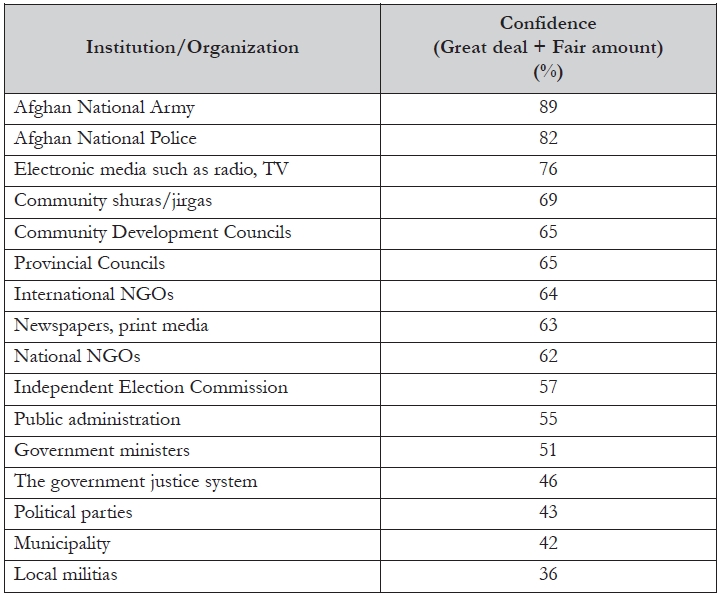
Regular readers of The Captain’s Journal know that we oppose simplistic applications of the Anbar awakening to Afghanistan.  The reasons are involved and complicated, and the reader is advised to stop by our category The Anbar Narrative for a fuller explanation.  But one reason that the concept of tribal militias may fail in Afghanistan can be found in a report by the Asia Foundation (h/t Small Wars Council).  In the report the following table of results can be found.

Local militias – for whatever reason, corruption, internecine warfare, etc. – rank at the lowest of all institutions in which the Afghan population has confidence.  Training and institutionalizing the Afghan Army and ridding the police of corruption – along with more U.S. troops to kill Taliban and provide security for the population and confidence for the Army until the process is complete – are the best bets to a stable and secure Afghanistan.

Blogs You Should Check Out

17 years, 1 month ago

Every once in a while it’s appropriate to mention the blogs I find and follow.  One such blog is Rogue Gunner, a Brit, and an interesting and lively chap.  Ex-military, conservative viewpoints, and champion for the warrior.  Stop by and say hello.

Another such blog is an upstart named This Veteran’s Life, garrisoned by a Marine and veteran of Operation Iraqi Freedom.

Finally, I am keeping in touch with T.T. Carnehan at Long Warrior, who is currently deployed in support of Operation Enduring Freedom and is an absolute MUST read.  Quoting a letter from a 2nd grader from his blog:

Keep your blood while you still have it. Fight with all your might. Kill people, steal weapons. You know, I used to be a soldier myself. I have mechanical hands now though. I was also a prisoner for 5 years.
Attention,
Sergeant Matt

And yet another real event he witnessed in Afghanistan.

Oh by the way, I saw a fully loaded passenger bus with a pickup truck and a station wagon strapped to the roof. The bus was on a jack while the driver changed a tire.

A fully loaded passenger bus with a pickup truck and station wagon strapped to the roof – on a jack.  And why didn’t you get a picture, Carnehan?  It would have been worth something.

At any rate, with our mechanical hand we salute all three of these blogs and ask that you send us any weapons that you steal.

Doctor Honors Fallen Marine Son by Deploying to Iraq

17 years, 1 month ago

I have been following this story (by Tony Perry of the L.A. Times) for quite a while.  This man meets the very definition of heroic.

When his son, Marine Lt. Nathan Krissoff, was killed two years ago in Iraq, Dr. Bill Krissoff found a unique way to honor his memory.

He closed up his lucrative orthopedic practice in Truckee, Calif., and, at age 60, joined the Navy medical corps in hopes of being assigned to Iraq to treat Marines and other military personnel.

It took presidential intervention to get Krissoff a waiver from the military’s age limits on enlistees.

Now, Lt. Cmdr. Krissoff, 62, is on the verge of deploying to Iraq with a Marine unit. And on Thursday night, President Bush — in his farewell address — included Krissoff among Americans who display “the best of our country — resilient and hopeful, caring and strong.”

Krissoff’s younger son, Austin, is also a Marine officer, now based at Camp Pendleton. He soon will return to Iraq for a second deployment.

“The way I see it, Austin and I are carrying on with Nathan’s unfinished business in Iraq,” Krissoff said Friday in a telephone call from Camp Lejeune, N.C. “We’ve picked up the fallen standard.”

Krissoff’s wife, Christine, will remain in northern San Diego County during the seven-month deployment. Many of their nonmilitary friends do not understand the couple’s decision, she said.

“It’s not a complicated thing,” she said. “It’s about serving our country.”

Nathan Krissoff was killed Dec. 9, 2006, by a roadside bomb outside Fallouja, west of Baghdad.

No, not really so complicated.  It’s all about honor, sacrifice, dignity, and having courage and a servant’s heart.  As one who has had to wonder late at night if a Marine Officer and Chaplain were going to show up at my door, this man and his wife have been through what I feared, and have come out on the other end honoring their son by sacrificing even more.  I’m left speechless, but honored to have heard Krissoff’s story, and of his son’s life.

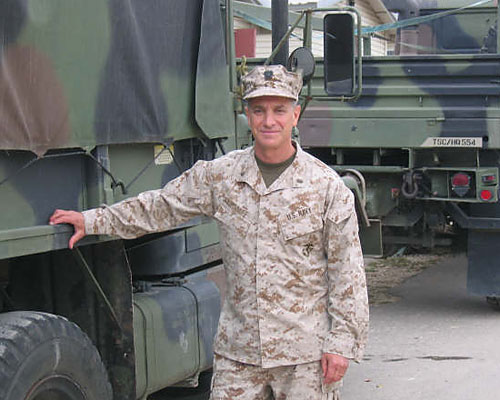
Navy Reserve Lt. Cmdr. Bill Krissoff, seen in a family photo at Camp Pendleton, joined the Navy medical corps to honor his Marine son Nathan, who was killed by a roadside bomb west of Baghdad in 2006. The doctor, who is on the verge of being deployed to Iraq, was praised by President Bush in his farewell address as among Americans who display “the best of our country — resilient and hopeful, caring and strong.

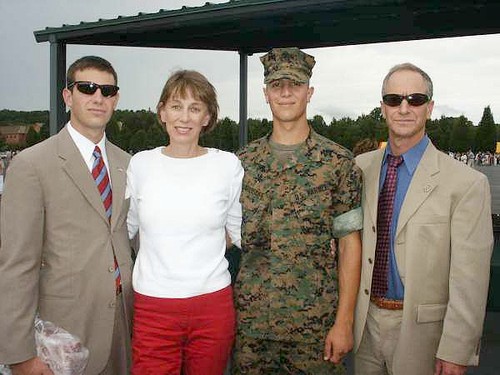
Dr. Bill Krissoff, far right, is seen in a family photo with, from left, his son Austin, who is a Marine Corps officer; his wife, Christine; and his son Nathan, a Marine who was killed by a roadside bomb in Iraq in 2006. To honor Nathan, Krissoff closed up his orthopedic practice in Truckee, Calif., and, at age 60, joined the Navy medical corps in hopes of being assigned to Iraq to treat wounded troops. It took presidential intervention to get Krissoff a waiver from the military’s age limits on enlistees, but now he is on the verge of deploying to Iraq with a Marine unit.

It’s Time for a Change in the COIN Debate

17 years, 1 month ago

In Gian Gentile v. Abu Muqawama, Round 582 (really, I cannot possibly rehearse the post or the lead-up debates to the post, so you’ll have to go and read it yourself), the latest comment to date by Mark O’Neill is interesting.

Dear Gian,

I agree with your point regarding debate and discussion, but I believe that the entire ‘argument’ has stretched passed (sic) any initial usefulness that it may have had. My reason for this assertion is that an objective reading of the ‘debate’ so far reveals far more in common that it does difference.

This begs the question as to what purpose there is in continually re-hashing or re-packagaing the ‘arguments’. Each new iteration does not illuminate any new point of debate, so what purpose are we meant to conclude lies behind it?

If I am wrong, (and I may well be), and the sustainment of the argument is actually part of a sustained IO campaign for genuine ‘change’ of some description, it is worth remembering that the audience switches off when nothing new is being broadcast. There is a fine line in delivery between effective IO and repetitive mantra that turns people off. Perhaps John Nagl et al are ‘playing’ that card a little better at the moment…

With respect to your position (or MG Dunlap’s) being heart felt, I am glad to hear it. It would otherwise be a truly cynical exercise to pursue your arguments. The problem may be that that passion is more of an advantage in the arena of physical endeavour than in the arean of intellectual debate where it often clouds logic and objectivity.

My question to move the debate forward is, “given the enduring reality of the two wars in Iraq and Afgahistan (implicit in this is the need to ‘win’ them), combined with the harsh realities of the current US budgetary position, what do you practical policy developments should be enacted now?” .

I think that for all of us, addressing questions of this nature are far more useful to leaders and policy makers than ‘chicken little-isms’ and arcane debates about who was doing COIN and who was not in 2004/05/06.

regards,

Mark

I couldn’t disagree more.  The argument hasn’t stretched passed (sic) it’s usefulness.  Rather, it has reached it’s graduation point.  I feel it.  The entire COIN community feels it.  It’s just a matter of truth-telling.  It’s a matter of giving the debate it’s certificate and moving it to the next grade.

The field manuals have been written, the experience has been obtained, the debates have been engaged.  Time to move on to the applications.

It is now time for the proponents of each side to weigh in on the real issues.  Training, money, field equipment, preparation for the officers and (maybe more importantly) the NCOs.  If Gian is concerned about the lack of ability to engage field artillery in conventional fights with near peer states, then it’s time to make a statement (white paper, opinion piece, or otherwise) on specific recommendations for new qualifications, activities and certifications to maintain appropriate skills.  Enough of the theory.

Next, if Nagl is as tired of the theory as I am (oh God I hope so), let’s hear some specific recommendations on what changes he considers most important to maintain the ability to engage near-failed states.  Language training?  We at The Captain’s Journal have long advocated strengthened work in this area.  Culture training?  Training in the ability to engage communities?  What would this look like?  Why hasn’t he made a specific recommendation to this effect?  Why hasn’t Gian made a specific recommendation concerning the lack of ability to engage near-peer states.

Why has this debate remained in the ethereal rather than landing in the real world of money, Soldiers and Marines, training, equipment and maintenance, squad rushes, language, satellite patrols, culture training, and so on?  It appears to me that the debate is easy when it concerns the theory and the manuals.  It becomes real work when it graduates to application, and hence, it hasn’t yet graduated.  It’s too easy to debate theory.

UPDATE:

Mark,

Sorry I took direct aim at the COIN debate at the expense of your comment (one too many beers late at night). The post was made a bit tongue-in-cheek to emphasize the point that it’s precisely because people like me are completely unable to engage the debate at this level that professional military needs to.

Ken White has weighed in before (and I agree completely) that the Leviathan – Sysadmin organization advocated by Barnett is a profoundly bad idea. Again, I agree. Ken seems to be willing to debate the details.

Andrew Exum has weighed in with killing the F-22 program completely. I disagree, but at least there is detail to his proposals. Finally, the Navy has weighed in with detail concerning their (ill-advised, I believe) littoral combat program (ill-advised because we are giving up control of the seas for the support of near-failed states).

One final example to support my thesis. Officer selection and promotion boards. Now, there’s where the rubber meets the road. Have you seen any debates more intense and application-oriented than that? But is it true that the only way to institutionalize lessons learned is to promote the right people to Colonel? Really?

Other than a few examples I have given, the real debate needs to graduate to the next level. What weapons systems does the advocate wish to be cancelled? What systems promulgated? What training stopped? What training started? What new certifications and qualifications implemented?

Until we get into the details, the debate remains less than as interesting and important as it could be. Again, I am certainly not the chief zeitgeist monitor for anything (ask anyone at the SWC who will be happy to tell you how many times I am wrong). Just advocating more detail to the debate. On this, I cannot see any down side to the proposal.

UPDATE #2 (Col. Gentile responds):

Dear Herschel:

Thanks for the post and your important points and call for moving the debate forward with some meat-on-the-bones so to speak.

Simply put, I think Colin Gray in his recent SSI essay, “After Iraq: A Search for Sustainable National Strategy” has it right in terms of what US Strategy should be and the components of it, namely how to structure the American military for the future around a set of imperatives.

So permit me to cite Gray shamelessly since my thinking (humbly admitted) is in line with his on these matters.

“1. Control of the global commons (sea, air, space, cyberspace), when and where it is strategically essential.

2. The ability to dissuade, deter, defeat, or at least largely neutralize any state, coalition of states, or nonstate political actor, that threatens regional or global order.

3. Adaptable and flexible strategy, operations, tactics, logistics, and forces. Future wars and warfare will occur all along the spectrum of regularity-irregularity. Asymmetry will be the norm, not the exception, even in regular conventional hostilities.

4. Continuing supremacy in regular conventional combat. Prediction of a strategic future that will be wholly irregular is almost certainly a considerable exaggeration.

5. Competence in counterinsurgency (COIN) and counterterror (CT). These activities should not dominate American defense preparation and action, but they comprise necessary military, inter alia, core competencies.

6. Excellence in raiding, thus exploiting the leverage of America’s global reach.

7. First-rate strategic theory and strategic and military doctrine. Ideas are more important than machines, up to a point at least.

8. A national security, or grand, strategy worthy of the name, in which military strategy can be suitably ‘nested.’

9. Policy choices and tactical military habits that do not offend American culture.

10. A fully functioning ‘strategy bridge’ that binds together, adaptably, the realms of policy and military behavior.”

Gray’s excellent essay is available online at the SSI home page and to see how he develops these imperatives further recommend it be read in its entirety.

My own thoughts as far as specifics in terms of possible organizational change for the US Army I believe that the best model available is still Macgregor’s which is centered around a ground force of marines and army that has strategic, operational, and tactical mobility along with firepower and protection that can draw on its own and joint fires in a distributed fashion. Such a force also has a robust infantry capability as well. It certainly won’t satisfy those who essentially want a light-infantry based force to conduct more nation-buildings and irregular wars of the future. But such a force like Macgregor’s that is built around the maneuver element of brigade sized battle groups can fight in the modern security environment. And if it can fight, it can do other missions called upon to do. It is not to say that in the future the American Army might have to do more nation-building missions, counterinsurgency etc. I fully accept that possibility. The question is how to organize the American army for a very uncertain future. It might be smallwars of nationbuilding and counterinsurgency but it might be more than that so we better have an American Army that can fight and win all of the wars assigned to us, not just a niche vision of the future.

Good response.

UPDATE #3:

Dr. John Nagl writes and sends me to the following links for evidence of having addressed the detail of the debate.

Armed Forces Journal, A Better War in Iraq

World Policy Institute, Striking the Balance: The Way Forward in Iraq

Thanks to Dr. Nagl for the links.

U.S. Soldiers on Afghan Border Patrol

17 years, 1 month ago

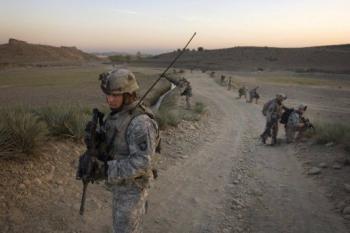
U.S. soldiers on patrol along the Afghan-Pakistan border.


26th MEU (10)
Abu Muqawama (12)
ACOG (2)
ACOGs (1)
Afghan National Army (36)
Afghan National Police (17)
Afghanistan (704)
Afghanistan SOFA (4)
Agriculture in COIN (3)
AGW (1)
Air Force (41)
Air Power (10)
al Qaeda (83)
Ali al-Sistani (1)
America (22)
Ammunition (304)
Animals (323)
Ansar al Sunna (15)
Anthropology (3)
Antonin Scalia (1)
AR-15s (393)
Arghandab River Valley (1)
Arlington Cemetery (2)
Army (91)
Assassinations (2)
Assault Weapon Ban (29)
Australian Army (7)
Azerbaijan (4)
Backpacking (4)
Badr Organization (8)
Baitullah Mehsud (21)
Basra (17)
BATFE (246)
Battle of Bari Alai (2)
Battle of Wanat (18)
Battle Space Weight (3)
Bin Laden (7)
Blogroll (3)
Blogs (24)
Body Armor (23)
Books (3)
Border War (18)
Brady Campaign (1)
Britain (39)
British Army (36)
Camping (5)
Canada (19)
Castle Doctrine (1)
Caucasus (6)
CENTCOM (7)
Center For a New American Security (8)
Charity (3)
China (19)
Christmas (18)
CIA (30)
Civilian National Security Force (3)
Col. Gian Gentile (9)
Combat Outposts (3)
Combat Video (2)
Concerned Citizens (6)
Constabulary Actions (3)
Coolness Factor (3)
COP Keating (4)
Corruption in COIN (4)
Council on Foreign Relations (1)
Counterinsurgency (218)
DADT (2)
David Rohde (1)
Defense Contractors (2)
Department of Defense (220)
Department of Homeland Security (26)
Disaster Preparedness (5)
Distributed Operations (5)
Dogs (15)
Donald Trump (27)
Drone Campaign (4)
EFV (3)
Egypt (12)
El Salvador (1)
Embassy Security (1)
Enemy Spotters (1)
Expeditionary Warfare (18)
F-22 (2)
F-35 (1)
Fallujah (17)
Far East (3)
Fathers and Sons (2)
Favorite (1)
Fazlullah (3)
FBI (39)
Featured (192)
Federal Firearms Laws (18)
Financing the Taliban (2)
Firearms (1,867)
Football (1)
Force Projection (35)
Force Protection (4)
Force Transformation (1)
Foreign Policy (27)
Fukushima Reactor Accident (6)
Ganjgal (1)
Garmsir (1)
general (15)
General Amos (1)
General James Mattis (1)
General McChrystal (44)
General McKiernan (6)
General Rodriguez (3)
General Suleimani (9)
Georgia (19)
GITMO (2)
Google (1)
Gulbuddin Hekmatyar (1)
Gun Control (1,717)
Guns (2,406)
Guns In National Parks (3)
Haditha Roundup (10)
Haiti (2)
HAMAS (7)
Haqqani Network (9)
Hate Mail (8)
Hekmatyar (1)
Heroism (5)
Hezbollah (12)
High Capacity Magazines (16)
High Value Targets (9)
Homecoming (1)
Homeland Security (3)
Horses (2)
Humor (72)
Hunting (61)
ICOS (1)
IEDs (7)
Immigration (123)
India (10)
Infantry (4)
Information Warfare (4)
Infrastructure (4)
Intelligence (23)
Intelligence Bulletin (6)
Iran (171)
Iraq (379)
Iraq SOFA (23)
Islamic Facism (64)
Islamists (98)
Israel (19)
Jaish al Mahdi (21)
Jalalabad (1)
Japan (3)
Jihadists (82)
John Nagl (5)
Joint Intelligence Centers (1)
JRTN (1)
Kabul (1)
Kajaki Dam (1)
Kamdesh (9)
Kandahar (12)
Karachi (7)
Kashmir (2)
Khost Province (1)
Khyber (11)
Knife Blogging (7)
Korea (4)
Korengal Valley (3)
Kunar Province (20)
Kurdistan (3)
Language in COIN (5)
Language in Statecraft (1)
Language Interpreters (2)
Lashkar-e-Taiba (2)
Law Enforcement (6)
Lawfare (14)
Leadership (6)
Lebanon (6)
Leon Panetta (2)
Let Them Fight (2)
Libya (14)
Lines of Effort (3)
Littoral Combat (8)
Logistics (50)
Long Guns (1)
Lt. Col. Allen West (2)
Marine Corps (281)
Marines in Bakwa (1)
Marines in Helmand (67)
Marjah (4)
MEDEVAC (2)
Media (68)
Medical (146)
Memorial Day (6)
Mexican Cartels (47)
Mexico (71)
Michael Yon (6)
Micromanaging the Military (7)
Middle East (1)
Military Blogging (26)
Military Contractors (5)
Military Equipment (25)
Militia (9)
Mitt Romney (3)
Monetary Policy (1)
Moqtada al Sadr (2)
Mosul (4)
Mountains (25)
MRAPs (1)
Mullah Baradar (1)
Mullah Fazlullah (1)
Mullah Omar (3)
Musa Qala (4)
Music (25)
Muslim Brotherhood (6)
Nation Building (2)
National Internet IDs (1)
National Rifle Association (97)
NATO (15)
Navy (31)
Navy Corpsman (1)
NCOs (3)
News (1)
NGOs (3)
Nicholas Schmidle (2)
Now Zad (19)
NSA (3)
NSA James L. Jones (6)
Nuclear (63)
Nuristan (8)
Obama Administration (222)
Offshore Balancing (1)
Operation Alljah (7)
Operation Khanjar (14)
Ossetia (7)
Pakistan (165)
Paktya Province (1)
Palestine (5)
Patriotism (7)
Patrolling (1)
Pech River Valley (11)
Personal (76)
Petraeus (14)
Pictures (1)
Piracy (13)
Pistol (4)
Pizzagate (21)
Police (672)
Police in COIN (3)
Policy (15)
Politics (998)
Poppy (2)
PPEs (1)
Prisons in Counterinsurgency (12)
Project Gunrunner (20)
PRTs (1)
Qatar (1)
Quadrennial Defense Review (2)
Quds Force (13)
Quetta Shura (1)
RAND (3)
Recommended Reading (14)
Refueling Tanker (1)
Religion (499)
Religion and Insurgency (19)
Reuters (1)
Rick Perry (4)
Rifles (1)
Roads (4)
Rolling Stone (1)
Ron Paul (1)
ROTC (1)
Rules of Engagement (75)
Rumsfeld (1)
Russia (37)
Sabbatical (1)
Sangin (1)
Saqlawiyah (1)
Satellite Patrols (2)
Saudi Arabia (4)
Scenes from Iraq (1)
Second Amendment (708)
Second Amendment Quick Hits (2)
Secretary Gates (9)
Sharia Law (3)
Shura Ittehad-ul-Mujahiden (1)
SIIC (2)
Sirajuddin Haqqani (1)
Small Wars (72)
Snipers (9)
Sniveling Lackeys (2)
Soft Power (4)
Somalia (8)
Sons of Afghanistan (1)
Sons of Iraq (2)
Special Forces (28)
Squad Rushes (1)
State Department (23)
Statistics (1)
Sunni Insurgency (10)
Support to Infantry Ratio (1)
Supreme Court (79)
Survival (214)
SWAT Raids (58)
Syria (38)
Tactical Drills (38)
Tactical Gear (17)
Taliban (168)
Taliban Massing of Forces (4)
Tarmiyah (1)
TBI (1)
Technology (21)
Tehrik-i-Taliban (78)
Terrain in Combat (1)
Terrorism (96)
Thanksgiving (13)
The Anbar Narrative (23)
The Art of War (5)
The Fallen (1)
The Long War (20)
The Surge (3)
The Wounded (13)
Thomas Barnett (1)
Transnational Insurgencies (5)
Tribes (5)
TSA (25)
TSA Ineptitude (14)
TTPs (4)
U.S. Border Patrol (8)
U.S. Border Security (22)
U.S. Sovereignty (29)
UAVs (2)
UBL (4)
Ukraine (10)
Uncategorized (105)
Universal Background Check (3)
Unrestricted Warfare (4)
USS Iwo Jima (2)
USS San Antonio (1)
Uzbekistan (1)
V-22 Osprey (4)
Veterans (3)
Vietnam (1)
War & Warfare (432)
War & Warfare (41)
War Movies (4)
War Reporting (21)
Wardak Province (1)
Warriors (6)
Waziristan (1)
Weapons and Tactics (80)
West Point (1)
Winter Operations (1)
Women in Combat (21)
WTF? (1)
Yemen (1)

February 2026
January 2026
December 2025
November 2025
October 2025
September 2025
August 2025
July 2025
June 2025
May 2025
April 2025
March 2025
February 2025
January 2025
December 2024
November 2024
October 2024
September 2024
August 2024
July 2024
June 2024
May 2024
April 2024
March 2024
February 2024
January 2024
December 2023
November 2023
October 2023
September 2023
August 2023
July 2023
June 2023
May 2023
April 2023
March 2023
February 2023
January 2023
December 2022
November 2022
October 2022
September 2022
August 2022
July 2022
June 2022
May 2022
April 2022
March 2022
February 2022
January 2022
December 2021
November 2021
October 2021
September 2021
August 2021
July 2021
June 2021
May 2021
April 2021
March 2021
February 2021
January 2021
December 2020
November 2020
October 2020
September 2020
August 2020
July 2020
June 2020
May 2020
April 2020
March 2020
February 2020
January 2020
December 2019
November 2019
October 2019
September 2019
August 2019
July 2019
June 2019
May 2019
April 2019
March 2019
February 2019
January 2019
December 2018
November 2018
October 2018
September 2018
August 2018
July 2018
June 2018
May 2018
April 2018
March 2018
February 2018
January 2018
December 2017
November 2017
October 2017
September 2017
August 2017
July 2017
June 2017
May 2017
April 2017
March 2017
February 2017
January 2017
December 2016
November 2016
October 2016
September 2016
August 2016
July 2016
June 2016
May 2016
April 2016
March 2016
February 2016
January 2016
December 2015
November 2015
October 2015
September 2015
August 2015
July 2015
June 2015
May 2015
April 2015
March 2015
February 2015
January 2015
December 2014
November 2014
October 2014
September 2014
August 2014
July 2014
June 2014
May 2014
April 2014
March 2014
February 2014
January 2014
December 2013
November 2013
October 2013
September 2013
August 2013
July 2013
June 2013
May 2013
April 2013
March 2013
February 2013
January 2013
December 2012
November 2012
October 2012
September 2012
August 2012
July 2012
June 2012
May 2012
April 2012
March 2012
February 2012
January 2012
December 2011
November 2011
October 2011
September 2011
August 2011
July 2011
June 2011
May 2011
April 2011
March 2011
February 2011
January 2011
December 2010
November 2010
October 2010
September 2010
August 2010
July 2010
June 2010
May 2010
April 2010
March 2010
February 2010
January 2010
December 2009
November 2009
October 2009
September 2009
August 2009
July 2009
June 2009
May 2009
April 2009
March 2009
February 2009
January 2009
December 2008
November 2008
October 2008
September 2008
August 2008
July 2008
June 2008
May 2008
April 2008
March 2008
February 2008
January 2008
December 2007
November 2007
October 2007
September 2007
August 2007
July 2007
June 2007
May 2007
April 2007
March 2007
February 2007
January 2007
December 2006
November 2006
October 2006
September 2006
August 2006
July 2006
June 2006
May 2006

about · archives · contact · register

Copyright © 2006-2026 Captain's Journal. All rights reserved.