Articles by Herschel Smith


The “Captain” is Herschel Smith, who hails from Charlotte, NC. Smith offers news and commentary on warfare, policy and counterterrorism.


Update on ROE Changes for Afghanistan

16 years, 8 months ago

From the BBC:

Speaking during a visit to a new US marine base in southern Helmand province, Gen McChrystal said that US and Nato troops must make a “cultural shift” from conventional warfare to protecting Afghan civilians.

“Traditionally American forces are designed for conventional, high-intensity combat. In my mind what we’ve really got to do is make a cultural shift,” he said

“When you do anything that harms the people you just have a huge chance of alienating the population. And so even with the best of intentions, if our operation causes them to lose property or loved ones, there is almost no way somebody cannot be impacted in how they view the government and us, the coalition forces.”

“If you are in a situation where you are under fire from the enemy… if there is any chance of creating civilian casualties or if you don’t know whether you will create civilian casualties, if you can withdraw from that situation without firing, then you must do so,” he told the BBC.

This address was probably delivered at Camp Leatherneck:

Where the U.S. Marines are preparing to take on an insurgency as well-entrenched as it was in the Anbar Province.  This information is valuable as a followup to our previous analysis of the new ROE.  Four more points are in order.

First, General McChrystal has essentially laid out the new insurgent strategy in Afghanistan.  This strategy is even more sure than it was in Iraq where staying among noncombatants yielded little succor, especially against the Marines in the Anbar Province (we’ll also remind you at this point that al Qaeda and the indigenous insurgency lost in Anbar – the Anbaris and the Marines won).

Second, it is bizarre in the extreme for General McChrystal, having spent his time in raids, high value target killings and other dark operations, to be telling the Marines (who not only did that, but spent time among the people too) what will and won’t win a counterinsurgency.  As the saying goes, he is trying to teach his granny to suck eggs.

Third, there is no possible way for Soldiers or Marines to know with certainty if noncombatants are in any particular location or domicile.  General McChrystal’s words were “if there is any chance.”  Without comprehensive knowledge of the situation, there is always a chance.  Thus the decision-making is biased in favor of disengagement.

Finally, protecting Afghan civilians involves killing Taliban.  One won’t be possible without the other.  Young Marines in Camps Lejeune and Pendleton preparing to deploy to Afghanistan must be wondering “just what kind of mess are they preparing for us?  I think I’d rather go on a float where I can shoot back.”  At Camp Leatherneck there must be young Marines staring in disbelief at their COs.  In the halls of the Pentagon the Marine Corps Commandant surely must be preparing an exit strategy for Afghanistan.

Prior: Changes to the Rules of Engagement for Afghanistan

How to Lose a Counterinsurgency Campaign

16 years, 8 months ago

From Reuters:

Inadequate assistance was allowing militant groups to operate in camps and communities housing hundreds of thousands of Pakistanis displaced by an offensive against the Taliban, an aid group said on Wednesday.

About 2 million people have fled the military’s push against the Taliban in Pakistan’s northwest, most since an offensive began in the Swat valley in May. Those numbers are expected to swell further as the offensive is widened.

U.N. officials said this week that only about 30 percent of a $543 million aid appeal it launched in May in a bid to avert a long-term humanitarian crisis had been met. Aid group Refugees International said the slow pace of help had created a vacuum which militants and other “political actors” were filling.

“Jihadist groups are present, leading an international agency to suspend its visits in some camps on Fridays and Saturdays as ‘these are the days the jihadists distribute their assistance’,” the Washington-based group said in a report on Wednesday.

How to lose a counterinsurgency campaign.  Displace millions of civilians, refuse to stay around and prevent the insurgents from coming back once the operations conclude, and then allow the insurgents to prevent the aid organizations from coming in and providing assistance.  Furthermore, allow the insurgents themselves to provide the aid that the government and NGOs should be providing.

There you have it.  How to lose a counterinsurgency campaign.  On another front, Peshawar is a war zone.

A deadly hotel bomb in Pakistan’s Peshawar underscores its shift from safe metropolis to besieged city where shop keepers are afraid to stock Western films and few foreigners dare to visit.

Up until a few years ago the northwest frontier town stirred up images of romance and intrigue, sitting on a historic trading route to Afghanistan and enticing tourists with bazaars, forts and ancient mosques.

Now kidnappings, killings, intimidation and scores of deadly blasts linked to Taliban militants have terrified Pakistanis and foreigners alike, with seven bombs in the past month alone killing nearly 50 people.

“Peshawar is now a dangerous city,” said Sharafat Ali Mubarak, president of the provincial chamber of commerce.

“Let me make it clear — even local people are not safe here.”

There you have it.  How to lose a counterinsurgency campaign.  Let the insurgents take charge.  It looks like the idyllic heaven that the Pakistan Army claims for the North West Frontier Province and FATA hasn’t materialized.

Changes to the Rules of Engagement for Afghanistan

16 years, 8 months ago

From the AP:

The U.S. commander in Afghanistan will soon order U.S. and NATO forces to break away from fights with militants hiding among villagers, an official said Monday, announcing one of the strongest measures yet to protect Afghan civilians.

The most contentious civilian casualty cases in recent years occurred during battles in Afghan villages when U.S. airstrikes aimed at militants also killed civilians. American commanders say such deaths hurt their mission because they turn average Afghans against the government and international forces …

Gen. Stanley McChrystal, who took command of international forces in Afghanistan this month, has said his measure of effectiveness will be the “number of Afghans shielded from violence” — not the number of militants killed.

McChrystal will issue orders within days saying troops may attack insurgents hiding in Afghan houses if U.S. or NATO forces are in imminent danger, said U.S. military spokesman Rear Adm. Greg Smith.

“But if there is a compound they’re taking fire from and they can remove themselves from the area safely, without any undue danger to the forces, then that’s the option they should take,” Smith said. “Because in these compounds we know there are often civilians kept captive by the Taliban.”

Reactions

J. D. Johannes takes a wait and see attitude, but is generally not opposed.

At first blush it may sound like the rule is to retreat.  I’ll save final judgement until I see the full order from the General McChrystal.  I’m wagering that it will have plenty of wiggle room for commander discretion.

But the key point of the change in the use of force is to move away from killing to suffocation.

As Marine General Mark Gurganus told me, “you can’t kill your way out of an insurgency.”

But you can suffocate an insurgency by denying its ability to operate.  You suffocate the insurgent by conducting detailed census data collection missions, ID card programs, gated communities and check points.

Uncle Jimbo at Blackfive is surprisingly supportive.

I assume there will be additional tactical changes to deny them what seems on the surface a big advantage, and this is not simply retreat but re-tooling. Since we know that the Talibs and AQ take people hostage and then attack us from their houses, maybe flattening the house with a 2,000 pounder and wiping out a family that wished they were anywhere else isn’t the most cunning plan. That coming from the King of Dead Tangos, I know.

MCQ at Blackfive isn’t so supportive.

Certainly I can understand the problems created by unintentional civilian casualties, especially in a tribal culture like Afghanistan. What I don’t understand, however, is an order which all but outlines the new tactics of the enemy.  I mean, you tell me, where, if possible, would you initiate all of your contact from now on if you’re the Taliban?

The Small Wars Council has a long and involved discussion thread on the new ROE.

Anthony Hoh: “How many times do you get shot at from the same compound/village that you drive by every day before you can do something about it?

Ken White: “I’ll give it a month or two before it quietly disappears. Not a smart move on several levels…”

IntelTrooper: “One recurring theme in talking to Afghans was “The Russians were jerks, but at least they never ran from a fight.” ISAF is already too prone to break contact. I can’t see this helping that.”

Ken White: “I suspect the civilians who are nominally innocent will get more visitation by various bad guys and said civilians will not really appreciate the extra attention (nor will they be happy that a small source of income, claiming non-existent casualties, has been removed).  Aside from the impacts on own forces, the net result is most likely to be more, not fewer, civilian casualties …”

But the discussion thread is a mixed bag, with some council members advocating the new rules in the interest of application of good counterinsurgency doctrine.  The discussion thread soon becomes oriented towards good practices rather than ROE (as pointed out by Ken White).

Analysis & Commentary

Let’s briefly revisit the ROE.  We have discussed the standing rules of engagement, the theater-specific rules of engagement for Iraq, and even the rules on the use of force.  Our problems with the existing ROE and RUF are legendary, and include the insurmountable initial problem that they are constructed around defensive operations and personal and unit self defense and include no discussion or guidance for offensive operations.  This is why General Kearney wanted to charge two Army snipers with murder for targeting a Taliban commander who didn’t happen to be holding a weapon.

Insurgents learn to game the system, as this event shows in Ramadi, Iraq, as reported by David Danelo.

The vehicle commander, Corporal Ronnie Davis, is in front of me holding a pair of binos.  Three other Marines peer down a street where Mujahideen have been firing at us from multi-story buildings scarred by gunfire and explosions.  While we exchange fire with the Muj, other observation assets available to 1 st Battalion, 6th Marines are mapping enemy positions for future operations.

“That’s the same two guys.  They’ve crossed back and forth four times,” Corporal Davis announces, referring to a pair of unarmed Iraqis who have run for cover.  Because these men are unarmed, the Americans under the Rules of Engagement are not allowed to shoot at them—even though gunfire is coming at us from that direction.

Get the picture?  The insurgents had emplaced weapons, fired them, dropped them, run to the next station and picked up another weapon, fired, and were repeating the process as long as they wanted.  The Marines couldn’t return fire because they never saw the insurgents run across the street holding a weapon.

Michael Totten describes for us what happens when insurgents are no longer able to game the system.

“AQI announced the Islamic State of Iraq in a parade downtown on October 15, 2006,” said Captain McGee. “This was their response to Sahawa al Anbar. They were threatened by the tribal movement so they accelerated their attacks against tribal leaders. They ramped up the murder and intimidation. It was basically a hostile fascist takeover of the city.”

Sheikh Jassim’s experience was typical.

“Jassim was pissed off because American artillery fire was landing in his area,” Colonel Holmes said. “But he wasn’t pissed off at us. He was pissed off at Al Qaeda because he knew they always shot first and we were just shooting back.”

So it’s possible that that this change to the ROE will help the Taliban, or anti-Afghan forces.  It is equally questionable whether simply leaving things as they are wouldn’t be better.  But besides the questionable tactical value in the change, we work best with examples.  Those who traffic in stories are some of the best teachers.

General McChrystal’s guidance further complicates the matter and hamstrings U.S. troops.  To be sure, The Captain’s Journal understands the damage done to the campaign when innocents are killed.  But no one intends to kill noncombatants with kinetic operations, and this leads us to the final – and most difficult – issue of all.  The guidance seems to be prima facie draconian, i.e., back off of engagements if possible.  This is a sure recipe for failure of the campaign.  But assuming the more gracious interpretation that U.S. troops should back off of engagements when they believe noncombatants will be involved, this raises the question of judgment and probability.

The Marines are currently engaged in heavy combat operations in Now Zad where several hundred Taliban fighters have cordoned themselves off from noncombatants to fight the Marines.  We pray for such engagements, but most of them are more ambiguous.

Take for instance the engagements in 2008 between the Marines and Taliban in Garmser (see also Marines in Helmand).  The Marines were involved in what they termed “constant and continual” contact and engagement with the enemy, and fire fights that at times involved “full bore reloading.”  They killed some 400 Taliban fighters in the engagements, and during this period although they worked the population by opening a complaint shop for home damage, the 24th MEU would have been unable to prove that noncombatants weren’t still resident in the city when kinetic operations began.

Thus one of the most important Marine Corps operations thus far in the campaign wouldn’t have been  conducted under the new ROE because there was no certainty regarding noncombatants.  This fixes the issue for us.  While exceptions make for bad law, this operation was not an exception.  The rules of engagement should provide adequate guidance during operations which prove to be the rule rather than the exception.

For a visual depiction of an engagement in Anbar that wouldn’t have been able to be conducted, see the video below from Recon by Fire.

Prior: Rules of Engagement Category

Combat Video from Now Zad

16 years, 8 months ago

The following combat action is good viewing, in addition to that previously linked.  There is a discussion taking place between Kristen Henderson of the Washington Post and random readers / commenters.  Ms. Henderson has to address comments like this.

So, what higher HQ lacked the knowlege that sent 2/7 in for a bogus mission? Not that I’d expect a Marine infantry battalion to be very good at training police procedures (italics and bold TCJ).

Wow.  Remember that we discussed this notion of actually sending Marines to fight Taliban fighters in Marines Take the Fight to the Enemy in Now Zad.  So rather than tell this commenter to come by so she can slap him, she actually answers with a kind, sophisticated response (but still incomplete, and you need to read Marines Take the Fight to the Enemy in Now Zad).  More than I feel compelled to do.  You will be dumber for having read the WaPo discussion.  Dumber.  Now for the recent Now Zad action.

The Failing UK Strategy in Afghanistan

16 years, 8 months ago

Abu Muqawama links a stinging report in the Telegraph.  Writing in the British Army Review, an official MoD publication, Major SN Miller, stated: “Lets not kid ourselves. To date Operation Herrick [the British codename for the War in Afghanistan] has been a failure”. (Editorial comment: Can professional journalists not learn the basic rule of quotation marks belonging outside the period?).

The reader should spend the time to study this Telegraph report in its entirety.  Noteworthy is that AM reflexively goes into a discussion of the fact that a number of British officers he knows have taken to reading FM 3-24 because the UK hasn’t given the right training to their own officers.

But note also that there is little if any of this in the discussion in the Telegraph.  What you do find is that:

Maj Miller, who has served in Afghanistan, also attacks the Department For International Development (DFID) for pumping millions of pounds of taxpayers money into a government where he claimed “corruption, inefficiency and incompetence” are “endemic” …

“Self-protection has become the main tactic, reinforced by air strikes that can backfire and undermine the campaign.

“Even as the Army renders itself more and more immobile with heavier vehicles and infantrymen weighing as much as a medieval knight, still the fantasy of the “manoeuvrist approach is peddled in staff courses.

“There is nothing manoeuvrist about weeks of petty, attritional fire fights within a few kilometres radius of a Forward Operating Base. The reason for all this is clear – zero casualties has become the tacit assumption behind operations.

“The Taliban are not being “coerced”, “deterred”, or “destabilised”. They simply disperse, knowing that the British cannot sustain pressure, and they return like the tide when the British troops withdraw, after a short period, back to their bases” …

“Until the government properly resources the war in Afghanistan, our strategy will fail.

The picture is not one of not knowing how to do it.  It’s one of under-resourcing, FOB-centric, casualty-averse operations, and corruption within Afghanistan itself (ironically, we covered CNAS’s own contribution to under-resourcing in CNAS Releases Afghanistan Study).

To be sure, FM 3-24 touches on much of this, but most of it is common sense.  Skirmishes with Taliban fighters (versus what the U.S. Marines are doing in Now Zad) is wasteful of time, money, resources, and the good will of the Afghans.

The issue is not publishing the UK version of FM 3-24.  The issue is will and fortitude.  And by the way, while we have hit on the UK hard for their failure in Basra (due in part to their ROE and belief in the applicability of their experience in Northern Ireland to anywhere else on earth), we have also noted the brave UK warriors under duress.  The problem is no more in the enlisted ranks than it is the lack of a field manual (publishing the UK version of FM 3-24 won’t solve the world’s problems, nor the problems of the UK Army).  The problem is in the politics and the officer corps.

See also British Hated Because of Musa Qala (and associated links provided).

Boss Mongo and TCJ on Various Subjects

16 years, 8 months ago

We have been fairly diligent to propose (and keep proposing) that the high value target campaign in Afghanistan be stopped, Special Operations Forces (SOF) be reattached to infantry, and SOF participate in the softer side of counterinsurgency while infantry also participates in the raids and other kinetics involved in supporting the campaign.

Boss Mongo at Mongo’s Montreaux (I know, cool pseudonym, great name for a web site, I wish I had thought of it first) disagreed.

Let’s talk basics. Conventional Forces, represented here by the Infantry, are regimented, hierarchical, and inflexible. SOF operations and culture–where merit, competence and aptitude often win out over rank–is anathema to CF. As for “no special privileges” like greater authoritiy than CF to call in indirect and air support: those “special privileges” are generated because the force receives special training and has special capabilities. What do you think the S in SOF is for? Is the argument that a 26-year old squad leader should have the same access to the wide array of US effects as a 44-year old, specially trained operator?

If, in our current COIN fights, SOF/GPF integration is so all-fired important, let’s turn the paradigm around: let’s attach infantry companies (commanded by captains) to SF companies (commanded by majors). Better yet, let’s attach infantry battalions to SF Groups and SEAL Teams. That would ensure that the forces are integrated. Of course, the infantry guys would be ruined forever (from thier commander’s point of view) because they’d learn to think for themselves, would prioritize mission accomplishment over placating the command, and would go to the gym and do PT in any clothes they wanted (the horror, the horror).

Starbuck pointed out the case of a sergeant major who admitted to using a multi-million dollar unmanned aerial vehicle to covertly inspect the uniforms of Soldiers at remote combat outposts. Yeah, the organization that promoted that guy and put him in a position of such responsibility and authority could properly utilize SOF.

Well, first of all, let’s distinguish between what I’m suggesting and what I’m not (since it’s impossible to lay out every recommendation and every caveat in a single article).  I’ve never understood the heavy land use of SEALs, and it seems to me that they should stay primarily in the water.  I don’t deny that there needs to be covert operations, and certainly a relatively small unit of commando-style soldiers needs to be maintained (with robust qualifications – HALO jumps, sniper qualifications, etc.).  I do not see the need for Rangers, since airborne qualifications are not unique to them, and air field seizure can be trained at the 82nd and 101st level (my father served in the 82nd).  My opinion is that women shouldn’t be allowed to have combat billets, so that problem would be dealt with under my scenario.

Now, to what I have proposed.  Much of SOF (not all, and certainly not SF with language skills) can be and should be reattached to infantry.  It is in the best interests of a robust military forces for kinetics not to be relegated to certain units, like Thomas P.M. Barnett has proposed with his Leviathan v. Sysadmin.

Boss Mongo gives good reason to question the institutional and bureaucratic makeup and reticence of the U.S. Army, but that’s just an organizational issue, one that can and should be corrected.  It works to have force recon and scout sniper attached to Marine infantry.  Change is hard, but regardless of what position one takes, it should be recognized what the debate is about.  It’s about a division of labor and qualifications into Leviathan and Sysadmin, whether one admits it up front or not.  It’s happening, and it has already happened to some extent.  The question is whether to reverse it or continue down this path.

Next, Boss Mongo gives us a good rundown on why we must entrust the battle against the insurgency to the ISF.  The point is granted, but I still have great reservations in the ISF, and even deeper reservations in the political structure, probably because I am so opposed to Maliki (who has failed to deliver on promises to incorporate the Sons of Iraq into the security apparatus).

But here is one for you.  While I cannot attest to this first hand (since I wasn’t there), I interviewed dozens of Marines coming back from Fallujah in 2007 (when my son was deployed).  They implicitly trusted the Sons of Iraq and worked with them as IPs.  No problems, slept with them, worked with them, ate with them, fought with them (initially against them, and then alongside them against AQ).

The ISF was the problem.  Their ranks were filled with lazy ne’er-do-wells and scurrilous, treacherous scumbags.  The Marines would only sleep in their vicinity with another armed Marine on watch and separated by concertina wire.  There’s the ISF for you.

Finally, Boss takes a shot at Iraqslogger.  TCJ agrees and was down on them long ago.  After all, what do you expect when someone like Eason Jordan leads the outfit?

TCJ says that Boss Mongo should keep up the good work, keep up the writing, and watch his six.

Marines Take the Fight to the Enemy in Now Zad

16 years, 8 months ago

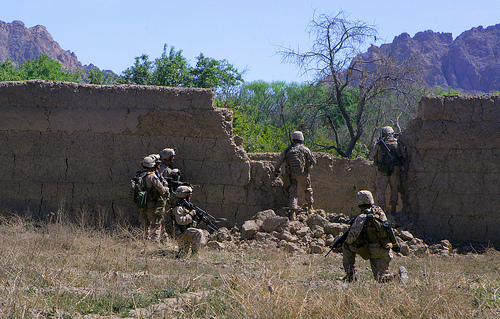
NOW ZAD, Helmand Province, Islamic Republic of Afghanistan – U.S. Marines maneuver through a wall to conduct site exploitation after a precision aerial attack during a combat operation in the abandoned village of Now Zad, Helmand Province, Islamic Republic of Afghanistan, April 3, 2009.

The residents of Now Zad were forced to abandon their homes nearly three years ago out of fear for their lives due to the strong presence of insurgents. By conducting combat operations here, Marines are bringing Now Zad closer to the reintroduction of Afghan-led governance.

The Marines of Company L, 3rd Battalion, 8th Marine Regiment (Reinforced), the ground combat element of Special Purpose Marine Air Ground Task Force – Afghanistan, have served in Now Zad since November 2008.

Now Zad, Afghanistan is in the news.

The 2nd Battalion of the 7th Marine Regiment had deployed to Afghanistan last spring to train Afghan police. But when Karell’s platoon arrived in Now Zad, the largest town in a remote northern district of Helmand province, they’d rolled into a ghost town.

The Afghans who used to live here, more than 10,000, had been gone for several years, their abandoned mud-brick homes slowly melting into the dusty valley. Insurgents were using the place for R&R. At night, all you heard were the jackals, ululating like veiled, grieving women. The fact that Now Zad had no civilian residents, much less any police, had somehow escaped the notice of the coalition planners who had given the Marines their mission.

“They saw what they wanted to achieve but didn’t realize fully what it would take,” Task Force 2/7’s commander, Lt. Col. Richard Hall, said at the time. “There were no intel pictures where we are now because there were few or no coalition forces in the areas where we operate. They didn’t know what was out there. It was an innocent mistake.”

So, with no police to train or civilians to protect, the Marines in Now Zad were left with the job of evicting the insurgents who had taken over the town.

Joshua Foust has an interesting take on this kind of narrative.

I think we’re starting to reach the point at which you can only tell the same story so many times: U.S. military comes to town, finds out things are worse than they realized, learns their training sucks, and must adapt. Cue gunfire, the agonizing death of comrades, and the realization that you finally get it, and the guys who come to replace you in a few months will be better off as a result. Rinse, repeat.

Well, perhaps intelligence missed it.  Perhaps it would have been better to have known what Now Zad was like before deploying.  But Marines are generally trained at the range (iron sights at 500 yards), close and hand to hand combat in MCMAP, room clearing, language, culture, checkpoints and traffic control, squad rushes, fast roping, and other infantry tactics.  It’s unlikely that they will face anything in Now Zad for which they cannot adapt.

The Captain’s Journal has a different take on things.  Notice the tip of the hat to population-centric counterinsurgency with the horrible notion that there were no civilians to protect.  We have been as strong an advocate as possible of the idea of protecting the population from the Taliban.  But recall that in the context of the Army’s presence at the Korengal Valley we also discussed enemy separation from the population – and targeting the enemy – as another line of operation.

But it will not always be this clear.  The enemy is who we are after, but to get to them at times requires focusing on the population.  Every situation is unique, and thus rather than finding a center of gravity, it is best to see the campaign as employing lines of effort.  In spite of the lack of adequate troops, the campaign will not be an either-or decision, focusing on the enemy or the population.  It will be both-and.

At times this will be extremely difficult, with the insurgency embedding with the population, shielding themselves with women and children, and hiding from U.S. forces.  Counterinsurgency thus proves to be a difficult mix of direct action military engagements, streetside conversations, visits to homes, learning the population and culture, and rebuilding the infrastructure.  There will be enough of this to go around for everyone in the campaign.

But just occasionally, the insurgents will separate themselves from the population, attempt to mass on a location, and go into conventional military formation.  When this happens and when U.S. forces can find it, it pays to kill them on the spot whether they are a direct threat or not.

Why are U.S. forces present in the Korangal valley?  The obvious answer is to kill the enemy.  It’s the perfect circumstances, crafted by the insurgents themselves.  No women, no children, no surrounding infrastructure to be destroyed, only the enemy and U.S. troops.  We dread the difficulty of population-centric counterinsurgency and pray for such engagements.

Intelligence failure or not, Lt. Col. Hall shouldn’t be apologizing for the fact that there are no civilians in Now Zad to protect.  This exigency should be the occasion for celebration.  It happened for the Marines in Garmser, and it’s happening again in Now Zad.  God must love the Marines.

In counterinsurgency, rarely does the opportunity present itself to have an unhindered killing field to defeat an enemy militarily.  This is it.  Several hundred hard core Taliban fighters have garrisoned themselves in Now Zad without any civilian inhabitants whatsoever.  This question was asked earlier and answered by us in Major Combat Operations in Now Zad Afghanistan.  Why are the Marines there?  Answer: Because the Taliban are.

But in this marvelous AP report, we learn – again – that there aren’t enough troops to clear and hold.  More are needed, and this is General McChrystal’s job.  Finally, when population-centric counterinsurgency doctrine makes us question why Marines are killing the enemy, as Col. Gian Gentile would point out, the doctrine is no longer our friend.  We must allow the forces to discover the center of gravity.  In this case, we don’t look a gift horse in the mouth.

Prior Featured Article: Taliban Tactics: Massing of Troops

Now Zad Video

Mullah Mohammed Omar Reasserting Control Over Taliban

16 years, 8 months ago

From the WSJ:

Mullah Omar, supreme leader of the Taliban, is reasserting direct control over the militant group’s loose-knit insurgency in Afghanistan, ordering attacks and shuffling field commanders in preparation for the arrival of thousands of additional U.S. troops, according to U.S. officials and insurgents in Afghanistan.

Until recently, the ground-level conduct of the Taliban’s war against the U.S.-led coalition has been left to local commanders acting on their own. Mr. Omar, who heads a Taliban leadership council called the Quetta “shura” — named after the city in southeast Pakistan where it is believed to be based — has typically focused on choosing Taliban leaders and funneling money, religious guidance and strategic advice to fighters.

But since the start of the year, Mr. Omar, through his direct lieutenants, has ordered a spate of suicide bombings and assassinations in southern and eastern Afghanistan that presage a bloody phase to come in the Afghan war, according to U.S. officials and Afghan insurgents …

In another unusual attack in mid-May, nearly a dozen suicide bombers struck targets in the provincial capital of Khost in eastern Afghanistan, leaving 12 people dead, not including the bombers. U.S. officials say the attack was ordered by the Quetta shura …

Mr. Omar’s push to centralize command has irked some rank-and-file Taliban, insurgents say, potentially leaving them more amenable to U.S. and Afghan outreach efforts. Drawing on a tactic first used in Iraq, the U.S. has been reaching out to moderate Taliban fighters in the hopes of reconciling them into Afghanistan’s political process.

However, Mr. Omar’s re-emergence could also lead to a more centralized and coordinated — and violent — insurgency that would pose an even greater threat, U.S. officials and insurgents say.

We have previously discussed the disaggregation of the Taliban into drug runners, petty thieves, local warlords, and distributed operations of small units of Taliban fighters.  We said that this would make battling the Taliban more difficult.

There is a flip side to this coin.  Despite romantic (maybe pedantic?) notions of swarm theory on the evolution of insurgencies (viz. John Robb at Global Guerrillas), every insurgency is different, from religious devotion to criminality, from (foreign) state sponsorship to complete independence from government influence or largesse, from responsibility being pushed downward to lower- and mid-tier commanders to (in this case) re-centralization of authority and power.

Apparently, Mullah Omar believes that reassuming tactical control over his fighters is in his and the Taliban’s best interest.  If he is successful, this might mean more difficulty in battling the Taliban in the South.  The claim that some insurgents would be more amenable to outreach efforts due to this re-centralization of power appears to be wishful thinking.  The Captain’s Journal simply doesn’t believe it.

Analysts Miss Iran’s Hidden Revolution

16 years, 8 months ago

Commenter and loyal reader TSAlfabet and TCJ are in a debate over what democracy in Iran might bring.  It’s the same debate that Michael Totten is having with himself at Commentary Magazine.  On the one hand, we should all support democracy programs in Iran, and Mir Hossein Mousavi seems light years better than Ahmadinejad.  But Michael Totten doesn’t trust him, although he does point out that Michael Ledeen believes that there has been a transformation in his views.  Either way, the disposition of the current upheaval in Iran likely doesn’t change anything regarding the push for a nuclear weapon.

But democracy is a good first step in Iran’s evolution towards being a viable twenty first century state.  Fox News recently reported (James Rosen) that Washington was abuzz with talks about how the Iran analysts and foreign policy experts had missed how Iran had transitioned from the Islamic revolution to a fascist, repressive state.  This hidden revolution was recently discussed in the New York Times, no doubt leading to the current debate over the expert analysts entirely missing it.

Just after Iran’s rigged elections last week, with hundreds of thousands of protesters taking to the streets, it looked as if a new revolution was in the offing. Five days later, the uprising is little more than a symbolic protest, crushed by the elite Iranian Revolutionary Guard Corps. Meanwhile, the real revolution has gone unnoticed: the guard has effected a silent coup d’état.

The seeds of this coup were planted four years ago with the election of President Mahmoud Ahmadinejad. And while he has since disappointed his public, failing to deliver on promised economic and political reforms, his allies now control the country. In the most dramatic turnabout since the 1979 revolution, Iran has evolved from theocratic state to military dictatorship.

Disenchantment with clerical rule has been growing for years. To the urban youths who make up Iran’s most active political class, the mullahs represent the crude rigidity of Islamic law. To the rural poor, they epitomize the corruption that has meant unbuilt schools, unpaved roads and unfulfilled promises of development.

The problem with the Fox News report is that not everyone missed it.  In 2004 Michael Ledeen said that we shouldn’t dismiss the prospects of democratic revolution in Iran.  In 2008 he clearly linked them with fascist dictatorships, and in 2007 he said concerning Iran, “the economy – insofar as it has to do with the daily lives of most people – is a disaster, the rulers are hated, the population is young, and there is a long tradition of self government” (page 208 of The Iranian Time Bomb; as a fellow Marine father, my copy is signed “From a fellow-suffering dad to another – Michael”).

Finally, writing for Pajamas Media, Michael said early in 2009:

… despite all their efforts to crush any sign of internal rebellion, many Iranians continue to publicly oppose the mullahs.  A few weeks ago, students at universities all over the country demonstrated in significant numbers, and as one Iranian now living in Europe put it to me, “they were surprised that the regime was unable to stop the protests, even though everyone knew they were planned.”   This is the background for the new wave of repression, accompanied by an intensification of jamming on the Internet, and an ongoing reshuffle of the instruments of repression;  Khamanei and Ahmadinejad have no confidence in the efficacy or blind loyalty of the army or of large segments of the Revolutionary Guards.  Most public actions are carried out by the Basij, who are judged more reliable, and repression is less in the hands of the traditional ministries than in new groups freshly minted in the Supreme Leader’s office.

In short, we are dealing with a regime that is very concerned about its future, and is not very comfortable with its friends, allies, and proxies.  The mullahs know that most Iranians would like to see their leaders treated the same way as the nine executed on Christmas Eve, and, like all tyrants, the Iranian despots are trying to demonstrate that they dominate both Iran and the region.

These are just a very few of the quotes cobbled together over ten minutes or so of research.  The debate that commenter TSAlfabet and TCJ are having and Michael Totten is having with himself is several steps above the current panic among so-called “experts” in Washington who wonder why they missed it so badly.  We’re further ahead in our discussion because we didn’t miss it.  Neither did Michael Ledeen.  So why is this administration listening to “experts” who miss major events like the next Iranian revolution?

Meanwhile, the revolution isn’t over quite yet, no matter what the NYT commentary asserts.

General McChrystal to go on Afghanistan Public Relations Offensive

16 years, 8 months ago

Gareth Porter has penned a commentary in the Asia Times on several subjects.  It’s long and much of it not very worthwhile reading.  But it’s necessary to read it entirely in order to understand his mistaken calculus.

At his confirmation hearings as the new commander in Afghanistan two weeks ago, General Stanley McChrystal said reducing civilian deaths from air strikes in Afghanistan was “strategically decisive” and declared his “willingness to operate in ways that minimize casualties or damage, even when it makes our task more difficult”.

Some McChrystal supporters hope he will rein in the main source of civilian casualties: Special Operations Forces (SOF) units that carry out targeted strikes against suspected “Taliban” on the basis of doubtful intelligence and raids that require air strikes when they get into trouble.

But there are growing indications that his command is preparing to deal with the issue primarily by seeking to shift the blame to the Taliban through more and better propaganda operations and by using more high-tech drone intelligence aircraft to increase battlefield surveillance rather than by curbing the main direct cause of civilian casualties.

United States officials at a North Atlantic Treaty Organization (NATO) conference in Brussels last Friday told reporters that “public relations” were now considered “crucial” to “turning the tide” in Afghanistan, according to an Agence-France Presse story on June 12.

Central Command chief General David Petraeus also referred to the importance of taking the propaganda offensive in a presentation to the pro-military think-tank the Center for a New American Security (CNAS) on June 11. “When you’re dealing with the press,” he said, “when you’re dealing with the tribal leaders, when you’re dealing with host nations … you got to beat the bad guys to the headlines.”

The new emphasis on more aggressive public relations appears to respond to demands from US military commanders in Afghanistan to wrest control of the issue of civilian casualties from the Taliban. In a discussion of that issue at the same conference, General David Barno, the commander of US forces in Afghanistan from 2003 to 2005, said, “We’ve got to be careful about who controls the narrative on civilian casualties.”

United States military commanders in Afghanistan “see the enemy seeking to take air strikes off the table” by exaggerating civilian casualties, Barno said. He objected to making civilian casualties an indicator of success or failure, as a CNAS paper has recommended.

The US command in Afghanistan has already tried, in fact, to apply “information war” techniques in an effort to control the narrative on the issue. The command has argued both that the Taliban were responsible for the massive civilians casualties in a US air strike on May 4 that killed 147 civilians, including 90 women and children, and that the number of civilian deaths claimed has been vastly exaggerated, despite detailed evidence from village residents supporting the casualty figures.

Colonel Greg Julian, the command’s spokesman, said in late May that a “weapon-sight” video would show that the Taliban were to blame. However, Nancy A Youssef reported on June 15 in McClatchy newspapers that the video in question showed that no one had checked to see if women and children were in the building before it was bombed, according to two US military officials.

The Afghan government has highlighted the problem of SOF units carrying out raids that result in air strikes against civilian targets. Kai Eide, the chief of the United Nations mission in Afghanistan, has now publicly supported that position, saying in a video conference call from Kabul to NATO defense ministers meeting in Brussels on June 12 that there is an “urgent need” to review raids by SOF units, because the civilian casualties being created have been “disproportionate to the military gains”.

But McChrystal hinted in his confirmation hearing that he hoped to reduce civilian casualties by obtaining more intelligence, surveillance and reconnaissance aircraft. Petraeus confirmed that approach to the problem in remarks at the CNAS conference last week, announcing that he was planning to shift some high-tech intelligence vehicles from Iraq to Afghanistan.

Petraeus referred to “predators, armed full motion video with Hellfire missiles”, “special intelligence birds”, and unmanned intelligence vehicles called Shadows and Ravens, which fly 24 hours a day.

Although such intelligence aircraft may make US battlefield targeting more precise, Petraeus’ reference to drones equipped with Hellfire missiles suggests that US forces in Afghanistan may now rely more than previously on drone strikes against suspected Afghan insurgents. Given the severe lack of accurate intelligence on the identity of insurgent leaders, that would tend to increase civilian casualties.

Petraeus’ past reluctance to stop or dramatically reduce such SOF operations, despite the bad publicity surrounding them, suggests that high level intra-military politics are involved.

The Marine Corps Special Operations Command (MarSOC) has been involved in the most highly publicized cases of massive civilian casualties in Afghanistan. MarSOC was only established by the Marine Corps in February 2006 and the first company arrived in Afghanistan just a year later.

MarSOC was unable to recruit the more mature officers and troops needed for cross-cultural situations, and its recruits had only a few months of training before being sent to Afghanistan.

The unit’s commanding officer had been warned by one participant in the training before the unit had arrived in Afghanistan that his troops were too young and too oriented toward killing to serve in Afghanistan, according to Chris Mason, a former US official in Afghanistan familiar with the unit’s history.

In March 2007, a company of MarSOC troops which had only arrived in the country the previous month were accused of firing indiscriminately at pedestrians and cars as they sped away from a suicide bomb attack, killing as many as 19 Afghan civilians. Five days later the same unit reportedly fired on traffic again.

As a result, a powerful Pashtun tribe, the Shinwari, demanded to the governor of Nangahar province and Afghan President Hamid Karzai that US military operations in the province be terminated. Within a month, the 120-man MarSOC company was pulled out of Afghanistan.

Significantly, however, a new MarSOC unit was sent back to Afghanistan only a few weeks later, assigned to Herat province. Last August, a MarSOC unit launched an attack against a preplanned target in Azizabad that combined unmanned drones, attack helicopters and a Spectre gunship. More than 90 civilians were killed in the attack, including 60 children, but not a single Taliban fighter was killed, according to Afghan and UN officials.

Karzai said the operation had been triggered by false information given by the leader of a rival tribe, and no US official contradicted him.

When Petraeus took command at CENTCOM just a few weeks later, Afghans were still seething over the Azizabad massacre. That would have been the perfect time for him to take decisive action on MarSOC’s operations.

But Petraeus took no action on MarSOC. Meanwhile, other SOF units were continuing to carry out raids that did not get headlines but which regularly killed women and children, stirring more Afghan anger. Petraeus may have been confronted with the necessity of stopping all the operations if he wished to discipline MarSOC, which would have been too serious a blow to the reputation of US Special Operations Forces.

For two weeks, from mid-February to early March, the rate of SOF raids was reduced. But in early March, they were resumed, despite the near certainty that there would be more embarrassing incidents involving SOF operations. The worst case of massive civilian deaths in the war would come just two months later, and involved the MarSOC unit.

Analysis & Commentary

Right up front let’s deal with the issue of casualties caused by SOF raids – again.  The Captain’s Journal is generally opposed to high value target raids since an insurgency must be defeated from the bottom up rather than the top down.  The HVT campaign has been a remarkable failure, and should serve as a lesson in military doctrine and strategy classes for the foreseeable future.  We warned you years ago.

But this is not the same thing as saying that casualties – unintended casualties, counterproductive casualties – won’t occur regardless of the tactics being used.  Cessation of the SOF high value target campaign won’t end unintended casualties.  Either Porter’s argument is a non sequitur, or he knows this and he is simply being dishonest.  So he’s either stupid or a liar.

All one must do to understand that the limited force size requires other tactics to prevent U.S. forces from being overrun is read Taliban Tactics: Massing of Troops (you won’t find this kind of analysis anywhere on the web, which is why it is still up as a featured article).  TCJ has opposed the separation of Force Recon into MARSOC, believing that it is better for the Corps in particular to keep them attached to infantry.  The same goes for Army SOF and Army infantry.  They should be re-attached.

But while we have been critical of SOF and their use, Porter is mistaken if he believes that we will turn on McChrystal and SOF when he charges McChrystal with dealing with the issue of civilian casualties “primarily by seeking to shift the blame to the Taliban through more and better propaganda operations and by using more high-tech drone intelligence aircraft to increase battlefield surveillance rather than by curbing the main direct cause of civilian casualties.”

This is stupid, and in a single article Porter has penned a hit job on McChrystal, U.S. air power, U.S. special operations forces, and especially MARSOC (of which he knows absolutely nothing).  Frankly, The Captain’s Journal doesn’t appreciate it one bit.  Furthermore, his radical bias leads him to miss the point, a point that was well taken and which would have been a worthwhile article had he drawn this point out and done some investigative labor.  He started well.  It didn’t take him long to crash and burn.

The U.S. is poor when it comes to releasing information, even information that demonstrates that enemy propaganda is false.  It’s OPSEC, or it’s FOUO (for official use only), or it’s has to make its way through a hundred layers of approval to be released.  Meanwhile, the enemy has already released their talking points.

We lose.  Game over.  We must do better at releasing the right information, and we must do it quickly.  Time is of the essence.  This goes contrary to the bureaucracy inherent in the U.S. military, and it will be a hard change to bring to the institution.  Can McChrystal accomplish this?  Time will tell.  But Porter missed the chance at a good article because he is stolid.


26th MEU (10)
Abu Muqawama (12)
ACOG (2)
ACOGs (1)
Afghan National Army (36)
Afghan National Police (17)
Afghanistan (704)
Afghanistan SOFA (4)
Agriculture in COIN (3)
AGW (1)
Air Force (41)
Air Power (10)
al Qaeda (83)
Ali al-Sistani (1)
America (22)
Ammunition (304)
Animals (322)
Ansar al Sunna (15)
Anthropology (3)
Antonin Scalia (1)
AR-15s (393)
Arghandab River Valley (1)
Arlington Cemetery (2)
Army (91)
Assassinations (2)
Assault Weapon Ban (29)
Australian Army (7)
Azerbaijan (4)
Backpacking (4)
Badr Organization (8)
Baitullah Mehsud (21)
Basra (17)
BATFE (246)
Battle of Bari Alai (2)
Battle of Wanat (18)
Battle Space Weight (3)
Bin Laden (7)
Blogroll (3)
Blogs (24)
Body Armor (23)
Books (3)
Border War (18)
Brady Campaign (1)
Britain (39)
British Army (36)
Camping (5)
Canada (19)
Castle Doctrine (1)
Caucasus (6)
CENTCOM (7)
Center For a New American Security (8)
Charity (3)
China (19)
Christmas (18)
CIA (30)
Civilian National Security Force (3)
Col. Gian Gentile (9)
Combat Outposts (3)
Combat Video (2)
Concerned Citizens (6)
Constabulary Actions (3)
Coolness Factor (3)
COP Keating (4)
Corruption in COIN (4)
Council on Foreign Relations (1)
Counterinsurgency (218)
DADT (2)
David Rohde (1)
Defense Contractors (2)
Department of Defense (220)
Department of Homeland Security (26)
Disaster Preparedness (5)
Distributed Operations (5)
Dogs (15)
Donald Trump (27)
Drone Campaign (4)
EFV (3)
Egypt (12)
El Salvador (1)
Embassy Security (1)
Enemy Spotters (1)
Expeditionary Warfare (18)
F-22 (2)
F-35 (1)
Fallujah (17)
Far East (3)
Fathers and Sons (2)
Favorite (1)
Fazlullah (3)
FBI (39)
Featured (192)
Federal Firearms Laws (18)
Financing the Taliban (2)
Firearms (1,867)
Football (1)
Force Projection (35)
Force Protection (4)
Force Transformation (1)
Foreign Policy (27)
Fukushima Reactor Accident (6)
Ganjgal (1)
Garmsir (1)
general (15)
General Amos (1)
General James Mattis (1)
General McChrystal (44)
General McKiernan (6)
General Rodriguez (3)
General Suleimani (9)
Georgia (19)
GITMO (2)
Google (1)
Gulbuddin Hekmatyar (1)
Gun Control (1,717)
Guns (2,406)
Guns In National Parks (3)
Haditha Roundup (10)
Haiti (2)
HAMAS (7)
Haqqani Network (9)
Hate Mail (8)
Hekmatyar (1)
Heroism (5)
Hezbollah (12)
High Capacity Magazines (16)
High Value Targets (9)
Homecoming (1)
Homeland Security (3)
Horses (2)
Humor (72)
Hunting (60)
ICOS (1)
IEDs (7)
Immigration (123)
India (10)
Infantry (4)
Information Warfare (4)
Infrastructure (4)
Intelligence (23)
Intelligence Bulletin (6)
Iran (171)
Iraq (379)
Iraq SOFA (23)
Islamic Facism (64)
Islamists (98)
Israel (19)
Jaish al Mahdi (21)
Jalalabad (1)
Japan (3)
Jihadists (82)
John Nagl (5)
Joint Intelligence Centers (1)
JRTN (1)
Kabul (1)
Kajaki Dam (1)
Kamdesh (9)
Kandahar (12)
Karachi (7)
Kashmir (2)
Khost Province (1)
Khyber (11)
Knife Blogging (7)
Korea (4)
Korengal Valley (3)
Kunar Province (20)
Kurdistan (3)
Language in COIN (5)
Language in Statecraft (1)
Language Interpreters (2)
Lashkar-e-Taiba (2)
Law Enforcement (6)
Lawfare (14)
Leadership (6)
Lebanon (6)
Leon Panetta (2)
Let Them Fight (2)
Libya (14)
Lines of Effort (3)
Littoral Combat (8)
Logistics (50)
Long Guns (1)
Lt. Col. Allen West (2)
Marine Corps (281)
Marines in Bakwa (1)
Marines in Helmand (67)
Marjah (4)
MEDEVAC (2)
Media (68)
Medical (146)
Memorial Day (6)
Mexican Cartels (47)
Mexico (71)
Michael Yon (6)
Micromanaging the Military (7)
Middle East (1)
Military Blogging (26)
Military Contractors (5)
Military Equipment (25)
Militia (9)
Mitt Romney (3)
Monetary Policy (1)
Moqtada al Sadr (2)
Mosul (4)
Mountains (25)
MRAPs (1)
Mullah Baradar (1)
Mullah Fazlullah (1)
Mullah Omar (3)
Musa Qala (4)
Music (25)
Muslim Brotherhood (6)
Nation Building (2)
National Internet IDs (1)
National Rifle Association (97)
NATO (15)
Navy (31)
Navy Corpsman (1)
NCOs (3)
News (1)
NGOs (3)
Nicholas Schmidle (2)
Now Zad (19)
NSA (3)
NSA James L. Jones (6)
Nuclear (63)
Nuristan (8)
Obama Administration (222)
Offshore Balancing (1)
Operation Alljah (7)
Operation Khanjar (14)
Ossetia (7)
Pakistan (165)
Paktya Province (1)
Palestine (5)
Patriotism (7)
Patrolling (1)
Pech River Valley (11)
Personal (76)
Petraeus (14)
Pictures (1)
Piracy (13)
Pistol (4)
Pizzagate (21)
Police (672)
Police in COIN (3)
Policy (15)
Politics (998)
Poppy (2)
PPEs (1)
Prisons in Counterinsurgency (12)
Project Gunrunner (20)
PRTs (1)
Qatar (1)
Quadrennial Defense Review (2)
Quds Force (13)
Quetta Shura (1)
RAND (3)
Recommended Reading (14)
Refueling Tanker (1)
Religion (499)
Religion and Insurgency (19)
Reuters (1)
Rick Perry (4)
Rifles (1)
Roads (4)
Rolling Stone (1)
Ron Paul (1)
ROTC (1)
Rules of Engagement (75)
Rumsfeld (1)
Russia (37)
Sabbatical (1)
Sangin (1)
Saqlawiyah (1)
Satellite Patrols (2)
Saudi Arabia (4)
Scenes from Iraq (1)
Second Amendment (708)
Second Amendment Quick Hits (2)
Secretary Gates (9)
Sharia Law (3)
Shura Ittehad-ul-Mujahiden (1)
SIIC (2)
Sirajuddin Haqqani (1)
Small Wars (72)
Snipers (9)
Sniveling Lackeys (2)
Soft Power (4)
Somalia (8)
Sons of Afghanistan (1)
Sons of Iraq (2)
Special Forces (28)
Squad Rushes (1)
State Department (23)
Statistics (1)
Sunni Insurgency (10)
Support to Infantry Ratio (1)
Supreme Court (79)
Survival (214)
SWAT Raids (58)
Syria (38)
Tactical Drills (38)
Tactical Gear (17)
Taliban (168)
Taliban Massing of Forces (4)
Tarmiyah (1)
TBI (1)
Technology (21)
Tehrik-i-Taliban (78)
Terrain in Combat (1)
Terrorism (96)
Thanksgiving (13)
The Anbar Narrative (23)
The Art of War (5)
The Fallen (1)
The Long War (20)
The Surge (3)
The Wounded (13)
Thomas Barnett (1)
Transnational Insurgencies (5)
Tribes (5)
TSA (25)
TSA Ineptitude (14)
TTPs (4)
U.S. Border Patrol (8)
U.S. Border Security (22)
U.S. Sovereignty (29)
UAVs (2)
UBL (4)
Ukraine (10)
Uncategorized (105)
Universal Background Check (3)
Unrestricted Warfare (4)
USS Iwo Jima (2)
USS San Antonio (1)
Uzbekistan (1)
V-22 Osprey (4)
Veterans (3)
Vietnam (1)
War & Warfare (432)
War & Warfare (41)
War Movies (4)
War Reporting (21)
Wardak Province (1)
Warriors (6)
Waziristan (1)
Weapons and Tactics (80)
West Point (1)
Winter Operations (1)
Women in Combat (21)
WTF? (1)
Yemen (1)

February 2026
January 2026
December 2025
November 2025
October 2025
September 2025
August 2025
July 2025
June 2025
May 2025
April 2025
March 2025
February 2025
January 2025
December 2024
November 2024
October 2024
September 2024
August 2024
July 2024
June 2024
May 2024
April 2024
March 2024
February 2024
January 2024
December 2023
November 2023
October 2023
September 2023
August 2023
July 2023
June 2023
May 2023
April 2023
March 2023
February 2023
January 2023
December 2022
November 2022
October 2022
September 2022
August 2022
July 2022
June 2022
May 2022
April 2022
March 2022
February 2022
January 2022
December 2021
November 2021
October 2021
September 2021
August 2021
July 2021
June 2021
May 2021
April 2021
March 2021
February 2021
January 2021
December 2020
November 2020
October 2020
September 2020
August 2020
July 2020
June 2020
May 2020
April 2020
March 2020
February 2020
January 2020
December 2019
November 2019
October 2019
September 2019
August 2019
July 2019
June 2019
May 2019
April 2019
March 2019
February 2019
January 2019
December 2018
November 2018
October 2018
September 2018
August 2018
July 2018
June 2018
May 2018
April 2018
March 2018
February 2018
January 2018
December 2017
November 2017
October 2017
September 2017
August 2017
July 2017
June 2017
May 2017
April 2017
March 2017
February 2017
January 2017
December 2016
November 2016
October 2016
September 2016
August 2016
July 2016
June 2016
May 2016
April 2016
March 2016
February 2016
January 2016
December 2015
November 2015
October 2015
September 2015
August 2015
July 2015
June 2015
May 2015
April 2015
March 2015
February 2015
January 2015
December 2014
November 2014
October 2014
September 2014
August 2014
July 2014
June 2014
May 2014
April 2014
March 2014
February 2014
January 2014
December 2013
November 2013
October 2013
September 2013
August 2013
July 2013
June 2013
May 2013
April 2013
March 2013
February 2013
January 2013
December 2012
November 2012
October 2012
September 2012
August 2012
July 2012
June 2012
May 2012
April 2012
March 2012
February 2012
January 2012
December 2011
November 2011
October 2011
September 2011
August 2011
July 2011
June 2011
May 2011
April 2011
March 2011
February 2011
January 2011
December 2010
November 2010
October 2010
September 2010
August 2010
July 2010
June 2010
May 2010
April 2010
March 2010
February 2010
January 2010
December 2009
November 2009
October 2009
September 2009
August 2009
July 2009
June 2009
May 2009
April 2009
March 2009
February 2009
January 2009
December 2008
November 2008
October 2008
September 2008
August 2008
July 2008
June 2008
May 2008
April 2008
March 2008
February 2008
January 2008
December 2007
November 2007
October 2007
September 2007
August 2007
July 2007
June 2007
May 2007
April 2007
March 2007
February 2007
January 2007
December 2006
November 2006
October 2006
September 2006
August 2006
July 2006
June 2006
May 2006

about · archives · contact · register

Copyright © 2006-2026 Captain's Journal. All rights reserved.