Articles by Herschel Smith


The “Captain” is Herschel Smith, who hails from Charlotte, NC. Smith offers news and commentary on warfare, policy and counterterrorism.


Iraqi Commanders Move to Restrict U.S. Troops Under SOFA

16 years, 7 months ago

Report:

The Iraqi government has moved to sharply restrict the movement and activities of U.S. forces in a new reading of a six-month-old U.S.-Iraqi security agreement that has startled American commanders and raised concerns about the safety of their troops.

In a curt missive issued by the Baghdad Operations Command on July 2 — the day after Iraqis celebrated the withdrawal of U.S. troops to bases outside city centers — Iraq’s top commanders told their U.S. counterparts to “stop all joint patrols” in Baghdad. It said U.S. resupply convoys could travel only at night and ordered the Americans to “notify us immediately of any violations of the agreement.”

The strict application of the agreement coincides with what U.S. military officials in Washington say has been an escalation of attacks against their forces by Iranian-backed Shiite extremist groups, to which they have been unable to fully respond.

If extremists realize “some of the limitations that we have, that’s a vulnerability they could use against us,” a senior U.S. military intelligence official said. “The fact is that some of these are very politically sensitive targets” thought to be close to the Shiite-dominated Iraqi government of Prime Minister Nouri al-Maliki.

The new guidelines are a reflection of rising tensions between the two governments. Iraqi leaders increasingly see the agreement as an opportunity to show their citizens that they are now unequivocally in charge and that their dependence on the U.S. military is minimal and waning.

The June 30 deadline for moving U.S. troops out of Iraqi towns and cities was the first of three milestones under the agreement. The U.S. military is to decrease its troop levels from 130,000 to 50,000 by August of next year.

U.S. commanders have described the pullout from cities as a transition from combat to stability operations. But they have kept several combat battalions assigned to urban areas and hoped those troops would remain deeply engaged in training Iraqi security forces, meeting with paid informants, attending local council meetings and supervising U.S.-funded civic and reconstruction projects.

The Americans have been taken aback by the new restrictions on their activities. The Iraqi order runs “contrary to the spirit and practice of our last several months of operations,” Maj. Gen. Daniel P. Bolger, commander of the Baghdad division, wrote in an e-mail obtained by The Washington Post.

“Maybe something was ‘lost in translation,’ ” Bolger wrote. “We are not going to hide our support role in the city. I’m sorry the Iraqi politicians lied/dissembled/spun, but we are not invisible nor should we be.” He said U.S. troops intend to engage in combat operations in urban areas to avert or respond to threats, with or without help from the Iraqis.

“This is a broad right and it demands that we patrol, raid and secure routes as necessary to keep our forces safe,” he wrote. “We’ll do that, preferably partnered.”

U.S. commanders have not publicly described in detail how they interpret the agreement’s vaguely worded provision that gives them the right to self-defense. The issue has bedeviled them because commanders are concerned that responding quickly and forcefully to threats could embarrass the Iraqi government and prompt allegations of agreement violations.

A spate of high-casualty suicide bombings in Shiite neighborhoods, attributed to al-Qaeda in Iraq and related Sunni insurgent groups, has overshadowed the increase of attacks by Iran-backed Shiite extremists, U.S. official say.

Officials agreed to discuss relations with the Iraqi government and military, and Iranian support for the extremists, only on the condition of anonymity because those issues involve security, diplomacy and intelligence.

The three primary groups — Asaib al-Haq, Khataib Hezbollah and the Promised Day Brigades — emerged from the “special groups” of the Jaish al-Mahdi (JAM) militia of radical Iraqi Shiite cleric Moqtada al-Sadr, which terrorized Baghdad and southern Iraq beginning in 2006. All receive training, funding and direction from Iran’s Revolutionary Guard Corps Quds Force.

“One of the things we still have to find out, as we pull out from the cities, is how much effectiveness we’re going to have against some of these particular target sets,” the military intelligence official said. “That’s one of the very sensitive parts of this whole story.”

As U.S. forces tried to pursue the alleged leaders of the groups and planned missions against them, their efforts were hindered by the complicated warrant process and other Iraqi delays, officials said.

Last month, U.S. commanders acquiesced to an Iraqi government request to release one of their most high-profile detainees, Laith Khazali. He was arrested in March 2007 with his brother, Qais, who is thought to be the senior operational leader of Asaib al-Haq. The United States thinks they were responsible for the deaths of five American soldiers in Karbala that year.

Maliki has occasionally criticized interference by Shiite Iran’s Islamic government in Iraqi affairs. But he has also maintained close ties to Iran and has played down U.S. insistence that Iran is deeply involved, through the Quds Force, in training and controlling the Iraqi Shiite extremists.

U.S. intelligence has seen “no discernible increase in Tehran’s support to Shia extremists in recent months,” and the attack level is still low compared with previous years, U.S. counterterrorism official said. But senior military commanders maintained that Iran still supports the Shiite militias, and that their attacks now focus almost exclusively on U.S. forces.

After a brief lull, the attacks have continued this month, including a rocket strike on a U.S. base in Basra on Thursday night that killed three soldiers.

The acrimony that has marked the transition period has sowed resentment, according to several U.S. soldiers, who said the confidence expressed by Iraqi leaders does not match their competence.

“Our [Iraqi] partners burn our fuel, drive roads cleared by our Engineers, live in bases built with our money, operate vehicles fixed with our parts, eat food paid for by our contracts, watch our [surveillance] video feeds, serve citizens with our [funds], and benefit from our air cover,” Bolger noted in the e-mail.

A spokesman for Bolger would not say whether the U.S. military considers the Iraqi order on July 2 valid. Since it was issued, it has been amended to make a few exemptions. But the guidelines remain far more restrictive than the Americans had hoped, U.S. military officials said.

Brig. Gen. Heidi Brown, the commander overseeing the logistical aspects of the withdrawal, said Iraqi and U.S. commanders have had fruitful discussions in recent days about the issue.

“It’s been an interesting time, and I think we’ve sorted out any misunderstandings that were there initially,” she said in an interview Friday.

One U.S. military official here said both Iraqi and American leaders on the ground remain confused about the guidelines. The official said he worries that the lack of clarity could trigger stalemates and confrontations between Iraqis and Americans.

“We still lack a common understanding and way forward at all levels regarding those types of situations,” he said, referring to self-defense protocols and the type of missions that Americans cannot conduct unilaterally.

In recent days, he said, senior U.S. commanders have lowered their expectations.

“I think our commanders are starting to back off the notion that we will continue to execute combined operations whether the Iraqi army welcomes us with open arms or not,” the U.S. commander said. “However, we are still very interested in and concerned about our ability to quickly and effectively act in response to terrorist threats” against U.S. forces.

Analysis & Commentary

The General said “Our [Iraqi] partners burn our fuel, drive roads cleared by our Engineers, live in bases built with our money, operate vehicles fixed with our parts, eat food paid for by our contracts, watch our [surveillance] video feeds, serve citizens with our [funds], and benefit from our air cover.”  Very well.  Then don’t clear the roads, provide them with air cover, supply them logistics, or give them vehicle parts.  It’s time for daddy to take away the car keys and see just how far junior thinks he can get without his old man’s money and stuff.

Seriously though.  This is both remarkable and dangerous.  A short review shows that The Captain’s Journal was dead set against the Iraqi-U.S. SOFA in any form and under any construction.  The SOFA already prohibits any kind of military operations against any of Iraq’s neighbors, even if the neighbors are guilty of supplying weapons and fighters to undermine the Iraqi government.  This isn’t surprising, given that Maliki sought Iran’s approval of the SOFA.

We also warned that the SOFA would make for reduced security for U.S. troops, and we were right.  The notion that the U.S. would be restricted to logistical operations only during certain hours is outrageous, and a manifest increase in risk to the force.  When the fundamentals of force protection are being targeted by Iraq, it has come time for some hard lessons.

Lesson #1: The stupid desire for “legitimacy” on the world stage created the situation in which we were seeking the approval of both Iraq and the U.N. for our continued presence in Iraq.  The mistake was in ever agreeing to a SOFA to begin with.  Too much national treasure (in blood and wealth) has been invested to allow Iraqi politicians to determine the disposition of U.S. forces in Iraq.  History has taught us the lesson that we cannot even fully trust U.S. politicians with the safety, troop strength and mission of U.S. troops.  A fortiori, the Iraqi politicians can be trusted even less.

Lesson #2: Legal agreements are always subject to “interpretations.”  Neither agreements nor interpretations should take priority over force protection of U.S. troops and the right of self defense.  Restricted lines of logistics is by its very definition an infringement on force protection.  When such demands are made by the ISF, they must be ignored.

Lesson #3: The support for the ISF must cease.  If the ISF wants to take on any remaining insurgency on its own, we should oblige them.  The only way to ascertain whether the ISF is ready to defend the nation is to allow them to take the training wheels off.  This part of it is a good sign.  Let them tackle problems of discipline, logistics, parts and supplies, intelligence and operations management without U.S. assistance.  If they fail they will back off of their demands.  If they succeed, then it’s time to leave Iraq.

However these lessons play out, we cannot and must not allow any agreement to threaten the safety of U.S. troops.  Any commander who does that should be relieved of command.  Finally, since Hamid Karzai has made his desired for an Afghanistan-U.S. SOFA known, this should serve as a harbinger to the way we should address Afghanistan.  The U.S. should not agree to an Afghanistan SOFA, no matter what international pressure is brought to bear.

Force Protection in Operation Khanjar

16 years, 7 months ago

A very good report from Matt Sanchez.

It’s the middle of the night at the east corner guard post of Fiddler’s Green, a Marine fire base in Afghanistan’s Helmand Province, along the border with Pakistan.

Corporal Ryan Joseph Bernal is on perimeter security duty.

Armed with an M-4, night vision binoculars and an array of high-powered automatic weaponry, the 22-year-old U.S. Marine and several others keep watch for activity just outside the concertina wire, which conveys the powerful message “DO NOT ENTER” in a universal language Marines, civilians and the Taliban all understand …

A tiny red flare warns potential intruders not to approach — but it’s the figures you can’t see who pose the greatest threat to Fiddler’s Green, located at what commanders call a “chokepoint to Taliban activity.”

Throughout the day, redundant checks are designed to account for Marines. “Accountability. Eyes on every Marine, pre-combat checks, pre-combat inspections,” said battalion commander Lt. Chris Lewis. “Physical and visual accountability, nothing less.”

Based upon what I know from Operation Alljah, I have always rejected the dichotomy between force protection and force projection, or between U.S. troop security and population security, no matter what the in vogue “population-centric COIN” doctrine says.  The Marines are in touch with the population during constant patrols – patrols so intense and long that many are suffering dehydration because they can’t carry enough water.  There is no need to make themselves insecure during sleep in order to win the cooperation of the population, no matter what a counterinsurgency field manual says.  It didn’t work that way in the Anbar Province of Iraq.

One other report to drive home the point from the Washington Post.

Two Marines on a road-clearing crew were killed Monday in Helmand’s Garmsir District, after they traced the wire of a suspected bomb into a house that was rigged to explode, according to an officer with their unit. Since the U.S. launched its Helmand operation, Western troops in Afghanistan have been dying at a rate of three a day, far higher than the normal rate.

The bomb attacks have slowed or obstructed the Marines’ use of the network of narrow, unpaved dirt roads that link farming villages in the river valley. The bombs have already disabled several vehicles which are further hampered by their bulk in navigating the primitive roads. The Marines’ mine-resistant armored protection vehicles “are just too big for those roads,” said Col. Eric Mellinger, operations officer for the Marine
brigade.

Commanders have made some roads off limits, instead requiring slow-going travel through adjacent deserts, or foot marches through fields and canals. Many of the supplies for the troops are being flown in by helicopter.

If, at the present time, the force presence isn’t enough to fully secure the physical terrain and thus IEDs remain a serious threat on the roads, then adapt.  It’s what Marines do.  Stick to the deserts, trenches and untraveled areas.  Slower, sure.  But do you think the Marines will be exposed to the population and meet some Afghanis during these treks?  And do you think the Taliban have the manpower or ordnance to mine the entire countryside with IEDs because of this adaptation, or will they get frustrated?

Postscript: Is “Fiddler’s Green” a cool name for a fire base, or what?  I want to go there.

Obama Administration Searching for an Exit Strategy in Afghanistan

16 years, 7 months ago

Report

Raising expectations for scaling back military operations in Afghanistan, President Barack Obama said Tuesday he hopes U.S. involvement can “transition to a different phase” after this summer’s Afghan elections.

The president said he is looking for an exit strategy where the Afghan security forces, courts and government take more responsibility for the country’s security. That would enable U.S. and other international military forces to play a smaller role.

Obama made his remarks after an Oval Office meeting with Dutch Prime Minister Jan Peter Balkenende. Talks between the two leaders included discussion of the Netherlands’ help with the U.S.-led effort to defeat Taliban and al-Qaida forces in Afghanistan and Pakistan. Dutch combat troops have been a mainstay among the allied forces fighting in the volatile southern reaches of Afghanistan.

After taking office in January, Obama reviewed U.S. progress in Afghanistan and announced in March a new approach that included sending an additional 17,000 combat troops, including Marines who have just kicked off an offensive in Taliban strongholds in the south of the country …

In remarks in Moscow last week, Obama said it was too early to judge the success of his new approach in Afghanistan because “we have just begun” to implement it. Obama also installed a new U.S. ambassador, Karl Eikenberry, in May and a new U.S. military commander, Gen. Stanley McChrystal, in June.

On Tuesday, however, the president emphasized an exit strategy.

“All of us want to see an effective exit strategy where increasingly the Afghan army, Afghan police, Afghan courts, Afghan government are taking more responsibility for their own security,” he said.

If the Afghan presidential election scheduled for Aug. 20 comes off successfully, and if the U.S. and its coalition partners continue training Afghan security forces and take a more effective approach to economic development, “then my hope is that we will be able to begin transitioning into a different phase in Afghanistan,” Obama said.

Analysis & Commentary

This is a remarkable report for one particular point we learn about this administration’s view of Operation Enduring Freedom.  But before we get to that point, let’s pause to reflect on the context.

Operation Iraqi Freedom proved to be much more difficult that we originally thought it would be for a whole host of reasons.  There have been many lessons (re)learned about counterinsurgency and nation-building, including the need for national and institutional patience.  It takes a long time and is costly in both wealth and blood.  There is a never-ending need for highly functional lines of logistics, and the chances of an acceptable outcome is (at least in the early and even middle stages) proportional to the force projection, one factor of which is the troop levels.  We have relearned that it is very difficult to rely on Arabic armies in large part because of corruption, incompetence and the lack of a Non-Commissioned Officer corps that is equivalent to the NCO corps in the U.S. armed forces.  It has been documented that this has directly affected the degree of success of the efforts to build an Iraqi Army.

For reasons of difficulty and cost, many believe that the U.S. should not engage in counterinsurgency and nation-building.  As the argument goes, when an existential threat is judged to exist, forcible entry is conducted, the regime is toppled, and U.S. forces leave to let the population sort out the balance of its history.  If this threat returns or another is perceived, then do it all over again.  While the cost of this approach is likely to be greater in the long run (in our estimation), there are a great many who hold this view, even among field grade and staff level officers (based our own on communications).

But when a counterinsurgency campaign is begun, not only does the doctrine say that it will be protracted, but this doctrine is exemplified by our experience in Iraq.  While continually adjusting strategy and tactics to press forward to a conclusion is appropriate, it doesn’t work to assume that it will be easy or shortlived.

But there are differences in campaigns for which the doctrine must be maleable.  As we have discussed before, General Petraeus has said that of the campaigns in the long war, Afghanistan would be the longest.

I did a week-long assessment in 2005 at (then Defense Secretary Donald) Rumsfeld’s request. Following our return, I told him that Afghanistan was going to be the longest campaign of what we then termed “the long war.” Having just been to Afghanistan a month or so ago, I think that that remains a valid assessment. Moreover, the trends have clearly been in the wrong direction.

This is true for numerous reasons, including the difficulty in logistics, lack of a strong central government, corruption, an increasingly problematic security situation, etc.  If Hamid Karzai wins the election, the very head of the government in which the U.S. administration is placing its hope is the man who recently pardoned five heroin smugglers, at least one of them a relative of a man who heads Karzai’s campaign for re-election.

The administration’s plan falls heavily into the lap of the Afghan National Army.  This is the same Army that is believed to have colluded with Taliban fighters to kill U.S. troops at the Battle of Bari Alai, and which, according to U.S. Marine embedded trainers, would lose as much as 85% of its troops if drug testing was implemented.  Fully independent ANA Battalions are targeted, but this is many years down the road, in the year 2014 at the earliest.  Even this may be wishful thinking.

It wouldn’t have been surprising if Obama had advocated complete withdrawal, although we would have disagreed with this decision.  It wouldn’t have been surprising if he had advocated long term commitment, since this is the nature of counterinsurgency.  When we pressed for the resignation of National Security Advisor Jim Jones, we noted that he had stated that the new strategy had the “potential to turn this thing around in reasonably short order.”

Nothing happens in counterinsurgency in short order, we observed, and thus his counsel to the President is poor.  The Generals are indignant, and have retained the right in their mind to request the troops they believe to be necessary for the campaign.  But this view has not been heard in Washington, and not only does Obama’s counselors and advisers believe that the campaign can be turned in short order, but we now learn that Obama believes this – contrary to doctrine, contrary to the views of General Petraeus, contrary to the Generals, and contrary to the lessons of Iraq.  Everyone wants an exit from war.  No one likes to see the human cost of battle.  The question is not one of exit – it is of when and how?

While issues of life and death play themselves out in Afghanistan and sons of America continue to lose limbs and lives, the administration blythely continues to believe in myths and fairly tales concerning war and peace, and fashion plans for Afghanistan that have no chance to succeed.  The plans must change, but until they do, the question is what the cost will be in national treasure and blood?

Prior Featured:

Calling on National Security Advisor James L. Jones to Resign

Marines Take the Fight to the Enemy in Now Zad

Taliban Tactics: Massing of Troops

The Coming War in the Caucasus

Combat Action in Nuristan and Now Zad

16 years, 7 months ago

Two videos, the first from the Nuristan Province of Afghanistan.
Watch CBS Videos Online

Next, this video was posted a few weeks ago, and is a followup to our article Video of U.S. Marine Operations in Helmand and Now Zad (see second video).  This video is low resolution and looks as if it was taken with a helment camera.  Bear with it.

Taliban and Security in the Wardak Province

16 years, 7 months ago

World Politics Review gives us a glimpse into operations in the Wardak Province of Afghanistan.

The most surprising thing, initially, is how difficult and time-consuming even the most basic tasks are — like getting around between coalition camps, for instance.

I had left Forward Operating Base Airborne — where I am based with U.S. Army units from the 10th Mountain Division and a French army training team — for a short trip to a nearby combat outpost, only a few miles away. The objective had been to take water, food, and building materials to the new outpost. The trip, which had promised to be relatively easy and painless, ended up consuming the entire morning, and was both inordinately tiring and far more dangerous than I had expected for such a minor mission.

The problems started as soon as the convoy of armoured vehicles and trucks left the camp’s gate. A suspicious object was spotted nearby on the road, and a group of Afghan soldiers — mentored by the French — was sent to investigate. Because the Taliban and other insurgent groups cannot take the Coalition on in a straight battle, they have multiplied roadside bomb attacks. These now cause the most Western casulties, leading Coalition convoys to proceed with extraordinary care.

When the road was eventually declared clear, the convoy turned onto it, rumbling along at little more than 10 mph. Army vehicles and trucks beat up the dust and shook painfully, the French-made VABs (véhicule de l’avant blindés, or armored vanguard vehicles) struggling against the unpaved Afghan road.

A French machine-gunner leaned out of the gunner’s window next to me at the back of the vehicle, his hands resting impassively on his gun. The only thing that gave away his excitement was the trembling of his voice as he occasionally translated the chatter coming over his crackling radio into English for me.

The convoy stopped repeatedly as the French, who are supposed to be here only in an advisory capacity, kept sending the Afghans ahead to check out an area before the convoy could roll on. Locals, whether passing by or standing outside their shops and fields, looked on, occasionally giving a nod, a wave or even a smile. Some just stared — impassively, sullenly, perhaps even with some hostility: Wardak province has been very violent since things started to fall apart in Afghanistan in 2006 and 2007.

My gunner still waved at almost everybody, evidently very aware that this campaign is now about winnings hearts and minds. He seemed less aware of the scorching heat, or else he had grown oblivious to it, to say nothing of the clouds of dust the VAB churned up in his face, and the violent shaking of the vehicle that kept bumping my helmet-covered head against the roof.

Upon reaching the combat outpost — perhaps the size of a soccer field surrounded by three-foot-wide walls — the soldiers quickly unloaded the supplies off the VABs. They then stopped for a cigarette break, during which their focused professionalism quickly dissolved into playfulness, chatter, and a happy performance of Happy Birthday for one of the sergeants.

Then the atmosphere quickly reverts back into soldiering, as the French commander explains to the American team returning with us how we are to proceed and how the convoy should respond should it be attacked.

Which is precisely what happens almost the moment the vehicles are out of the gate. The whoosh of an incoming rocket, then two more, is followed by a burst of crackle over the radio. The machine-gunner shouts to me — “Get down, get down!” — his head turning back towards the front of the vehicle, his hands ready on his gun. I automatically lower myself inside the VAB, wondering numbly whether I should perhaps take at least a few photos.

We aren’t hit and neither is the base, but the convoy is now stuck. There is no more firing, but mortars are soon launched from inside the base, and the two A-10 bombers covering the convoy are called in. We sit there for minutes as nothing seems to happen. And then we rumble on. We do not stop anywhere on the way back, and in fact take a different route than the one we used to come. It is unclear where the rockets were fired from, or even who fired them.

Stepping out of their vehicles, some of the soldiers begin to enthusiastically discuss the events. “Did you hear how they came?” they ask one another. “Whoosh, whoosh, whoosh: one, two, three!”

A French officer walks over. “You okay?” he asks.

“Yeah,” I nod, exhausted, black from the dust, my skin badly sunburnt on my neck.

He grins. “Monsieur, c’est normal ici, tu sais?” (“Mister, that’s normal here, you know?”) Apparently they come under attack every day.

Did this report impress you the same way it did me?  Good men all around, but bad strategy.  What’s missing in this account is something like the following:

Following the desire to protect the population as well as provide for force protection, the 10th Mountain had sent several squads out on what they termed “distributed operations” to find and kill the enemy.  The dispatching of troops occurred during dark so as to preclude direct observation by insurgents.  The Soldiers were deployed with night vision gear, and had found concealment prior to combat operations beginning.

Upon initial mortar fire, the squads from the 10th Mountain Division went into action, having observed the terrain for the last eight hours.  They apparently knew where the fire was coming from, and had not only prepared to initiate offensive combat operations upon detection of insurgent movement, but had also called in close air support in anticipation of the kinetic engagement.

Six insurgents were killed in the ensuing operations, and two were captured.  Subsequent interrogation revealed information that led to the discovery of an extensive weapons cache.  PAO “so-and-so” remarked that subsequent aggressive patrolling by the 10th Mountain Division in the AO was intended to assure the population that their security was improving and would make further gains upon cooperation to find and kill or capture the Taliban fighters who were causing the instability.

Why is it that we’re reading accounts of the 10th Mountain squirreling away in FOBs and logistics routes which are regularly subject to mortar attacks?  Why does the Taliban have the initiative rather than the 10th Mountain Division?

Concerning Marines and Mules

16 years, 7 months ago

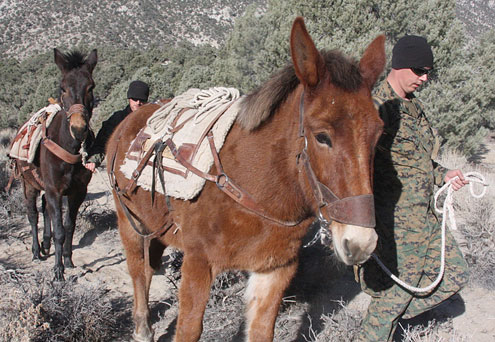
Yes, there is many a Marine NCO out there who after reading the title of this post, is asking himself “what’s the difference?”  Well, Starbuck at the Small Wars Journal Blog has written about the recent Marine Corps training in mule handling as a means of transport of heavy supplies, including ammunition, ordnance, and the other things that weigh the Marine down while patrolling and travelling.

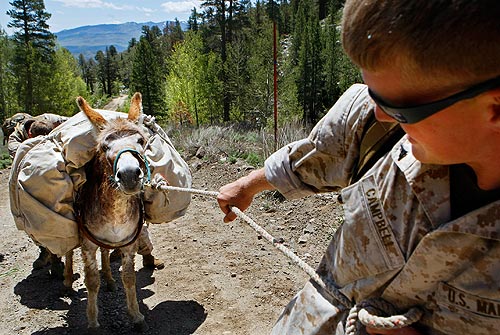
With 75 pounds of military gear cinched on her furry back, Annie was stubborn the whole way.

The two Marines assigned to her pushed, pulled and sweet-talked her up the steep, twisting trail on the eastern side of the Sierra Nevada.

“C’mon, girl, you can make it,” Lance Cpl. Chad Campbell whispered in her ear.

“Only one more hill,” promised Lance Cpl. Cameron Cross as he shoved Annie’s muscular hindquarters.

The red-hued donkey snorted, nibbled on grass and let loose that distinctive braying, which begins with a loud nasal inhalation and concludes with an even louder blast of deep-throated protest.

She also dropped green, foul-smelling clumps, which the Marines carefully sidestepped.

On the rocky, uneven path, Annie never stumbled. A good donkey, Marines say, knows three steps ahead where it wants to walk.

For Campbell and Cross, the day with Annie could be a preview of days to come. The two may soon deploy to Afghanistan, where donkeys and mules have been the preferred mode of military transport for centuries — and remain so.

With the U.S. shifting its focus from the deserts of Iraq to the mountains of Central Asia, this course on pack animals at the Marine Corps Mountain Warfare Training Center has become critical to the new mission.

I just have one bone to pick.  I dealt with this almost four months ago in Marines, Animals and Counterinsurgency.  I also linked and embedded the video of the Big Dog, a mechanized set of processors, servos and other components that will malfunction, have no power when the batteries degrade or die, and require constant maintenance due to dust, mud, and overuse.  Brandon Friedman at the SWJ has it about right.

The BigDog seems pretty ridiculous. We could probably buy a mule for every infantry squad in Afghanistan and feed it for a year for well under the price of one BigDog. How does the BigDog work in the rain? Can it make a water crossing? How many batteries does it require? How heavy are they? How are they charged? Who’s trained to do maintenance on it? Will he or she have to accompany the BigDog on missions? I really love the stealthy buzzing sound it makes, too.

Yes, the thing sounds like a million angry Africanized bees.  I am all in favor of weight reduction for warriors, and have constantly advocated R&D for ESAPI plates to reduce body armor weight.  But the low hanging fruit has been picked, and any further weight reductions will come at high expense and hard work.

I can’t escape the feeling that some of the drive at DARPA to build mechanical beasts to support logistics has to do with the eradication or neutralization of gender differences.  We have dealt with this issue before in:

Marines, Beasts and Water

Scenes from Operation Khanjar II

Where we discussed the fact that Marine infantry and Army Special Forces don’t allow females to occupy billets.  Females have different PT requirements than males, and suffered an inordinately high number of lower extremity injuries compared to males in the Russian Army while they conducted their campaign in Afghanistan.

When the average Marine Infantryman leaves the line at greater than 120 pounds, it’s obvious that gender differences become pronounced, as do differences in conditioning and training.  If one supposes that this load is reduced to 90 – 100 pounds, how does that allow for the eradication of gender differences?  In fact, suppose that the Marine is only carrying his body armor, hydration system, weapon (let’s suppose a SAW), ammunition (let’s suppose several drums of ammunition), and a few other essentials for a daily patrol.  How does a reduction in the weight to 60 – 70 pounds eradicate gender differences when the Marine needs to sprint from compound to compound in order to avoid sniper fire?

As for the mules and donkeys, I have previously described my view of what fathers should be doing with their sons.  My Marine knew how to train Quarter horses and care for dogs before he ever went into the Marines because I taught him.  He eventually became better than me.  Every Marine should know something about how to handle dogs, mules, horses, and other animals, and should also know something about the anatomy of animals (e.g., how do you prepare a snake to eat after you have killed it, how do you care for horses in the absence of a farrier, and so on).

As we pointed out before, the discussions about animals in the Small Wars Manual doesn’t seem so far fetched in this day and age, does it?  The Afghanistan terrain and climate that would kill most machines is ready made for beasts of burden.

In summary, weight reduction ought to be pursued with available funds to reduce the burden on the Infantryman.  But Marine infantry is for young men, and the push to eradicate gender differences, if that’s what this is about, makes the DoD and DARPA look stupid.  Marine Infantrymen must be males for a whole host of very good reasons.  The push to eradicate gender considerations should stop, as the money is needed elsewhere.  All Marines should know something about the proper care of animals, and there is no excuse for leaving this out of pre-deployment training.  The Marines aren’t so busy that they can’t rotate through a week long course with another Marine instructor who has himself been more thoroughly trained on animals.

Seriously.  What could possibly be controversial about what I have said?

Obama’s Shame: Rewarding Iranian Terror

16 years, 7 months ago

It is no secret that the Iranians continue to supply weapons to Iraqi Shi’a insurgents, and even deploy their own Quds to perpetrate violence inside Iraq.  From the June 2009 issue of the Sentinel at the Combatting Terrorism Center at West Point.

On may 6, 2009, Iraqi Army and police auxiliary units supported by U.S. advisers discovered a cache of weapons hidden along the banks of the Tigris River in Amara, the capital of the majority Shi`a Maysan Province. The hoard included 150 copper plates for use in Explosively-Formed Projectile (EFP) roadside bombs, which have the highest per-incident lethality rate of any explosive device used in Iraq. Along with the professionally milled copper cones were 70 passive infrared firing switches used to precisely detonate EFP devices as vehicles enter the killing zone. Fifty rocket launching rails were also located, composed of modified carjacks designed to elevate 107mm and 122mm rockets for relatively accurate long-range attacks.

This is recent indication of the extent and magnitude of involvement of Iranian elements in the affairs of Iraq – and by extrapolation the U.S. because so many U.S. Soldiers, Sailors, Airmen and Marines have died in Iraq.  While this was a weapons cache, a static display of involvement, the kinetic fight against Iranian elements went on on unabated even as late as autumn 2008 according to intelligence reports mined by the Sentinel.

The Hawr al-Howeiza marshes further to the south offer another clear example of insurgent groups seeking to defend their lines of communication and supply to sanctuaries and logistical networks in Iran. The Hawr al-Howeiza has long been a major smuggling route between Iran and Iraq due to the difficulties of policing the maze of waterways that permeate the border. U.S. and Iraqi Army forces have strung a line of border forts across the Hawr al-Howeiza, supported by FOBs north and south of the marshes at Musharrah and Qalit Salih, respectively. U.S. forces met resistance as soon as the process began in the autumn of 2008. Large Iranian-made 240mm rockets were used to attack U.S. FOBs around Qalit Salih, and the frequency of mortar and rocket attacks increased against the U.S. FOB in Majar al-Kabir. Each month since September 2008, two to four EFPs have been laid on U.S. access routes to the marshes. These attacks have borne the classic hallmarks of Lebanese Hizb Allah training in terms of configuration of passive-infrared telemetry, remote-control arming switches and encasement in molded insulation foam “rocks.” Other roadside bombs included 10 well-concealed daisy-chained 155mm artillery shells on the access roads between the FOB in Qalit Salih and the Hawr al-Howeiza field. These attacks confirmed to patterns previously noted by UK explosives ordnance technicians when British forces last patrolled the areas in 2005.

So just how effective has Iranian involvement been in Iraq?  Steve Schippert gives us an important metric.

Immediately, the context you need: Since the beginning of U.S. operations in Iraq in 2003, fully 10 percent of our combat fatalities there have come at the hands of just one Iranian weapon — the EFP (Explosively Formed Penetrator), designed by Iran’s Islamic Revolutionary Guard Corps specifically to penetrate the armor of the M1 Abrams main battle tank and, consequently, everything else deployed in the field. It is how the Iranian regime has been killing your sons and daughters, brothers and sisters, mothers and fathers serving in Iraq.

I’ll wager you were not aware of that rather damning statistic. How do I know it? Well . . . I asked a friend in the Pentagon in 2007.  If ambitious journalists would like to share this with their readers and viewers, please do. The numbers are not secret; I am sure they have even been updated. Perhaps they were published elsewhere around the same time. If they were, chances are you never saw it. And those who have seen the figure likely saw it right here at The Tank on National Review Online. Because I wrote it. Over and over.

The current number of U.S. warriors who have perished in Iraq is at 4322.  This means that some 430 Soldiers, Sailors, Airmen and Marines have been killed in Iraq either by Iranians or Iranian supply weapons or trained insurgents.  We judge even this number to be likely a very low estimate.  Take note, however, that this doesn’t include the many more thousands or U.S. warriors who have no legs, who have lost hearing or eyesight, or who have lost proper brain function because of Iranian-supplied IEDs.

The previous administration battled Iran in Iraq, while still failing to see and treat this as the regional war that it is.  Democracy programs at the State Department were killed under Condi Rice, and up until late 2008 Iranian elements were given free access to Iraq.  The only success in battling Iranian elements came within Iraq itself, a victory to be sure, but costly nonetheless.

Has Iran learned any lessons from this, and how will the current administration interact with Iran?  If the recent failure even to give verbal and informal support to fledgling freedom fighters on the streets of Tehran wasn’t enough, we now have the Obama administration to thank for one of the the most shameful incidents in American history.

There are a few things you need to know about President Obama’s shameful release on Thursday of the “Irbil Five” — Quds Force commanders from Iran’s Islamic Revolutionary Guards Corps (IRGC) who were coordinating terrorist attacks in Iraq that have killed hundreds — yes, hundreds — of American soldiers and Marines.

First, of the 4,322 Americans killed in combat in Iraq since 2003, 10 percent of them (i.e., more than 400) have been murdered by a single type of weapon alone, a weapon that is supplied by Iran for the singular purpose of murdering Americans. As Steve Schippert explains at NRO’s military blog, the Tank, the weapon is “the EFP (Explosively Formed Penetrator), designed by Iran’s IRGC specifically to penetrate the armor of the M1 Abrams main battle tank and, consequently, everything else deployed in the field.” Understand: This does not mean Iran has killed only 400 Americans in Iraq. The number killed and wounded at the mullahs’ direction is far higher than that — likely multiples of that — when factoring in the IRGC’s other tactics, such as the mustering of Hezbollah-style Shiite terror cells.

Second, President Bush and our armed forces steadfastly refused demands by Iran and Iraq’s Maliki government for the release of the Irbil Five because Iran was continuing to coordinate terrorist operations against American forces in Iraq (and to aid Taliban operations against American forces in Afghanistan). Freeing the Quds operatives obviously would return the most effective, dedicated terrorist trainers to their grisly business …

Third, Obama’s decision to release the five terror-masters comes while the Iranian regime (a) is still conducting operations against Americans in Iraq, even as we are in the process of withdrawing, and (b) is clearly working to replicate its Lebanon model in Iraq: establishing a Shiite terror network, loyal to Iran, as added pressure on the pliant Maliki to understand who is boss once the Americans leave.

Fourth, President Obama’s release of the Quds terrorists is a natural continuation of his administration’s stunningly irresponsible policy of bartering terrorist prisoners for hostages. As I detailed here on June 24, Obama has already released a leader of the Iran-backed Asaib al-Haq terror network in Iraq, a jihadist who is among those responsible for the 2007 murders of five American troops in Karbala. While the release was ludicrously portrayed as an effort to further “Iraqi reconciliation” (as if that would be a valid reason to spring a terrorist who had killed Americans), it was in actuality a naïve attempt to secure the reciprocal release of five British hostages — and a predictably disastrous one: The terror network released only the corpses of two of the hostages, threatening to kill the remaining three (and who knows whether they still are alive?) unless other terror leaders were released.

Michael Ledeen has reported that the release of the Irbil Five is part of the price Iran has demanded for its release in May of the freelance journalist Roxana Saberi. Again, that’s only part of the price: Iran also has demanded the release of hundreds of its other terror facilitators in our custody. Expect to see Obama accommodate this demand, too, in the weeks ahead.

So this report begs the question: is a free lance journalist so valuable that the President of the U.S. would release terrorists who had managed the killing of well over 400 U.S. servicemen?  The obvious answer to that question is no, which leaves us with only one other alternative.

Finally, when it comes to Iran, it has become increasingly apparent that President Obama wants the mullahs to win. What you need to know is that Barack Obama is a wolf in “pragmatist” clothing: Beneath the easy smile and above-it-all manner — the “neutral” doing his best to weigh competing claims — is a radical leftist wedded to a Manichean vision that depicts American imperialism as the primary evil in the world.

Sadly, McCarthy’s analysis is the only logical one left.  If there is no pragmatic reason to take an action, one must search next for ideological ones.  And the ghosts of hundreds of sons of America haunt us still.

Marines, Beasts and Water

16 years, 7 months ago

In Scenes From Operation Khanjar II we discussed heavy battle space weight, the contribution of water to this weight, and the necessity for Marine infantry to be all male.  A debate ensued concerning all of the salient points, but the truth remains that it requires young males in superior condition to sprint with body armor under fire, and carry (in many cases) more than 120 pounds of weapons, food, armor, water, ammunition and equipment for ten to twelve hours a day in more than 100 degree heat.  The low hanging fruit has already been picked.  There isn’t much else that can be done concerning weight with the exception of ESAPI plates, and even modifications to these won’t remove the heavy weight of water.

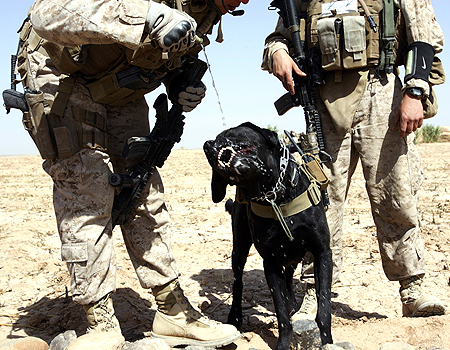
U.S. Marine dog handler corporal Chad Perraut, with 2nd platoon, F company, 5th battalion, 10th Marines pours water for Body, a Marine bomb sniffer patrol dog, during a patrol in southern Afghanistan. After five years coping with the most dangerous province in Iraq, the U.S. Marines have been given their next assignment: Helmund, the most dangerous province in Afghanistan.

Heavy exertion in hot weather while wearing body armor requires that the Marine carry enough to drink multiple liters of water every hour to avoid dehydration and even heat stroke.  The heat is as much of an enemy as the insurgents.

After hours of ferocious fighting in southern Afghanistan, the two young US Marines desperately needed emergency medical care — and it was the heat, not the Taliban, that had finally defeated them.

Charles Auge and Edwin Saez had landed at a canal junction at dawn last Thursday as part of a major US offensive against Islamist insurgents in the key province of Helmand.

They were engaged in an intense battle through the heat of day against dozens of gunmen who were determined not to lose control of the Mian Poshtey intersection in the south of Garmsir district.

When their two-and-a-half-litre (five-US-pint) water backpacks ran out, Auge and Saez looked to restock from the bottles that Echo company from the 2/8 infantry battalion had brought with them on the helicopter assault.

But as the company came under constant fire, the supplies were limited and the water scorchingly hot when it did arrive.

“We were on the flank beside a thick grass berm, and in the middle of the day the sun was so strong and there was no shade,” Auge, 24, said. “I began to feel dizzy and everything turned white.”

Saez, 21, also became a “heat casualty” soon after, having shot at — and apparently killed — two gunmen who were firing at the Marines from behind a wall.

“I started slipping in and out of consciousness,” he said. “The water we got was so hot it burnt in my throat.”

The two Marines became so seriously ill that they were evacuated from the battlefield by Red Cross helicopters that came in under hostile fire.

They were treated with intravenous drips and ice baths, and kept under observation at a field hospital for three days before being released, now recovering from the ordeal.

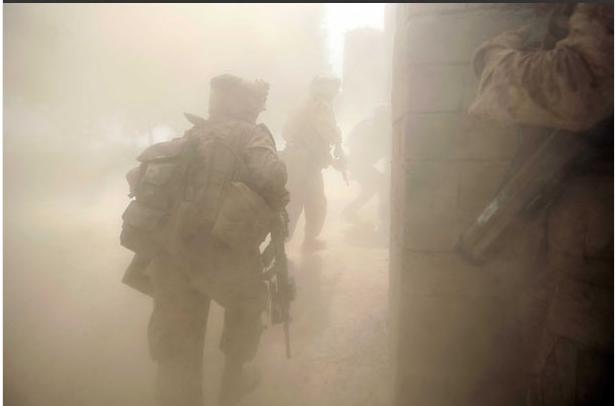
Marines run through a door that they blew open with explosives after taking fire from inside a compound in Mian Poshteh, in the hot dust of Helmand.

Command knows that this is an issue and is trying to deal with it.

… we understand the number one threat here right now today is not the Taliban, it’s the heat.  And as I said, it is hot as fire.  Every day we’ve got helicopters, day and night, pushing all manner of logistics, but especially pallets of water to the Marines.  I am more than confident — and I stay in touch with my commanders down there — I am more than confident that we’re getting the amount of water they need in a timely manner.  No one is going without water.

My problem, and what I’m fussing about with my staff, is that the water’s not cold.  We need to freeze that water.  We need to deliver water that’s pretty well frozen.  It will thaw out very quickly.  So we’re working on that.

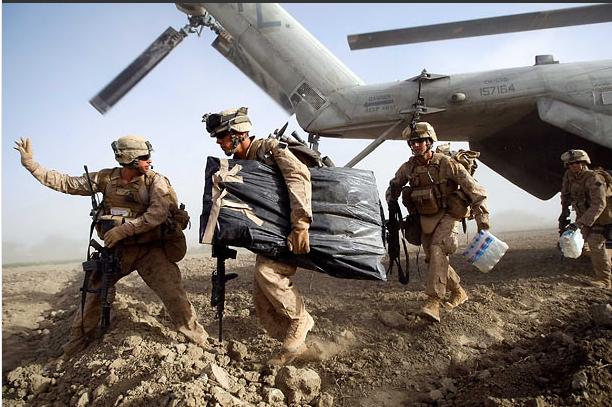
Insertion of Marines at the outset of Operation Khanjar, Marines carry water.

Failure to plan for this is stolid and inept.  But there are families that are pressing for formal investigations into marches in severe heat at the beginning of Operation Khanjar.  This is about as inept as the failure to plan for cold water.  What would the results of such an investigation be?  That the life of a Marine infantryman is hard?

The Marine logistics officers in Southern Helmand should plan better, the Marine families should drop their demands for investigations, and Marine infantry remains a young man’s job (with special emphasis on both young and man).

Mullen Pops Jones in the Back of the Head

16 years, 7 months ago

You know all about National Security Advisor Jim Jones’ terse warning to the commanders in Afghanistan that they had gotten all of the troops they were going to get?  As it turns out, Mullen decided that he would respond by giving Jones a pop to the back of the head.

WALLACE: You talked about troop levels. I want to talk about not just in southern Afghanistan but throughout the country…

MULLEN: Sure.

WALLACE: … because there seem to be mixed messages this week about our troop level policy for Afghanistan.

National Security Adviser James Jones was quoted this week as telling U.S. commanders they are not to expect any more troops beyond what the president has already promised.

You were quoted the next day as saying the top new commander, General McChrystal, is going to make a review, and he can ask for as many troops as he wants. Admiral, which is it?

MULLEN: I’ve had — I’ve had discussions with General Jones, also with the president, and I think we’re all committed to making sure we resource this correctly.

President Obama has committed the forces that we’ve asked this year. General McChrystal, who is the brand-new leader there, is in the middle of an assessment. He’ll come back in about 45 days with his assessment in terms of what he needs.

My guidance to him had been, “Tell us what you need, and then come back and we’ll work that.” And it’s guidance that both General Jones and the president understands and support.

I think one of the points is we have to make sure that every single American that is there is one that we absolutely need.

In addition, the commander on the ground has to assess with a new strategy, and he’s a — and new leadership — really zero base — not just what’s there, but what he needs for the future, and we expect that sometime the end of July or middle of August.

We’ll see if the administration deploys the necessary troops and does the necessary logistics to ensure that the campaign ends acceptably.  In the mean time, it couldn’t be clearer.  Jim Jones is not a serious man, and as a sign of his impotence and uselessness to us in his current position, Mullen has had to tell him to shut up because he doesn’t know what he’s talking about.  Jim Jones should resign.

Prior:

Calling on National Security Advisor James L. Jones to Resign

Afghanistan: The WTF? War

Scenes From Operation Khanjar V

16 years, 7 months ago

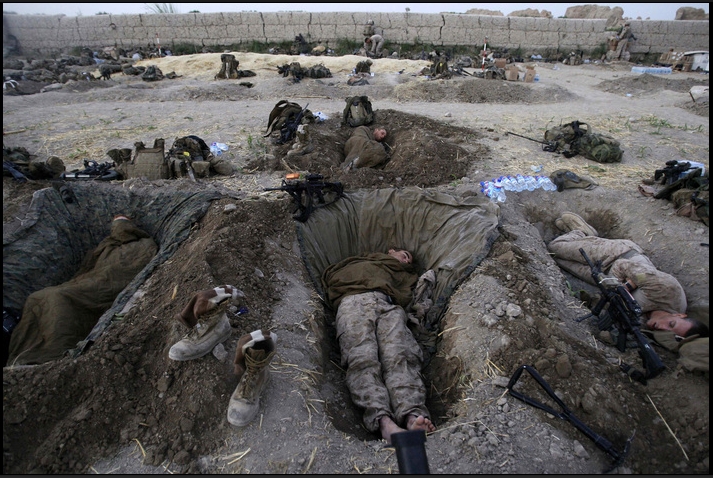
U.S. Marines from the 2nd MEB, 1st Battalion 5th, sleep in their fighting holes inside a compound where they stayed for the night, in the Nawa district of Afghanistan.  Ah … there’s nothng like sleeping in a hole.


26th MEU (10)
Abu Muqawama (12)
ACOG (2)
ACOGs (1)
Afghan National Army (36)
Afghan National Police (17)
Afghanistan (704)
Afghanistan SOFA (4)
Agriculture in COIN (3)
AGW (1)
Air Force (41)
Air Power (10)
al Qaeda (83)
Ali al-Sistani (1)
America (22)
Ammunition (304)
Animals (322)
Ansar al Sunna (15)
Anthropology (3)
Antonin Scalia (1)
AR-15s (393)
Arghandab River Valley (1)
Arlington Cemetery (2)
Army (91)
Assassinations (2)
Assault Weapon Ban (29)
Australian Army (7)
Azerbaijan (4)
Backpacking (4)
Badr Organization (8)
Baitullah Mehsud (21)
Basra (17)
BATFE (246)
Battle of Bari Alai (2)
Battle of Wanat (18)
Battle Space Weight (3)
Bin Laden (7)
Blogroll (3)
Blogs (24)
Body Armor (23)
Books (3)
Border War (18)
Brady Campaign (1)
Britain (39)
British Army (36)
Camping (5)
Canada (19)
Castle Doctrine (1)
Caucasus (6)
CENTCOM (7)
Center For a New American Security (8)
Charity (3)
China (19)
Christmas (18)
CIA (30)
Civilian National Security Force (3)
Col. Gian Gentile (9)
Combat Outposts (3)
Combat Video (2)
Concerned Citizens (6)
Constabulary Actions (3)
Coolness Factor (3)
COP Keating (4)
Corruption in COIN (4)
Council on Foreign Relations (1)
Counterinsurgency (218)
DADT (2)
David Rohde (1)
Defense Contractors (2)
Department of Defense (220)
Department of Homeland Security (26)
Disaster Preparedness (5)
Distributed Operations (5)
Dogs (15)
Donald Trump (27)
Drone Campaign (4)
EFV (3)
Egypt (12)
El Salvador (1)
Embassy Security (1)
Enemy Spotters (1)
Expeditionary Warfare (18)
F-22 (2)
F-35 (1)
Fallujah (17)
Far East (3)
Fathers and Sons (2)
Favorite (1)
Fazlullah (3)
FBI (39)
Featured (192)
Federal Firearms Laws (18)
Financing the Taliban (2)
Firearms (1,867)
Football (1)
Force Projection (35)
Force Protection (4)
Force Transformation (1)
Foreign Policy (27)
Fukushima Reactor Accident (6)
Ganjgal (1)
Garmsir (1)
general (15)
General Amos (1)
General James Mattis (1)
General McChrystal (44)
General McKiernan (6)
General Rodriguez (3)
General Suleimani (9)
Georgia (19)
GITMO (2)
Google (1)
Gulbuddin Hekmatyar (1)
Gun Control (1,717)
Guns (2,406)
Guns In National Parks (3)
Haditha Roundup (10)
Haiti (2)
HAMAS (7)
Haqqani Network (9)
Hate Mail (8)
Hekmatyar (1)
Heroism (5)
Hezbollah (12)
High Capacity Magazines (16)
High Value Targets (9)
Homecoming (1)
Homeland Security (3)
Horses (2)
Humor (72)
Hunting (60)
ICOS (1)
IEDs (7)
Immigration (123)
India (10)
Infantry (4)
Information Warfare (4)
Infrastructure (4)
Intelligence (23)
Intelligence Bulletin (6)
Iran (171)
Iraq (379)
Iraq SOFA (23)
Islamic Facism (64)
Islamists (98)
Israel (19)
Jaish al Mahdi (21)
Jalalabad (1)
Japan (3)
Jihadists (82)
John Nagl (5)
Joint Intelligence Centers (1)
JRTN (1)
Kabul (1)
Kajaki Dam (1)
Kamdesh (9)
Kandahar (12)
Karachi (7)
Kashmir (2)
Khost Province (1)
Khyber (11)
Knife Blogging (7)
Korea (4)
Korengal Valley (3)
Kunar Province (20)
Kurdistan (3)
Language in COIN (5)
Language in Statecraft (1)
Language Interpreters (2)
Lashkar-e-Taiba (2)
Law Enforcement (6)
Lawfare (14)
Leadership (6)
Lebanon (6)
Leon Panetta (2)
Let Them Fight (2)
Libya (14)
Lines of Effort (3)
Littoral Combat (8)
Logistics (50)
Long Guns (1)
Lt. Col. Allen West (2)
Marine Corps (281)
Marines in Bakwa (1)
Marines in Helmand (67)
Marjah (4)
MEDEVAC (2)
Media (68)
Medical (146)
Memorial Day (6)
Mexican Cartels (47)
Mexico (71)
Michael Yon (6)
Micromanaging the Military (7)
Middle East (1)
Military Blogging (26)
Military Contractors (5)
Military Equipment (25)
Militia (9)
Mitt Romney (3)
Monetary Policy (1)
Moqtada al Sadr (2)
Mosul (4)
Mountains (25)
MRAPs (1)
Mullah Baradar (1)
Mullah Fazlullah (1)
Mullah Omar (3)
Musa Qala (4)
Music (25)
Muslim Brotherhood (6)
Nation Building (2)
National Internet IDs (1)
National Rifle Association (97)
NATO (15)
Navy (31)
Navy Corpsman (1)
NCOs (3)
News (1)
NGOs (3)
Nicholas Schmidle (2)
Now Zad (19)
NSA (3)
NSA James L. Jones (6)
Nuclear (63)
Nuristan (8)
Obama Administration (222)
Offshore Balancing (1)
Operation Alljah (7)
Operation Khanjar (14)
Ossetia (7)
Pakistan (165)
Paktya Province (1)
Palestine (5)
Patriotism (7)
Patrolling (1)
Pech River Valley (11)
Personal (76)
Petraeus (14)
Pictures (1)
Piracy (13)
Pistol (4)
Pizzagate (21)
Police (672)
Police in COIN (3)
Policy (15)
Politics (998)
Poppy (2)
PPEs (1)
Prisons in Counterinsurgency (12)
Project Gunrunner (20)
PRTs (1)
Qatar (1)
Quadrennial Defense Review (2)
Quds Force (13)
Quetta Shura (1)
RAND (3)
Recommended Reading (14)
Refueling Tanker (1)
Religion (499)
Religion and Insurgency (19)
Reuters (1)
Rick Perry (4)
Rifles (1)
Roads (4)
Rolling Stone (1)
Ron Paul (1)
ROTC (1)
Rules of Engagement (75)
Rumsfeld (1)
Russia (37)
Sabbatical (1)
Sangin (1)
Saqlawiyah (1)
Satellite Patrols (2)
Saudi Arabia (4)
Scenes from Iraq (1)
Second Amendment (708)
Second Amendment Quick Hits (2)
Secretary Gates (9)
Sharia Law (3)
Shura Ittehad-ul-Mujahiden (1)
SIIC (2)
Sirajuddin Haqqani (1)
Small Wars (72)
Snipers (9)
Sniveling Lackeys (2)
Soft Power (4)
Somalia (8)
Sons of Afghanistan (1)
Sons of Iraq (2)
Special Forces (28)
Squad Rushes (1)
State Department (23)
Statistics (1)
Sunni Insurgency (10)
Support to Infantry Ratio (1)
Supreme Court (79)
Survival (214)
SWAT Raids (58)
Syria (38)
Tactical Drills (38)
Tactical Gear (17)
Taliban (168)
Taliban Massing of Forces (4)
Tarmiyah (1)
TBI (1)
Technology (21)
Tehrik-i-Taliban (78)
Terrain in Combat (1)
Terrorism (96)
Thanksgiving (13)
The Anbar Narrative (23)
The Art of War (5)
The Fallen (1)
The Long War (20)
The Surge (3)
The Wounded (13)
Thomas Barnett (1)
Transnational Insurgencies (5)
Tribes (5)
TSA (25)
TSA Ineptitude (14)
TTPs (4)
U.S. Border Patrol (8)
U.S. Border Security (22)
U.S. Sovereignty (29)
UAVs (2)
UBL (4)
Ukraine (10)
Uncategorized (105)
Universal Background Check (3)
Unrestricted Warfare (4)
USS Iwo Jima (2)
USS San Antonio (1)
Uzbekistan (1)
V-22 Osprey (4)
Veterans (3)
Vietnam (1)
War & Warfare (432)
War & Warfare (41)
War Movies (4)
War Reporting (21)
Wardak Province (1)
Warriors (6)
Waziristan (1)
Weapons and Tactics (80)
West Point (1)
Winter Operations (1)
Women in Combat (21)
WTF? (1)
Yemen (1)

February 2026
January 2026
December 2025
November 2025
October 2025
September 2025
August 2025
July 2025
June 2025
May 2025
April 2025
March 2025
February 2025
January 2025
December 2024
November 2024
October 2024
September 2024
August 2024
July 2024
June 2024
May 2024
April 2024
March 2024
February 2024
January 2024
December 2023
November 2023
October 2023
September 2023
August 2023
July 2023
June 2023
May 2023
April 2023
March 2023
February 2023
January 2023
December 2022
November 2022
October 2022
September 2022
August 2022
July 2022
June 2022
May 2022
April 2022
March 2022
February 2022
January 2022
December 2021
November 2021
October 2021
September 2021
August 2021
July 2021
June 2021
May 2021
April 2021
March 2021
February 2021
January 2021
December 2020
November 2020
October 2020
September 2020
August 2020
July 2020
June 2020
May 2020
April 2020
March 2020
February 2020
January 2020
December 2019
November 2019
October 2019
September 2019
August 2019
July 2019
June 2019
May 2019
April 2019
March 2019
February 2019
January 2019
December 2018
November 2018
October 2018
September 2018
August 2018
July 2018
June 2018
May 2018
April 2018
March 2018
February 2018
January 2018
December 2017
November 2017
October 2017
September 2017
August 2017
July 2017
June 2017
May 2017
April 2017
March 2017
February 2017
January 2017
December 2016
November 2016
October 2016
September 2016
August 2016
July 2016
June 2016
May 2016
April 2016
March 2016
February 2016
January 2016
December 2015
November 2015
October 2015
September 2015
August 2015
July 2015
June 2015
May 2015
April 2015
March 2015
February 2015
January 2015
December 2014
November 2014
October 2014
September 2014
August 2014
July 2014
June 2014
May 2014
April 2014
March 2014
February 2014
January 2014
December 2013
November 2013
October 2013
September 2013
August 2013
July 2013
June 2013
May 2013
April 2013
March 2013
February 2013
January 2013
December 2012
November 2012
October 2012
September 2012
August 2012
July 2012
June 2012
May 2012
April 2012
March 2012
February 2012
January 2012
December 2011
November 2011
October 2011
September 2011
August 2011
July 2011
June 2011
May 2011
April 2011
March 2011
February 2011
January 2011
December 2010
November 2010
October 2010
September 2010
August 2010
July 2010
June 2010
May 2010
April 2010
March 2010
February 2010
January 2010
December 2009
November 2009
October 2009
September 2009
August 2009
July 2009
June 2009
May 2009
April 2009
March 2009
February 2009
January 2009
December 2008
November 2008
October 2008
September 2008
August 2008
July 2008
June 2008
May 2008
April 2008
March 2008
February 2008
January 2008
December 2007
November 2007
October 2007
September 2007
August 2007
July 2007
June 2007
May 2007
April 2007
March 2007
February 2007
January 2007
December 2006
November 2006
October 2006
September 2006
August 2006
July 2006
June 2006
May 2006

about · archives · contact · register

Copyright © 2006-2026 Captain's Journal. All rights reserved.