That’s what Josh Horwitz would have you believe. Actually, the Huffington Post can’t get their narrative straight. Five days before publishing Horwitz’ piece they published the narrative that background checks of firearms spiked in 2011 and especially towards the end of the year. But let’s note that consistency isn’t the stock and trade of the Huffington Post and move on.
While noting that background checks for firearms had increased, Josh points out that “Thousands of background checks each year result in denials” … “Background checks are performed under a number of circumstances that do not involve gun sales, for example, when an individual pawns a weapon and later redeems it” … “In some states, a concealed handgun permit exempts permit holders from having to undergo additional background checks when they purchase new firearms,” and so on the explanation goes.
That these same exceptions and caveats existed prior to 2011 and also effected data from the previous years (assumed to the same extent unless and until proven otherwise) is irrelevant to Josh. What matters is selling the narrative. But Josh must have missed the memoranda, and presumably there isn’t really any better witness than firearms dealers. A sampling (albeit anecdotal) follows.
There has been an increase in both the sale of firearms and in concealed handgun permit requests in Gaston County, North Carolina, in 2011.
At Second Amendment Sports in Bakersfield, California, firearms sales were up 25% from the previous year.
In and around Cleveland, Ohio, local firearms dealers say their sales have been up from anywhere between 20 and 40 percent. A large part of the surge in gun sales has been by women who want to learn how to shoot and defend themselves.
At Sharpshooters in Lubbock, Texas, they have seen their handgun sales increase by 10 to 15 percent over the past year.
Sales of firearms to women in Permian Basin, Texas, have doubled.
You see, Josh Horwitz relied on data supplied by the highly biased Violence Policy Center for his analysis. But he is using the data to attempt to dispute a tidal wave of evidence that the second amendment is alive and well with American citizens.
It isn’t clear what Horwitz is attempting to do with his analysis. Perhaps he intends to substantiate the constant assertions by his organization and the Brady Campaign that the NRA “owns” the Congress, and always uses scare tactics to convince people to give more and more of their money to the NRA in order to protect the second amendment – that the real threat isn’t gun control advocates, and in fact, there are fewer gun owners in America. The real threat is the NRA. Perhaps that’s his aim, although it’s an odd, forced, stilted and uncompelling argument.
Then there are those like me who believe that until recently (in American Rifleman magazine), Wayne LaPierre and Chris Cox have undersold and soft pedaled the message. They seem to have just recently hit their stride, but this just goes to show that not all of us propagate NRA conspiracy theories or fall prey to them. Many of us are out ahead of them waiting for them to catch up. If the NRA is Horwitz’ target, his analysis fails miserably. If not, then no one knows why he wrote the analysis in the first place. Besides, if there are fewer and fewer gun owners in America, then there is far less need for gun control laws, another unintended consequence of Horwitz’ argument.
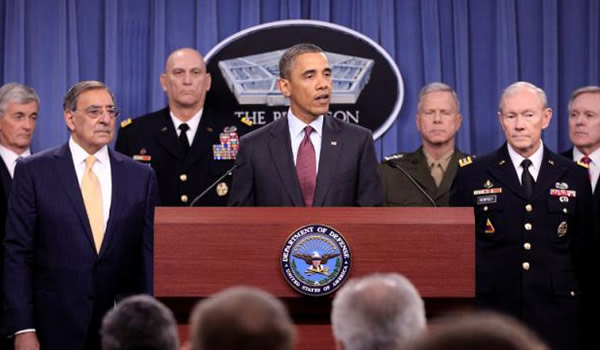
Obama has rolled out his plan for defense cuts. He appeared at the Pentagon with such notables as Generals Odierno and Amos. This is extremely bad form, and this tactic was used to make it appear that the military agrees with or is setting national defense policy, specifically, the Obama administration policy. It isn’t the business of the military to agree or disagree with its civilian leadership on national defense policy.
To the point, the revised policy includes things such as a so-called rebalancing towards the Asia-Pacific region. It also will place higher emphasis on drones and cyberwarfare, and will markedly decrease the size of the Army and Marine Corps. This shift in policy is supposed to align with an increased concern over saber-rattling by China and increased growth of its military.
There has also been a large amount of posturing over the wasteful spending at the Pentagon. At Foreign Affairs Lawrence Korb has penned an article entitled Why Panetta’s Pentagon Cuts Are Easier Than You Think. Any review of my advocacy will show that I have opposed ridiculous programs as well. I’ve called for the end of the Expeditionary Fighting Vehicle and counseled the Marine Corps to focus its energies on forcible entry based on more rapid and aggressive airborne assault (such as with helicopters and V-22 Ospreys). I have advocated the end of the highly wasteful F-35 program, as well as more F-16s and F-22s (both of which outperform the F-35). I have advocated against the Army Future Combat Systems, and other wasteful programs.
Furthermore, my own advocacy for the far east has been to cut Japan loose from our umbrella of nuclear protection, as well as for South Korea. Nothing would slow China’s military advances more than having to worry over a nuclear Japan. But my advocacy has also been for staying the course in both Iraq and Afghanistan, for strengthening our infantry, both Army and Marines, and for replacing and upgrading infantry equipment. An entirely new armory of rifles and automatic arms will be needed to replace the aging actions of older firearms in order to keep our infantry well-supplied. Future policy has also pointed towards a reduction in the number of aircraft carrier groups, while I have argued for steady or increasing carrier availability as one of the most effective elements of force projection.
But this – the current Obama administration actions – is more than re-apportionment and redistribution of resources to ensure wiser spending. Make no mistake about it. Approximately one and a half years ago, the CATO institute produced a study entitled Sustainable Defense Task Force, and it wasn’t the only such study. The unspoken presupposition of these efforts was the need to find money for entitlement spending. They saw it coming, and they prepared the think tank papers and studies to show that it was necessary.
Like many chaps round these parts, my general line on Ron Paul was that, as much as I think he’s out of his gourd on Iran et al, he performs a useful role in the GOP line-up talking up the virtues of constitutional conservatism. But this Weekly Standard piece by John McCormack suggests Paul is a humbug even on his core domestic turf: The entitlement state is the single biggest deformation to the Founders’ republic, and it downgrades not only America’s finances but its citizenry. Yet Paul has no serious proposal for dealing with it, and indeed promises voters that we won’t have to as long as we cut “overseas spending”.
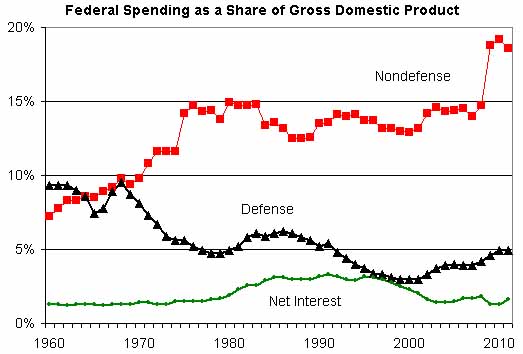
This is hooey. As I point out in my book, well before the end of this decade interest payments on the debt will consume more of the federal budget than military spending. So you could abolish the Pentagon, sell off the fleet to Beijing and the nukes to Tehran and Khartoum and anybody else who wants ‘em, and we’d still be heading off the cliff. If a candidate isn’t talking about entitlement transformation, he’s unserious.
And, before the Ronulans start jeering “Neocon!”, I part company with many friends on the right who argue that defense spending can’t be cut. I wrote a cover story for NR a couple of months back arguing that the military’s bloated size (and budget) is increasingly an impediment to its effectiveness: When you’re responsible for 43 per cent of global military expenditure, it’s hardly surprising that you start acting like the world’s most lavishly funded transnational-outreach non-profit rather than the sharp end of America’s national interest. In Afghanistan, the problem is not that we haven’t spent enough money but that so much of it has been utterly wasted – and mostly in predictable ways. I am in favor of a leaner, meaner military, with the emphasis on both adjectives.
But Ron Paul, with his breezy indifference to the entitlement question, is peddling the same illusion Obama sold a gullible electorate in 2008 – that, if only America retreats from “Bush’s wars”, life can go on, and we’ll be fat and happy with literally not a care in the world. Big Government parochialism is an appealing fantasy because it suggests America’s fortunes can be restored without pain. But they can’t – and when Ron Paul tells you otherwise he’s talking hogwash.
The illusion is that cuts to defense spending can save our economic system from collapse. The administration talks of two wars ending, and the wars of the last decades “coming to an end.” Coming to an end indeed. While I have argued endlessly for better and smarter logistics, the difficulty facing the logisticians now is getting troops and materiel out of Afghanistan rather than into it. And with waning political support for the campaign, it would be easy to argue for complete withdrawal, even immediately. If the campaign won’t be taken seriously and run to its completion with an outcome that we can live with, I argue (herein) for such withdrawal. America apparently isn’t prepared to encounter militant Islam on our own terms. Very well. Then we’ll do it on their terms, and it will be more painful.
The wars of the “last decade” won’t go away. The enemy gets a vote on our fate fate as well. And Robert Scales outlines the downside of defense cuts.
Harry Truman seeking to never repeat the costs of World War II reduced the Army from 8 million soldiers to fewer than half a million. Without the intervention of Congress, he would have eliminated the Marine Corps entirely. The result was the evisceration of both land services in Korea, a war Truman never intended to fight.
With Dwight Eisenhower came the “New Look” strategy that sought to reduce the Army and Marine Corps again to allow the creation of a nuclear delivery force built around the Strategic Air Command. Along came Vietnam, a war that Eisenhower, John Kennedy and Lyndon Johnson never wanted to fight. But by 1970 our professional Army broke apart and was replaced by a body of amateurs. The result was defeat and 58,000 dead.
After Vietnam, the Nixon administration broke the Army again. I know. I was there to see the drug addiction, murders in the barracks and chronic indiscipline, caused mainly by a dispirited noncommissioned corps that voted with its feet and left. Then came Jimmy Carter’s unique form of neglect that led to the “hollow Army” of the late ’70s, an Army that failed so miserably in its attempt to rescue the American hostages in Iran.
The only exception to this very sad story was the Reagan years, when the land services received enough funding to equip and train themselves to fight so well in Operation Desert Storm. Then tragedy again as the Clinton administration reduced the ground services, intending to rely on “transformation,” a program that paid for more ships and planes by reducing the Army from 16 divisions to 10. In the George W. Bush administration, Donald Rumsfeld continued a policy that sought to exploit information technology to replace the human component in war. Had it not been for the Sept. 11, 2001, attacks, the Army would have gone down to fewer than eight divisions.
So, here we go again. The Obama administration will reduce its long-service, professional land force to pay for something called “Air Sea Battle,” a strategy that seeks to buy more ships and planes in order to confront China with technology rather than people. This strategy shows a degree of a-historicism that exceeds that of any post-World War II administration. So much for remembering “the lessons of the past.”
I’m in good company in my advocacy for good men and materiel. Drones are slow and lumbering, and our national fascination with them will come to a timely end when they see service against states that can easily shoot them out of the air (such as recently with Iran). They are no replacement for the Air Force flying manned fighters, GPS is no real replacement for the ability to read maps and use a compass, red dot optics is no replacement for knowing how to use iron sights, and heavy reliance on logistics is no replacement for training in the ability to use the land for survival. The human element in warfare cannot be replaced by technology.
We will suffer some future hardships from lack of intelligent and wise funding of our military. Defense cuts can exacerbate those hardships. But what defense cuts cannot possibly do is be anything other than a very short-lived and dangerous bank account for survival until we deal with what will be the true root cause of our economic demise: the entitlement state.
Search warrant in hand, a team of bulletproof vest-wearing officers rapped on the door of a small, red-brick Utah house, identifying themselves as police. When no one responded, authorities say, the officers burst inside.
That’s when the gunfire erupted.
When it was over Wednesday night, a seven-year veteran officer was dead and five of his colleagues were wounded, some critically. The suspect, an Army veteran whose estranged father said suffered from post-traumatic stress disorder and may have been self-medicating with marijuana, was injured.
As the city tried Thursday to grapple with the outburst of violence and the loss of one of its officers, investigators were trying to determine how the raid as part of a drug investigation could have gone so terribly wrong.
“It’s a very, very sad day,” an emotional Ogden Police Chief Wayne Tarwater said.
Police declined to reveal details of the shooting besides a general timeline, citing the ongoing investigation.
Among the questions that authorities will try to answer was whether the officers, in the chaotic moments upon entering the house, may have inadvertently fired on each other.
Police said the warrant was based on information about possible drug activity, but would not say what officers were specifically looking for inside Matthew David Stewart’s home.
Stewart, 37, was in the hospital with non-life-threatening injuries, authorities said. He does not have an attorney yet.
Stewart served in the Army from July 1994 to December 1998, spending a year based in Fort Bragg, N.C., and nearly three years stationed in Germany, Army records show.
He held a post as a communications equipment specialist, earning an Army Achievement Medal and a National Defense Service Medal. Both are given for completing active service.
Stewart’s father, Michael Stewart, said his son works a night shift at a local Walmart and may have been sleeping when police arrived.
“When they kicked in the door, he probably felt threatened,” said Michael Stewart, who has been estranged from his son for more than a year, but keeps track of him through his two other sons.
He said he didn’t believe his son owned any automatic weapons and that the family is upset by what happened. Weber County Attorney Dee Smith said it wasn’t yet clear what charges Stewart might face once the shooting investigation concludes.
SWAT raids, in all but a handful of cases, constitute reckless endangerment of the individuals inside the home. Recall that we previously discussed how these kinds of raids also involve endangerment to the officers themselves? In this case, one officer is dead and five wounded – all unnecessarily. It will be interesting to see how this case proceeds. If Mr. Stewart believed that his life was in danger from a home invasion, will a judge or jury actually rule that he had no right to defend himself? Should he sit and allow a home intruder to kill him given the possibility that it might be police officers? Will prosecution bring charges against Mr. Stewart?
There is a solution, of course, to this problem. Don’t do no-knock SWAT raids.
We’re all aware of the recent boasting over how Iran can shut down the Strait of Hormuz. We also know all about the pipelines being constructed by the UAE in an attempt to circumvent the Persian Gulf and thereby defang Iran in its hegemony over the region, at least as regards its threats over the waterways.
There is also – as usual – the bluster about how Iran won’t possibly make good on its promises, and how the U.S. Navy issued threats of its own. But rest assured that if the U.S. or Israel launches a strike against the Iranian nuclear program, given the radical Mullahs apocalyptic and eschatological view of reality, they will hold nothing back from their retaliation.
And don’t rest so comfortably in the blustering of of the U.S. Navy. Their fear of shore to ship missile technology has been the basis for their demurral to define any role at all in what they want so desperately to have a role in, i.e., littoral combat. They won’t tread any closer than 20 miles to shore, the “beyond the horizon” distance.
As for anecdotal data, consider what happened (I have reported this before) with the 26th MEU in 2008. The USS Iwo Jima was in vicinity of the very subject of our discussion (somewhere in the Persian Gulf, or Strait of Hormuz), and an Iranian helicopter virtually landed aboard the ship. The Marines at that time judged a threat and prepared to engage the enemy, but Navy officers, not wanting an incident, of course, ensured that the Marines didn’t respond.
The incident of Iran filming a U.S. Aircraft Carrier rather pales in comparison to an Iranian helicopter hovering just over the deck of the USS Iwo Jima, does it not? I have no confidence whatsoever in the willingness of the US Navy to engage Iran on any level at all.
Friend Rick Keyes writes with this prayer request:
My brother the AC130 pilot is in the hospital in Landstuhl with a non combat related sickness however it is serious enough they evaced him as soon as they could. Any prayers and thoughts that could be sent his direction would be greatly appreciated.
Done. Actually, send your thoughts to Rick and his brother, your prayers in the direction of God.
“And she will bear a Son; and you shall call His name Jesus, for it is He who will save His people from their sins. Now all this took place that what was spoken by the Lord through the prophet might be fulfilled, saying, “Behold the virgin shall be with child, and shall bear a Son, and they shall call His name Immanuel, which translated means, “God with us.” [Matthew 1:21-23]
To all my readers, please enjoy this Christmas season and remember and be thankful for the greatest gift of all, God’s only son, eternal, without beginning and without end, without whom we would truly perish.
If you haven’t heard enough good Christmas music, enjoy the King’s Brass below. All three videos are well worth the time. I had the opportunity to play a few charts with this group when they came through my city, when original member Doug Warner was with them (the greatest trombone player I have ever known, and with whom I had the chance to play).
Peace officers throughout California have bought more than 7,600 assault weapons that are outlawed for civilians in the decade since state lawmakers allowed the practice, according to data obtained by the Associated Press after it was revealed that federal authorities are investigating illegal gun sales by law enforcement.
Investigators have not said what kinds of weapons were involved, but did say they were ones that officers can buy but civilians cannot. That category also can include certain types of handguns and high-capacity ammunition magazines.
The AP’s findings and the federal probe have prompted one state lawmaker to revisit the law to ensure that the guns can be bought only for police purposes.
“I think it’s much more questionable whether we should allow peace officers to have access to weapons or firearms that a private citizen wouldn’t have access to if the use is strictly personal,” said Assemblyman Roger Dickinson, D-Sacramento.
The information was obtained through a California Public Records Act request filed after federal authorities served search warrants in November as part of an ongoing investigation into allegations of illegal weapons sales by several Sacramento-area law enforcement officers.
The investigation has raised questions about the kinds of restricted weapons that the more than 87,000 peace officers in the state are entitled to purchase and about a 2001 law that allows them to buy assault weapons “for law enforcement purposes, whether on or off duty.”
The AP found that some departments allow officers to use the weapons in their off time while others require that the weapons be used only on-duty, although an opinion by the state attorney general issued last year says officers can acquire the guns for any purpose but must relinquish them when they retire.
A department-by-department breakdown of purchases made this year, released as part of the AP’s records request, shows that Los Angeles Police Department officers bought 146 guns, the most in the state. The department’s policy says the guns are to be used only for police purposes.
Today, about 1,300 of the nearly 10,000 LAPD officers have assault rifles, more than 500 of them purchased by the officers themselves.
“We’re not interested in loading up people’s gun closets with assault weapons,” said Cmdr. Andrew Smith, who spent $1,200 on his gun. “The idea is that these guys would be able to have these in the trunks of their police cars if they’re needed.”
Officers in the San Diego Police Department, Riverside County Sheriff’s Department and Long Beach Police Department also registered large numbers of assault weapons so far this year.
Skirting the law, they are. So the LEOs purchase the weapons, and then don’t turn them in when they retire. But the LEOs want to keep their weapons.
“We think that an officer that extends himself and buys this for his department and his community is being unduly punished as they go out the door,” said Ron Cottingham, president of the Peace Officers Research Association of California.
City police officers, county sheriff’s deputies, California Highway Patrol officers, state game wardens, school police officers and other law enforcement personnel can buy assault weapons with their own money, at a cost often exceeding $1,200.
The proposed legislation is still being written but likely would allow officers to re-register their weapons once they retire, similar to the registrations required for those who owned assault rifles before California’s ban became law in 1999.
The peace officers group is a federation of more than 900 local, state and federal law enforcement associations representing 62,000 public safety employees in California. It bills itself as the state’s largest law enforcement organization.
No, no, and a thousand times no! It doesn’t work this way. So there is some utility in so-called assault weapons having nothing whatsoever to do with the official duties of being a law enforcement officer (such as home defense), or the retired LEOs wouldn’t want to keep them.
But if retired LEOs can be deemed to be stable, crime-free and reliable enough to own a weapon with a high capacity magazine and a forend grip, then so can citizens who weren’t employed as LEOs. There is no basis – logical, moral or legal – on which to exempt retired LEOs from the same law under which everyone else must live in California.
I must strongly encourage the state legislature of California to do the right thing and reject this subversion of the rule of law. On the other hand, if they may be persuaded that so-called assault weapons aren’t really used to perpetrate mass killings like the propaganda says, and that the AR may be considered a legitimate home defense weapon, and if the sensibilities of the retired LEOs in California are correct and there is some utility to so-called assault weapons in defense of the home, then perhaps they may also be persuaded to undo the assault weapons ban for all citizens of California. Either way, consistency isn’t the hobgoblin of little minds as claimed by the idiot Ralph Waldo Emerson. It is the stuff of life. It’s the way we all live.
The US is now less dependent on Pakistan for supply of cargo for its troops fighting al-Qaida and Taliban militants in Afghanistan, a Congressional report said today, amid a standoff between Washington and Islamabad over supplies through the country.
The Senate committee report said that only 29% of the total Afghan cargo supply now goes through Pakistan; which about an year ago was nearly 50%.
Islamabad has closed the crucial Nato supply route from Pakistan after the November 26th airstrikes that killed 24 of its soldiers.
“An estimated 40% of all cargo transits the NDN (Northern Distribution Network), 31% is shipped by air, and the remaining 29% goes through Pakistan. An estimated 70% of cargo transiting the NDN enters Afghanistan via Uzbekistan’s Hairaton Gate,” the Senate Foreign Relations Committee said.
Since 2009, the US has steadily increased traffic on the Northern Distribution Network (NDN), a major logistical accomplishment.
According to US Transportation Command, close to 75 per cent of ground sustainment cargo is now shipped via the NDN, it said.
As a result of increasing dependence on NDN for supply of logistics and cargo to its troops in Afghanistan, Senator John Kerry, chairman of the Senate Foreign Relations Committee emphasized that there was a need to build relationship with the Central Asia countries.
“Central Asia matters. Its countries are critical to the outcome in Afghanistan and play a vital role in regional stability. As we reassure our partners that our relationships and engagement in Afghanistan will continue after the military transition in 2014, we should underscore that we have long-term strategic interests in the broader region,” Kerry said.
And of course, you heard about the need for this transition here before you heard about it anywhere else. But there is a catch. Kerry is right – Central Asia matters, but our lines of logistics now rely exclusively on routes through Central Asia and Russia (whereas I had recommended a logistics line from the Mediterranean Sea through the Bosporus Strait in Turkey, and from there into the Black Sea. From the Black Sea the supplies would go through Georgia to neighboring Azerbaijan. From here the supplies would transit across the Caspian Sea to Turkmenistan, and from there South to Afghanistan). The added benefit of such a logistics line would be increased spending, influence and authority in the region, a region heavy in oil and natural gas.
The “disbalance of interests” (see EDM, December 15), favoring Russia over the United States in the South Caucasus, used to be offset by superior US resources, attractiveness and credibility. But that offset has diminished as US policy turned toward de-prioritizing this region (compared with the earlier level of Washington’s engagement). Lacking a strategy for the South Caucasus, the US has taken a back seat to Russia at least since 2008 in the negotiations on the Armenia-Azerbaijan conflict.
Washington had reduced its profile and role on this issue (and on South Caucasus regional security writ large) already during the second term of the Bush administration. It folded the Karabakh conflict portfolio into other portfolios within the State Department; it handled this issue through medium-level diplomats versus Russia’s top leaders; and it separated this issue from US regional strategy, which was itself fading out. Under the Obama administration, the policy drift grew more pronounced, with domestic politics distorting US diplomacy on the Armenia-Azerbaijan conflict.
Takeaway point: “Lacking a Strategy.” Read the whole report. What other administration could pull off such a feat? We have transitioned our logistics lines to the North (as I recommended almost three years ago), all the while alienating the Caucasus region in favor of Russian routes. Meanwhile, while every other nation is preparing to cut and run from Afghanistan, including the U.K., Georgia is literally doubling down on its troop levels in Afghanistan.
What a strange world in which we live. Georgia is begging to be our ally, assisting us in Afghanistan at their own peril, and we have the chance to increase U.S. authority and presence in the Caucasus, and choose instead to empower Russia. Again, what other administration could pull off something like this?
Texas Gov. Rick Perry vowed today that if he is elected president he will only appoint U.S. Supreme Court justices who support the Second Amendment rights of gun owners.
Asked his stance on the issue during a town hall meeting with about 60 people at a Pizza Ranch in Manchester, Perry said he has a “real clear” position in favor of gun owners, and he used the occasion to attack President Barack Obama. The man who asked the question was wearing a National Rifle Association baseball cap.
“When I look at some of the issues that this administration is dealing with, it’s clearly in conflict with what most Americans believe in from the standpoint of what our Founding Fathers meant when they wrote the Constitution,” Perry said. “This isn’t about a militia. This is about the private citizens of this country.
“I happen to believe it’s our constitutional right and I will put Americans on the Supreme Court who will understand the strict construction that says Americans have the right to bear arms, and may it always be so,” Perry said.
This is a very basic expression of his view of the second amendment, and it dovetails with his previous sentiments. However, I prefer basic and solid to pedantic and vacillating. See Mitt Romney’s views on the second amendment in Mitt Romney on Gun Control.
As an editorial remark before beginning our journey through Mitt Romney’s views on the second amendment and gun control, I cannot promise the reader that this article will be easy to read, nor that the various videos and sources won’t be more time consuming than you would otherwise wish. However, I can promise you that after studying the sources I cite, you will understand enough about Mitt Romney’s views to categorize and understand what he believes and see how his record matches what he believes.
To begin our journey, take a moment and view Romney’s position on the federal assault weapons ban that had a sunset provision at 0001 hours on September 13, 2004.
Take careful note. Romney is referring to the federal assault weapons ban, not the assault weapons ban he signed into law in Massachusetts. Along with Obama, he would have signed an extension of this ban. But this is only the beginning of the maneuvering concerning the portrayal of his views. The Gun Owners Action League attempts to defend Romney’s having signed the pertinent bill banning assault weapons.
The bill was the greatest victory for gun owners since the passage of the gun control laws in 1998 (Chapter 180 of the Acts of 1998). It was a reform bill totally supported by GOAL. Press and media stories around the country got it completely wrong when claimed the bill was an extension of the “assault weapon” ban that had sunset at the federal level. They could not have been more wrong … [the bill]
Permanently attached the federal language concerning assault weapon exemptions in 18 USC 922 Appendix A to the Massachusetts assault weapons laws. This is the part that the media misrepresented.
In 1998 the Massachusetts legislature passed its own assault weapons ban (MGL Chapter 140, Section 131M). This ban did not rely on the federal language and contained no sunset clause. Knowing that we did not have the votes in 2004 to get rid of the state law, we did not want to loose all of the federal exemptions that were not in the state law so this new bill was amended to include them.
GOAL is dancing on the head of a pin. For those people who claimed that the particular bill was an “extension of the federal assault weapons ban,” that’s a bit of a misnomer. I have never made that claim. Romney signed an assault weapons ban in Massachusetts, and that’s the long and short of it, whether it was precisely an extension of the federal ban or not. The other crumbs that “fell from the master’s table,” as it were, included a reversal of prior Massachusetts law that banned certain versions of certain pistols that were considered competition weapons (“bull” barrels, modified trigger pull force, etc.). The concessions given by the Democrats were not very significant, and the assault weapons ban was continued into the foreseeable future for Massachusetts.
What is more troubling, however, is Romney’s defense of the bill. Assessing a DNC ad criticizing Romney’s flip-flop on assault weapons, Politifact.com weighs in with this citation from 2004.
“It very well may be. In our state what we did is we got both sides of this issue to come together, because we relaxed a number of things, allowing people who hadn’t been able to get weapons in the past to be able to purchase those. … There are hunters in the NRA and the gun owners’ action league (who) backed the legislation that said, ‘Look, let’s protect our citizens from dangerous assault weapons, but let’s also make … regular weapons more available to our citizens.’ And we made a compromise that works.”
Our takeaway is that Romney, at that moment, was arguing that ordinary Americans have the right to bear some types of arms but not assault weapons. He said it “very well may be necessary” to extend the federal assault-weapons ban, while adding that he acted on the state ban because it also included expansions on other types of gun ownership rules.
And then in 2008 they have this from Romney.
“I do support the Second Amendment. And I believe that this is an individual right of citizens and not a right of government. And I hope the Supreme Court reaches that same conclusion.
“I also, like the president, would have signed the assault weapon ban that came to his desk. I said I would have supported that and signed a similar bill in our state. It was a bill worked out, by the way, between pro-gun lobby and anti-gun lobby individuals. Both sides of the issue came together and found a way to provide relaxation in licensing requirements and allow more people to have guns for their own legal purposes. And so we signed that in Massachusetts, and I said I would support that at the federal level, just as the president said he would. It did not pass at the federal level. I do not believe we need new legislation.
“I do not support any new legislation of an assault weapon ban nature, including that against semiautomatic weapons. I instead believe that we have laws in place that if they’re implemented and enforced, will provide the protection and the safety of the American people. But I do not support any new legislation, and I do support the right of individuals to bear arms, whether for hunting purposes or for protection purposes or any other reason. That’s the right that people have.”
[ … ]
The reality is that Romney’s answer in the debate was unfocused, even self-contradictory. He said that he would have signed a federal assault ban extension — but he added that after it failed on the federal level, he felt he did not believe new legislation was necessary.
Romney is dancing on the head of the same pin that GOAL is on. His position is logically incoherent because he is attempting to appeal to multiple (and diametrically opposed) constituencies. In fact, the language he used to defend the bill is as troubling as his having signed it.
“These guns are not made for recreation or self-defense. They are instruments of destruction with the sole purpose of hunting down and killing people.”
Of course, these guns are indeed used for home defense, and modern sporting rifles of the AR design are used for hunting, target shooting and competition in the .223 / 5.56 mm, .243, and .308 / 7.62 mm calibers. Hear the same sentiments in the video below.
These same words could have been spoken by Dennis Henigan of the Brady Campaign. If these sentiments seem conflicted between supporting the second amendment and finding room for gun control, Alex Kauffman writing for Conservative Daily News explains why as he analyzes similarities between Romney and his father on three different fronts.
Handgun Ownership: In order to understand Mitt Romney’s actions here, it is necessary to give a little background information about Massachusetts gun control laws: In 1998, Massachusetts established a list of “safety” criteria for handguns sold in the state. The criteria were designed to disqualify most handguns. The Roster is the list of those few makes and models which have passed the testing requirements.
Mitt Romney created two exemptions: One for handguns already licensed in the state prior to October 21, 1998, and one for “match-grade” pistols (high-dollar handguns purpose-built for shooting competitions).
The 1998 exemption is significant when one understand the “preban effect”: Some gun laws are written with an effective date, where firearms sold after the date are subject to the law, while those sold before the date are “grandfathered”. Since there is a limited supply of grandfathered items, the sale price of those items skyrockets.
The net effect of Mitt Romney’s exemptions was this: In Massachusetts, a person now has three options for legally owning a handgun: 1) an expensive pre-1998 handgun; 2) an expensive “safety-approved” handgun; 3) an expensive match-grade handgun.
Compare this to George Romney’s “safety” law- Public Acts 215 and 216 of 1964- which required all handguns to be submitted, within ten days of purchase, for inspection by a law enforcement officer in order to obtain a “safety certificate”. “Safety”, however, was undefined, and determining that a handgun was “safe” was left entirely to the discretion of the officer conducting the inspection. In effect, law enforcement could determine any handgun to be “unsafe”, and confiscate the handgun on the spot, without compensating the buyer for his loss. This provided a disincentive for unpopular persons and minorities to attempt to lawfully buy handguns, knowing their handguns would be confiscated. Likewise, a lower-income person would not want to take the risk of saving money to buy a handgun, only to have their investment confiscated in this manner.
Like father, like son: Both Romneys used the guise of “safety” to deny the right to own a handgun to lower-income persons and “undesireables“.
Next, Kauffman turns to carrying handguns.
Before George Romney became governor, Michigan had created a very restrictive licensing law for carrying a concealed handgun: License applicants had to prove an immediate physical risk to a county license board consisting of representatives of the county prosecuting attorney, county sheriff, and the commissioner of state police. Needless to say, many applications for a carry license were rejected (and this state of affairs led to concealed carry reforms decades later). A concealed carry license was also required if a person wanted to transport a loaded handgun in an automobile, whether or not the handgun was concealed. Open (visible) carry of a handgun was technically legal (outside of an automobile), but in practice, doing it would usually lead to arrest for a “disturbing the peace” type of charge.
So, what was one to do if they wanted to carry a handgun, but weren’t politically connected enough to get a concealed carry license? Answer: Get a private security guard license. Said license authorized a person to carry a handgun openly without fear of arrest, carry a loaded handgun in an automobile, and was issued to virtually anyone who applied.
George Romney, however, made that practice illegal. Public Act 100 of 1966 made it a misdemeanor for a licensed security guard to carry a handgun except during work; Public Act 49 of 1967 made it a felony.
Romney did, however, extend concealed carry privileges in Michigan to licensees from other states- understanding that, in the 1960s, almost all states had similarly-restrictive processes for issuing a license to carry concealed. Romney did little more than extend a privilege given to an “elite few” in his state, to the similar “elite few” of other states.
By comparison, Mitt Romney had little work to do in this regard: By the time he took office, Massachusetts already had a two-tiered carry law: Persons with a “Class B” license could “carry” (transport in a box) an unloaded firearm to and from hunting areas and target ranges; the “elite few” granted a “Class A” license (issued to those who could prove a “need” to local law enforcement, as in Michigan in the 1960s) were entitled to carry a concealed handgun for self-defense.
While running for Governor in 2002, Mitt Romney infamously said: “I won’t chip away at them; I believe they protect us and provide for our safety.” And he didn’t.
Like father, like son: Both Romneys supported restricting the carrying of handguns for self-defense to an “elite few” of police and politically-connected businessmen.
Kauffman’s discussion on Romney and assault weapons is a recapitulation of what we already know. Summarizing his analysis, Kaufmann says:
It is fair to say that Mitt is an elitist on the subject of firearms. His record demonstrates a WASP-y, 1950′s view of gun ownership: “Decent” people own guns for hunting and sporting, and protecting their homes. “Decent” people don’t “need” to carry guns for self-defense. Preventing people who aren’t “decent” from owning guns is a good idea.
I have spent some time studying the firearms laws in Massachusetts, and find them to be some of the most draconian of any state. There are also odd and inexplicable statutes such as this one:
Such club shall not permit shooting at targets that depict human figures, human effigies, human silhouettes or any human images thereof, except by public safety personnel performing in line with their official duties.
Presumably this is part of that elitist culture in Massachusetts, where LEOs can train on silhouettes but other shooters can’t. My state, on the other hand, sees the common sense in requiring CHP holders to be qualified on their weapons. I filled out paperwork for the County Sheriff attesting that I had been tested placing so many rounds on target at 7 yards using silhouettes. It’s better, in the state’s opinion, if I am going to carry a weapon, to ensure to the extent possible that my rounds impact their intended target if I ever have to use my weapon.
As best as publicly contradictory views can be assessed and summarized, Romney wants firearms only in the hands of sportsmen who hunt, and then only transported to hunting lands in certain ways (I would point out that the second amendment has absolutely nothing whatsoever to do with hunting). Only LEOs have the right to carry, along with a certain small number of other “approved” people. You have the right to own a handgun in your own home, but only under certain circumstances, and only if you can afford the high price. If you want to carry that weapon outside the home, you’re a creepy person, perhaps even poorly bred, uncouth and ill mannered. You’re even more creepy if you want one of those awful assault weapons. You just want to kill lots of people.
In a nutshell, Romney is a consistent Northeastern elitist concerning his views on the second amendment, smokescreens notwithstanding. He and the Brady campaign got along just fine while he was governor of Massachusetts.



 14 years, 1 month ago