Articles by Herschel Smith


The “Captain” is Herschel Smith, who hails from Charlotte, NC. Smith offers news and commentary on warfare, policy and counterterrorism.


Where Counterinsurgency Hath Brought Us

13 years, 11 months ago

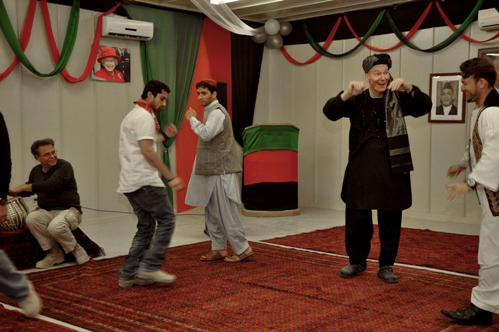
Courtesy of reader Šťoural.  The COIN dance.

Maj. Gen. John Toolan turned over the reins of Regional Command Southwest yesterday to Maj. Gen. Charles Gurganus, who will lead Marine forces in Helmand and Nimroz provinces this summer.

Toolan has repeatedly praised Mohammad Gulab Mangal, Helmand’s provincial governor for his leadership. The general cited Mangal jumping to action as one reason why Helmand didn’t have the same kind of violent protests other parts of the country did after U.S. soldiers burned Qurans at Bagram Air Base last month.

To thank Mangal and other top Afghan officials for their year-long partnership, Toolan held a farewell dinner last week at the Afghan Cultural Center at Camp Leatherneck. And as you can see in the photograph above released by the Corps, the general threw himself into the mix completely, dressing in traditional Afghan garb and joining others on the dance floor.

Observe where population-centric counterinsurgency hath brought us … and left us.

Marines In Afghanistan Told To Disarm Prior To Panetta Speech

13 years, 11 months ago

From MSNBC:

In an unusual move, around 200 U.S. Marines were asked to leave their weapons outside the tent where U.S. Defense Secretary Leon Panetta was set to speak during his trip to Afghanistan on Wednesday.

Although the military said the order was not given in response to the Sunday’s shooting of 16 Afghan civilians allegedly by an American soldier, it possibly underlined how high tensions were running after the incident.

Major General Mark Gurganus told reporters at Camp Leatherneck that he had given the order because the two dozen Afghan soldiers also there were unarmed and he did not want to treat them differently.

“You’ve got one of the most important people in the world in the room,” he told reporters, dismissing concerns related to the shooting. “This is not a big deal.”

“All I know is I was told to get the weapons out,” Sergeant Major Brandon Hall told The New York Times. Asked why, he replied, “Somebody got itchy, that’s all I’ve got to say. Somebody got itchy; we just adjust.”

Panetta’s visit comes after Sunday’s shooting that left 16 Afghan civilians dead, including nine children. Some of the bodies were reportedly burned. The suspect, who hasn’t been named, is in U.S. custody.

According to the newspaper, the Marines, who were waiting to hear Panetta’s speech, were abruptly told by their commander to get up, leave their weapons, including M16 and M-4 automatic rifles and 9 mm pistols, outside and return unarmed. Hall said he was acting on orders from superiors, the Times reported.

Disarming in this way was noteworthy, according to NBC News’ chief Pentagon correspondent Jim Miklaszewski.

He told NBC’s Chuck Todd that the move was “highly unusual” and that Marines in a combat zone are always supposed to have weapons within their reach.

Without going into too much detail, what the Marines were told to do violates everything about Marine Corps doctrine, from top to bottom, concerning not only self protection but protection and security that Marines provide to other Marines.  It runs counter to what they are taught in Boot Camp, School of Infantry, and as a fleet Marine.  And to have 200 Marines completely disarmed in a combat zone is worse than just stolid or ignorant.  It is immoral.

But as for Panetta, let’s be clear.  If his plane were to crash on the way back to the states, requiring us to find a new Secretary of Defense, the world would not come to an end.  Time moves on, as does daily events and decisions.  This is true of me, readers, and even “one of the most important people (sic) in the world.”  But doctrine is for little people. While the Marines were armed Panetta was in one of the safest places on earth – i.e., around 200 armed Marines.  With the Marines disarmed, Panetta unwittingly placed himself and his entourage in mortal danger.

The only analogue I can think of is new gun owners.  If they cannot bring themselves to become trained and practice and trust in their muzzle and trigger discipline, then perhaps they shouldn’t own guns.  If the Secretary of Defense is nervous about being around firearms, perhaps he should have just stayed home and avoided this photo-event.  It would have been better for him and the Marines.

Be A Victim

13 years, 11 months ago

Emily Miller has documented quite a fiasco at The Washington Times concerning her attempt to legally procure a handgun in D.C., even after the Supreme Court Heller decision.  The most recent direction to her from the D.C. police (concerning ammunition) was incorrect, as was their counsel concerning whether she could conceal or open carry her weapon into Virginia (I could give much better counsel).  But even though the D.C. council recently voted to relax firearms regulations (a rare victory for gun owners in D.C.), the contumacious atmosphere in D.C. towards gun owners remains.  Now, officials want D.C. residents simply to become victims.

But one doesn’t have to go all the way to D.C. to find such things.  Recall Sheriff Wright in Spartanburg County, S.C., who after a sexual assault recommended that women obtain guns and concealed carry permits?  Well, not all is well in Spartanburg politics.

In late October, Sheriff Chuck Wright, reacting to recent violent crime, told Spartanburg residents to arm themselves, but have those comments impacted crime rates?

Numbers provided by the sheriff’s office tell two different stories when it comes to crime trends.

For instance, from October 31, 2011 (when the sheriff urged people to get guns) through January 24, 2012, certain violent crimes spiked, while others stayed the same or even dropped, as compared to the same time period the year before.

From 10/31/2011 – 1/24/2012 there was one murder, 21 forcible rapes, 28 robberies, and 95 aggravated assaults (any assault where a weapon was used or where there was a serious injury).

A year earlier between 10/31/2010 – 1/24/2011 there were four murders, 21 forcible rapes, 42 robberies, but 66 aggravated assaults.

So after the sheriff’s comments, the murder rate decreased, the rape rate stayed the same, robberies decreased, but aggravated assaults spiked.

Whether the dramatic increase (450%) of concealed weapon permits since the sheriff’s comments played a role in those numbers, no one can be for sure, not even the sheriff.

“But I guarantee you there are fewer victims out there,” Wright said Wednesday.

But Wright has begun to receive criticism from other elected officials who say the sheriff is sending the wrong message.

“To continue to promote a climate in which we’re asking or even advocating for an increase in concealed weapons permits then you’re asking for an increase in weapons themselves,” said Spartanburg County Councilman Michael Brown.

Brown called the sheriff’s continued remarks “irresponsible” and said law enforcement should be the ones enforcing the laws.

Brown further said “I think it’s irresponsible, irreprehensible (sic) and of course incendiary if you keep on making these types of comments.”

Now, I’m fully capable of finding the first and second moments of a set of statistical data, as well as inferring conclusions from it.  But to do this is the play the social engineer’s game.  When they invoke groups of people and social affects rather than personal liberties and rights, they require something that even God Himself doesn’t require (Exodus 22:2).  They require that you sacrifice your personal safety and security for the benefit of select interest groups.

Because this invades your personal rights and the security of your family in order to effect certain socially engineered ends (those ends themselves being in question), this is fundamentally an evil thing.  It is redistribution from one segment of society to another, but this time on the most personal and valuable level imaginable.  Your own life.

The Incorrigible Corruption In Afghanistan

13 years, 11 months ago

From NYT:

For the past few months, possibly the most intriguing poker game in Kabul has been taking place in the sprawling pink sitting room of the man at the center of one of the most public corruption scandals in the world, the near collapse of Kabul Bank.

The players include people tied to President Hamid Karzai’s inner circle, many of whom have profited from the crony capitalism that has come to define Afghanistan’s economic order, and nearly brought down Kabul Bank. The game’s stakes “aren’t too big — a few thousand dollars up or down,” one of the participants said.

Betting thousands of dollars a night in a country where most families live off a few hundred dollars a year would seem like a bad play for Sherkhan Farnood, the founder and former chairman of Kabul Bank, the country’s biggest. His assets are supposed to be frozen, and he is still facing the threat of prosecution over a scandal that could end up costing the Afghan government — and, by extension, the Western countries that pay most of its expenses — almost $900 million, a sum that nearly equals the government’s total annual revenues.

But Mr. Farnood, who in 2008 won about $143,000 at a World Series of Poker event in Europe, appears to know a good wager when he sees one. Despite years of urging and oversight by American advisers, Mr. Karzai’s government has yet to prosecute a high-level corruption case. And now many American officials say that they have little expectation that Mr. Farnood’s case will prove to be the exception — or that Washington will try to do much about it, especially after violent anti-American protests in recent weeks have sowed fresh doubts in the Obama administration over the viability of the mission in Afghanistan.

As Americans pull back from Afghanistan, Mr. Farnood’s case exemplifies how the United States is leaving behind a problem it underwrote over the past decade with tens of billions of dollars of aid and logistical support: a narrow business and political elite defined by its corruption, and despised by most Afghans for it.

And thus is Afghanistan perfectly set up for the return of the Taliban when we leave.  The Taliban will deal with corruption from the barrel of an AK-47.  They will do it quickly, effectively and without mercy.

Our strategy of marginalizing the Taliban, imprisoning their mid-level commanders, and creating a legitimate central government that would take the place of Taliban governance doesn’t seem too smart now, huh?  It would have been better to have killed the Taliban all along.

Oh, and all of those mid-level Taliban commanders will soon be released from their prisons only to take charge of their fighters once again as the U.S. leaves and the Karzai government tries (unsuccessfully) to keep from perishing by kowtowing to the demands of the Taliban (thereby hastening the return of the very elements that will end the Karzai government).

You couldn’t have scripted a darker tragedy with pen, paper and any amount of time.

Obama Mocks Romney On Iran

13 years, 11 months ago

The Obama apparatchiks mock Romney on Iran.

The Obama campaign mocked Mitt Romney Wednesday, warning that if the Republican pacesetter cowed before talk radio top dog Rush Limbaugh, he would be easy prey for Iran’s firebrand president.

Campaign aides to President Barack Obama were clearly enjoying the spectacle of Romney’s prolonged battle for the Republican nomination, after the former Massachusetts governor failed to kill off his rivals in Super Tuesday contests.

Obama political guru David Axelrod laid into Romney for his somewhat tepid response after Limbaugh said a Georgetown University student who wanted her college health plan to pay for birth control was a “slut” and a “prostitute.”

“If you don’t have the strength to stand up to the most strident voices in your party, how are you going to stand up to (president Mahmoud) Ahmadinejad?” Axelrod asked on a conference call with reporters.

Obama on Tuesday criticized the campaign bluster of Romney and other Republican candidates on Iran, saying “this is not a game” and cautioning against casual talk of war.

Limbaugh is the undisputed champion of the fiery conservative talk radio circuit and wields outsize influence in the Republican Party thanks to his huge audience built up over years of five-day-a-week broadcasts.

Democratic leaders however like to portray the multi-millionaire king of the airwaves as the “de-facto head of the Republican Party” in the knowledge that his brand of conservatism is unpopular with some moderate voters.

Romney’s response to Limbaugh’s attack on student Sandra Fluke, for which he has apologized,” was judged too timid by liberal observers, when he said merely that he wouldn’t have used such “language.”

Now, I’m not particularly a fan of Romney.  Jonah Goldberg thinks he’s “frustratingly anodyne and undefined.”  I think he’s a cardboard cutout that waves and smiles.  But to see the Obama camp mock Romney in light of their own record with Iran is truly hilarious.

Remember?

Having sent the Iranian people a video greeting on their New Year, President Obama is now inviting them to help celebrate a quintessentially American holiday, the Fourth of July.

Last Friday, the State Department sent a cable to its embassies and consulates around the world notifying them that “they may invite representatives from the government of Iran” to their Independence Day celebrations — annual receptions that typically feature hot dogs, red-white-and-blue bunting and some perfunctory remarks about the founding fathers.

Administration officials characterized the move as another in a series of American overtures to Iran. The United States has not had relations with Iran since the American Embassy in Tehran was seized by protesters in 1979; the country’s diplomats have not been formally invited to American events since then.

“It is another way of saying we are not putting barriers in the way of communicating,” said one administration official. “It is another way of signaling that there is an opportunity that should not be wasted.”

 And then to show them what a bunch of bad asses we really are?

It was an attempt by President Obama to reach out to Iran with a classically American invitation: celebrate July 4 with hot dogs and hale fellowship at United States embassies worldwide. Now, hot-dog diplomacy is the latest casualty of the bloody clashes in Tehran.

On Wednesday, Secretary of State Hillary Rodham Clinton, who had authorized diplomatic posts earlier this month to invite Iranians to their Independence Day parties, sent out a cable rescinding the invitations.

“Unfortunately, circumstances have changed, and participation by Iranian diplomats would not be appropriate in light of the unjust actions that the president and I have condemned,” she said. Embassies that had already invited Iranian diplomats were instructed to disinvite them.

It is not clear this will be much of a snub to the Iranians. The State Department spokesman, Ian C. Kelly, said he was not aware of a single diplomat who had R.S.V.P.’d, anywhere in the world.

David Axelrod.  Providing a circus act since, well, a long time ago.

The Better War

13 years, 11 months ago

There are a lot of Milbloggers, military aficionados, knowledgeable members of the military, and veterans of wars that can and often do weigh in on issues of policy, strategy, tactics, techniques and procedures.  But occasionally a real warrior-scholar steps into the fray, and we are always blessed with insights beyond what we could normally bring to the table.  Gian Gentile is just such a warrior-scholar.  I do not believe that a man has to have waged war in order to be a scholar and great historian on it, but with Gentile, we have the entire package.  He has both studied it and lived it.  He is both a friend and a genuinely good man, and we are richer for having his insights.

Gentile uses the occasion of a new book to give us insights into Vietnam, extending his lessons into Iraq and Afghanistan.  The book is Westmoreland: The General Who Lost Vietnam, by Lewis Sorley.  Gentile begins his review thusly.

DID GENERAL Westmoreland lose Vietnam? The answer is no. But he did lose the war over the memory of the Vietnam War. He lost it to military historian Lewis Sorley, among others. In his recent biography of William C. Westmoreland, Sorley posits what might be called “the better-war thesis”—that a better war leading to American victory was available to the United States if only the right general had been in charge. The problem, however, is that this so-called better war exists mostly in the minds of misguided historians and agenda-driven pundits.

[ … ]

In 2008, former secretary of defense Robert Gates chided the American military establishment, and the army in particular, for its affliction of “Next-War-itis.” Parts of the American military, lamented Gates, were too focused on fighting hypothetical future wars rather than the immediate wars in Iraq and Afghanistan. But the secretary also might have noted another dangerous affliction suffered by parts of the U.S. Army: “Past-War-itis.” Those afflicted with this disease obsess about a Vietnam defeat they believe should have been averted.

Sorley titles his book Westmoreland: The General Who Lost Vietnam. This is “Past-War-itis” run amok. Is it possible that a single man actually lost the war and all of Vietnam? The question is pertinent today because many seeking to bring logic to the past ten years of war in Iraq and Afghanistan have embraced the simplistic concept that to win those wars we just need to put the right guy in charge. One such example is the Council on Foreign Relations’ Max Boot, an enthusiastic supporter of the Iraq and Afghanistan wars … another example is writer Thomas Ricks, one of the purveyors of the better-war thesis for Iraq. Ricks wrote a glowing jacket endorsement for Sorley’s book, and he also noted on his military-affairs blog that it would probably end up as the “definitive” biography of Westmoreland. If one is interested, however, in a fair and balanced historical biography of William C. Westmoreland, Ricks is wildly off the mark.

The better-war thesis argues that there was a tactical panacea in Vietnam—a golden cipher of success—just waiting for the right general who could grasp and apply it. Instead, for the first three years of the war beginning in 1965, the U.S. Army was led by a fumbling general named William Childs Westmoreland, who did not crack the code that would have produced victory for the United States. Luckily, as the better-war thesis continues, once Westmoreland was replaced in the summer of 1968 by a savior general named Creighton Abrams, everything changed for the better, and Abrams’s army actually won the war in the South by 1971. The tragedy, according to this thesis, was that weak American politicians undermined the victory by eventually cutting off material support to South Vietnam after the United States departed in 1972.

Weak American politicians and an unwilling American public did indeed undermine the campaign, but I’ll basically state my agreement with Gian’s thesis on the better general, while I’ll also [later] demur with some of his specific findings on Vietnam and Iraq. We’ll continue with Gian’s observations.

The tale of a better war in Vietnam is seductive. It offers a simple explanation of an army redeemed through tactical innovation brought about by a savior general. But the United States did not lose the Vietnam War because it didn’t have the right general in charge at the start, or because of weak politicians toward the end of the war. Washington lost because it failed at strategy. It failed, in short, to discern that the war was unwinnable at a cost in blood and treasure that the American people would accept. There was never a “better war” in Vietnam.

THIS FAITH in the promise of better tactical wars with savior generals has emerged in full force in the current wars in Iraq and Afghanistan. In August 2007, as the violence in Iraq dropped precipitously, Clifford May, former New York Times reporter and current president of the Foundation for Defense of Democracies, identified Petraeus as the main cause of the reduction in violence. May wrote that this enlightened general replaced a failed general and then equipped his army in Iraq with new methods for conducting counterinsurgency. Later, in October 2009, Sorley penned a New York Times article that praised the counterinsurgency tactics of General Stanley McChrystal, then senior American commander in Afghanistan. May and Sorley saw Iraq and Afghanistan as better wars in the making based on the arrival of savior generals.

[ … ]

But the conditions in Iraq that would lead to the lowering of violence in late 2007 were already in place. They included the spread of the Anbar Awakening and the decision of Shia militias to end attacks against Sunni civilians. Recently published databases such as the Iraq Body Count project’s show quite clearly that the sectarian violence peaked in December 2006 and then started to drop a good two months before Petraeus ever rode onto the scene with his new counterinsurgency manual in hand. Petraeus, the savior general, played only a marginal role in the greater series of events and circumstances that brought down the level of Iraqi violence.

I do indeed think that there was a “better war” in Vietnam – not in the sense that Gian critiques – but we’ll get to that later.  His observations on Iraq contain a number of things I have personally addressed with Gian, but it will be useful and productive to lay it out for closer inspection.

First, let’s address the so-called Anbar Awakening.  The Awakening – primarily in 2006 and beyond – was significant.  It certainly truncated the Marine Corps campaign for Anbar shorter than what it would have been.  But it was primarily a feature of Ramadi, and it was primarily a feature that obtained as a result of hard Marine Corps combat operations in the Anbar Province convincing the population that the victor would ultimately be the Marine Corps.

In Haditha late in 2006 and early in 2007 pacification is primarily attributed to a former officer in the Saddam Hussein army known simply as Colonel Faruq, with the power and charisma to bring the town to heel, along with sand berms around the city (constructed by the Marines) to prevent transnational insurgents from coming in from Syria and causing problems.

In Al Qaim, the fight against al Qaeda began in 2005 when Abu Ahmed took them on, lost, fled to the desert, and sought (and obtained) help from the U.S. Marines to defeat AQ.  In Fallujah in 2007, al Qaeda fighters were so firmly ensconced in the city that the people, fearing for their lives, were sending their own children out to mark and encircle Marine patrols with balloons (at the direction of the AQ fighters) so that the patrols could be targeted with crew served weapons.

It took the 2/6 Marines using extremely hard and aggressive tactics, coupled with local IPs and block captains, or Mukhtars, recruited from among the population, again using extremely hard and aggressive tactics, to drive AQ from the city.

My point is that invoking the Anbar Awakening has become in many ways symptomatic the campaign.  It’s as if without it, the Marines wouldn’t have been successful, but with it, Anbar was Shangri La.  Neither view is true.  Nor is it true that the Marines weren’t grateful for what awakening that did occur in various parts of Anbar.  The truth is more complex than simple narratives can possible convey.

Similarly, to say that the Shia militias decided to end attacks on the Sunnis misses the point, and in the superlative degree.  Perhaps they did, but this bit of historical myopia is tailor made for constructing false narratives about Baghdad and the Shia South.

In 2003 the 3/2 Marines had Moqtada al Sadr in their custody (this is as conveyed from the Battaion Commander to Andrew Lubin).  They were ordered to release him.  Then as the U.S. Marines (BLT 1/4) and U.S. Army Calvary swept through al-Najaf in 2004, for all practical purposes they obliterated the Sadrist militia.  The year of 2004 could have seen the virtual end of the organized Shi’a militia threat.  The 1/4 Marines had surrounded Moqtada al Sadr (see this John Burns interview, beginning at 17:20 into the discussion).  Sadr and his militia were essentially finished twice, once in 2003 and again in 2004, due to 3/2 and 1/4 Marine Corps combat operations.  Both times they were ordered to stand down.*

We could have chosen to kill Sadr, finish the Shi’a militia, and end the threat of a violent Shi’a uprising against the Sunni population.  We chose unwisely, and the order came down to let Sadr go.  To say that the Shi’a militia later decided to end attacks against the Sunnis is to miss the bigger picture, i.e., there wouldn’t have been any Sadr to command them, and likely no militia to speak of, had we engaged in the “better war” in Iraq when we had the chance.  Instead we had Paul Bremer, the British and horrible leadership.  It was a toxic combination, and it cost precious lives.

Meanwhile to the West, campaign command pulled the Marines back from Al Fajr I, creating the necessity for Al Fajr II, more loss of lives, more time wasted, and more legitimacy lost.  We didn’t fight the better war in Fallujah either.  And when we completed the job, we sent Marines on wasteful MEUs rather than into Fallujah to ensure stability, and thus the 2/6 Marines had to deal with an ensconced al Qaeda in 2007.

But something tells me what while Gian and I may disagree on the details of the campaign in Iraq, he would concur with my general theme.  Gian observes of Vietnam:

The better-war thesis argues that if only the U.S. Army had concentrated from the start on building up the South Vietnamese armed forces and winning the hearts and minds of the South Vietnamese people through limited applications of military force, we would have won the war. But the question remains: Precisely how could tactical adjustments early in the war have overpowered the political constraints placed on the army by the Johnson administration, which kept it from taking the fight to the North Vietnamese? Or the dysfunctional nature of the South Vietnamese government and military that precluded them from standing on their own? Or the declining popular support and political will in the United States as the war dragged on without a decent end in sight? Or, perhaps most importantly, how could tactical adjustments toward better methods of counterinsurgency have overpowered a communist enemy that fought the war totally while the United States fought it with limited means? In his Westmoreland biography, Sorley essentially ignores these questions.

Could the United States have prevailed in Vietnam? Yes, but it would have had to commit to staying there for generations, not a mere handful of years. The Vietnam War was an attempt at armed nation building for South Vietnam.

The better fight in Vietnam to which I earlier referred has nothing to do with staying for generations or armed nation-building.  These are the policy mistakes we have made in Iraq and Afghanistan.  We tend to see campaigns as failures unless they install governments and re-create populations that never pose another threat to the U.S.  But this isn’t reality, and this is certainly not the way the U.S. Marines think about these issues.

This last point isn’t mere inter-service rivalry.  I cannot count the number of times I have heard Marines express their desire to end campaigns quickly, and then go back and do it again in two, five or ten years if the need arises.

The better war to which I refer was alluded to by Gian when he posed the question, “Precisely how could tactical adjustments early in the war have overpowered the political constraints placed on the army by the Johnson administration, which kept it from taking the fight to the North Vietnamese?”

If this question isn’t explored, the book is essentially worthless no matter how many endorsements the author obtained.  Consider for a moment how we dealt with the threat from Germany during World War II.

The burning of Hamburg that night was remarkable in that I saw not many fires but one.  Set in the darkness was a turbulent dome of bright red fire, lighted and ignited like the glowing heart of a vast brazier.  I saw no flames, no outlines of buildings, only brighter fires which flared like yellow torches against a background of bright red ash.  Above the city was a misty red haze.  I looked down, fascinated but aghast, satisfied yet horrified.  I had never seen a fire like that before and was never to see its like again.

Roads melted, and some people were seen stuck in the melted asphalt, having put their hands out to try to get out, only to get their hands stuck as well.  Many were seen on fire, eventually melting in their own fat.  Eight square miles of Hamburg were completely burned out that night, killing 45,000 Germans.

If we had not done this, countless more American lives would have been lost, and the war may not have been won by the allies at all.  Destruction of the will and industry to wage war was necessary to end the war, whether this fits into the American clinical view of bloodless war or not.

Compare this with the decision to refuse to take the fight to the North Vietnamese.  Consider for a moment what would have happened if we had bombed the dikes and dams on the Red River Delta.  To be sure, the cost in human tragedy would have been staggering, but this is exactly the point.  We wish to wage war, but only partly.  The Viet Cong insurgency in the South was for all practical purposes defeated (in spite of the succor given to them by the North via the Ho Chi Minh trail), and it was the entrance of the NVA regulars that saved the insurgency.  A hobbled North Vietnam from having bombed the Red River Delta for year wouldn’t have been able to give the kind of assistance that the VC got.  It might have even brought down the regime.

Back to Iraq, if we had taken on the Syrian pre-deployment camps for AQ fighters (80 – 150 fighters per year crossed the border to fight in Iraq), and if we had fought the Iranian Quds forces by targeting them in Iraq and elsewhere (while we also engaged in a program of targeting Quds generals like Suleimani), and if we had allowed the Marines to kill Sadr and finish off his militia, and if we had allowed them to continue the sweep through Anbar like they started it in Fallujah, and if we had sent more Marines into Anbar instead of on wasteful MEUs … what would the campaign have looked like?

Gian continues:

In war, political and societal will are calculations of strategy, and strategists in Vietnam should have discerned early on that the war was simply unwinnable based on what the American people were willing to pay. Once the war started and it became clear that to prevail meant staying for an unacceptable amount of time, American strategy should have moved to withdraw much earlier than it did. Ending wars fought under botched strategy and policy can be every bit as damaging as the wars themselves.

The better-war thesis, with its seductively simple cause-and-effect schema, buries the reality of American strategic failure in Vietnam.

The campaign in Vietnam was unwinnable under the stipulations dictated by the President, Congress and perhaps the Secretary of Defense.  And the campaign was unwinnable if winning was defined as building an American-like democracy (in which Gian is correct, taking multiple decades of toil).  On this Gian and I concur.  The proposed end was wrong, and the means weren’t defined in a manner that matched the proposed end.

Gian goes on to supply data that contradicts Sorley’s theses.  Again, I concur.  Westmoreland didn’t lose the war in Vietnam any more than Creighton Abrams could have won it with alternative tactics.  Tactics, techniques and procedures don’t replace strategy, and they certainly don’t replace policy.

The “better” general in Iraq didn’t win Iraq.  As we have [briefly] discussed, the hard work of the U.S. Army and Marine Corps was done before and during the tenure of all the generals who commanded the campaign.  It was a matter of time, endurance and professionalism by the U.S. military.  To the extent that we attained success in Iraq, it is attributable to the U.S. military.  To the extent that we failed in Iraq, it is attributable to lack of vision or clear policy by the administration(s), e.g., the failure to fight Iraq as a regional war, the support of corrupt Iranian apparatchiks like Nouri al-Maliki, the failure to secure the borders, the engagement of protracted nation-building, etc.

Afghanistan is lost due to the same reasons.  I generally give the U.S. military more credit and attribute more capabilities to them than does Gian.  But one thing the U.S. military cannot pull off is replacement for national policy.  Gian reminds us again that seeking out military heroes to do just this is a distinctly American pastime, but it is mistaken and dangerous, at least for the thinking men among us.

* Thanks to  Wes Morgan and Andrew Lubin for assisting me to get the Marine Corps units and dates correct regarding operations in 2003 and 2004.


The TSA Wants Legitimacy

13 years, 11 months ago

From Forbes:

Believe it or not, only 7 years ago, TSOs went by a more deserving title, “airport security screeners.” At the time, their title and on the job appearance consisted of a white shirt and black pants. This was fitting because airport security screening is exactly what’s required of the position. However, this is no longer the case.

In the dead of night, the Transportation Security Administration (TSA) administratively reclassified airport security screeners as Transportation Security Officers. The TSA then moved to administratively upgrade TSOs uniforms to resemble those of a federal law enforcement officer. They further completed the makeover with metal law enforcement badges. Not surprisingly, government bureaucrats at the TSA left out one crucial component during the artificial makeover – actual federal law enforcement training as is required of Federal Air Marshalls.

While TSOs may have the appearance of a federal law enforcement officer they have neither the authority nor the power. If a passenger brings a loaded gun or an explosive device into an airport screening area there is nothing a TSO can do until the local police step in to save the day.

If TSOs are truly our nation’s last line of defense in stopping an act of terrorism, then the TSA should immediately end the practice of placing hiring notices for available TSO positions on pizza boxes and at discount gas stations as theyhave done in our nation’s capital. Surely, this is not where our federal government is going to find our brightest and sharpest Americans committed to keeping our traveling public safe. I would contend that we can surely strive for a higher standard and may want to look first to our veterans returning home from the battlefield.

Interestingly enough, as TSA officials like to routinely point out, their agency’s acronym stands for Transportation Security Administration, not the Airport Security Administration. This fact has extended the TSA’s reach has far beyond the confines of our nation’s airports. Many of my constituents discovered this first hand this past fall as those familiar blue uniforms and badges appeared on Tennessee highways. In October Tennessee became the first state to conduct a statewide Department of Homeland Security Visible Intermodal Prevention and Response (VIPR) team operation which randomly inspected Tennessee truck drivers and cars.

VIPR teams which count TSOs among their ranks, conduct searches and screenings at train stations, subways, ferry terminals and every other mass transit location around the country. In fact, as the Los Angeles Times has detailed, VIPR teams conducted 9,300 unannounced checkpoints and other search operations in the last year alone. The very thought of federal employees with zero law enforcement training roaming across our nation’s transportation infrastructure with the hope of randomly thwarting a domestic terrorist attack makes about as much sense as EPA Administrator Lisa Jackson’s Environmental Justice tour.

I have seen this.  Its scary.  No, not the look of the “officers” or the demeanor they exude, but the belief that these people are law enforcement officers.  I saw a gaggle of them a few months ago walking the light rail in Charlotte, N.C.  They were sporting body armor, drop holsters, Tru-spec pants and other tactical gear, and ‘TSA’ in huge letters across their chests.  Swaggering, they were.

It occurred to me that if they had wished to seek out or prevent some perpetrator from harming the transit system or those who frequent the same, then hiding their identity would be the best bet (no gear, IWB holsters).  The existence of TSA screeners swaggering down the sidewalk for the light rail wouldn’t have prevented me from doing harm to the system if I had chosen to do so.  It wouldn’t be hard.  Dress in a suit, carry a gym bag full of C4, slide it under a seat when you exit, and then watch the explosion from a safe distance.  It sounds so cold, and yet it would be this easy to pull off.  And again, the existence of TSA screeners walking down the rail line wouldn’t have made a bit of difference in this scenario.  They need to think outside the box to ensure safety.  Strutting around in this garb won’t cut it.

My son spent a combat tour in Fallujah, Iraq, and I asked him about all of this tactical gear.  He reported to me something like the following:

The body armor is heavy (of course, he wore the SAPI plates too), and it makes you sweat, it constrains your breathing, it constrains your movements and motions, and the other gear is equally terrible.  I carried a SAW as you know, and so I routinely had enough stuff on my vest, including SAW drums.  I would do everything I could to minimize my PPEs and move things about to keep them from getting in my way.  When your CO dictates your PPEs there was only so much you could do.  As a SAW gunner I carried a handgun, and there wasn’t any place left for it on my vest.  I had to wear a drop holster.  It got in my way.  Go around a couch when clearing a room, it got caught.  Go through a doorway, it got caught on the doorjamb.  It flopped around endlessly like some loose appendage to your body that had been damaged and was barely hanging on.  Drop pouches are the same way, except worse.  If you ran in all that stuff, it banged around and beat you up without mercy.

No one in their right mind would voluntarily wear that crap.  There is nothing going on in Charlotte, or any other major American city for that matter, that requires a peace officer to wear that stuff.  If you see someone wearing it, whether TSA or Charlotte Police, they want to look tacti-cool.  There is no other reason.

Yea, and I won’t have one ounce of respect for a TSA luggage screener stopping me on the road wanting to know what’s in my car or where I am going.  If they want to legitimize their role, then get training, stop molesting children and old women, stop looking at cute figures in the body scanners, and perform their jobs like everyone else has to in America.  Or better yet, install explosive trace detection portals in airports, negating the need for groping children and old women, just like we have in nuclear power plants around the country.  Then, contract airport security out to private contractors.

Either way, simply declaring yourselves to have legitimacy doesn’t change the fact that you’re a laughingstock and nuisance.  Legitimacy comes with service and skills, not oafishness and bullying.

Update On Open Carry Laws

13 years, 11 months ago

The State of Utah is close to jettisoning bigotry and prejudice associated with firearms.

Utah residents may be one step closer to being able to carry their firearms with them wherever they go. Wednesday the Utah House of Representatives passed House Bill 49, an open-carry law that would make it legal for a resident to carry a gun in plain sight.

HB 49, sponsored by Rep. Paul Ray (R-Clearfield) says that in the absence of threatening behavior, the lawful possession of a firearm or dangerous weapon, whether visible or concealed, cannot be considered in violation of municipal ordinances and government entities cannot give citations for disorderly conduct or a enforce dangerous weapon laws.

But bigotry and hatred die hard.

Summit County Sheriff Dave Edmunds said that he is against the bill because it would complicate the job of his officers. According to Edmunds, it is unreasonable to allow someone to carry a weapon in plain view if they are not an officer.

“The world is becoming an increasingly violent place and firearms in plain view frighten people,” Edmunds said, adding that while he is against the bill, he is a big firearms proponent and a strong believer in the Second Amendment. “I have never had a problem with someone who holds a concealed weapons permit; in all my years as Sheriff I have never encountered a problem with those people. You should be allowed to carry a weapon in public but you need to go through the proper channels.”

Edmunds, who is president of the Utah Sheriff’s Association, said the group as a whole is against the bill.

Park City Police Chief Wade Carpenter said he is against the bill as it is currently drafted because it takes away law enforcement’s right to enforce disorderly conduct codes if a person carrying a weapon causes shock and alarm to citizens in a public place.

Some police officers are even more crass and bold about their bigotry.

… says Salt Lake City Police Chief Chris Burbank, a bad guy with a loaded weapon can do “a lot of damage very fast.”

He said that in his 20 years as a policeman, “we’ve had very few problems and concealed-weapons holders. It’s not a big issue.”

But open-carry is different, he adds. For example, a law enforcement officer openly carries a weapon for its “intimidation factor. In law enforcement, that’s the message you send.”

Civilians who openly carry weapons are another matter. “Is this person’s intent to do harm, or is he just carrying a gun? It puts police officers in a very awkward position,” he said.

You know, because only police officers can be trusted with weapons, and especially ones that can be seen by others.  It’s the “intimidation” factor.  And it causes me to wonder how many more LEOs think this way.

Except that this is fake … make believe … fantasy land.  The issue is a red herring.  I open carry, and as I have mentioned before, and women and children don’t run off screaming in fear, and the Charlotte-Mecklenburg Police, who are well-educated and comprehensively trained, simply wave and smile as they go past me while openly carrying my weapon.  The issue has to do with bigotry and prejudice, not concocted or fabricated problems that it causes.

And speaking of civil rights, I notice that South Carolina is pressing forward to show that they are a gun-friendly state.

Firearm enthusiasts might have something more to look forward to than sales at the mall this Black Friday if one Upstate lawmaker gets his way.

Rep. Mike Pitts (R-Laurens) put a proviso in this year’s budget that would reinstate a three-day gun tax holiday the weekend after Thanksgiving. The holiday, called “Second Amendment Weekend” was introduced at the start of the recession in 2008 to encourage buying but was cancelled last year because of the state’s shrinking budget.

This year revenues are higher than expected and Pitts said that the $13,000 of sales taxes the state won’t get from guns that weekend is really a drop in the bucket of a $22.5 billion budget.

Plus there’s a huge increase in the sale of other items like camouflage hunting gear, boots and ammunition that bring in more tax revenue and pump profits into small businesses.

Right.  A tax holiday.  How about Representative Pitts supporting  the same bill we discussed in Utah making it acceptable to open carry in S.C. (I have proposed this before).  South Carolina has the dubious distinction of being similar to California in prohibiting open carry.  Would Rep. Pitts move into the twenty first century in rejecting bigotry and supporting our civil rights?

Concerning Those Burned Qu’rans At Bagram Air Base

13 years, 12 months ago

It is easy to lose count of the number of administration officials who have issued groveling, pitiful “apologies” over the burned Qu’rans at Bagram Air Base.  But take note that our apologies aren’t sufficient.  The protests are still active, they are spreading to Pakistan, and Iran wants more – a lot more.  It’s ironic how we see things through Western, secular eyes concerning issues pertaining to religious pre-commitments.  Our apologies are so serious, so heartfelt, so sincere, so sober – and so completely irrelevant to the Muslim world.

Iran wants the officers who made this decision to pay a hefty price.

In a move likely to irk tension between Iran and United States, a top Iranian military commander said on Saturday that nothing short of burning the White House and hanging American military commanders can compensate for the burning of Qurans at a U.S. military base in Afghanistan last week.

“The U.S. has committed such an ugly act and burnt Qurans because of the heavy slap it has been given by Islam,” commander of Iran’s Basij force, Brigadier General Mohammad Reza Naqdi told the semi-official Fars news agency.

So we punish the officers who made this decision according to Sharia law, we torch the White House, and we completely withdraw from Afghanistan, and then perhaps the Iranian generals will be appeased.

But also take careful note why the copies of the Qu’ran were burned in the first place.

As riots over the accidental improper disposal of the Koran led to seven deaths by Wednesday, two senior NATO military officials stressed that it was because of clandestine communications written into the Korans in the first place that a decision was made to have them destroyed by U.S. troops.

Afghan detainees at Bagram Air Base wrote inside Korans as a method for passing messages to fellow detainees, defacing the holy books in a manner considered blasphemous within Islam, the officials said, speaking to Fox News exclusively.

[ … ]

A second official said that local religious leaders who came to look at the damaged material as part of an investigation into the incident were “shocked by what they saw.”

Pages of the Korans contained many handwritten messages and in some cases printed notes were found inside the books. This official described the messages as “extremist” in nature.

This entire incident has as its root cause the fact that rather than killing the insurgents on the field of battle, we imprisoned them in hopes of rehabilitating them and releasing them to return to productive lives in the service of greater Afghanistan.

Ah.  Those Western ideals at work again.  How sweet.  But in reality, prisons in counterinsurgency are opportunities for rest and relaxation, a chance to be fed and to receive good medical care, and a safe haven to recruit and radicalize other insurgents.

These copies of the Qu’ran should have been burned, but Afghans should never have been involved.  In fact, the prisons, which are currently full to overflowing with radicalized Islamists and criminals soon to be released when the U.S. exits Afghanistan (or sooner if the prisons are turned over to Afghan authorities), should completely go out of business.  We should have been killing these fighters rather than giving them the opportunity to concoct further plans for harm to U.S. troops.

All of this – and more – is why I have recommended that we withdraw from Afghanistan.  We simply don’t have a clue what it takes to win the campaign in this region of the world.  For future campaigns, we should take note yet again that prisons really, really don’t work in counterinsurgency.

As if all of this isn’t enough, we may yet sacrifice the careers of some of the officers in the service of Islam.

NATO officials promised to meet Afghan nation’s demand of bringing to justice, through an open trial, those responsible for the incident and it was agreed that the perpetrators of the crime be brought to justice as soon as possible.

Sad beyond belief.

UPDATE #1: Many thanks to Glenn Reynolds for his attention to this.

Prior:

Night Raids, Prisons, Politics and the Afghanistan Strategy

The Long Term Effects of Prisons in Counterinsurgency

The Great Escape – In Afghanistan!

Because Prisons Work So Well In Counterinsurgency

Afghan Prison An Insurgent Breeding Ground

Prisons Do Not Work In Counterinsurgency

The Ineffectiveness of Prisons in Counterinsurgency

Jirgas and Release of Taliban Prisoners

Prisons in Afghanistan

Prisons in Counterinsurgency

If I Could Just Own 240 Handguns!

14 years ago

From LA Times Editorial.

Virginia is for lovers — of guns. Last week that state’s Senate, newly under Republican control after a GOP  election surge in November, overturned a 20-year-old law that barred residents from buying more than one handgun a month. Why? Apparently because in Virginia, deadly firearms are like Lay’s potato chips — you can’t stop at just one.

Virginia’s refusal to close the notorious “gun-show loophole” has long been criticized by New York Mayor Michael Bloomberg, who frets that relatively tough regulations in his state are undermined when criminals can easily purchase firearms in other states and bring them into New York. In fact, similar worriesabout interstate gun-running were what prompted Virginia’s Legislature to restrict handgun purchases in 1993. But with Republican lawmakers and two Democrats from rural districts eager to make a statement about gun rights, the state Senate approved the repeal by a 21-19 vote, and Gov. Bob McDonnell is expected to sign it.

Backers say they’re just trying to bring Virginia’s laws in line with those in other states, pointing out that only California, Maryland and New Jersey have monthly limits on handgun purchases. Moreover, they say the ban isn’t effective because it doesn’t apply to groups such as police officers and holders of concealed weapons permits. But that’s a reason to strengthen the law, not to repeal it. And we have yet to hear a gun-rights advocate articulate why any law-abiding citizen has a compelling need to buy more than one gun a month. Criminals sometimes need to get their hands on a lot of guns at once to pull off a big job or to keep gangs well-armed; citizens who want to protect their homes from intruders have no such imperative.

A more colorful way of phrasing that point came from state Democratic Sen. Richard L. Saslaw, who noted to the Richmond Times-Dispatch that if a Virginian had bought one handgun a month from the time the ban was enacted until today, he would have 240 guns. “If you need more than 240 handguns, then I would submit something’s wrong with you. Something’s gone wrong in your life,” he said.

I’m sure that armies of criminals await this change in the law to run down to their local Sheriff, apply for a weapons permit, purchase hundreds of weapons, and then pull off the robbery of the century.  The only problem is that Saslaw’s hysterical objection has nothing to do with the real problem behind the the law.

The issue pertains to much more mundane things that tend to dominate the lives of real, law-abiding citizens.  For example, if someone gets a bonus check or tax refund once per year, and the surplus tends to get gone if it isn’t spent quickly (you know, on accoutrements- and odds and ends associated with home ownership), he might need to purchase more than a single weapon in one month.

Or perhaps someone finds a good deal on multiple weapons he has been watching for some time.  Waiting a month would mean watching the deal disappear.  Or perhaps someone wants to invest in something that isn’t losing its value and is actually fun to bequeath to his children and grandchildren.  Or perhaps he is simply a collector and aficionado, and happens to have the money to invest in weapons.

In any of theses examples (and many more), Mr. Saslaw has rudely impugned the character of the gun owner.  If I could only own 240 handguns (not to mention long guns), well, that would be awesome, and I would do it in a heartbeat if I had the money.  And according to the bill, it would be none of Saslaw’s business.

I like the idea of Mr. Saslaw having nothing to do with how I or his constituents spend money.  Oh, and as one of my colleagues at reddit.com/r/guns points out, Seung-Hui Cho bought both of his guns in a Virginia gun store and was subject to the 1 handgun a month law.  Perhaps Mr. Saslaw needs to worry himself with things other than how his constituents spend their money.  Perhaps being Enid Strict isn’t the real purpose of his office.

Now, I was thinking, as for those 240 handguns I want …


26th MEU (10)
Abu Muqawama (12)
ACOG (2)
ACOGs (1)
Afghan National Army (36)
Afghan National Police (17)
Afghanistan (704)
Afghanistan SOFA (4)
Agriculture in COIN (3)
AGW (1)
Air Force (41)
Air Power (10)
al Qaeda (83)
Ali al-Sistani (1)
America (22)
Ammunition (304)
Animals (321)
Ansar al Sunna (15)
Anthropology (3)
Antonin Scalia (1)
AR-15s (393)
Arghandab River Valley (1)
Arlington Cemetery (2)
Army (90)
Assassinations (2)
Assault Weapon Ban (29)
Australian Army (7)
Azerbaijan (4)
Backpacking (4)
Badr Organization (8)
Baitullah Mehsud (21)
Basra (17)
BATFE (246)
Battle of Bari Alai (2)
Battle of Wanat (18)
Battle Space Weight (3)
Bin Laden (7)
Blogroll (3)
Blogs (24)
Body Armor (23)
Books (3)
Border War (18)
Brady Campaign (1)
Britain (39)
British Army (36)
Camping (5)
Canada (19)
Castle Doctrine (1)
Caucasus (6)
CENTCOM (7)
Center For a New American Security (8)
Charity (3)
China (19)
Christmas (18)
CIA (30)
Civilian National Security Force (3)
Col. Gian Gentile (9)
Combat Outposts (3)
Combat Video (2)
Concerned Citizens (6)
Constabulary Actions (3)
Coolness Factor (3)
COP Keating (4)
Corruption in COIN (4)
Council on Foreign Relations (1)
Counterinsurgency (218)
DADT (2)
David Rohde (1)
Defense Contractors (2)
Department of Defense (220)
Department of Homeland Security (26)
Disaster Preparedness (5)
Distributed Operations (5)
Dogs (15)
Donald Trump (27)
Drone Campaign (4)
EFV (3)
Egypt (12)
El Salvador (1)
Embassy Security (1)
Enemy Spotters (1)
Expeditionary Warfare (18)
F-22 (2)
F-35 (1)
Fallujah (17)
Far East (3)
Fathers and Sons (2)
Favorite (1)
Fazlullah (3)
FBI (39)
Featured (192)
Federal Firearms Laws (18)
Financing the Taliban (2)
Firearms (1,866)
Football (1)
Force Projection (35)
Force Protection (4)
Force Transformation (1)
Foreign Policy (27)
Fukushima Reactor Accident (6)
Ganjgal (1)
Garmsir (1)
general (15)
General Amos (1)
General James Mattis (1)
General McChrystal (44)
General McKiernan (6)
General Rodriguez (3)
General Suleimani (9)
Georgia (19)
GITMO (2)
Google (1)
Gulbuddin Hekmatyar (1)
Gun Control (1,717)
Guns (2,405)
Guns In National Parks (3)
Haditha Roundup (10)
Haiti (2)
HAMAS (7)
Haqqani Network (9)
Hate Mail (8)
Hekmatyar (1)
Heroism (5)
Hezbollah (12)
High Capacity Magazines (16)
High Value Targets (9)
Homecoming (1)
Homeland Security (3)
Horses (2)
Humor (72)
Hunting (60)
ICOS (1)
IEDs (7)
Immigration (123)
India (10)
Infantry (4)
Information Warfare (4)
Infrastructure (4)
Intelligence (23)
Intelligence Bulletin (6)
Iran (171)
Iraq (379)
Iraq SOFA (23)
Islamic Facism (64)
Islamists (98)
Israel (19)
Jaish al Mahdi (21)
Jalalabad (1)
Japan (3)
Jihadists (82)
John Nagl (5)
Joint Intelligence Centers (1)
JRTN (1)
Kabul (1)
Kajaki Dam (1)
Kamdesh (9)
Kandahar (12)
Karachi (7)
Kashmir (2)
Khost Province (1)
Khyber (11)
Knife Blogging (7)
Korea (4)
Korengal Valley (3)
Kunar Province (20)
Kurdistan (3)
Language in COIN (5)
Language in Statecraft (1)
Language Interpreters (2)
Lashkar-e-Taiba (2)
Law Enforcement (6)
Lawfare (14)
Leadership (6)
Lebanon (6)
Leon Panetta (2)
Let Them Fight (2)
Libya (14)
Lines of Effort (3)
Littoral Combat (8)
Logistics (50)
Long Guns (1)
Lt. Col. Allen West (2)
Marine Corps (281)
Marines in Bakwa (1)
Marines in Helmand (67)
Marjah (4)
MEDEVAC (2)
Media (68)
Medical (146)
Memorial Day (6)
Mexican Cartels (46)
Mexico (70)
Michael Yon (6)
Micromanaging the Military (7)
Middle East (1)
Military Blogging (26)
Military Contractors (5)
Military Equipment (25)
Militia (9)
Mitt Romney (3)
Monetary Policy (1)
Moqtada al Sadr (2)
Mosul (4)
Mountains (25)
MRAPs (1)
Mullah Baradar (1)
Mullah Fazlullah (1)
Mullah Omar (3)
Musa Qala (4)
Music (25)
Muslim Brotherhood (6)
Nation Building (2)
National Internet IDs (1)
National Rifle Association (97)
NATO (15)
Navy (31)
Navy Corpsman (1)
NCOs (3)
News (1)
NGOs (3)
Nicholas Schmidle (2)
Now Zad (19)
NSA (3)
NSA James L. Jones (6)
Nuclear (63)
Nuristan (8)
Obama Administration (222)
Offshore Balancing (1)
Operation Alljah (7)
Operation Khanjar (14)
Ossetia (7)
Pakistan (165)
Paktya Province (1)
Palestine (5)
Patriotism (7)
Patrolling (1)
Pech River Valley (11)
Personal (76)
Petraeus (14)
Pictures (1)
Piracy (13)
Pistol (4)
Pizzagate (21)
Police (672)
Police in COIN (3)
Policy (15)
Politics (998)
Poppy (2)
PPEs (1)
Prisons in Counterinsurgency (12)
Project Gunrunner (20)
PRTs (1)
Qatar (1)
Quadrennial Defense Review (2)
Quds Force (13)
Quetta Shura (1)
RAND (3)
Recommended Reading (14)
Refueling Tanker (1)
Religion (499)
Religion and Insurgency (19)
Reuters (1)
Rick Perry (4)
Rifles (1)
Roads (4)
Rolling Stone (1)
Ron Paul (1)
ROTC (1)
Rules of Engagement (75)
Rumsfeld (1)
Russia (37)
Sabbatical (1)
Sangin (1)
Saqlawiyah (1)
Satellite Patrols (2)
Saudi Arabia (4)
Scenes from Iraq (1)
Second Amendment (708)
Second Amendment Quick Hits (2)
Secretary Gates (9)
Sharia Law (3)
Shura Ittehad-ul-Mujahiden (1)
SIIC (2)
Sirajuddin Haqqani (1)
Small Wars (72)
Snipers (9)
Sniveling Lackeys (2)
Soft Power (4)
Somalia (8)
Sons of Afghanistan (1)
Sons of Iraq (2)
Special Forces (28)
Squad Rushes (1)
State Department (23)
Statistics (1)
Sunni Insurgency (10)
Support to Infantry Ratio (1)
Supreme Court (79)
Survival (214)
SWAT Raids (58)
Syria (38)
Tactical Drills (38)
Tactical Gear (17)
Taliban (168)
Taliban Massing of Forces (4)
Tarmiyah (1)
TBI (1)
Technology (21)
Tehrik-i-Taliban (78)
Terrain in Combat (1)
Terrorism (96)
Thanksgiving (13)
The Anbar Narrative (23)
The Art of War (5)
The Fallen (1)
The Long War (20)
The Surge (3)
The Wounded (13)
Thomas Barnett (1)
Transnational Insurgencies (5)
Tribes (5)
TSA (25)
TSA Ineptitude (14)
TTPs (4)
U.S. Border Patrol (8)
U.S. Border Security (22)
U.S. Sovereignty (29)
UAVs (2)
UBL (4)
Ukraine (10)
Uncategorized (105)
Universal Background Check (3)
Unrestricted Warfare (4)
USS Iwo Jima (2)
USS San Antonio (1)
Uzbekistan (1)
V-22 Osprey (4)
Veterans (3)
Vietnam (1)
War & Warfare (432)
War & Warfare (41)
War Movies (4)
War Reporting (21)
Wardak Province (1)
Warriors (6)
Waziristan (1)
Weapons and Tactics (80)
West Point (1)
Winter Operations (1)
Women in Combat (21)
WTF? (1)
Yemen (1)

February 2026
January 2026
December 2025
November 2025
October 2025
September 2025
August 2025
July 2025
June 2025
May 2025
April 2025
March 2025
February 2025
January 2025
December 2024
November 2024
October 2024
September 2024
August 2024
July 2024
June 2024
May 2024
April 2024
March 2024
February 2024
January 2024
December 2023
November 2023
October 2023
September 2023
August 2023
July 2023
June 2023
May 2023
April 2023
March 2023
February 2023
January 2023
December 2022
November 2022
October 2022
September 2022
August 2022
July 2022
June 2022
May 2022
April 2022
March 2022
February 2022
January 2022
December 2021
November 2021
October 2021
September 2021
August 2021
July 2021
June 2021
May 2021
April 2021
March 2021
February 2021
January 2021
December 2020
November 2020
October 2020
September 2020
August 2020
July 2020
June 2020
May 2020
April 2020
March 2020
February 2020
January 2020
December 2019
November 2019
October 2019
September 2019
August 2019
July 2019
June 2019
May 2019
April 2019
March 2019
February 2019
January 2019
December 2018
November 2018
October 2018
September 2018
August 2018
July 2018
June 2018
May 2018
April 2018
March 2018
February 2018
January 2018
December 2017
November 2017
October 2017
September 2017
August 2017
July 2017
June 2017
May 2017
April 2017
March 2017
February 2017
January 2017
December 2016
November 2016
October 2016
September 2016
August 2016
July 2016
June 2016
May 2016
April 2016
March 2016
February 2016
January 2016
December 2015
November 2015
October 2015
September 2015
August 2015
July 2015
June 2015
May 2015
April 2015
March 2015
February 2015
January 2015
December 2014
November 2014
October 2014
September 2014
August 2014
July 2014
June 2014
May 2014
April 2014
March 2014
February 2014
January 2014
December 2013
November 2013
October 2013
September 2013
August 2013
July 2013
June 2013
May 2013
April 2013
March 2013
February 2013
January 2013
December 2012
November 2012
October 2012
September 2012
August 2012
July 2012
June 2012
May 2012
April 2012
March 2012
February 2012
January 2012
December 2011
November 2011
October 2011
September 2011
August 2011
July 2011
June 2011
May 2011
April 2011
March 2011
February 2011
January 2011
December 2010
November 2010
October 2010
September 2010
August 2010
July 2010
June 2010
May 2010
April 2010
March 2010
February 2010
January 2010
December 2009
November 2009
October 2009
September 2009
August 2009
July 2009
June 2009
May 2009
April 2009
March 2009
February 2009
January 2009
December 2008
November 2008
October 2008
September 2008
August 2008
July 2008
June 2008
May 2008
April 2008
March 2008
February 2008
January 2008
December 2007
November 2007
October 2007
September 2007
August 2007
July 2007
June 2007
May 2007
April 2007
March 2007
February 2007
January 2007
December 2006
November 2006
October 2006
September 2006
August 2006
July 2006
June 2006
May 2006

about · archives · contact · register

Copyright © 2006-2026 Captain's Journal. All rights reserved.