
Kelly Johnson, the SR-71 Blackbird, and Skunk Works. The genius that changed aviation.
BY PGF 4 years, 1 month ago
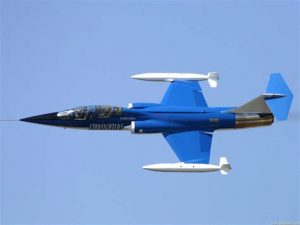
Pictured: F-104 Starfighter
Due to Johnson designing the F-104 to be better than any other aircraft, many other countries were interested in the F-104. At one point in time, the F-104 was operated by 15 different militaries.
This has always been one of my favorite aircraft. As a boy, I had a die-cast F-104 and spent seemingly endless hours destroying everything in its path. Here’s an interesting background on his work.
The Man Behind Lockheed Skunk Works
SR-71 Blackbird
Following the introduction of the U-2, both the USAF and CIA loved the aircraft. However, the 1960 U-2 incident [ Wiki ] highlighted to the USAF and CIA that the U-2 wasn’t invincible and needed something to prevent that.
Arming U-2s wasn’t an option- this would decrease the service ceiling of the U-2 and make it easier for Soviet radars to detect. As such, the CIA contracted Lockheed to develop a new, undetectable spy plane.
Lockheed contracted Johnson, then head of Lockheed Skunk Works, to develop the U-2s replacement. Johnson soon realized that arming the aircraft was nearly impossible, so chose another route: speed.
Johnson and his team developed the A-12 for the CIA. During the 1964 Presidential Election, Republican Barry Goldwater and Democrat Lyndon B. Johnson were having a televised debate.
Here, Goldwater accused Lyndon Johnson of allowing the Soviets to out compete the US. As such, LBJ decided to reveal the A-12 program and the fact that the USAF was implementing a variant of the A-12, called the SR-71.
Kelly Johnson had designed the fly higher than the U-2, at 85,000 ft (26,000 m). Instead of giving the SR-71 weapons, Johnson designed the SR-71 to travel at Mach 3.32, making it the fastest aircraft ever.
Herschel may have posted something about Mr. Johnson previously, but if you haven’t seen it, watch the Video Documentary of his career. They don’t make ’em like that anymore.
|
|






That story about the tower chatter with various aircraft trying to one-up each other trying to ‘verify’ the ground speed indicator is a classic!!
Here ya go, Joe–
https://www.youtube.com/watch?v=hFJMs15sVSY
…and all done with slide-rules and drawing boards.
The Lockheed employee publication “Lockheed Horizons” issue of Winter 1981/82 has two excellent articles on the Blackbird. “Development of the Lockheed SR-71 Blackbird” by Clarence (Kelly) Johnson and “J58/SR-71 Propulsion Integration” by William H. Brown from Pratt & Whitney. The issue is not easy to find but the articles are”must reads” for any Blackbird fan since the authors are the two chief designers of the aircraft.
I was once told that part of the F-104’s “secret sauce” was that the leading edges of its wings were sharp enough to do damage if one were to accidentally walk into one, so when they were on the ground, felt blankets were draped over each wing for the safety of the ground crew.
When I was a wee laddie my uncle worked for Lockheed at Luke AFB. I was fortunate enough to sit in the cockpit of a 104 several times.
The Starfighter “Howl” never gets old…………………
Note that “the U-2s replacement” retired almost 25 years ago, while the U2 is still flying. ;-)
Back in the days when the military industrial complex could actually build something that worked.
Mom came from TX in ’42 and worked in Lockheed on the P-38 effort at the time. After Dad came back from the Pacific I was made, and it was Leave it to Beaver Americana. She later went back to work for Lockheed and worked for Kelly Johnson. Said they were the happiest days of her life, scrambling to update tech drawings everytime Johnson or one of his minions picked up a piece of sheet metal & snips to twist it one way or other in an effort to make something better/faster. Improvements were designed on the fly for a variety of projects. Different times for sure, energized by standout people.