Myths About Afghanistan
Victor Davis Hanson on whether Afghanistan is really the "graveyard of empires ..."
Ernie Pyle's timeless wartime columns ...
No July 4 hot dogs with the Iranian Mullahs ...
Mark Steyn, U.S. sclerotic and ineffectual, declining into societal dementia ...
Nicholas Schmidle asks some hard questions about Nawaz Sharif ...
The CIA's war against President Bush was motivated by ass covering, or by political
NSA Director Keith Alexander, a three-star general, is expected to earn a fourth star when he
Providing electronic devices for IEDs ...
Police watched from a distance and did not intervene ...
Been there, done that in the Middle East ...
Matt Sanchez - repealing DADT would be a disaster.
Too much U.S. largesse has created corruption in Afghan government.
Dan Riehl weighs in on language, thinking and security from terrorism ...
The U.S. is seeking to hire a merchant ship to deliver hundreds of tonnes of arms to Israel
Sharif brothers on Baitullah Mehsud's hit list.
No Georgian destruction of Tskhinvali, contrary to lying Russian claims.
Nuclear yield within six to twelve months.
McNeill ties length to Pakistan tribal region, likely to be protracted anyway.
Multinational force press release on Sadr City operations and seizure of weapons and munitions.
"We will fight them to the end."
War on terror not popular with Pakistani population.
U.S. presence expanding Southward in Iraq.
Its full steam ahead for Iran.
And SECDEF Gates continues to press this issue.
Pajamas Media exclusive: how your tax dollars fund terror.
Southwestern Baptist Theological Seminary Graduate executed in Afghanistan.
Nearly 1000 dead from harshest Afghan winter in 30 years.
Attacks in Baghdad down 80% according to Iraqi Army.
Lack of appropriate defense spending a grave situation.
Olmert claims Iran still on target to construct nuclear weapon.
Promoted to Army Vice Chief of Staff. Well deserved.
Must read on Israeli Army shame and lawyer happiness with war against Hezbollah.
Libyans joining jihad in increasing numbers.
How relevant will Maliki be to Iraq's future?
Maj. Gen. Gaskin: "The positive trends are permanent."
Abizaid questions whether Maliki can bring unity to Iraq.
From the Multinational Force, more on Operation Lion Pounce.
An important ally in Iraq has been assassinated.
Israel to show Chairman of Joint Chiefs of Staff nuclear intelligence on Iran.
Cabinet approves proposed agreement with U.S.
Prof. Kingsley Browne on his new book.
Major General Robert Scales: "Outcome is irreversible"
Mullen says military needs larger slice of GNP to modernize.
For siding with the U.S. against al Qaeda.
Terrorist poses as bride. Ugh!
Legislation in trouble.
Al Qaeda documents discovered near Syrian border.
Shameful people jeer disabled veterans in swimming pool.
Saudi jihadist in Iraq tells his personal story.
Concerning Iranian meddling and Quds.
Michael Yon breaks bread with General Petraeus.
Ralph Peters on the advancements in Iraq.
War between al Qaeda and Hezbollah.
Traumatic brain injury not recognized.
Ballistic Sensor Fused Munition.
High intensity electronic warfare.
Iranian weapons are a sign of continued Iranian meddling in Iraq.
U.S. forces in Iraq are using a high-resolution, thermal/infrared sensor system.
Washington Post profiles AQI (al Qaeda in Iraq, or al Qaeda in Mesopotamia).
Taiwan may not be as secure as we would like to think.
Be thankful your daughter isn't be raised in Basra.
Pastor discusses rules of engagement and sacrificial U.S. deaths.
In counterinsurgency (COIN), patience is a virtue. But violence has decreased so fast in
From the New York Times (h/t Mudville):
Last week the United States military pulled out of the Korengal Valley in eastern Afghanistan. Six miles long, sparsely populated and of dubious strategic value, the Korengal was the scene of some of the most relentless fighting of the Afghan war. American forces have been there in one form or another since the summer of 2005, when Taliban fighters cornered a four-man Navy Seal team on a nearby mountain and killed three of them. They then shot down a Chinook helicopter with 16 commandos on board. All of them died.
For much of 2007 and 2008, I was an embedded reporter with a platoon of airborne infantry at a remote outpost called Restrepo, which was attacked up to four times a day. Many soldiers had creases in their uniforms from bullets that had brushed them. In one firefight a bullet hit a sandbag six inches from my head.
The psychological pressure was enormous. “I’ve only been here for four months and I can’t believe how messed up I am,” one soldier told me. “I went to the counselor and he asked if I smoked cigarettes and I told him no and he said, ‘Well, you may want to think about starting.’”
There were around 20 men at Restrepo — part of a 150-member unit called Battle Company of the 173rd Airborne Brigade Combat Team — and the possibility of getting overrun by the enemy was openly discussed. The men slept next to their guns and sometimes with their boots on. More than 40 American soldiers have died in the Korengal Valley.
Now, the military has retreated, saying that the valley is too isolated and that the American presence was possibly pushing the locals to side with the Taliban. This raises some questions: If the Korengal was really worth fighting for, why would we ever pull out? Or, conversely, why did we go there in the first place? Like the soldiers at Restrepo, I was looking at the war through a tiny keyhole, and have no way to answer such overarching questions. But I do know that several important points must be acknowledged.
First, a significant proportion of enemy fighters in the Korengal were foreigners who had come to Afghanistan to wage jihad. There were Pakistani cellphone numbers painted on rocks around the valley as a recruiting tool for potential volunteers; there were Arabic graffiti urging local men to join the fight. These foreigners presumably would have fought the Americans wherever they found them; if we had avoided the Korengal they would simply have shifted the battle elsewhere. (To a better place? A worse one? I doubt even the Taliban could say.)
Furthermore, I was told that one of the reasons for establishing a base in the Korengal was to prevent militants from using the valley to stage attacks on the vastly more important Pech River Valley, immediately to the north. The Pech was a major corridor for moving men and supplies, and after American bases were established in the Korengal, attacks at Pech dropped off significantly. The Korengal may not have been important per se, but arguably the Pech was, and there may have been no way to strategically separate the two.
At the beginning of the commentary, Sabastian Junger judges Korengal of dubious strategic value. By the end of the seventh paragraph he has carefully crafted a good case for its unmatched strategic value. Similarly, I said:
… until the places where the religiously-motivated and hard core fighters are taken on head-to-head, his means of rest and recruitment denied him, and his largesse taken away from him, this counterinsurgency cannot be won. While they are unmolested in their favorite places, they can continue to send insurgents into the cities – Kandahar, Jalalabad and Kabul.
DVIDS published several videos of the dis-assembly of Korengal (here and here), but they aren’t as interesting as one published by al Jazeera which shows the Taliban swarming over the remains of the COP.
So why wasn’t a drone re-tasked to keep watch over the remains of the COP, and monitor the presence of enemy fighters and kill them while congregated in the COP? This is yet another missed opportunity.
On a slightly different front, the Asia Times has an article up by Brian M Downing in which it is suggested that the reason for the insurgency was the presence of U.S. troops. The solution? Withdraw, just like we have done. The culmination of this logic is to withdraw all U.S. forces from everywhere there is global or transnational insurgency, and presto – the fighters will disappear, never to cause problems anywhere.
With idiotic commentaries like this one (and others recently by anti-American Gareth Porter), the Asia Times is turning into a laughingstock, and is increasingly not worth the time, even for canvassing Taliban propaganda (which is the main reason I study this site).
Make no mistake about it. This withdrawal is harmful to U.S. interests.
Prior: Withdrawal from Korengal
The last U.S. Soldiers have been pulled out of the Korengal Valley.
It was as if the five years of almost ceaseless firefights and ambushes had been a misunderstanding — a tragic, bloody misunderstanding.
More than 40 U.S. troops have been killed, and scores more wounded, in helicopter crashes, machine-gun attacks and grenade blasts in the Korengal Valley, a jagged sliver just six miles long and a half-mile wide. The Afghan death toll has been far higher, making the Korengal some of the bloodiest ground in all of Afghanistan, according to American and Afghan officials.
In the pre-dawn hours of Wednesday, the U.S. presence here came to an abrupt end.
[ ... ]
For U.S. commanders, the Korengal Valley offers a hard lesson in the limits of American power and goodwill in Afghanistan. The valley’s extreme isolation, its axle-breaking terrain and its inhabitants’ suspicion of outsiders made it a perfect spot to wage an insurgency against a Western army.
U.S. troops arrived here in 2005 to flush out al-Qaeda and Taliban fighters. They stayed on the theory that their presence drew insurgents away from areas where the U.S. role is more tolerated and there is a greater desire for development. The troops were, in essence, bullet magnets.
In 2010, a new set of commanders concluded that the United States had blundered into a blood feud with fierce and clannish villagers who wanted, above all, to be left alone. By this logic, subduing the Korengal wasn’t worth the cost in American blood.
There’s more than a little hyperbole in this report. There was and is no surprise in the difficulty of the Korengal Valley. This is where the Battle of Wanat occurred, but in spite of the level of difficulty, Bing West points out that:
The scale of the fighting was not the reason for withdrawing. One American soldier was killed in the Korengal in the last ten months, a loss rate less than in an average rifle company. The strongest technical rationale for the withdrawal was economy of force. The troop-to-population ratio and the logistics for air support were too onerous, regardless of the level of fighting.
The troop (and air power and logistics) commitment in Korengal didn’t comport with a population-centric counterinsurgency model General McChrystal wants to employ. When it comes to population, the Korengal Valley can’t compete with Kandahar with its half a million residents.
But is it really correct to assert that we merely stumbled into a tribal feud? Bing West continues: “… in 2007, half the fighters were locals and half were hard-core Islamic jihadists. When I was in the Korengal in 2009, the interpreters estimated a third of the voices heard over the enemy radios had Pakistani-tinged accents, a third were Pashto and a third were the local dialects.”
The Washington Post report eventually becomes interesting with a touchstone account of attempting to persuade hard core insurgents.
Moretti’s predecessors had spent countless hours trying to persuade Zalwar Khan to rally the locals to support the road project. Three years of prodding had produced virtually no progress. Moretti sensed that the real power in the valley lay with the men leading the insurgency.
He asked Khan to deliver a letter to a timber baron and insurgent leader known as Matin, who like many Afghans uses only one name. Long before Moretti’s arrival in the valley, U.S. troops had killed several of Matin’s family members in airstrikes, according to the Korengalis. In banning the timber trade, the Afghan government had deprived him of his sole means of income.
“Haji Matin hates the Americans too much,” Khan told Moretti, using an honorific that signified Matin’s completion of the pilgrimage to Mecca. “He won’t respond.”
Instead he advised Moretti to write to Nasurallah, a colleague of Matin’s. “It is our belief that you are the rightful leader of the Korengalis,” the captain wrote. “You hold the power not only among the villagers but also among the fighters. If you want the valley to prosper all you have to do is talk with us and bring your fighters down from the mountains.”
The letter offered Nasurallah two choices: development or death. “It is not our wish to kill your fellow Korengalis,” Moretti continued. “But we are good at it and will continue to do it as long as you fight us.”
Two days later, Moretti received a response. “If you surrender to the law of God then our war against you will end,” Nasurallah wrote. “If you keep fighting for man’s law then we will fight you until Doomsday.”
As I have contended before, until the places where the religiously-motivated and hard core fighters are taken on head-to-head, his means of rest and recruitment denied him, and his largesse taken away from him, this counterinsurgency cannot be won. While they are unmolested in their favorite places, they can continue to send insurgents into the cities – Kandahar, Jalalabad and Kabul.
We don’t have enough troops, and SOF raids against high value targets – which contrary to belief is becoming even more important that it was previously – won’t ameliorate the need for contact with both the enemy and the population. U.S. forces in the Korengal Valley have fought bravely, but don’t be surprised if this area becomes safe haven for not only hard core Taliban, but globalist insurgents of various ilk.
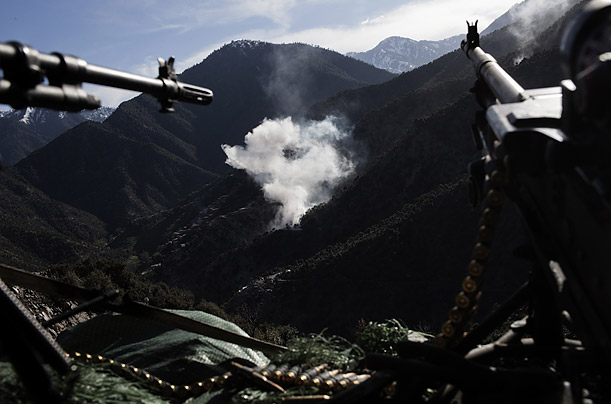
From Time’s Adam Ferguson.
The enemy routinely fires on the soldier’s positions from perches in the gorge. No one knows what — or who — lies at the end of the 6-mile-long valley because no one has been able to make it that far. In this photo, smoke rises from a mortar fired by American troops.
“No one has been able to make it that far.” Too few troops, says The Captain’s Journal. Korengal Valley is there as the prize for successful counterinsurgency with enough troops to take and hold the terrain, win the population and enforce authority.
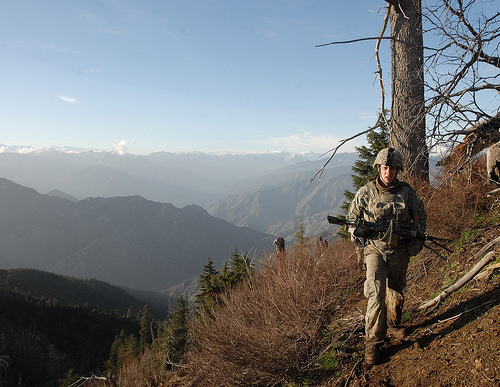
A different view of the valley.
Spc. Andrew Harvey, a 1st Infantry Soldier, patrols along steep cliffs of the Korengal Valley’s surrounding mountains during Operation Viper Shake, Afghanistan, April 21, 2009.
Prev | List | Random | Next · Join Powered by RingSurf! |