Myths About Afghanistan
Victor Davis Hanson on whether Afghanistan is really the "graveyard of empires ..."
Ernie Pyle's timeless wartime columns ...
No July 4 hot dogs with the Iranian Mullahs ...
Mark Steyn, U.S. sclerotic and ineffectual, declining into societal dementia ...
Nicholas Schmidle asks some hard questions about Nawaz Sharif ...
The CIA's war against President Bush was motivated by ass covering, or by political
NSA Director Keith Alexander, a three-star general, is expected to earn a fourth star when he
Providing electronic devices for IEDs ...
Police watched from a distance and did not intervene ...
Been there, done that in the Middle East ...
Matt Sanchez - repealing DADT would be a disaster.
Too much U.S. largesse has created corruption in Afghan government.
Dan Riehl weighs in on language, thinking and security from terrorism ...
The U.S. is seeking to hire a merchant ship to deliver hundreds of tonnes of arms to Israel
Sharif brothers on Baitullah Mehsud's hit list.
No Georgian destruction of Tskhinvali, contrary to lying Russian claims.
Nuclear yield within six to twelve months.
McNeill ties length to Pakistan tribal region, likely to be protracted anyway.
Multinational force press release on Sadr City operations and seizure of weapons and munitions.
"We will fight them to the end."
War on terror not popular with Pakistani population.
U.S. presence expanding Southward in Iraq.
Its full steam ahead for Iran.
And SECDEF Gates continues to press this issue.
Pajamas Media exclusive: how your tax dollars fund terror.
Southwestern Baptist Theological Seminary Graduate executed in Afghanistan.
Nearly 1000 dead from harshest Afghan winter in 30 years.
Attacks in Baghdad down 80% according to Iraqi Army.
Lack of appropriate defense spending a grave situation.
Olmert claims Iran still on target to construct nuclear weapon.
Promoted to Army Vice Chief of Staff. Well deserved.
Must read on Israeli Army shame and lawyer happiness with war against Hezbollah.
Libyans joining jihad in increasing numbers.
How relevant will Maliki be to Iraq's future?
Maj. Gen. Gaskin: "The positive trends are permanent."
Abizaid questions whether Maliki can bring unity to Iraq.
From the Multinational Force, more on Operation Lion Pounce.
An important ally in Iraq has been assassinated.
Israel to show Chairman of Joint Chiefs of Staff nuclear intelligence on Iran.
Cabinet approves proposed agreement with U.S.
Prof. Kingsley Browne on his new book.
Major General Robert Scales: "Outcome is irreversible"
Mullen says military needs larger slice of GNP to modernize.
For siding with the U.S. against al Qaeda.
Terrorist poses as bride. Ugh!
Legislation in trouble.
Al Qaeda documents discovered near Syrian border.
Shameful people jeer disabled veterans in swimming pool.
Saudi jihadist in Iraq tells his personal story.
Concerning Iranian meddling and Quds.
Michael Yon breaks bread with General Petraeus.
Ralph Peters on the advancements in Iraq.
War between al Qaeda and Hezbollah.
Traumatic brain injury not recognized.
Ballistic Sensor Fused Munition.
High intensity electronic warfare.
Iranian weapons are a sign of continued Iranian meddling in Iraq.
U.S. forces in Iraq are using a high-resolution, thermal/infrared sensor system.
Washington Post profiles AQI (al Qaeda in Iraq, or al Qaeda in Mesopotamia).
Taiwan may not be as secure as we would like to think.
Be thankful your daughter isn't be raised in Basra.
Pastor discusses rules of engagement and sacrificial U.S. deaths.
In counterinsurgency (COIN), patience is a virtue. But violence has decreased so fast in
Mullah Abdul Ghani Baradar has been captured.
The Taliban’s top military commander was captured several days ago in Karachi, Pakistan, in a secret joint operation by Pakistani and American intelligence forces, according to American government officials.
The commander, Mullah Abdul Ghani Baradar, is an Afghan described by American officials as the most significant Taliban figure to be detained since the American-led war in Afghanistan started more than eight years ago. He ranks second in influence only to Mullah Muhammad Omar, the Taliban’s founder and a close associate of Osama bin Laden before the Sept. 11 attacks.
Mullah Baradar has been in Pakistani custody for several days, with American and Pakistani intelligence officials both taking part in interrogations, according to the officials …
American officials believe that besides running the Taliban’s military operations, Mullah Baradar runs the group’s leadership council, often called the Quetta Shura because its leaders for years have been thought to be hiding near Quetta, the capital of Baluchistan Province in Pakistan.
One of the more intriguing elements of this report is where he has been detained: Karachi. I can be counted among that group who believes that the Quetta Shura is based in Quetta. But the theory has been floated for a while now that Mullah Omar was in Karachi, and now his second in command has been detained there.
This follows on soon after logistics attacks occurred in Karachi, not too long after attacks directly against Christians, shootouts between the Taliban and Pakistani police, and about a year and a half after I noted the Talibanization of Karachi. This is yet another data point arguing for the importance of focus on Karachi, the port city through which the vast majority of logistics flows to Afghanistan.
The other interesting thing about this detainment is that it is of a Taliban leader in Pakistan, not a Tehrik-i-Taliban, or Pak-Taliban. This is actually a good sign from Pakistan.
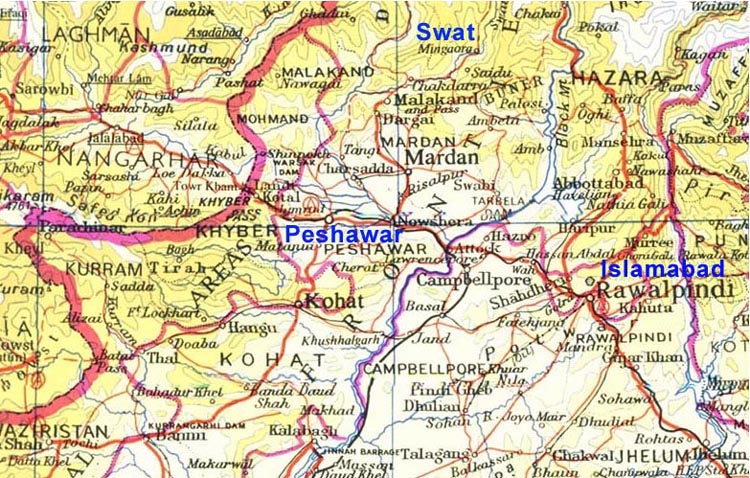
There is more logistical trouble with the supply lines through Pakistan (lines which supply approximately 85% – 90% of our needs in Afghanistan). The first report has to do with a bridge near Peshawar.
Suspected terrorists on Thursday blew up a bridge on a link road connecting Peshawar’s Badbher village to Khyber Agency’s Bara town, officials and locals said. A police official said the blast took place at around 1:30am. The bridge over the Frontier Road was blown up as police personnel travelled through the area, the official said, adding that the terrorists escaped the scene. He said that a search was being conducted to trace the perpetrators of the blast.
The second report pertains to a tanker attack near Peshawar.
Taliban blew up a tanker carrying oil supply to NATO forces in Afghanistan on the ring road in the Chamkani police precincts early on Monday, police said. Chamkani police officials told Daily Times that an Afghanistan-bound tanker carrying oil supply for NATO forces was attacked by armed men on Monday morning. They said the assailants fired at the tanker and destroyed it with a magnet bomb.
The third report is even more important for where it occurred – the port city of Karachi.
A NATO convoy came under assault Thursday while carrying supplies through Pakistan to Afghanistan in a rare ambush inside Karachi, the relatively secure port city from which 300 to 400 of the coalition’s trucks leave each day.
Any assault on the Pakistani supply route is worrisome to the US-led forces in Afghanistan, who use it to ship three-quarters of their materials and will need it even more as the surge of 30,000 US troops progresses.
But the attack in Karachi – which is the commercial capital of Pakistan, and has largely escaped the bomb attacks troubling other major cities and the northwest – raises particular concern, especially if it marks the beginning of a trend.
From the beginning to end of the supply lines, logistics is under attack. It still isn’t too late to do the right thing, and engage the Caucasus.
In news that is both remarkable and under-reported, the Taliban have launched an attack against Christians in the major Pakistan port city of Karachi.
The Taliban, emboldened by their success in Swat Valley and advance near Islamabad, have attacked a Christian neighborhood and executed two residents after Christians held a rally protesting graffiti ordering them to convert to Islam or die.
On April 20, residents of Taseer Town in Karachi woke up to find pro-Taliban messages chalked onto the walls of two churches. The messages included, “Long Live the Taliban,” “Talibanization is our goal,” and “Embrace Islam or Prepare to Die.” The next day, the Christian residents staged a protest in the hopes of attracting the attention of the local government to provide protection. Officials, however, did nothing.
The night of the protest, April 21, more than 100 masked terrorists invaded Taseer Town with automatic rifles. The terrified Christian residents ran to their homes and locked themselves inside. According to Asif Stephen, a Christian politician, one of the protestors said, “We were protesting peacefully and all of sudden (sic), a few militants carrying the latest weapons rushed in. Some of the attackers entered homes and pillaged money and jewelry and abused the women and burned their properties. The elderly were injured and one child fell to the ground and died in my friend’s arms.”
The Taliban militants went door to door, breaking into Christian homes and dragging the elderly and women out into the street by their hair. The Taliban leaders shouted, “You infidels have to convert to Islam or die. Why did you wash up warnings inscribed on walls of church and home doors? How dare you are (sic) to take out procession against Taliban?”
The terrorists sexually assaulted several women and physically abused dozens more with clubs, iron rods, and whips. They set a number of homes on fire. When two Christians resisted, the militants killed them execution-style directly in front of their families. The identity of those killed has not yet been confirmed.
According to AsiaNews, police have arrested seven of the Taliban militants involved in the attack. However, they are unsure who was behind the incident.
This is yet another example of the Talibanization of Karachi, something we have discussed before. The number of Taliban fighters in Karachi is unknown, but we do know that vast parts of the inner city are practically off limits for Westerners. Assuming the accuracy of this report, to field more than 100 fighters in an attack as brazen as this one demonstrates proof of principle. The Taliban are strong enough to be considered to be a legitimate insurgency in Karachi, hundreds of miles from the North West Frontier Province.
It should also be mentioned again that Karachi is the port city through which NATO supplies come (except for some small part that is transported by air). If the Taliban manage to shut down shipping traffic in Karachi, the logistical routes into Afghanistan are all but dried up (unless the U.S. pursues the line of logistics we recommended through the Caucasus).
Finally, in another indication of the vacillation of the Pakistan police, the Christians were completely helpless in the face of the Taliban onslaught. Lesson learned. Purchase guns and ammunition, learn to shoot, and defend family and property. It’s their God-given right.
We have discussed the Talibanization of Karachi, and while the alleged number of Taliban in Karachi (400,000) is probably exaggerated, there is no doubt that extremism has taken root in Karachi. It was the launch point for the Mumbai attacks, and as we have also discussed before, the port city through which all NATO supplies into Afghanistan through Pakistan flow. Recently the police and Taliban fighters had a shootout in Karachi in which numerous police casualties occurred.
Pakistani police have arrested more than a dozen Islamist militants in the southern city of Karachi after a gun battle following a pre-dawn raid on their hideout, officials said.
Two policemen were killed and nine wounded before the militants’ resistance was broken after several hours of shooting.
The raid came as tension is running high between Pakistan and India in the wake of a militant attack on the Indian city of Mumbai in November, and there is pressure from the international community for Pakistan to crack down harder on jihadi groups.
A senior police official who declined to be identified said the detained men had links with Pakistani Taliban commander Baitullah Mehsud, who is based in lawless ethnic Pashtun lands on the Afghan border …
“We were getting reports for a long time that some jihadi elements were active in this area. Today, we raided the area and arrested many of them,” Ahmed said.
One Pakistani official also said (coincidentally before this shootout) that “The Taliban won’t cause real trouble in Karachi because it’s their funding point – they get their infrastructure here, the money, the SIM chips, the mobile phones.” Perhaps this official should re-evaluate his position on whether the Taliban wish to cause “real” trouble. Funding point or not, the Taliban will be able to focus their activities on the implementation of Islamic writ and anti-American activities – including the closing of the port city to NATO supplies – with enough fighters.
Finally, it isn’t clear whether the police believe their propaganda or not, but one thing is certain. In arresting approximately a dozen Taliban, the Karachi police haven’t yet seen the tip of the iceberg, much less arrested many of the Taliban.
Prior:
Glenn Reynolds links the Small Wars Journal on a potential surge in Afghanistan, and Michael Yon weighed in saying that in his opinion the proposed 25-40K troops won’t be enough. Then Glenn asks a salient and insightful question: How many troops can we support, logistically, in Afghanistan? Glenn has been carefully examining the reports.
The Captain’s Journal has a right to weigh in on this subject because first of all, we have been advocating a surge for Afghanistan for at least one year, manned partly by an expeditious withdrawal of Marines from the Anbar Province as recommended by Commandant Conway (we are, after all, a Marine blog). Second, we make very few forecasts, but when we do, we have good track record of accuracy. When Army intelligence was claiming that there wouldn’t be a spring offensive in Afghanistan, we said that there would be a two-front Taliban offensive, one by the Tehrik-i-Taliban in Pakistan and the other in Afghanistan by the followers of Mullah Omar.
We also described the strategy of interdiction of NATO supplies into Afghanistan many months before it began to occur. Afghanistan is land-locked, and transportation of supplies and ordnance to U.S. and NATO troops occurs basically in three ways. Ten percent comes into Afghanistan via air supply. The other ninety percent comes in through the port city of Karachi, of which the vast majority goes to the Torkham Crossing (and then to Kabul) via the Khyber pass, with some minor portion going to Kandahar through Chaman.
This interdiction of supply routes by the Taliban is an integral part of their offensive. The Taliban have been successful in stopping and confiscating some of the supplies, and Pakistan officials have temporarily stopped transit of sealed containers through Khyber.
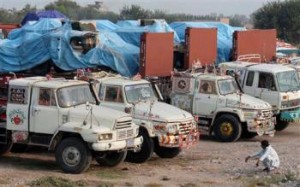
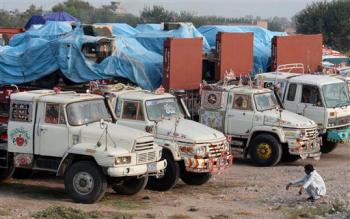
A Pakistani driver sits beside parked trucks loaded with supplies for American and NATO forces, Sunday, Nov. 16, 2008 in Peshawar, Pakistan. Pakistan has temporarily suspended oil tankers and trucks carrying sealed containers from using a key passage to Afghanistan, an official said Sunday, a move that will likely impact supplies heading to U.S. and NATO troops. (AP Photo/Muhammad Iqbal)
So returning to the question of logistical support of U.S. troops, there has been an impact from insecurity thus far, and assuming a closing of the transit routes by Taliban fighters, no logistics would be sustainable. But ironically, an increase in force projection in Afghanistan will bring its own logistical rewards and unintended [good] consequences.
We tend to see the struggle through Western eyes, and where we see territorial borders, the Taliban and al Qaeda see nothing. It is we who see the phantom, not the Taliban. The enemy is a transnational insurgency and knows no borders, and operations against them in Afghanistan will cause pressure in Pakistan as well. Fighters from Pakistan have been sent to assist fighters in Afghanistan on a regular basis, and Baitullah Mehsud has made it one of his duties to support the anti-government efforts in Afghanistan. Logistics and the degree to which supply routes remain operational will be a function of pressure on the Taliban, and the coupling of these two variables is inversely related.
Does this analysis not sound convincing because it is open source and proferred by a non-professional? Very well. Listen to a jihadi say it: “If NATO remains strong in Afghanistan, it will put pressure on Pakistan. If NATO remains weaker in Afghanistan, it will dare [encourage] Pakistan to support the Taliban, its only real allies in the region.”
While analysis at The Captain’s Journal relies mainly upon open source information from jihadist web sites, Pakistani, Afghan and other news sources, 95% of which can be Taliban propaganda on any given day, we were right on the danger in Khyber based on these sources, as well as the fact that there would be a two-front spring offensive. The trick is to know when it’s propaganda and when it’s not.
The U.S. should continue to work on alternative means of supply, as well as pressure the Pakistan Army to continue operations against the Tehrik-i-Taliban in Khyber and in and around Peshawar. But the surest way to put pressure on the Taliban is to conduct kinetic operations against them in Afghanistan. Pressure on the Taliban anywhere will redound to open supply routes.
UPDATE: Welcome to Instapundit readers, and thanks to Glenn for the interest.

Prev | List | Random | Next · Join Powered by RingSurf! |