
Pentagon Supercomputer Powers IED-Hunting
BY Herschel Smith 17 years, 7 months ago
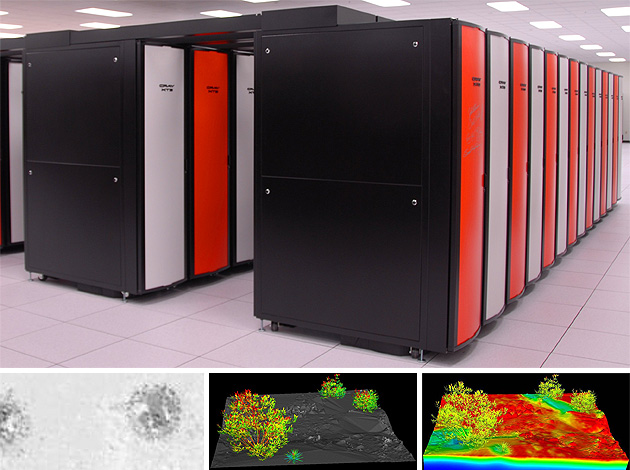 Popular Mechanics tells us about a Pentagon program that couples advanced computer technology with UAVs to aid in IED-hunting. The program relies on physical terrain mapping by the use of UAVs along with a Cray supercomputer to utilize the information gleaned from the survey data. These two things, when combined with “learning” algorithms (i.e., artificial intelligence), are intended to produce knowledge of the battle space for the warrior thousands of miles away.
Half a world away from the fighting in Iraq and Afghanistan, nestled near the border of Mississippi and Louisiana, a 34-year-old electrical engineer is wielding one of the planet’s most powerful computers to lend a virtual helping hand to American soldiers. Joshua Fairley’s detailed 3D modeling of warzone scenes, based at the U.S. Army Engineer Research and Development Center (ERDC) in Vicksburg, Miss., has vastly improved the effectiveness of airborne sensors in scoping out deadly ground-based threats.Deployed in space or on aircraft—often in UAVs—electro-optical and infrared sensors scan urban and rural terrain for explosive devices. Automatic Target Recognition (ATR) algorithms then digitally decipher the fuzzy images, picking out the mines from the manholes and the bombs from the bushes. At least that’s the hope, with visual clutter triggering regular false alarms. One very time-consuming and expensive way to improve the sensors would be to fly the systems repeatedly, performing case study after case study. Instead, Fairley and his team have used the ERDC’s Cray XT3, the Defense Department’s second most powerful supercomputer, capable of 40 trillion computations per second, to simulate landscapes from combat and do the case studies in a lab on American soil.What makes the work stand out is the level of detail they are achieving: By taking into account soil types, plant distribution, species of plants and even the distinct characteristics of those species, Fairley says his team has processed data “literally down to the weeds.” Soon, the Army Corps researchers hope to model beneath the ground. Why? “Each plant takes up a certain amount of moisture through its roots,” explains Fairley, who once designed sensors for Lockheed Martin. “That moisture could affect localized temperature, which affects the ability to detect a threat.” Fairley then uses the sensors to scan these “synthetic images” for potential hazards, taking note of how well the sensors function under certain weather conditions, at certain times of year and even different times of day. That way he can write complex new algorithms to “teach” the sensors, some of which take thermal readings, to distinguish harmless objects from threats. In one case study, he cut the false alarm rate by 75 percent. Results like that, he says, “will benefit the well-being and health of our warfighters, which is a reason why I get up in morning and come to work.”
While the best intelligence is still human, in a campaign that has seen its fair share of unpreparedness for the enemy tactics, this is welcome advancement. The technology is basically one of finding what is out of place – the old game of “what doesn’t belong in this picture?” As long as the UAV coverage is sufficient, the computing should be able to cope. Still … Crays? I thought that the Cray had disappeared with the dinosaur? I thought most supercomputing was done now with multiple RISC processors communicating via message passing (MPI), similar to the Los Alamos National Laboratory’s Blue Mountain computer?
As it turns out, Cray has apparently kept up with technology, or so they say, and the “vector processor of the Cray XT5h system has unique global addressing capabilities programmable by Co-Array Fortran and Unified Parallel C (UPC), which can solve problems beyond the capabilities of MPI.”
It would have been nice if Popular Mechanics had followed this story up with a discussion on the type of computer being used and why the choice had been made. In any case, this is good leveraging of our technological advantage to aid in the campaign in Iraq, even if the timing is later than desirable. A followup article should be issued in the future to report on the effectiveness of this program. Theory is good, but results are proof of principle.






On December 2, 2007 at 4:56 am, Brian H said:
True neural net learning would be more interesting; it is best suited for distinguishing patterns and recognizing form. Algorithms are human rule sets for logically deriving “correct” answers, and are limited by the verbalization / conceptualization capacities of the composer(s). Real experts do not follow rules; they tack between significant examples, and only use words and numbers after the fact. Neural nets do the same; it is not usually possible to track or describe how they reach conclusions, and often the result itself is not readily “boxable”.
I suspect that there are many ideosyncratic practices and patterns amongst IED makers and planters, both from individual characteristics and from instruction/teaching patterns passed on by insurgent highers. Some may love culverts; others ruts. Some like dissolved and reset asphalt; some like planting inside brick walls. Etc. Trying to make one-ruleset-fits-all “AI” systems from simulated scenarios is an inherently limited strategy.