New York Court Holds Stun Gun Ban is Not Unconstitutional, in Contravention of Caetano

Herschel Smith · 30 Mar 2025 · 2 Comments

Dean Weingarten has a good find at Ammoland. Judge Eduardo Ramos, the U.S. District Judge for the Southern District of New York,  has issued an Opinion & Order that a ban on stun guns is constitutional. A New York State law prohibits the private possession of stun guns and tasers; a New York City law prohibits the possession and selling of stun guns. Judge Ramos has ruled these laws do not infringe on rights protected by the Second Amendment of the United States Constitution. Let's briefly…… [read more]

The Best Way to Ensure That the Marines Become Irrelevant

BY Herschel Smith
15 years, 10 months ago

From National Defense Magazine, another silly article on massive amphibious assault landings in the 21st century (only part reproduced below).

While many pundits (Editorial comment: And to whom might this be referring?) contend that ship-to-shore fighting is fast becoming archaic, Marine Corps leadership insists that future conflicts may again require amphibious skills. They admit that training for a forced entry operation has atrophied during the last nine years of conflict and the Corps’ alliance between ships and sailors is not what it once was.

“In order to capitalize on the Navy-Marine Corps relationship, we need concepts like ship-to-shore maneuver in order to get the best out of both sides of the equation,” said Brig. Gen. Robert F. Hedelund, commanding officer of the Marine Corps Warfighting Laboratory.

The trick in the future is to conduct a beach landing from a ship sailing beyond the horizon, miles away from shore where it is safe from anti-ship missiles. That means marines not only will have to stomach a longer journey to shore, but also they will have to operate ashore knowing that supplies, medical evacuations and fire support will take more time.

In an experiment during the biennial Rim of the Pacific naval exercise in Hawaii, the Marine Corps Warfighting Laboratory put to the test a revamped concept of storming the beach. It gave a company landing team, enhanced by an artillery platoon, a suite of advanced communications and robots to help them fight, resupply and evacuate casualties.

“We’re taking the things that marines are doing in Afghanistan and sprinkling saltwater on them,” said Vince Goulding, director of the experiments division in the lab. “We’re taking them from the sea base, bringing them ashore to do the things they’ve already learned how to do.”

Marines know how to land on a beach. The challenge is sustaining them on the shore when the ship is a hundred miles at sea maneuvering with the naval force, said Goulding. “How do you get food to them? How do you take care of injured marines? Can you command and control them adequately? How do you provide fires for them?”

Some of those questions were answered during a four-day amphibious assault exercise on Oahu. In the early morning hours of the first day, marines from Golf Company, 2nd Battalion, 3rd Marine Regiment and Alpha Battery, 1st Battalion, 12th Marine Regiment lined up in the hangar of the amphibious ship. They loaded up with packs that were stuffed full of experimental communication gear and batteries. One by one they marched down into the lower vehicle bay and onto the three landing craft docked in the well deck. As the ship rocked on the heavy seas, sailors aboard the craft greeted them by saying, “You will get sick.” They instructed the marines to vomit into the plastic bags provided or to use their helmets. So warned, the marines dispersed. Some climbed into truck cabs for the hour-long ride; others sat inside the windowless passenger areas.

For many of the marines, it was the first time they had ever operated aboard a ship, much less ridden to shore in a landing craft.

More than an hour later, an innocuous bump marked when the LCAC hit the beach. The marines ran off the deck and collected ashore as the artillery vehicles were unloaded. Many troops had radio handsets tucked underneath their helmets and strapped into place over their ears. There was a little bit of shouting, a name here, a name there, but mostly it was quiet as the marines spoke discreetly into their radios. It was an amphibious landing unlike any other that had preceded them. By the end of the next 72 hours, they had accomplished their mission of rooting out a terrorist training compound.

The experiment is analogous to what the Marine Corps did in the 1930s, in trying to get ready for amphibious fight in Pacific, Goulding said. “We’re preparing for the amphibious fight, wherever it might be, in 2020.”

The experiment proved that the company landing team concept is feasible, but that improvements are needed in the size, weight and power of the infantry gear.

“We’re still on the curve where the technology we’re getting for individual marines is driving up the weight,” said Hedelund.

The demand for water was a significant concern for commanders both ashore and at sea. A large number of helicopter sorties from the ship were carrying water. When they dropped off the supplies, troops did not have vehicles to transport the goods.

“I am convinced now more than ever that a MV-22 Osprey-borne dismounted marine infantry company inserted into rough terrain needs some sort of organic, internally transportable ground mobility asset,” said Goulding. Whether it’s manned or unmanned is beside the point, he said. Dismounted troops need a way to move supplies.

“When those infantry platoons were resupplied with 5-gallon cans of water, except for what they could put into CamelBaks and drink, they now had this stuff with them, and it became a mobility impediment to them,” explained Goulding.

A small vehicle, such as the John Deere Gator, could fit inside an MV-22 Osprey. It could be driven by troops and help them transport supplies, he said.

The amphibious landing concept from a ship sailing beyond the horizon is viable, Goulding said in an interview after the exercise concluded. But “we need to get hot on ship-to-maneuver logistics,” he pointed out.

“This is a problem from two ends: It ties up a high-demand low-density aviation asset that we could better employ by providing mobility to marines on the ground,” said Goulding. “It also demonstrated that we need to do better foraging for water.”

Goulding, a retired marine, flew over the mountainous Kahukus Training Range twice in a helicopter during the exercise. “There is water everywhere in the Kahukus,” he pointed out, but the marines had to rely on drinking water supplied from the ship.

In a separate effort, the lab is experimenting with a tactical reverse osmosis water purification unit that would have turned the free flowing Hawaiian water into potable water for the squads.

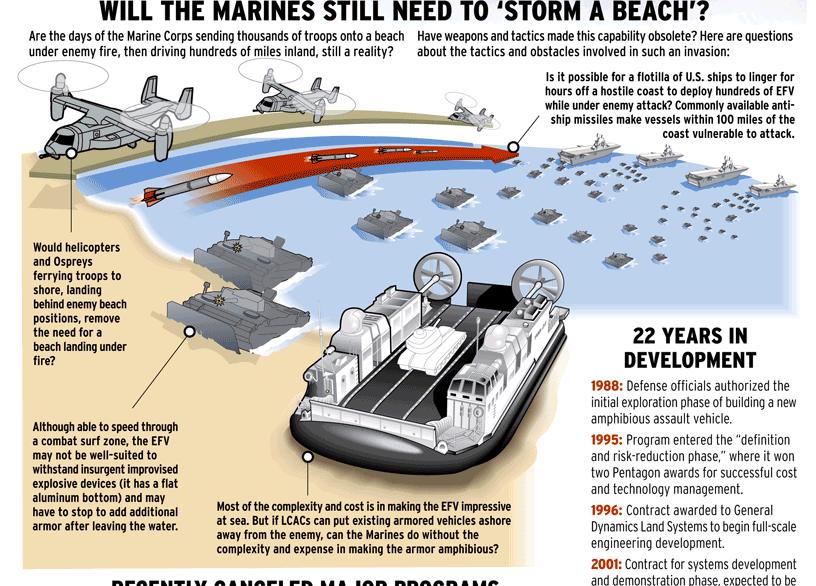
Good grief.  We’re complaining about the Marines becoming too heavy, while we plan to send them ashore in the extremely heavy Expeditionary Fighting Vehicles.  The Navy wants to be relevant, and in lieu of close support for the Marines, they plan on never-to-be-used powerless and irrelevant littoral combat ships.  We want to do massive amphibious assaults against unknown enemies, yet we plan to start from so far off shore that we’re vulnerable to missile fire for some twenty five miles or more.

We want to be self sufficient, and yet logistics controls us to the point that we are planning for reverse osmosis purification units.  We want to be quick to get to shore, but we cast our lots with the EFV when a new fleet of helicopters would allow us fast transit to the shore (and further inland) and fast-roping would allow quick ingress to the battle space with light, fast and well trained troops.

But are our Marines well trained?  From backpacking, hiking and camping, I and each of my four children know how to purify water from our surroundings.  I and each of my four children know how to climb and rappel.  I and each of my four children know how to make decisions on the fly, not waiting on specific commands but relying on broad mission goals to guide our actions.  And only one among my four children is a Marine.

It would have been better for the Marines if they had been dropped on shore from helicopters and told that their first mission was to “Find your own damn water and food – you have no support and you’re on your own.”  That would have built self sufficiency and small unit leadership.

It’s expectations such as this – EFV, constant logistics, bloated support to infantry troop ratio, gadgets and doodads in place of adapt, improvise and overcome – that will cause future administrations to turn to SOCOM and Special Operations Forces rather than the Marines to conduct special missions, expeditionary engagements and small wars, and in general turn to the SOCOM chain of command rather than the U.S. Marine Corps.  This model for the future is the best way to ensure that the Marines become irrelevant.

Good grief.  The Marines are in need of a gut check.

Soldiers’ Voices, War Reporting and Context

BY Herschel Smith
15 years, 10 months ago

In The Five Hundred Meter War I linked a report at Global Post by James Foley, who also blogs at A World of Troubles.  Please spend the time to read my analysis as context for my criticism of another article below, and also visit Jim’s web site.  His prose is current, salient, well-informed and well written.

Citing the same report at Global Post by Jim, Pia de Solenni writing at National Review Online’s Corner weighs in quite differently from my analysis.

Two years ago today, my brother Bruno was killed while serving in the U.S. Army in Afghanistan. Before going to Afghanistan, he’d done two other tours, including Iraq. I think just about every family member of a deployed soldier surveys the news with trepidation, worrying that it could be their loved one who’s the latest casualty or, worse, fatality.

There’s not a day that goes by that I don’t think of my brother and, naturally, there’s a poignancy around certain dates like holidays, birthdays, and today. But last Friday, as I was watching the PBS NewsHour, I was completely unprepared for the footage of soldiers in Afghanistan. Viewers were warned that the segment would contain graphic images and graphic language. That warning didn’t begin to describe the content.

Footage included a soldier getting shot in the head; fortunately his helmet slowed down the bullet. Another soldier lost part of his arm. It was as if this were just a segment from an action film or a so-called reality show. But this is real life. The wounds are not special effects. They won’t go away when the cameras are turned off. The families of these soldiers could see them in danger and being wounded. And somehow, it’s all right to expose audiences, including families, to this very real brutality being done to U.S. soldiers; but the same audiences are too fragile to hear the f-bombs that, in such circumstances, are very understandable. Real life amputations and wounds, but no profanities.

Most soldiers are far more comfortable with people hearing them use profanity than they are with having their families caused any additional worry about their safety.

The journalists who prepared the segment would argue that they’re just reporting the facts. Ah, but these are selective facts. Did they show footage asking the soldiers whether they have any positive interactions with the Afghans? Did they ask the soldiers what they think of their mission? No, and they didn’t even allow them the expression of an f-bomb. So much for hearing the soldiers in their own voices. Instead, they were exploited by the graphic images of their activities. As the saying goes, if it bleeds, it leads. But if an audience is too fragile to hear certain words, surely it’s too fragile to see real life casualties.

Segments like this convey nothing but fear and futility. They give no context to the situation. To me it seems that they undermine the concerns of our soldiers insofar as they create greater fear and anxiety for families, precisely what the soldiers don’t want, all in the name of journalism so slanted that it looks more like propaganda aiding the enemy.

Yes, I am emotionally vested. But I’ve seen very little news coverage that represents the experiences of the soldiers I’ve known, including my brother. (Our hometown newspaper was one of the few exceptions I’ve seen. They even published a letter from Bruno, written just a few days before he died, explaining why he was serving in the Army.) I have an aunt who has organized an impressive local network of volunteers to send care packages to numerous troops. Frequently, she forwards their e-mails with their stories, which are so very different from most of what the media presents.*

Regardless of what one thinks of the wars in Afghanistan and Iraq, most people agree that those who serve in the military deserve our support. They’re already risking, even giving up, their lives for our country. If certain commentators and media outlets don’t agree with this, they only have that right because we have a long tradition of military men and women who have fought and died to protect that right for them. All I’m asking is that the soldiers themselves not be exploited, whether in the broadcasting of their injuries or by causing additional anxiety and suffering to their families.

Thanks to Pia de Solenni for the heavy sacrifice of a loved one.  Having deployed a son to Operation Iraqi Freedom in Fallujah at the very height of the violence in 2007, I know first hand what a heavy burden it is to bear up under the ubiquitous darkness of knowing that your flesh and blood  is under fire.  Friend and fellow Marine father Michael Ledeen signed his book The Iranian Time Bomb to me with these words: “To a fellow suffering father.”

I have suffered through having a son under fire, but not losing him in battle.  Losing a family member qualifies one, my my opinion, to have almost any view of the particular war, and seldom do I weigh in on the griefs or even views of others who have lost loved ones, even when they disagree with my own.  Andrew Bacevich is a good example.  Michael Ledeen and I have discussed Andrew, and while I am certain that he seldom writes anything with which I am in complete agreement, Andrew is qualified to speak his mind.  He lost a Marine son in the Anbar Province.

But Pia de Solenni’s opinion rings differently that mere commentary on a particular engagement or the overall campaign.  The commentary seems to be tilting towards self censorship of certain types of coverage and commentary of the war.  If something is too gruesome, too graphic, without enough prose or pictures of Soldiers and Marines walking hand in hand with indigenous peoples, then the coverage and commentary is without context.

Jim Foley is an embedded reporter who has been in theater since March.  According to his most recent communication to me, he is currently in Kandahar continuing to try to get a sense of things in that AO.  A quick survey of his blogroll and a longer survey of his prose shows him to be a well rounded reporter and analyst who is reporting with passion but also with balance.

No regular reader of my own posts over the last four years could possibly charge me with any sort of failure to provide context or lack of support for the troops.  But I have been critical when I felt that command or strategy deserved criticism, and for this I have been dropped from blogrolls, lost traffic, and received very tersely worded letters from various readers, including some military readers (usually in the NCO ranks, and usually among those who have yet to come to terms with blogs knowing anything about the detailed goings-on within the military).

If I comment on overall strategy, that should be left to the generals in the Pentagon.  If I link and comment on the rules of engagement, I am endangering the troops, regardless of the fact that they have previously been released on other web sites.  If I convey original reporting because of some contact I have within the military, I am cast into the same category as the military-hating main stream media if the reporting doesn’t have that jingoistic bent to it.

But war is violence, and so that I don’t rehearse the exploits of my son, I will refer to comments made by an Army officer in Iraq.

One thing that I think many people forget about Iraq (or maybe it wasn’t reported?) is that in 2007 and 2008 we were killing and capturing lots of people on a nightly basis. Protecting the populace was A priority. When speaking to the folks back home, in order to sell the war, perhaps we said that it was the priority. But on the ground, I do not recall a single Commander’s Update Brief spending any time at all discussing what we had done to protect anyone. We were focused on punching al-Qaeda in the nuts at every opportunity and dismantling their networks. The reconcilables got the message loud and clear that they could take money and jobs in return for cooperation, or they would die a swift death when we came knocking down their doors in the middle of the night. The rest of the populace made it clear to them that they should take the offer. The only protection that the population got from us was good fire discipline so that we did not kill non-combatants. We made it clear that the government intended to win this thing and we did not send that message by delivering governance or digging wells. We shot motherf******s in the face.  Pop-COIN blasphemers, your scripture is false teaching. Here is some truth:

To every thing there is a season, and a time to every purpose under the heaven: A time to be born, and a time to die; a time to plant, and a time to pluck up that which is planted; A time to kill, and a time to heal; a time to break down, and a time to build up; – Ecclesiastes 3:1-3 (KJV)

It’s time to kill.

There are many experiences, many examples, and a huge amount of context to deal with in any analysis.  It isn’t possible to address all of it all of the time.  On the other hand, I have repeatedly addressed the lack of force projection in the Provinces of Nuristan and Kunar, the failures at Wanat and Kamdesh, and the hard work of the men who fought in the Korengal Valley, while still calling out the bravery of the men who did our fighting in Eastern Afghanistan and covering my Marines in Helmand.  Soldiers who have written me have felt the love, as well as agreed with me on many occasions as I argued for more force projection, more distributed operations, and enemy-centric tactics such as chasing the insurgents rather than just focusing on population centers.

In the case in point, I have observed that it makes little sense to send troops on patrols to be shot at, blown up, and dismembered, while the insurgents roam the hills unmolested.  The insurgents aren’t being killed and the population isn’t being protected.  More troops are required, and then a different set of tactics.  This observation doesn’t detract from the bravery of the Soldiers who went on this particular patrol.  In fact, this observation does indeed set the correct context.

Honesty and advocacy for their needs is the best context that can be given to the story.  Sometimes this involves glowing reports about giving cows to widows of the war so that their sons don’t turn to the insurgency.  At other times this involves saying that some tactic, strategy or doctrine doesn’t suit the need of the moment.  The former is routinely accepted by those who lean right of center.  The same right of center folk must learn to accept the later without calling it out as disloyalty or lack of full context.  It’s what honest reporters and good military bloggers do.

The Five Hundred Meter War

BY Herschel Smith
15 years, 10 months ago

In Korengal, the fighting often happened at several hundred meters.  In fact, Staff Sergeant Jeffrey Wall states that “we know that 52% of the fights in Afghanistan begin at 500 meters and go out from there.”  He laments the poor state of long distance rifleman skills and training, and recommends a return to that very basic training that creates riflemen.  The Marines are in better shape regarding this concern, every Marine having to qualify at 500 yards.

Yet there is something unstated here – an assumed precondition that sets the framework for this problem.  It is assumed that it will remain a 500 meter war, that we must increase rifleman skills (which we must), and that the only solution to this problem is to perform long distance shooting of the enemy.

But this presupposition only points us to a deeper problem.  We are not manned to close with and destroy the enemy by fire and maneuver.  We are engaging in long distance fire fights until then are completed by calling in air strikes or artillery, rather than engaging in small unit (fire team, squad, platoon, company) maneuver warfare.

Squad rushes, distributed operations, development of enfilade fire and so forth are being done in some circumstances, but unless we chase the enemy they will go unmolested to kill and maim again.  This 500 meter war also becomes problematic for IEDs and ambushes.  The Taliban wouldn’t be able to plant IEDs if they were continuously under fire and surveillance, but of course, this requires more troops.

Eastern Afghanistan (Kunar, Nuristan, etc.) is still an important cornerstone in the campaign in Afghanistan, regardless of the population-centric approach being employed by current command (with which I strongly disagree).  An important report on a recent ambush in the Kunar Province demands our attention.

The ambush I recorded on video for GlobalPost Aug. 26 was not particularly unique.  Unfortunately, it’s an all too common occurrence for the soldiers patrolling here. Soldiers from Monti have been ambushed from the nearby steep mountainsides at least three times. The Taliban are known for being creatures of habit, using the same ambush spot if it proves effective.  The difference is that this time the first truck was hit with a “lucky shot” which disabled it and the driver.  I don’t want to go into more detail per Army operation security rules for embedded reporters.

When Pvt. Justin Greer got hit in the helmet, at first it didn’t seem real. I’ve noticed this immediate reaction in myself before. The mind, for several seconds, acts like it’s watching a movie.  If this lasts for more than several seconds, one could freeze and really put themselves in danger.  I’ve never seen an infantry soldier freeze. They’ve been trained to react to contact and in Kunar, their buddies’ lives depend on it.

Greer also appeared amazed with how close the bullet came to killing him. He showed me the bullet hole and the round he found in his helmet, before tucking it in his pocket as keepsake.  Most likely it was an indirect shot, those Kevlar helmets rarely can stop a direct AK-47 7.62 round.  A reporter told me that the layers of Kevlar in the U.S. helmet are actually designed to split and channel bullets, like Greer’s seemed to do.

Since this position was a suspected ambush site by the Taliban, wouldn’t it have been nice to have brought enough troops to chase the insurgents, or perhaps pre-deployed snipers, or both?  Isn’t it a shame that they were left alive?  The ambush cost us a lost arm, a concussion, a head wound, and a destroyed vehicle.  Isn’t it worth it to deploy enough troops to do the job?  In the end, from the perspective of a cost-benefit analysis, wouldn’t it have been cheaper to have anticipated this and brought enough firepower to chase and kill the enemy instead of sustaining the losses?

Prior: Taking Back the Infantry Half-Kilometer

The Beauty of American Politics

BY Herschel Smith
15 years, 10 months ago

It’s really a wonderful thing to witness.  The GOP establishment is saying the same things as the NYT.

Perhaps I will break from my military blogging and weigh in as the political season draws neigh, but it really is a wonderful thing.  I know that I have many British and Australian readers, and I want to assure them that this, despite what they may have been told, is not the worst of American politics.  It is the best.  We are at our best, and this is the pinnacle of the American system right now.  They can sit back and only wish it could be them.

Witness the beauty and grandeur.  The GOP puts up someone who, rather than calling O’Donnell to concede, calls Obama and Biden (um, not his party) to chat after his loss.  He votes for cap and trade, and then refuses to say that he’ll overturn the most hideous, obscene monstrosity in American economic history – Obamacare – and then finally sends a blast e-mail to the people of Delaware saying essentially that they were stupid.  O’Donnell doesn’t deserve what has been bestowed upon her, says Castle.

But enter the American voter.  When the establishment finally loses control over the narrative, when the people finally get fed up with the crap, when the electorate is finally awakened, she, the voter, is a mean bitch, she is.  She rules.

Win, lose or draw, the voters are giving the slap down to the man.  “The man.”  This isn’t bad, or unseemly, or dirty, or somehow to be hidden.  I am not embarrassed in the least.  We, the voters, are at our finest.  Sit back and admire us.  The man answers to us now.

Weekend Reading #4

BY Herschel Smith
15 years, 10 months ago

First up, regular comment contributor to The Captain’s Journal Roy Keyes gives us:

Hezbollah: The Party of God

Viewed as both hero and villain, Hezbollah is possibly the most dangerous terrorist organization in the world today. Hezbollah’s worldview is fueled by the perception that the Muslim world is experiencing a period of deep crisis and as a result, members of the organization are encouraged to strike at the forces of evil in the world in order to accelerate the final battle between Muslims and the West (Hezbollah Dossier, 2009).

This is a good one and is well worth some time today or this weekend.

Second, another paper on Hezbollah:

Hezbollah in South America

Hezbollah, Lebanon’s Iran-sponsored Shi’i Muslim terrorist organization, has established global networks in at least 40 countries. Its growing presence in South America is increasingly troublesome to U.S. policymakers, yet there are few experts on Hezbollah and fewer still on Hezbollah Latino America. Hezbollah’s operatives have infiltrated the Western Hemisphere from Canada to Argentina, and its activity is increasing, particularly in the lawless Tri-Border Area (TBA) of Brazil, Argentina, and Paraguay. This research was conducted to expose the actions and objectives of Hezbollah in the TBA. The majority of US officials and operators believe that Hezbollah’s terrorist wing is separate from its political wing, but these are misconceptions from people who “mirror-image” the American experience when assessing Hezbollah. Unfamiliarity with the organization makes these assessors vulnerable to its propaganda, which is a severe problem that permeates the US government and its operatives. People who think Hezbollah is or could be compartmentalized or disunited are not familiar with the organization and perceive Hezbollah through the lens of the organization’s extensive propaganda effort. Hezbollah has a large operational network in the TBA, which generates funds for the party, but its primary mission is to plan attacks and lie dormant, awaiting instructions to execute operations against Western targets.

And one more must read from the Center for Security Policy:

Sharia: The Threat to America

Team B II believes that the role played in this regard by shariah’s most sophisticated jihadists, the Muslim Brotherhood, is of particular concern.  Steeped in Islamic doctrine, and already embedded deep inside both the United States and our allies, the Brotherhood has become highly skilled in exploiting the civil liberties and multicultural proclivities of Western societies for the purpose of destroying the latter from within. As America’s top national security leadership continues to be guided by its post-modernist, scientific, and high-tech world-view, it neglects the reality that 7th Century impulses, enshrined in shariah, have reemerged as the most critical existential threat to constitutional governance and the freedom-loving, reason-driven principles that undergird Western civilization.

I found especially pleasing that the authors were scholarly in their approach.  They traced the contemporary jihadist movement not only back to its original theological roots, but also back to its temporal and contemporary roots in Sayyid Qutb, whom I have know about a long time.  Interestingly, he inveighed:

“`The American girl is well acquainted with her body’s seductive capacity,` he wrote. `She knows seductiveness lies in the round breasts, the full buttocks, and in the shapely thighs, sleek legs and she shows all this and does not hide it.` These curvy jezebels pursued boys with `wide, strapping chest[s]` and `ox muscles,` Qutb added with disgust.”

Seems that Qutb is giving us a little more information than we need if he actually believes that all of this is true, no?  Is he enjoying this discussion a little too much?

Degrading Security in Afghanistan

BY Herschel Smith
15 years, 10 months ago

In my younger years I trained quarter horses.  Naturally, I was both surprised and excited to see an article about taking rodeos from Texas to Afghanistan.  I expected stories about how the Afghans learned of the utility of the quintessential horse – the quarter horse – in barrel racing, roping, ring riding, and just about everything else.  Lord, I love the quarter horse.  I do.  I was very disappointed and saddened to read the report.

In a place where life can end abruptly or change forever in an instant, Arnold Norman is offering a belt buckle to the best soldier.

Correction: the best roper soldier.

Of all of Norman’s missions as an agricultural adviser at a remote outpost in Afghanistan, organizing a roping competition would not have appeared anywhere.

But Norman, 59, an avid team roper on weekends in Texas, discovered dozens of young American soldiers, and a few Afghans, who found swinging a rope at a dummy steer to be an unexpected salve for the stresses of combat and loneliness.

“I thought it’d be kind of cool to have a little dummy-roping contest,” said Norman, who lives outside Burleson. “It just kept getting bigger. I’ve probably got 50 guys signed up for it now.”

The contest is scheduled for Oct. 1 in the town of Baraki Barak, a couple of weeks after Norman returns from his leave. The best roper will get to take custom-made belt buckles home from deployment. Norman hears that the Stars & Stripes newspaper and Armed Forces Network might cover it.

Norman won’t be winning, though.

“No one was going to enter if I did,” he said, laughing. “But I’m doing this for them anyway.”

More soldiers from other bases would like to participate, but neither Norman nor their commanders are willing to get someone hurt or killed to rope a metal and wood steer. Conditions on the ground have deteriorated significantly just outside his post in recent weeks.

“I’ve told people, ‘If you can’t figure out a way to come on a helicopter, don’t come,'” Norman said. “I don’t travel in [ground] vehicles anymore. That’s what has really changed since I’ve been here. When I came last fall, very seldom was anyone getting blown up. Now it’s common.”

He says this matter-of-factly, as if U.S. Department of Agriculture employees say it all the time.

Used to be, in what feels like a very long time ago, Norman drove to work every morning at the federal complex on Felix Street in south Fort Worth.

He works as a range management specialist for the National Resources Conservation Service, an agency within the USDA. He teaches other USDA employees around the country about methods of restoring land to its pre-farming days.

But last year, the USDA asked for volunteers to go to Afghanistan. Norman didn’t need to volunteer. He could retire whenever he wants after 37 years of service.

Maybe it was the enticement of “danger pay” for a USDA employee.

“It’s been an adventure, for sure,” he said. “You know, I’ve had a very successful career. I’ve been able to teach a lot of people about land and their animals. I thought I had some skills to improve the Afghans’ way of life.”

What I wasn’t expecting to see was such a stark and honest appraisal of the degrading security situation in Afghanistan.  Remember, too, it was during this time that we killed and captured so many high value targets with the ultra-secretive night raids by SOF troopers.  Surely at risk of repeating myself for the millionth time, I guess that strategy isn’t working, huh?

AQI Courting Shi’ite Gangs?

BY Herschel Smith
15 years, 10 months ago

Iraqi military officials have had some buyer’s remorse over the U.S. exit, calling for more troops for an extended period of time.  The knowledgeable ones know the drill, and they know that Iraq is not ready.  Conditions continue to be problematic in Iraq, and AQI appears to be courting Shi’ite gangs for membership.

Shiite gangs are joining the Sunni extremists of al Qa’eda to form new and dangerous alliances that threaten stability in southern Iraq, government officials and community leaders have warned.

A series of deadly attacks last month in once secure areas, including the southern cities of Kut and Basra, caught the Iraqi authorities by surprise and, they say, indicate that al Qa’eda has made contacts with Shiite groups willing to carry out strikes in the region.

The cooperation, driven by a mixture of money, fear and a mutual hatred of Iran, represents a stark reversal. Since the formation of al Qa’eda in the late 1990s, the radical Sunni Muslim group and its affiliates have regularly targeted Shiites, whom they consider heretics. That hostility continued following the US-led invasion of Iraq in 2003 and the factional fighting that broke out soon thereafter.

There are signs, however, that this longstanding acrimony has given way to the desire of al Qa’eda sympathisers to penetrate Iraq’s Shiite-dominated southern provinces. To that end, they have found willing Shiite allies, according to regional officials.

“It is unfortunate but we understand that some Shia people are involved with and support the work of al Qa’eda,” said Shamel Mansour Ayal, chairman of Wasit provincial council’s security commission, which is headquartered in Kut.

Some might say that this is a sign of desperation, but at what point has AQI not be desperate?  That’s not the point.  The point is that Iraq needs U.S. troops and they know it, but even if the troops are deployed, they are essentially powerless without renegotiation of the SOFA.  Witness the most recent stupidity in a long line of them.

Gone are the days when U.S. soldiers kicked in doors and searched for insurgents and weapons, U.S. officers say, adding that they cannot even enter towns now unless invited and escorted.

However, a tip-off that a suicide bomber from the Iraqi affiliate of al-Qaeda planned to attack a joint Iraqi-U.S. checkpoint in western Nineveh during the Muslim holiday of Eid al-Fitr, which started on Friday, led U.S. troops to take the initiative in a raid last week.

“Being that it is a credible threat specifically against U.S. forces, we kind of have to act,” said Captain Keith Benoit, a squadron commander in the 7th Cavalry Regiment, at the checkpoint a few hours before the raid.

The mission was planned by U.S. forces but it was to be carried out by the Iraqi army and Kurdish peshmerga security forces, while U.S. soldiers stood about 100 meters away, said Benoit.

“If we were to capture these folks alive tonight, I have a specific interest in this … so I would probably join in the questioning, but there is no unilateral questioning by U.S. forces any more,” he said.

Then there is no point in U.S. forces being deployed there.  There are no kinetic operations, and the patrols and questioning necessary to develop atmospherics and good intelligence networks are non-existent.  Bring the troops home now or renegotiate the SOFA.

Afghanistan Study Group Report

BY Herschel Smith
15 years, 10 months ago

Joshua Foust recently excoriated the Afghanistan Study Group Report.  I’ve pretty much ignored the report, it being yet another dumb small footprint, attack of the drones, CT v. COIN, send in the “special boys” SOF to kill all of the HVTs, etc., etc., ad nauseum, document.  Josh does a good job of exploring all of its inconsistencies.  Logical contradictions are death to an argument, and this report is chock full of them.  Consistency is not the hobgoblin of small minds.  It is the stuff of life.  Logical inconsistencies are to me a complete turnoff.  I close my mind quickly to someone who can’t maintain logical attention to detail.

Josh and I agree on many (and most) things, except for one important thing I will mention.  He argues that Afghanistan’s problems are not, per se, due to Afghanistan, but other things, including the messy way in which we have waged this campaign.  Josh and I agree on the messiness of the campaign, but I will continue to hold that Afghanistan’s problems are due to a multitude of things, not all of which but not the least of which is Afghanistan.  With my more enemy-centric view of counterinsurgency, I see a limit to the extent to which we are going to be able to convert their governance, ensure domestic tranquility, and bring them into the 21st century.  I believe that Josh sees more cultural engagement as necessary for Afghanistan than I believe we have the time or resources for.  That said, Josh is a smart Afghanistan analyst and his assessment of the report should be your next reading assignment.

Shortly after weighing in on the report, Josh catalogs various folk calling him a dumb ass.  Well, it happens, and I’ve had my fair share of folk calling me a dumb ass.  It rarely changes my mind on the facts of the matter, but sometimes amuses me.  On a related note, one particularly amusing comment to Josh’s post comes from Bernard Finel, with whom I rarely agree on anything.  He says:

I suspect that we have different definitions of “anything substantial.” We cannot wage a COIN campaign with 30k troops. But NO ONE claims we can.

As for the drones issue. Yes, I agree. The problem with an off-shore drone campaign is the intelligence challenge. I have never argued otherwise, but the report does not suggest striking individuals. It suggests striking essentially pre-9/11 style AQ facilities which we DID have good intel on despite having little ground presence.

So again, you are making a false argument. 30k is not enough to do what YOU want to do in Afghanistan. It is likely sufficient to do what the study authors believe is necessary for US national interests.

Strange comment.  He must mean 30k additional troops, not 30k troops.  And yes, Petraeus et. al., do indeed claim that we can wage a COIN campaign with what we currently have in Afghanistan.  As for the supposed intelligence pre-9/11, he must be joking.  I cannot seriously comment on this because it isn’t a serious point.  Moving on to his solution, most readers know what I think about the SOF high value target campaign, but just in case anyone has missed it, let me be clearer.

It doesn’t work.  Period.  Neither does the drone campaign.  I am not opposed to killing Taliban.  That’s what I want to have done anyway – from the bottom up, thereby marginalizing Taliban “leaders” because they cannot recruit fighters.  I am not compassionate over either the Taliban or those who harbor them.  But searching out HVTs didn’t work in Iraq, isn’t working in Afghanistan, and won’t ever work in any serious insurgency (to be clear, other things caused us to succeed in Iraq).  If the U.S. pulled out of Afghanistan – and here I am including leaving a small SOF footprint of several thousand troops, perhaps 10k to 20k, even though we don’t have than many to give – here is the list of things that would happen.

Within several months the Afghan National Police would dissociate, leaving nothing but an empty shell for local security.  The ANP who weren’t high on opium would have scattered.  The ANA would last a little longer, maybe half a year, but many of them would be high on opium or would scatter.  That corrupt bastard Ahmed Wali Karzai would have his carcass thrown out into the road, and Kandahar would fall to the Taliban within months.  The ANA would soon desert and run for home.  The Northern Alliance would crank up again in earnest, but wouldn’t be able to stop the surge of Taliban control.  Kabul would fall within a year.  It would take a SOF campaign just to save the SOF troops who had stayed in Afghanistan.  Except they would all be in Afghanistan, so someone else would have to do it.

All who had cooperated with the U.S. would be drug into the streets and shot.  Intelligence would be non-existent.  Most contractors who had provided logistics to U.S. troops would be shot within several months, and the rest would scatter.  The only logistics would be via air, and the only bases which would continue to be open would have to engage in force protection around the clock.  There would be no SOF raids because they wouldn’t know whom to target.  The drone campaign would cease and desist because any intelligence asset within Pakistan would quickly figure out that the U.S. had cut and run, and that the Taliban were clear winners.  Intelligence in Pakistan would  evaporate overnight, as if it had never existed.  Only the ghosts would be left to talk to us.

Now.  It isn’t true that I simply want more troops and more of the same while we try harder this time around, a potential charge and one that Col. Gian Gentile makes of Josh.  I have advocated against population-centric COIN and in favor of chasing the insurgents where they live.  I have advocated distributed operations and small unit maneuver warfare, less restrictive ROE, getting off of the FOBs, and around the clock contact with both the population and the insurgency.  The Marines are doing this in Helmand, and part of the Army is doing this in Kunar and Nuristan.  But we’re not doing this everywhere, and we should be.

Finally, others know solutions that are not being implemented.  SFC Jeromy Henning comments:

The smaller footprint argument is simply ridiculous. A true surge is needed on this side in order to support the Pakistani initiatives. Every time they had conducted a major action on their side (into the territories along the border) the porous border and minimally-manned US Zones became safe-havens for the bad guys. We need plenty more troops in Afghanistan to secure the border districts/provinces in order to destroy insurgents as they seek safety from Pakistani efforts. Afghanistan needs the same footprint achieved in Iraq to accomplish this.

One of the places we are continuing to ignore is the support of the Afghan Border Police (ABP). Of all ANSF, they maintain more kinetic contacts than anybody else, yet they are mostly ignored and barely mentored by a token US presence at the Zoon(BDE) level and higher. They could use better training and mentorship as they live and serve on the border. As long as they feel that they are of no importance to the overall cause against the insurgents and remain under supplied, under-equipped, undermanned, and poorly led, they will be vulnerable to corruption resulting in a continuance of poor border security.

So there are several things you won’t hear from either Joshua Foust or me.  You won’t hear advocacy for the small footprint, you won’t hear advocacy for SOF raids, and you won’t hear stupid advocacy for negotiations and reconciliation with the Taliban (big T).  What you will hear is advocacy for doing things smarter, for better language training, and for more troops.  One area where Josh and I disagree has to do with distributed operations versus population centers.  But at this point we are gilding the lily.  We need more troops and more force projection before that issue becomes relevant.

HVTs and the Taliban Decapitation Campaign

BY Herschel Smith
15 years, 10 months ago

From Strategy Page:

Between April and July of this year, U.S. and allied (including Afghan) special operations forces killed nearly 400 Taliban leaders, and arrested another 1,400 Taliban. All this was mostly done via night operations by commandos (mainly U.S. Special Forces and SEALs) and missile attacks by American UAVs. This is part of a trend.

In the past two years, SOCOM has been shifting forces from Iraq (where it had 5,500 personnel two years ago) to Afghanistan (where it had 3,000 troops two years ago). The ratio is now largely reversed. Most American allies have moved all their commando forces from Iraq to Afghanistan, where they not only do what they were trained for, but also train Afghans for special operations tasks. This has already been done in Iraq, where it worked quite well. As a result, there are now nearly 10,000 special operations troops in Afghanistan. The SOCOM troops in Iraq and Afghanistan account for about 80 percent of American special operations forces overseas. The rest are in places like Colombia, the Philippines and Djibouti (adjacent to Somalia).

Special operations troops not only participate in most of the attacks on the Taliban leadership (and key technical people building and placing roadside bombs), but also conduct a lot of the surveillance missions that locate safe houses where Taliban leaders operate from, as well as those used for bomb making workshops. Many Special Forces troops speak the local languages, and can negotiate with village and tribal leaders for information and assistance.

This “decapitation” campaign was successful in Iraq, and earlier, in Israel (where it was developed to deal with the Palestinian terror campaign that began in 2000.) Actually, the Americans have used siimilar tactics many times in the past (in World War II, 1960s Vietnam, the Philippines over a century ago and in 18th century colonial America.) But the Israelis developed decapitation tactics customized for use against Islamic terrorists.

In some cases, the Special Forces efforts have been so successful that the Taliban has been unable to get anyone to take the place of dead leaders. In some cases, the Taliban have called on friend and kin in the Afghan government, to try and get the Americans to stop. This puts these Afghan officials in a tight spot. While they are officially on board with this campaign against the Taliban, they also have members of their tribe, or even close relatives, who are in the Taliban. That’s not unusual in Afghanistan, where even the most pro-Taliban tribes have members who are not only pro-government, but actually work (most of the time) for the government. That’s how politics works in Afghanistan.

Ooooo.  Wow.  I’m sure this will end the insurgency in Afghanistan just like killing Zarqawi brought an abrupt end to the insurgency in Iraq.  Uh … er … nevermind, maybe not.  Maybe it’s not really killing several hundred “leaders” of what is already a disaggregated and decentralized insurgency that ends it.  Maybe, like Iraq, it’s operations against the insurgents themselves, thereby rendering the “leaders” embarrassed, irrelevant and powerless when they can’t get fighters to join their cause because they are seen as the losing side.

I continue to advocate reassignment of SOF to be matrixed directly to infantry (their skills could be put to good use), and I continue to advocate the ideas that the HVT campaign did not work in Iraq, is not working in Afghanistan, and will not work anywhere. You may disagree, but you must give me data that shows the effectiveness of this strategy.  I have yet to see any such evidence.  And as for the use of the term “strategy” to define this approach, it’s exactly in line with the facts.  Our strategy in Afghanistan at the present seems to be use of the GPF for force protection for logistics, medical personnel and air power, while the SOF boys take out leaders.  Pitiful strategy, this is.  If we cannot do any better than that we need to come home.

So how is Afghanistan now that we have killed or captured (and then released) all of those leaders?  Well, this doesn’t speak so well of things.

Even as more American troops flow into the country, Afghanistan  is more dangerous than it has ever been during this war, with security deteriorating in recent months, according to international organizations and humanitarian groups.

Large parts of the country that were once completely safe, like most of the northern provinces, now have a substantial Taliban presence — even in areas where there are few Pashtuns, who previously were the Taliban’s only supporters. As NATO forces poured in and shifted to the south to battle the Taliban in their stronghold, the Taliban responded with a surge of their own, greatly increasing their activities in the north and parts of the east.

Unarmed government employees can no longer travel safely in 30 percent of the country’s 368 districts, according to published United Nations estimates, and there are districts deemed too dangerous to visit in all but one of the country’s 34 provinces.

The number of insurgent attacks has increased significantly; in August 2009, insurgents carried out 630 attacks. This August, they initiated at least 1,353, according to the Afghan N.G.O. Safety Office, an independent organization financed by Western governments and agencies to monitor safety for aid workers.

An attack on a Western medical team in northern Afghanistan in early August, which killed 10 people, was the largest massacre in years of aid workers in Afghanistan.

“The humanitarian space is shrinking day by day,” said a CARE Afghanistan official, Abdul Kebar.

And likewise, neither does this.  Maybe we just aren’t killing the right high value targets, or something?  Or maybe we just need to focus on chasing and killing insurgents where they live by troops in contact with them every day.  You know, distributed operations and small unit maneuver warfare.  Some troops are doing that.  All of them should be.

The Future of the Marine Corps

BY Herschel Smith
15 years, 10 months ago

Greg Grant writing at DefenseTech weighs in on a subject near to our hearts.

As I read the news reports, and this post at Tom Rick’s blog on the future of the Marine Corps, I recalled a recent conversation with some department of the Navy types who expressed just how bad the relationship is between the sea services. Like most troubled relationships, the soured feelings revolve around money, or the lack thereof.

The Marines want to maintain a robust amphibious assault, enough to lift two Marine Expeditionary Brigades, and get them ashore via their Expeditionary Fighting Vehicle (EFV) armored amphibian. The Navy wants capital ships and intends to cut maritime prepositioning force ships, possibly amphibs and the EFV. A real battle is brewing and it’s bound to get ugly as budget realities sink in.

The long wars in Iraq and Afghanistan have turned the Marines into a much smaller and more poorly equipped version of the Army. Defense Secretary Robert Gates has made it clear he thinks the U.S. has too much amphibious assault insurance. Few defense watchers believe Marine numbers won’t come down in the near future; the question is will they go lower than the pre-2007 175,000 level.

Given all that, it was a bit amusing to hear Undersecretary of the Navy Bob Work declare at a forum at CSIS recently that “the future of the Marine Corps is bright.”

Robert Haddick makes the point that the Marines have made the obvious choice to lose around 27,000 Marines from the force in favor of pressing forward with the expensive EFV and the balance of its vision.  They are apparently already resigned to it, and instead of saving the size of the Marines, leadership is sacrificing bodies on the altar of large scale amphibious assault landings against near-peer states, something I find remarkably creepy.

I haven’t advocated against the idea of forcible entry capabilities, but rather, the specific version of it being pressed by current leadership.

… the tactical capabilities of the EFV are not at issue.  It’s the place that it occupies in the strategic plan.  I still reject the Commandant’s dilemma, i.e., that we fund the EFV or the Marines become obsolete.  This is the thinking of outdated, mid-20th century, South Pacific strategy, not that of the 21st century.  The U.S. Marines will always be needed, but the paradigm must be retooled.  It must be.  All Marine Corps readers, listen to me, and listen to me well.

I continue to pose the following questions to the strategic thinkers in the Marine Corps.  Where are we going to invade?  What country, or what failed state?  What are the tactical capabilities of this country or failed state, and why do we need floating tanks?  Does this state have shore to ship missiles?  Have you thought much about a fighting vehicle that has all of the capabilities of the EFV (MK44 cannon, stabilized turret, etc.) but without the need for flotation?  Why can’t troops come ashore via air delivery (e.g., fast-roping) rather than sitting in a floating tank?

I have proposed that the U.S. Marines transport behind enemy lines and take the beach head, thus allowing the Navy to deliver more land-based vehicles to the campaign rather than the Marines fighting their way on shore through a hail of missile and artillery fire and water borne mines, and in response, we get the stuck record of the current argument:  “Give us the EFV or we cease to exist.”

Sorry, I don’t buy it.  Do better.

And to date no one has explained to me why the Marine Corps needs this particular vision.  But while Tom Ricks doesn’t weigh in with any particular view, one commenter has the right idea.

Here is how the Corps can keep 40 amphibs.

Cut MEU-ARG steaming days in half. The Navy thinks amphibs are surface combatants (they are run by SWOs) so they want to steam and maneuver for no real reason, which burns up billions in fuel. Deployed MEUs should sit in port most of the time, and just steam from port to port unless they are doing a landing. No more sailing in circles for fun.

Cut amphib crews in half. Less time at sea allows cutting stuff like ship stores, barbers, ect. Use the bored Marines to pick up much of the load, like mess duty, helo refueling, and other stuff.

Save the Navy manpower by merging the Navy Beach Groups with Marine Logistics groups.

Scrap the three old Admiral pleasure ships, the ampib “command ships” that have no value.

Cancel the LHA-R, just build more proven LHDs

Get the failed V-22s off the ships and deploy with more CH-53s and UH-1s. The V-22s are destroying the decks with their engine heat, the Navy has complained, but the Marines don’t care. Same problem with the F-35 JSF, cancel that turd. Buy practical FA-18Fs instead.

Commenters (such as at Ricks’ blog) and bloggers (me) are making more sense than the Marine Corps leadership at the present.  I don’t like the push to save money at the expense of the military, but this is about more than money.  We ought to be spending it on the right things.  I am still not convinced that we are.


26th MEU (10)
Abu Muqawama (12)
ACOG (2)
ACOGs (1)
Afghan National Army (36)
Afghan National Police (17)
Afghanistan (704)
Afghanistan SOFA (4)
Agriculture in COIN (3)
AGW (1)
Air Force (42)
Air Power (10)
al Qaeda (83)
Ali al-Sistani (1)
America (23)
Ammunition (305)
Animals (335)
Ansar al Sunna (15)
Anthropology (3)
Antonin Scalia (1)
AR-15s (397)
Arghandab River Valley (1)
Arlington Cemetery (2)
Army (91)
Assassinations (2)
Assault Weapon Ban (29)
Australian Army (7)
Azerbaijan (4)
Backpacking (4)
Badr Organization (8)
Baitullah Mehsud (21)
Basra (17)
BATFE (247)
Battle of Bari Alai (2)
Battle of Wanat (18)
Battle Space Weight (3)
Bin Laden (7)
Blogroll (3)
Blogs (24)
Body Armor (23)
Books (3)
Border War (18)
Brady Campaign (1)
Britain (39)
British Army (36)
Camping (5)
Canada (20)
Castle Doctrine (1)
Caucasus (6)
CENTCOM (7)
Center For a New American Security (8)
Charity (3)
China (19)
Christmas (18)
CIA (30)
Civilian National Security Force (3)
Col. Gian Gentile (9)
Combat Outposts (3)
Combat Video (2)
Concerned Citizens (6)
Constabulary Actions (3)
Coolness Factor (3)
COP Keating (4)
Corruption in COIN (4)
Council on Foreign Relations (1)
Counterinsurgency (218)
DADT (2)
David Rohde (1)
Defense Contractors (2)
Department of Defense (220)
Department of Homeland Security (26)
Disaster Preparedness (5)
Distributed Operations (5)
Dogs (15)
Donald Trump (27)
Drone Campaign (4)
EFV (3)
Egypt (12)
El Salvador (1)
Embassy Security (1)
Enemy Spotters (1)
Expeditionary Warfare (18)
F-22 (2)
F-35 (1)
Fallujah (17)
Far East (3)
Fathers and Sons (2)
Favorite (1)
Fazlullah (3)
FBI (39)
Featured (192)
Federal Firearms Laws (18)
Financing the Taliban (2)
Firearms (1,876)
Football (1)
Force Projection (35)
Force Protection (4)
Force Transformation (1)
Foreign Policy (27)
Fukushima Reactor Accident (6)
Ganjgal (1)
Garmsir (1)
general (15)
General Amos (1)
General James Mattis (1)
General McChrystal (44)
General McKiernan (6)
General Rodriguez (3)
General Suleimani (9)
Georgia (19)
GITMO (2)
Google (1)
Gulbuddin Hekmatyar (1)
Gun Control (1,730)
Guns (2,416)
Guns In National Parks (3)
Haditha Roundup (10)
Haiti (2)
HAMAS (7)
Haqqani Network (9)
Hate Mail (8)
Hekmatyar (1)
Heroism (5)
Hezbollah (12)
High Capacity Magazines (16)
High Value Targets (9)
Homecoming (1)
Homeland Security (3)
Horses (2)
Humor (72)
Hunting (65)
ICOS (1)
IEDs (7)
Immigration (123)
India (10)
Infantry (4)
Information Warfare (4)
Infrastructure (4)
Intelligence (23)
Intelligence Bulletin (6)
Iran (171)
Iraq (379)
Iraq SOFA (23)
Islamic Facism (64)
Islamists (98)
Israel (19)
Jaish al Mahdi (21)
Jalalabad (1)
Japan (3)
Jihadists (82)
John Nagl (5)
Joint Intelligence Centers (1)
JRTN (1)
Kabul (1)
Kajaki Dam (1)
Kamdesh (9)
Kandahar (12)
Karachi (7)
Kashmir (2)
Khost Province (1)
Khyber (11)
Knife Blogging (7)
Korea (4)
Korengal Valley (3)
Kunar Province (20)
Kurdistan (3)
Language in COIN (5)
Language in Statecraft (1)
Language Interpreters (2)
Lashkar-e-Taiba (2)
Law Enforcement (6)
Lawfare (14)
Leadership (6)
Lebanon (6)
Leon Panetta (2)
Let Them Fight (2)
Libya (14)
Lines of Effort (3)
Littoral Combat (8)
Logistics (50)
Long Guns (1)
Lt. Col. Allen West (2)
Marine Corps (281)
Marines in Bakwa (1)
Marines in Helmand (67)
Marjah (4)
MEDEVAC (2)
Media (68)
Medical (146)
Memorial Day (6)
Mexican Cartels (48)
Mexico (72)
Michael Yon (6)
Micromanaging the Military (7)
Middle East (1)
Military Blogging (26)
Military Contractors (5)
Military Equipment (25)
Militia (9)
Mitt Romney (3)
Monetary Policy (1)
Moqtada al Sadr (2)
Mosul (4)
Mountains (25)
MRAPs (1)
Mullah Baradar (1)
Mullah Fazlullah (1)
Mullah Omar (3)
Musa Qala (4)
Music (25)
Muslim Brotherhood (6)
Nation Building (2)
National Internet IDs (1)
National Rifle Association (97)
NATO (15)
Navy (31)
Navy Corpsman (1)
NCOs (3)
News (1)
NGOs (3)
Nicholas Schmidle (2)
Now Zad (19)
NSA (3)
NSA James L. Jones (6)
Nuclear (63)
Nuristan (8)
Obama Administration (222)
Offshore Balancing (1)
Operation Alljah (7)
Operation Khanjar (14)
Ossetia (7)
Pakistan (165)
Paktya Province (1)
Palestine (5)
Patriotism (7)
Patrolling (1)
Pech River Valley (11)
Personal (77)
Petraeus (14)
Pictures (1)
Piracy (13)
Pistol (4)
Pizzagate (21)
Police (673)
Police in COIN (3)
Policy (15)
Politics (999)
Poppy (2)
PPEs (1)
Prisons in Counterinsurgency (12)
Project Gunrunner (20)
PRTs (1)
Qatar (1)
Quadrennial Defense Review (2)
Quds Force (13)
Quetta Shura (1)
RAND (3)
Recommended Reading (14)
Refueling Tanker (1)
Religion (501)
Religion and Insurgency (19)
Reuters (1)
Rick Perry (4)
Rifles (1)
Roads (4)
Rolling Stone (1)
Ron Paul (1)
ROTC (1)
Rules of Engagement (76)
Rumsfeld (1)
Russia (37)
Sabbatical (1)
Sangin (1)
Saqlawiyah (1)
Satellite Patrols (2)
Saudi Arabia (4)
Scenes from Iraq (1)
Second Amendment (714)
Second Amendment Quick Hits (2)
Secretary Gates (9)
Sharia Law (3)
Shura Ittehad-ul-Mujahiden (1)
SIIC (2)
Sirajuddin Haqqani (1)
Small Wars (72)
Snipers (9)
Sniveling Lackeys (2)
Soft Power (4)
Somalia (8)
Sons of Afghanistan (1)
Sons of Iraq (2)
Special Forces (28)
Squad Rushes (1)
State Department (23)
Statistics (1)
Sunni Insurgency (10)
Support to Infantry Ratio (1)
Supreme Court (84)
Survival (216)
SWAT Raids (58)
Syria (38)
Tactical Drills (38)
Tactical Gear (17)
Taliban (168)
Taliban Massing of Forces (4)
Tarmiyah (1)
TBI (1)
Technology (21)
Tehrik-i-Taliban (78)
Terrain in Combat (1)
Terrorism (96)
Thanksgiving (13)
The Anbar Narrative (23)
The Art of War (5)
The Fallen (1)
The Long War (20)
The Surge (3)
The Wounded (13)
Thomas Barnett (1)
Transnational Insurgencies (5)
Tribes (5)
TSA (25)
TSA Ineptitude (14)
TTPs (4)
U.S. Border Patrol (8)
U.S. Border Security (22)
U.S. Sovereignty (29)
UAVs (2)
UBL (4)
Ukraine (10)
Uncategorized (107)
Universal Background Check (3)
Unrestricted Warfare (4)
USS Iwo Jima (2)
USS San Antonio (1)
Uzbekistan (1)
V-22 Osprey (4)
Veterans (3)
Vietnam (1)
War & Warfare (435)
War & Warfare (41)
War Movies (4)
War Reporting (21)
Wardak Province (1)
Warriors (6)
Waziristan (1)
Weapons and Tactics (80)
West Point (1)
Winter Operations (1)
Women in Combat (21)
WTF? (1)
Yemen (1)

July 2026
June 2026
May 2026
April 2026
March 2026
February 2026
January 2026
December 2025
November 2025
October 2025
September 2025
August 2025
July 2025
June 2025
May 2025
April 2025
March 2025
February 2025
January 2025
December 2024
November 2024
October 2024
September 2024
August 2024
July 2024
June 2024
May 2024
April 2024
March 2024
February 2024
January 2024
December 2023
November 2023
October 2023
September 2023
August 2023
July 2023
June 2023
May 2023
April 2023
March 2023
February 2023
January 2023
December 2022
November 2022
October 2022
September 2022
August 2022
July 2022
June 2022
May 2022
April 2022
March 2022
February 2022
January 2022
December 2021
November 2021
October 2021
September 2021
August 2021
July 2021
June 2021
May 2021
April 2021
March 2021
February 2021
January 2021
December 2020
November 2020
October 2020
September 2020
August 2020
July 2020
June 2020
May 2020
April 2020
March 2020
February 2020
January 2020
December 2019
November 2019
October 2019
September 2019
August 2019
July 2019
June 2019
May 2019
April 2019
March 2019
February 2019
January 2019
December 2018
November 2018
October 2018
September 2018
August 2018
July 2018
June 2018
May 2018
April 2018
March 2018
February 2018
January 2018
December 2017
November 2017
October 2017
September 2017
August 2017
July 2017
June 2017
May 2017
April 2017
March 2017
February 2017
January 2017
December 2016
November 2016
October 2016
September 2016
August 2016
July 2016
June 2016
May 2016
April 2016
March 2016
February 2016
January 2016
December 2015
November 2015
October 2015
September 2015
August 2015
July 2015
June 2015
May 2015
April 2015
March 2015
February 2015
January 2015
December 2014
November 2014
October 2014
September 2014
August 2014
July 2014
June 2014
May 2014
April 2014
March 2014
February 2014
January 2014
December 2013
November 2013
October 2013
September 2013
August 2013
July 2013
June 2013
May 2013
April 2013
March 2013
February 2013
January 2013
December 2012
November 2012
October 2012
September 2012
August 2012
July 2012
June 2012
May 2012
April 2012
March 2012
February 2012
January 2012
December 2011
November 2011
October 2011
September 2011
August 2011
July 2011
June 2011
May 2011
April 2011
March 2011
February 2011
January 2011
December 2010
November 2010
October 2010
September 2010
August 2010
July 2010
June 2010
May 2010
April 2010
March 2010
February 2010
January 2010
December 2009
November 2009
October 2009
September 2009
August 2009
July 2009
June 2009
May 2009
April 2009
March 2009
February 2009
January 2009
December 2008
November 2008
October 2008
September 2008
August 2008
July 2008
June 2008
May 2008
April 2008
March 2008
February 2008
January 2008
December 2007
November 2007
October 2007
September 2007
August 2007
July 2007
June 2007
May 2007
April 2007
March 2007
February 2007
January 2007
December 2006
November 2006
October 2006
September 2006
August 2006
July 2006
June 2006
May 2006

about · archives · contact · register

Copyright © 2006-2026 Captain's Journal. All rights reserved.