Don’t Do This
BY Herschel SmithHe’s fortunate he didn’t kill someone.
The price point rather speaks for itself, and this is a very positive review. Quick. Take a look before some snowflake objects and the Bolsheviks at Google remove the video.
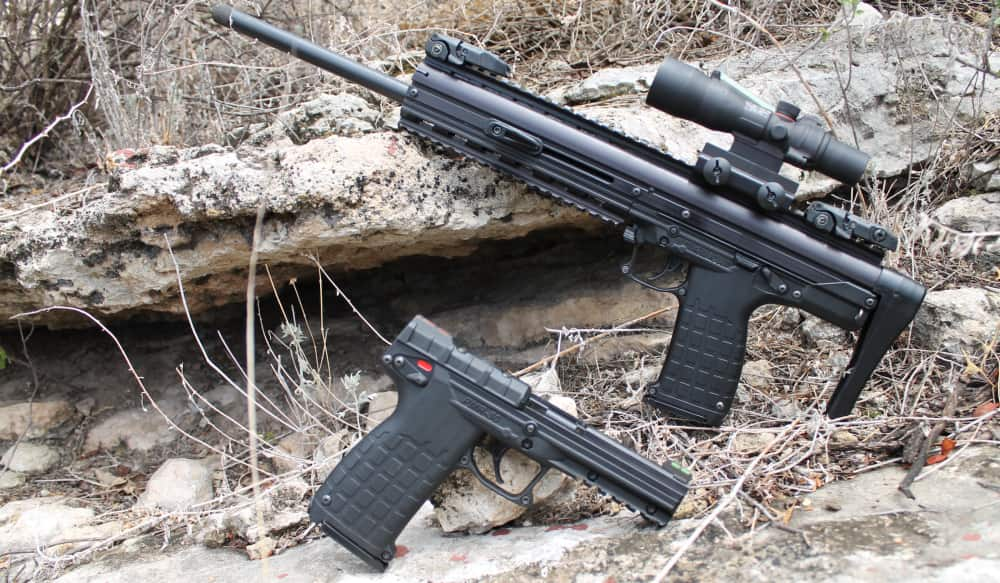
I am a big fan of compact carbines and a companion pistol that can share the same caliber of ammo and magazine. What a great approach for a survival/hunting package. Some folks may not realize that Kel-Tec offers what I consider to be a great duo of guns in the 22 WMR (Winchester Magnum Rimfire); the CMR-30 and its companion the Kel-Tec PMR-30 pistol also in 22 Magnum. Aside from survival and hunting applications either of these two guns have practicality in defensive and target shooting uses. Additionally the 22 magnum cartridge has been time tested for hunting small to medium size game (there has also been more than just a few deer taken with the 22 magnum). Most outdoorsmen are acutely aware of the 22 WMR and its inherent accuracy. When you consider this compact carbine and a its companion pistol has magazine capacities of 30 rounds each and total weight for the two combined is about 5 lbs., well its makes any survivalist sit up and take notice.

Yea, I’m a fan of that concept too. But given my review of the PMR-30, which problems have not yet been remedied by a new magazine design based on Aluminum rather than polymer (among other possible fixes), I’d think a better combination would be the FN 5.7 and the CMMG Mk57.
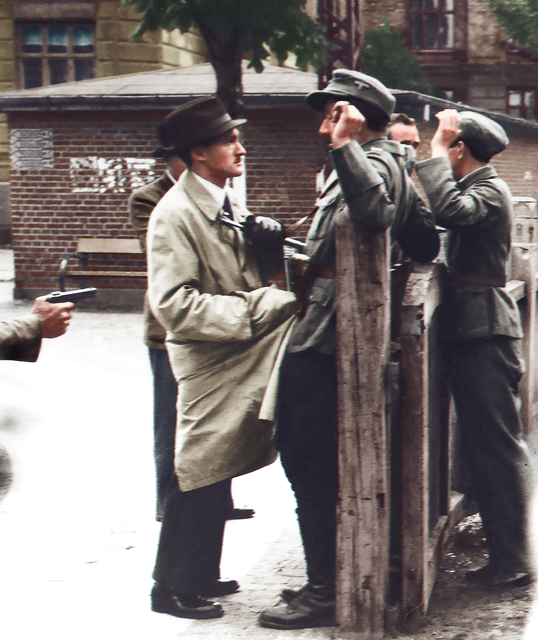
Danish resistance fighters disarming Germans.

The picture appears to be legitimate. I’m reminded of two things. First, a comment on TCJ.
At the end of WWII, a German prisoner who knew English quite well asked my father if he could just see a .45 acp cartridge. He asked why they exploded when they hit. My father explained that they didn’t. The guy then showed him a large exit wound on his leg from a .45 slug the German took during the retreat from Paris.
Second, while I can’t seem to locate it at the moment, Mike Vanderboegh had a very good writeup on the utility of a mere pistol. I’m sure some enterprising reader will find and link it for us in the comments. After all, I have the best readers on the interwebz.
Anyone who has spent time at the range shooting high-powered rifles knows that sustained fire or continuously shooting without letting the barrel cool down between strings of shots will get the barrel so hot that accuracy will suffer and shots can be thrown off a couple of inches. It isn’t hard to fire a military-style rifle in semi-auto mode at 100 rounds a minute, and many owners of these rifles do just that at times when shooting at the range.
Even when shooting a semi-auto rifle in rapid fire mode, an enormous amount of heat is generated, which can quickly ruin a rifle barrel .
The leade, which is the unrifled portion of the barrel just forward of the chamber as well as the first few inches of rifling, are subjected to enormous temperatures approaching those on the surface of the sun as well as pressures exceeding 50,000 PSI during rapid-fire exercises.
During slow-fire conditions, this area is allowed to cool sufficiently between strings of fire.
Under sustained rapid fire, however, there is no time for the heat to dissipate and temperatures soar into the thousands of degrees Fahrenheit.
Currently there are four very different methods used by shooters to protect and extend the service life of their barrels.
Those who participate in bench-rest and long-range completion use very heavy and long barrels which can last much longer than the barrels found on most sporting and hunting rifles. Still, those big heavy barrels have to be replaced when accuracy begins to deteriorate.
Currently, the military hard chrome lines the barrels of their rifles to protect them from the excess erosion that occurs during sustained fire. This greatly extends the barrel life of rifles that are fired for prolonged periods in full auto or semi-auto mode. It takes a very knowledgeable professional person to evenly apply the hard chrome lining to the inside of a barrel, but the barrel will have approximately twice the service life of an unprotected barrel. Both the military and civilians who shoot semi-auto versions of military style rifles swear by the hard chrome lining of the barrels.
Some claim that hard chrome lined barrels aren’t as accurate as unprotected barrels because the rifling of hard chrome lined barrels is not as sharp as in unprotected barrels. This is true, but the difference in accuracy will never be notice by the majority of shooters. One MOA is pretty common in most of the military rifles and their semi-auto counterparts being built with hard chrome lined barrels today.
Another method of dealing with the heat and pressure that rifle barrels can be subjected to is a process where the un-blued barrel is immersed in a very hot liquid nitride salt bath for a period of time. The process is known as “ferritic nitrocarburizing.” This is not a new technology but has recently been applied to rifle barrels to protect them from the heat and pressure from sustained fire.
Most people will recognize terms like Melonite, Tennifer, Ni-Corr, Blacknitride or Salt Bath Nitride. They are all variations of the same process …
Read the rest. I always like to catch everything that Smokey writes. I’ve exchanged email with him and find him to be a very nice guy, and always very knowledgeable.
From what I understand it’s a good idea to keep muzzle velocity under the 3000 FPS – 3200 FPS threshold, and that guys who shoot the .243 in competition approach 4000 FPS with the lighter loads and have to change out barrels every several hundred rounds.
Those folks would have to be sponsored.
The simplest, yet most important, difference between the two cartridges is their respective pressure limits. The .223 Rem. cartridge is held to a lower pressure than 5.56 NATO. Some of the testing methods to determine these actual pressures can be confusing, as both cartridges have been tested by the ballistic authorities (read CIP and SAAMI) in the same 5.56 mm chamber, and the resulting data will appear to be nearly equal. However, because of the dimensional variations in the distance between the case mouth and the beginning of the rifling, trying to fire 5.56 NATO ammunition in a .223 Rem. chamber is, simply put, just a bad idea.
The reverse is not true. It is, and always will be, safe to shoot .223 Rem. ammunition in a chamber marked for 5.56 NATO. Commit that idea to memory, and you’ll never get in trouble. The pressures that a 5.56 NATO cartridge can generate are too high for the .223 Rem. chamber, and that is based primarily on the leade dimensions. If you feel that the ability to shoot 5.56 NATO ammunition out of your .223 Rem.-chambered rifle is paramount, take that rifle to a competent gunsmith to have the chamber reamed out to handle 5.56 NATO ammunition.
That chamber dimension for the 5.56 NATO is, in fact, slightly larger than the chamber for the .223 Rem.—in order to have the smoothest feeding and ejection, even with a dirty weapon, to best serve as a battlefield implement—but it is the leade dimension that makes the biggest difference. Leade is defined as the area from the bullet’s resting place before firing to the point where the rifling is engaged. The shorter the leade dimension, the faster the bullet will engage the rifling, and the faster the pressures can rise to a dangerous level.
The most interesting thing about the article is that there is a throw-down in the comments over whether the author is perpetuating the alleged “myth” that 5.56mm cases have thicker walls and therefore less volume, leading to the higher pressure.
John Farnam at Ammoland:
After decades of piously assuring us the 5.56×45 round was “adequate” for military purposes, despite mounting complaints (unsatisfactory range and penetration), dating back to Vietnam, the Pentagon has apparently finally changed its mind.
In spite of a dreary series of failed “wonder bullets” that have, every few years, come forth to “upgrade” the 5.56 round, faith that the 5.56 can ever be “adequate” is fading!
Just as the Marines are buying the HK 416 (M27), a gas-piston AR (in 5.56×45 caliber), to replace aging M4s, Congress and the Army are putting the breaks on that project.
After fifty years of pointless hope that the 5.56×45 round might really be “adequate,” a new, bigger military caliber may now be about to make its debut!
When the AR (in 5.56×45 caliber) first reared its head, and garnered the attention of then Secretary of Defense McNamara, it was slated to gradually replace only the M1 Carbine, never the M1 Garand, later the short-lived M14.
The M1 Carbine, manufactured by the millions during WWII, was originally intended only for rear-area defense and police actions. It was never intended to be a front-line, battle rifle, although it eventually found its way into every corner of the campaign during WWII and Korea.
When I was in Vietnam in 1968, M1 Carbines were still around in large numbers. I saw (and used) plenty of them.
Yet, the AR (in 5.56×45 caliber) somehow eventually became the main, battle rifle of all US Forces, and remains in that status to this day. This, despite continuous misgivings about its adequacy that have been desperately voiced since Vietnam.
Up until now, the Pentagon as assured us that these qualms about adequacy were all in our imaginations!
That is apparently about to change.
Of course, the Pentagon will never admit they’ve been wrong all this time. They’ll simply say “It’s time to move on.”
It was time to move on fifty years ago!
You can color me unimpressed with John’s analysis. First of all, nothing is going to change because Amerika is flat broke and printing money like there’s no tomorrow.
Second, the only real need for caseless ammunition is so that women can be sent into combat.
Third, there is nothing wrong with the 5.56mmX45. That’s the real myth here.
The 5.56mm round has killed scores of enemy fighters (hundreds of thousands, perhaps millions) in Vietnam, Africa, Iraq, Afghanistan and South America. It doesn’t need to be replaced, and it did just fine for my son in Iraq.
There are exceptions, of course. He once told me of a time when he had to shoot an insurgent with a nine-round burst from his SAW, only to see the fighter keep coming at him. It took a grenade to stop him. He also told me that he and other Marines had to continue the fight with insurgents (foreign fighters) who had lost limbs and continued to shoot or fist fight.
Those kinds of fighters are ideologically motivated and doped up on epinephrine and morphine. They tested them and learned that information after the fact. It would take a .50 Sasser to bring someone like that down with one shot.
The better option is to teach Soldiers to shoot, uphill and down, at distance, and supplement their ranks with a designated marksman who shoots something larger than the 5.56mm or employ a crew served weapon. Each weapon system has its purpose, and there isn’t a do-everything gun. If anyone tells you that, he’s lying.
On the other hand, if they do actually replace the 5.56X45, I’ll just grin and nod and say, “Good. That’s just more for me.”

The AR-15 design limits the length of the cartridge, so the only way to increase the power level is by going bigger diameter. That’s good, as heavy bullets at moderate velocity are well proven in the hunting fields.
In other words as I take it, the cartridge must be short-action. So Shooting Illustrated covers three cartridges: The .50 Beowulf, the .450 Bushmaster and the .458 SOCOM.

I see no need for this kind of cartridge unless there is a real need. Another way of saying it is that this is no good for target shooting, plinking, fun, or mere range time. If you need it, you need it for personal defense against very large predatory animals, and then you really need it.
We covered one such gun, the .450 Bushmaster Windham Weaponry AR pistol. I also know that there are bolt action long guns that shoot this round. Savage sells one. I guess if I had to purchase a large bore AR or AR pistol I’d choose the .450 Bushmaster and make sure there was another gun in that caliber in my gun safe.
I clean my AR-15 gas systems approximately every 1,000 rounds. Direct-impingement gas tubes are easily maintained by inserting a long [purpose-made] pipe cleaner wet with solvent into the tube, then following it up with a fresh pipe cleaner. The portion that extends through the upper receiver is easily cleaned with a couple cotton swabs. Carbon build-up on the inner surface of adjustable gas-block screws can be cleaned off with a wire brush after removing the screw(s). Operating-rod systems with removable gas regulators also benefit from occasional removal of carbon deposits. Follow the manufacturers’ instructions for cleaning them, as they tend to be unique. If your AR-15 has an operating rod that moves through a bushing in the upper receiver, a bit of lubrication on the rod where it passes through the bushing helps to prevent binding.
I guess I haven’t thought much about cleaning the gas system of my guns. I guess I need to.
I like what I see. The price seems reasonable, and the accuracy good. Bergara is doing good things, and it hosts the popular 6.5 Creedmoor round.
Paul Penzone is the sheriff of Maricopa County, Ariz.
I am not fearful of firearms. I believe the Second Amendment was written with purpose and with sensitivity to generational circumstances. But what I am extremely concerned about is who has access to firearms and the devastation firearms are capable of in the wrong hands.
Imagine a world in which anyone — including terrorists, convicted felons and domestic abusers — has immediate access to untraceable guns. Now imagine that many of these guns are made entirely of plastic or other materials not recognized by traditional metal detectors.
Idiot.
As for The Washington Post, just consider: layers upon layers upon layers of “fact checkers” believe we’re soon going to have plastic chambers and barrels. I wonder if SAAMI knows about this?