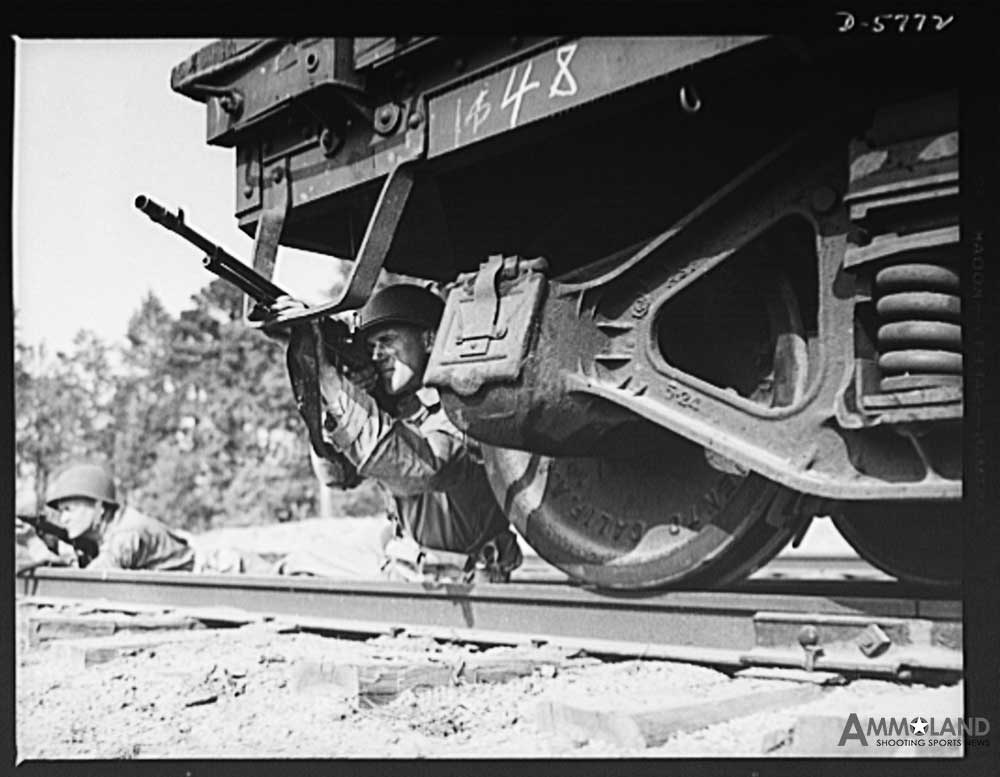
At Ammoland.
Frankly, I like this modernized version available at Ohio Ordnance Works.
I’m just dropping this out there in case anyone was thinking Christmas presents.
At Ammoland.
Frankly, I like this modernized version available at Ohio Ordnance Works.
I’m just dropping this out there in case anyone was thinking Christmas presents.
During a recent discussion at the gun store, the subject of headspace as it pertains to the many varieties of ammunition available for semi-automatic pistols was the primary topic. With all the variables in bullet weight and velocity in the available calibers, we could not imagine how headspace could be held to any kind of standard in a pistol. Enlighten us as to why headspace is important in a handgun and how to ensure the headspace on the ammunition we buy is correct for the gun we have.
R.R. Johnson
Meridian, MSHeadspace has nothing to do with bullet weight or the velocity of a particular cartridge. It pertains more to the chamber of the barrel and its relationship to the bolt or breechface when the action is closed. The manner in which the cartridge sits in the chamber may have an impact on the function of headspace if it is undersize or oversize.
In a semi-automatic pistol, with few exceptions, the chambered cartridge case is restricted in its forward movement into the chamber by the case mouth contacting the cartridge seat at the forward edge of the chamber. The measured distance between the cartridge seat and the breechface with the action closed is the headspace for the pistol. For every caliber commonly available, there are gauges that are used, principally by gunsmiths, to determine whether the headspace of a firearm is within specified tolerances or not. If the action closes on a GO gauge, but not on a NO-GO gauge, the gun is considered within the tolerances specified. Should the action close on a NO-GO gauge, that would be an indicator there may be excessive headspace and the gun needs the attention of a gunsmith for further analysis.
It is important to recognize there are tolerances associated with measurements of headspace involving ammunition, and necessarily so. When one considers all of the brands and types of ammunition manufactured for a specific caliber with the subtle differences in their cartridge cases alone, it might be understood why tolerances exist.
[ … ]
Guns that have excessive headspace have the potential to leave enough space between the chambered cartridge and the breechface that the firing pin may fail to reach or indent the primer sufficiently to fire the cartridge. This also presents a danger in that the cartridge could possibly fire without the full support of the chamber. In high-pressure cartridges such as the 9 mm, .40 S&W or .357 SIG, for example, the lack of support could cause a rupture in the body of the cartridge case or possibly a complete head separation. Either of these events could release uncontrolled, high-pressure gasses into the interior of the pistol that are likely to cause parts breakage or mechanical failure.
Read the rest. I like simple, easy-to-understand explanations.
The Army Ordnance folks around the beginning of the 20th Century had seen the failures of round-nosed, full-metal jacketed bullets in the British .303 rifles, and our own .30 U.S. Government (aka “.30-40 Krag”) in stopping a determined armed assailant.
They reasoned that since their .38 Long Colt Model 1892 revolvers had shown similarly poor results, and the re-issuance of the .45 SAA (Single Action Arm) into combat had added to the eventual defeat of the Philippine Moros, our military review board sought to adopt another large bore handgun. The British too paralleled this thought process, and as early as the mid-1880s they had already started issuing some of the first .455 Webley revolvers as a result.
By the middle of the first decade of the 20th Century, Colt was developing, along with the genius designer of most of their handguns, John Browning, a .45 cal. semi-automatic pistol. While the original development utilized a 200gr bullet at approximately 900 feet per second in 1906, the Ordnance Department subsequently desired a cartridge that approximated the old .45 Colt revolver cartridge in power, while being shorter in length than the substitute standard .45 S&W Schofield round.
Thus, the 230gr RN FMJ bullet at 850 fps nominal speed was created, and it found a home in the concurrently developed Colt Model 1911 pistol, the longest serving pistol of any military force to the best of my knowledge, some 75 years of official issue.
In the civilian world however, it has remained as popular as ever. Due to the existence of new generation jacketed hollow point bullets, it still retains its terminal ballistic advantages of expansion and consistent penetration compared to smaller bore diameter offerings. A recent detailed study indeed illustrated that the Federal HST 230gr standard pressure rounds offer 16” of penetration and consistent 0.85” of controlled expansion with no bullet fragmentation in an unofficial “FBI heavy clothing test” into simulated ballistic gelatin.
One other thing that is not mentioned much is that its stopping power is achieved without superior “sectional density,” high pressure, or high velocity. It operates at a very low 21,000 copper units of pressure, it has no supersonic crack, and is, therefore, nearly ideal for use with a suppressor. The recoil, while “there,” is more a push than a quick snap, while controlled-pairs shooting aimed rapid-fire are pretty easy to do out to ten yards and can usually be within an inch of each other. I’ve done it, and I’m just not that great a shot.
Moreover, the . 45 ACP cartridge has long borne the brunt of technical development as a precision target shooting round as well as being a supremely controllable defense round. In both the original 230gr RN,FMJ format for “hardball matches,” as well as reduced weight 185gr and 200g target matches, it remains one of the most accurate service pistol rounds extant.
And of course, with the hotter loads you can get from Buffalo Bore and Double Tap, you can send a 230 grain ball at around 1050 FPS, or a 450 SMC at 1120 FPS, and be okay for defense against large predators.
I like the push instead of the snap. I love shooting the .45 ACP more than any other cartridge, pistol or rifle.
To me it’s not just a competition or self defense round. If somebody said, “Hey we’re headed to the range, grab a gun,” the first thing I’d reach for is a 1911.

Via SurvivalBlog, eventually via Notes From The Bunker.
His presentation this time is a bit quirky, but if you can get past the quirks, it’s an informative video.
At the same time that gun sales have skyrocketed as more Americans reach for a firearm to protect themselves from threats real and perceived, warning shots abound that should have gun rights advocates on edge.
The latest is the court ruling allowing a lawsuit against the Cabela’s store in Cheektowaga to proceed after it sold ammunition to then- 19-year-old Jake Klocek, who used it in a handgun to accidentally kill 19-year-old Anthony King, a friend he’d invited over while housesitting for an Elma couple.
The suit by the victim’s family contends that Cabela’s – a defendant along with Klocek and the Elma couple – “knew or should have known its failure to use reasonable care” in selling the ammunition to someone like Klocek would result in serious injury or death.
But that claim hinges on the fact that Klocek, under 21 at the time, could not legally buy handgun ammunition.
However, he could legally buy long gun ammunition. And as Cabela’s attorneys point out, the ammunition in question – .45 ACP – can be used in both handguns and rifles. If the clerk asks and the buyer says it’s for a rifle, how is the store supposed to know, short of having a polygraph machine at every register?
Nevertheless, the fact that both a State Supreme Court justice and an appellate court allowed the case to proceed is likely to ripple through the retail firearms industry. If the case makes it to trial and King’s parents win, it’s easy to envision it precipitating more of the types of marketplace constrictions that anti-gun politicians can only dream about.
[ … ]
If this case proceeds to trial and Cabela’s is found liable, I would expect it – and parent company Bass Pro Shops – to join the list of businesses making it harder or impossible for law-abiding shooters to find the guns and supplies they want.
The Protection of Lawful Commerce in Arms Act (PLCAA) doesn’t matter to these courts because no one will enforce it. Federal Marshals won’t be dispatched to arrest local judges who let stupid things like this go forward, and the Supreme Court hasn’t the balls to take up something like this. So lower courts do what they way to do, unencumbered by any rules or social mores.
As if things could get any worse for gun owners and ammunition buyers (guns won’t work without ammunition), keep this in mind for the future.
ILION — Following complaints by the union as well as U.S. Rep. Anthony Brindisi and Sen. Chuck Schumer, investigators from the National Labor Relations Board launched a probe into the outgoing owners of Remington Arms, which laid off nearly 600 employees ahead of selling the 206-year-old firearms plant in a bankruptcy proceeding.
United Mine Workers of America, Local 717, has complained of what they say are unfair labor practices when the company in October laid off 585 employees without severance pay or continuing health care coverage, which the union says is in their labor contract.
“Our career experts in region 3, Buffalo, have begun an investigation,” NLRB Congressional Liaison Kevin Petroccione wrote in an email on Monday.
One of the allegations contends that “Within the previous six months, the Employer unlawfully dominated or controlled the operations of a labor organization,” and the “the Employer failed and refused to recognize the union as the collective bargaining representative of its employees.”
In a better world, Remington’s previous management would not have sold out to Cerberus Capital, “financial engineers” who had no intention other than to fleece all capital out of the company and leave it in shambles. Good men don’t do that to a company, no matter how much they are paid to do it, no matter how many homes on the beach and in the mountains they are promised.
In a better world, workers would not be in a collective bargaining agreement anywhere, because that means there is no right to work by other men who need to feed their families. They are blocked. They cannot cross the line into the plants. There is no competition between men. The competition is between companies, and Remington got destroyed by that.
This is all a failure to live life by Biblical principles, whether on the part of the management or the workers, or both. In the mean time, quality went down, innovation stopped, design ideas stayed on the drawing board or never even made it that far, and men simply worked their shift while the management got rich.
How sad for everyone.
Will that time ever come? Should it even come?
Lever guns have (thankfully) become increasingly popular of late. Don’t get me wrong – as readers know my favorite gun is the Stoner pattern rifle. But there’s just something about a lever action gun that makes me want to get it, from the aspect of fun, to the utility of having a carbine and a wheel gun in the same caliber, with the rifle putting that extra zip on it.
TFB published this video about ten months ago (that I embedded before), but it’s worth watching again.
Then this very recent video by Chris Baker at Lucky Gunner (“Are Lever Action Rifles Reliable?), the latest in his series on lever guns, explains a lot of reasons why it can be a temperamental gun to own and operate. So be aware of what you’re purchasing.
After everything else Remington has been through – the Sandy Hook lawsuit, awful management, the Remington 700 trigger system failures and their refusal to own the design and correct it – there has to be this.
ILION, N.Y. — Workers at the sprawling Remington factory in this upstate New York village took pride in a local gunmaking tradition stretching back to the days of flintlock rifles. Now they’re looking ahead with uncertainty.
Jacquie Sweeney and her husband were among almost 600 workers fired by the company this week, a few months after Remington Outdoor Co. sought bankruptcy protection for the second time in two years.
Successful bidders for the idled plant in bankruptcy proceedings have said they plan to restart at least some production, though details remain scarce.
There are high hopes for a successful reload of the plant that dominates the local economy. But these hopes are tempered by questions about how many workers will come back, and when.
“My husband, he’s looking for work, just like everybody else. And I plan on going back to college unless I find a job before I start that up,” said Sweeney, recording secretary for the local unit of the United Mine Workers of America. “That’s all we can really do. We can’t sit around and wait for forever.”
It’s common for people here to say that Ilion is Remington and Remington is Ilion. Company founder Eliphalet Remington started making flintlock rifles on his father’s forge near here in 1816, and the Ilion factory site dates to 1828. Though the company moved its headquarters to Madison, North Carolina, the old factory dominates — literally and figuratively — a village that has long depended on workers making rifles and shotguns to power the economy.
Union signs reading “United We Stand with Remington Workers” are in the windows of local businesses that sell everything from pizza slices to steel-toed boots. At Beer Belly Bob’s beverage center across the street from the plant, Bob McDowell recalled the sales bump on Thursdays and Fridays after shifts ended at 3 p.m.
Remington’s recent history has been a roller coaster ride with a lot of drops. Layoffs have been common. The plant, which employed around 1,200 people eight years ago, was down recently to about 600 union workers plus an estimated 100 or so salaried workers. The company began moving two production lines to a new plant in Huntsville, Alabama, in 2014.
[ … ]
Roundhill pledged in court documents to bring back at least 200 workers. They could eventually add hundreds more, but details are not clear.
Well, that was an idiotic thing to do. This is why.
Local officials believe a number of pieces need to be in place before production starts, from a collective bargaining agreement with the union to a new federal firearms license.
The UMW said it has held “productive discussions” with Roundhill. Meanwhile, it also has excoriated the outgoing owners for terminating 585 workers this week along with their health care and other contractual benefits. The union said the company is refusing to pay severance and accrued vacation benefits, sparking pickets in Ilion this week.
Legally, I agree with them on the issue of paid vacation. I agree with them morally on the issue of severance.
Collective bargaining helped kill the plant and company. You have a right to be a member of any organization you wish. What you don’t have a right to do is prevent another man from working your job.
Don’t repeat the mistakes.