The ATF Targets Pistol Braces
BY Herschel Smith 5 years, 3 months ago
 5 years, 3 months ago
We previously discussed the ongoing tribulations of Polymer80 here and here. I told you the real intent behind all of this was to locate buyers of the kits. As it turns out, I was right.
The reader stated that on the afternoon of December 10, 2020, they were visited by the ATF and were requested to surrender any Polymer80 kits. The ATF took custody of the Buy Build Shoot Kit and provided them with a receipt for the property. In the “Basis for Transfer or Seizure of Items” box, the ATF agent wrote “Polymer80, Inc. Investigation”. The email to TFB stated:
They are also going after customers. Had ATF at my house approximately 1pm yesterday telling me I need to surrender my P80 or he would return to raid my house with a warrant. Enclosed is my surrender sheet for proof. If anyone purchased a “Buy, Build, Shoot” kit from them they will probably be hearing from the ATF as well.
In my previous more amusing post (taken from reddit/firearms) on the ATF statement, one reader had a question on this and more explanation is required.
The ATF has allowed / will allow / no one knows if they will allow 80% receivers to be sold as non-firearms. They have also allowed other required other parts to be sold that the builder needs to turn this into a firearm.
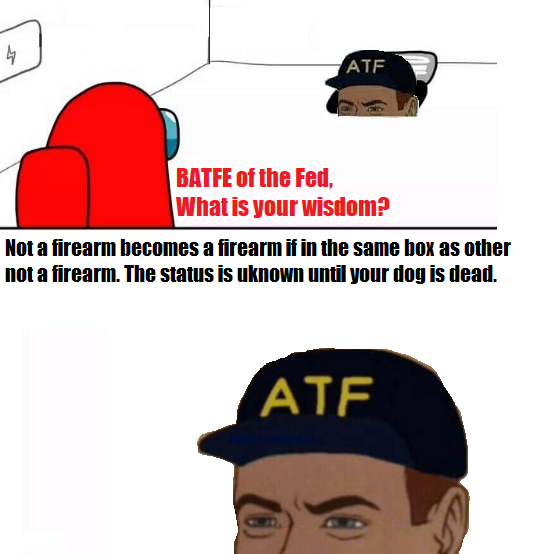
Apparently, the ATF doesn’t like the parts being sold as a kit (“Not a firearm becomes a firearm if in the same box as other not a firearm. The status is unknown until your dog is dead”). Those who purchased them separately (it is presumed) will not receive a visit from the ATF. Thus, the reference in the cartoon to contradiction and paradox, with the subject being Schrödinger’s dog rather than Schrödinger’s cat, since the ATF likes to kill dogs in raids.
5 years, 3 months ago
Len Savage learned of this before I did, and sends the WSJ article, but I don’t subscribe, nor do I send readers to text behind paywalls.
UPDATE: I see that reader Ned sent me this as well.
5 years, 3 months ago
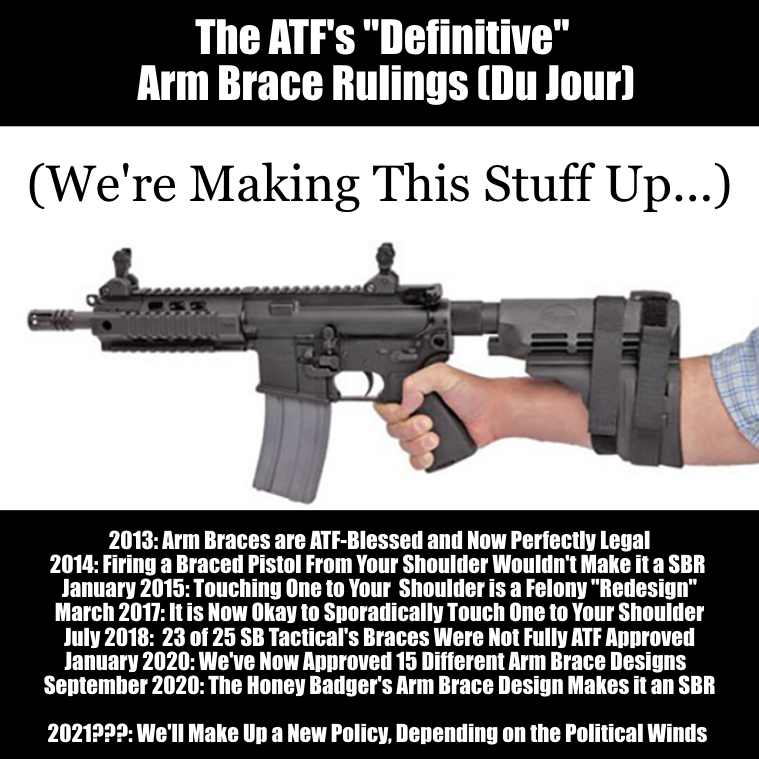
Courtesy of JWR.
5 years, 3 months ago
Did they see this kerfuffle coming from way back and try to poison the well? You be the judge.
5 years, 4 months ago
The first case testing a Trump administration edict outlawing bump stocks failed during a brief federal bench trial in Tuesday in Houston.A federal prosecutor withdrew the unique charge before the trial began for a Houston man accused of owning the device. However, the defense was prepared to call an ATF expert to testify that bump stocks, attachments that cause a rifle to fire more rapidly, do not render a semiautomatic gun a machine gun.
Senior U.S. District Judge Gray H. Miller convicted Ajay Dhingra, 44, on three remaining counts that he lied when he purchased a handgun, rifle and ammunition, and illegally possessed a weapon as a person who had been committed for mental illness.
Experts had conflicting views on the matter, said defense attorney Tom Berg. But Rick Vasquez, a retired ATF agent and firearms expert, would have told the court the bump stock did not meet the statutory definition of a machine gun. The prosecution dismissed case, he said, because the government couldn’t prove beyond a reasonable doubt the bump stock was a machine gun.
Prosecutors don’t indiscriminately drop cases. They do it if they think they have a bad case and a non-trivial chance of losing, coupled with high consequences of a loss.
This continues a pattern of cases where the ATF feels that continued prosecution of a case could possibly cause a loss in court and a restriction of their ability to enforce other regulations.
It’s good to see this loss, as the bump stock ruling should never have even seen the light of day.
5 years, 4 months ago
Did the hopeful administration of His Fraudulency Joe Biden collude with the ATF to stir the waters with pistol braces?
November 10th, 2020, during an ATF conference call, Acting Director Regina Lombardo told those in attendance that the anti-gun Biden transition team has reached out to the ATF to get the agency’s “top priorities”.
AmmoLand News’ anonymous source said Lombardo told those on the call that her priorities would be pistol braces and 80% lower receivers.
The Department of Justice told the ATF’s industry side not to move on pistol braces until the agency could be worked out regulations (sic). SB Tactical and other companies have been working with the federal government to clarify the rules surrounding braces. Currently, the rules are very subjective, which means it depends on the reviewer that gets assigned the review to determine if a brace is legal. There is no set standard.
Instead, the rogue ATF’s law enforcement side sent letters to multiple companies stating that their pistol brace firearms were short-barreled rifles (SBRs). Q LLC, which makes the Honey Badger AR pistol, went public with the cease and desist letter that the ATF sent to the company. Because of pressure from the Trump administration and the general public, the agency walked back their demands and gave Q a 60-day reprieve.
[ … ]
Through an executive order, he created Schedule F. The order allows the President to move government workers into the new category to more easily fire them. Trump could send a message by using Schedule F to remove the rogue ATF leadership.
It sure looks that way from where I sit. And it causes things to make a lot better sense. Something like pistol braces and SBRs wouldn’t have even been on Trump’s radar screen.
5 years, 4 months ago
Gun Owners of America recently filed a lawsuit against the ATF, after the agency blocked Alabama firearms dealers from allowing buyers to use their concealed handgun permits in place of going through the National Instant Criminal Background Check System (NICS).
Federal law says that state concealed handgun permits (CHP) that meet or exceed the requirement of section 922(t)(3) of Title 18 can be used by dealers instead of requiring background checks. Alabama’s concealed firearms permit statute meets the federal requirements because sheriffs are supposed to run applicants through NICS before issuing a permit.
The ATF discovered that some sheriffs in Alabama were not using NICS. Some of these sheriffs were running applicants through The National Crime Information Center (NCIC) and other federal databases, but not NICS. Yet NCIC is the same database that NICS pulls its information from before returning with a denial or approval. The ATF decided to revoke dealers’ ability to use CHPs because of a few sheriffs’ actions.
[ … ]
… as ATF records show, multiple ATF employees decided it was worth the litigation risk because of “public safety.
Oh it has nothing at all to do with “public safety” and they know it. That’s a smoke screen.
But it does go to show just how much the ATF is feeling its oats.
5 years, 4 months ago
Despite ATF previously stating that there is no limit to how long or heavy a handgun should be to qualify as “sporting” under section 925(d)(3), ATF private classification letters issued within the past few months indicate that the agency has shifted course by reinterpreting what constitutes a “handgun.” In company-specific letters, ATF takes the position that if a submitted firearm is too long or too heavy, it fails to meet the definition of “handgun” under the Gun Control Act, as it is not “designed to be held and fired by the use of a single hand.” The Firearms and Ammunition Technology Division (FATD) of ATF—which conducts importability evaluations—says that it is taking a subjective approach to the statute by allowing individual examiners to determine if he or she can fire the weapon with one hand without difficulty.
This approach is resulting in inconsistent determinations, of which the regulated community should take note. Within the past few months, at least one HK91 pistol-style submission as light as 8 pounds, with a barrel length of 8-3/4 inches and an overall length of 21-3/4 inches, has been determined to fall outside the definition of “handgun.” This is a change from previous determinations where firearms weighing over 8 pounds, with 20-inch barrels, and an overall length of approximately 31-1/2 inches were held by FATD to be “handguns.” Since the letters are not publicly available, it is impossible for regulated companies to know the full range of FATD’s determinations. This has serious implications for regulated businesses.
In some of the new letters, ATF has begun listing the following “objective design features” when making its evaluations:
- Incorporation of rifle sights;
- Utilization of “rifle caliber ammunition” (both 5.56mm and 7.62mm have been considered as such);
- Incorporation of “rifle-length barrel;”1
- The “weapon’s heavy weight;”
- Ability to accept magazines that range in capacity from 20 rounds to 100 rounds, “which will contribute to the overall weight of the firearm”; and
- Overall length of the weapon which “creates a front-heavy imbalance when held in one hand.”
However, ATF also noted in the most recent private ruling that the above design features are “neither binding on future classifications nor is any factor individually determinative[.]” ATF explained without elaboration that “the statutory and regulatory definitions provide the appropriate standard in classifying the firearm.” ATF concluded that “a firearm that is too large, too heavy or . . . otherwise not designed to be held and fired in one hand (as demonstrated by the objective features) cannot be a handgun under the statutory definition and cannot be subject to importation criteria governing handguns.” In light of ATF’s subjective and inconsistent analysis of size and weight, it is difficult to predict how the agency will classify any given firearm under this standard.
As was always the intent. The bureaucratic state is always the implementing organ of communism, and law enforcement is always the underwriter of its rules and regulations.