Articles by Herschel Smith


The “Captain” is Herschel Smith, who hails from Charlotte, NC. Smith offers news and commentary on warfare, policy and counterterrorism.


Targeting the Insurgency Versus Protecting the Infrastructure

18 years, 6 months ago

In Instructions on How to Repair the Electrical Grid in Iraq, we made the case that the electrical grid was too delicate, complicated and far-flunge to be amenable to protection against insurgents (in this case it was the Jaish al Mahdi who was targeting the electrical grid, destroying parts of it and in other cases hijacking the power for local use).  Another example of this same tactic comes to us from a different region of Iraq; this time the example comes from the Diyala Province, and is likely perpetrated by al Qaeda in Mesopotamia.

The US military says its troops have killed 33 insurgents in a joint operation with Iraqi troops 80km (50 miles) north of Baghdad.  It said several hundred US and Iraqi soldiers took part in the operation on Monday to reopen the water supply to the town of Khalis.

Residents say al-Qaeda fighters have a strong presence in the area.

Insurgents cut water supplies to Khalis several days ago by shovelling earth into an irrigation canal.

The US military said a joint assault force of US and Iraqi troops – which landed by helicopter – killed 13 insurgents. It said fire from attack aircraft killed 20 others.

It is not possible to deploy enough troops to protect all infrastructure when making it dysfunctional simply involves shovelling dirt into an irrigation canal (most likely a weir type of structure).  There are too many kilometers of canals to protect.  This isn’t to deny that there is a complex interplay between the availability of goods, services, security and government, and the population informing on insurgent identities and locations.  Counterinsurgency remains a difficult venture.

But it is to say that when the impossible presents itself (i.e., protect all infrastructure, whether electrical grids, water supplies, or other utilities such as sewage, in order to win the population), the stipulations are unacceptable and the game must be reformulated.  Coalition forces implemented the correct tactic to restore basic services.

They targeted those who targeted the infrastructure.

Counterinsurgency: One Size Doesn’t Fit All

18 years, 6 months ago

In Al Qaeda, Indigenous Sunnis and the Insurgency in Iraq, we discussed how most of the insurgency in Kirkuk was comprised of left-over Ba’athists, and the cooperation with the 1920 Revolution Brigade in Anbar had spread to Baghdad.  Yet in Fallujah proper, as we discussed in Operation Alljah and the Marines of 2nd Battalion, 6th Regiment, this approach was not only not necessary in Fallujah proper, but would not have worked.

As for the awakening, that is more of a tribal thing.  Tribes have little influence inside Fallujah because of how mixed up the population is.  They are all solidly against AQI though, because they want nothing to do with their extremist agenda and are appalled by the tactics AQI is using … I am sure that there are former insurgents in the police and neighborhood watch – which is why I tell my guys that we can never completely trust them – but we have not had a single instance where we took a known insurgent and turned him to our side.  We continue to target them heavily and most have either been detained, or fled the city.  The ones remaining spend a lot of time trying to keep from being detained instead of planning on how they will attack us.  We keep the pressure on them to keep them off balance and on the run.  That is having the best effect in the city.

Rather than this approach, the more classical approach of gated communities was used to partition the battle space and interdict insurgents.  Yet the use of former insurgents is still a strategy that is being employed in the Anbar Province.  Michael Yon observes that it is in use in Falahat.

The men of MiTT 8 are living along with their Iraqi protégées in filthy shipping containers on a highway. Several months ago they were attacked by a car bomb. But at about 0900, while I was traveling to their location with Marines in a Humvee (with sparkling glass) some Falahat villagers went to the new police station to report the presence of a culprit they knew to emplace bombs on the road.

It happened that quickly.

Within mere days of opening the station, people spoke up. The Iraqi Police (some of whom freely admitted to having been recent insurgents) called the tip into the Iraqi Army who were living with the Marines of MiTT 8 …

As we have observed before, the U.S. forces have tried to drive a wedge between the insurgents and the terrorists, a highly technical parsing of terms.  Reuters continues this reporting on the Diyala Province and the use of former insurgents.

U.S. forces have rebranded one of the main insurgent groups in Iraq and now use the term “concerned local nationals” to refer to a group that once claimed responsibility for killing scores of Americans.

The updated vocabulary for referring to the 1920 Revolution Brigade, described by a U.S. commander on Saturday, is a sign of the abrupt change in tactics that has seen U.S. forces cooperate with former Sunni Arab enemies.

The 1920 Revolution Brigade was one of the main anti-American Sunni Arab insurgent groups in Iraq in the years after the 2003 U.S.-led invasion and has claimed responsibility for killing scores of U.S. troops in ambushes and bomb attacks.

But for the past several months its members have cooperated with U.S. forces to help drive the strict al Qaeda Islamists out of Sunni Arab areas, part of a new U.S. tactic of cooperating with former Sunni Arab foes against al Qaeda.

Colonel David Sutherland, the U.S. commander in Diyala Province, said his men prefer not to call the group by its name.

“The 1920s as they’re called, we call them ‘the Baquba Guardians’, we call them the ‘concerned local nationals’,” he said. Baquba is the provincial capital.

“These are patriots who have come forward and have joined the security process. They are working with my soldiers and they are working with the Iraqi security forces,” he said.

Al Qaeda’s adherence to a hardline form of Sunni Islam and indiscriminate attacks has isolated it from Sunni Arabs and nationalist insurgent groups.

Sutherland said the 1920 Revolution Brigade name was now being used widely to refer to local pro-government militia and not anti-American insurgents. Some Shi’ite elders were asking if they too could recruit “1920s,” he said, a sign the Sunni Arab group’s name was no longer seen as sectarian.

“It has become a name, a catch-all phrase for these concerned local nationals throughout the province,” he told a news conference by video link to Baghdad.

His forces “do not deal with terrorists, and if we have information on individuals then we will act accordingly,” Sutherland said. “The individuals we are working with…. I have confidence in them and I have confidence in their leadership.”

One size doesn’t fit all in counterinsurgency.

Counterinsurgency: One Size Doesn’t Fit All

18 years, 6 months ago

In Al Qaeda, Indigenous Sunnis and the Insurgency in Iraq, we discussed how most of the insurgency in Kirkuk was comprised of left-over Ba’athists, and the cooperation with the 1920 Revolution Brigade in Anbar had spread to Baghdad.  Yet in Fallujah proper, as we discussed in Operation Alljah and the Marines of 2nd Battalion, 6th Regiment, this approach was not only not necessary in Fallujah proper, but would not have worked.

As for the awakening, that is more of a tribal thing.  Tribes have little influence inside Fallujah because of how mixed up the population is.  They are all solidly against AQI though, because they want nothing to do with their extremist agenda and are appalled by the tactics AQI is using … I am sure that there are former insurgents in the police and neighborhood watch – which is why I tell my guys that we can never completely trust them – but we have not had a single instance where we took a known insurgent and turned him to our side.  We continue to target them heavily and most have either been detained, or fled the city.  The ones remaining spend a lot of time trying to keep from being detained instead of planning on how they will attack us.  We keep the pressure on them to keep them off balance and on the run.  That is having the best effect in the city.

Rather than this approach, the more classical approach of gated communities was used to partition the battle space and interdict insurgents.  Yet the use of former insurgents is still a strategy that is being employed in the Anbar Province.  Michael Yon observes that it is in use in Falahat.

The men of MiTT 8 are living along with their Iraqi protégées in filthy shipping containers on a highway. Several months ago they were attacked by a car bomb. But at about 0900, while I was traveling to their location with Marines in a Humvee (with sparkling glass) some Falahat villagers went to the new police station to report the presence of a culprit they knew to emplace bombs on the road.

It happened that quickly.

Within mere days of opening the station, people spoke up. The Iraqi Police (some of whom freely admitted to having been recent insurgents) called the tip into the Iraqi Army who were living with the Marines of MiTT 8 …

As we have observed before, the U.S. forces have tried to drive a wedge between the insurgents and the terrorists, a highly technical parsing of terms.  Reuters continues this reporting on the Diyala Province and the use of former insurgents.

U.S. forces have rebranded one of the main insurgent groups in Iraq and now use the term “concerned local nationals” to refer to a group that once claimed responsibility for killing scores of Americans.

The updated vocabulary for referring to the 1920 Revolution Brigade, described by a U.S. commander on Saturday, is a sign of the abrupt change in tactics that has seen U.S. forces cooperate with former Sunni Arab enemies.

The 1920 Revolution Brigade was one of the main anti-American Sunni Arab insurgent groups in Iraq in the years after the 2003 U.S.-led invasion and has claimed responsibility for killing scores of U.S. troops in ambushes and bomb attacks.

But for the past several months its members have cooperated with U.S. forces to help drive the strict al Qaeda Islamists out of Sunni Arab areas, part of a new U.S. tactic of cooperating with former Sunni Arab foes against al Qaeda.

Colonel David Sutherland, the U.S. commander in Diyala Province, said his men prefer not to call the group by its name.

“The 1920s as they’re called, we call them ‘the Baquba Guardians’, we call them the ‘concerned local nationals’,” he said. Baquba is the provincial capital.

“These are patriots who have come forward and have joined the security process. They are working with my soldiers and they are working with the Iraqi security forces,” he said.

Al Qaeda’s adherence to a hardline form of Sunni Islam and indiscriminate attacks has isolated it from Sunni Arabs and nationalist insurgent groups.

Sutherland said the 1920 Revolution Brigade name was now being used widely to refer to local pro-government militia and not anti-American insurgents. Some Shi’ite elders were asking if they too could recruit “1920s,” he said, a sign the Sunni Arab group’s name was no longer seen as sectarian.

“It has become a name, a catch-all phrase for these concerned local nationals throughout the province,” he told a news conference by video link to Baghdad.

His forces “do not deal with terrorists, and if we have information on individuals then we will act accordingly,” Sutherland said. “The individuals we are working with…. I have confidence in them and I have confidence in their leadership.”

One size doesn’t fit all in counterinsurgency.

Faster Kill Chain

18 years, 6 months ago

In A-10s Aid in Counterinsurgency, we discussed the new role being contemplated for A-10s.  The storied tank-killer has a new mission, i.e., that of aiding and assisting in counterinsurgency, or so it was being planned (debates on this can be seen in Air Power and Small Wars, and Warfare and Lawfare: An Unstable Alchemy).  Perhaps as a test for this mission, the A-10 (438th Air Expeditionary Group) went back into action to provide close air support for Marines in the Anbar Province.  Not long after this deployment, it was announced that the The USAF was considering a new A-10 COIN Squadron.  The consideration and debates have been concluded, and the decision has been made to upgrade the “Warthog” to the A-10C, with improved electronics, avionics and weapons controls, consistent with our observation that “redeployment of this beautiful aircraft will require the involvement of engineering.”

The deployment of the newly upgraded Fairchild Republic A-10C Thunderbolt II bomber-attack aircraft in Iraq next month will make it easier for the US Air Force (USAF) to provide close air support to ground troops, according to the commander of USAF’s Air Combat Command, General Ronald Keys.

However, more extensive upgrades are still needed to keep the aircraft on top of its game, he said.

General Keys said the USAF’s modernisation plans for the A-10 ‘Wart Hog’ have been held back from their full potential by bureaucratic wrangling and congressional resistance.

“This is not the super Hog we envisioned but this is a better-than-average Hog,” Gen Keys said during a ceremony to announce initial operational capability of the A-10C at Langley Air Force Base in Virginia on 21 August.

“The hardest wars we fight are not on the battlefield but the wars we fight in the halls of Congress, they are fought in the Pentagon, they are fought in these programmes, to make sure the money is paid and eventually the programme is operating.”

Despite voicing frustration with the overall pace of A-10 modernisation, Gen Keys said the USAF was off to a good start with the USAF’s Precision Engagement programme, which aims to upgrade all 356 aircraft to the A-10C configuration by 2011.

The modifications to the A-10C were significant.

The A-10’s enhancements included, among other modifications, new sensors that allow the fighter to “identify and strike targets from higher altitudes and greater distances,” according to the Air Force.

New color displays were added in the cockpit and the throttle and stick were upgraded to increase “situational awareness of the pilot and the ability to perform most tasks without removing his or her hands from the throttle or the stick.”

Courtesy of Dailypress.com.  We only disagree on one count: ugly aircraft!  Nay, and in the superlative degree.  She’s a beauty!  Watch it all.  Faster kill chain.  Just so.

Instructions on How to Repair the Electrical Grid in Iraq

18 years, 6 months ago

The New York Times brings us a story about the electrical system in Iraq, its unreliability, and the nexus with militias and gang control of the countryside.

Armed groups increasingly control the antiquated switching stations that channel electricity around Iraq, the electricity minister said Wednesday.

That is dividing the national grid into fiefs that, he said, often refuse to share electricity generated locally with Baghdad and other power-starved areas in the center of Iraq.

The development adds to existing electricity problems in Baghdad, which has been struggling to provide power for more than a few hours a day because insurgents regularly blow up the towers that carry power lines into the city.

The government lost the ability to control the grid centrally after the American-led invasion in 2003, when looters destroyed electrical dispatch centers, the minister, Karim Wahid, said in a news briefing attended also by United States military officials.

The briefing had been intended, in part, to highlight successes in the American-financed reconstruction program here.

But it took an unexpected turn when Mr. Wahid, a highly respected technocrat and longtime ministry official, began taking questions from Arab and Western journalists.

Because of the lack of functioning dispatch centers, Mr. Wahid said, ministry officials have been trying to control the flow of electricity from huge power plants in the south, north and west by calling local officials there and ordering them to physically flip switches.

But the officials refuse to follow those orders when the armed groups threaten their lives, he said, and the often isolated stations are abandoned at night and easily manipulated by whatever group controls the area.

This kind of manipulation can cause the entire system to collapse and bring nationwide blackouts, sometimes seriously damaging the generating plants that the United States has paid millions of dollars to repair.

The temptation in response to this is to contemplate ways to make the electrical grid more reliable.  But the story has what lawyers call a misdirect at the very beginning: ” … antiquated switching stations.”  This point is entirely out of context, and in fact not very meaningful or important.  All electrical grids are designed the same way.  They are interconnected, have thousands of miles of unprotected high voltage cable, important switching stations, step up and step down transformers, protective relaying, and breakers to isolate ground faults.  They are by their very nature finicky and touchy things, and while the grid in Iraq may be antiquated, the real problem is not the grid.  It is those who target the grid.

In The Rise of the JAM, we documented the rise of the Jaish al Mahdi to prominence in much of Iraq, detailing incidents where U.S. forces simply refused to engage the Mahdi militia for fear of it creating a “political problem.”  We followed up this article with Danger Signs in Shi’ite Country, where we observed that “the U.S. will choose to deal a blow to the JAM and thereby allow reconciliation among the more peaceful of the population, or it will cower to the arrogant, undisciplined teenagers roaming the streets as thugs and criminals, taking and harming whatever and whomever they wish.  The first choice means stability and security for Iraq.  The second means a complete, chaotic disaster.”

Obviously, we have chosen chaotic disaster rather than security for Iraq.  No amount of money on reconstruction will accomplish anything good as long as rogue elements are left unmolested.  Also, we are proud to bring you the news and analysis here at The Captain’s Journal before others do, and without air brushing it first.  With respect to the issue of the JAM being comprised of “arrogant, undisciplined teenagers roaming the streets as thugs and criminals,” the Washington Post brings us a story about how many in Iraq see the JAM: “They control people’s lives,” said one resident of Hurriyah, a Shiite government employee who would give his name only as Abu Mahdi, 36, because he feared Mahdi militia reprisals. Scornfully calling them uneducated, bullying teenagers, he said: “They are worse than the Baathists” – the party that held total authority under the rule of Saddam Hussein.”

The Iraqi electrical grid problems are unrelated to engineering.  To be sure, as soon as security has been restored to Iraq, we can turn loose the electrical transmission engineers who would love to reconstruct the system.  But this step awaits security.  The moral of the Iraqi story on electrical grids is just this: let’s let the electrical engineers work on the electrical system.  Let’s let the U.S. Army and Marines work on targeting the enemy, which includes the JAM, whether we want to admit it or not.

Sometimes our efforts at counterinsurgency by winning hearts and minds simply have to go through kinetic operations — in this case, combat action — to “close with and destroy the enemy by fire and maneuver.”  There are no easy ways to do this, and we cannot throw enough money at or deploy enough engineers on this problem to make it go away.

Operation Alljah and the Marines of 2nd Battalion, 6th Regiment

18 years, 6 months ago

Lt. Col. William F. Mullen who commands the 2nd Battalion, 6th Marine Regiment (currently at Forward Operating Base Reaper on the South side of Fallujah), gives us an exclusive look into Operation Alljah and what has been accomplished in Fallujah.  His discussion is both informative and interesting, and points to modifications and adjustments to the template used in the Anbar Province.  Every city and engagement has been a unique experience, but the adaptability of the United States Marine Corps has proven to be one of the most effective weapons in their arsenal.
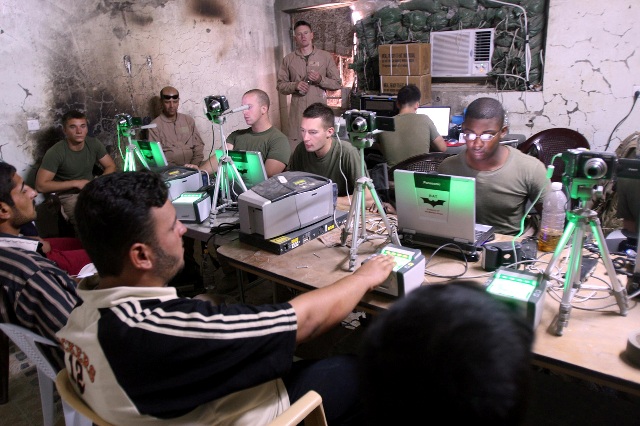
biometrics-automated-tool-set.jpg

Marines take fingerprints, iris scans and other information from Iraqi citizens using the Biometrics Automated Toolset in an Iraqi Police precinct in Fallujah on July 19.

Interview with Lt. Col. William F. Mullen

TCJ: Lt. Col. Mullen, thanks for the chance to interview you on the hard work and accomplishments of 2nd Battalion, 6th Marines in Fallujah. Operation Alljah seems to have had multiple phases.  For instance, the Multi-National Force issued press releases on June 5th, 7th, 8th, 9th and 10th on kinetic operations against the insurgency and terrorists.  Can you describe this part of the operation for us?  For instance,  since the so-called Anbar Awakening came somewhat late to Fallujah compared to Ramadi, how did 2/6 identify the insurgents?

Lt. Col. Mullen: Well, to help clarify, many times MNF-W identifies attacks or kinetic events as happening in Fallujah, but they mean the Fallujah area.  There has been a great deal going on in the smaller towns outside of the city to curtail enemy activities out there and keep them from trying to return to the city.  We have had some small events in the city, but overall, it has been very quiet.  The latest big event we had was on June 2nd when we conducted a raid with the police that killed 7 enemy, captured 8, found two truck bombs before they went off, IED making material and other enemy supplies.  Three of the dead enemy had suicide vests on and they were killed before they could set off the vests.  This was a great operation based off of intelligence that the police had gained.  We have also been conducting quiet little cordons and searches on houses based off of more tips from the civilian population and are picking off the enemy one or two at a time.  They never fight when we do this because we are too strong for them and this is having a serious demoralizing effect on the enemy.  We had a serious sniper problem in the city when we first took over and it is gone for all intents and purposes now.  We detained 11 suspected snipers and killed two.  They now operate well away from the city.  As for the awakening, that is more of a tribal thing.  Tribes have little influence inside Fallujah because of how mixed up the population is.  They are all solidly against AQI though, because they want nothing to do with their extremist agenda and are appalled by the tactics AQI is using.  As just one example, in an area NE of the city, AQI herded 12 women and children, all relatives of a prominent area Sheik who had declared himself against AQI, into a building and blew it up on them killing them all.  That is the type of rabid dog enemy we all face out here.  They are cutting off their nose to spite their face and the average Iraqi wants nothing to do with them.

TCJ: It seems as if the police of Fallujah have managed to assist and work together in the pacification of Fallujah, with the Marines doing a lot of the heavy lifting in the way of combat operations in the initial stages of Operation Alljah.  Can you describe the working relationship between the Marines and the police?

Lt. Col. Mullen: The relationship between us and the police is very good.  At the start of ALLJAH, they were centrally located in the HQ in the middle of the city.  They were afraid to go home in uniform, some never went home at all, IP houses were getting blown up or burned down, some would get assassinated on their front doorsteps, etc.  When they went out to do a raid, they went out in force and scared to death.  Now they are spread all over the city in precincts supported by over 1400 neighborhood watch personnel.  They not only go home now, they do so in uniform proudly. They used to always wear masks over their face so they would not be recognized and targeted off duty – few do that now.  They have a lot of logistical support issues, but we are working hard to iron them out and make them self sufficient.  They are brave (at last count they had lost over 200 police since they were reestablished in mid 2005) and genuinely want to restore security to their city.  They are well on their way.  We know they have corruption issues – it is a cultural thing that is much more acceptable to them than it is to us – and they are infiltrated by the enemy, but all of these things are issues they are specifically working on.  Given the track record of our own police departments, I’d say they are doing pretty well.  We implemented a professional development program for them using actual American Police officers that have come over to train police here and it is starting to reap positive results.  They have a long way to go, but are moving with a purpose in the right direction.

TCJ: Working with erstwhile insurgents to turn them against the insurgency and terrorists has been called a risky strategy by some, and of course, any strategy comes with risks.  But it would seem that working with the insurgents and using their services against the very violence they at one time perpetrated is part of the genius of the approach.  Can you describe how this has occurred in Fallujah?

Lt. Col. Mullen: We aren’t really doing that here in the city.  I am sure that there are former insurgents in the police and neighborhood watch – which is why I tell my guys that we can never completely trust them – but we have not had a single instance where we took a known insurgent and turned him to our side.  We continue to target them heavily and most have either been detained, or fled the city.  The ones remaining spend a lot of time trying to keep from being detained instead of planning on how they will attack us.  We keep the pressure on them to keep them off balance and on the run.  That is having the best effect in the city.

TCJ: It appears that you have made signficant use of the concept of “gated communities” in Fallujah in order to bring security.  I noted that there is also a temporary ban on vehicle traffic that will be lifted soon.  Can you describe how the ban has helped and what the role of the gated communities has been?  How successful has this tactic been?

Lt. Col. Mullen: The gated community idea was implemented because the enemy uses cars almost exclusively to conduct their attacks.  The barriers emplaced allow the citizens of each precinct to choose who they want to come into their area, and makes it difficult for the enemy to move around and escape in a vehicle.  The vehicle curfew was implemented by the Mayor and Police chief due to several suicide vehicle bomb attacks, one of which was particularly horrific.  There was a funeral for an Iraqi that had been fighting AQI and AQI had a suicide bomber drive right into the funeral procession and blow himself up.  20 civilians were killed and 17 were injured.  This was a watershed event here in Fallujah.  We were not confident that a vehicle curfew could be implemented, but it has been, almost solely by the police and in conjunction with the barriers we have been emplacing, and it has resulted in a three-fold decrease in enemy attacks.  The people do not like the barriers or the curfew, but they do like the security and indicate they are willing to put up with them to keep the security.

TCJ: To what extent have you utilized COPS (variously called Combat Outposts and Combat Operation Posts) as part of Operation Alljah versus the more traditional military doctrine of force protection?

Lt. Col. Mullen: We do use Combat Outposts, but in this case, we call them Joint Security Stations.  We have Marines partnered with IP at every precinct HQ.  Force Protection is a constant, so we make sure each site is protected against suicide bombers and sniper fire, but we also ensure that the HQ is accessible to people on foot.  It is a difficult balance, but it is absolutely necessary.  Being out amongst the population is the only way to finish this fight.  Driving to work means you miss a lot.  Also, at least initially, the police would only stay in the precincts if we were there with them.  They were pretty intimidated.  This is no longer the case.  They know we have their back while they grow stronger by the day.

TCJ: It appears that the transition to nonkinetic operations was fairly stark.  Press reports about combat operations stopped and press reports about construction of police precincts started.  In a professional military academic climate that claims that standard counterinsurgency takes ten to twelve years, how did the Marines of 2/6 manage to pull this off?

Lt. Col. Mullen: We got the citizens of the city involved in providing their own security through the neighborhood watch system.  We pay them a pittance of $50 a month (only a part time job as an extra set of eyeballs for the police – they are not police) and we authorize them to carry a weapon if they have one for their own protection.  As I said above, the result has been a three-fold decrease in enemy attacks.  We also give the people a serious reason to stay on this side of the fence – we call it the “What’s in it for me?” program.  We have a heavy civil affairs emphasis that is changing the face of Fallujah.  In addition to the essential infrastructure improvements noted above, we are hiring them to pick up rubble and garbage, to paint cement barriers and school walls with murals (negates graffiti) and we are putting them to work in every way we can think of so they can put food on the table for their families.  Progress has been astounding and whenever we measure atmospherics (several times a week) all indications are that we are having a tremendous amount of success.  We have tied all of this to the improvements in the security situation and we tell them that if they want it to continue, then the enemy has the be driven out completely and kept out.  They understand and are providing a great deal more tips than they used to.  The enemy has not been able to do much of anything of late and we just passed the three month mark without having a single casualty from this battalion as a result of enemy action.  That is unheard of in Fallujah.

TCJ: In the accelerated environment in which the Marines work, how concerned should we be about the potential stand down of U.S. forces in Fallujah in 2008?  How soon will the police be trained, funded, cohesive and able to work alone in the security of Fallujah?

Lt. Col. Mullen: The police are watching activity in the US as much as we are.  They are getting better, but if we pull out early, it could have a serious detrimental effect.  I think they will manage to remain in control, but it will not be pretty.  They have a way of muddling through that makes us cringe, but it does work for them.  We certainly need to finish what we started, but pulling out would not be an unmitigated disaster here in Fallujah.  Neither the police nor the citizens want us to leave any time soon because they fully recognize what is happening around them and want it to continue.

TCJ: How badly has the lack of political reconciliation harmed the efforts to pacify the Anbar Province and in particular Fallujah?  It seems that there is still much animosity between Fallujah and Baghdad.

Lt. Col. Mullen: I cannot comment too much on the political situation in Baghdad, but the people here do not like the Iraqi Government and blame them for all the shortcomings in fuel, food and essential services.  I will say also though that things are rarely as bad as the Iraqi’s make them out to be. They are prone to serious over exaggeration and always want to blame someone else.  It is never their fault.  For example, fuel arrives in the city, but to make extra money, the truck drivers sell it to “free enterprise” folks that then sell it curbside from plastic jugs – it is known as black market fuel where we come from.  They charge much more than normal and keep the fuel from getting to the gas stations and city government in enough amounts to keep them open and operating.  They also tap into electrical and water lines illegally to get better service, all of which seriously degrades the overall service provided.  The city government is working on these things, but they all contribute to the problems Fallujah is having, and the Fallujans blame it all on the “Iranians” who make up the current government.  In the general opinion here, only Sunni can run a country properly, as they have until the past few years.  You also have a hard time convincing them that they are a minority.  The things they come up with really are amazing at times.  It is only a semi-literate society though so word of mouth, despite how illogical or ridiculous the rumor, has a big impact – especially if it is along the lines of what they want to believe.

TCJ: Can you describe any actions by NGOs or U.S. forces to help the people of Fallujah with utilities (e.g., power and water)?

Lt. Col. Mullen: Our Civil Affairs, the US Army Corps of Engineers and USAID have all teamed up to restore basic infrastructure in the city of Fallujah.  They have been trying to do this for several years now, but the security situation was not conducive to making much progress.  Major projects stalled due to the lack of security and both electricity and water were becoming scarce in the city.  Complaints were frequent and fully justified.  All of this has been turned around due to Operation ALLJAH.  All major projects have been restarted, the electricity and water services are being restored and people are very appreciative.  As a recent example, one of our patrols was trying to get some atmospherics in one of the neighborhoods of Fallujah and could not find anyone out on the streets.  This is normally a bad sign.  They knocked on some doors and found that everyone was inside enjoying the air conditioning and satellite TV because they had reliable electricity.  It isn’t on 24 hours a day (they never had this even before Saddam was toppled) but we are working towards that.  Water is plentiful now also as you can see cars and sidewalks getting washed, vegetation getting watered, and children playing in the water from hoses.

TCJ: I have called the the counterinsurgency campaign by the Marines in the Anbar Province one of the greatest in history.  I believe that it will be discussed and taught as part of advanced warfighting for years or even decades to come.  How much attention has Operation Alljah received, and how do the Marines of 2/6 feel about their accomplishments?

Lt. Col. Mullen: I’d say that the jury is still out on the claim to be the greatest counterinsurgency campaign in history, especially because we cannot say that we have won it yet.  It looks that way, but a lot can happen between now and when we leave.  Even more can happen after we leave.  These types of wars cannot be properly judged until many years later.  If Iraq pulls itself together and rejoins the community of nations as a well respected and contributing member, then we have been successful.  If it collapses in civil war or anarchy and we end up with a situation like there was in Afghanistan under the Taliban, then no matter how well 2/6 did, we will have failed overall.  ALLJAH has gotten some attention at some pretty high levels as an example of something that could work in other places in Iraq and this is always good.  As for how we feel, we are amazed by the progress and greatly encouraged by it.  Whereas last year, the battalion returned from a difficult 7 month deployment where they lost 12 of their comrades and had many wounded with precious little evident progress to show for it, this time we have taken few casualties and the progress is incredible.  All of the Marines and Sailors see it and are proud of what we have been able to do to date.  They all comment on it when I talk to them and it is very encouraging.  We have frequent high level visitors and they all comment on how well we have done here in Fallujah.  It is obvious to all who see it in person.

Other Information

Prior at TCJ:

Other Milblogs:

Main Stream Media:

Military Links:
scene2.jpg

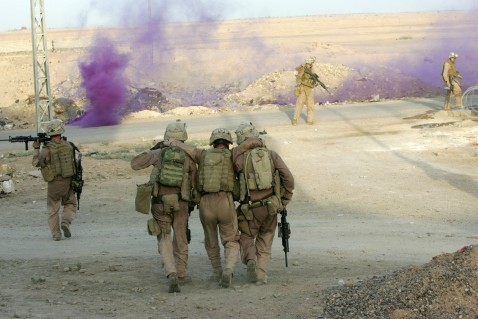
Combat action in Fallujah in June, 2007, AFP Photograph 

Short List of Accomplishments

Here is a rundown of a few of the accomplishments of the 2/6 Marines in the past several months:

 – Enemy attacks have gone from a high of 72 in April when we first took over, to only 21 last month
 – We have discovered and destroyed 40 different enemy weapons caches
 – We have captured 64 suspected enemy and taken them off the streets of Fallujah
 – We have distributed close to 10,000 food bags (each feeds a family of 4 for 2-3 days) throughout the city
 – We have made marked progress in restoring electricity, water and sewage services all ravaged by 4 years of fighting
 – We have removed tons of trash and rubble from the streets
 – We are sponsoring mural painting on school walls and cement barriers all over the city 
 – We are building soccer fields all over the city (their national team just won the Asia Cup and they all went nuts!) and are sponsoring teams and tournaments
 – We are installing solar powered street lights along the main street

The British Flight from Basra

18 years, 6 months ago

In Calamity in Basra and British Rules of Engagement, we pointed out that the British had essentially been militarily defeated in Basra.

Richard Beeston, diplomatic editor of The Times of London recently returned from a visit to Basra, his first since 2003. He says in 2003, British soldiers were on foot patrol, drove through town in unarmored vehicles and fished in the waters of the Shaat al Arab on their days off. He says the changes he saw four years later are enormous.

“Nowadays all troop movement in and out of the city are conducted at night by helicopter because it’s been deemed too dangerous to go on the road and its dangerous to fly choppers during the day,

The British Flight from Basra

18 years, 6 months ago

In Calamity in Basra and British Rules of Engagement, we pointed out that the British had essentially been militarily defeated in Basra.

Richard Beeston, diplomatic editor of The Times of London recently returned from a visit to Basra, his first since 2003. He says in 2003, British soldiers were on foot patrol, drove through town in unarmored vehicles and fished in the waters of the Shaat al Arab on their days off. He says the changes he saw four years later are enormous.

“Nowadays all troop movement in and out of the city are conducted at night by helicopter because it’s been deemed too dangerous to go on the road and its dangerous to fly choppers during the day,

Iranians Proud to be Terrorists

18 years, 6 months ago

The U.S. administration intends to designate the Iranian Revolutionary Guard Corps (or perhaps better known as the Quds force) as a specially designated global terrorist group.  “The designation of the Revolutionary Guard will be made under Executive Order 13224, which President Bush signed two weeks after the Sept. 11, 2001, attacks to obstruct terrorist funding. It authorizes the United States to identify individuals, businesses, charities and extremist groups engaged in terrorist activities.”

Ralph Peters adds that “The real reason for the move is to set up a legal basis for airstrikes or special operations raids on the Guard’s bases in Iran.  Our policy is that we reserve the right to whack terrorists anywhere in the world. Now we have newly designated terrorists. And we know exactly where they are.”  Of course as Michael Ledeen points out, the Quds force is a terrorist organization simply because they are an arm of Iran, which is a state sponsor of terror.

The only real mystery is why anyone in the government felt that it was necessary to have a formal decision to declare the IRGC a bunch of terrorists. I guess that would be the lawyers, for whom it wasn’t sufficient to know that the entire Islamic Republic had been branded a sponsor of terrorism, and hence (a normal person would say) any part of it is ipso facto culpable of terrorist activity, and it’s particularly true of the IRGC, which directly kills people, both inside and outside Iran.

And indeed, the Iranians are proud of it.  A more preening, arrogant, self-important dance-strut is hard to imagine.  Think end-zone dance during a football game.  This is the picture of the “Holy Man” of Iran dancing to the sound that the U.S. declares his nation’s special forces to be a terrorist organization.

Provisional Friday Prayer Leader of Tehran said here Friday the US decision to include the Islamic Revolution Guards Corps (IRGC) in the list of international terrorist organizations is another golden page in the IRGC’s history.

Ayatollah Seyyed Ahmad Khatami added, “As in the nuclear case, the Iranian nation and government would never leave alone their revolutionary offsprings.”

Two leading US dailies, the Washington Post and the New York Times reported in their Wednesday edition about US officials intention to survey adding the name of Iran’s Revolutionary Guards to the list of the international organs involved in terrorist acts.

According to IRNA Political Desk reporter, Ayatollah Khatami in his second sermon, addressed to thousands of Tehrani worshipers at central campus of Tehran University, congratulated the IRGC on blessed birth anniversary of the Third Shi’a Imam, Husain ibn Ali (PBUH), that is marked as the Islamic Guards Day.

He said, “The IRGC has truly shined well during the 28-year history of the Islamic Republic of Iran, both in confronting foreign enemies and foiling domestic plots.”

Khatami said, “Among the prides of the IRGC we can refer to the late founder of the Islamic Republic’s words about the Guard Corps, where he said he was pleased with the IRGC, and that he would never think negatively about them.

He added, “The late Imam also said that there would have been no Islamic Republic of Iran if there were no IRGC; I love the IRGC very dearly; My entire hope lies in IRGC’s conduct;” and “There is nothing in the records of the IRGC, save serving Islam.”

Ayatollah Khatami said, “Therefore, the US State Department’s decision to include IRGC in its list of world terror organs is merely another golden point in the records of IRGC pride.

A senior Iranian cleric also warns the U.S. not to pick on the Guards. ““Americans should know that in this field, as with nuclear energy, they are dealing with the whole nation. And the great nation of Iran will never abandon its revolutionary people,

Accolades for the Marines

18 years, 6 months ago

The U.S. Navy Secretary recently had praise for the Marines and their efforts in Anbar.

U.S. Marines have achieved “very significant results” in restoring security in western Iraq by engaging with locals, U.S. Navy Secretary Donald Winter said Wednesday.

Winter, who also oversees the U.S. Marine Corps, said an example of success in Iraq was western Anbar province, where U.S. Marines have principal responsibility for security.

“I think that we’ve seen a great lessening of tension there, reduced attacks, and a general support of the coalition efforts to provide peace in the region,” Winter told reporters in the Australian capital, where he held discussions with local defense officials.

“And we just hope that that is replicated throughout the rest of Iraq,” he added.

Asked if the cited progress in Anbar was evidence that the deployment of more U.S. troops was working, Winter replied: “I think in Al Anbar, we’ve seen some very significant and positive results.

“I think it’s a positive indication. I’m not sure to what extent we can use that as totally exemplary of what’s occurring in all areas of Iraq, because I’m not sure it totally represents the situation elsewhere.”

Winter said Marines had been focussing in recent months on “engagement with the local population, and I think that that has helped very significantly.”

The only thing as tough as a Marine infantry company is another Marine infantry company.  Only the Marines could have done this in Anbar.  Consider the situation.  Al Anbar had a more dense activity of terrorism than any place on earth in 2004 when the Marines took over responsibility.  Further, the indigenous insurgency upon which the terrorism was superimposed made the fight more local and near to the hearts of the people of Anbar than it otherwise would have been if the fight had only been against foreign fighters.  Yet within three years Anbar is relatively safe compared to other parts of Iraq, and this might have been shorter if not for various political decisions that hampered the military effort.  In a professional military academic climate that claims that counterinsurgency is supposed to take ten years, the Marines have beaten that benchmark by seven.

As we have observed earlier:

The coup is not merely that the tribal chiefs and their people are cooperating with U.S. forces.  It is larger than that.  The coup is that the insurgency, properly defined as indigenous fighters rather than terrorists and foreign fighters – those who were previously pointing a gun towards U.S. troops – are now pointing them at the terrorists.  Not only have many of them made peace with the U.S., but in a development just as important, the U.S. forces have made peace with them.  This has been accomplished with the new difficulty introduced by globalization (foreign fighters), and the new difficulty introduced by religious fanaticism (suicide bombers), and the new difficulty introduced by technology (stand off weapons such as roadside bombs).  This is a counterinsurgency tour de force, and as time judges this victory it will take its rightful place in the great military campaigns of world history.

While the Marines have won a military victory in Anbar, there are always the political and bureaucratic problems that threaten to unravel the situation that the Marines have worked so hard to repair (see How to Lose in Iraq).

Secretary Winter concludes the discussion with welcome words for those of us who have covered rules of engagement.  Says Winter:

U.S. personnel could not be taken captive by Iranian forces if there was a repeat of a clash in the Arabian Gulf in March in which 15 British sailors and marines were held for almost two weeks for allegedly straying into Iranian waters.

“We think we’d be able to deal with any situation that would present itself,” Winter said without elaborating.

Just so.  No elaboration is necessary.  We know what you mean, and so do the Iranians.


26th MEU (10)
Abu Muqawama (12)
ACOG (2)
ACOGs (1)
Afghan National Army (36)
Afghan National Police (17)
Afghanistan (704)
Afghanistan SOFA (4)
Agriculture in COIN (3)
AGW (1)
Air Force (41)
Air Power (10)
al Qaeda (83)
Ali al-Sistani (1)
America (22)
Ammunition (304)
Animals (323)
Ansar al Sunna (15)
Anthropology (3)
Antonin Scalia (1)
AR-15s (393)
Arghandab River Valley (1)
Arlington Cemetery (2)
Army (91)
Assassinations (2)
Assault Weapon Ban (29)
Australian Army (7)
Azerbaijan (4)
Backpacking (4)
Badr Organization (8)
Baitullah Mehsud (21)
Basra (17)
BATFE (246)
Battle of Bari Alai (2)
Battle of Wanat (18)
Battle Space Weight (3)
Bin Laden (7)
Blogroll (3)
Blogs (24)
Body Armor (23)
Books (3)
Border War (18)
Brady Campaign (1)
Britain (39)
British Army (36)
Camping (5)
Canada (19)
Castle Doctrine (1)
Caucasus (6)
CENTCOM (7)
Center For a New American Security (8)
Charity (3)
China (19)
Christmas (18)
CIA (30)
Civilian National Security Force (3)
Col. Gian Gentile (9)
Combat Outposts (3)
Combat Video (2)
Concerned Citizens (6)
Constabulary Actions (3)
Coolness Factor (3)
COP Keating (4)
Corruption in COIN (4)
Council on Foreign Relations (1)
Counterinsurgency (218)
DADT (2)
David Rohde (1)
Defense Contractors (2)
Department of Defense (220)
Department of Homeland Security (26)
Disaster Preparedness (5)
Distributed Operations (5)
Dogs (15)
Donald Trump (27)
Drone Campaign (4)
EFV (3)
Egypt (12)
El Salvador (1)
Embassy Security (1)
Enemy Spotters (1)
Expeditionary Warfare (18)
F-22 (2)
F-35 (1)
Fallujah (17)
Far East (3)
Fathers and Sons (2)
Favorite (1)
Fazlullah (3)
FBI (39)
Featured (192)
Federal Firearms Laws (18)
Financing the Taliban (2)
Firearms (1,867)
Football (1)
Force Projection (35)
Force Protection (4)
Force Transformation (1)
Foreign Policy (27)
Fukushima Reactor Accident (6)
Ganjgal (1)
Garmsir (1)
general (15)
General Amos (1)
General James Mattis (1)
General McChrystal (44)
General McKiernan (6)
General Rodriguez (3)
General Suleimani (9)
Georgia (19)
GITMO (2)
Google (1)
Gulbuddin Hekmatyar (1)
Gun Control (1,717)
Guns (2,406)
Guns In National Parks (3)
Haditha Roundup (10)
Haiti (2)
HAMAS (7)
Haqqani Network (9)
Hate Mail (8)
Hekmatyar (1)
Heroism (5)
Hezbollah (12)
High Capacity Magazines (16)
High Value Targets (9)
Homecoming (1)
Homeland Security (3)
Horses (2)
Humor (72)
Hunting (61)
ICOS (1)
IEDs (7)
Immigration (123)
India (10)
Infantry (4)
Information Warfare (4)
Infrastructure (4)
Intelligence (23)
Intelligence Bulletin (6)
Iran (171)
Iraq (379)
Iraq SOFA (23)
Islamic Facism (64)
Islamists (98)
Israel (19)
Jaish al Mahdi (21)
Jalalabad (1)
Japan (3)
Jihadists (82)
John Nagl (5)
Joint Intelligence Centers (1)
JRTN (1)
Kabul (1)
Kajaki Dam (1)
Kamdesh (9)
Kandahar (12)
Karachi (7)
Kashmir (2)
Khost Province (1)
Khyber (11)
Knife Blogging (7)
Korea (4)
Korengal Valley (3)
Kunar Province (20)
Kurdistan (3)
Language in COIN (5)
Language in Statecraft (1)
Language Interpreters (2)
Lashkar-e-Taiba (2)
Law Enforcement (6)
Lawfare (14)
Leadership (6)
Lebanon (6)
Leon Panetta (2)
Let Them Fight (2)
Libya (14)
Lines of Effort (3)
Littoral Combat (8)
Logistics (50)
Long Guns (1)
Lt. Col. Allen West (2)
Marine Corps (281)
Marines in Bakwa (1)
Marines in Helmand (67)
Marjah (4)
MEDEVAC (2)
Media (68)
Medical (146)
Memorial Day (6)
Mexican Cartels (47)
Mexico (71)
Michael Yon (6)
Micromanaging the Military (7)
Middle East (1)
Military Blogging (26)
Military Contractors (5)
Military Equipment (25)
Militia (9)
Mitt Romney (3)
Monetary Policy (1)
Moqtada al Sadr (2)
Mosul (4)
Mountains (25)
MRAPs (1)
Mullah Baradar (1)
Mullah Fazlullah (1)
Mullah Omar (3)
Musa Qala (4)
Music (25)
Muslim Brotherhood (6)
Nation Building (2)
National Internet IDs (1)
National Rifle Association (97)
NATO (15)
Navy (31)
Navy Corpsman (1)
NCOs (3)
News (1)
NGOs (3)
Nicholas Schmidle (2)
Now Zad (19)
NSA (3)
NSA James L. Jones (6)
Nuclear (63)
Nuristan (8)
Obama Administration (222)
Offshore Balancing (1)
Operation Alljah (7)
Operation Khanjar (14)
Ossetia (7)
Pakistan (165)
Paktya Province (1)
Palestine (5)
Patriotism (7)
Patrolling (1)
Pech River Valley (11)
Personal (76)
Petraeus (14)
Pictures (1)
Piracy (13)
Pistol (4)
Pizzagate (21)
Police (672)
Police in COIN (3)
Policy (15)
Politics (998)
Poppy (2)
PPEs (1)
Prisons in Counterinsurgency (12)
Project Gunrunner (20)
PRTs (1)
Qatar (1)
Quadrennial Defense Review (2)
Quds Force (13)
Quetta Shura (1)
RAND (3)
Recommended Reading (14)
Refueling Tanker (1)
Religion (499)
Religion and Insurgency (19)
Reuters (1)
Rick Perry (4)
Rifles (1)
Roads (4)
Rolling Stone (1)
Ron Paul (1)
ROTC (1)
Rules of Engagement (75)
Rumsfeld (1)
Russia (37)
Sabbatical (1)
Sangin (1)
Saqlawiyah (1)
Satellite Patrols (2)
Saudi Arabia (4)
Scenes from Iraq (1)
Second Amendment (708)
Second Amendment Quick Hits (2)
Secretary Gates (9)
Sharia Law (3)
Shura Ittehad-ul-Mujahiden (1)
SIIC (2)
Sirajuddin Haqqani (1)
Small Wars (72)
Snipers (9)
Sniveling Lackeys (2)
Soft Power (4)
Somalia (8)
Sons of Afghanistan (1)
Sons of Iraq (2)
Special Forces (28)
Squad Rushes (1)
State Department (23)
Statistics (1)
Sunni Insurgency (10)
Support to Infantry Ratio (1)
Supreme Court (79)
Survival (214)
SWAT Raids (58)
Syria (38)
Tactical Drills (38)
Tactical Gear (17)
Taliban (168)
Taliban Massing of Forces (4)
Tarmiyah (1)
TBI (1)
Technology (21)
Tehrik-i-Taliban (78)
Terrain in Combat (1)
Terrorism (96)
Thanksgiving (13)
The Anbar Narrative (23)
The Art of War (5)
The Fallen (1)
The Long War (20)
The Surge (3)
The Wounded (13)
Thomas Barnett (1)
Transnational Insurgencies (5)
Tribes (5)
TSA (25)
TSA Ineptitude (14)
TTPs (4)
U.S. Border Patrol (8)
U.S. Border Security (22)
U.S. Sovereignty (29)
UAVs (2)
UBL (4)
Ukraine (10)
Uncategorized (105)
Universal Background Check (3)
Unrestricted Warfare (4)
USS Iwo Jima (2)
USS San Antonio (1)
Uzbekistan (1)
V-22 Osprey (4)
Veterans (3)
Vietnam (1)
War & Warfare (432)
War & Warfare (41)
War Movies (4)
War Reporting (21)
Wardak Province (1)
Warriors (6)
Waziristan (1)
Weapons and Tactics (80)
West Point (1)
Winter Operations (1)
Women in Combat (21)
WTF? (1)
Yemen (1)

February 2026
January 2026
December 2025
November 2025
October 2025
September 2025
August 2025
July 2025
June 2025
May 2025
April 2025
March 2025
February 2025
January 2025
December 2024
November 2024
October 2024
September 2024
August 2024
July 2024
June 2024
May 2024
April 2024
March 2024
February 2024
January 2024
December 2023
November 2023
October 2023
September 2023
August 2023
July 2023
June 2023
May 2023
April 2023
March 2023
February 2023
January 2023
December 2022
November 2022
October 2022
September 2022
August 2022
July 2022
June 2022
May 2022
April 2022
March 2022
February 2022
January 2022
December 2021
November 2021
October 2021
September 2021
August 2021
July 2021
June 2021
May 2021
April 2021
March 2021
February 2021
January 2021
December 2020
November 2020
October 2020
September 2020
August 2020
July 2020
June 2020
May 2020
April 2020
March 2020
February 2020
January 2020
December 2019
November 2019
October 2019
September 2019
August 2019
July 2019
June 2019
May 2019
April 2019
March 2019
February 2019
January 2019
December 2018
November 2018
October 2018
September 2018
August 2018
July 2018
June 2018
May 2018
April 2018
March 2018
February 2018
January 2018
December 2017
November 2017
October 2017
September 2017
August 2017
July 2017
June 2017
May 2017
April 2017
March 2017
February 2017
January 2017
December 2016
November 2016
October 2016
September 2016
August 2016
July 2016
June 2016
May 2016
April 2016
March 2016
February 2016
January 2016
December 2015
November 2015
October 2015
September 2015
August 2015
July 2015
June 2015
May 2015
April 2015
March 2015
February 2015
January 2015
December 2014
November 2014
October 2014
September 2014
August 2014
July 2014
June 2014
May 2014
April 2014
March 2014
February 2014
January 2014
December 2013
November 2013
October 2013
September 2013
August 2013
July 2013
June 2013
May 2013
April 2013
March 2013
February 2013
January 2013
December 2012
November 2012
October 2012
September 2012
August 2012
July 2012
June 2012
May 2012
April 2012
March 2012
February 2012
January 2012
December 2011
November 2011
October 2011
September 2011
August 2011
July 2011
June 2011
May 2011
April 2011
March 2011
February 2011
January 2011
December 2010
November 2010
October 2010
September 2010
August 2010
July 2010
June 2010
May 2010
April 2010
March 2010
February 2010
January 2010
December 2009
November 2009
October 2009
September 2009
August 2009
July 2009
June 2009
May 2009
April 2009
March 2009
February 2009
January 2009
December 2008
November 2008
October 2008
September 2008
August 2008
July 2008
June 2008
May 2008
April 2008
March 2008
February 2008
January 2008
December 2007
November 2007
October 2007
September 2007
August 2007
July 2007
June 2007
May 2007
April 2007
March 2007
February 2007
January 2007
December 2006
November 2006
October 2006
September 2006
August 2006
July 2006
June 2006
May 2006

about · archives · contact · register

Copyright © 2006-2026 Captain's Journal. All rights reserved.