Articles by Herschel Smith


The “Captain” is Herschel Smith, who hails from Charlotte, NC. Smith offers news and commentary on warfare, policy and counterterrorism.


The Disaggregation of the Taliban

17 years, 10 months ago

David Ignatius has a very positive analysis in his latest commentary at the Washington Post.

The most interesting discovery during a visit to this city where Osama bin Laden planted his flag in 1996 is that al-Qaeda seems to have all but disappeared. The group is on the run, too, in Iraq, and that raises some interesting questions about how to pursue this terrorist enemy.

“Al-Qaeda is not a topic of conversation here,” says Col. Mark Johnstone, the deputy commander of Task Force Bayonet, which oversees four provinces surrounding Jalalabad in eastern Afghanistan. Lt. Col. Pete Benchoff agrees: “We’re not seeing a lot of al-Qaeda fighters. They’ve shifted here to facilitation and support.”

You hear the same story farther north from the officers who oversee the provinces along the Pakistan border. A survey conducted last November and December in Nuristan, once an al-Qaeda stronghold, found that the group barely registered as a security concern among the population.

The enemy in these eastern provinces is a loose amalgam of insurgent groups, mostly linked to traditional warlords. It’s not the Taliban, much less al-Qaeda. “I don’t use the word ‘Taliban,’ ” says Alison Blosser, a State Department political adviser to the military commanders here in the sector known as Regional Command East. “In RC East we have a number of disparate groups. Command and control are not linked up. The young men will fight for whoever is paying the highest rate.”

But this analysis is far too positve.  Hamid Karzai is so concerned about the resurgence of the Taliban and future departure of U.S. troops (and consequent Taliban violence) that he has warned the U.S. against arresting Taliban.  It’s time to talk and negotiate, Karzai believes.

But there is more to this problem than meets the eye.  We have previously discussed how the Afghan Taliban have jettisoned a strict command and control structure in favor of distributed operations.  We have also examined how the Pakistani Taliban have fractured into multiple distinct but connected groups in The Taliban: An Organizational Analysis.

Turning to a more in depth analysis, Ashley J. Tellis, writing for The Washington Quarterly, gives us an important analysis in Pakistan’s Record on Terrorism: Conflicted Goals, Compromised Performance.  Part of his analysis is given below pertaining to the current makeup of the Pakistani Taliban.

The operational context surrounding the counterterrorism effort in the tribal areas and in Afghanistan has changed considerably to the disadvantage of the Western coalition since Operation Enduring Freedom began in 2001.  To begin with, the Taliban movement, which was never a tight and cohesive political entity in any case, has become any even looser network of affiliated individuals and groups since it was forced from power in Kabul.  Today, the Taliban “alliance” can be characterized as a disparate congeries of several elements united only by a common religious ideology, a desire to regain power in Afghanistan or in their local areas of operation, and a deep antagonism toward the United States and its regional allies.

Several distinct elements can be identified in the current Taliban coalition: the leadership council centered around Mullah Omar, other war councils, Taliban cadres, tribal networks of former mujahideen commanders, and “Pakistani Taliban” commanders.  Moreover, many drug lords in eastern and southern Afghanistan are either taxed or willingly contribute revenues that are indispensable for the Taliban war against Kabul.  Sundry former anti-Soviet commanders control small groups of fighters and are engaged primarily in criminal activities while offering their services as guns for hire.  Disaffected Afghan Pashtun tribes, most conspicuously the rural Ghilzai, feel disenfranchised in the current governing arrangements and subsequently continue to support the Taliban with manpower and sanctuary within Afghanistan.  Finally, al Qaeda, although distinct from all of the foregoing groups in that its focus of operations remains the global jihad, nonetheless collaborates with the Taliban to assist the later in recovering control of Kabul while continuing to preserve a sanctuary in the FATA in the interim.

The implication of such a diverse target set is that destroying the “Taliban” today has become much more difficult because its previously weak hierarchical structure has become even more diffuse with truly diverse entities coordinating as necessary, but each also carrying out their local agendas.  The complexity of Islamabad’s relations with many of the constituent elements in the Taliban coalition does not help.  Although Islamabad may readily cooperate in targeting some of the Pakistani Taliban commanders, the drug lords, the petty anti-Soviet commanders, and al Qaeda elements, the ties nurtured by its military and intelligence services with the Taliban leadership and the tribal networks of key former mujahideen commanders make these targets relatively inviolate, at least in the near term.  Therefore, winning the war on terrorism in Afghanistan will require combating all of these targets as well as dealing with the sanctuary enjoyed by various militant groups in Pakistan.

If Tellis is correct, this disaggregation of the Taliban will make it more difficult to conduct operations against them.

Losing Hearts and Minds in Afghanistan

17 years, 10 months ago

Context

A New York Times article published recently upon the occasion of Hamid Karzai’s visit to the U.S. went largely unnoticed, but the importance of this article can hardly be overestimated.

President Hamid Karzai strongly criticized the British and American conduct of the war here on Friday, insisting in an interview that his government be given the lead in policy decisions.

Mr. Karzai said that he wanted American forces to stop arresting suspected Taliban and their sympathizers, and that the continued threat of arrest and past mistreatment were discouraging Taliban from coming forward to lay down their arms.

He criticized the American-led coalition as prosecuting the war on terrorism in Afghan villages, saying the real terrorist threat lay in sanctuaries of the Taliban and Al Qaeda in Pakistan.

The president said that civilian casualties, which have dropped substantially since last year, needed to cease completely. For nearly two years the American-led coalition has refused to recognize the need to create a trained police force, he said, leading to a critical lack of law and order.

The comments came as Mr. Karzai is starting to point toward re-election next year, after six years in office, and may be part of a political calculus to appear more assertive in his dealings with foreign powers as opponents line up to challenge him.

But they also follow a serious dip in his relations with some of the countries contributing to the NATO-led security force and the reconstruction of Afghanistan, and indicate that as the insurgency has escalated, so, too, has the chafing among allies.

Complaints have been rising for months among diplomats and visiting foreign officials about what is seen as Mr. Karzai’s weak leadership, in particular his inability to curb narcotics trafficking and to remove ineffective or corrupt officials. Some diplomats have even expressed dismay that, for lack of an alternative, the country and its donors may face another five years of poor management by Mr. Karzai.

Analysis and Commentary

The tendency for Afghanistan to blame Pakistan and Pakistan to blame Afghanistan is becoming so commonplace that it appears reflexive.  There is enough blame to go around, but Karzai’s recent rebuke of the U.S. carries the import of panic.  This is a critical development in the state of the counterinsurgency campaign in Afghanistan.  Just when the recently deployed U.S. Marines are showing signs of rapid success in their area of operation, along with which General Dan McNeill has said that this infusion of Marines signifies a step change in the nature and pace of operations, the President of Afghanistan has signified his reluctance to continue cooperation in kinetic operations against the Taliban.

This is a revelation of gargantuan proportions.  It must be remembered that the Taliban are in many ways the ideological precursors of al Qaeda.  For Hamid Karzai to inform the U.S. that he no longer supports the arresting of Taliban would be analogous to Prime Minister Maliki telling the Multinational Force that we must win the hearts and minds of al Qaeda, and thus, arrests of their members in Iraq will no longer be tolerated because it might dissuade them from coming forward to surrender.

It ignores a fundamental point that is critical to the understanding of the campaigns in which we are now engaged.  Winning hearts and minds must occur from a position of strength rather that weakness, just as it did in the Anbar Province with the U.S. Marines.  Negotiating from a position of weakness means surrender, and the Taliban know that.  Although much of the population is amenable to nonkinetic operations to rebuild and reconstruct, there are certain elements whose hearts and minds will never be won, and unfortunately for those who see easy routes to victory, those elements must be killed.

Karzai is a weak leader, but given the situation, he can hardly be blamed for the vacillation.  Colonel Thomas F. Lynch gives us an important assessment of the situation that is stunning in its honesty and wonderful in its brevity.

… the U.S. “miscalculated” when it gave NATO control of the counter-insurgency mission in southern Afghanistan in 2006, thinking that peacekeeping and stability work would follow.

Instead, the Taliban insurgency flared up, forcing Canada and other NATO members into a combat role they were not expecting. That in turn, prompted the bickering over troop commitments that now plagues the alliance.

Lynch says NATO’s troop commitments are not what ails the mission.

“The mission in Afghanistan is not in jeopardy mainly because NATO members refuse to provide sufficient troops,” he says. “The real issue is the transitory and uncertain U.S. military posture in Afghanistan.”

Lynch says the key to success lies in the politics of Pakistan, which has long viewed Afghanistan as a source of strategic depth against India: fear of India in the east, and fear of losing control of Afghanistan on its western frontier, have been a driving force in Pakistan since independence. That is why Pakistan helped create the Taliban as a puppet government in Kabul – and why elements of the Pakistan government still support them.

Lynch says only by convincing Pakistan – and the majority of Afghans – of its will to guarantee the security and stability of Afghanistan for decades to come, can the U.S. and its allies put an end to Taliban support, both from inside Pakistan, and from ordinary Afghans.

Consider that the U.S. has abandoned each country to their fates once before, withdrawing from the region soon after the Soviets retreated from Afghanistan.

Today, “our uncertain commitment to Afghanistan has the effect of bolstering Taliban propaganda (while providing) incentives for Pakistan to hedge its bets.”

NATO can claim military supremacy over the Taliban, says Lynch, but so what?

“Our focus on tactical military facts obscures the Taliban’s overall political success. Sanctuary in Pakistan has enabled the Taliban to evade decisive military engagement in order to rearm, regroup and train to fight another day,” he says.

Meanwhile, the Taliban spreads the message: “‘America will leave Afghanistan prematurely, as it has abandoned Afghanistan in the past; and when America leaves, we Taliban shall return to power and kill all Afghans who have collaborated with unbelievers.’

The commitment to the campaign in Afghanistan must be long term by the U.S., and it must be seen that way, in order for there to be success.  Karzai is only a reflection of the fear that grips Afghanistan.  He is a mirror of their feelings rather than a source of inspiration to his people.  The national feeling is that negotiations with the Taliban must proceed in order to bring them into the fold, and that failure to do so will only be the cause of untold violence and brutality when the Americans leave, as they surely will.

The failure to show commitment and resolve in the Afghanistan campaign up until recently has, it has been surmised, only led to a resurgence of the Taliban and al Qaeda, along with the creation of safe have in the tribal areas of Pakistan.  In reality, the situation is far worse.  We have lost the heart of the senior-most leader of Afghanistan.  Quick and decisive action by both the State Department and the DoD must set the context for future operations in Afghanistan.  Commitment must be forthcoming in terms of troops levels and strategy, but it is also apparent that the State Department has failed us once again when Karzai has to inform America by telling the New York Times that he is not happy with the us.

Operation Azada Wosa – “Stay Free”

17 years, 10 months ago

In Marines Engage Taliban in Helmand Province we discussed the beginnings of the Operation Azada Wosa (“Stay Free” in the local Pashto language) by the U.S. Marines in the Helmand Province.  The operation is going forward with success without serious Marines Corps casualties thus far.

The Taliban aren’t giving up without a fight. In groups of three and four, they open fire at the Marines with assault rifles or rockets, then flee. Sometimes they attempt infantry maneuvers, trying to draw the Marines in one direction with a feint, then attacking from another direction. “They were tactically sound,” Moder says. “It shows that they’ve done it before, that they might have been trained.”

Moder estimates his men have killed 30 Taliban fighters. Maj. Tom Clinton, executive officer of the Marines’ infantry battalion, could not confirm Taliban casualties, but he says the Marines are getting reports that wounded Afghan men are seeking medical treatment in Helmand’s capital, Lashkar Gah.

So far, U.S. casualties have been relatively light. Through Thursday afternoon, no Marines had been killed in the operation, although two died last month when a roadside bomb hit their supply convoy.

Six Marines had been injured, none critically: One was shot in the foot, perhaps accidentally; one suffered a concussion from a Taliban rocket or mortar attack; one was bitten by a dog; one fell from a roof and broke an ankle; two broke their legs; and two more sprained their ankles.

The nagging injuries and intense heat are sometimes a more immediate threat than the enemy itself, troops say. “Imagine carrying 75 to 120 pounds of gear and playing a football game where each quarter lasts three hours,” says 1st Lt. Mark Matzke, 21, of Arlington, Va.

Keeping them supplied with water, ready-to-eat meals and ammunition is a full-time operation. From Camp Dwyer, a handpicked team of two dozen Marines runs convoys to infantrymen in the field.

“We wanted to be called ‘The Nomads’ but they gave us ‘Wagon Wheel’ ” instead, says Gunnery Sgt. Javier Duarte, 34, of Miami. Before every convoy, Duarte usually gives the Wagon Wheel team a profanity-laden pep talk, then introduces the chaplain for a prayer.

The convoy heads outside Camp Dwyer’s concertina wire and into the desert on the way to the Marines fighting on the outskirts of Garmser. Along the way, they pass Afghans working in the fields, harvesting the poppy that could be turned into heroin and sold in Europe and the United States.

Back at Camp Dwyer, a special team of combat surgeons, doctors, nurses and medics plays cards and lounges in scarce shade, relieved that light casualties mean their skills haven’t been needed. Some of the doctors have trained in emergency rooms in Los Angeles and Baltimore, treating victims of gangland shootings.

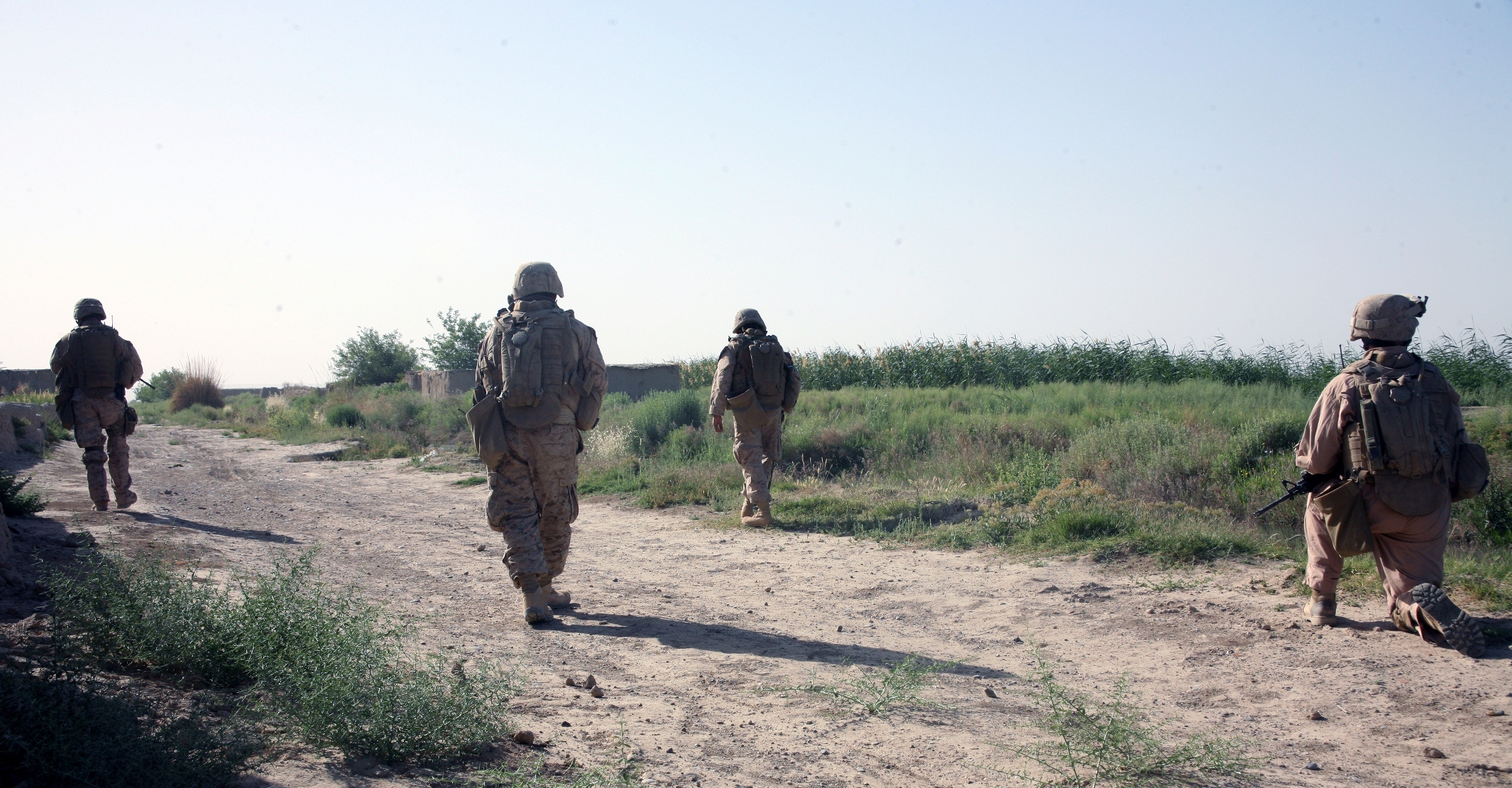
The picture below is taken from DVIDS.  Click for high resolution version of the photograph.

Marines with Charlie Company, 1st Battalion, 6th Marine Regiment, 24th Marine Expeditionary Unit, NATO – International Security Assistance Force conduct operations in Garmsir District, Helmand province, Afghanistan.

Canadians Enlisted in New American-Style Afghan War

17 years, 10 months ago

We recently discussed the first combat engagement of the Marines in Afghanistan, involving a town named Garmser.  The Marines are fully prepared and will push the operation through to success.  However, false doctrine dies hard in war, and the problems associated with the Afghanistan campaign become clearer with passing time and attention.  The Canadians are concerned about the recent addition of the Marines.

Bush has come to shove in southern Afghanistan (Editorial note: This is a pitiful pun – TCJ). The U.S. commander-in-chief has sent in the marines.

It’s reported that this has made NATO forces operating there uneasy.

It’s not that the Canadians and British and the rest of them don’t appreciate the extra manpower the 3,500 U.S. marines will provide, or the extra aircraft and light armoured vehicles they’ve brought.

But the other NATO forces have been told they have to learn to operate in what’s called “the American way” alongside the marines, and they’re not quite sure how this is going to make the job of winning hearts and minds any easier when the Americans have left in seven months when their “mini-surge” is over …

The United Nations envoy, Kai Eide, has just warned that everything won in Afghanistan since the Taliban regime was overthrown seven years ago is in danger of being lost because of the fragmented international approach to securing and rebuilding the country and the weakness of the government of President Hamid Karzai.

The president himself had to be hustled away from the scene of an attack by insurgents near his palace in Kabul on Sunday while all those Afghan soldiers ran for cover.

And in the eastern part of the country yesterday, 19 members of a poppy-eradication team under NATO guard were killed in an attack.

Gen. Dan McNeill is the U.S. army officer who commands NATO troops in Afghanistan, and it’s he who says things must be done there, now, the American way.

Specifically, he wants the Canadians and other forces to deploy their soldiers for longer periods, make more effort to eradicate the cultivation of opium poppies and get more involved in reconstruction and humanitarian work.

The marines are under McNeill’s direct command and seem to have the same gung-ho approach that they exhibited in Iraq, where many of them served. McNeill himself has said they’re in the southern part of the country to “stir things up.”

In March last year, about 100 marines, it was reported, were sent packing for responding to an ambush using “Iraq rules” that violated the less violent rules of engagement that were supposed to be in place in Afghanistan.

It looks as if the Afghan war, at least for the next seven months, is to be played by Iraq rules, which don’t seem to have endeared a lot of people in that country to the American invaders.

Restoring security and rebuilding a country is a long, slow process. First, a region has to be cleared of insurgent fighters, then it has to be held to provide the security under which the third stage, rebuilding, can take place.

The marines might be in Afghanistan long enough to rout the insurgents where they are concentrated.

They might even be able to stop or reduce the traffic in fighters, arms, opium and money.

But when they have gone, someone else is going to have to hold what they’ve gained and someone else is going to carry on with the rebuilding.

When the marine mini-surge was announced in January, a Pentagon spokesman said it was to be “a one-time deal — that’s it.”

Maybe we should hope it’s not. Maybe we should hope that the Americans will be persuaded — if only because their allies aren’t up to the job — to stay long enough to finish what, after all, they started.

The Captain’s Journal has been critical of General McNeill, but we appreciate his sentiments and applaud his perspective with the deployment of the Marines.  He has a tough row to hoe because of the strategic differences within the NATO forces in Afghanistan.

The Canadians seem to assume that they couldn’t adopt a posture like the U.S. Marines on the one hand (such that they would be rather lost without the Marines in place), but on the other hand, seem to criticize the Marine posture as if it somehow cannot be successful because of failing to win hearts and minds (which begs the question why the Canadians want the Marines to stay?).  The Canadian narrative is so confused and contradictory that it brings into question just what the Canadians themselves would propose.

That question is also recently answered for us.  The Canadians want to talk to the Taliban.

Canadian troops are reaching out to the Taliban for the first time, military and diplomatic officials say, as Canada softens its ban on speaking with the insurgents.

After years of rejecting any contact with the insurgents, Canadian officials say those involved with the mission are now rethinking the policy in hopes of helping peace efforts led by the Afghan government.

The Canadian work on political solutions follows two separate tracks: tactical discussions at a local level in Kandahar, and strategic talks through the Kabul government and its allies. Neither type of negotiation appears to have made progress so far, though efforts are still in the early stages.

The Afghanistan campaign has faltered and proceeded haltingly when negotiations are pursued with the Taliban, most recently when the British used this approach in Musa Qala.  What affect has this approach had on the recent Pakistani negotiations with the Pakistani Taliban?  In this instance, Baitullah Mehsud has used the stand down in combat operations to his advantage.

Pakistani Taliban commander Baitullah Mehsud, based in the South Waziristan tribal area, has ended peace talks with the Islamabad government, just a week after ordering a ceasefire against security forces. A spokesman for Mehsud is reported to have said the talks broke down because the government refused to withdraw troops from the tribal areas, the strategic backyard of the Taliban’s insurgency in Afghanistan.

Under a well-orchestrated program, the Taliban “switched off” their attacks on politically vulnerable Pakistan this month and they patiently allowed the Western-sponsored game of carrots and sticks involving tribal peace accords to play out, even letting anti-Taliban politicians into their region. For the Taliban, it was just a matter of buying time until the end of April to put the finishing touches to their spring campaign in Afghanistan.

It should be pointed out again just who the U.S. engaged in negotiations in the Anbar province.  The peace accord involved the tribes and muktars, not the more religiously motivated al Qaeda or Ansar al Sunna fighters.  Again it bears repeating: negotiations were never engaged with al Qaeda.  Not a single time.  Negotiations with the Taliban will not redound to success in the campaign any more than they would have with al Qaeda.  Winning hearts and minds in Afghanistan doesn’t refer to the Taliban.  It refers to everyone but the Taliban.

It should also be remembered that between the campaigns in Iraq and Afghanistan, the only province where major combat operations have ceased and the enemy has been vanquished is the Anbar Province where the Marines were assigned.

Even if confused by the more aggressive posture of the Marines, the Canadians appear to be concerned not about the fate of the Taliban, but of themselves.  The Marines might have a long term Afghanistan presence in their future.  A one-time seven month deployment may not be nearly enough.

Is Iran the Biggest Problem in Iraq?

17 years, 10 months ago

A few days ago McClatchy published an exposé on an Iranian General they called the most powerful man in Iraq.  A short selection will be reproduced below.

One of the most powerful men in Iraq isn’t an Iraqi government official, a militia leader, a senior cleric or a top U.S. military commander or diplomat,

He’s an Iranian general, and at times he’s more influential than all of them.

Brig. Gen. Qassem Suleimani commands the Iranian Islamic Revolutionary Guard Corps’ Quds Force, an elite paramilitary and espionage organization whose mission is to expand Iran’s influence in the Middle East.

As Tehran’s point man on Iraq, he funnels military and financial support to various Iraqi factions, frustrating U.S. attempts to build a pro-Western democracy on the rubble of Saddam Hussein’s dictatorship.

According to Iraqi and American officials, Suleimani has ensured the elections of pro-Iranian politicians, met frequently with senior Iraqi leaders and backed Shiite elements in the Iraqi security forces that are accused of torturing and killing minority Sunni Muslims.

“Whether we like him (Suleimani) or not, whether Americans like him or not, whether Iraqis like him or not, he is the focalpoint of Iranian policy in Iraq,” said a senior Iraqi official who asked not to be identified so he could speak freely. “The Quds Force have played it all, political, military, intelligence, economic. They are Iranian foreign policy in Iraq.”

McClatchy reported on March 30 that Suleimaniintervened to halt the fighting between mostly Shiite Iraqi security forces and radical Shiite cleric Muqtada al Sadr’s Mahdi Army militia in the southern city of Basra. Iraqi officials now confirm that in addition to that meeting, Iraqi President Jalal Talabani personally met Suleimaniat a border crossing to make a direct appeal for help.

Iraqi and U.S. officials told McClatchy that Suleimani also has: [i] Slipped into Baghdad’s Green Zone, the heavily fortified seat of the U.S. occupation and the Iraqi government, in April 2006 to try to orchestrate the selection of a new Iraqi prime minister. Iraqi officials said that audacious visit was Suleimani’s only foray into the Green Zone; American officials said he may have been there more than once, [ii] Built powerful networks that gather intelligence on American and Iraqi military operations. Suleimani’s network includes every senior staffer in Iran’s embassy in Baghdad, beginning with the ambassador, according to Iraqi and U.S. officials, and [iii] Trained and directed Shiite Muslim militias and given them cash and arms, including mortars and rockets fired at the U.S. Embassy and explosively formed penetrators, or EFPs, the sophisticated roadside bombs that have caused hundreds of U.S. and Iraqi casualties.

At Abu Muqawama, Dr. iRack read this report and said:

The story is part of the growing drum beat of Iran stories Dr. iRack has pointed to this week (see here and here). There is clearly a concerted effort underway by the Bush administration (which began during the April Petraeus/Crocker testimony and President Bush’s April 10th speech) to prime the media pump and ratchet up the perceived threat posed by Iran’s “malign” activities in Iraq.

To which The Captain’s Journal responds, rubbish.  We have had twenty five years of experience reading Knight-Ridder / McClatchy due to it being the exclusive supplier for our very own hometown newspaper.  It is unapologetically and unabashedly biased and leftist.  This has consistently been the case for well over a quarter of a century, which is the amount of time we have invested in this rag and pitiful excuse for news.

It might take on the trappings of erudition to critique the McClatchy report as part of the “growing drumbeat on Iran,” but erudite it isn’t.  If they thought that this report would even be perceived as shilling for the administration, they would have killed it even if sourced better than any story even done at McCatchy.  In fact, this might be only the second instance of actual reporting we have ever seen from McClatchy (the first being a good report on snipers in Ramadi).

Along with this same theme, NBC News’ Richard Engel had an interesting post today about the role of Iran in Iraq, sourcing his information to “senior U.S. military officials,” duplicated below.

Over a meal this weekend at a Green Zone chow hall (chicken salad and Baskin-Robbins pralines and cream ice cream, a KBR delight), I had a revealing conversation with two senior U.S. military officials.

“We’ve pretty much defeated al-Qaida here,” one of the military officers said. “If Iran stopped doing what it’s doing, things would dramatically change.”

“You think that would be it, a turning point? If Iran stopped backing militias, you think things would get much better?” I asked.

“No doubt. It would be dramatic,” replied the officer.

For many military commanders there is a feeling of euphoria that the U.S. troop “surge” and the top commander in Iraq Gen. David Petraeus managed to reduce violence, especially in Sunni areas.

The surge has become something sacred for the military in Iraq. It was a plan that worked. It has been entered into the annals of history – at least here – as a success, not to be questioned. The commanders I spoke to this weekend were angry Iran, they claim, is trying to ruin their surge.

The frustration is understandable. Sunni radicals have gone quiet, thanks in part to the “Sons of Iraq” program in which former insurgents (mostly Sunnis) are paid to fight al-Qaida. (Critics say the program is just arming the insurgents to fight another day).

Anbar province, once considered a lost region overrun by Sunni radicals, is now mostly calm. It is the Shiite areas, especially where Iran is strong, like in Basra and Sadr City, which are now in revolt.

U.S. military commanders deduce that if Iran stopped stoking the fires of conflict, both Sunnis and Shiites would stop fighting long enough for Iraq to blossom into the prosperous nation that U.S. officials promised and that the U.S. military needs to prevent failure in Iraq.

Perhaps they are correct. It would be logical to assume that if both sides stop fighting, there would be less bloodshed and more room for dialogue.

He goes on to wonder if this is the “flavor of the month” enemy in Iraq.  Contrary to this fear and Dr. iRack’s diminutive analysis of the McClatchy report, we vote that Iran is a powerful actor in Iraq – but then, we were saying this before it became popular.  Perhaps our warnings were prescient.

But the reader will not detect rumblings of war at The Captain’s Journal.  Rather, we will advocate as we always have, i.e., full engagement in the covert warfare in which Iran has engaged against the U.S. for twenty five years.  The U.S. is so powerful and resourced so well in this type of warfare, yet engages so poorly in it, that it can only be the fault of the CIA.

In this case, there is a solution for General Suleimani.  It is selective targeting, analogous to the same for Mughniyeh.  It will get their attention far more effectively than deployment of yet another carrier to the Persian gulf.

Marines Engage Taliban in Helmand Province

17 years, 10 months ago

After sitting idle mired in NATO bureaucratic red tape for six weeks, the U.S. Marines have finally been deployed into the Helmand Province where they have targeted a Taliban stronghold town called Garmser.

US Marines pushed into a stronghold of extremist Taliban resistance in southernmost Afghanistan Tuesday in their first major operation since deploying to Afghanistan last month …

Garmser in southern Helmand is an area of difficult desert terrain that extends down to the Pakistan border across which Taliban reinforcements and weapons are said to arrive to enter a growing insurgency.

Soldiers with the 24th Marine Expeditionary Unit, based in the neighbouring province of Kandahar, were airlifted into forward bases in the area last week or moved in on convoys, ISAF said.

From there they launched the operation named Azada Wosa, which means Be Free in the Pashtu language of southern and eastern Afghanistan …

Military officials say Helmand is a nest of hardcore Taliban fighters supported by international Islamic “jihadists” and the centre of Afghanistan’s booming opium and heroin trade.

But for reasons recommended by The Captain’s Journal in October of 2007, the Marines aren’t after poppy according to Major Tom Clinton.

The Marines are entering an area lush with opium poppies. The Marines don’t want to antagonize the local population by joining U.S.-backed efforts to destroy the crop. “We’re not coming to eradicate poppy,” Clinton says. “We’re coming to clear the Taliban.”

The town of Garmser has been under the control of Taliban fighters who have been expecting a fight for some time.

The Taliban presence in Garmser has been a running sore for British forces for the past year, but British commanders have not previously had the combat forces available to push the Taliban out.

The Taliban claims to have several hundred fighters in the area, with prepared bunkers and tunnel complexes that have proved resistant to frequent Western aerial bombing raids.

The Telegraph was able to interview two Taliban commanders operating in the Garmserarea last month, who said they expected to resist any assault by Western forces.

“It will be really difficult for the British,” said Mullah Ghafour, not his real name. “We have 20 kilometres depth of defences, with all kinds of mines. They have tried before to push us back. In Garmser it is a face to face fight.”

But the Taliban are facing the U.S. Marines, many of whom are veterans of the Anbar Province.  Being dug in is not helping the Taliban, who lost their command center today.

In one short engagement this morning, the Marines took rocket-propelled grenade and small arms fire, and a Marine scout helicopter killed two insurgents with rockets and .50-cal machine gun fire.

The battle for the Taliban command center raged all day today, said Lt. Anthony Henderson, who commands the 1st Battalion 6th Marine Regiment, the core infantry unit of the 24th MEU.

Henderson said the Marines gradually pushed the Taliban back into a corner of the facility and then called in air strikes by Cobra attack helicopters with Hellfire missiles.

The Taliban are learning what General George Patton knew years ago, namely that fixed fortifications are monuments to man’s stupidity.  Inch by inch, room by room, the Marines are prepared to complete the battle, both kinetic operations and reconstruction of the area.

The Marines had prepared on Monday by cleaning weapons and handing out grenades. The leader of one of the three companies involved — Charlie Company commander Capt. John Moder — said his men were ready.

“The feeling in general is optimistic, excited,” said Moder, 34, of North Kingstown, Rhode Island. “They’ve been training for this deployment the last nine months. We’ve got veteran leaders.”

Many of the men in the 24th Marine Expeditionary Unit served in 2006 and 2007 in Ramadi, the capital of Anbar province in western Iraq. The vast region was once the stronghold of al-Qaida in Iraq before the militants were pushed out in early 2007.

Moder said that experience would affect how his men fight in Afghanistan. “These guys saw a lot of progress in Ramadi, so they understand it’s not just kinetic (fighting) but it’s reconstruction and economic development.”

But on the initial assault, Moder said his men were prepared to face mines and homemade bombs and “anybody that wants to fight us.”

One Marine in Charlie Company, Cpl. Matt Gregorio, 26, from Boston, alluded to the fact the Marines had been in Afghanistan for six weeks without carrying out any missions. He said the mood was “anxious, excited.”

“We’ve been waiting a while to get this going,” he said.

A while indeed.  Six weeks mired in red tape.  But progress has started, and the Taliban in this AO will surrender or die.

**** UPDATE ****

Welcome to Hugh Hewitt readers and thanks to Hugh for the link.  Also welcome to Pajamas Media readers.

Taliban Tactics Evolve

17 years, 10 months ago

In The Taliban and Distributed Operations we pointed to evolving tactics of Taliban fighters, saying:

This tactic of forcing decision-making down within the organization, dispatching smaller, self-sufficient groups of fighters, and maintaining looser communication is perfectly adapted to the Afghanistan countryside, which is less about MOUT (military operations on urban terrain) than in Iraq.  This guerrilla approach to warfare requires aggressive offensive operations to root them out in their hiding places.  It also requires that U.S. forces participate in the chase.  Fire and melt-away must become less attractive to the Taliban.

It is partially for this reason The Captain’s Journal has claimed that there would be a so-called spring offensive by the Taliban (which U.S. Army intelligence and command in Afghanistan has repeatedly denied that this offensive would occur).  When NATO speaks of a spring offensive, they are talking tactical maneuvers and larger scale kinetic fights.  When we speak of a spring offensive, we are talking about guerrilla tactics – small teams, fire and melt away, etc.

Antonio Giustozzi is a research fellow at the London School of Economics who has studied the evolution of the Taliban since the September 11, 2001, terrorist attacks in the United States, and he recently reiterated the same points that we made.

“Today, the Taliban are essentially a guerrilla movement, whereas in the 1990s — even in the early days of 1994 or 1995 — they were never something like that,” Giustozzi says. “Even when they were fighting for power, they were not using these guerrilla tactics. They were more like an army moving along the highways and trying to occupy the provincial centers. In that sense, the main difference is the way they operate. It is not so easy to say what their actual aims are.” 

But he says that, too, might change.

“Essentially, they say what they want is just to get the foreigners out of the country,” Giustozzi explains. “But even in the early days, they were claiming that their main aim was to pacify the country and bring back law and order — not to become a kind of government which would stay in power indefinitely, which, of course, proved not to be correct once they actually took Kabul.”

As for ordinary Taliban foot soldiers, recent research suggests that the Taliban has been recruiting a younger generation of Afghans to carry out suicide attacks and to fight within its rank and file.

Working for the United Nations Assistance Mission in Afghanistan, Christine Fair last year studied the phenomenon of suicide bombings across Afghanistan. Her work led to important conclusions not only about suicide bombers, but also about the emergence of this new generation of Taliban fighters.

“The important big picture is Afghans like to tell you that this is a Pakistani phenomenon,” Fair says. “As we all know, there is Pakistani involvement. There is recruitment across the border. In the tribal areas, madrasahs figure prominently. But even if Pakistan went away, you still have a largely Afghan-driven insurgency.”

Fair describes the situation as a “cross-border phenomenon,” and says that “the insurgency is not going to be resolved if you think that the problem stops either at one side or the other of the Afghan border.”

Distributed operations include the use of suicide bombers, which we the Taliban have begun to see as their “smart bomb.”  While some of the ISAF generals have ridiculed the notion of an increase in Taliban violence, the top general in Afghanistan, Maj.Gen. Jeffrey Schloesser, has gone on record saying that he expects increased insurgent activity.

Schloesser says violence “may well reach a higher level than it did in 2007,” now seen as the bloodiest year since the ouster of the Taliban in 2001. The United Nations says more than 8,000 people, mostly rebels, died in insurgency-related violence last year.

Schloesser says the rebels are no military match for NATO forces.

Instead, they are increasingly directing attacks against civilians and Afghan police and security forces protecting development projects.

“They are going for what is an easier target,” said Schloesser, who heads the 101st Airborne Division. He took up his command in Afghanistan on April 10.

With the indigenous insurgency and the fact that deployment of Taliban fighters is likely complete, focus on the border may miss the point.  Force projection is needed inside Afghanistan, and the guerrilla fighters must be chased in order to create the security for the creation of infrastructure.

Continuing Operations Against the Sadrists

17 years, 10 months ago

To a significant degree it appears that the Mahdi militia is disappearing from the streets of Basra.  Disappearing from the streets is not the same thing as being identified, disarmed and arrested.  But at least in Baghdad – and most specifically in Sadr City – their are continuing operations against the Sadrists.

US and Iraqi forces have killed at least 45 insurgents in fierce battles with Shiite fighters in eastern Baghdad over the past 24 hours, the US military said on Monday.

Three US soldiers were also killed in east Baghdad on Monday when they were hit by rocket or mortar fire, the military said.

Earlier, the military said seven “criminals” were killed in the flashpoint Sadr City district of the Iraqi capitalwhen US forces called up an aerial weapons team (AWT) and a M1A2 Abrams Tank after soldiers came under attack with small-arms fire.

Another 38 militiamen were killed on Sunday, including 22 in one of the heaviest clashes in weeks, when militiamen blasted Baghdad’s fortified Green Zone with rockets and mortars, taking advantage of a blinding dust storm that grounded US attack helicopters.

The biggest clash in the day-long battles came at dusk on Sunday when “a large group of criminals engaging with small-arms fire” attacked a security forces checkpoint, a US military statement said.

“US soldiers used 120 mm fire from M1A12 Abrams tanks and small-arms fire to kill … 22 criminals, forcing remaining enemy forces present to retreat,” the military said.

One particular statistic that cries out for robust counterinsurgency is that “More than 712 rockets and mortar rounds have been launched in Baghdad in the past month, according to Maj. Gen. Qassim Atta, an Iraqi army spokesman.”  This divides to approximately 24 rounds of ordnance per day being launched within the confines of the city.  It isn’t likely that truces and offers of talks will persuade the militia to disarm.  Their disarmament will have to be forcible.

There has been speculation that with attention focused on the Mahdi militia, al Qaeda will have a chance to regroup and conduct an offensive.  Time engaged in such speculation, using as evidence only a few lone bombings.  There has also been speculation that al Qaeda would join forces with the Mahdi militia.  The Captain’s Journal judges both of these speculations to be so unlikely that the chances of obtaining are statistically insignificant.  The Sadrists and al Qaeda will not be able to get along any more than Ansar al Sunna or the 1920s Brigade could get along with al Qaeda.  Furthermore, there is too much history of violence between these two groups, the bombing of the Samarra shrine being one such unforgivable occurrence.

Operations continue against al Qaeda, and on April 28 the Sons of Iraq killed a dozen al qaeda fighters while defending themselves.  There has never been a time in the Iraq campaign in which operations against al Qaeda have ceased.  The Mahdi militia must be seen as the Shi’a equivalent of al Qaeda rather than a disenfranchised segment of the population.  The impoverished in Iraq are not one and the same with the militia.

Moderation on Basra and Sadr City

17 years, 10 months ago

The Captain’s Journal has complained about analysis of the Basra and Sadr City fighting that tends toward the extremes.  Effusive analysis and reporting about the recent events is neither productive nor compelling.  A recent example of sardonic analysis comes from Dr. iRack at Abu Muqawama (Editorial note: Matthew Yglesias who writes for The Atlantic addresses previous Basra opinion from Dr. iRack, and in the same post, the commenters curse The Captain’s Journal.  This brings a smile to our face.  Riddle us this.  What could be better than to draw the ire of either Yglesias or his boy-fan readers?).

Dr. iRack has detected a new narrative coming out of the Iraqi Government (and MNF-I). The story goes something like this. “Once upon a time, a brave prime minister took on the criminals trying to destroy his kingdom. He sent a ‘charge of the knights’ deep into the rogue principality of Basra to slay the minions of the evil wizard Sadr and save countless damsels in distress. After a shakey start, the knights vanquished their foes. The black-pajama-clad-ninja-JAM-gangster-flying-monkeys flew away, and life returned to the streets. The world turned from black-and-white to technocolor. Damsels felt free to let down their hair and don multi-colored robes, children frolicked and went joyously back to school, long-delayed weddings commenced, popular bards were able to share their mirth-filled tunes, and celebratory gunfire rang throughout the land. And so they all lived happily ever after.”

For an eye-witness account of this transformation which basically tells this story (minus the sarcasm), see this piece in the London Times.

There seem to be many morals to this tale:

1. The limp-wristed British were defeated in Basra, but with a wee-bit of manly American help (advisors, air support), the JAMsters were sent scurrying.

2. The ISF (especially the Iraqi army) is more capable than all those playa-haters like the Special Inspector General for Iraq Reconstruction claim, despite all the difficulties during the early phase of the Basra operation and the need to fire 1,300 deserters who refused to fight JAM.

To be fair about our analysis of the British and the recent history of Basra, The Captain’s Journal has never claimed that the British are limp-wristed.  We have always claimed that the British warrior is as good as any, but that the Colonels and Generals misled their political leadership and failed their men.  The strategy is to blame, not the quality of the British enlisted men.  Nor have we made any claims concerning the presence of the U.S. in Basra.  However, it is unlikely that Dr. iRack is pointing to our analyses, especially since he links certain articles in his post.

His analysis drips with sarcasm, so much so that it may blind him to certain truths concerning the recent fighting.  All of the prose he (and anyone else) is capable of bringing to bear on the issue doesn’t change the facts that the Marines are standing down in Anbar because the campaign is complete, and the campaigns for Basra and Sadr City are just beginning.

In Concrete Walls for Sadr City, we noted that counterinsurgency tactics were finally being brought to Sadr City.  We were fooled by appearances, and it now has become clear that the walls are a continuing testimony to the aborted efforts against the Sadrists that have plagued the campaign from the beginning.  There are no intentions to continue the operation throughout Sadr City.

American and Iraqi forces building a wall in Sadr City have no plans to besiege the east Baghdad Shiite bastion where they have been battling militiamen for weeks, a US general said on Thursday.

“Our purpose is to secure only the southern part of Sadr City, to prevent rockets being fired towards the Green Zone from the area,” Major General Jeffery Hammond, commander of US forces in Baghdad, told a news conference.

Rather than see things from the extreme end of the spectrum (victory has been achieved within a few short weeks, contra victory cannot possibly be achieved no matter what), moderation and a measured approach is best.  The Captain’s Journal has found such an analysis, crafted by Richard S. Lowry writing at OpFor.  His analysis will be cited at length.

Last Tuesday evening an Apache helicopter crew noticed three criminals loading a mortar into the trunk of their car in Sadr City. After insuring there were no civilians nearby, the American soldiers fired a Hellfire missile which obliterated the front end of the vehicle. The criminals rushed to the mangled auto and grabbed the mortar, tossed it into a second vehicle and sped away.

Events like these have become commonplace as neither American nor Iraqi Security Forces have been patrolling the streets of Sadr City. Even though Muqtada al Sadr has declared a cease-fire, the Sadr City District has been a very dangerous place for Coalition forces. The lower-class neighborhoods of eastern Baghdad (Sadr City) continue to remain an Al Sadr stronghold. So much so, that the area has been cordoned and Iraqi and Coalition forces do not venture into the majority of the eastern Baghdad slums. The area is laced with IEDs and armed criminal elements that will stand and fight, if confronted. So, the majority of the Coalition’s security is facing inward and the city streets are patrolled from the sky. Contrary to some reports, Sadr City is not under siege. There are control points to stem the influx of illegal weapons, but people are free to come and go as they please.

Rest assured, Sadr City is under constant surveillance. High above the attacking Apache, an Unmanned Arial Vehicle (UAV) circled the district. Air Force controllers watched the Apache attack and the enemy speed away in their streaming video broadcast from the drone. They stalked the vehicle as it sped through the streets like a hawk circling its prey. When the thugs finally stopped in an empty field, another Hellfire screamed out of the evening sky. This time both criminals were killed and the vehicle and mortar were destroyed.

There may not be a cop on every corner in Sadr City, but the ISF and American Forces can see what is going on and they can swiftly react to acts of aggression. For some time now, there has been a tense stalemate in Sadr City. Al Sadr’s radical followers continue to conduct violent acts in the form of mortar and rocket attacks, IED attacks on Coalition and Iraqi Security forces, and outright skirmishes with the authorities. More often than not, the fighters are rounded up or killed, but they continue to harass the establishment.

All the while, the vast majority of the civilian population is trying to live a peaceful life amid this small groups’ struggle for power and influence. Security is slowly returning to the other districts of Baghdad and as the streets become safer, overall life is improving for the every-day Iraqi. The streets are being cleaned up, markets, parks and schools are open and there is a glimmer of hope for the future. Bread winners are returning to work and children are returning to school.

But Muqtada and his followers do not want the people of Sadr City to gain hope for their future. Their power comes from the downtrodden, from the poor, from the disadvantaged. They want to have continued chaos in Sadr City, Baghdad and Iraq. Stability is their enemy. So, Sadr’s supporters roam the streets in armed gangs, lob mortar rounds at American facilities, plant IEDs and rocket the International Zone. Recently, after British troops withdrew from the streets of Basra, Sadrist thugs took over Iraq’s second largest city.

Last month, the Iraqi government moved to restore law and order in Basra. Until then, Muqtada al Sadr and his radical followers enjoyed a shaky stalemate with the Coalition forces and the government in Baghdad. Al Sadr, who has been hiding in Iran, has issued a fatwa declaring a cease-fire with the Multi-National Forces in Iraq. He has been literally sitting on the sidelines, waiting for American forces to go home. But, his Mahdi army has seized every opportunity to make trouble. Some – many – of Muqtada Al Sadr’s followers have violated the cease-fire and have quickly been killed or captured.

When the ISF moved to retake Basra, Sadrist thugs throughout the country counterattacked from Basra to Nasiriyah to Sadr City. Last week, Iranian-made 107mm rockets were hurled across the Tigris River into the International Zone from the most southern reaches of Sadr City. Iraqi Security Forces quickly moved into that area with coalition support. They have built a temporary barrier that separates the southern edge of the district from the rest of Sadr City. The rocket teams that have not been killed have been forced out of effective range to be able to hit the International Zone. While the ISF are in the lead, there is a considerable Coalition force supporting the Iraqis, particularly in the air.

With support of the Coalition, Iraqi Security Forces have had great success in neutralizing, killing and destroying the mortar and rocket teams who were firing from within Sadr City. “We have taken out literally dozens of those teams” Rear Admiral Greg Smith, Director of Communications for the Multi-National Force – Iraq, added that some of these criminals were, “in the process of setting up to fire.” These criminals were lobbing rockets across the Tigris River, attempting to hit government and Coalition targets in the International Zone. Most of the rockets fell short, killing and injuring innocent Iraqi civilians.

The burned out vehicles we are seeing in the streets on the nightly news belong to rocket and mortar teams, victims of precision weapons launched from Unmanned Arial Vehicles (UAVs) or Apache helicopters. The enemy cannot escape the watchful eyes of coalition forces. “What you have is a very persistent coverage from the air by US forces.” Smith went on to say, “We spot ‘em, we track ‘em and we kill ‘em.”

Still, the levels of violence today are higher than they were before Easter Sunday. There was a serious peak of violence after the Iraqi government moved to take back the streets of Basra. The number of incidents has recently decreased, but is still elevated in nearly every category.

What is Next?

The next few weeks will be crucial to bringing the citizens of Sadr City into the fold. Today, Muqtada al Sadr has a significant following within the slums of the city named after his martyred father. But, his influence is waning. Extremists want him dead and moderates are considering reconciliation. The Iraq government will be pumping $150,000,000 into the southern extremities of Sadr City. The money will be used to revitalize the areas that are under government control. If the moderates see that the government is making an effort to help the people of Sadr City, they may be inclined to denounce the violent elements that control their neighborhoods.

Even then, the future of the citizens of Eastern Baghdad, and most of southern Iraq, rests in the hands of Muqtada al Sadr and the violent factions within his following. If the government of Iraq can provide some political accommodations to the Sadrists, if Al Sadr can be convinced that he can maintain his power base peacefully, if the extreme shi’a can reconcile with the moderate shi’a, there might be a chance of a peaceful outcome in Sadr City.

Let us all hope that sane minds prevail because if they don’t, a military operation will be needed to clear Sadr City, ala Najaf, Fallujah and Basra. Muqtada Al Sadr needs to realize that we can do this the easy way or the hard way, but the Coalition and Iraqi Security Forces will not be deterred from bringing peace and stability to all the people of Iraq, including those in Sadr City.

This is careful reporting, and readers should make OpFor a daily stop.  The Basra campaign was aborted.  More needs to be done.  Sadr City is just beginning.  The Sadrists are the most prolific provider of welfare funds in Iraq.  Their power springs from the impoverished, and they won’t slink away into the night without a fight.  The SIIC needs to be forced to demonstrate their loyalties.  The best way to do this is to place them at the point in targeting Iranian elements within Iraq.  They, more than any other group, would be in a position to identify Quds operators, IRG fighters, Iranian weapons caches, Iranian training camps for insurgents, and Iranian smuggling lines and monies.  If they will not do this, then their loyalties are proven to be with Iran rather than Iraq.  They cannot be considered a legitimate part of the Iraqi government.

The campaign involving the Sadrists and SIIC –  it isn’t lost, and it hasn’t been won.  The campaign to bring Iraqi law and order to their encampments is just beginning.  As we have said about every engagement, patience and force projection are the two most critical elements to success.


The Torkham Crossing

17 years, 10 months ago

In Taliban and al Qaeda Strategy in Afghanistan and Pakistan we set out the intended strategy of attacking NATO supply lines through the Khyber pass.  This Al Jazeera video does a fairly good job of laying out the strategy and summarizing the importance of this plan to date.

This strategy is, according to an Asia Times report, in tatters, and according to a Globe and Mail report, meeting resistance.  The Asia Times report is lengthy but gives us a glimpse into the treachery involved  along the Khyner pass from a trader named Namdar, who apparently sold the Taliban out for $150 000 right around the time of the March 20 attack on 40 gasoline tankers.

Unlike in previous Taliban attacks in the area, local paramilitary forces chased the Taliban after this incident. The Taliban retaliated and five soldiers were killed, but then their ammunition ran out and they surrendered the two workers and tried to flee, but they were blocked.

The Taliban called in reinforcements, but so did the paramilitary troops, and a stalemate was reached. Eventually, the Taliban managed to capture a local political agent (representing the central government) and they used him as a hostage to allow their escape.

They retreated to their various safe houses, but to their horror, paramilitary troops were waiting for them and scores were arrested, and their arms caches seized. A number of Taliban did, however, manage to escape once word got out of what was happening.

The only person aware of the safe houses was Namdar, their supposed protector: they had been sold out.

Their worst suspicions were confirmed when Namdarbroke his cover and announced on a local radio station that Taliban commanders, including Ustad Yasir, should surrender or face a “massacre”, as happened when local tribes turned against Uzbek fighters in South Waziristan in January 2007.

Namdar said that he had the full weight of the security forces behind him, and he did not fear any suicide attack.

Al-Qaeda and the Taliban immediately called an emergency shura in North Waziristan to review the situation. Al-Qaeda’s investigations revealed that the CIA and Pakistani intelligence had got to Namdarand paid him $150,000 in local currency.

The immediate result is that Taliban operations in Khyber Agency have been cut off. This in itself is a major setback, as the attacks on supply lines had hit a raw NATO nerve.

In the broader context, Namdar’s betrayal vividly illustrates the dangers of traitors within the ranks of the Taliban and al-Qaeda. The fear is that the various peace deals being signed now between the Islamabad government and selected tribal leaders could lead to a whole new batch of betrayals.

Namdar is a pawn, and the real power according to the Globe and Mail report is a tribal leader who owns a local army of fighters.

An Islamist warlord whose fighters are overrunning Pakistan’s famous Khyber Pass area may now be the only force stopping the Taliban from swooping in to cut off this key supply route for NATO in neighbouring Afghanistan.

Mangal Bagh, who leads a group called Lashkar-i-Islam, said in an interview that he has rebuffed an offer from Pakistan’s Taliban to join them. Although he voiced his disdain for the United States, his independence is likely to be significant for NATO troops fighting in Afghanistan.

Khyber agency is a 2,500-square-kilometre district that is part of Pakistan’s tribal belt, and truckloads of food, equipment and fuel for NATO troops wind through it daily to the bustling border at Torkham. Last week, fighting between Mr. Bagh’s men and a pocket of resistance around the town of Jamrut closed the Pak-Afghan highway for several days.

Mr. Bagh’s stronghold, the market town of Bara, is a 30-minute drive from the city-centre of the provincial capital, Peshawar. An escort of his heavily armed followers is needed to reach his fortified compound in the surrounding countryside.

“I’m not the ruler of Khyber, I’m the servant,” said Mr. Bagh, who had an unexpectedly gentle manner, as he relaxed with his Kalashnikov-toting men, drinking tea. “My aim is to finish all social evils.”

There have been repeated entreaties to combine forces from the Pakistani Taliban, who run other parts of the country’s wild northwestern border terrain, known as the Federally Administered Tribal Areas. A traditional jirga, a meeting of elders, was held between Lashkar-i-Islam and the Taliban about 40 days ago.

“I told them that what I am doing is enough. It is the right direction. There is no need to join you,” he said.

“The Taliban consists of religious scholars. We are fighters for Islam – laypeople. We don’t have any religious figures in our organization.”

However, he said that the U.S. intervention in Afghanistan was “wrong” and that U.S. soldiers must leave.

Our assessment is that this is a mixed blessing.  First, Asia Times can give good information, but tends towards exaggeration, and it isn’t likely that the whole strategy of attacking NATO supply lines is in tatters.  Second, before beginning the dances of jubilation over the failure of the Taliban approach, remember that Mangal Bagh is no friend of the U.S.  It is likely that the battles in this area are just beginning.  The Taliban have not typically been inclined to give up after the first battle.

Continued CIA pressure must be brought to bear in this region, in addition to UAV strikes when known Taliban are observed.  This force must be balanced against the need to prevent targeting Mangal’s fighters, even if he is unfriendly to NATO efforts.  For now, at least, he must be considered a friend, even if a tenuous and potentially treacherous one at that.

Prior:

Taliban and al Qaeda Strategy in Pakistan and Afghanistan

The Khyber Pass


26th MEU (10)
Abu Muqawama (12)
ACOG (2)
ACOGs (1)
Afghan National Army (36)
Afghan National Police (17)
Afghanistan (704)
Afghanistan SOFA (4)
Agriculture in COIN (3)
AGW (1)
Air Force (41)
Air Power (10)
al Qaeda (83)
Ali al-Sistani (1)
America (22)
Ammunition (304)
Animals (323)
Ansar al Sunna (15)
Anthropology (3)
Antonin Scalia (1)
AR-15s (393)
Arghandab River Valley (1)
Arlington Cemetery (2)
Army (91)
Assassinations (2)
Assault Weapon Ban (29)
Australian Army (7)
Azerbaijan (4)
Backpacking (4)
Badr Organization (8)
Baitullah Mehsud (21)
Basra (17)
BATFE (246)
Battle of Bari Alai (2)
Battle of Wanat (18)
Battle Space Weight (3)
Bin Laden (7)
Blogroll (3)
Blogs (24)
Body Armor (23)
Books (3)
Border War (18)
Brady Campaign (1)
Britain (39)
British Army (36)
Camping (5)
Canada (19)
Castle Doctrine (1)
Caucasus (6)
CENTCOM (7)
Center For a New American Security (8)
Charity (3)
China (19)
Christmas (18)
CIA (30)
Civilian National Security Force (3)
Col. Gian Gentile (9)
Combat Outposts (3)
Combat Video (2)
Concerned Citizens (6)
Constabulary Actions (3)
Coolness Factor (3)
COP Keating (4)
Corruption in COIN (4)
Council on Foreign Relations (1)
Counterinsurgency (218)
DADT (2)
David Rohde (1)
Defense Contractors (2)
Department of Defense (220)
Department of Homeland Security (26)
Disaster Preparedness (5)
Distributed Operations (5)
Dogs (15)
Donald Trump (27)
Drone Campaign (4)
EFV (3)
Egypt (12)
El Salvador (1)
Embassy Security (1)
Enemy Spotters (1)
Expeditionary Warfare (18)
F-22 (2)
F-35 (1)
Fallujah (17)
Far East (3)
Fathers and Sons (2)
Favorite (1)
Fazlullah (3)
FBI (39)
Featured (192)
Federal Firearms Laws (18)
Financing the Taliban (2)
Firearms (1,867)
Football (1)
Force Projection (35)
Force Protection (4)
Force Transformation (1)
Foreign Policy (27)
Fukushima Reactor Accident (6)
Ganjgal (1)
Garmsir (1)
general (15)
General Amos (1)
General James Mattis (1)
General McChrystal (44)
General McKiernan (6)
General Rodriguez (3)
General Suleimani (9)
Georgia (19)
GITMO (2)
Google (1)
Gulbuddin Hekmatyar (1)
Gun Control (1,717)
Guns (2,406)
Guns In National Parks (3)
Haditha Roundup (10)
Haiti (2)
HAMAS (7)
Haqqani Network (9)
Hate Mail (8)
Hekmatyar (1)
Heroism (5)
Hezbollah (12)
High Capacity Magazines (16)
High Value Targets (9)
Homecoming (1)
Homeland Security (3)
Horses (2)
Humor (72)
Hunting (61)
ICOS (1)
IEDs (7)
Immigration (123)
India (10)
Infantry (4)
Information Warfare (4)
Infrastructure (4)
Intelligence (23)
Intelligence Bulletin (6)
Iran (171)
Iraq (379)
Iraq SOFA (23)
Islamic Facism (64)
Islamists (98)
Israel (19)
Jaish al Mahdi (21)
Jalalabad (1)
Japan (3)
Jihadists (82)
John Nagl (5)
Joint Intelligence Centers (1)
JRTN (1)
Kabul (1)
Kajaki Dam (1)
Kamdesh (9)
Kandahar (12)
Karachi (7)
Kashmir (2)
Khost Province (1)
Khyber (11)
Knife Blogging (7)
Korea (4)
Korengal Valley (3)
Kunar Province (20)
Kurdistan (3)
Language in COIN (5)
Language in Statecraft (1)
Language Interpreters (2)
Lashkar-e-Taiba (2)
Law Enforcement (6)
Lawfare (14)
Leadership (6)
Lebanon (6)
Leon Panetta (2)
Let Them Fight (2)
Libya (14)
Lines of Effort (3)
Littoral Combat (8)
Logistics (50)
Long Guns (1)
Lt. Col. Allen West (2)
Marine Corps (281)
Marines in Bakwa (1)
Marines in Helmand (67)
Marjah (4)
MEDEVAC (2)
Media (68)
Medical (146)
Memorial Day (6)
Mexican Cartels (47)
Mexico (71)
Michael Yon (6)
Micromanaging the Military (7)
Middle East (1)
Military Blogging (26)
Military Contractors (5)
Military Equipment (25)
Militia (9)
Mitt Romney (3)
Monetary Policy (1)
Moqtada al Sadr (2)
Mosul (4)
Mountains (25)
MRAPs (1)
Mullah Baradar (1)
Mullah Fazlullah (1)
Mullah Omar (3)
Musa Qala (4)
Music (25)
Muslim Brotherhood (6)
Nation Building (2)
National Internet IDs (1)
National Rifle Association (97)
NATO (15)
Navy (31)
Navy Corpsman (1)
NCOs (3)
News (1)
NGOs (3)
Nicholas Schmidle (2)
Now Zad (19)
NSA (3)
NSA James L. Jones (6)
Nuclear (63)
Nuristan (8)
Obama Administration (222)
Offshore Balancing (1)
Operation Alljah (7)
Operation Khanjar (14)
Ossetia (7)
Pakistan (165)
Paktya Province (1)
Palestine (5)
Patriotism (7)
Patrolling (1)
Pech River Valley (11)
Personal (76)
Petraeus (14)
Pictures (1)
Piracy (13)
Pistol (4)
Pizzagate (21)
Police (672)
Police in COIN (3)
Policy (15)
Politics (998)
Poppy (2)
PPEs (1)
Prisons in Counterinsurgency (12)
Project Gunrunner (20)
PRTs (1)
Qatar (1)
Quadrennial Defense Review (2)
Quds Force (13)
Quetta Shura (1)
RAND (3)
Recommended Reading (14)
Refueling Tanker (1)
Religion (499)
Religion and Insurgency (19)
Reuters (1)
Rick Perry (4)
Rifles (1)
Roads (4)
Rolling Stone (1)
Ron Paul (1)
ROTC (1)
Rules of Engagement (75)
Rumsfeld (1)
Russia (37)
Sabbatical (1)
Sangin (1)
Saqlawiyah (1)
Satellite Patrols (2)
Saudi Arabia (4)
Scenes from Iraq (1)
Second Amendment (708)
Second Amendment Quick Hits (2)
Secretary Gates (9)
Sharia Law (3)
Shura Ittehad-ul-Mujahiden (1)
SIIC (2)
Sirajuddin Haqqani (1)
Small Wars (72)
Snipers (9)
Sniveling Lackeys (2)
Soft Power (4)
Somalia (8)
Sons of Afghanistan (1)
Sons of Iraq (2)
Special Forces (28)
Squad Rushes (1)
State Department (23)
Statistics (1)
Sunni Insurgency (10)
Support to Infantry Ratio (1)
Supreme Court (79)
Survival (214)
SWAT Raids (58)
Syria (38)
Tactical Drills (38)
Tactical Gear (17)
Taliban (168)
Taliban Massing of Forces (4)
Tarmiyah (1)
TBI (1)
Technology (21)
Tehrik-i-Taliban (78)
Terrain in Combat (1)
Terrorism (96)
Thanksgiving (13)
The Anbar Narrative (23)
The Art of War (5)
The Fallen (1)
The Long War (20)
The Surge (3)
The Wounded (13)
Thomas Barnett (1)
Transnational Insurgencies (5)
Tribes (5)
TSA (25)
TSA Ineptitude (14)
TTPs (4)
U.S. Border Patrol (8)
U.S. Border Security (22)
U.S. Sovereignty (29)
UAVs (2)
UBL (4)
Ukraine (10)
Uncategorized (105)
Universal Background Check (3)
Unrestricted Warfare (4)
USS Iwo Jima (2)
USS San Antonio (1)
Uzbekistan (1)
V-22 Osprey (4)
Veterans (3)
Vietnam (1)
War & Warfare (432)
War & Warfare (41)
War Movies (4)
War Reporting (21)
Wardak Province (1)
Warriors (6)
Waziristan (1)
Weapons and Tactics (80)
West Point (1)
Winter Operations (1)
Women in Combat (21)
WTF? (1)
Yemen (1)

February 2026
January 2026
December 2025
November 2025
October 2025
September 2025
August 2025
July 2025
June 2025
May 2025
April 2025
March 2025
February 2025
January 2025
December 2024
November 2024
October 2024
September 2024
August 2024
July 2024
June 2024
May 2024
April 2024
March 2024
February 2024
January 2024
December 2023
November 2023
October 2023
September 2023
August 2023
July 2023
June 2023
May 2023
April 2023
March 2023
February 2023
January 2023
December 2022
November 2022
October 2022
September 2022
August 2022
July 2022
June 2022
May 2022
April 2022
March 2022
February 2022
January 2022
December 2021
November 2021
October 2021
September 2021
August 2021
July 2021
June 2021
May 2021
April 2021
March 2021
February 2021
January 2021
December 2020
November 2020
October 2020
September 2020
August 2020
July 2020
June 2020
May 2020
April 2020
March 2020
February 2020
January 2020
December 2019
November 2019
October 2019
September 2019
August 2019
July 2019
June 2019
May 2019
April 2019
March 2019
February 2019
January 2019
December 2018
November 2018
October 2018
September 2018
August 2018
July 2018
June 2018
May 2018
April 2018
March 2018
February 2018
January 2018
December 2017
November 2017
October 2017
September 2017
August 2017
July 2017
June 2017
May 2017
April 2017
March 2017
February 2017
January 2017
December 2016
November 2016
October 2016
September 2016
August 2016
July 2016
June 2016
May 2016
April 2016
March 2016
February 2016
January 2016
December 2015
November 2015
October 2015
September 2015
August 2015
July 2015
June 2015
May 2015
April 2015
March 2015
February 2015
January 2015
December 2014
November 2014
October 2014
September 2014
August 2014
July 2014
June 2014
May 2014
April 2014
March 2014
February 2014
January 2014
December 2013
November 2013
October 2013
September 2013
August 2013
July 2013
June 2013
May 2013
April 2013
March 2013
February 2013
January 2013
December 2012
November 2012
October 2012
September 2012
August 2012
July 2012
June 2012
May 2012
April 2012
March 2012
February 2012
January 2012
December 2011
November 2011
October 2011
September 2011
August 2011
July 2011
June 2011
May 2011
April 2011
March 2011
February 2011
January 2011
December 2010
November 2010
October 2010
September 2010
August 2010
July 2010
June 2010
May 2010
April 2010
March 2010
February 2010
January 2010
December 2009
November 2009
October 2009
September 2009
August 2009
July 2009
June 2009
May 2009
April 2009
March 2009
February 2009
January 2009
December 2008
November 2008
October 2008
September 2008
August 2008
July 2008
June 2008
May 2008
April 2008
March 2008
February 2008
January 2008
December 2007
November 2007
October 2007
September 2007
August 2007
July 2007
June 2007
May 2007
April 2007
March 2007
February 2007
January 2007
December 2006
November 2006
October 2006
September 2006
August 2006
July 2006
June 2006
May 2006

about · archives · contact · register

Copyright © 2006-2026 Captain's Journal. All rights reserved.