Articles by Herschel Smith


The “Captain” is Herschel Smith, who hails from Charlotte, NC. Smith offers news and commentary on warfare, policy and counterterrorism.


Developments in Treating Traumatic Brain Injury

17 years, 7 months ago

There is exciting hope for our warriors who may otherwise suffer from traumatic brain injury (TBI).

In a study of service members returning from Iraq and Afghanistan, researchers at the Rand Corporation found earlier this year that about 19 percent reported a possible traumatic brain injury while deployed, with 7 percent reporting a probable brain injury. An editorial last year in the medical journal the Lancet explained that due to increased use of explosive devices, the proportion of injured soldiers with TBI has increased to 60 percent, from 20 percent or less in previous wars. “With its mechanisms murky, diagnosis tricky, incidence under-reported, treatment uncertain, and personal, societal, and economic tolls enormous, TBI is a clear crisis for the U.S. military,” the editorial stated.

The results can be life-shattering. Even mild TBI, in which the victim never loses consciousness, can lead to erratic mood swings, impaired memory and confused thinking.

TBI used to be thought of as a single injury. But, over the past 10 or 15 years, a more complex picture has emerged.

“Now we know it’s a dynamic process,” said Dr. Ross Zafonte, professor and chair of the Department Physical Medicine and Rehabilitation at Harvard Medical School. “We like to separate it out into two parts.”

First is the immediate blow to the head. Neurons, the nerve cells that transmit and process information, might be stretched or torn apart entirely by the force. There might also be bleeding or swelling inside the skull, leading to more neuron damage.

But the process doesn’t end there. “There’s a whole chemical cascade,” said Lisa Kreber, senior neuroscientist and research coordinator for the Center for Neuroskills Clinical Research Education Foundation in Bakersfield, Calif.

“As neurons are damaged, chemicals and neurotransmitters get released in mass quantities. The blood-brain barrier might be compromised and calcium from your body could get into your brain. All that is toxic to brain cells, so you have further damage going on over the course of hours or days after the injury,” she said.

Trouble is, the damage isn’t always easy to spot. Axons, cable-like parts of neurons that form the fiber pathways information travels along, might not be completely broken, but could still be damaged from stretching and pulling. This kind of damage wouldn’t show up on an MRI or CT scan, Kreber said. So doctors might not realize anything is physically wrong.

But diffusion tensor imaging, a type of MRI, could change that by showing doctors the individual axon pathways. “You can see where the pathways have been stretched and where there are holes, so you have a better idea of how much damage has been done and to what parts of the brain,” she said.

Another possible diagnostic technique would sidestep imagery in favor of chemical analysis.

Serum biomarkers are substances, such as proteins or enzymes, which show up in higher-than-normal or lower-than-normal levels in the blood following specific types of damage. Hospitals already use a biomarker test to diagnose heart attack victims and researchers are looking for a way to make diagnosing TBI as simple.

“This is still in the research stage,” Bullock said. “But the idea is that you could take sample and know whether the person has had a brain injury, how severe it is, and whether there’s ongoing brain damage from hour to hour based on the biomarkers present in the blood.”

Once doctors know TBI has happened, treatment can begin. One of the most promising areas of research in treating TBI is in the field of neuroprotection, essentially finding substances that can protect neurons and give them an extra line of defense against secondary damage.

One example of neuroprotection comes from a study detailed June 27 in the Journal of Biological Engineering. Researchers Andrew Koob and Richard Borgens of Purdue University found that secondary damage might be lessened by giving victims an injection of polyethylene glycol.

Rats that got the injection within four hours of injury showed less behavioral impairment than those who didn’t get a shot at all or got one after that four-hour window. Because of the time constraint, this type of treatment would probably be most useful in situations where emergency personnel could reach victims quickly and give the injection before the patient ever reached a hospital.

Note this last warning.  The techniques under study necessarily deal with rapid response and amelioration of the conditions in order to avoid TBI rather than the treatment of it.  This is important.  This means that in addition to training doctors at military hospitals, there will be required training of rapid reaction personnel, including but not limited to the Corpsman and medic.

This will be difficult, time consuming, expensive and risky.  But it is worth it to protect the brain function of our warriors who have suffered battle space explosions.  It would be sinful and criminal not to invest in this technology.

Faster, please.

Anti-Taliban Plot Failed

17 years, 7 months ago

In Sons of the Soil or Deal with the Devil? we covered the plot hatched by the Pakistan ISI to undermine the Tehrik-i-Taliban.  The plan reads like a bad intrigue novel.

Pakistan’s planners now see their objective as isolating radicals within the Taliban and cultivating tribal, rustic, even simplistic, “Taliban boys” – just as they did in the mid-1990s in the leadup to the Taliban taking control of the country in 1996. It is envisaged that this new “acceptable” tribal-inspired Taliban leadership will displace Taliban and al-Qaeda radicalism.

This process has already begun in Pakistan’s tribal areas.

A leading Pakistani Taliban leader, Haji Nazeer from South Waziristan, who runs the largest Pakistani Taliban network against coalition troops in Afghanistan, recently convened a large meeting at which it was resolved to once again drive out radical Uzbeks from South Waziristan. This happened once before, early last year.

In particular, Nazeer will take action against the Uzbeks’ main backer, Pakistani Taliban hardliner Baitullah Mehsud, if he tries to intervene. Nazeer openly shows his loyalty towards the Pakistani security forces and has reached out to other powerful Pakistani Taliban leaders, including Moulvi Faqir from Bajaur Agency, Shah Khalid from Mohmand Agency and Haji Namdar in Khyber Agency. Nazeer also announced the appointment of the powerful commander of North Waziristan, Hafiz Gul Bahadur, as the head of the Pakistani Taliban for all Pakistan.

The bulk of the Pakistani Taliban has always been pro-Pakistan and opposed to radical forces like Baitullah Mehsud and his foreign allies, but this is the first time they have set up a formal organization and appointed an amir (chief) as a direct challenge to the radicals.

Pitiful, this plan was.  It refused to acknowledge the conversion of the Taliban to the Next-Gen Taliban.  This evolution has been one of increasing radicalization and focus towards global expansion.  The plan also neglects to mention the tens of thousands of fighters that Mehsud has at his disposal.

The Captain’s Journal weighed in making Nazeer’s situation clear.

There it is in a nutshell – the Pakistan strategy for the war on terror.  The Pakistani military isn’t concerned about Nazeer’s military actions against the coalition in Afghanistan.  They are siding with one Taliban faction against another in the hopes of the stability of the Pakistani government.  Afghanistan is the sacrificial lamb in this deal.

As for the brave Nazeer’s first actions in this deal?  Yes, it’s driving out those powerful Uzbeks from Pakistan!  Without them the landscape takes a turn for the idyllic according the Pakistani military strategy.  As for Baitullah Mehsud who has around 20,000 fighters, he will likely have none of this.  Nazeer’s life will be in serious danger very soon if he pursues this plan.

The Asia Times follows up a week later with the latest in this ridiculous tale (extensive citation is necessary).

Al-Qaeda was wise to the ploy, though, and the proxies were last Friday wiped out before they could even gain a toehold.

A senior Pakistani militant affiliated with al-Qaeda’s setup told Asia Times Online on condition of anonymity, “Pakistan and the Saudi establishment tried to create a conspiracy, taking advantage of some tribal feuds between Taliban commanders coming from [tribal] Wazir and Mehsud backgrounds, and planted their proxy network to hijack the whole Taliban movement.

“But on Friday there was a clash in Mohmand Agency in which Taliban commanders close to Baitullah Mehsud terminated the leadership [of the proxies], including Shah Khalid, the local leader of the pro-government Taliban. The move to hijack the Taliban movement vanished into smoke,” the militant said.

At least 15 people, including Khalid, the chief of a militant outfit known as the “Shah group”, and his deputy, Qari Abdullah, were killed in the fighting. (State-run PTV, however, reported that Khalid had been killed after surrendering to militants loyal to Mehsud.)

Khalid’s group had previously been involved only in fighting United States-led forces in Afghanistan and was not interested in local Pakistani affairs. But it recently became a part of a newly formed group headed by North Waziristan’s Wazir tribal commander, Gul Bahadur, to rival al-Qaeda’s franchise – Mehsud’s network …

Mehsud is now on the offensive, all too aware of the establishment’s schemes to undermine him and al-Qaeda.

Since the US invasion of Afghanistan in 2001, Pakistan has tried to drive al-Qaeda from the seat of the ideological throne of the Afghan resistance against Western armies by encouraging local Afghan commanders to structure the resistance on tribal lines.

In the broader picture, Pakistan envisaged this would improve the chances of reconciliation between the tribal movement and the Western armies, and the tribals would eventually be tolerated as the rulers of Afghanistan. Pakistan’s connections would in the process remain intact in Afghanistan, and al-Qaeda would be alienated …

As a follow up, Mullah Omar’s delegates, including Ustad Yasir and Qari Ziaur Rahman, issued a strict warning that such intra-Taliban bloodletting was not acceptable and that in the future all fighters would work under one umbrella with no stand-alone activities tolerated. This is a clear message to the rivals of Baitullah.

Isn’t it odd that Pakistani ISI hatched a plot – for all of their alleged knowledge and understanding of the region and its inhabitants, their intelligence, and their skills in black operations and behind-the-scenes-deals – that collapses so badly within a week of birth, while The Captain’s Journal submits open-source analysis that nails the future with perfection?  And TCJ supplies this analysis free to the DoD and CIA.

Perhaps now these anemic, cheap imitations of the Anbar awakening can be dismissed and operations begun against the Taliban.

Ann Marlowe, Obama, Magic and Counterinsurgency

17 years, 7 months ago

Ann Marlowe, who has just completed her 10th trip to Afghanistan and third embed with U.S. forces, has a commentary at the Wall Street Journal claiming that Afghanistan doesn’t need a surge of troops.

Afghanistan needs many things, but two more brigades of U.S. troops are not among them.

Barack Obama said: “We need more troops, more helicopters, better intelligence-gathering and more nonmilitary assistance to accomplish the mission there.” Mr. Obama should have supported the surge in Iraq, but that doesn’t mean that advocating one in Afghanistan makes sense.

Yes, Barack Obama should have supported the surge in Iraq, but let’s stop and observe two things.  First of all, if this is about Barack Obama, then we are entirely in her camp.  Obama’s thinking, which clearly never graduated beyond his childish Marxist college days, adds nothing to the debate about Afghanistan, Iraq, national security, or any other weighty issue.  But it’s about more than that, because Ann has weighed in on one of the most important campaigns of the twenty first century.

This is the problem with going on record with such issues.  The Captain’s Journal went on record more than half a year ago saying that the forces and force projection in Afghanistan were not sufficient.  The fact that Obama is now singing the same song is not relevant to us; nor does it put us in the same camp on Iraq.  Everyone is spuriously correct from time to time.

But back to Ann’s commentary for our second observation.  Ann is right concerning the fact that two more brigades are not appropriate for Afghanistan, even if spuriously so.  Properly resourcing the campaign will require at least – but not limited to – three Marine Regimental Combat Teams (outfitted with V-22s, Harriers and all of the RCT support staff) and three Brigades (preferably at least one or two of which are highly mobile, rapid reaction Stryker Brigades).  These forces must be deployed in the East and South and especially along the border, brought out from under the control of NATO and reporting only to CENTCOM.  Finally, NATO must implement a sound, coherent counterinsurgency strategy across the board in the balance of Afghanistan.

The forces and realignment above are bare minimum (we retain the right to weigh in later if the Pentagon implements our proposal and we need more resources later).  As for Ann, her commentary goes down hill at this point.

Afghanistan’s problems are not the same as Iraq’s. Its people aren’t recovering from a brutal, all-controlling tyranny, but from decades of chaos and centuries of bad government. Afghanistan, unlike Iraq, is largely illiterate and has a relatively undeveloped civil society. Afghan society still centers around the family and, for men, the mosque. Its society and traditions are still largely intact, in contrast to Iraq’s fractured, urbanized and half-modernized population.

The Afghan insurgency has no broad popular base and doesn’t mirror an obvious religious or ethnic fault line. It is also far more linked with Pakistani support than the Iraqi insurgency or militias were with Iran. Afghanistan needs a better president, judiciary and police force — and a Pakistani government that is not playing footsie with the Taliban.

These are two important and pregnant paragraphs, so let’s unpack them a bit.  It’s difficult to imagine, but Ann doesn’t see public raping of women for not wearing their Burka properly, public executions of potential Taliban detractors, schools which have been shut down (especially for women), extortion and kidnapping of children for the purpose of Taliban training as brutal tyranny.  It assuredly is, and this is important for the purposes of understanding the single most important thing in counterinsurgency.  Security.

As we have discussed in our coverage of Marine operations in Helmand:

Take particular note of the words of town elder Abdul Nabi: “We are grateful for the security.  We don’t need your help, just security.”  Similar words were spoken at a meeting in Ghazni with the U.S. Ambassador to Afghanistan: ““We don’t want food, we don’t want schools, we want security!” said one woman council member.”

Again, similar words were spoken upon the initial liberation of Garmser by the U.S. Marines: “The next day, at a meeting of Marines and Afghan elders, the bearded, turban-wearing men told Marine Capt. Charles O’Neill that the two sides could “join together” to fight the Taliban. “When you protect us, we will be able to protect you,” the leader of the elders said.”

The narrative emerging is not one of largesse, roads, education, crop rotation, irrigation and all of the other elements of the soft side of counterinsurgency.  To be sure, these elements are necessary and good, but sequentially they come after security.

The Afghanis don’t care much about the things Ann does.  As for the Taliban in Pakistan, they came like a embryo from the Taliban in Afghanistan, and have evolved into something even worse.  We have addressed the issue of Pakistan by saying that the Pashtun have rejected the U.S.-led war on terror, and the initial place to engage the Taliban is Afghanistan.  We will get little if any help from Pakistan, and continuing to rely on them is a pipe dream.  Only after we have shown commitment to the campaign will Pakistan reconsider its position.

Ms. Marlowe could embed ten thousand times and it wouldn’t change her predisposition to see things her way.  We recently said of COIN that “there is no magic to perform, no secret Gnostic words to utter, no tricks.  Troops are necessary, and warrior-scholars who can fight a battle as well as govern a city council meeting.”

But The Captain’s Journal can smell the deep magic of counterinsurgency from a mile away.  Find that single center of gravity, that pressure point that only a few are smart enough to understand, and suddenly counterinsurgency becomes much easier.  Ann believes in the magician’s incantation version of counterinsurgency.  It isn’t about religious radicalism, killings, lack of security, overbearing rules and regulations, and brutality.  All Afghanistan needs is a good president, good judges and a good police force.

Every country needs a good president, good judges and good police.  As we have pointed out before, “In this version of the problem, the root of the extremism becomes disenfranchisement, poverty, and valid grievances which require redress (regardless of the example of Bangladesh, which is 90% Muslim and one of the poorest nations on earth, but without the violent extremism).”

But in the end, the similarity between Iraq and Afghanistan is that the population wants and needs security for a legitimate government to be emplaced and grow and mature.  Contrary to Ann’s view, The Captain’s Journal doesn’t believe in magic.  We believe in killing the enemy, contact with the population and intelligence-driven operations.  Special operations actions against high value targets (as recommended in Ann’s commentary) might make for interesting media reports and good movies back in the States, but black operations and surreptitious engagements don’t win the population.

The Marines did it in Garmser, and it can be done in the balance of Afghanistan while the believers in magic cite their incantations as they hope for special operations and a new President to bail them out of the mess that is OEF.  In the mean time, what Barack Obama says about Afghanistan continues to be as irrelevant as what he says about Iraq.  So we’ll continue to ignore him.

Battle of Wanat Disputed?

17 years, 7 months ago

In Nine U.S. Soldiers Killed in Kunar, Afghanistan: What Can We Learn? we covered the Taliban attack on a combat outpost in the Kunar Province, specifically near Wanat.  We’ll call it the Battle of Wanat, for which there is already a Wikipedia entry.

But command is vigorously disputing the media presentation of events surrounding the battle of Wanat.

“The sky is not falling,” Col. Charles “Chip” Preysler, commander of the 173rd Airborne Brigade Combat Team, said Saturday from Jalalabad, Afghanistan.

Preysler spoke via telephone less than a week after his paratroops and their Afghan allies were involved in a fierce attack at a small post near the village of Wanat. In the July 13 battle, nine of his men were killed and 15 others wounded.

But the attack is not a sign of conditions worsening in the country, he said.

The battle occurred just after dawn at a temporary vehicle patrol base near Wanat. A platoon-sized element of Chosen Company, 2nd Battalion, 503rd Infantry Regiment (Airborne) soldiers and a smaller Afghan National Army force were occupying a hastily built area as they had done many times over the 15 months they’d been in country, Preysler said. The soldiers were there on a reconnaissance mission to establish a presence and find a good location to connect with the local government, populace and Afghan National Police, he said.

The small outpost had been built just days before the attack and consisted of protective wire and observation posts surrounding strategically placed vehicles. “That’s all it was, a series of vehicles that went out there,” Preysler said.

“People are saying that this was a full-up [forward operating base]/combat outpost, and that is absolutely false and not true. There were no walls,” Preysler said, latter adding, “FOB denotes that there are walls and perimeters and all that. It’s a vehicle patrol base, temporary in nature.”

But that doesn’t mean the soldiers were not prepared to take on the enemy, he said …

The Army did not “abandon” the base after the attack, as many media reporters have suggested, Preysler said.

He said the decision to move from the location following the attack was to reposition, which his men have done countless times throughout their tour, and to move closer to the local seat of government.

“If there’s no combat outpost to abandon, there’s no position to abandon,” he said. “It’s a bunch of vehicles like we do on patrol anywhere and we hold up for a night and pick up any tactical positions that we have with vehicle patrol bases.

“We do that routinely…. We’re always doing that when go out and stay in an area for longer then a few hours, and that’s what it is. So there is nothing to abandon. There was no structures, there was no COP or FOB or anything like that to even abandon. So, from the get-go, that is just [expletive], and it’s not right.”

He also didn’t like the media’s characterization that his men were “overrun.”

“As far as I know, and I know a lot, it was not overrun in any shape, manner or form,” an emotional Preysler said. “It was close combat to be sure — hand grenade range. The enemy never got into the main position. As a matter of fact, it was, I think, the bravery of our soldiers reinforcing the hard-pressed observation post, or OP, that turned the tide to defeat the enemy attack.”

Though Preysler and his staff have seen several reports on the fight and numbers of enemy, he said true specifics still remain unclear.

“I do not know the exact numbers. But I know they had much greater strength than one U.S. platoon,” he said. “I believe the enemy to number over 100 in that area when he attacked. I don’t know the casualties that he took, but I know that it’s got to be substantial based on the different reports I’m getting. We may not know the true damage we inflicted on the enemy, but we certainly defeated his attack and repulsed his attack and he never got into our position.”

Preysler and his staff also object to media reports that because of the size of the attack, it could be a harbinger of change in the way militants fight in eastern Afghanistan.

“I think people are taking license and just misusing statistics, and I refuse to do that,” he said …

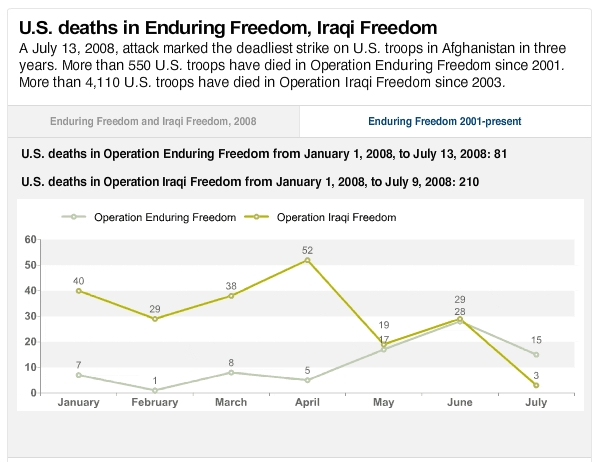
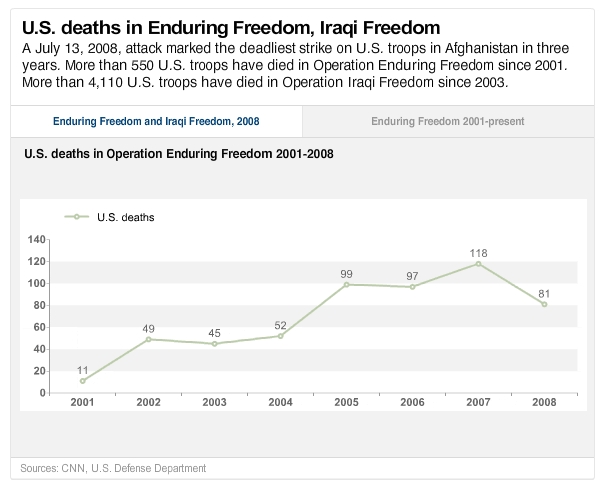
The Captain’s Journal proudly reminds the reader that we’ve advocated an increase in forces, realignment of forces from NATO to CENTCOM, and a change in strategy for NATO for more than six months.  The Battle of Wanat wasn’t misused at TCJ, as we have documented the diminution of security for half a year.  The two graphics below show recent U.S. deaths in OIF and OEF, and long term U.S. deaths in OEF, respectively.

Courtesy of CNN.

But the Battle of Wanat shows an increased intensity of kinetic engagement for the Taliban, as well as a massing of higher numbers of fighters than seen recently.  But the statistics tell a story regardless of the Battle of Wanat.

Further, the information we learn from Colonel Preysler leads to the notion that there was less force protection than even a combat outpost.  He points to the “temporary” nature of the outpost, but this is not meaningful given that no FOB or COP is permanent.  This might be fruitful terrain for more investigation to learn the lessons of the battle.

Colonel Preysler is understandably jealous for the preservation of the bravery of his troops.  But this goes without saying.  No one thinking rightly would doubt that.  But preservation of bravery doesn’t change the battle space dynamics in which nine U.S. troops died on that fateful day, fifteen were wounded amounting to more than half of the U.S. force counted as casualties, and no Afghan deaths were reported (leading us to surmise that the primary engagement was between the Taliban and U.S. with the Afghan troops sitting on the sidelines of the battle).

The “sky is not falling,” but nine brave U.S. warriors are dead now, and questions remain as to the propriety of this engagement without the proper force projection, force protection or troop presence.  At least one Corporal knew what was coming.  Cpl. Gunnar Zwilling suspected that his days were numbered last week, while he and his band of brothers in the 173rd Airborne Brigade Combat Team prepared for a mission near Wanat, Afghanistan.  “It’s gonna be a bloodbath,” he told his father, Kurt Zwilling, on the phone in what would be their last conversation.

May Corporal Zwilling and his brothers rest in peace.  Despite Colonel Preysler’s defense of his troops, in addition to the remarkable bravery, the story is one of need for forces.  It doesn’t do his troops, his unit, or Operation Enduring Freedom any good to deny the reality on the ground.

The Example of Musa Qala

17 years, 7 months ago

We have previously covered the secret negotiations between MI6 agents and mid-level Taliban commanders, the result of which was the agreement between British forces and one Mullah Abdul Salaam who had promised military help when British and U.S. forces retook Musa Qala late in 2007.  The military assistance never materialized, and instead of engaging in the battle, Salaam and his “fighters” stayed in his compound in Shakahraz, ten miles east, with a small cortège of fighters, where he made increasingly desperate pleas for help.  “He said that he would bring all the tribes with him but they never materialised,” recalled one British officer at the forefront of the operation. “Instead, all that happened was a series of increasingly fraught and frantic calls from him for help to Karzai.”

For this he was rewarded with rule of Musa Qala.  But not more than half a year later relations between Salaam and the British have badly degraded.  The British have accused him of corruption and thuggery, while he has accused the British of undermining his “authority.”  Salaam is “feathering his own nest” while reconstruction is not forthcoming.  As for the most recent account of the situation in Musa Qala, the Times recently penned an important article on the crumbling dream of utopia in Musa Qala.  It is a sorry tale of lack of electricity, lack of services, wasted and lost reconstruction money, complaints from city elders, and comparisons with life under the Taliban (where it is being said that life was easier and without corruption).

The security is still problematic since the retaking of Musa Qala.

Musa Qala seems a desolate place of broken houses and rubble, though we are assured it has a clinic, a mosque and a paid workforce. The building in which we sleep was once a hotel and then the headquarters of the Taleban, but is now little more than a concrete shell, pock-marked by bullet-holes. The town’s security depends on its resident defence force – 5 Scots (the Argylls) and the Afghan National Army.

Its population is testimony to its instability – estimates vary from 3,000 to 20,000. We sleep outside, under mosquito nets, taking care to shade our torches in the night, woken occasionally by the sound of artillery fire (which we hope is ours not theirs).

This remains a highly charged war zone. Three days ago, while we were in the district centre – the army camp on the outskirts of Musa Qala – three platoons of D Company of the Argylls came back from a 48-hour patrol to the north of the town, in the course of which they came under heavy fire on three separate occasions. Private David Poderis, 37, showed us tangible evidence of the Taleban’s ferocity in the form of two neat bullet-holes in his helmet.

Finally, the CTC Sentinel at the Combating Terrorism Center at West Point, July 2008, has an important article by David C. Isby entitled “The High Stakes Battle for the Future of Musa Qala.”  A very few of his observations are pointed out below (while the entire article is recommended reading).

The Musa Qala Taliban were not destroyed in battle, but moved largely to adjacent districts in 2007. Helmand member of parliament Nasima Niazi has claimed that the Taliban remain active in Musa Qala despite the reoccupation. Security outside the district center remains uncertain [page 11].

The British 2006 campaign in southern Afghanistan has already become part of military history—marked by a popular 2007 exhibition at the National Army Museum in London—but the results of that fighting have not helped the United Kingdom’s image as NATO’s foremost practitioner of counter-insurgency and stability operations, employing tactics refined since Malaya in conflicts worldwide. Rather, the image was of besieged “platoon house” outposts under Taliban attack and of too few deployed forces being desperately under-resourced. British forces in Afghanistan lack an ability to fund quick response development programs in a way comparable to the United States, and, according to the Economist, “a growing number of British officers grudgingly recognize that America is learning the lessons of irregular warfare, drawn mainly from British colonial experience, better than the modern British Army” [page 11 & 12].

Since the initial withdrawal from Musa Qala in 2006, the British image for military capability in general and counter-insurgency competence in particular has suffered a number of setbacks, by no means all in Afghanistan. The success of Iraqi forces in Basra in 2008 was widely seen as them doing a job that the British had left unfinished for political reasons. Britain’s relations with Kabul have suffered a number of setbacks, from the removal of diplomats following direct negotiations (bypassing Kabul) with the Taliban at Musa Qala in 2006 to Kabul’s rejection of Lord Paddy Ashdown to be the new UN envoy in Afghanistan. British differences with the government in Kabul have increased, and Britain has become the focus of much of the frustration with coalition efforts [page 12].

Isby goes on to discuss the importance of Musa Qala for Kabul and then for the UK.

For the United Kingdom, it is a chance to show that the second largest coalition member in terms of troops in Afghanistan can demonstrate results on the ground commensurate with their status in bilateral and multilateral security relationships. As British policy is to channel aid through Kabul where feasible, this provides an opportunity for aid to be directed in Musa Qala in order to show a long-term commitment at preventing the Taliban from returning to burn schools and kill Afghans. If the United Kingdom fails in Musa Qala, its relations with coalition partners and Afghans alike is likely to be harmed, and it may have a further impact on its international standing.

We have already pointed out that the British grunts are among the bravest on earth, but the problems here are associated with strategy and force projection.  The campaign didn’t begin well in Musa Qala, with the British appointing by fiat a man who had neither moral authority nor personal investment in the area.  The situation has degraded since then.

Musa Qala is a thorny set of problems, but this could also have been said of the Anbar Province.  But the U.S. Marines had continual force projection for a protracted period of time, and when kinetic operations needed to be mixed with biometrics and gated communities, this transition was instantaneous.  Then when Lt. Colonels had to be at city council meetings, they participated as warrior-scholars.

When Marine Lt. Col. Bill Mullen showed up at the city council meeting here Tuesday, everyone wanted a piece of him. There was the sheikh who wants to open a school, the judge who wants the colonel to be at the jail when several inmates are freed, and the Iraqi who just wants a burned-out trash bin removed from his neighborhood.

As insurgent violence continues to decrease in Iraq’s Sunni-dominated Anbar Province – an improvement that President Bush heralded in his visit to Al Asad Air Base Monday as one sign of progress in the war – the conversation is shifting in Anbar. Where sheikhs and tribal leaders once only asked the US to protect them from Sunni extremists, now they want to know how to get their streets cleaned and where to buy generators …

The changes here have allowed provincial and local governments to get established over the past few months, US officials here say. And now, true to the tribal culture that permeates Iraqi society, Sunni sheikhs here want to create a relationship of true patronage with what they consider to be the biggest and most powerful tribe here: the Marines of Anbar Province.

The U.S. Marines have had significant success in the Garmser area of operations in the Helmand Province, but the 24th MEU will be rotating out soon.  Whether the replacements are U.S. Marines or British forces, the strategy must be one of being the most powerful tribe in Helmand.  Only then can a society be [re]constructed so that forces can turn over to legitimate governmental authorities and stand down.  It is a proven paradigm, and without it, we will fail in Afghanistan.

There is no magic to perform, no secret Gnostic words to utter, no tricks.  Troops are necessary, and warrior-scholars who can fight a battle as well as govern a city council meeting.  Under-resourced forces and shady deals with corrupt, second rate, has-been Taliban commanders (or religiously motivated hard core Taliban commanders) simply won’t do the job.  The CTC Sentinel has it right concerning the need for the British (and NATO) to get Musa Qala right.  The CTC Sentinel might be overestimating the importance of Musa Qala to the campaign.  The real importance of Musa Qala is the shining example it gives us as to the wrong way to do counterinsurgency in a tribal region fighting a transnational insurgency.

Prior:

Musa Qala and the Argument for Force Projection

Our Deal with Mullah Abdul Salaam

The Failure of Talking with the Taliban

Troop Surge for Afghanistan?

17 years, 7 months ago

Similar to the opposition to the surge in Iraq, the chorus of voices calling for a military stand-down in Afghanistan are growing.  There is the classical “we can’t win” approach, analogous to the “insurgencies cannot be beaten” meme (regardless of the fact that the insurgency has essentially been beaten in Iraq).  Then there is the “we must educate the extremists out of their extremism” approach.  In this version of the problem, the root of the extremism becomes disenfranchisement, poverty, and valid grievances which require redress (regardless of the example of Bangladesh, which is 90% Muslim and one of the poorest nations on earth, but without the violent extremism).  There are other stupid arguments for a draw-down of troops (or leaving a very small military footprint) over which we won’t waste our time.

But The Captain’s Journal has been advocating increased forces and force projection for more than half a year, along with a change in the command structure and the implementation of a comprehensive strategy.  Finally, we have also pointed out that regardless of the fact that Pakistan is no apparent ally in the fight against the Taliban, Afghanistan is the first and primary place to engage them, with U.S. military pressure resulting in Pakistani commitment to the campaign.

It sounds as if Admiral Mullen has been listening to The Captain’s Journal rather than the other arguments.  “It’s very clear that additional (US) troops will have a big impact on insurgents coming across that border,” Mullen asserted Wednesday.  Gates is also looking for an increase in troops.

The US is looking for ways to send more troops to Afghanistan amid a resurgence of violence in the country nearly seven years after the ousting of the -Taliban regime.

Robert Gates, US defence secretary, said the Pentagon was “working very hard to see if there are opportunities to send additional forces sooner rather than later”.

His comments, late on Wednesday, increased the likelihood of further reductions in US troop levels in Iraq later this year to free up forces for Afghanistan.

Admiral Michael Mullen, chairman of the Joint Chiefs of Staff, said he expected to recommend additional withdrawals from Iraq in early autumn provided recent security gains were sustained.

US commanders in Afghanistan have been appealing for additional troops for months as the insurgency has revived.

Pentagon leaders have made clear that significant increases would have to wait until more troops returned from Iraq but the need to rebalance forces between the two battlefields has become more urgent in recent weeks. Coalition deaths in Afghanistan have exceeded US fatalities in Iraq for the past two months and nine soldiers were killed on Sunday in the deadliest insurgent attack against US forces since 2005.

Briefing reporters after visits to both war zones last week, Admiral Mullen said security was “remarkably better” in Iraq but warned the US faced a “tough and complicated” fight in Afghanistan.

The hand wringing over a large footprint – it’ll cause the population to turn against us, military action cannot win against an insurgency, etc., etc. – has been seen before concerning Iraq.  The meme is getting tired and old, but some “experts” and “analysts” don’t mind sounding tired and old.  Fortunately, Gates and Mullen see the need.  But note that The Captain’s Journal saw this need before the so-called analysts did.  Finally, we say that the campaign needs more than three Brigades (as has been claimed).  But it will take a while to convince the chain of command of our position.

Pictures from Afghanistan

17 years, 7 months ago

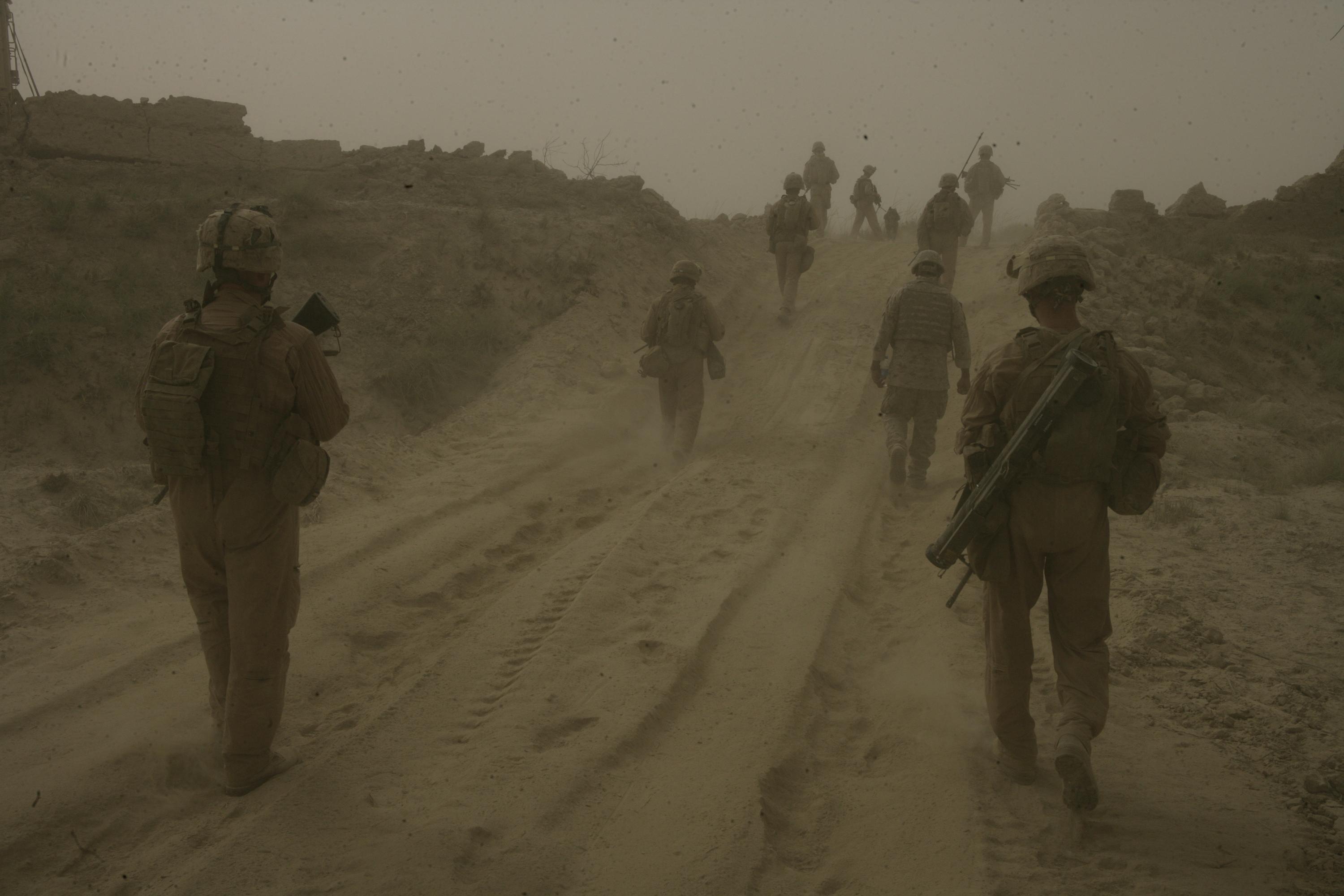
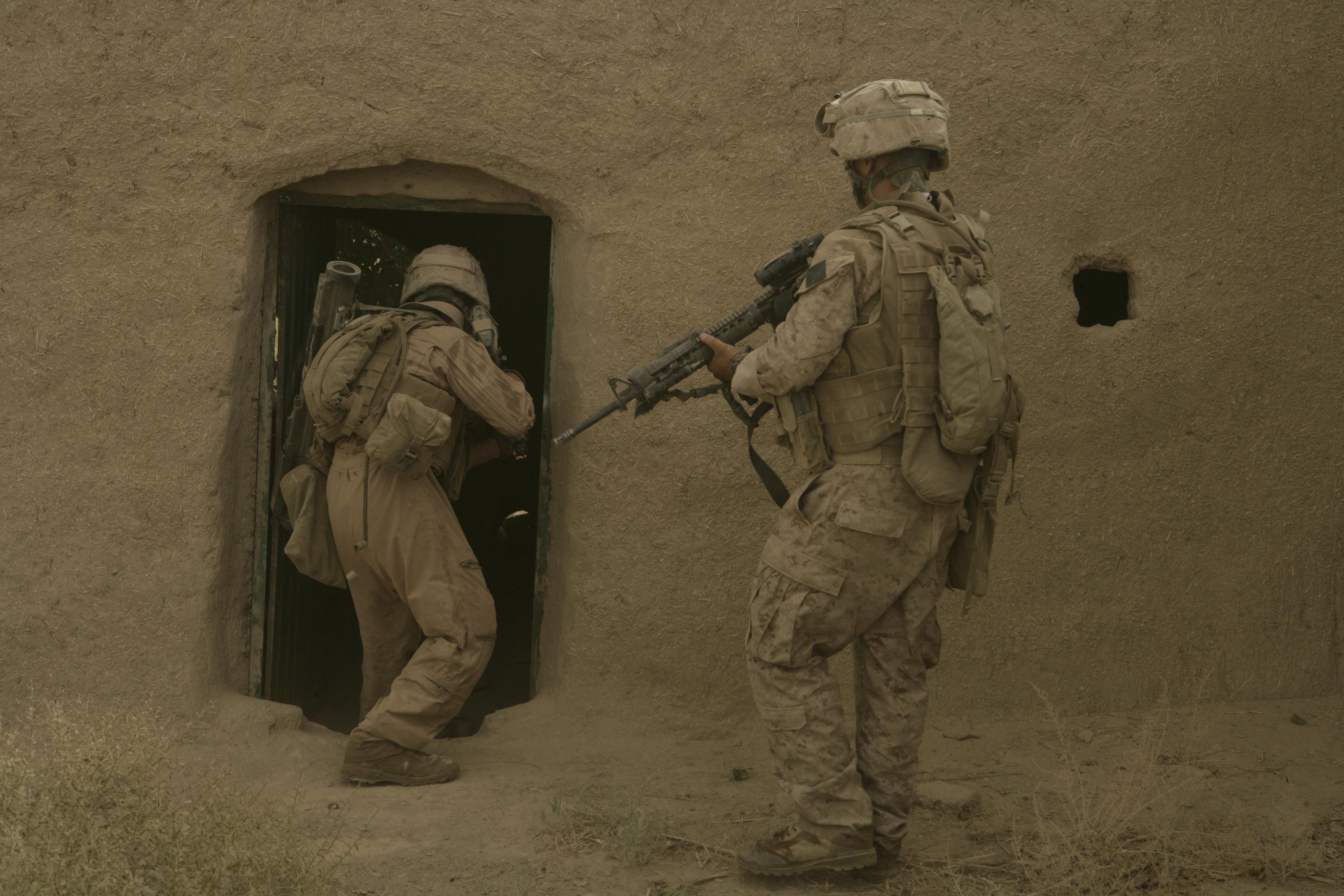
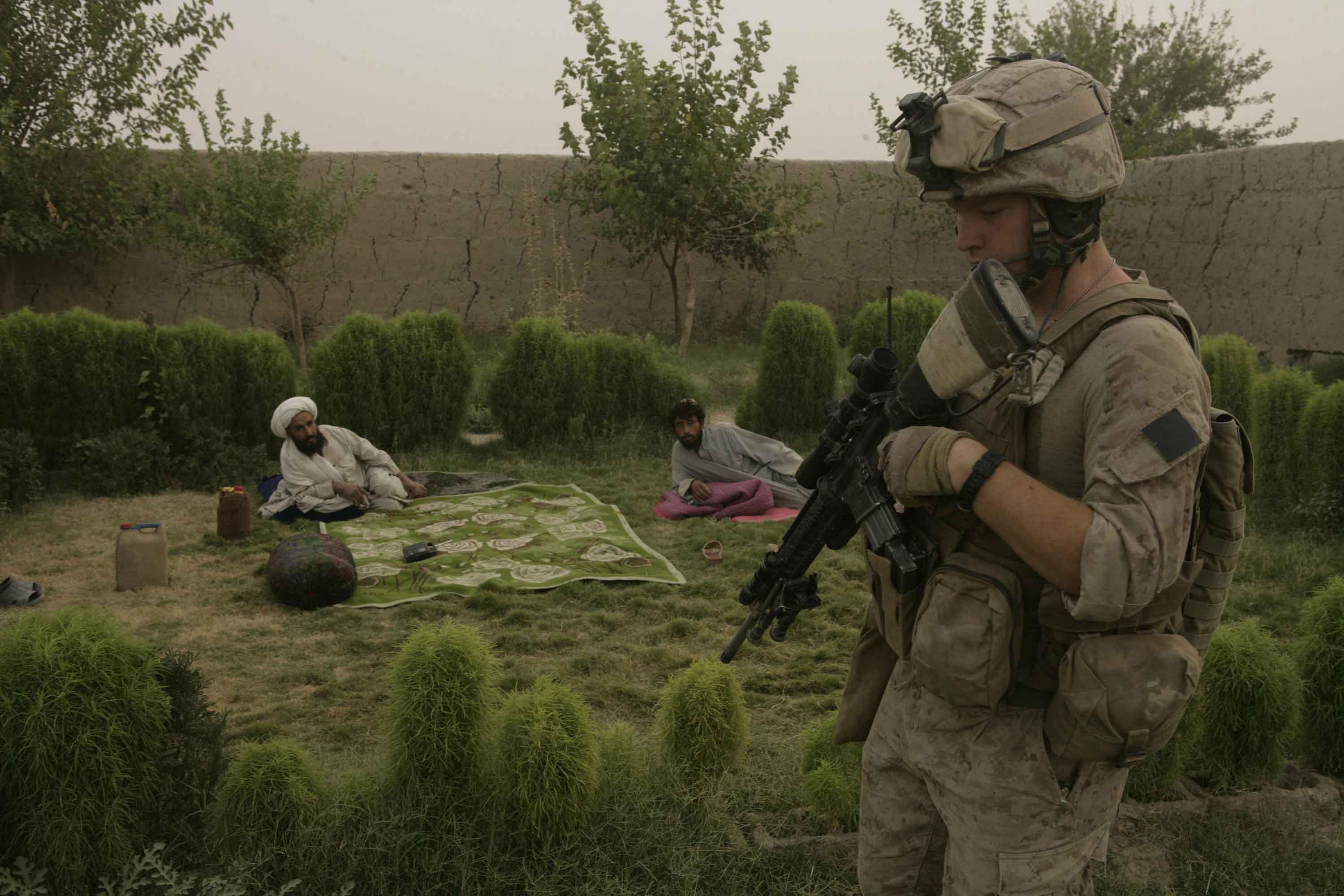
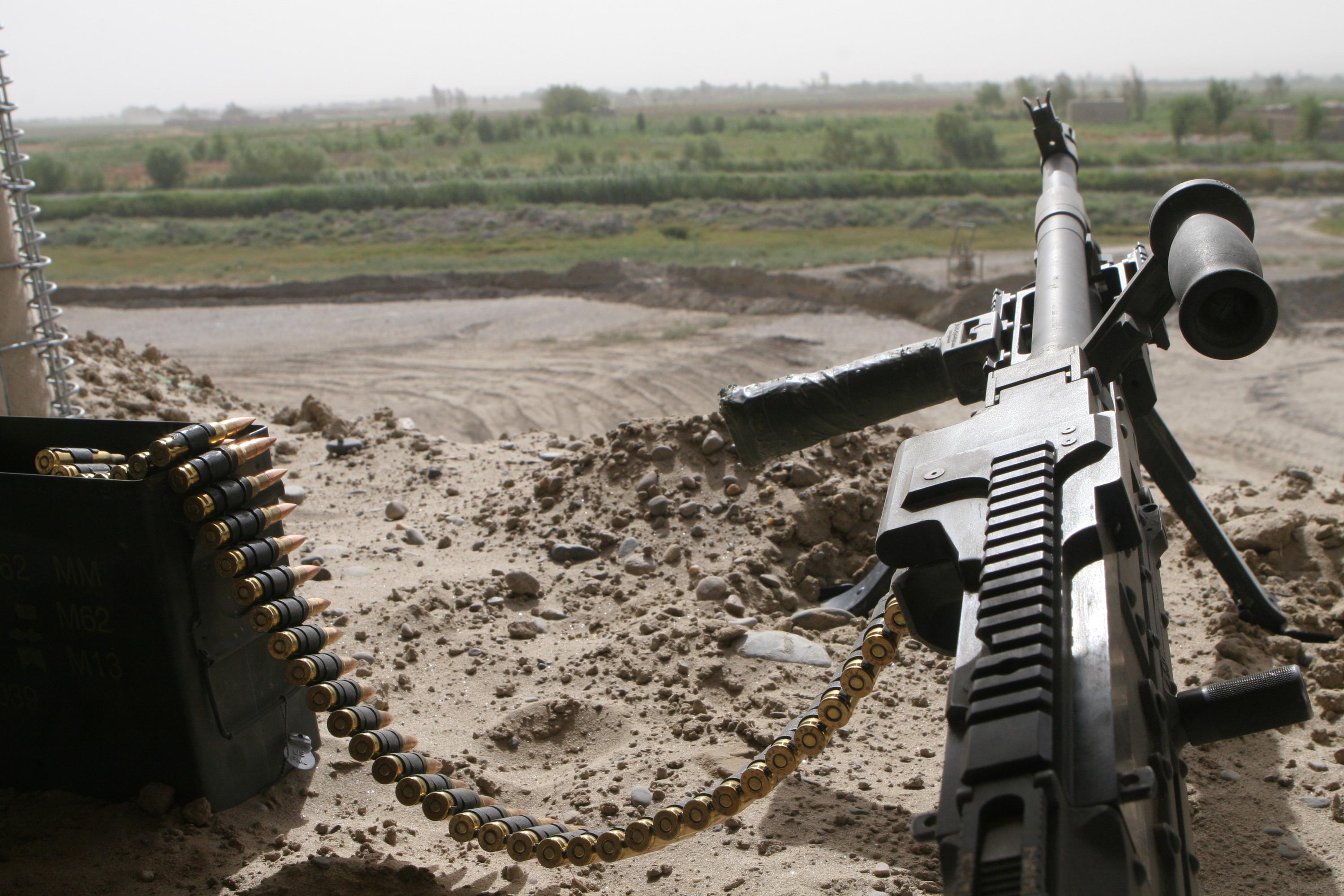
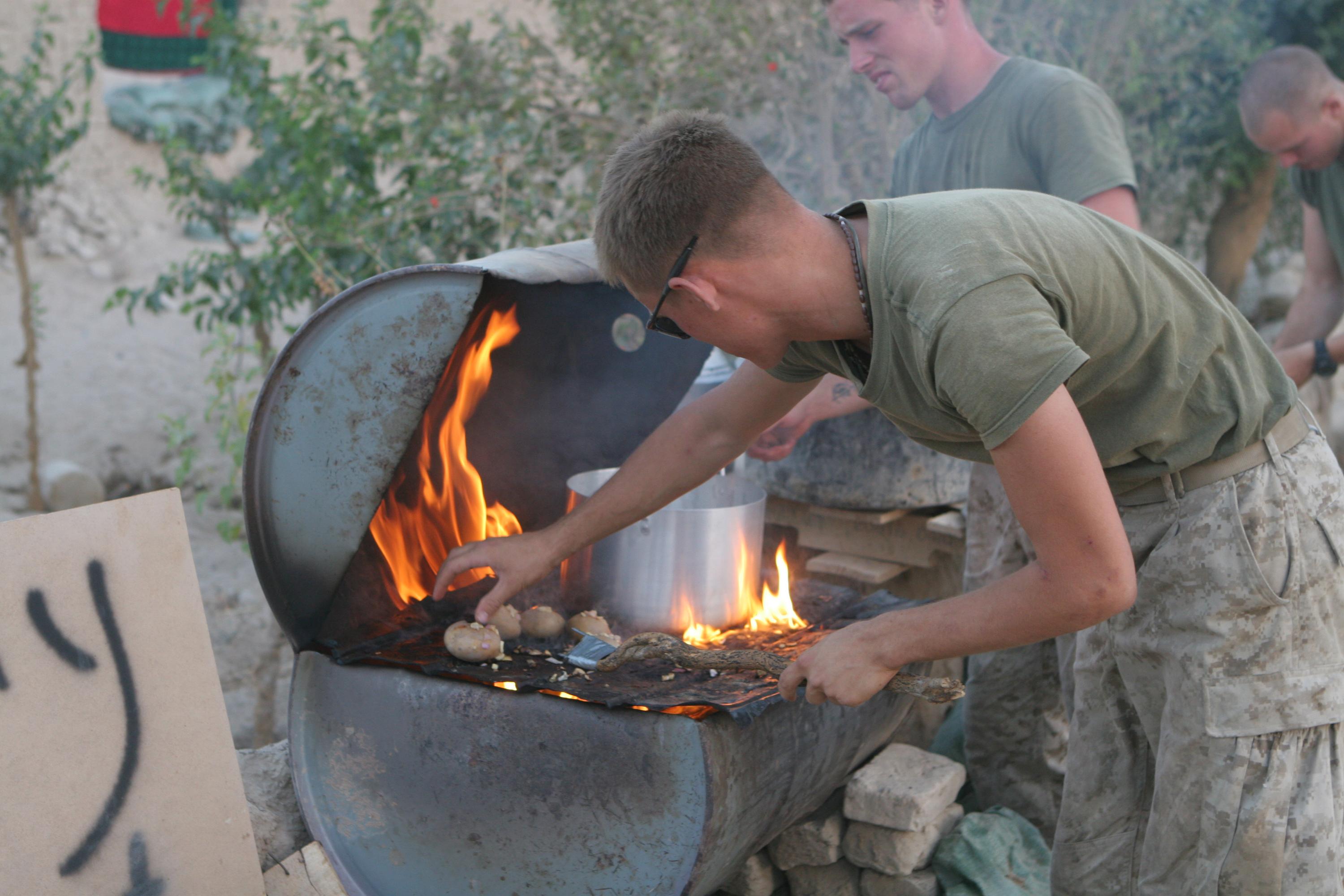
Scenes of Marines (24th Marine Expeditionary Unit) from Garmser, Afghanistan, courtesy of DVIDS.


British Rules of Engagement and Brave Warriors

17 years, 7 months ago

In the fall of 2007 British troops in the Garmser area were involved in a firefight in which their rules of engagement placed them in danger, and likely caused the deaths of several troops.

A mission involving British soldiers in Afghanistan in which two men died after coming under heavy enemy fire, had to be stopped for an hour to enable officers to discuss what rules of engagement they were using, an inquest heard today.

The night-time operation near Garmsir on September 8, 2007, described by one soldier as “Operation Certain Death” was led by Major Jamie Nowell.

Giving evidence to the inquest in Trowbridge, Wiltshire today, Nowell said the problems started when he told his air support to open fire on four militants spotted in a trench.

He was then told over the radio that his airborne colleagues were not permitted to engage the enemy.

Nowell explained that his men were under “429 A” rules of engagement, which meant they could engage the identified enemy while the men in the air were on “Card A” which permitted them to fire only in self-defence.

“I could not understand how it happened,” he said.

“Eventually the aircraft was put on 429 A, but it took 60 minutes. The opportunity to engage with the Taliban was lost.”

The incident “dented the confidence of commanders on the ground” he said, but had “no real impact” on the operation as a whole.

A short time later, one of Nowell’s platoons came under heavy fire from the Taliban.

Wiltshire coroner David Masters said it would have “put lives at risk”.

Of course this foolishness put lives at risk, and contrary to Nowell’s confusion, with the preeminence of lawfare over warfare in the battle space today, it isn’t at all difficult to understand how this happened.  Since it put lives at risk, and also since the platoon came under fire after the Taliban weren’t engaged, it’s likely that, notwithstanding the assertion that this had no “real impact” on the operations, lives were lost because of this fiasco.

The rules of engagement (outside of a few countries like Poland which allows significant freedom for snipers) look much the same for most Western countries.  We have discussed this in More ROE Problems in which we gave the opportunity to study the standing rules of engagement CJCSI 3121.01A, the rules for the use of force CJCSI 3121.02, and the theater-specific rules of engagement for Iraq, and challenged the fact that the ROE and RUF contain no notion of offensive operations.  Self defense is the hub upon which all of the rules turn.  This also formulated the basis, no doubt, for General Kearney’s misbegotten idea to charge two U.S. snipers with murder because they had targeted a known Taliban who happened not to be holding a weapon at the time.

It is intractable, this refusal to address offensive operations, and it is pathological, this notion that lawfare should hold such an esteemed and prestigious perch in the middle of combat.  The Captain’s Journal has worked tirelessly to knock lawfare off of this perch, but lives continue to be sacrificed to this nonsense.  Britain apparently suffers from the same stupid ideas of lawyers sitting in sterile offices writing rules for warfare they have never experienced, and to which they will never risk their lives.  If it sounds ridiculous for Generals to charge snipers with murder, and pilots to refuse to target the enemy, it’s because it is.  Some things are not complicated.

But there is good news, too.  While the British experience in Basra was calamitous, and the panicked calls for negotiations with the Taliban by Brown and Miliband were embarrassing, The Captain’s Journal has always claimed that these failures were the fault of high level leadership, not of the rank and file warrior.  True enough, there is another side to this engagement after the commanders waxed on about rules written down on paper.  It is a story of bravery.

Sergeant Craig Brelsford was taking part in a night-time mission dubbed “Operation Certain Death” behind enemy lines, trying to destroy vantage points near the Taliban stronghold of Garmsir in Helmand Province.

As he and his comrades crept across the landscape of bombed-out buildings and drainage ditches under cover of darkness, the enemy opened fire, immediately felling four of a section of seven soldiers.

The battle that ensued on September 8, 2007 lasted several hours, left two dead and saw three others badly injured.

It became one of the most-documented examples of the bravery of British troops and resulted in clutch of gallantry awards for the regiment, including three MCs, a Conspicuous Gallantry Cross and five Mentions in Dispatches.

One of those killed was Private Johan Botha, 25, from South Africa. According to reports shortly after the incident, Taliban fighters tried to grab his body as a trophy, but the men from A Company the 2nd Battalion, The Mercian Regiment, fought to stop them from as little as 15 yards away.

Sgt Brelsford, 25, from Nottingham, led a team of the men who nicknamed themselves the Spartans back into a stream of bullets and rocket-propelled grenades in a bid to retrieve Pte Botha’s body.

He was killed within minutes, leaving his mother to collect his posthumous MC award for bravery.

Another soldier to receive the MC was Private Luke Cole, 22, who despite suffering serious thigh and stomach injuries, managed to drag himself to a colleague to provide life-saving first aid. He then picked up a rifle to lay down suppressive fire and stop the Taliban taking Pte Botha’s body.

The platoon commander, Captain Simon Cupples, 25, helped to pull two men to safety, including Pte Cole, for which he was later awarded the Conspicuous Gallantry Cross – an honour for bravery second only to the Victoria Cross.

At the inquest into Pte Botha and Sgt Brelsford’s deaths yesterday, he described crawling in the darkness, trying to locate casualties under Taliban fire.

He said he asked Sgt Brelsford, leading another section, to push forward to find Pte Botha while he extracted the other two wounded men.

A few minutes later, he heard a cry of “Man down”.

Capt Cupples said: “All the blokes that night, they all went forward, there was incredible bravery.”

Second Lieutenant Michael Lockett was knocked unconscious during the firefight, but recovered and led another team to extract wounded soldiers, an act for which he too received an MC. “During this incident my life and those of my colleagues were in danger more times than I can remember,” he told the hearing.

As you grab a pint tonight, sit alone for a while and imagine yourself in the middle of this firefight.  Say a prayer thanking God for such men, along with similar brave American warriors.  Ask for peace for their families, and pray that God continues to grace our lives with warriors of this caliber – in spite of ourselves.

Taliban Cross-Border Operations

17 years, 7 months ago

As we have discussed before, nationalism is out of accord with both the tenets and goals of radical militant Islamism.  Al Qaeda, the Taliban, Hezbollah, and Salafists and Wahhabists worldwide have no recognition of the legitimacy of borders.  This characteristic of being a transnational insurgency coupled with Pakistan’s capitulation to them has caused problems for the so-called border region of Pakistan and Afghanistan.

Recently The Captain’s Journal said that the most recent deals with the Taliban made Afghanistan the sacrificial lamb while intending to maintain Pakistan’s stability.  Almost as if on cue, a report comes to us on current Taliban freedom to roam to and fro about the border region.

RAWALPINDI, Pakistan – In early June, about 300 fighters from jihadist groups came together for a secret gathering here, in the same city that serves as headquarters to the Pakistani army.

The groups were launched long ago with the army’s clandestine support to fight against India in the disputed Himalayan region of Kashmir. But at the meeting, they agreed to resolve their differences and commit more fighters to another front instead: Afghanistan.

“The message was that the jihad in Kashmir is still continuing but it is not the most important right now. Afghanistan is the fighting ground, against the Americans there,” said Toor Gul, a leader of the militant group Hezb-ul Mujahedeen. The groups included the al-Qaida-linked Jaish-e-Mohammed and Lashkar-e-Tayyaba, banned by Pakistan and branded terrorists by the U.S., he said …

Militants say they operate with minimal interference, and sometimes tacit cooperation, from Pakistani authorities, while diplomats say the country’s new government has until now been ineffectual in dealing with a looming threat.

“Where there were embers seven years ago we are now fighting flames,” a serving Western general told The Associated Press, referring to both Afghanistan and Pakistan’s border regions. He agreed to be interviewed on condition his identity and nationality were not revealed …

Pakistan’s Mohmand and Bajaur tribal areas are emerging as increasingly strong insurgent centers, according to Gul, the militant. His information was corroborated by Pakistani and Western officials. Both those tribal areas are right next door to Afghanistan’s Kunar province.

“Before there were special, hidden places for training. But now they are all over Bajaur and Mohmand,” he said. “Even in houses there is training going on.”

A former minister in President Pervez Musharraf’s ousted government, who did not want to be identified for fear of reprisals, said insurgents were being paid between 6,000 and 8,000 rupees — the equivalent of $90 and $120 — a month in Mohmand and grain was being collected to feed them. He did not identify the source of the donations but said Pakistan’s army and intelligence were aware of them.

Maulvi Abdul Rahman, a Taliban militant and former police officer under the ousted hardline regime, said jihadistsympathizers in the Middle East are sending money to support the insurgents and more Central Asians are coming to fight. Rahman said under a tacit understanding with authorities, militants were free to cross to fight in Afghanistan so long as they do not stage attacks inside Pakistan, which has been assailed by an unprecedented wave of suicide attacks in the past year.

“It is easy for me now. I just go and come. There are army checkposts and now we pass and they don’t say anything. Pakistan now understands that the U.S. is dangerous for them,” he said. “There is not an article in any agreement that says go to Afghanistan, but it is understood if we want to go to Afghanistan, OK, but leave Pakistan alone.'”

Again, just as we had pointed out, the Pakistani deal with the Taliban has as its sole purpose to save Pakistan.  It will ultimately lead to the strengthening of the Taliban and the destabilization of Pakistan as well, but given the Pashtun rejection of the war on terror and the malaise of the Pakistani Army, The Captain’s Journal expected the deals to occur.

Note that the Kunar Province mentioned above is the location of 50% casualty rate for U.S. forces in recent combat operations.  As the reader might have suspected, The Captain’s Journal says if the Taliban want to fight us in the tribal region, saddle up!  Send the Marines after them, border or no border.  If Pakistan won’t do the job, then the U.S. can.

Nine U.S. Soldiers Killed in Kunar, Afghanistan: What Can We Learn?

17 years, 7 months ago

It was a very bad weekend for U.S. Soldiers in the Kunar Province of Afghanistan.  A combat outpost in the Kunar Province has sustained heavy fighting with the Taliban, and nine U.S. Soldiers have been killed, while fifteen were wounded (along with four Afghan troops).  What can we learn from the deaths of nine Soldiers?  We’ll focus our efforts under four headings: (1) The Taliban spring offensive, (2) the evolution of Taliban tactics and capabilities, (3) small, disconnected combat outposts, and (4) inadequate forces.

The Taliban Spring Offensive

We have covered the escalation of violence and insurgent activity in Afghanistan recently, but as far back as five months ago U.S. Army intelligence and General Rodriguez were claiming that the Taliban efforts inside Pakistan would effectively kill any chances it had inside Afghanistan, thus negating any consideration of a Taliban spring offensive.  The Captain’s Journal called this out as an analysis and intelligence blunder, and we were right.

Violence and insurgent activity have increased yearly since 2002.  Generals (and Colonels) and intelligence analysts who examine and assess the data and conclude that a spring offensive is unlikely, while at the same time the Pentagon knows better and planned for one by deploying 3200 Marines to the theater, should be replaced if they haven’t already been.  They are at best an impediment to the success of the campaign.

Critical analysis capabilities and an understanding of the ebb and flow of military campaigns (especially insurgencies) should be one of the minimum qualifications for holding a position of such power and authority in the U.S. armed forces.

Evolution of Taliban Tactics

While we have pointed out that Taliban tactics would evolve over time to one of fire and melt away, roadside bombs, suicide bombs and otherwise asymmetric guerrilla warfare, this attack seems to have been much more sophisticated and conventional in both its planning and execution.

A Taliban attack that killed nine U.S. soldiers, the biggest single American loss in Afghanistan since 2005, was a well-planned, complex assault which briefly breached the defenses of an outpost near the Pakistan border.

The Taliban have largely shied away from large-scale attacks on foreign forces since suffering severe casualties in assaults on NATO bases in the south in 2006. Instead the militants have scaled up hit-and-run attacks and suicide and roadside bombs.

“The insurgents went into an adjacent village, drove the villagers out, used their homes and a mosque as a base from which to launch the attack and fire on the outpost,” said NATO spokesman Mark Laity on Monday.

The Taliban also chose the timing wisely.

Troops from NATO’s International Security Assistance Force (ISAF) and the Afghan army only moved into the combat outpost in the mountainous and forested Pech Valley district of Kunar province days before and the defenses were not fully constructed.

Which raises the question of force protection and combat outposts.

Combat Outposts

The use of combat outposts in Ramadi and elsewhere in the Anbar Province (where they were introduced well before the surge and security plan for Baghdad) involved connectedness to other combat outposts in the case of resupply or reinforcement issues.  The combat outposts were not randomly placed throughout Anbar, and neither were they garrisoned before ready for force protection.

The force size in this combat outpost was small: 45 U.S. troops and 25 Afghan troops.  The nearest help was air power, which was used with effectiveness, but not before a large number of troops were killed or wounded.  With nine U.S. soldiers killed, this is an appalling 20% of U.S. Soldiers lost.  With fifteen more wounded, this amounts to approximately half of the U.S. soldiers garrisoned at this outpost counted as casualties.  Further, because force protection was not possible at this point, the Taliban were the ones to engage in the chase rather than U.S. troops.

The governor of neighbouring Nuristan province, Hazrat Noor, said: “After the attack the US troops decided to move their base to the district centre of Wanat and they tried to build shelters there in the bazaar overnight. Now the Taleban have attacked again.” US strategy in Afghanistan has focused increasingly on the use of smaller and more numerous bases, called combat outposts. They aim to give US forces greater influence in local communities. However, American military commanders have privately admitted that such small bases could prove vulnerable if the Taleban was able to concentrate enough fighters and take the base by surprise, as apparently happened yesterday.

Finally, while the loss was horrible, it is necessary to think about the effectiveness of the battle.  Normally U.S. troops inflict a kill ratio of 10:1.  Forty insurgents were killed in the battle, dropping the results to a rate of about 4:1.  This is not high enough.

Inadequate Forces

As we have been arguing for half a year, more forces are needed in Afghanistan, and not of the kind which cannot engage in kinetic operations (e.g., the Germans) due to political decisions at home.  Combat outposts are effective when combined with the proper size force to make almost constant contact with the enemy and population, and engage in the chase of insurgents.  None of these things obtained in the battle in Kunar.

Summary

Due to the high losses, this unit is likely combat ineffective and needs replacement (or at least reinforcements) soon.  This time around, additional troops need to be committed to the area of operation in recognition of its strategic importance.  The Captain’s Journal has already recommended the redeployment of the Marines to Afghanistan.


26th MEU (10)
Abu Muqawama (12)
ACOG (2)
ACOGs (1)
Afghan National Army (36)
Afghan National Police (17)
Afghanistan (704)
Afghanistan SOFA (4)
Agriculture in COIN (3)
AGW (1)
Air Force (41)
Air Power (10)
al Qaeda (83)
Ali al-Sistani (1)
America (22)
Ammunition (304)
Animals (323)
Ansar al Sunna (15)
Anthropology (3)
Antonin Scalia (1)
AR-15s (393)
Arghandab River Valley (1)
Arlington Cemetery (2)
Army (91)
Assassinations (2)
Assault Weapon Ban (29)
Australian Army (7)
Azerbaijan (4)
Backpacking (4)
Badr Organization (8)
Baitullah Mehsud (21)
Basra (17)
BATFE (246)
Battle of Bari Alai (2)
Battle of Wanat (18)
Battle Space Weight (3)
Bin Laden (7)
Blogroll (3)
Blogs (24)
Body Armor (23)
Books (3)
Border War (18)
Brady Campaign (1)
Britain (39)
British Army (36)
Camping (5)
Canada (19)
Castle Doctrine (1)
Caucasus (6)
CENTCOM (7)
Center For a New American Security (8)
Charity (3)
China (19)
Christmas (18)
CIA (30)
Civilian National Security Force (3)
Col. Gian Gentile (9)
Combat Outposts (3)
Combat Video (2)
Concerned Citizens (6)
Constabulary Actions (3)
Coolness Factor (3)
COP Keating (4)
Corruption in COIN (4)
Council on Foreign Relations (1)
Counterinsurgency (218)
DADT (2)
David Rohde (1)
Defense Contractors (2)
Department of Defense (220)
Department of Homeland Security (26)
Disaster Preparedness (5)
Distributed Operations (5)
Dogs (15)
Donald Trump (27)
Drone Campaign (4)
EFV (3)
Egypt (12)
El Salvador (1)
Embassy Security (1)
Enemy Spotters (1)
Expeditionary Warfare (18)
F-22 (2)
F-35 (1)
Fallujah (17)
Far East (3)
Fathers and Sons (2)
Favorite (1)
Fazlullah (3)
FBI (39)
Featured (192)
Federal Firearms Laws (18)
Financing the Taliban (2)
Firearms (1,867)
Football (1)
Force Projection (35)
Force Protection (4)
Force Transformation (1)
Foreign Policy (27)
Fukushima Reactor Accident (6)
Ganjgal (1)
Garmsir (1)
general (15)
General Amos (1)
General James Mattis (1)
General McChrystal (44)
General McKiernan (6)
General Rodriguez (3)
General Suleimani (9)
Georgia (19)
GITMO (2)
Google (1)
Gulbuddin Hekmatyar (1)
Gun Control (1,717)
Guns (2,406)
Guns In National Parks (3)
Haditha Roundup (10)
Haiti (2)
HAMAS (7)
Haqqani Network (9)
Hate Mail (8)
Hekmatyar (1)
Heroism (5)
Hezbollah (12)
High Capacity Magazines (16)
High Value Targets (9)
Homecoming (1)
Homeland Security (3)
Horses (2)
Humor (72)
Hunting (61)
ICOS (1)
IEDs (7)
Immigration (123)
India (10)
Infantry (4)
Information Warfare (4)
Infrastructure (4)
Intelligence (23)
Intelligence Bulletin (6)
Iran (171)
Iraq (379)
Iraq SOFA (23)
Islamic Facism (64)
Islamists (98)
Israel (19)
Jaish al Mahdi (21)
Jalalabad (1)
Japan (3)
Jihadists (82)
John Nagl (5)
Joint Intelligence Centers (1)
JRTN (1)
Kabul (1)
Kajaki Dam (1)
Kamdesh (9)
Kandahar (12)
Karachi (7)
Kashmir (2)
Khost Province (1)
Khyber (11)
Knife Blogging (7)
Korea (4)
Korengal Valley (3)
Kunar Province (20)
Kurdistan (3)
Language in COIN (5)
Language in Statecraft (1)
Language Interpreters (2)
Lashkar-e-Taiba (2)
Law Enforcement (6)
Lawfare (14)
Leadership (6)
Lebanon (6)
Leon Panetta (2)
Let Them Fight (2)
Libya (14)
Lines of Effort (3)
Littoral Combat (8)
Logistics (50)
Long Guns (1)
Lt. Col. Allen West (2)
Marine Corps (281)
Marines in Bakwa (1)
Marines in Helmand (67)
Marjah (4)
MEDEVAC (2)
Media (68)
Medical (146)
Memorial Day (6)
Mexican Cartels (47)
Mexico (71)
Michael Yon (6)
Micromanaging the Military (7)
Middle East (1)
Military Blogging (26)
Military Contractors (5)
Military Equipment (25)
Militia (9)
Mitt Romney (3)
Monetary Policy (1)
Moqtada al Sadr (2)
Mosul (4)
Mountains (25)
MRAPs (1)
Mullah Baradar (1)
Mullah Fazlullah (1)
Mullah Omar (3)
Musa Qala (4)
Music (25)
Muslim Brotherhood (6)
Nation Building (2)
National Internet IDs (1)
National Rifle Association (97)
NATO (15)
Navy (31)
Navy Corpsman (1)
NCOs (3)
News (1)
NGOs (3)
Nicholas Schmidle (2)
Now Zad (19)
NSA (3)
NSA James L. Jones (6)
Nuclear (63)
Nuristan (8)
Obama Administration (222)
Offshore Balancing (1)
Operation Alljah (7)
Operation Khanjar (14)
Ossetia (7)
Pakistan (165)
Paktya Province (1)
Palestine (5)
Patriotism (7)
Patrolling (1)
Pech River Valley (11)
Personal (76)
Petraeus (14)
Pictures (1)
Piracy (13)
Pistol (4)
Pizzagate (21)
Police (672)
Police in COIN (3)
Policy (15)
Politics (998)
Poppy (2)
PPEs (1)
Prisons in Counterinsurgency (12)
Project Gunrunner (20)
PRTs (1)
Qatar (1)
Quadrennial Defense Review (2)
Quds Force (13)
Quetta Shura (1)
RAND (3)
Recommended Reading (14)
Refueling Tanker (1)
Religion (499)
Religion and Insurgency (19)
Reuters (1)
Rick Perry (4)
Rifles (1)
Roads (4)
Rolling Stone (1)
Ron Paul (1)
ROTC (1)
Rules of Engagement (75)
Rumsfeld (1)
Russia (37)
Sabbatical (1)
Sangin (1)
Saqlawiyah (1)
Satellite Patrols (2)
Saudi Arabia (4)
Scenes from Iraq (1)
Second Amendment (708)
Second Amendment Quick Hits (2)
Secretary Gates (9)
Sharia Law (3)
Shura Ittehad-ul-Mujahiden (1)
SIIC (2)
Sirajuddin Haqqani (1)
Small Wars (72)
Snipers (9)
Sniveling Lackeys (2)
Soft Power (4)
Somalia (8)
Sons of Afghanistan (1)
Sons of Iraq (2)
Special Forces (28)
Squad Rushes (1)
State Department (23)
Statistics (1)
Sunni Insurgency (10)
Support to Infantry Ratio (1)
Supreme Court (79)
Survival (214)
SWAT Raids (58)
Syria (38)
Tactical Drills (38)
Tactical Gear (17)
Taliban (168)
Taliban Massing of Forces (4)
Tarmiyah (1)
TBI (1)
Technology (21)
Tehrik-i-Taliban (78)
Terrain in Combat (1)
Terrorism (96)
Thanksgiving (13)
The Anbar Narrative (23)
The Art of War (5)
The Fallen (1)
The Long War (20)
The Surge (3)
The Wounded (13)
Thomas Barnett (1)
Transnational Insurgencies (5)
Tribes (5)
TSA (25)
TSA Ineptitude (14)
TTPs (4)
U.S. Border Patrol (8)
U.S. Border Security (22)
U.S. Sovereignty (29)
UAVs (2)
UBL (4)
Ukraine (10)
Uncategorized (105)
Universal Background Check (3)
Unrestricted Warfare (4)
USS Iwo Jima (2)
USS San Antonio (1)
Uzbekistan (1)
V-22 Osprey (4)
Veterans (3)
Vietnam (1)
War & Warfare (432)
War & Warfare (41)
War Movies (4)
War Reporting (21)
Wardak Province (1)
Warriors (6)
Waziristan (1)
Weapons and Tactics (80)
West Point (1)
Winter Operations (1)
Women in Combat (21)
WTF? (1)
Yemen (1)

February 2026
January 2026
December 2025
November 2025
October 2025
September 2025
August 2025
July 2025
June 2025
May 2025
April 2025
March 2025
February 2025
January 2025
December 2024
November 2024
October 2024
September 2024
August 2024
July 2024
June 2024
May 2024
April 2024
March 2024
February 2024
January 2024
December 2023
November 2023
October 2023
September 2023
August 2023
July 2023
June 2023
May 2023
April 2023
March 2023
February 2023
January 2023
December 2022
November 2022
October 2022
September 2022
August 2022
July 2022
June 2022
May 2022
April 2022
March 2022
February 2022
January 2022
December 2021
November 2021
October 2021
September 2021
August 2021
July 2021
June 2021
May 2021
April 2021
March 2021
February 2021
January 2021
December 2020
November 2020
October 2020
September 2020
August 2020
July 2020
June 2020
May 2020
April 2020
March 2020
February 2020
January 2020
December 2019
November 2019
October 2019
September 2019
August 2019
July 2019
June 2019
May 2019
April 2019
March 2019
February 2019
January 2019
December 2018
November 2018
October 2018
September 2018
August 2018
July 2018
June 2018
May 2018
April 2018
March 2018
February 2018
January 2018
December 2017
November 2017
October 2017
September 2017
August 2017
July 2017
June 2017
May 2017
April 2017
March 2017
February 2017
January 2017
December 2016
November 2016
October 2016
September 2016
August 2016
July 2016
June 2016
May 2016
April 2016
March 2016
February 2016
January 2016
December 2015
November 2015
October 2015
September 2015
August 2015
July 2015
June 2015
May 2015
April 2015
March 2015
February 2015
January 2015
December 2014
November 2014
October 2014
September 2014
August 2014
July 2014
June 2014
May 2014
April 2014
March 2014
February 2014
January 2014
December 2013
November 2013
October 2013
September 2013
August 2013
July 2013
June 2013
May 2013
April 2013
March 2013
February 2013
January 2013
December 2012
November 2012
October 2012
September 2012
August 2012
July 2012
June 2012
May 2012
April 2012
March 2012
February 2012
January 2012
December 2011
November 2011
October 2011
September 2011
August 2011
July 2011
June 2011
May 2011
April 2011
March 2011
February 2011
January 2011
December 2010
November 2010
October 2010
September 2010
August 2010
July 2010
June 2010
May 2010
April 2010
March 2010
February 2010
January 2010
December 2009
November 2009
October 2009
September 2009
August 2009
July 2009
June 2009
May 2009
April 2009
March 2009
February 2009
January 2009
December 2008
November 2008
October 2008
September 2008
August 2008
July 2008
June 2008
May 2008
April 2008
March 2008
February 2008
January 2008
December 2007
November 2007
October 2007
September 2007
August 2007
July 2007
June 2007
May 2007
April 2007
March 2007
February 2007
January 2007
December 2006
November 2006
October 2006
September 2006
August 2006
July 2006
June 2006
May 2006

about · archives · contact · register

Copyright © 2006-2026 Captain's Journal. All rights reserved.