Articles by Herschel Smith


The “Captain” is Herschel Smith, who hails from Charlotte, NC. Smith offers news and commentary on warfare, policy and counterterrorism.


Piracy Poll

17 years, 2 months ago

In addition to being a scourge on intercontinental commerce and transit, piracy on the Somalian coast has now take the next step.  A passenger liner – note, cruise ship – was recently the target of pirates.

An example of legal hand-wringing over law of the sea issues, rules of engagement and general reluctance of address the issue can be found at Opinio Juris.  Mr. Anderson at one point states that “No use of force question is ever truly easy.”  Of course, this is wrong, and the question is very easy to answer.  The Captain’s Journal has already done so (while also noting concurring opinions).

The Captain’s Journal has weighed in saying:

This is easy. We tell the LOAC and ROE lawyers that they’re special and that they should go to their rooms and write high-sounding platitudes about compassion in war so that they’re out of the way, we land the Marines on the ship, and we kill every last pirate. Then we hunt down his domiciles in Somali and destroy them, and then we find his financiers and buyers and kill them. Regardless of the unfortunate potential loss of Ukrainian or Russian civilian life upon assaulting the ship, this weaponry and ordnance should never have been shipped in this part of the world without escort (and perhaps it shouldn’t have been shipped even with escort). Negotiations will only serve to confirm the pirates in their methods. It’s killing time. It’s time to turn the United States Marines loose.

Ralph Peters has weighed in saying:

Piracy must be exterminated. Pirates aren’t folk heroes or champions of the oppressed. They’re terrorists and violent criminals whose ransom demands start at a million bucks. And they’re not impressed by the prospect of trials in a velvet-gloved Western court. The response to piracy must be the same as it was when the British brought an end to the profession’s “golden age:” Sink them or board them, kill them or hang them.

Lt. Col. P at OpFor has weighed in saying:

Kill all of the pirates.

Seriously. Why do we allow a handful of khat-addled assholes to dominate one of the world’s most important sea lanes? We, the western powers, have sufficient naval units in the area to take care of the problem in very quick order. What we lack is the will. We apply an idiotically high standard of judicial due process to a situation that doesn’t lend itself well to a judicial solution. Anyone who has dealt with Somalis can tell you that they laugh at western legalisms, and what they perceive as western weaknesses. And then they redouble their violent efforts to take what they want from you. They do react very well to a boot on their necks, and a gun to their heads. Then they tend to wise up quickly.

Here’s how it needs to be done. Oil tanker sends distress call, takes evasive actions insofar as it is capable. (Or better yet, armed men aboard oil tanker defend by fire.) Coalition forces despatch (sic) vessels and boarding parties. Pirates who survive ensuing gun battle are lined up by the rail and shot in the head, then dumped overboard. Pirate boats are burned. If their bases or villages on the coast can be identified, said bases are raided and destroyed. No fuss no muss, no ransom, no hostages, no skyrocketing costs.

The inability to deal with pirates properly is a 21st century phenomenon, entirely a function of legal problems, rules of engagement, rules for the use of force, and the impossible desire to be infallible and utterly perfect and pristine in the application of force.

At any rate, this is what we have previously stated to be the manifest solution to the problem.  But now, readers get a chance to weigh in by answering the easy poll below.  Remember – your heart may be telling you to vote the last bullet, while your head is telling you to vote something else.  But we expect the proper donation and we’ll know if you haven’t dropped coins into the coffers.

What should be done about the Somali Pirates?
Tell the lawyers to go home and then kill all of the pirates!
Turn the lawyers loose! They’re righteous and will show us the way.
What pirates? Where’s Johnny Depp?
The author of this poll is an ass. He can go kill them himself. Here’s $100 for travel expenses.
  
pollcode.com free polls

Thanks for taking the time to vote.

Vector Calculations at U.S. Military Academy

17 years, 2 months ago

Nice school spirit here, but it’s now time for all cadets at West Point to go back and repeat statics and dynamics (Physics and Engineering Professors, nothing like seeing your young students perform, is there?).  Just too far off the mark.  Sigh … too far.

Robert M. Gates on a Balanced Strategy for the Pentagon

17 years, 2 months ago

In the January / February 2009 issue of Foreign Affairs, Secretary of Defense Robert M. Gates has a paper entitled A Balanced Strategy: Reprogramming the Pentagon for a New Age. It is a lengthy paper, and some selected quotes are extracted below, followed by a brief analysis.

The defining principle of the Pentagon’s new National Defense Strategy is balance. The United States cannot expect to eliminate national security risks through higher defense budgets, to do everything and buy everything. The Department of Defense must set priorities and consider inescapable tradeoffs and opportunity costs.

The strategy strives for balance in three areas: between trying to prevail in current conflicts and preparing for other contingencies, between institutionalizing capabilities such as counterinsurgency and foreign military assistance and maintaining the United States’ existing conventional and strategic technological edge against other military forces, and between retaining those cultural traits that have made the U.S. armed forces successful and shedding those that hamper their ability to do what needs to be done.

The United States’ ability to deal with future threats will depend on its performance in current conflicts. To be blunt, to fail — or to be seen to fail — in either Iraq or Afghanistan would be a disastrous blow to U.S. credibility, both among friends and allies and among potential adversaries.

In Iraq, the number of U.S. combat units there will decline over time — as it was going to do no matter who was elected president in November. Still, there will continue to be some kind of U.S. advisory and counterterrorism effort in Iraq for years to come …

It would be irresponsible not to think about and prepare for the future, and the overwhelming majority of people in the Pentagon, the services, and the defense industry do just that. But we must not be so preoccupied with preparing for future conventional and strategic conflicts that we neglect to provide all the capabilities necessary to fight and win conflicts such as those the United States is in today.

Support for conventional modernization programs is deeply embedded in the Defense Department’s budget, in its bureaucracy, in the defense industry, and in Congress. My fundamental concern is that there is not commensurate institutional support — including in the Pentagon — for the capabilities needed to win today’s wars and some of their likely successors.

What is dubbed the war on terror is, in grim reality, a prolonged, worldwide irregular campaign — a struggle between the forces of violent extremism and those of moderation. Direct military force will continue to play a role in the long-term effort against terrorists and other extremists. But over the long term, the United States cannot kill or capture its way to victory. Where possible, what the military calls kinetic operations should be subordinated to measures aimed at promoting better governance, economic programs that spur development, and efforts to address the grievances among the discontented, from whom the terrorists recruit. It will take the patient accumulation of quiet successes over a long time to discredit and defeat extremist movements and their ideologies …

The recent past vividly demonstrated the consequences of failing to address adequately the dangers posed by insurgencies and failing states. Terrorist networks can find sanctuary within the borders of a weak nation and strength within the chaos of social breakdown. A nuclear-armed state could collapse into chaos and criminality. The most likely catastrophic threats to the U.S. homeland — for example, that of a U.S. city being poisoned or reduced to rubble by a terrorist attack — are more likely to emanate from failing states than from aggressor states.

The kinds of capabilities needed to deal with these scenarios cannot be considered exotic distractions or temporary diversions. The United States does not have the luxury of opting out because these scenarios do not conform to preferred notions of the American way of war.

The military and civilian elements of the United States’ national security apparatus have responded unevenly and have grown increasingly out of balance. The problem is not will; it is capacity. In many ways, the country’s national security capabilities are still coping with the consequences of the 1990s, when, with the complicity of both ends of Pennsylvania Avenue, key instruments of U.S. power abroad were reduced or allowed to wither on the bureaucratic vine. The State Department froze the hiring of new Foreign Service officers …

Yet even with a better-funded State Department and U.S. Agency for International Development, future military commanders will not be able to rid themselves of the tasks of maintaining security and stability. To truly achieve victory as Clausewitz defined it — to attain a political objective — the United States needs a military whose ability to kick down the door is matched by its ability to clean up the mess and even rebuild the house afterward.

Given these realities, the military has made some impressive strides in recent years. Special operations have received steep increases in funding and personnel. The air force has created a new air advisory program and a new career track for unmanned aerial operations. The navy has set up a new expeditionary combat command and brought back its riverine units. New counterinsurgency and army operations manuals, plus a new maritime strategy, have incorporated the lessons of recent years in service doctrine. “Train and equip” programs allow for quicker improvements in the security capacity of partner nations. And various initiatives are under way that will better integrate and coordinate U.S. military efforts with civilian agencies as well as engage the expertise of the private sector, including nongovernmental organizations and academia …

The United States cannot take its current dominance for granted and needs to invest in the programs, platforms, and personnel that will ensure that dominance’s persistence.

But it is also important to keep some perspective. As much as the U.S. Navy has shrunk since the end of the Cold War, for example, in terms of tonnage, its battle fleet is still larger than the next 13 navies combined — and 11 of those 13 navies are U.S. allies or partners. Russian tanks and artillery may have crushed Georgia’s tiny military. But before the United States begins rearming for another Cold War, it must remember that what is driving Russia is a desire to exorcise past humiliation and dominate its “near abroad” — not an ideologically driven campaign to dominate the globe. As someone who used to prepare estimates of Soviet military strength for several presidents, I can say that Russia’s conventional military, although vastly improved since its nadir in the late 1990s, remains a shadow of its Soviet predecessor. And adverse demographic trends in Russia will likely keep those conventional forces in check.

All told, the 2008 National Defense Strategy concludes that although U.S. predominance in conventional warfare is not unchallenged, it is sustainable for the medium term given current trends. It is true that the United States would be hard-pressed to fight a major conventional ground war elsewhere on short notice, but as I have asked before, where on earth would we do that? U.S. air and sea forces have ample untapped striking power should the need arise to deter or punish aggression — whether on the Korean Peninsula, in the Persian Gulf, or across the Taiwan Strait. So although current strategy knowingly assumes some additional risk in this area, that risk is a prudent and manageable one.

Analysis

The entire paper is worth studying, but Secretary Gates continues to build upon the theme of maintaining a balance between arming and training for near peer conflicts and irregular warfare. The theme is in keeping with his history, as he has convinced the current administration that the 183 F-22s already purchased are enough to fill the gap between now and the advent of the F-35 (which by all accounts is far outperformed by the F-22). The Air Force wants more, but will likely have to settle for 183. Gates’ pragmatic view is also in keeping with our own advocacy of the A-10 (which we believe to have been prematurely retired and entirely capable of performing another decade or two), but our advocacy is not entirely based on its performance in COIN. It is also a very capable tank killer, and can still function as originally designed. Not every aerial weapon has to be new, and outfitting the A-10 to bring it up to the digital age is quite enough for now.

Gates even goes to lengths that The Captain’s Journal isn’t prepared to go, in allowing money for the ill-conceived and (soon-to-be) ill-fated Army future combat system with its exoskeleton. We’ve made our desires know, i.e., lighter ESAPI plates with the same ballistic stopping power are a worthy investment, the exoskeleton is not (and is suited merely for erasing gender, strength and fitness differences in combat, not a laudable goal anyway). Kill the program, Secretary Gates.

Gates also pushes the notion that investment in almost-failed states is a worthy goal compared to the risk, i.e., the next attack that levels a city or kills civilians is more likely than not going to come from almost-failed states rather than stable ones. So far, so good. The Captain’s Journal has always been an advocate for Secretary Gates and will be so into the future.

But one cannot escape the sinking feeling that Gates is on another level in his understanding of things compared to the team that will surround him (excluding General Jim Jones). Gates clearly delineates between the army of State Department employees, foreign operatives and NGOs that are necessary for the proper engagement of almost-failed states and such notions for large state actors. The delineation is that while Gates works hard on the former, he doesn’t mention the later. The incoming administration appears by all accounts to believe that negotiations will suffice to dissuade bad state actors from their intentions. We have gone on record disagreeing with this.

One cannot escape the reality that Russia just might push for some version of its former global empire, that China might just decide that it has lost patience with Taiwan, and that Iran, no matter the size of the army of negotiators, will continue its push for nuclear weapons grade material. At some point we must consider that in addition to the ground troops in Iraq and Afghanistan, it’s prudent to have fleets in the Persian Gulf and Gulf of Aden along with Marines for CENTCOM ready reserve.

It’s going to be a difficult four years, we believe, but we feel certain about one thing. President-elect Obama couldn’t do any better than Secretary Gates, and his team is stronger for having him there, and would be profoundly weak without him. For those who have opined that the U.S. military is losing focus on conventional warfare with the institutional focus on counterinsurgency and stability operations, the argument is settled for the moment. We’ll do both, but we’ll focus for now on the campaigns we have at hand. And that’s that.


Restoring the Balance

17 years, 2 months ago

We are told that “experts” have now warned President-elect Barack Obama of a nuclear Iran.

Iran poses the greatest foreign policy challenge to Barack Obama, the President-elect, with Tehran on course to produce a nuclear bomb in the first year of an Obama administration, a coalition of top think-tanks gave warning yesterday.

Mr Obama must keep his promises of direct talks with Tehran and engage the Middle East region as a whole if he is to halt a looming crisis that could be revisited on the US, the experts said.

“Diplomacy is not guaranteed to work,” Richard Haass, one of the authors said. “But the other options – military action or living with an Iranian weapon are sufficiently unattractive for it to warrant serious commitment.”

The warnings came in a report entitled Restoring the Balance. The Middle East strategy for the President-elect was drafted by the Council for Foreign Relations and the Brookings Institution.

Gary Samore, one of the authors, said that the level of alarm over the “hornet’s nest” facing the President-elect in the Middle East, and the need for the swift adoption of previously untested approach, had inspired the decision to write policy for him. “New administrations can choose new policies but they can’t choose next contexts,” Mr Samore said.

The report paints a grim picture of the problems in the region but asserts that Mr Obama is still in a strong position. For the first time since the Iranian revolution the leadership in Tehran has endorsed the idea of talking directly with Washington, as Mr Obama has suggested. Falling oil prices also provide an opportunity, restricting Iran’s means to sponsor terrorist groups such as Hamas and Hezbollah that act as its proxy in the region.

The new administration, however, must not fall into the trap of treating Iran in isolation to the rest of the Middle East, as the previous administration did.

Syria, which has shown tentative signs of a desire for better relations with the West and has held negotiations with Israel, could be the ideal test case for a new diplomatic approach.

The full report, Restoring the Balance, is a product of the Council on Foreign Relations and the Brookings Institution. The Captain’s Journal is actually a bit surprised to see Michael O’Hanlon associated with the report – he seems a bit too smart to have endorsed it. But it is also worth pointing out that our record of forecasts is thus far impeccable. Three important examples evince the point. First, when Army intelligence forecast that there wouldn’t be a Taliban spring offensive in 2008 because of the alleged split between Baitullah Mehsud and Mullah Omar, we predicted that there would in fact be a two-front offensive, one in Pakistan by the Tehrik-i-Taliban and the other in Afghanistan. Second, we accurately predicted the Taliban strategy of interdiction of NATO supplies in Pakistan in March of 2008. Third, we predicted that Joseph Lieberman would be victorious in the Connecticut Senate Race. We seldom make forecasts, but when we do, we’re usually right.

There were no instances of refusal to guarantee our forecasts when we went on record. The Captain’s Journal – although it is tempting to wait until the new year to weigh in on these important issues – will weigh in concerning some of the recommendations of the subject report, and make some forecasts of our own.

First, Richard Haass doesn’t guarantee that diplomacy will work with Iran. Without equivocation or qualification, we guarantee that diplomacy will not work to dissuade Iran from pursuing nuclear weapons. Iran might make a show of allowing IAEA inspectors into certain parts of their facilities, or responding to IAEA inquiries as to the status of special nuclear material (” … this is not the same highly enriched Uranium we tested on such-and-such date, so where did it come from”), or employ any number of other decoys as a subterfuge. But in a truly verifiable and serious way, Iran will not cease and desist the pursuit of weapons grade nuclear material no matter the size of the army of negotiators or lawyers the U.S. deploys or the number of IAEA inquiries with which Iran gets pelted. Again, this is an absolute guarantee, something that The Council on Foreign Relations couldn’t provide.

Second, the desire to “spin off” Syria from Iran into an ally or even partial or halting ally in Middle East stability is a day dream. Syria is an apparatchik of Iran, and Damascus gets its orders directly from Tehran. Syria will court such negotiations and talks as long as it convinces the battalion of U.S. diplomats that there is something to be gained from it. When it is no longer prudent and efficacious to perform the show, Syria will drop the pretense. The battalion of U.S. diplomats will look like stooges on the world stage.

Third – concerning the recommendation in Chapter 5 of the report that the U.S. encourage Egypt, Saudi Arabia and other Arab actors to pressure Hamas to police the cease-fire agreement with Israel and to convince the Hamas leadership to accept the April 2002 Arab League Peace Initiative – this avenue will fail because Hamas will cease to exist as an effective and viable organization unless it acquiesces to pressure from the surging Salafist movement inside Palestine itself (with religious schools numbering as many as 50,000). Palestine will become more radical, not less. A corollary forecast is that holding Israel to its commitment to freeze settlement and construction in Jerusalem (Chapter 5) will be meaningless to the Palestinian cause. When Hamas refers to the “occupation,” they don’t mean occupation of Gaza or Palestine proper. They mean that they consider the existence of the Jews at all to be an occupation of their land. In other words, Palestine will continue to reject the two-state solution, and no army of negotiators will change that.

Finally, as to some particulars:

  1. Hamas will begin launching rockets at Israel again from Gaza during the upcoming administration.
  2. Hezbollah will attack Israel again during the upcoming administration. The orders will come directly from Tehrah to Damascus and then be relayed to Hasan Nasrallah.
  3. Russia will continue the pressure on the Georgian administration and expand its military presence inside the borders of Georgia.
  4. Russia will (covertly) support the installation of a pro-Russian administration in the Ukraine (which is not the same as forecasting that a pro-Russian administration will actually end up being installed).
  5. Russia will assist Iran in its desire to achieve weapons grade nuclear material.
  6. Without direct action to undermine the Iranian regime (such as democracy programs or even the fomenting of an insurgency to topple the regime), Iranian elements (Quds, IRG) will expand the scope of their operations inside Iraq and Afghanistan and even support Hezbollah as it battles Israel. No amount of diplomacy will change this.
  7. Finally, the State Department will begin the administration will high hopes, excitement and grand ambitions for the role of diplomacy, negotiations and multi-lateral talks. By the end of the administration, a general malaise and confusion will have descended upon the entire State Department, and yet there will still be sparse and shallow understanding of why negotiations have so miserably failed to prevent or ameliorate the various calamities for which they were targeted.

Planning for these exigencies should “restore the balance.” The Captain’s Journal will send a bill to the incoming administration for our consultative services. They will prove to be better than those of the Council on Foreign Relations and well worth the cost.

British Brass Defends Basra Campaign

17 years, 2 months ago

The Captain’s Journal has a history on the one hand of defending the bravery of the enlisted British soldier, and on the other of criticizing the strategy that the British brass brought to the campaign in Southern Iraq. Without a doubt the British enlisted man wanted to participate in counterinsurgency in Basra, and also quite without a doubt, his chain of command effectively prevented him from doing so.

Now comes Air Chief Marshal Sir Jock Stirrup who vigorously defends the British campaign, and more particularly, we note, the decisions by the military brass.

Although operation charge of the knights got off to an inauspicious start, its eventual success and subsequent developments have transformed the situation in Basra. But the operation has also attracted a degree of controversy, particularly with regard to the British role.

So I want to take this opportunity to lay to rest some of the myths that have emerged. Myths such as: the British had given up in Basra; that they’d done a deal to hand the city over to the militias; and that they failed to support the Iraqis during charge of the knights. But to do so, I need to take you back a bit. Back to the latter part of 2006, in fact. Now at that particular time, we and the United States were in a process of transition, working to transfer responsibility for security away from the coalition to the Iraqi government. But there were obstacles to this transition. And the obstacles were different in different parts of the country. The problem for the Americans in Baghdad and the surrounding areas was that the Iraqis were too busy trying to kill one another to face up to the question of how Shia and Sunni could co-exist politically. The problem for the British in the south east was that the Iraqis were too busy trying to kill us to focus on the intra-Shia political issues in Basra. These different problems required different solutions.

Thus has the Air Chief Marshal created a false picture of the British task versus the American task. First of all, the U.S. Army in Baghdad and surrounding areas was indeed targeted by both al Qaeda and radical Shi’a elements, including the Jaish al Mahdi. But more to the point, the Air Chief Marshal has conveniently ignored the fact that the U.S. Marines in Anbar were under attack twenty four hours a day, 365 days a year for a very long time. They know what it’s like to have fighters trying to kill them, but even before the U.S. Army in Baghdad, they implemented combat outposts, traditional counterinsurgency tactics, and even more advanced tactics such as sand berms, gated communities and biometrics, and the concerned citizens program along with payments for labor. More than 1000 Marines perished in Anbar as a result of the campaign, so it is disingenuous and insulting for the Air Chief Marshal to attempt to portray the British dilemma as somehow unique in history, or even the history of Iraq. Continuing:

The US decided to increase its force levels – the surge – in order to suppress Sunni-Shia violence and create space within which the political process had some chance of success. This was a key step. But the process got a helping hand from a most unexpected quarter: al Qaida in Iraq. Their appalling treatment of the Sunni tribes in the areas they dominated – such as Anbar province – led to their rejection by the local population, which then looked to the coalition for support.

It is an adulteration of the narrative to insert the feature of the tribal awakening and population’s rejection of al Qaeda without also including the months and even years of buildup to this via combat operations to prove to the population who was the stronger tribe and who could be trusted with security and protection. Again, the narrative must be complete in order to be accurate. Again continuing:

The UK made repeated attempts to deal with extremist militia violence in the south east. We planned and sought to execute numerous Special Forces operations. We also developed Operation Salamanca – an ambitious, comprehensive and hard-edged plan to confront and subdue the militias. All of these combined powerful offensive action with stabilisation and development activity. But each was, in the event, emasculated. Because we simply couldn’t get the agreement of the Iraqi government; their own internal politics made it impossible. The Iraqi government was at that stage still dependent on the political support of Muqtada al Sadr, which made decisive action against the Jaish al-Mahdi somewhat problematic for them. And there was a growing desire to assert Iraqi sovereignty, manifested by increasing restrictions on our offensive activity.

Here again the Air Chief Marshal is only telling his listeners part of the narrative. The Jaish al Mahdi and power of Moqtada al Sadr is largely a creation of the UK, which after he was in the actual custody of the 3/2 Marines in 2004, went to great lengths to ensure his release and safety by performing an emergency transport of Ali al Sistani (who was in the UK at the time undergoing medical treatment) back to Iraq to negotiate his release with the support of the UK. At that time, the JAM numbered a few hundred followers, and by the time the British were no longer effective in Basra they numbered in the thousands. Again continuing:

Interestingly, one of its best and most enduring legacies – the destruction of the hated and feared Jamiat police station, source of so much corruption and intimidation – brought down on us the wrath of the government in Baghdad. So the question was how else we could free Basra from its cycle of violence. Early in 2007 we came to the conclusion that we were going to have to do something significant to break the impasse. Something that would force the Iraqis to face up to their problems and to their responsibilities. We judged that the only way to do this was to withdraw our permanently based forces from Basra city, and to put the Iraqis in the lead there.

The “wrath of the government in Baghdad.” Maybe the U.S. Marines weren’t too concerned about the wrath of the government in Baghdad when the Iraqi officials turned on the Marines for engaging the Sunnis in the Concerned Citizens program (later called the Sons of Iraq) because the Shi’a officials in power believed the program to be an embarrassment to Iraq at the hands of the Americans who were making deals with “gangs of killers.” There were even reports of U.S. troops standing down far superior numbers of Iraqi troops along with armor, bent on doing harm to Sunni members of the Sons of Iraq, coming close to exchanging fire with the ISF. Take particular note of this incident – it means that the U.S. forces came close to a military confrontation with the ISF in the protection of the Sunni population. So much for the notion of the British enduring the “wrath of the government.”

The fact of the matter is that the soft cover, the almost invisible force projection and the low visibility, and the extremely restrictive rules of engagement aided the continual diminution of the security situation in Basra rather than stopped it. Further, the Iraqi government only dealt with the JAM when it became obvious that the UK insisted on there being one to begin with. A counterinsurgency strategy suited for Northern Ireland just doesn’t apply to Iraq, but the British found this out too late to do much in the way of counterinsurgency. Unfortunately, the Air Chief Marshal still hasn’t learned anything about the campaign.

Prior:

What Basra can teach us about Counterinsurgency

The Good and Bad in Basra

More British Trouble in Basra

Continued Chaos in Basra

Calamity in Basra and British Rules of Engagement

The Rise of the JAM

Will we continue to invest in military power?

17 years, 2 months ago

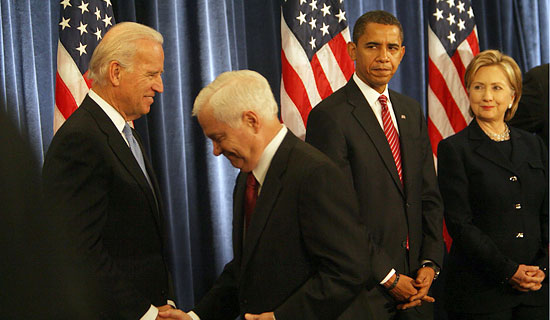
The Captain’s Journal respects only one individual on the national security team and featured in the photograph above – Secretary of Defense Robert Gates. He has earned every bit of respect he has throughout the defense community. The balance of the team must earn their respect but is off to a very bad start. Eric Holder with his pitiful judgment inspires absolutely no confidence, and Janet Napolitano may as well have turned Arizona over to MS 13. The President-elect stands opposed even to refurbishing the existing nuclear weapons stockpile (the greatest deterrence we have), much less do we believe that we’ll get support for new developments in nuclear weapons.

As for the incoming Secretary of State, that horrible, juvenile interrogation before the Senate where General David Petraeus and Ambassador Crocker were mocked by both Biden and Clinton will go down as one of the worst and most dishonorable displays of any politicians in our history. As it turns out, Crocker and Petraeus were right, so our incoming Secretary of State and Vice President-elect are batting 0.000.

President-elect Obama has talked a good game at times, vowing to fund the U.S. military needs of the 21st century.

“We will also ensure that we have the strategy — and resources — to succeed against al Qaeda and the Taliban,” Obama told a news conference. “And going forward, we will continue to make the investments necessary to strengthen our military and increase our ground forces to defeat the threats of the 21st century.”

But these words ring hollow when he has all but given up on high powered deterrence such as nuclear weapons and put into place a national security team that has such a poor incoming record. Secretary of Defense Gates, who opposes Obama on nuclear weapons, is the one bright spot on the team. Thank God for Gates.

The Obama team will back the use of soft power in the coming months and years.

President-elect Barack Obama’s national security team, introduced Monday in Chicago, includes two veteran Cold Warriors and a political rival whose records are all more hawkish than the new president who will face them in the White House Situation Room.

Yet all three of his choices – Senator Hillary Rodham Clinton as old rival turned secretary of state; General James Jones, the former NATO commander to be the national security adviser; and Robert Gates, the current and future defense secretary – were selected in large part because they have embraced a sweeping shift of resources in the national security arena.

The shift in resources, which would come partly out of the military’s huge budget, would create a greatly expanded corps of diplomats and aid workers that, in the vision of the incoming Obama administration, would be engaged in projects around the world aimed at preventing conflicts and rebuilding failed states. Obama also said he was nominating Susan Rice, a former National Security Council official, as ambassador to the United Nations.

“Whether they can make the change one that Obama started talking about in the summer of 2007, when his candidacy was a long shot at best, will be the great foreign policy experiment of the Obama presidency,” one of his senior advisers said recently. But the adviser, who spoke on condition of anonymity because he was not authorized to speak publicly, said the three officials had all embraced “a rebalancing of America’s national security portfolio” after a huge investment in new combat capabilities during the presidency of George W. Bush.

But is Gates really completely in line with this thinking? To be sure, he has advocated the use of soft power in counterinsurgency.

… my message today is not about the defense budget or military power. My message is that if we are to meet the myriad challenges around the world in the coming decades, this country must strengthen other important elements of national power both institutionally and financially, and create the capability to integrate and apply all of the elements of national power to problems and challenges abroad. In short, based on my experience serving seven presidents, as a former Director of CIA and now as Secretary of Defense, I am here to make the case for strengthening our capacity to use “soft” power and for better integrating it with “hard” power

Gates nowhere discusses the diminution of combat capabilities or the jettisoning of military power as a foundation for being able to afford this soft power. In fact, just before making the statement above, Gates said this.

One of my favorite lines is that experience is the ability to recognize a mistake when you make it again. Four times in the last century the United States has come to the end of a war, concluded that the nature of man and the world had changed for the better, and turned inward, unilaterally disarming and dismantling institutions important to our national security – in the process, giving ourselves a so-called “peace” dividend. Four times we chose to forget history.

The left has their pet views about what Obama has promised and what he should accomplish.

President-elect Barack Obama has affirmed his commitment to bring the war in Iraq to a close and to refocus our attention on Afghanistan. To do both, Obama must do more than fix ambitious timelines or offer hazy plans with muddy particulars. He must stick to his campaign pledge that would fundamentally shift the ideological orientation of America’s foreign policy establishment: ending the Iraq mission will require engaging Iran, solving Afghanistan will mean dialogue with terrorists.

Tacit in this demand is that Iran is participating in the violence and engaging them in dialogue will convince them to renounce that violence despite the fact that twenty five years of engagement has failed to do this. Tacit in the expectation that we dialogue with the Taliban is that they are interested in this dialogue. Hamid Karzai has literally begged Mullah Omar to negotiate and promised him complete safety, but both The Captain’s Journal and Ayman al-Zawahiri have pointed out that we would be currently negotiating from a position of weakness rather than strength.

The full engagement of the State Department should involve things like democracy programs for Iran (which the State Department effectively killed), while the perspective is being nurtured by the incoming administration that full involvement of soft power involves thousands of negotiators, as if, hearkening back to their experience in American jurisprudence, we can lawyer our way to victory if we only deploy better talkers than they do.

So there seems to be a fundamental difference between Gates and the balance of the team. Gates apparently doesn’t believe in fairy tales and myths, while the demands on the left are for Obama not only to defund the military and engage enemies with dialogue, but to succeed, and that, remarkably so. This administration and the American public are being set up for huge disappointment, but all is not lost.  At least we have one adult on the national security team who can speak sense to the others.

See also W. Thomas Smith, America’s Naval Supremacy Slipping, and The Captain’s Journal, Is Obama Proposing Leviathan and Sysadmin?, and Civilian National Security Force.

Pakistan Declares Baitullah Mehsud Patriot

17 years, 2 months ago

Baitullah Mehsud, the most powerful man in the Tehrik-i-Taliban and the one who has created a literal terror state in the North West Frontier Province, and whose organization was outlawed approximately three months ago, was declared a patriot by the Pakistan Army.

All main militant groups fighting in Fata, from South Waziristan to Bajaur and from Mohmand to the Khyber Agency, have contacted the government through different sources after the Mumbai bombings and have offered a ceasefire if the Pakistan Army also stops its operations.

And as a positive sign that this ceasefire offer may be accepted, the Pakistan Army has, as a first step, declared before the media some notorious militant commanders, including Baitullah Mehsud and Maulvi Fazlullah, as “patriotic” Pakistanis.

These two militant commanders are fighting the Army for the last four years and have invariably been accused of terrorism against Pakistan but the aftermath of the Mumbai carnage has suddenly turned terrorists into patriots.

A top security official told a group of senior journalists on Saturday: “We have no big issues with the militants in Fata. We have only some misunderstandings with Baitullah Mehsud and Fazlullah. These misunderstandings could be removed through dialogue.”

The Indian allegations against Pakistan have suddenly forced the military establishment in Pakistan to finally accept that they are not fighting an American war inside the Pakistani territory.

On another level, the parliamentary leader of the 12 Fata members in the National Assembly, Munir Orakzai, has expressed optimism in this regard, saying: “I see a bright ray of peace in the tribal areas and if we come out of the American pressure, I can guarantee that there will be peace in the tribal areas in a few days and we will be ready to fight against India on the eastern border along with the Pakistan Army.”

The change in the attitude of the Pakistani military establishment is remarkable. Thanks to India, the security officials, who used to criticise the Pakistani media, are now praising its role in the recent days, saying: “You have proven that you are patriotic Pakistanis.”

Last year, the same officials were part of a decision to impose a ban on many Pakistani TV channels because of their alleged anti-state behaviour. Meanwhile, Army Chief Gen Ashfaq Parvez Kayani has made it clear to President Asif Ali Zardari and Prime Minister Yousuf Raza Gilani that if India escalates tensions, then Pakistan has to move its troops from the tribal areas to the eastern borders and it would not be possible to continue the war against terrorism.

While the new Pakistan administration sees the need for the war against the Taliban and al Qaeda, the Pakistan Army mostly doesn’t and wishes not to be fighting their own people. The Army also has an almost pathological preoccupation with India, and the rumblings in India over the Mumbai attacks have given both the Pakistan Army and the Tehrik-i-Taliban the perfect cover to end their cooperation with the U.S. and NATO over the Taliban safe haven in the Pakistan FATA and NWFP.

This is a troubling development for Operation Enduring Freedom, but it doesn’t end the danger for Pakistan. The Taliban still see the current administration in Pakistan as an infidel regime which governs a nation that is entirely too Western and secular. Sharia law is the goal for Pakistan, and the Taliban will stop at nothing to effect this end.

In 2003 Ayman al-Zawahiri, al Qaeda second in command and head of field operations, began arguing that the primary goal of jihad should be the toppling of impious regimes. To the North in Afghanistan, Hamid Karzai has demanded a time table for NATO withdrawal from Afghanistan, a move which can only be interpreted as a sign of the continual diminution of his senses. Without NATO forces the Taliban would be inside Kabul within one week and Karzai would be fleeing the country to save his own life. And regarding Zawahiri’s view of the negotiations with the Taliban demanded by Karzai, he sees this as a sign of weakness, a view similar to our own.

There are seasons in any campaign, and Hamid Karzai is showing signs of increased desperation over the security situation in Afghanistan just as the Pakistan Army is showing signs of weakness by labeling the head of a terror state – Baitullah Mehsud – a patriot. Time is short for strengthening the force presence in Operation Enduring Freedom.

The Mumbai Attacks and American Imperialism

17 years, 3 months ago

While some speculation exists as to the possibility that the attacks in Mumbai are from home-grown terrorists, it appears that there was at least some involvement by foreign fighters, and specifically, from Karachi, Pakistan.

The terrorists who carried out multiple strikes in Mumbai yesterday landed on Indian shores on a boat that had set sail from Karachi before anchoring in one of the many barren islands in the Rann of Kutch along Gujarat’s coastline.

The 25-30 terrorists then used smaller boats to reach the Mumbai shores the same day they struck at 12 locations in the country’s financial capital. “They landed at Sasoon dock (off the Gateway of India) and reached the metropolis using rubber dinghies. We have information about their route, which we would share in time to come,” said the Special Secretary (Internal Security), Mr ML Kumawat.

The attacks have exposed India’s 7,516-km-long vulnerable coastline. It has shown that terrorists can create a Kargil-like situation along India’s coastline to harbour terror modules in the 1,200-odd barren islands and attack over 200 sensitive strategic installations spread across the country.

There is also a certain shock and dread among Indians that accompanies this attack.

India’s cities are no strangers to indiscriminate terror attacks. Such attacks have occurred regularly, and with steadily increasing frequency, in recent years. Mumbai, India’s financial capital, has been targeted before …

So what is new about Mumbai, November 2008? The obvious novelty is the use of frontal assault tactics instead of timed explosive devices.

This is new in the urban Indian context. There was one notable exception – an attack by a five-man squad armed with rifles and grenades on India’s Parliament in New Delhi in December 2001.

The attackers were narrowly prevented by alert staff from gaining access to the building, where hundreds of parliamentarians and ministers were attending a session.

They were gunned down near the entrance by security personnel after an hour-long battle. Nine guards and parliament stewards also died.

This attack led to the crisis of 2002 between India and Pakistan.

The Indian government blamed Pakistani religious radicals, and embarked on a major military build-up on the border with Pakistan, to which Pakistan responded with its own mobilisation.

The stand-off eventually wound down later in 2002 after months of tension and brinkmanship.

But frontal assaults, usually carried out by two-man teams firing semi-automatic rifles and lobbing grenades, were the favoured tactic of the insurgency in Indian-administered Kashmir between 1999 and 2003 …

The tactic is thus not without precedent, but the mayhem in Mumbai may nonetheless mark a new chapter in the evolution of urban terrorism in India.

Bombs planted in markets and on commuter trains kill and maim working-class and middle-class Indians.

The gunmen who attacked two luxury hotels, and a fashionable cafe frequented by visiting Westerners, have brought the “war” – as they see it – to India’s elite class, and to affluent Westerners living in or visiting India’s most cosmopolitan city.

Analysis

There might be a sense of sympathetic understanding among Americans, as if we’ve seen this before with 9/11 and understand all about the war being brought to one’s doorstep. But when thoughtfully considered, this sentiment doesn’t stand the test of reasonableness, or even magnitude, for what could have been or what could be in the future.

This analysis doesn’t minimize the suffering of those who lost loved ones on 9/11, or the magnitude of effort and commitment to respond to the initial or delayed affects of 9/11. But considered analysis forces the conclusion that there is a nontrivial chance that we haven’t seen the worst yet. The so-called Hamburg cell, at the direction of al Qaeda command, attacked symbolic targets, but left face-to-face confrontations in the streets for engagements they had hoped would come later by other jihadists.

They fundamentally left important (and remarkably soft) infrastructure unmolested. Terror would be multiplied in the future by fighters targeting women and children in shopping malls. A few hundred fighters would cause untold death among innocent and unprotected civilians, and cause terror on a heretofore unparalleled level. New York is still far away from the heartland of America. The local shopping mall is not. A few hundred fighters could cause tens of thousands of deaths.

Furthermore, the basic infrastructure still functioned after 9/11, even if the economy suffered for a period of time. Targeting the right (relatively unprotected) medium or high voltage transformers on the electrical grid of America would literally shut down industry and business in America. These are components that don’t sit on the shelves in great numbers and which must be fabricated, and upon losing the electrical grid, the power wouldn’t even be available to manufacture these components, at least for weeks or months. What is now easy to Google and purchase over the internet would become very scarce upon thousands being destroyed. Granted, this would take involvement of more fighters than were involved in the 9/11 attacks, but Mumbai is in significant trouble over much fewer fighters.

Targeting the right infrastructure could lead to economic consequences more catastrophic than 9/11 by an order of magnitude or more. And hence, it takes a special naivety to dismiss so easily the issues surrounding so-called American imperialism, as if the actions of a “meddling” armed forces must necessarily be evil because they are anticipatory rather than reactionary.

There are certainly unintended consequences to American imperialism, and the practice of fighting wars on soil other than our own is a costly affair, both monetarily and in terms of the human sacrifice. But there are also unintended consequences to isolationism too, and one such consequence might very well be that the sacrifice is even more costly when the fight is in one’s own back yard.

The ones affected by tactics described above might be constrained to reconsider just who the evil one is after such attacks: the leader who meddled in the affairs of other nations, or the leader who failed to anticipate the danger and dire consequences of failing to act before the terror came to our own shores.

Postscript: In anticipation of the charge that articles such as this give the terrorists ideas, it isn’t the terrorists who need ideas. They already know which targets are hard and which ones are soft. Before making the charge, the reader should consider the question, “why is it that I don’t want to hear this information?” The terrorists already know it.

USS San Antonio Heads Back to Sea

17 years, 3 months ago

The San Antonio Express-News gives us the conclusion of weeks of repairs in Bahrain for the USS San Antonio.

The USS San Antonio, docked in Bahrain the past several weeks for repairs to a leaky engine oil lubrication system, left port Tuesday and prepared to rejoin its strike force in the Persian Gulf.

The Navy said that poor welds and joints that lacked support caused the leaks, which sprang up during the ship’s maiden voyage this fall.

But spokeswoman Pat Dolan said the Navy team that spent 25 days making the repairs still had not determined who was responsible for the sub-par construction: the service or Northrop Grumman Ship Systems. It also isn’t clear if three other San Antonio-class ships in the fleet have the same problems.

“They’re just returning from Bahrain,” she said of the repair team, “so we don’t have the root-cause analysis complete yet.”

The San Antonio will rejoin the USS Iwo Jima expeditionary strike force, now in the Navy’s 5th Fleet area of operations. As the ship continues its mission, the Navy will press its investigation into the cause of the leaks as well as learn if there are problems with oil lubrication systems aboard the USS New Orleans, USS Mesa Verde and USS Green Bay.

Dolan said the Navy hopes to have the analysis of those ships finished by mid-December.

Troubled by design flaws, construction delays and a failed inspection last year, the San Antonio entered the fleet well behind schedule, its $1.8 billion price tag three times the original estimate. The San Antonio left the East Coast for the Persian Gulf at the end of August but put into port in Bahrain last month when the crew discovered the leaks.

A special 40-member team that included pipe fitters, inspector and engineers was flown to Bahrain and spent more than three weeks analyzing and repairing the oil lubrication system.

Dolan said the team repaired the systems for two of the ship’s four engines in the forward and aft main machinery rooms of the San Antonio. She said she was unaware of any other problems with the ship.

Inspectors found an inadequate number of hangers to support lubrication pipes that feed oil into the engines, Dolan said. The lack of hangers, coupled with vibration throughout the ship, caused some of the welded joints to come loose, she said.

The failures can be attributed to inadequate piping support, poor welding, material selection and insufficient quality assurance,” she said. “They ended up putting in additional pipe support, going in and taking out in some cases whole sections of pipes and joints. I can’t tell you the blow-by-blow, what they did or repairs. I can tell you that’s in general what they did.”

It’s good that a root cause analysis is being performed, but this analysis should include fully independent engineers, contracted from a pool of engineers not associated with defense contractors. The team should include experts in welding, fracture mechanics, mechanical and vibration engineering, and fluid flow and corrosion (chemical) engineers.

Furthermore, the analysis shouldn’t stop with a technical analysis, but should include the whole management and decision chain that led to the circumstances we face with the USS San Antonio, such as the use of Management Oversight and Risk Tree analysis. The problems listed above must be categorized into root and contributing causes and a full open source report issued on the management and engineering failures, along with recommended corrective actions.

Prior and other resources:

Time, The Navy’s Floating Fiasco.

The Captain’s Journal, The 26th MEU Stuck at Bahrain.

The Captain’s Journal, The 26th MEU, The USS San Antonio, and Military Equipment.

Thanksgiving

17 years, 3 months ago

Thanksgiving – the only truly Christian, American holiday, unadulterated by any add-on superstition. Pausing and reflecting for a moment on another year since last Thanksgiving, I am thankful for my son enduring combat in Iraq and yet coming home safely; I am thankful for my other three children, two sons and a daughter, and for two wonderful grandchildren, and a wonderful wife.

I am thankful for a job and all of God’s provision to me and my family; but most of all I am thankful for Jesus Christ, the Son of God the Father, taking on my penalty and saving me, and for a Father who loves me enough to send His only begotten Son to die for me; and finally, I am thankful for resurrection power by which Jesus sits at the right hand of the Father even now, interceding on my behalf. On behalf of The Captain’s Journal, I wish my readers a very restful, peaceful and meaningful time of reflection on God’s provision this Thanksgiving season. My best to you and your family.


26th MEU (10)
Abu Muqawama (12)
ACOG (2)
ACOGs (1)
Afghan National Army (36)
Afghan National Police (17)
Afghanistan (704)
Afghanistan SOFA (4)
Agriculture in COIN (3)
AGW (1)
Air Force (41)
Air Power (10)
al Qaeda (83)
Ali al-Sistani (1)
America (22)
Ammunition (304)
Animals (323)
Ansar al Sunna (15)
Anthropology (3)
Antonin Scalia (1)
AR-15s (393)
Arghandab River Valley (1)
Arlington Cemetery (2)
Army (91)
Assassinations (2)
Assault Weapon Ban (29)
Australian Army (7)
Azerbaijan (4)
Backpacking (4)
Badr Organization (8)
Baitullah Mehsud (21)
Basra (17)
BATFE (246)
Battle of Bari Alai (2)
Battle of Wanat (18)
Battle Space Weight (3)
Bin Laden (7)
Blogroll (3)
Blogs (24)
Body Armor (23)
Books (3)
Border War (18)
Brady Campaign (1)
Britain (39)
British Army (36)
Camping (5)
Canada (19)
Castle Doctrine (1)
Caucasus (6)
CENTCOM (7)
Center For a New American Security (8)
Charity (3)
China (19)
Christmas (18)
CIA (30)
Civilian National Security Force (3)
Col. Gian Gentile (9)
Combat Outposts (3)
Combat Video (2)
Concerned Citizens (6)
Constabulary Actions (3)
Coolness Factor (3)
COP Keating (4)
Corruption in COIN (4)
Council on Foreign Relations (1)
Counterinsurgency (218)
DADT (2)
David Rohde (1)
Defense Contractors (2)
Department of Defense (220)
Department of Homeland Security (26)
Disaster Preparedness (5)
Distributed Operations (5)
Dogs (15)
Donald Trump (27)
Drone Campaign (4)
EFV (3)
Egypt (12)
El Salvador (1)
Embassy Security (1)
Enemy Spotters (1)
Expeditionary Warfare (18)
F-22 (2)
F-35 (1)
Fallujah (17)
Far East (3)
Fathers and Sons (2)
Favorite (1)
Fazlullah (3)
FBI (39)
Featured (192)
Federal Firearms Laws (18)
Financing the Taliban (2)
Firearms (1,867)
Football (1)
Force Projection (35)
Force Protection (4)
Force Transformation (1)
Foreign Policy (27)
Fukushima Reactor Accident (6)
Ganjgal (1)
Garmsir (1)
general (15)
General Amos (1)
General James Mattis (1)
General McChrystal (44)
General McKiernan (6)
General Rodriguez (3)
General Suleimani (9)
Georgia (19)
GITMO (2)
Google (1)
Gulbuddin Hekmatyar (1)
Gun Control (1,717)
Guns (2,406)
Guns In National Parks (3)
Haditha Roundup (10)
Haiti (2)
HAMAS (7)
Haqqani Network (9)
Hate Mail (8)
Hekmatyar (1)
Heroism (5)
Hezbollah (12)
High Capacity Magazines (16)
High Value Targets (9)
Homecoming (1)
Homeland Security (3)
Horses (2)
Humor (72)
Hunting (61)
ICOS (1)
IEDs (7)
Immigration (123)
India (10)
Infantry (4)
Information Warfare (4)
Infrastructure (4)
Intelligence (23)
Intelligence Bulletin (6)
Iran (171)
Iraq (379)
Iraq SOFA (23)
Islamic Facism (64)
Islamists (98)
Israel (19)
Jaish al Mahdi (21)
Jalalabad (1)
Japan (3)
Jihadists (82)
John Nagl (5)
Joint Intelligence Centers (1)
JRTN (1)
Kabul (1)
Kajaki Dam (1)
Kamdesh (9)
Kandahar (12)
Karachi (7)
Kashmir (2)
Khost Province (1)
Khyber (11)
Knife Blogging (7)
Korea (4)
Korengal Valley (3)
Kunar Province (20)
Kurdistan (3)
Language in COIN (5)
Language in Statecraft (1)
Language Interpreters (2)
Lashkar-e-Taiba (2)
Law Enforcement (6)
Lawfare (14)
Leadership (6)
Lebanon (6)
Leon Panetta (2)
Let Them Fight (2)
Libya (14)
Lines of Effort (3)
Littoral Combat (8)
Logistics (50)
Long Guns (1)
Lt. Col. Allen West (2)
Marine Corps (281)
Marines in Bakwa (1)
Marines in Helmand (67)
Marjah (4)
MEDEVAC (2)
Media (68)
Medical (146)
Memorial Day (6)
Mexican Cartels (47)
Mexico (71)
Michael Yon (6)
Micromanaging the Military (7)
Middle East (1)
Military Blogging (26)
Military Contractors (5)
Military Equipment (25)
Militia (9)
Mitt Romney (3)
Monetary Policy (1)
Moqtada al Sadr (2)
Mosul (4)
Mountains (25)
MRAPs (1)
Mullah Baradar (1)
Mullah Fazlullah (1)
Mullah Omar (3)
Musa Qala (4)
Music (25)
Muslim Brotherhood (6)
Nation Building (2)
National Internet IDs (1)
National Rifle Association (97)
NATO (15)
Navy (31)
Navy Corpsman (1)
NCOs (3)
News (1)
NGOs (3)
Nicholas Schmidle (2)
Now Zad (19)
NSA (3)
NSA James L. Jones (6)
Nuclear (63)
Nuristan (8)
Obama Administration (222)
Offshore Balancing (1)
Operation Alljah (7)
Operation Khanjar (14)
Ossetia (7)
Pakistan (165)
Paktya Province (1)
Palestine (5)
Patriotism (7)
Patrolling (1)
Pech River Valley (11)
Personal (76)
Petraeus (14)
Pictures (1)
Piracy (13)
Pistol (4)
Pizzagate (21)
Police (672)
Police in COIN (3)
Policy (15)
Politics (998)
Poppy (2)
PPEs (1)
Prisons in Counterinsurgency (12)
Project Gunrunner (20)
PRTs (1)
Qatar (1)
Quadrennial Defense Review (2)
Quds Force (13)
Quetta Shura (1)
RAND (3)
Recommended Reading (14)
Refueling Tanker (1)
Religion (499)
Religion and Insurgency (19)
Reuters (1)
Rick Perry (4)
Rifles (1)
Roads (4)
Rolling Stone (1)
Ron Paul (1)
ROTC (1)
Rules of Engagement (75)
Rumsfeld (1)
Russia (37)
Sabbatical (1)
Sangin (1)
Saqlawiyah (1)
Satellite Patrols (2)
Saudi Arabia (4)
Scenes from Iraq (1)
Second Amendment (708)
Second Amendment Quick Hits (2)
Secretary Gates (9)
Sharia Law (3)
Shura Ittehad-ul-Mujahiden (1)
SIIC (2)
Sirajuddin Haqqani (1)
Small Wars (72)
Snipers (9)
Sniveling Lackeys (2)
Soft Power (4)
Somalia (8)
Sons of Afghanistan (1)
Sons of Iraq (2)
Special Forces (28)
Squad Rushes (1)
State Department (23)
Statistics (1)
Sunni Insurgency (10)
Support to Infantry Ratio (1)
Supreme Court (79)
Survival (214)
SWAT Raids (58)
Syria (38)
Tactical Drills (38)
Tactical Gear (17)
Taliban (168)
Taliban Massing of Forces (4)
Tarmiyah (1)
TBI (1)
Technology (21)
Tehrik-i-Taliban (78)
Terrain in Combat (1)
Terrorism (96)
Thanksgiving (13)
The Anbar Narrative (23)
The Art of War (5)
The Fallen (1)
The Long War (20)
The Surge (3)
The Wounded (13)
Thomas Barnett (1)
Transnational Insurgencies (5)
Tribes (5)
TSA (25)
TSA Ineptitude (14)
TTPs (4)
U.S. Border Patrol (8)
U.S. Border Security (22)
U.S. Sovereignty (29)
UAVs (2)
UBL (4)
Ukraine (10)
Uncategorized (105)
Universal Background Check (3)
Unrestricted Warfare (4)
USS Iwo Jima (2)
USS San Antonio (1)
Uzbekistan (1)
V-22 Osprey (4)
Veterans (3)
Vietnam (1)
War & Warfare (432)
War & Warfare (41)
War Movies (4)
War Reporting (21)
Wardak Province (1)
Warriors (6)
Waziristan (1)
Weapons and Tactics (80)
West Point (1)
Winter Operations (1)
Women in Combat (21)
WTF? (1)
Yemen (1)

February 2026
January 2026
December 2025
November 2025
October 2025
September 2025
August 2025
July 2025
June 2025
May 2025
April 2025
March 2025
February 2025
January 2025
December 2024
November 2024
October 2024
September 2024
August 2024
July 2024
June 2024
May 2024
April 2024
March 2024
February 2024
January 2024
December 2023
November 2023
October 2023
September 2023
August 2023
July 2023
June 2023
May 2023
April 2023
March 2023
February 2023
January 2023
December 2022
November 2022
October 2022
September 2022
August 2022
July 2022
June 2022
May 2022
April 2022
March 2022
February 2022
January 2022
December 2021
November 2021
October 2021
September 2021
August 2021
July 2021
June 2021
May 2021
April 2021
March 2021
February 2021
January 2021
December 2020
November 2020
October 2020
September 2020
August 2020
July 2020
June 2020
May 2020
April 2020
March 2020
February 2020
January 2020
December 2019
November 2019
October 2019
September 2019
August 2019
July 2019
June 2019
May 2019
April 2019
March 2019
February 2019
January 2019
December 2018
November 2018
October 2018
September 2018
August 2018
July 2018
June 2018
May 2018
April 2018
March 2018
February 2018
January 2018
December 2017
November 2017
October 2017
September 2017
August 2017
July 2017
June 2017
May 2017
April 2017
March 2017
February 2017
January 2017
December 2016
November 2016
October 2016
September 2016
August 2016
July 2016
June 2016
May 2016
April 2016
March 2016
February 2016
January 2016
December 2015
November 2015
October 2015
September 2015
August 2015
July 2015
June 2015
May 2015
April 2015
March 2015
February 2015
January 2015
December 2014
November 2014
October 2014
September 2014
August 2014
July 2014
June 2014
May 2014
April 2014
March 2014
February 2014
January 2014
December 2013
November 2013
October 2013
September 2013
August 2013
July 2013
June 2013
May 2013
April 2013
March 2013
February 2013
January 2013
December 2012
November 2012
October 2012
September 2012
August 2012
July 2012
June 2012
May 2012
April 2012
March 2012
February 2012
January 2012
December 2011
November 2011
October 2011
September 2011
August 2011
July 2011
June 2011
May 2011
April 2011
March 2011
February 2011
January 2011
December 2010
November 2010
October 2010
September 2010
August 2010
July 2010
June 2010
May 2010
April 2010
March 2010
February 2010
January 2010
December 2009
November 2009
October 2009
September 2009
August 2009
July 2009
June 2009
May 2009
April 2009
March 2009
February 2009
January 2009
December 2008
November 2008
October 2008
September 2008
August 2008
July 2008
June 2008
May 2008
April 2008
March 2008
February 2008
January 2008
December 2007
November 2007
October 2007
September 2007
August 2007
July 2007
June 2007
May 2007
April 2007
March 2007
February 2007
January 2007
December 2006
November 2006
October 2006
September 2006
August 2006
July 2006
June 2006
May 2006

about · archives · contact · register

Copyright © 2006-2026 Captain's Journal. All rights reserved.