Articles by Herschel Smith


The “Captain” is Herschel Smith, who hails from Charlotte, NC. Smith offers news and commentary on warfare, policy and counterterrorism.


Rapidly Collapsing U.S. Foreign Policy

17 years ago

Iran is quickly advancing towards becoming a nuclear state.  In troubling developments in air power, Iran can now deploy UAVs, and Russia may have supplied Iran with new air defense systems, including their long range S-300 surface to air missiles.  If they haven’t, the system is being used as a bargaining chip by Russia.  There are reports that they have refused to sell the missile system, but responding to the Israeli plan to sell weapons systems to Georgia by saying that Moscow expected Israel “to show the same responsibility.”  In the first case, Iran is armed with an air defense system that would make an attack against its nuclear assets much more difficult.  In the second case, Russia has used this potentiality to weaken Georgia and prime it for another invasion.
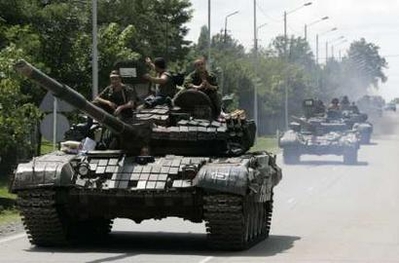
Pavel Felgenhauer at the The Jamestown Foundation has recently published a commentary entitled Russia’s Coming War with Georgia.  The commentary very smartly connects the isolated Russian base in Armenia – which in itself is further demonstration of Russian intentions of control over its “near abroad” – with the need to control Georgia.    Says Felgenhauer, “The ceasefire last August has left the strategically important Russian base in Armenia cut off with no overland military transit connections. The number of Russian soldiers in Armenia is limited to some 4000, but during 2006 and 2007 large amounts of heavy weapons and supplies were moved in under an agreement with Tbilisi from bases in Batumi and Akhalkalaki (Georgia). At present there are some 200 Russian tanks, over 300 combat armored vehicles, 250 heavy guns and lots of other military equipment in Armenia – enough to fully arm a battle force of over 20,000 (Nezavisimoye Voyennoye Obozrenie, August 20, 2004). Forces in Armenia can be swiftly expanded by bringing in manpower by air transport from Russia. Spares to maintain the armaments may also be shipped in by air, but if a credible overland military transit link is not established within a year or two, there will be no possibility to either replace or modernize equipment. The forces will consequently degrade, undermining Russia’s commitment to defend its ally Armenia and Moscow’s ambition to reestablish its dominance in the South Caucasus.”

Concerning the timing of the potential invasion, Felgenhauer observes:

While snow covers the Caucasian mountain passes until May, a renewed war with Georgia is impossible. There is hope in Moscow that the Georgian opposition may still overthrow Mikheil Saakashvili’s regime or that the Obama administration will somehow remove him. However, if by May, Saakashvili remains in power, a military push by Russia to oust him may be seriously contemplated. The constant ceasefire violations could escalate to involve Russian servicemen – constituting a public casus belli. The desire by the West to “reset” relations with Moscow, putting the Georgia issue aside, may be interpreted as a tacit recognition of Russia’s right to use military force.

With the addition of the Biden pronouncement that the U.S. would “press the reset button” with Russia, the U.S. is now in the throes of a logistical dilemma.  On the one hand, the missile defense program for NATO states is meant as a deterrent for a potential Iranian nuclear and missile based military capability.  On the other hand, the current administration is seen as likely to jettison the whole project.

The U.S. is now beholden to Russia for logistical supply lines to Afghanistan.  General David Petraeus has visited numerous European and Central Asian countries recently, including Kyrgyzstan and Uzbekistan.  Supplies are soon to leave Latvia bound for Afghanistan.  But the common element in all of the logistical supply lines are that they rely on Russian good will.  This good will exists as long as the missile defense doesn’t, and the missile defense was intended to be used as a deterrent for Iranian nuclear ambitions.

Alternative supply routes have been suggested, including one which wouldn’t empower Russian hegemony in the region, from the Mediterranean through the Bosporus strait, into the Black sea, and through Georgia to neighboring Azerbaijan.  From there the supplies would transit across the Caspian Sea to Turkmenistan, and from there South to Afghanistan.  An alternative to the air route from the recently closed Manas Air base is sea transport to India, rail or truck to the Indian-controlled Kashmir region, and then air transport to Kabul.  But none of these options has been pursued.  The current administration is locked into negotiations that empower Russia.

Pakistan President Zardari has observed, and correctly so, that Pakistan is in a state of denial concerning the threat posed by the Taliban, yet rather than eliminate the threat, the strategy has been to make peace deals with the Tehrik-i-Taliban and plead for the same financial bailout being offered across America, saying that in order to defeat the Taliban Pakistan needs a “massive program,” a “Marshall Plan” to defeat the Taliban through economic development.

Certainly, some of the foreign policy problems were present with the previous administration, from the failure to plan for logistics for Afghanistan, to support for Musharraf’s duplicitous administration, assisting the Taliban by demure on the one hand while money was received with the other.  But the currents appear to be pointing towards a revised world opinion of what the U.S. is willing to sustain on behalf of “good relations,” and the current administration’s prevarications appear to be going headlong into numerous dilemmas.

We wish to use the missile program in Europe as an bargaining chip to avoid the reality of an Iranian nuclear program, while the Iranian supreme has said that “relations with the U.S. have for the time being no benefit to the Iranian nation.”  Russia, who is assisting Iran in its military buildup, is unimpressed because we have planned for no other option for logistics for Afghanistan except as dictated by Vladimir Putin.  The best that we can come up with, so far, is to forestall the planned troop reduction in the European theater, a troop reduction that is needed to help fund and staff the war against the global insurgency.

Pakistan’s Zardari figures that if the administration is willing to give away on the order of a trillion dollars, they can play the game of “show me the money” like everyone else, from Russia over logistical lines to Afghanistan to over-leveraged homeowners in the U.S.

Israel figures that all of this points to throwing their concerns under the bus, and thus they have launched a covert war against Iran, a program that is unlikely to be successful, pointing to broader regional instability in the near term.  Hassan Nasrallah, leader of Hezbollah, has said that they will acquire or have acquired anti-aircraft weapons.  While they have stood down over the war in Gaza, they are apparently preparing for more of the same against Israel.

The current administration has attempted to befriend Syria, while at the same time the USS San Antonio has interdicted Iranian weapons bound by ship to Syria, intended for Hezbollah or Hamas.  Most of this has occurred within less than two months of inauguration of the current administration in Washington.  It may prove to be a difficult four years, with unintended consequences ruling the day.

Update: Welcome to Instapundit readers and thanks to Glenn for the link.

How many Taliban will settle?

17 years ago

Counterinsurgency luminary David Kilcullen was interviewed by Reuters, and made an interesting forecast regarding settling with the Taliban.

Q – Should U.S.-led forces negotiate with the Taliban?

A – The answer to that question depends on who you think the Taliban are. I’ve had tribal leaders and Afghan government officials at the province and district level tell me that 90 percent of the people we call Taliban are actually tribal fighters or Pashtun nationalists or people pursuing their own agendas. Less than 10 percent are ideologically aligned with the Quetta shura (a Taliban leadership council) or al Qaeda.

I would divide the enemy in Afghanistan into two very broad categories, people who are directly aligned with the Quetta shura or al Qaeda. Those people are probably beyond negotiating and I don’t think we’d gain anything significant from trying to negotiate with them.”

The others are almost certainly reconcilable under some circumstances. What I’d say with regard to that would be that its very important to negotiate from a position of strength, not a position of weakness. We want to make the population feel safe. We want to secure the environment and then negotiate to bring the people in. That’s very much what we did in Iraq. We negotiated with 90 percent of the people we were fighting and and then brought them into the inclusive security structure.

Kilcullen is of course correct about the need to be in a position of strength as well as the strategy of settling with Sunni insurgents in Anbar.  Referral to our category Concerned Citizens (the original name for the Sons of Iraq) shows that we strongly supported this strategy.  However, the difference is that while al Qaeda and al Qaeda-aligned fighters fought mainly for religion reasons, the indigenous Sunni insurgency had no religious motivation whatsoever.

Beyond the need to project force, comparisons of the Anbar campaign with Afghanistan might be an overreach.  The Haqqani network of Taliban, previously based in Pakistan, has moved into Kandahar in strength, as well as Khost.  Said one person of the network of fighters, “I thought it was the insurgents who are meant to go around hiding, but it’s not the Taliban who are hiding, it’s the government’s people. They can’t go out of the district offices alone.”

But according to one Taliban leader in Kandahar, they don’t report to the Haqqani fighters.  “We are all fighting for Islam,” said the leader.  This religious motivation – even if perfunctory – is dissimilar to the indigenous Sunni fighters in Anbar.

Also, it is difficult to see how, of the estimated 20,000 Taliban fighters in the Helmand Province alone, 90% of them will support the government to the point that globalists (al Qaeda, Tehrik-i-Taliban) will not be allowed in Afghanistan.  Besides, the numbers of fighters aligning with the government is small and dropping, even when promised a home.  “In the last three months of 2008, the number Taliban who decided to take up [the] offers of written amnesty [in Kandahar] slowed to a trickle.  Only 11 militants have decided to lay down their arms, compared with 28 during the same period last year.”

The sense of things now is that Iraq and Afghanistan are too different to apply this one lesson from Iraq.  Kilcullen cites “tribal leaders” for his statistic (he might simply be citing rather than endorsing the statistic), but of course people can say anything for just about any reason.  For that matter, so could the Taliban leader in Kandahar who said they all fight for Islam.  That’s the point.  This campaign is probably not far enough along to know if 90% of the Taliban will side with a government which sides with the U.S.

1-6 Field Artillery on Patrol

17 years ago

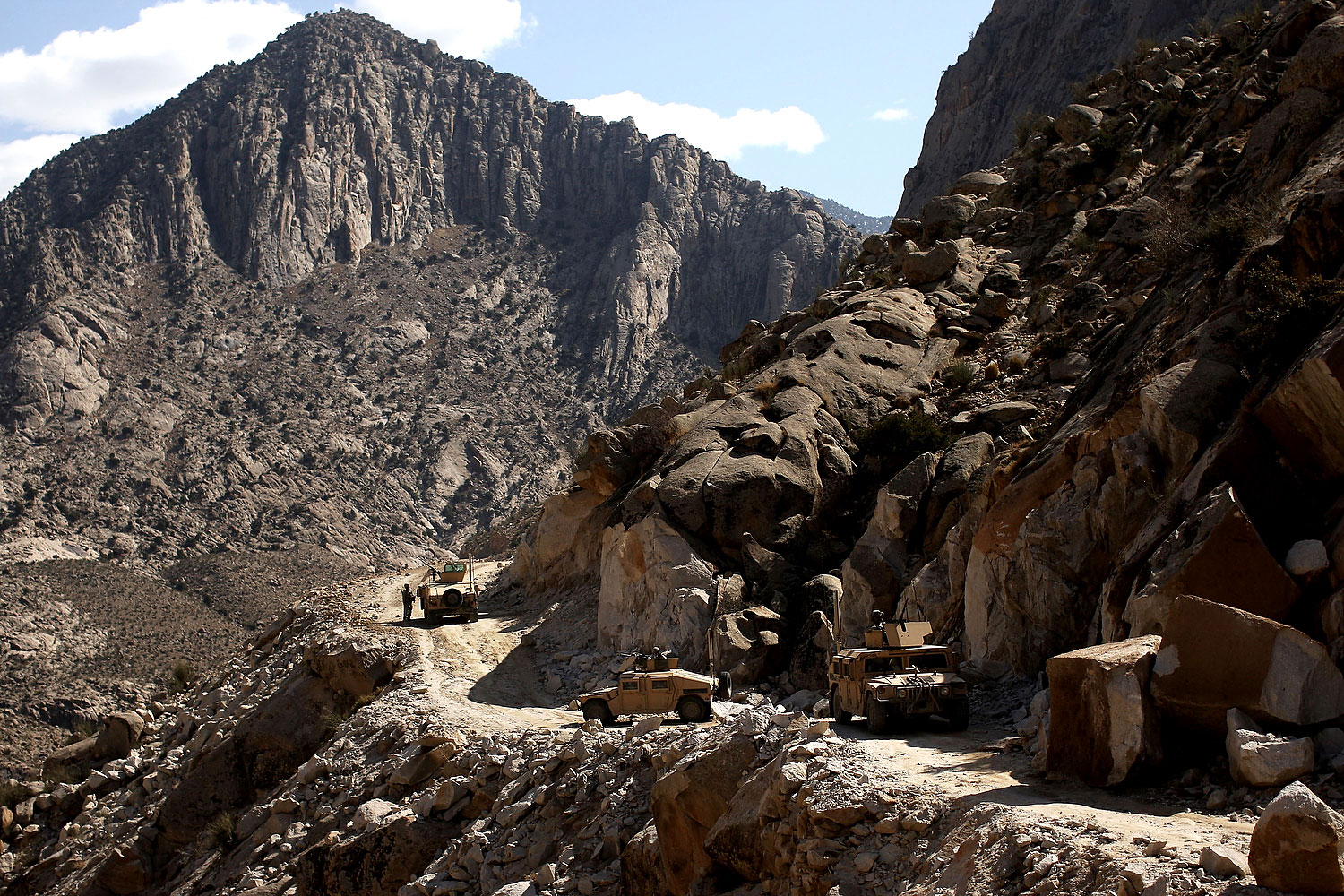
U.S. Army soldiers with the 1-6 Field Artillery division patrol an area where there has been reported Taliban presence February 18, 2009 in Gandalabog, Afghanistan. (Photo by Spencer Platt/Getty Images).

Iran Advances Towards Nuclear Weapons

17 years ago

The Obama administration is advancing a strategy of assurances of regime stability (versus regime change) and security guarantees as an incentive for jettisoning its steady but deliberate advances towards becoming a nuclear state.  Such an approach is founded upon the axiom that the Iranian Mullahs are seeking security and stability rather than regional or world hegemony.  But this is contrary to their stated views.

“We do not worship Iran.  We worship Allah.  For patriotism is another name for paganism.  I say let this land [Iran] burn.  I say let this land go up in smoke, provided Islam emerges triumphant in the rest of the world” (Khomeini, pg. 16, The Iranian Time Bomb).

So unhindered in their pursuit of nuclear weapons by either the past or the current administrations (since they both have bought into the “grand bargain” approach to Iran), the Iranian scientists and engineers under the thumb of the Mullahs have advanced their plans for nuclear weapons to the point that even the U.N. (IAEA) is now a bit surprised at their progress.

Iran has built up a stockpile of enough enriched uranium for one nuclear bomb, United Nations officials acknowledged on Thursday.

In a development that comes as the Obama administration is drawing up its policy on negotiations with Tehran over its nuclear programme, UN officials said Iran had produced more nuclear material than previously thought.

They said Iran had accumulated more than one tonne of low enriched uranium hexafluoride at a facility in Natanz.

If such a quantity were further enriched it could produce more than 20kg of fissile material – enough for a bomb.

“It appears that Iran has walked right up to the threshold of having enough low enriched uranium to provide enough raw material for a single bomb,” said Peter Zimmerman, a former chief scientist of the US Arms Control and Disarmament Agency

The new figures come in a report from the International Atomic Energy Agency, the UN’s nuclear watchdog, released on Thursday. This revealed that Iran’s production of low enriched uranium had previously been underestimated.

When the agency carried out an annual stocktaking of Natanz in mid-November Iran had produced 839kg of low enriched uranium hexafluoride – more than 200kg more than previously thought. Tehran produced an additional 171kg by the end of January.

“It’s sure certain that if they didn’t have it [enough] when the IAEA took these measurements, they will have it in a matter of weeks,” Mr Zimmerman said.

Iran’s success in reaching such a “breakout capacity” – a stage that would allow it to produce enough fissile material for a bomb in a matter of months – crosses a “red line” that for years Israel has said it would not accept.

While the prose is more discriminating, the headline is completely, factually incorrect.  The Financial Times article is headlined “Iran Holds Enough Uranium for Bomb.”  The Telegraph headline reads about the same.  It’s important to understand what this does – and doesn’t – mean.

The process begins with Uranium ore, which is then milled into a concentrate called “yellowcake” (U3O8).  This is then converted to Uranium Hexafluoride gas (UF6) before enrichment.  Further chemical processing converts this to UO2, and this is apparently where the Iranians are in the process.  “Low enriched Uranium.”  This means on the order of 4-5% U-235, not the 90% or greater U-235 enrichment needed for nuclear weapons.  They still have work to do.

This realistic assessment doesn’t ameliorate the threat that Iran poses, but it does mean that there is still time to prevent a nuclear Iran.  Iran needs to enrich the Uranium to weapons grade, and to date there is no indication that they have done so.

But there is every indication that they intend to do so.  The question is whether the will exists to prevent the existence of a nuclear Iran.  A survey of the scene shows that Iran can now deploy UAVs (or drones), is still assisting the Taliban, and doesn’t want any part of the grand bargain.

The Obama administration is moving full-speed ahead to prepare for U.S.-Iran talks. The reaction from Iran, though, has not been so fawning.  In the wake of President Ahmadinejad’s rhetoric holding open the possibility of talks with the United States should Obama acquiesce to Tehran’s demands on its nuclear program, apologies, and abandonment of Israel, Jomhouri-ye Eslami editorialized that, with regard to such fundamental issues as talks with Washington, it was not Ahmadinejad’s decision to make. After all, in Iran, the president is about style and the Supreme Leader about substance. The newspaper, close to the intelligence ministry and security agencies, quoted the Supreme Leader’s speech at Yazd: “Relations with the U.S. have for the time being no benefit to the Iranian nation and most certainly on the day that relations with America are beneficial for the nation, I’ll be the first person to recognize it.”

It’s important to clarify what the most recent revelations from the IAEA mean.  It’s also important to clarify where the U.S. stands with respect to a nuclear Iran.  While the U.S. investigates its policy,  the advancement of Iran proceeds apace to become nuclear.

Taliban Win in Swat

17 years ago

Syed Saleem Shahzad writing for the Asia Times gives us an important perspective on the Taliban victory in Swat where Sharia law was instituted and a truce called.

In Malakand, which includes the Swat area, the militants are a part of the Pakistan Tehrik-i-Taliban and the vanguard of the Taliban’s cause in the region against Western occupation forces in Afghanistan and their ally – Pakistan. They have established their own writ with a parallel system that includes courts, police and even a electric power-distribution network and road construction, and all this is now official in the eyes of Islamabad.

All intelligence indicated that further concentration on military operations in Swat could lead to an expansion of the war theater into Pakistan’s non-Pashtun cities, such as Islamabad, Lahore and Karachi. The security forces were already stretched and even faced rebellions.

These combined factors culminated in Monday’s peace agreement, which is a major defeat for Washington as well as Pakistan, and it could also lead to a major setback for the North Atlantic Treaty Organization in Afghanistan come spring when hordes of better-trained fighters from Swat pour into Afghanistan …

The developments in Malakand division coincide with the arrival in Afghanistan of close to 3,000 American soldiers as part of an extra 30,000 to boost the already 30,000 US troops in the country. The new contingent will be deployed in Logar province to secure violent provinces near the capital Kabul. Petraeus must now be thinking of how many more troops he will need to confront the additional Taliban fighters that will come from Malakand.

There is much more at the link to the Asia Times commentary, but basically, Shahzad is correct.  Implementation of Sharia law is only part of the deal.  The Pakistani Army will leave.  The institutions set up by the Taliban are now formalized and official, recognized by the Pakistani government.  Given the proximity of Swat to Afghanistan, safe haven for the Taliban doesn’t even begin to explain the depths of the problem.  The problem goes not only to territory and terrain, but preoccupation of the Tehrik-i-Taliban (TTP).

Although not exclusively, the TTP has primarily been disposed with fights inside of the North West Frontier Province and Federally Administered Tribal Areas.  They are now no longer occupied with fights with the Pakistani Army.

These fighters are now free to engage U.S. troops, and thus has Pakistan traded off its “security” for that of Afghanistan.  And the campaign in Afghanistan has just gotten a little harder.  Now.  How about all of those dignitaries summoned to Sharia court by the Taliban in Swat?  Had the Pakistani negotiators forgotten about that?

One final thing.  Sufi Mohammad … will soon travel to Matta, a sub-district of Swat, to visit his son-in-law Mullah Fazlullah (the Tehrik-i-Taliban commander in Swat) to try to persuade him to end the insurgency.  Of course he’ll be happy to oblige.

We’re not going to run out of people to kill!

17 years ago

Back in the days when The Captain’s Journal was arguing with General Rodriguez about the badly devolving security situation in Afghanistan it was difficult to see around the bend to a brighter future.  But General McKiernan is showing the way.

The top U.S. commander in Afghanistan offered a grim view Wednesday of military efforts in southern Afghanistan, warning that 17,000 new troops will take on emboldened Taliban insurgents who have “stalemated” U.S. and allied forces.

Army Gen. David McKiernan also predicted that the bolstered numbers of U.S. soldiers in Afghanistan – about 55,000 in all – will remain near those levels for up to five years.

Still, McKiernan said, that is only about two-thirds of the number of troops he has requested to secure the war-torn nation.

McKiernan told reporters at the Pentagon Wednesday that the extra Army and Marine forces will be in place by the summer, primed for counterinsurgency operations against the Taliban but also ready to conduct training with Afghan police forces.

McKiernan said what the surge “allows us to do is change the dynamics of the security situation, predominantly in southern Afghanistan, where we are, at best, stalemated.

“I’m not here to tell you that there’s not an increased level of violence, because there is,” he said.

The 17,000 additional troops, which President Barack Obama approved Tuesday to begin deploying this spring, will join an estimated 38,000 already in Afghanistan.

Another 10,000 U.S. soldiers could be headed to Afghanistan in the future as the Obama administration decides how to balance its troop levels with those from other nations and the Afghan army. The White House has said it will not make further decisions about its next moves in Afghanistan until it has completed a strategic review of the war, in tandem with the Afghan government.

Whatever the outcome of the review, McKiernan said, “we know we need additional means in Afghanistan, whether they are security or governance-related or socioeconomic-related.”

The estimated level of 55,000 troops needs “to be sustained for some period of time,” he said, adding that could be as long as three to five years.

Actually, we have called for more.

Properly resourcing the campaign will require at least – but not limited to – three Marine Regimental Combat Teams (outfitted with V-22s, Harriers and all of the RCT support staff) and three Brigades (preferably at least one or two of which are highly mobile, rapid reaction Stryker Brigades).  These forces must be deployed in the East and South and especially along the border, brought out from under the control of NATO and reporting only to CENTCOM.

The command has been changed as we had hoped and U.S. troops now report to CENTCOM, but we still need more troops.  John Nagl has called for as many as 600,000 troops.  So how can all of this be considered a “brighter future?”  Simple.  We are now being honest with ourselves about the campaign.

General McKiernan then makes the following head-turning statement.  “We’re not going to run out of people that either international forces or Afghan forces have to kill or capture.”  He adds that “ultimately, the conflict will be solved not by military force – but through the political will of the Afghan people.”

McKiernan is right of course about the will of the Afghan people being determinative in the campaign, and of course counterinsurgency experts are right to note that the application of soft power is a necessary corollary to kinetics.

But take careful note of the General’s sobering words: “We’re not going to run out of people that either international forces or Afghan forces have to kill or capture.”  Reliance on cheap, manufactured copies of the Anbar awakening, splitting off the “moderate” Taliban from the irreconcilables, and new electrical distribution systems is whistling through the grave yard.  There are hard core kinetic operations that await us, and this is going to get a lot harder before it gets easier.

How Fast Can NATO Surrender to the Taliban?

17 years ago

In a little known and poorly publicized report on the Danish part of the NATO effort in Afghanistan, they have begun to negotiate with the Taliban on their own.

Danish soldiers in Afghanistan have begun negotiating with the Taliban to try to break the deadlock there, a newspaper reported Monday, as a poll suggested most Danes considered the war unwinnable.

Troops had been holding talks with the Taliban as wiping out the insurgency was proving so difficult, a Danish officer told the Jyllands-Posten daily.

“We have already held several meetings with local chiefs where the Taliban were represented,” Lieutenant Colonel Bjarne Hoejgaard told the paper after a six-month mission in Afghanistan.

“We cannot get around it. We must intensify the dialogue and the negotiations with the Taliban if we want to have peace in Afghanistan, because we cannot eliminate the enemy,” he said.

This report was also picked up by the Globe and Mail.  Oh, and Hamid Karzai saw it as well.  The report apparently got his panties in a wad, because he responded that only the “government” in Kabul would be allowed to surrender to, um, negotiate with the Taliban.

Talks with Taliban insurgents must only take place through Afghan government channels, President Hamid Karzai’s office warned Tuesday after reports surfaced of dialogue led by Danish soldiers.

Presidential spokesman Homayun Hamidzada told reporters he was unaware of a report in a newspaper, which cited a Danish officer saying that Taliban were represented at soldiers’ talks with local chiefs.

“We must intensify the dialogue and the negotiations with the Taliban if we want to have peace in Afghanistan, because we cannot eliminate the enemy,” the lieutenant colonel was quoted as saying on Monday after a six-month mission.

Asked about the report, Hamidzada said he had not seen it.

“But the policy of the Afghanistan government is, any talks or dialogue should take place through government, not by the friendly countries who have a presence in Afghanistan,” he said.

Remember, Karzai is the one who said directly to Afghan Taliban leader Mullah Omar ‘My brother, my dear, come back to your homeland. Come back and work for peace, for the good of the Afghan people. Stop this business of brothers killing brothers’.

Secretary of Defense Robert Gates has recently said that the NATO effort must be expanded in Afghanistan, and that this effort must not be seen as an “American” war.  But with such attitudes among the NATO “warriors” who serve there, it is difficult to imagine a scenario in which it won’t become America’s campaign, good or bad.

Prior: Petraeus on Pursuing the Enemy

Zardari, Pakistan and Belief in the War

17 years ago

In order to stop the violence in Pakistan’s Swat valley of the North West Frontier Province, or so the government of Pakistan hopes, a deal has been struck to turn over Swat to fudamentalist Sharia law.  Zardari still believes that the Taliban problem poses the greatest risk to the survival of Pakistan, and in this he is correct.  The Taliban must be eliminated, he says.

But the analysis is basically correct.  While Zardari believes that the Taliban are the real threat to Pakistan’s existence, Pakistan still does not.  Zardari cannot wage the war against the Taliban – the Army and ISI are needed, and since they are still convinced that this is an American war, the deal has been struck with the Taliban.  Note the nuance with which Pakistan’s Foreign Minister deals with the issue.

This notion of reconcilable Taliban versus irreconcilable Taliban is a convenient excuse for turning off the war.  There may be those irreconcilables out there, but The Captain’s Journal believes that there are relatively few of them.  Another way of saying it is that the ones who have perpetrated the violence will continue to perpetrate the violence.  The tenacity and commitment to the mission is evidence of their intentions.

As for the Pakistani Army and the ISI, as we discussed about five months ago, there is duplicitous behavior taking place.

ONE SWELTERING AFTERNOON in July, I ventured into the elegant home of a former Pakistani official who recently retired after several years of serving in senior government posts. We sat in his book-lined study. A servant brought us tea and biscuits.

Was it the obsession with India that led the Pakistani military to support the Taliban? I asked him.

“Yes,” he said.

Or is it the anti-Americanism and pro-Islamic feelings in the army?

“Yes,” he said, that too.

And then the retired Pakistani official offered another explanation — one that he said could never be discussed in public. The reason the Pakistani security services support the Taliban, he said, is for money: after the 9/11 attacks, the Pakistani military concluded that keeping the Taliban alive was the surest way to win billions of dollars in aid that Pakistan needed to survive. The military’s complicated relationship with the Taliban is part of what the official called the Pakistani military’s “strategic games.” Like other Pakistanis, this former senior official spoke on the condition of anonymity because of the sensitivity of what he was telling me.

“Pakistan is dependent on the American money that these games with the Taliban generate,” the official told me. “The Pakistani economy would collapse without it. This is how the game works.”

As an example, he cited the Pakistan Army’s first invasion of the tribal areas — of South Waziristan in 2004. Called Operation Shakai, the offensive was ostensibly aimed at ridding the area of Taliban militants. From an American perspective, the operation was a total failure. The army invaded, fought and then made a deal with one of the militant commanders, Nek Mohammed. The agreement was capped by a dramatic meeting between Mohammed and Safdar Hussein, one of the most senior officers in the Pakistan Army.

“The corps commander was flown in on a helicopter,” the former official said. “They had this big ceremony, and they embraced. They called each other mujahids. ”

“Mujahid” is the Arabic word for “holy warrior.” The ceremony, in fact, was captured on videotape, and the tape has been widely distributed.

“The army agreed to compensate the locals for collateral damage,” the official said. “Where do you think that money went? It went to the Taliban. Who do you think paid the bill? The Americans. This is the way the game works. The Taliban is attacked, but it is never destroyed.

Whatever the motivation – money or as a buffer against India – the Army is not eliminating the Taliban as Zardari had hoped.  Counterinsurgency tactics can be learned, but belief and volition must underlie the Army’s actions for the campaign to be anything other than for show.  Thus continue the Talibanization of Pakistan.

Prior: Pashtun Rejection of the Global War on Terror

Bad Form in Counterinsurgency Debates

17 years ago

Andrew Exum blogging at Abu Muqawama has a piece up on who he perceives to be the winner and losers in Tom Ricks’ new book The Gamble: General David Petraeus and the American Military Adventure in Iraq, 2006-2008.  I personally like Andrew and have enjoyed the exchanges I have had with him, via e-mail and in blog articles.  But let’s deal with a few items from this post by Andrew.

First, one of the “losers” is determined to be Colonel Gian Gentile who commanded a Battalion in Baghdad in 2006.  Tom Ricks judges the performance of his unit to be “actually quite poor.”  Major General Hammond is cited saying “Gentile had a different stance. It was night and day. He was FOB-centric. We are JSS-centric.”

Well, do tell.  Actually, I judge the performance of books that promulgate myths to be poor.  I have not read the book because Tom hasn’t sent me a free copy to review.  Had he sent me a copy I would have responded.  As a matter of fact, I haven’t even been able to get Tom to respond to a single e-mail.  But if Tom’s book advocates the idea that the campaign was won by jettisoning the notion of FOB-centric counterinsurgency and embracing Combat Outposts (or Joint Security Stations), then it is an exercise in simplistic myth-telling.

We have dealt with this before, this notion of a simple, one line narrative for Iraq.  The country, the security situation, the units, the commanders, and the enemy was simply too diverse for a one-size-fits-all narrative.  Even as late as the middle of 2007 operations were conducted in Fallujah, Anbar that were essentially FOB-centric.  The Marines in Operation Alljah would spend some time at JSS, but rotate in and out of them, never spending more than about two or three weeks per rotation.  The FOB was the main strategy for force protection, and yet the Marines still spent most of their time interacting with the population no matter where they garrisoned (heavy census operations, heavy patrolling, and especially heavy kinetic operations).  These operations were so successful that many high level visitors were received to discuss the methods, including the Commandant of the Marine Corps.

To say that a commander is FOB-centric is to say nothing more than he is committed to force protection.  It means nothing regarding the ability to do counterinsurgency.  And so now we have let the cat out of the bag, haven’t we?  There it is.  The great myth.  Now, let’s distinguish between levels.  Currently much of the Army in Afghanistan is cloistered into huge FOBs and left without much contact with the population.  Let’s contrast that the right way to do it.  In Opening a Combat Outpost for Business, we listened as the Marines built their force protection.

Marines with 2nd Platoon, Motor Transportation Company, Combat Logistics Battalion 3, conducted multiple combat logistics patrols in support of Operation Gateway III in Farah Province, Islamic Republic of Afghanistan Dec. 28, 2008, through Jan. 25, 2009.

The logistics combat element Marines, part of Special Purpose Marine Air Ground Task Force – Afghanistan, endured more than two weeks behind their steering wheels and gun turrets in improvised explosive device-laden terrain during the initial phases of the operation.  Military planners with SPMAGTF-A designed Operation Gateway III as a deliberate plan to clear southern Afghanistan’s Route 515 of any existing IED and insurgent threats on the important east-west route.

The combat logisticians directly supported 3rd Battalion, 8th Marine Regiment (Reinforced), the ground combat element of SPMAGTF-A, with the essential supplies and construction support necessary to erect three combat outposts at strategic locations along Route 515.  In a limited amount of time, the three locations were successfully developed from barren land into safe havens for the 3/8 Marines occupying the area.

“Ultimately I was surprised,” said Staff Sgt. Chris O. Ross, platoon sergeant. “The COPs were built quickly, and the Marines were working overtime to do it.”

Ross also said the timing and coordination required to conduct the operation came together well.

Second Lt. Juliann C. Naughton, 2nd Platoon’s convoy commander, explained it’s shocking for the locals to wake up the next morning to see that a military outpost has appeared from nowhere during the course of the night.

“The logistical support was a success, and we delivered the materials in a timely manner,” Naughton said. “We’ve also been interacting with the villagers and letting them know why we’re here.”

Fortifications including concertina wire, a parapet several feet tall and dirt-filled protective barriers ensured the Marines on the interior of the COPs were shielded from outside threats. Multiple observation posts and several heavy and medium machine guns provided security and over-watch for the combat logisticians as they performed their craft.

The interior of the COPs offer living quarters, hygiene facilities, combat operations centers and more to accommodate its current and future residents.

The posts were strategically placed along the route to show an alliance presence, as well as enable safe travel.

And thus can it be done successfully, this notion of force protection combined with contact with the population.  To set them in juxtaposition as opposites or somehow mutually exclusive is the grand myth around which the narrative of the surge is being built.  In reality, the situation was more complicated, a subject we covered in The Surge.

Second, Gian Gentile asks Tom in the comments of this post at Abu Muqawama:

Ref your book Fiasco, which at the end you spend about a page talking about my unit, 8-10 Cav. In Fiasco you said this about my unit and what we were doing in 2006:

“… overall the US effort was characterized by a more careful, purposeful style.”

you even went on to praise a simple tactic of slow mounted movement that we adopted and noted that

“it was less disruptive to the Iraqis and sends a message of calm, control…”

OK, you were not saying that Gentile was the next Galula, that they were on the way to winning the war by themselves. But clearly your impression was positive, at least the way you portrayed us in Fiasco.

Then The Gamble comes along and in it you become a harsh critic of my unit’s performance (and that criticism was based on the same embed tour that you did with us in early February). So what changed between the two books?

To which Tom responds thusly:

‘what changed between the two books?’

A small civil war, and the prospect of defeat.

So there you have it.  One may ask rhetorically what this has to do with Gian Gentile, and the obvious answer is nothing whatsoever.  So we may conclude that Tom doesn’t have a good answer for what happened between the two books.

Third, as for Gian, he and I have slightly disagreed and nuanced our arguments to come to agreement elsewhere, such as with Sadr (I believe that marginalization of his forces did him in, and that he wouldn’t have been alive anyway had the 3/2 Marines had their way, as he was under their custody in 2004) and the Sons of Iraq and pay to participate (which saw robust use in the Anbar province in 2007 as it should have).

But Gian is a great American and a warrior-scholar, and to place him in the category of “loser” as Andrew does is simply bad form.  There is no excuse for it.  Again, I like Andrew, but he seems to have bought into the Gnostic version of counterinsurgency.  Only a few “get it,” and the rest of us should simply be consigned to the doofus category in counterinsurgency.  Such may be the indiscretions of youth.

Andrew is a bright young man and his contributions to this discipline in the future will be enormous.  But with this authority comes responsibility.  Andrew should be circumspect with his thoughts.  Gian doesn’t advocate jettisoning counterinsurgency doctrine, any more than he wishes to lose the campaigns in which we are engaged.  Gian wants to be prepared for the future, no matter what that may bring.  It was a very wise man who once said:

“For waging war you need guidance, and for victory many advisers” (Proverbs 24:6, NIV).

See also: The Man in the Arena, Small Wars Journal Blog

On the Front Lines in Afghanistan

17 years ago

Jim Landers of the Dallas News is on the front line with U.S. soldiers in Afghanistan.  All of his observations are interesting, but there are two that are particularly poignant.

KALAGU, Afghanistan – Sgt. Corey Tack guns the engine of the 18-ton armored truck up a snow-streaked, gravelly hill. He parks on a spot with a commanding view of the valley between white, jagged mountains. Sgt. Oscar Macias opens the 400-pound back door and jumps out.

Facing a night of midteen temperatures and heavy frost, the soldiers start digging holes for their sleeping bags.

“A mortar hits in the middle here, bang, we’re all dead,” said Macias, from Rio Hondo, Texas. “But if it hits over there, you’ll be in a hole and the shrapnel will go over your head.”

The confident, weather-burned faces of these soldiers tell a story. They’re battle-tested and undefeated. They sense the enemy knows and avoids their truck with its red-and-white banners that read “Hooligans.” But they also know they are not winning the battle against insurgents in Afghanistan.

“When I first rolled in, it was kill everybody and everything,” Macias said with exaggeration.

No more.

Even if you do take their leaders out, there’s always somebody else to replace them,” he said.

These Cavalry Scouts say there aren’t enough American troops here to cover a country the size of Texas.

They know their enemies roam unchecked across much of the bleak high plains. They know the enemy is winning on the information front, spreading propaganda about U.S. soldiers smashing down doors in the middle of the night to rape, pillage and murder.

To win, they know they have to hand over security to their Afghan counterparts, who often come to a fight ill-equipped and stoned on hashish.

The hash smoking “happens a lot – more than I know or want to know,” said Sgt. 1st Class Bruce Kobel, a Lewiston, Maine, firefighter with the Vermont National Guard who is training Afghan soldiers here. “It’s like, you learn there’s an accepted level of corruption. Well, there’s also an accepted level of drug abuse, too. It’s part of their culture.”

Macias’ observation runs right in line with reports to The Captain’s Journal from field grade officers in Afghanistan.  Kill a mid-level Taliban commander, and they stay low for a few weeks to regroup and realign.  Then the violence starts again, and the cycle continues.  The Special Operations Forces campaign against high value targets, however effective it might have been to get us far enough to stand down troops in Iraq and switch focus to Afghanistan, is now failing us.  A HVT campaign is no replacement for counterinsurgency.

We have previously commented on the corruption in Afghanistan and how it will cause the campaign to fail if it proceeds unchecked (because it legitimizes the Taliban shadow government).  But we learn something new with Landers’ report from the front lines.  Hash smoking is not only rampant within Afghan culture (we knew this), but the Afghan Army doesn’t control it among their own.

This is yet another example of reverse legitimacy.  It would almost be better for the population not to see the Afghan Army at all than to see them staggering towards their home on patrol, stoned on Hashish.  The Captain’s Journal thinks that it’s time to throw away the bongs and pick up a rifle.  Without being able to turn over to a legitimate Afghan Army, all will be lost in Afghanistan.


26th MEU (10)
Abu Muqawama (12)
ACOG (2)
ACOGs (1)
Afghan National Army (36)
Afghan National Police (17)
Afghanistan (704)
Afghanistan SOFA (4)
Agriculture in COIN (3)
AGW (1)
Air Force (41)
Air Power (10)
al Qaeda (83)
Ali al-Sistani (1)
America (22)
Ammunition (304)
Animals (323)
Ansar al Sunna (15)
Anthropology (3)
Antonin Scalia (1)
AR-15s (393)
Arghandab River Valley (1)
Arlington Cemetery (2)
Army (91)
Assassinations (2)
Assault Weapon Ban (29)
Australian Army (7)
Azerbaijan (4)
Backpacking (4)
Badr Organization (8)
Baitullah Mehsud (21)
Basra (17)
BATFE (246)
Battle of Bari Alai (2)
Battle of Wanat (18)
Battle Space Weight (3)
Bin Laden (7)
Blogroll (3)
Blogs (24)
Body Armor (23)
Books (3)
Border War (18)
Brady Campaign (1)
Britain (39)
British Army (36)
Camping (5)
Canada (19)
Castle Doctrine (1)
Caucasus (6)
CENTCOM (7)
Center For a New American Security (8)
Charity (3)
China (19)
Christmas (18)
CIA (30)
Civilian National Security Force (3)
Col. Gian Gentile (9)
Combat Outposts (3)
Combat Video (2)
Concerned Citizens (6)
Constabulary Actions (3)
Coolness Factor (3)
COP Keating (4)
Corruption in COIN (4)
Council on Foreign Relations (1)
Counterinsurgency (218)
DADT (2)
David Rohde (1)
Defense Contractors (2)
Department of Defense (220)
Department of Homeland Security (26)
Disaster Preparedness (5)
Distributed Operations (5)
Dogs (15)
Donald Trump (27)
Drone Campaign (4)
EFV (3)
Egypt (12)
El Salvador (1)
Embassy Security (1)
Enemy Spotters (1)
Expeditionary Warfare (18)
F-22 (2)
F-35 (1)
Fallujah (17)
Far East (3)
Fathers and Sons (2)
Favorite (1)
Fazlullah (3)
FBI (39)
Featured (192)
Federal Firearms Laws (18)
Financing the Taliban (2)
Firearms (1,867)
Football (1)
Force Projection (35)
Force Protection (4)
Force Transformation (1)
Foreign Policy (27)
Fukushima Reactor Accident (6)
Ganjgal (1)
Garmsir (1)
general (15)
General Amos (1)
General James Mattis (1)
General McChrystal (44)
General McKiernan (6)
General Rodriguez (3)
General Suleimani (9)
Georgia (19)
GITMO (2)
Google (1)
Gulbuddin Hekmatyar (1)
Gun Control (1,717)
Guns (2,406)
Guns In National Parks (3)
Haditha Roundup (10)
Haiti (2)
HAMAS (7)
Haqqani Network (9)
Hate Mail (8)
Hekmatyar (1)
Heroism (5)
Hezbollah (12)
High Capacity Magazines (16)
High Value Targets (9)
Homecoming (1)
Homeland Security (3)
Horses (2)
Humor (72)
Hunting (61)
ICOS (1)
IEDs (7)
Immigration (123)
India (10)
Infantry (4)
Information Warfare (4)
Infrastructure (4)
Intelligence (23)
Intelligence Bulletin (6)
Iran (171)
Iraq (379)
Iraq SOFA (23)
Islamic Facism (64)
Islamists (98)
Israel (19)
Jaish al Mahdi (21)
Jalalabad (1)
Japan (3)
Jihadists (82)
John Nagl (5)
Joint Intelligence Centers (1)
JRTN (1)
Kabul (1)
Kajaki Dam (1)
Kamdesh (9)
Kandahar (12)
Karachi (7)
Kashmir (2)
Khost Province (1)
Khyber (11)
Knife Blogging (7)
Korea (4)
Korengal Valley (3)
Kunar Province (20)
Kurdistan (3)
Language in COIN (5)
Language in Statecraft (1)
Language Interpreters (2)
Lashkar-e-Taiba (2)
Law Enforcement (6)
Lawfare (14)
Leadership (6)
Lebanon (6)
Leon Panetta (2)
Let Them Fight (2)
Libya (14)
Lines of Effort (3)
Littoral Combat (8)
Logistics (50)
Long Guns (1)
Lt. Col. Allen West (2)
Marine Corps (281)
Marines in Bakwa (1)
Marines in Helmand (67)
Marjah (4)
MEDEVAC (2)
Media (68)
Medical (146)
Memorial Day (6)
Mexican Cartels (47)
Mexico (71)
Michael Yon (6)
Micromanaging the Military (7)
Middle East (1)
Military Blogging (26)
Military Contractors (5)
Military Equipment (25)
Militia (9)
Mitt Romney (3)
Monetary Policy (1)
Moqtada al Sadr (2)
Mosul (4)
Mountains (25)
MRAPs (1)
Mullah Baradar (1)
Mullah Fazlullah (1)
Mullah Omar (3)
Musa Qala (4)
Music (25)
Muslim Brotherhood (6)
Nation Building (2)
National Internet IDs (1)
National Rifle Association (97)
NATO (15)
Navy (31)
Navy Corpsman (1)
NCOs (3)
News (1)
NGOs (3)
Nicholas Schmidle (2)
Now Zad (19)
NSA (3)
NSA James L. Jones (6)
Nuclear (63)
Nuristan (8)
Obama Administration (222)
Offshore Balancing (1)
Operation Alljah (7)
Operation Khanjar (14)
Ossetia (7)
Pakistan (165)
Paktya Province (1)
Palestine (5)
Patriotism (7)
Patrolling (1)
Pech River Valley (11)
Personal (76)
Petraeus (14)
Pictures (1)
Piracy (13)
Pistol (4)
Pizzagate (21)
Police (672)
Police in COIN (3)
Policy (15)
Politics (998)
Poppy (2)
PPEs (1)
Prisons in Counterinsurgency (12)
Project Gunrunner (20)
PRTs (1)
Qatar (1)
Quadrennial Defense Review (2)
Quds Force (13)
Quetta Shura (1)
RAND (3)
Recommended Reading (14)
Refueling Tanker (1)
Religion (499)
Religion and Insurgency (19)
Reuters (1)
Rick Perry (4)
Rifles (1)
Roads (4)
Rolling Stone (1)
Ron Paul (1)
ROTC (1)
Rules of Engagement (75)
Rumsfeld (1)
Russia (37)
Sabbatical (1)
Sangin (1)
Saqlawiyah (1)
Satellite Patrols (2)
Saudi Arabia (4)
Scenes from Iraq (1)
Second Amendment (708)
Second Amendment Quick Hits (2)
Secretary Gates (9)
Sharia Law (3)
Shura Ittehad-ul-Mujahiden (1)
SIIC (2)
Sirajuddin Haqqani (1)
Small Wars (72)
Snipers (9)
Sniveling Lackeys (2)
Soft Power (4)
Somalia (8)
Sons of Afghanistan (1)
Sons of Iraq (2)
Special Forces (28)
Squad Rushes (1)
State Department (23)
Statistics (1)
Sunni Insurgency (10)
Support to Infantry Ratio (1)
Supreme Court (79)
Survival (214)
SWAT Raids (58)
Syria (38)
Tactical Drills (38)
Tactical Gear (17)
Taliban (168)
Taliban Massing of Forces (4)
Tarmiyah (1)
TBI (1)
Technology (21)
Tehrik-i-Taliban (78)
Terrain in Combat (1)
Terrorism (96)
Thanksgiving (13)
The Anbar Narrative (23)
The Art of War (5)
The Fallen (1)
The Long War (20)
The Surge (3)
The Wounded (13)
Thomas Barnett (1)
Transnational Insurgencies (5)
Tribes (5)
TSA (25)
TSA Ineptitude (14)
TTPs (4)
U.S. Border Patrol (8)
U.S. Border Security (22)
U.S. Sovereignty (29)
UAVs (2)
UBL (4)
Ukraine (10)
Uncategorized (105)
Universal Background Check (3)
Unrestricted Warfare (4)
USS Iwo Jima (2)
USS San Antonio (1)
Uzbekistan (1)
V-22 Osprey (4)
Veterans (3)
Vietnam (1)
War & Warfare (432)
War & Warfare (41)
War Movies (4)
War Reporting (21)
Wardak Province (1)
Warriors (6)
Waziristan (1)
Weapons and Tactics (80)
West Point (1)
Winter Operations (1)
Women in Combat (21)
WTF? (1)
Yemen (1)

February 2026
January 2026
December 2025
November 2025
October 2025
September 2025
August 2025
July 2025
June 2025
May 2025
April 2025
March 2025
February 2025
January 2025
December 2024
November 2024
October 2024
September 2024
August 2024
July 2024
June 2024
May 2024
April 2024
March 2024
February 2024
January 2024
December 2023
November 2023
October 2023
September 2023
August 2023
July 2023
June 2023
May 2023
April 2023
March 2023
February 2023
January 2023
December 2022
November 2022
October 2022
September 2022
August 2022
July 2022
June 2022
May 2022
April 2022
March 2022
February 2022
January 2022
December 2021
November 2021
October 2021
September 2021
August 2021
July 2021
June 2021
May 2021
April 2021
March 2021
February 2021
January 2021
December 2020
November 2020
October 2020
September 2020
August 2020
July 2020
June 2020
May 2020
April 2020
March 2020
February 2020
January 2020
December 2019
November 2019
October 2019
September 2019
August 2019
July 2019
June 2019
May 2019
April 2019
March 2019
February 2019
January 2019
December 2018
November 2018
October 2018
September 2018
August 2018
July 2018
June 2018
May 2018
April 2018
March 2018
February 2018
January 2018
December 2017
November 2017
October 2017
September 2017
August 2017
July 2017
June 2017
May 2017
April 2017
March 2017
February 2017
January 2017
December 2016
November 2016
October 2016
September 2016
August 2016
July 2016
June 2016
May 2016
April 2016
March 2016
February 2016
January 2016
December 2015
November 2015
October 2015
September 2015
August 2015
July 2015
June 2015
May 2015
April 2015
March 2015
February 2015
January 2015
December 2014
November 2014
October 2014
September 2014
August 2014
July 2014
June 2014
May 2014
April 2014
March 2014
February 2014
January 2014
December 2013
November 2013
October 2013
September 2013
August 2013
July 2013
June 2013
May 2013
April 2013
March 2013
February 2013
January 2013
December 2012
November 2012
October 2012
September 2012
August 2012
July 2012
June 2012
May 2012
April 2012
March 2012
February 2012
January 2012
December 2011
November 2011
October 2011
September 2011
August 2011
July 2011
June 2011
May 2011
April 2011
March 2011
February 2011
January 2011
December 2010
November 2010
October 2010
September 2010
August 2010
July 2010
June 2010
May 2010
April 2010
March 2010
February 2010
January 2010
December 2009
November 2009
October 2009
September 2009
August 2009
July 2009
June 2009
May 2009
April 2009
March 2009
February 2009
January 2009
December 2008
November 2008
October 2008
September 2008
August 2008
July 2008
June 2008
May 2008
April 2008
March 2008
February 2008
January 2008
December 2007
November 2007
October 2007
September 2007
August 2007
July 2007
June 2007
May 2007
April 2007
March 2007
February 2007
January 2007
December 2006
November 2006
October 2006
September 2006
August 2006
July 2006
June 2006
May 2006

about · archives · contact · register

Copyright © 2006-2026 Captain's Journal. All rights reserved.