Articles by Herschel Smith


The “Captain” is Herschel Smith, who hails from Charlotte, NC. Smith offers news and commentary on warfare, policy and counterterrorism.


The Afghanistan Strategy

16 years, 11 months ago

The administration has announced its Afghanistan strategy, parts of which are reproduced below.

Let me start by addressing the way forward in Pakistan. The United States has great respect for the Pakistani people. They have a rich history and have struggled against long odds to sustain their democracy. The people of Pakistan want the same things that we want. An end to terror, access to basic services, the opportunity to live their dreams and the security that can only come with the rule of law. The single greatest threat to that future comes from Al Qaida and their extremist allies. And that is why we must stand together …

So, today, I’m calling upon Congress to pass a bipartisan bill co-sponsored by John Kerry and Richard Lugar that authorizes $1.5 billion in direct support to the Pakistani people every year over the next five years, resources that will build schools, roads, and hospitals, and strengthen Pakistan’s democracy …

Now, we must make a commitment that can accomplish our goals. I’ve already ordered the deployment of 17,000 troops that have been requested by General McKiernan for many months. These soldiers and Marines will take the fight to the Taliban in the south and the east and give us a great capacity to partner with Afghan security forces and to go after insurgents along the border.

This push will also help provide security in advance of the important presidential elections in Afghanistan in August. At the same time, we will shift the emphasis of our mission to training and increasing the size of Afghan security forces so that they can eventually take the lead in securing their country. That’s how we will prepare Afghans to take responsibility for their security and how we will, ultimately, be able to bring our own troops home …

The additional troops that we deployed have already increased our training capacity. And later this spring, we will deploy approximately 4,000 U.S. troops to train Afghan security forces. For the first time, this will truly resource our effort to train and support the Afghan army and police.

Every American unit in Afghanistan will be partnered with an Afghan unit, and we will seek additional trainers from our NATO allies to ensure that every Afghan unit has a coalition partner. We will accelerate our efforts to build an Afghan army of 134,000 and a police for the of 82,000 so that we can meet these goals by 2011 …

At a time of economic crisis, it’s tempting to believe that we can short change the civilian effort. But make no mistake, our efforts will fail in Afghanistan and Pakistan if we don’t invest in their future. And that’s why my budget includes indispensable investments in our State Department and foreign assistance programs.

These investments relieve the burden on our troops. They contribute directly to security. They make the American people safer. And they save us an enormous amount of money in the long run because it’s far cheaper to train a policeman to secure his or her own village that to help a farmer seed a crop or to help a farmer seed a crop than it is to send our troops to fight tour after tour of duty with no transition to Afghan responsibility.

Analysis & Commentary

We fear that this strategy will be disastrous in the superlative degree.  Several points are in order prior to summary and conclusion.

  1. This strategy places too large of a bet on similarities between Americans and Pakistanis.  We weighed in concerning the Pakistani elections one year ago amid the celebration among U.S. politicians that the Pakistanis had rejected religious extremism, saying that their analysis missed the point.  The elections rejected the incompetence of the official Islamic clerics who had poorly governed the tribal regions, but the party that had been put into power represented what those who were more familiar with Pakistani politics had feared – a voter rejection of the war on terror.  The Tehrik-i-Taliban (Taliban of Pakistan) and their supporters boycotted the elections and were untouched by the votes.
  2. More money is exactly what the Pakistan government wants.  As one former Pakistani official told Dexter Filkins,  The reason the Pakistani security services support the Taliban, he said, is for money: after the 9/11 attacks, the Pakistani military concluded that keeping the Taliban alive was the surest way to win billions of dollars in aid that Pakistan needed to survive. The military’s complicated relationship with the Taliban is part of what the officialcalled the Pakistani military’s “strategic games.” Like other Pakistanis, this former senior officialspoke on the condition of anonymity because of the sensitivity of what he was telling me.  “Pakistan is dependent on the American money that these games with the Taliban generate,” the officialtold me. “The Pakistani economy would collapse without it. This is how the game works.”As an example, he cited the Pakistan Army’s first invasion of the tribal areas — of South Waziristan in 2004. Called Operation Shakai, the offensive was ostensibly aimed at ridding the area of Taliban militants. From an American perspective, the operation was a total failure. The army invaded, fought and then made a deal with one of the militant commanders, Nek Mohammed. The agreement was capped by a dramatic meeting between Mohammed and SafdarHussein, one of the most senior officers in the Pakistan Army.“The corps commander was flown in on a helicopter,” the former official said. “They had this big ceremony, and they embraced. They called each other mujahids. ”“The army agreed to compensate the locals for collateral damage,” the officialsaid. “Where do you think that money went? It went to the Taliban. Who do you think paid the bill? The Americans. This is the way the game works. The Taliban is attacked, but it is never destroyed. “It’s a game,” the official said, wrapping up our conversation. “The U.S. is being taken for a ride.”
  3. 17,000 troops have not been requested by General McKiernan.  This additional force presence meets only around 2/3 of what McKiernan had requested as of February 2009.  Furthermore, this request should be seen in the light of the fact that the U.S. Armed Forces in Afghanistan are so under-resourced that contractors are now being sought to provide Forward Operating Base (FOB) force protection.  Quite literally, contractors will be used to stand post at FOBs because there aren’t enough troops supporting Operation Enduring Freedom.
  4. As we have pointed out before, the Afghan National Army is the most trusted institution in Afghanistan, and so the campaign must eventually expand, empower, train and equip the Army to protect the population.  The Police aren’t far behind in the trust the population places in it, but there are extreme problems with both corruption and drug abuse (on duty) within the police.  The Afghan Army is shot through with drug abuse as well.  The campaign has lacked force projection and destruction of the enemy’s power to intimidate the population, and it simply isn’t the time or season for the effort to rely so heavily on indigenous forces.
  5. We have supported efforts at reconstruction and agricultural assistance, but it must be remembered that agricultural efforts won’t rid the country of Taliban.  We’ve pointed out a clever plan to replace poppy and opium as the crop of choice with pomegranates.  Asked about the how this plan might affect the Taliban, the proponent said “In the complexity of the tribal system in Afghanistan, the Taliban are in every element of society.  When I talked at the three tribal gatherings, the Taliban were present. I believe that if we don’t communicate with every faction of this problem, we’re not going to solve it.”  So the plan to replace poppy with pomegranates redounds to fixing Afghanistan as the opium supplier of the world while it continues to strengthen the Taliban because the plan has no parallel line of effort to kill the Taliban.

In a sign of how under-resourced and poorly constructed this plan is, the administration plan was met with praise from both Presidents Zardari and Karzai – Zardari because Pakistan gets the right answer to their query to “show me the money,” and Karzai because he wants international forces to play a secondary role to Afghan forces.

It should be remembered that Karzai has aggressively sought a Status of Forces Agreement similar to the one under which the U.S. currently operates in Iraq.  Karzai also happens to be the Afghan President who said to Taliban leader Mullah OmarMy brother, my dear, come back to your homeland. Come back and work for peace, for the good of the Afghan people. Stop this business of brothers killing brothers.”

The Afghan Army and Police aren’t ready for a rapid or massive turnover of authority to them.  The government isn’t prepared to be the foundation for these institutions due to the endemic corruption, and the U.S. shouldn’t be ready to settle with any insurgents without first having a fight.

Finally, the most troubling aspect of the administration plan is its failure to address the issue of the Taliban.  Al Qaeda is mentioned, but the hosts for AQ training camps receive little attention.  In fact, while disparate and factious, the Taliban mission has steadily harmonized over the past few years: to “support the regional war and then the global war against Western hegemony; this is the concept driving the neo-Taliban.”

The globalist jihad movement of al Qaeda has been merged with the Tehrik-i-Taliban of Pakistan.  The TTP shout to passersby in Khyber “We are Taliban! We are mujahedin! We are al-Qaida!”  There is no distinction.  A Pakistan interior ministry official has even said that the TTP and al Qaeda are one and the same.

TTP chief Baitullah Mehsud has said “We want to eradicate Britain and America, and to shatter the arrogance and tyranny of the infidels. We pray that Allah will enable us to destroy the White House, New York, and London.”  Now there are even indications that the original Afghan Taliban under Mullah Omar have morphed into an organization that desires regional Islamist revolutions.

There are some indigenous poor who might be able to be stripped away from the hard core Taliban fighters, but the campaign is much more than a counterterrorism operation against some al Qaeda fighters.  It is a full blown insurgency that must be defeated with a full orbed counterinsurgency.  Anything else won’t do.  There still aren’t enough troops in the plan, and it is more likely to cause the diminishing of respect for American troops across the globe than simply withdrawing completely and going back in to topple the next problematic regime.

Financing the Taliban Part 2

16 years, 11 months ago

In Financing the Taliban we addressed the issue of poppy, and why its eradication wouldn’t end the Taliban or the threat they pose to Afghanistan, Pakistan and the larger region.  In addition to poppy, Taliban support comes from taxation of various businesses as well as active participation in larger industrial-size operations.

ZIARAT, Pakistan — The Taliban’s takeover in April of the Ziarat marble quarry, a coveted national asset, is one of the boldest examples of how they have made Pakistan’s tribal areas far more than a base for training camps or a launchpad for sending fighters into Afghanistan.

A rare, unescorted visit to the region this month revealed how the Taliban are grabbing territory, using the income they exact to strengthen their hold and turn themselves into a self-sustaining fighting force. The quarry alone has brought tens of thousands of dollars, said Zaman, a tribal leader.

The seizure of the quarry is a measure of how, as the Pakistani military has pulled back under a series of peace deals, the Pakistani Taliban have extended their reach through more of the rugged 600-mile-long territory in northern Pakistan known as the Federally Administered Tribal Areas, or FATA.

The quarry here in the Mohmand tribal district, strategically situated between Peshawar and the Afghan border, is a new effort by the Taliban to harness the region’s abundant natural resources of coal, gold, copper and chromate.

Of all the minerals in the tribal areas, the marble from Ziarat is one of the most highly prized for use in expensive floors and walls in Pakistan, and in limited quantities abroad …

The Taliban decided that one mountain in the Ziarat area belonged to the Masaud division of the main Safi tribe, and said the Gurbaz subtribe would be rewarded another mountain, Zaman, the contractor, said.

The mountain assigned to the Masauds was divided into 30 portions, he said, and each of six area villages was assigned five of the 30 portions.

Zaman said the Taliban demanded $1,500 commission upfront for each portion, giving the insurgents a quick $45,000.

The Taliban also demanded a $7 tax on each truckload of marble, he said. With a constant flow of trucks, the Taliban were collecting up to $500 a day, Zaman said.

Taliban interest doesn’t stop with marble quarries though.  The recent deal with the Taliban in Swat has led to Taliban control over precious stone mines.

The Pakistani Taliban have taken control of mines producing precious lapis lazuli stones in the insurgency-hit Swat valley and started operating them on their own.

The Taliban have confirmed that they took control of the mines two months ago when they arrived in the hilly area of Fiza Ghat, a resort on the outskirts of Mingora, the main city in Swat valley.

The militants have appointed hundreds of local labourers to work round the clock to excavate lapis lazuli stones as authorities in the area had left the mines, BBC Urdu reported on Wednesday on its website.

One-third of the income from the mines is taken by the Taliban while the rest is offered to the labourers, a Taliban militant said. The Taliban have deployed senior commanders at several mines to monitor the excavation of stones.

The mines hold the promise of a significant source of income for the Taliban.

When fully operational, the mines yielded a quarter of a million carats of emeralds between 1978 and 1988. The last official estimate put the projected yield at about 13.2 million carats. Gemstone dealers say that most emeralds range from just under one carat to just over five. Prices range from $1,000 to more than $100,000 for a cut stone.

The problem is not pomegranate, marble, emeralds, or small businesses.  The problem is the Taliban, and until they are dealt with, the targeting of their sources of income will only end up harming our reputation among the very population whose cooperation we need to win the campaign.

Prior:

Financing the Taliban

NATO and Poppy: The War Over Revenue Part 2

NATO and Poppy: The War Over Revenue

Daniel Hannan

16 years, 11 months ago

Is it possible to get Mr. Daniel Hannan to change citizenship to the U.S. and run for President? We need leadership like this because we currently have none of our own. Moral character, nerves of steel, and persuasive oratory.

The Global Aspirations of the Afghan Taliban

16 years, 11 months ago

Regular readers of The Captain’s Journal know what we believe regarding negotiations with the Taliban.  Some indigenous poor may be stripped away from the hard core Taliban, but the hard core Taliban cannot be reconciled.  We needn’t rehearse this issue again.  But there is a recent analysis on negotiating with the Taliban that has both an important and related observation.

The premise underlying negotiations is that the insurgency can be short-circuited by splitting commanders who are fighting because of grievances like the civilian deaths in U.S. military operations away from true believers loyal to Taliban founder and Osama bin Laden ally Mullah Mohammad Omar.

Other experts have serious doubts. They say Omar and the leaders of associated militant groups believe that President Hamid Karzai’s government has lost popular support and they are winning against U.S.-led military forces. So long as they are of that view, there can be no peace, these experts say.

“Afghanistan was created by God for this kind of guerrilla fighting. It has high mountains and long valleys and narrow trails,” said Wahid Mughzdah, a former anti-Soviet fighter-turned-political analyst who worked in the Foreign Ministry during the former Taliban regime. “Al-Qaida and the Taliban understand that America doesn’t have a chance of success in this country.”

Further, he said, the Taliban are no longer only concerned with imposing Islamic rule on Afghanistan, but have adopted al-Qaida’s aim of staging Islamist revolutions throughout Asia and the Middle East.

We’ve already dealt with the evolution of the thinking of the Tehrik-i-Taliban to a much more global perspective in Resurgence of Taliban and al Qaeda, something Nicholas Schmidle calls the next-gen Taliban.  Until now The Captain’s Journal has always been careful to distinguish between the Tehrik-i-Taliban of Pakistan and the Afghan Taliban led by Mullah Omar, emphasizing that the globalist perspective had thoroughly set in to the TTP world view, but somewhat less so for the Afghan Taliban.

Some may object that Wahid Mughzdah is exaggerating, but if so, for what purpose?  In either case, this data point suggests that there is less difference between the Tehrik-i-Taliban and the Afghan Taliban than we thought.  It is only a single data point, but it is an important one.  File this away with the label “very important” and tag it to make it easily search-able for instant recall.

Another Nonsense Strategy Page Article

16 years, 11 months ago

Another nonsense Strategy Page article.

The U.S. believes that many al Qaeda leaders have fled to southwest Pakistan (Baluchistan) to escape the increasing number of U.S. UAV missile attacks in the Pushtun tribal areas along the Afghan border. The UAV attacks are apparently following al Qaeda into Baluchistan. Both Britain and the U.S. are sending more trainers to Pakistan, to show the paramilitary Frontier Corps better techniques for dealing with the Taliban. The Frontier Corps recruits from the local tribes and normally acts as a rural constabulary. Fighting the heavily armed and fanatical Taliban is often more than the Frontier Corps troopers can handle.

The Baluchi tribes are not as violently opposed to the government as the Pushtun ones. While the Pushtun tribes want independence, the Baluchis mainly want more autonomy (and a larger share of the money from the oil and gas fields on their territory.) The Pushtun tribes (15 percent of the population, in the north and east, along the Afghan border) and the Baluchi tribes (four percent, in the southwest) do not get along with the majority Punjabis (45 percent of the population) or Sindhis (14 percent) in the eastern lowlands. The resulting violence has been going for over a thousand years.

Many Indians are coming to regard Pakistan as a failed state. Politically and economically unstable, with far more factional violence than India, the Pakistani leaders seem unable to agree among themselves, or act in concert, to solve fundamental problems. Not a lot of change since the nation was created 60 years ago, and many aspects of Pakistani society have gotten worse. Prospects are not good.

The big problem with Pakistan is that the many factions are more into themselves than they are “Pakistan.” The military, the Pushtun tribes, the Baluchi tribes, various religious factions and the few hundred families that own most of the country, all see themselves as more important than Pakistan. For the country to survive, there has to be more “civil society” (lots of Pakistanis of put the needs of the country above their partisan goals.) The Taliban are basically another faction, combining conservative tribal and extremist religious elements. The Taliban solve nothing, and just cause a lot of violence. Most Pakistanis realize this, and are willing to fight against the Taliban, but less enthusiastic about fighting for Pakistan.

In Indian controlled Kashmir, about twenty soldiers, civilians and terrorists were killed in the last few days. While the Islamic radicals have lost much of their capabilities there, the intense hostility between Kashmiri Moslems and Indian police remains.

In the Swat Valley, the Taliban have ordered all aid or advocacy groups out of the area. The Taliban plan to impose a strict Islamic lifestyle, which won’t work. Just like it didn’t work in Afghanistan in the 1990s. But the idea lives on.

Sometimes I wonder what those guys are smoking over at the Strategy Page.  So much of their analysis is interesting and timely, but they don’t do a good job of staying between the ditches.

Where to begin.  First of all, the Taliban are more than just troubling folk who cause violence.  They are taking over much of Pakistan, and their leaders, Baitullah Mehsud and others, have communicated a global ambition and vision.

Second, the Pakistanis have done nothing to cause us to believe that most of them are willing to fight the Taliban.  “Settlement” after “ceasefire” after “settlement” with the Tehrik-i-Taliban has allowed the continuing strengthening of the Taliban and the diminution of the writ of state in the NWFP and FATA.

Third, a strict, Islamic lifestyle has worked in the NWFP and FATA because of the threat of death to those who oppose it.  It also worked in Afghanistan until the Taliban were overthrown during the initial stages of Operation Enduring Freedom.  Have the analysts at the Strategy Page forgotten that the Taliban were still in charge of Afghanistan during 9/11?

Finally, while the Pakistani political leadership has certainly shown the factious nature and incompetence in governing, that hasn’t caused the Taliban extremism in the NWFP and FATA.  Pakistan may be an almost failed-state, as are many nations in the world.  Not all of them have al Qaeda or the Taliban.  Poverty doesn’t lead to militant, Islamic radicalism, and militant, Islamic radicalism isn’t just another brand of insurgency seeking more influence and governmental legitimacy.

The Plan for Afghanistan

16 years, 11 months ago

It appears that details of the administration’s plan for Afghanistan is leaking out piece by piece.

President Barack Obama has been given a new Afghan war strategy that calls for linking aid to Pakistan to its willingness to fight extremists and narrowing the U.S. mission to preventing attacks on American soil from there or Afghanistan, said people familiar with the plan.

The strategy will entail increasing Afghan security forces and strengthening crop substitution to deny opium revenue to the Taliban, Obama’s special representative for Afghanistan and Pakistan, Richard Holbrooke, said March 21 …

Previewing the new strategy, Holbrooke said the U.S. favors greater investment in agriculture to wean Afghanistan away from the opium poppy production that finances the Taliban insurgency. Opium is the raw ingredient in heroin …

The draft plan suggests raising U.S. non-military assistance to Pakistan, especially for job creation aimed at those drawn to militant action for money, while conditioning military help on measurable cooperation against extremists in the border province of Baluchistan and the Federally Administered Tribal Areas, where the Taliban has regrouped.

Measurable cooperation against extremists.  This sounds nice, but is naive in the superlative.  Regular readers of The Captain’s Journal know about the games of duplicity in Pakistan.

ONE SWELTERING AFTERNOON in July, I ventured into the elegant home of a former Pakistani official who recently retired after several years of serving in senior government posts. We sat in his book-lined study. A servant brought us tea and biscuits.

Was it the obsession with India that led the Pakistani military to support the Taliban? I asked him.

“Yes,” he said.

Or is it the anti-Americanism and pro-Islamic feelings in the army?

“Yes,” he said, that too.

And then the retired Pakistani official offered another explanation — one that he said could never be discussed in public. The reason the Pakistani security services support the Taliban, he said, is for money: after the 9/11 attacks, the Pakistani military concluded that keeping the Taliban alive was the surest way to win billions of dollars in aid that Pakistan needed to survive. The military’s complicated relationship with the Taliban is part of what the official called the Pakistani military’s “strategic games.” Like other Pakistanis, this former senior official spoke on the condition of anonymity because of the sensitivity of what he was telling me.

“Pakistan is dependent on the American money that these games with the Taliban generate,” the official told me. “The Pakistani economy would collapse without it. This is how the game works.”

Read the whole thing.  If Holbrooke thinks that the games are finished because his contacts tell him so, then his is sadly mistaken.  Further, we have dealt with this issue of poppy and opium being the sole contribution to Taliban wealth.  The Taliban are able to turn a profit from kidnapping, mining operations, taxes on small businesses, and even pomegranates.  Stopping opium production only means that the Taliban turn to other means.  It doesn’t make them go away.

On another front, Rich Lowry of the National Review weighs in with prose on what hasn’t worked in Afghanistan.

If Afghanistan is far from lost, it isn’t susceptible to quick fixes, either. Scaling back our commitment to focus on only counter-terrorism operations — targeted strikes against high-value targets — risks a generalized collapse that would make much of the country a safe haven for terrorists and empower the extremists across the border threatening the Pakistani government. A regional meltdown would become all too possible. Reconciling with elements of the Taliban is another fantasy, since there aren’t moderate Taliban with whom to reconcile. Less-committed local fighters can be pulled away from the insurgency, but only if the insurgency is first beaten back.

No, the only way we can succeed in Afghanistan — i.e., create  a government minimally competent and decent enough to sustain itself — is by undertaking the hard work of counter-insurgency, as we did in Iraq with the surge.

So has someone  been reading The Captain’s Journal, we asked Rich?  Rich responded:

I’m with you hersch! How can we leave huge chunks of hemand prov open and uncontested to the insurgents and then conclude the war’s not working?? (I don’t think the development piece has been really been tried either)

Right.  Helmand Province, Khost, and all of the rest in Eastern and Southern Afghanistan.

Here on Emerald Isle for the Return of the 26th MEU

16 years, 11 months ago

So we’re here on beautiful Emerald Isle, N.C., right outside of Camp Lejeune, to welcome my son back from his second deployment.  His first was in Fallujah, 2007, and this one was with the 26th MEU functioning as ready-reserve for CENTCOM.

I’ve been pondering and worrying over the whole idea of MEUs held in ready-reserve aboard Amphibious Assault Docks when there is such a heavy need for troops in Afghanistan, while Somalia turns headlong towards jihadi militancy, and when there is a need for force projection in the Caucasus in order to hedge against Russian hegemony and ensure logistics supply to Afghanistan.  Yet there is also a need for force projection in the Persian Gulf and in the Middle East generally.

Really.  I have pondered these and related issues until it hurts.  I have also been clear in my advocacy for responsible budgetary and engineering decisions.   The Captain’s Journal has been clear concerning our disapproval of the poor engineering and cost overruns of the Expeditionary Fighting Vehicle.  We even recommended against continuation of the program.  After all, if cuts are coming to the Department of Defense, then we must do our part.

No more.  As it turns out, the current administration is planning to make drastic cuts in everything from nuclear weapons refurbisment to the F-22 program.  Because the DoD is filled mostly with responsible people who implement policy, it has been targeted for cuts, while we throw away multiple trillions of dollars on only God knows what for only God knows what reason.

So to the extent that I am read in the circles of power, I have helped to justify the jettisoning of an important element in the Marine Corps’ expeditionary program.  I feel that I have sinned against God and the Commandant of the Marine Corps.  After this post I will engage in protracted prayer and then drop and give the Commandant 100 pushups.

If it’s okay for a sniveling lackey like Timothy Geithner to print a trillion dollars and throw it down the drain, then it’s okay for the Marines to have their EFV.  They deserve it more than any other recipient of Geithner’s money.

In fact, in addition to repenting of the responsibility that I feel towards the fiduciary fidelity of the U.S. economy, I have adopted a new slogan.  “Show me the money!”  I want to see every weapons system currently in the design or manufacture stage followed through to completion, and then I want to see a two or threefold expansion in the weapons systems being planned and funded.  I want to see the number of MEUs increased at least threefold, and the size of the Marine Corps increased similarly or greater.  No more worrying for me.

So as I receive my son back from his hard work overseas and Mr. Obama ponders his NCAA bracket picks, my having agonized over the hard decisions has made the coming years easy for this administration.  No fuss, no trouble and no looking back.  Build the weapons and swear in the boys.  If anyone asks how we’re going to pay for it all, just tell them we’ll print the money.

Marines, Animals and Counterinsurgency

16 years, 11 months ago

In More on Battle Space Weight we covered the almost frantic search for pounds as the fact became increasingly clear that the weight Soldiers and Marines carried in Iraq was heavy, but perhaps even prohibitive in Afghanistan.  Exhaustion, lower extremity injuries and lack of mobility mark the heavy weight our warriors carry today.  One possible remedy is the Big Dog, the otherwise cool machine that sounds like a million angry bees.  Here it is one more time.

To our observation that the warrior today carries at least 32 more pounds than in WWII due exclusively to body armor, commenter mwc33 responded:

Isn’t the other big difference between World War II and today the load our enemies are carrying? German and Japanese troops carried comparable combat loads; insurgents in Iraq or Afghanistan don’t – and the disparity in mobility in Iraq’s urban environment has to be multiplied in mountainous and other difficult terrain.

Those 32 pounds of body armor are a big pain in the a$$ and everything possible should be done to lighten them. But while “big dog” may be kinda dumb, even with the lightest possible armor we’re still carrying 40 -70 more pounds than the bad guys; something has to be figured out to lighten the load – not just because of the weight itself, but because our combat loads can straitjacket us with TTPs and can make us predictable in the eyes of the enemy.

Outstanding point!  It’s not just that we’re carrying heavier loads, it’s also that the insurgent isn’t carrying any at all due to the fact that he lives among the population.  So even if the Big Dog works, what to do?

Animals.

The taxpayer has spent billions to make sure America’s fighting forces have the most high-tech modes of transportation.

But in a country like Afghanistan where the enemy hides in mountain lairs, where there are few foot paths, and no roads at all, sometimes a more primitive conveyance makes more sense.

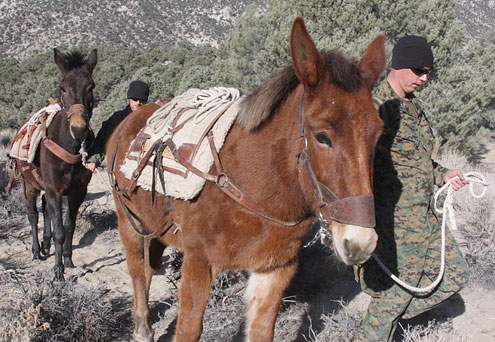
And so soldiers and Marines possibly headed to Afghanistan were at the Animal Packers Course at the Hawthorne (Calif.) Army Ammunition Depot learning how to use mules, donkeys and horses to pack water, ammunition, weapons and medical supplies.

“With vehicles, you have to worry about things like lubrication, tires and fuel,” said Marine Staff. Sgt. Tyler McDaniel. “With animals, you have to think about stuff like shoes and grooming.”

True enough, there may be a call for Farriers in the Marines.  Wonder if that will become a billet?  At any rate, having trained them before, I am partial to quarter horses, and while on their back I have put them in some precarious and dangerous places and positions on the trail.  They are sure-footed and reliable.

But whether horses or mules, the solution may be a millennium old.  Well now.  It looks as if all of that discussion about the health of transport animals in the Small Wars Manual isn’t so dated and irrelevant after all.

Satellite Patrols

16 years, 11 months ago

The tactical brother of the highly strategic Field Manual FM 3-24 has been released, entitled Tactics in Counterinsurgency, FM 3-24.2.  There are certain Milblogs that are known as the beer drinkers in the outer room, raucous and loud.  You know who they are.  Then there are the more sophisticated guys smoking cigars and drinking Bourbon in a more secluded room.  The Captain’s Journal likes to think of itself in the later category.  From time to time the loud boys break into the back room and want to throw down, and we can do that too.  But soon enough we go back to our high brow thoughts and pedantic ways while we draw on a Macanudo.

But our grunt ties come through all of the time, truth be told.  We just can’t hide it.  That’s why we are more of a logistics, weapons and tactics blog rather than a strategy blog, and we secretly break into the outer room to throw down with the boys from time to time.  And so FM 3-24.2 interests us much more than its predecessor, all things being equal.

There will be many opportunities to mine the depths of this magnificent document, and so don’t hold it against us that we start with a seeming random bit of detail.  Satellite patrols.

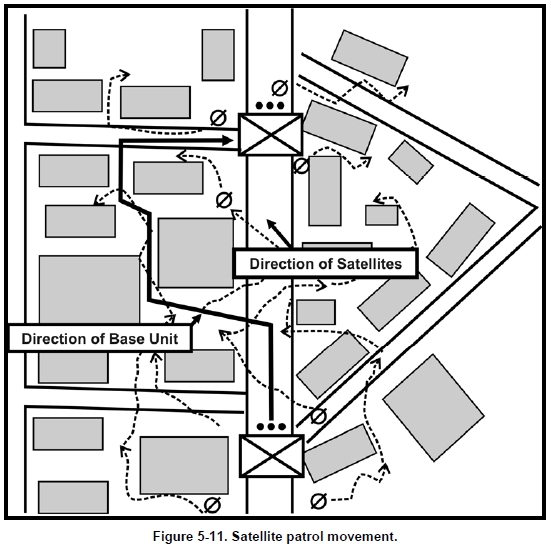
The field manual says (page 166, Section 5-216):

All units must know the overall route and if possible, left and right boundaries. Both the base unit and the satellite units move in ways to confuse the enemy as to the patrol’s actual axis of advance.  Standard movement techniques are still used. Satellites move away from the base unit for limited periods  of time to inspect potential ambush sites, dead spaces, parallel roads, or other assigned missions. The time  that the satellite is separated from the base unit should be prescribed by the patrol leader prior to departure.

It’s a wonderful and effective tactic, the notion of smaller units connected to the larger unit patrolling in diagonal, circular and perpendicular patterns to the main unit, all with the intention of providing force protection for not only the larger unit but itself and the other smaller units as well by confusing the enemy as to the axis of advance.

I have long known about this tactic, as well as some of the finer details not shown or discussed here, but been reluctant to discuss it over the blog since it was unknown whether this should be considered FOUO, OPSEC or something that otherwise shouldn’t be divulged to the enemy.

Think I’m paranoid?  In Marines, Taliban, Tactics Techniques and Procedures, using a Powerpoint presentation I obtained from Michael Yon, I outlined a number of lessons learned from Marine Recon battling the Taliban in highly conventional fights recently in Afghanistan with close to Battalion-sized units of enemy, from their understanding of the use of combined arms, to interlocking fields of fire, to fire discipline, massing forces and other problematic issues stemming from the fact that the Taliban are more skilled than the insurgents in Iraq.  The presentation also had a discussion of Marine tactics to counter the Taliban, some of which had been highly successful.

No sooner did this post go up than I received a note from the Marine officer in Afghanistan (a Small Wars Council member as am I) who authored the presentation.  This officer complained about the release of the document and its presence on this web site, saying that not all Taliban are as skilled as these were and the presence of the presentation on this web site could lead to the education of other Taliban.

Sure, if they had access to electricity, a laptop, Powerpoint and the time to read it, along with a total absence of communication with their colleagues to teach them about these tactics.  Not likely.  But the officer hung his hat on the fact that the document was FOUO, which in reality means that whomever released it in Afghanistan should have been the target of this officer’s complaint, not me.  The term FOUO means nothing to me, since I am the official owner and founder of this web site.

So what do the readers think?  What about revealing the tactics of the Taliban and our counter-tactics, and satellite patrols as applied in urban areas?  Problematic, or not?

Attack on Logistics Near Chaman

16 years, 11 months ago

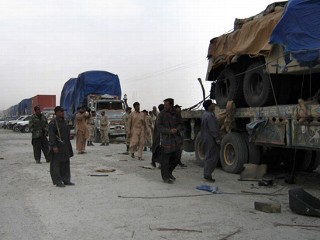
In Caucasus Talks on Logistical Transit Routes for Afghanistan we discussed the recent attack on NATO supplies in Baluchistan province’s Soorab, noting that this seemed to be a new front in the Taliban campaign against logistics.  Now comes a second attack within eight days, this time near the town of Chaman.

Two men on a motorcycle threw a bomb at a truck carrying an excavating machine to NATO troops in Afghanistan, halting traffic Wednesday along a supply route through Pakistan’s southwest, officials said.

No one was injured in the blast near the Pakistani frontier town of Chaman, but the machine was damaged, area police chief Gul Mohammed said.

U.S. and NATO forces in Afghanistan rely heavily on two major supply routes running through Pakistan. The main one goes through the Khyber Pass in the northwest, and trucks that use it have frequently been attacked.

The smaller route through Chaman has attracted less attention from militants, but has not been exempt from violence.

This developing trend to expand the targeting of NATO supplies into the South makes all the more important the trial runs of supplies through the Caucasus and the need to engage that region.  Faster, please.


26th MEU (10)
Abu Muqawama (12)
ACOG (2)
ACOGs (1)
Afghan National Army (36)
Afghan National Police (17)
Afghanistan (704)
Afghanistan SOFA (4)
Agriculture in COIN (3)
AGW (1)
Air Force (41)
Air Power (10)
al Qaeda (83)
Ali al-Sistani (1)
America (22)
Ammunition (304)
Animals (323)
Ansar al Sunna (15)
Anthropology (3)
Antonin Scalia (1)
AR-15s (393)
Arghandab River Valley (1)
Arlington Cemetery (2)
Army (91)
Assassinations (2)
Assault Weapon Ban (29)
Australian Army (7)
Azerbaijan (4)
Backpacking (4)
Badr Organization (8)
Baitullah Mehsud (21)
Basra (17)
BATFE (246)
Battle of Bari Alai (2)
Battle of Wanat (18)
Battle Space Weight (3)
Bin Laden (7)
Blogroll (3)
Blogs (24)
Body Armor (23)
Books (3)
Border War (18)
Brady Campaign (1)
Britain (39)
British Army (36)
Camping (5)
Canada (19)
Castle Doctrine (1)
Caucasus (6)
CENTCOM (7)
Center For a New American Security (8)
Charity (3)
China (19)
Christmas (18)
CIA (30)
Civilian National Security Force (3)
Col. Gian Gentile (9)
Combat Outposts (3)
Combat Video (2)
Concerned Citizens (6)
Constabulary Actions (3)
Coolness Factor (3)
COP Keating (4)
Corruption in COIN (4)
Council on Foreign Relations (1)
Counterinsurgency (218)
DADT (2)
David Rohde (1)
Defense Contractors (2)
Department of Defense (220)
Department of Homeland Security (26)
Disaster Preparedness (5)
Distributed Operations (5)
Dogs (15)
Donald Trump (27)
Drone Campaign (4)
EFV (3)
Egypt (12)
El Salvador (1)
Embassy Security (1)
Enemy Spotters (1)
Expeditionary Warfare (18)
F-22 (2)
F-35 (1)
Fallujah (17)
Far East (3)
Fathers and Sons (2)
Favorite (1)
Fazlullah (3)
FBI (39)
Featured (192)
Federal Firearms Laws (18)
Financing the Taliban (2)
Firearms (1,867)
Football (1)
Force Projection (35)
Force Protection (4)
Force Transformation (1)
Foreign Policy (27)
Fukushima Reactor Accident (6)
Ganjgal (1)
Garmsir (1)
general (15)
General Amos (1)
General James Mattis (1)
General McChrystal (44)
General McKiernan (6)
General Rodriguez (3)
General Suleimani (9)
Georgia (19)
GITMO (2)
Google (1)
Gulbuddin Hekmatyar (1)
Gun Control (1,717)
Guns (2,406)
Guns In National Parks (3)
Haditha Roundup (10)
Haiti (2)
HAMAS (7)
Haqqani Network (9)
Hate Mail (8)
Hekmatyar (1)
Heroism (5)
Hezbollah (12)
High Capacity Magazines (16)
High Value Targets (9)
Homecoming (1)
Homeland Security (3)
Horses (2)
Humor (72)
Hunting (61)
ICOS (1)
IEDs (7)
Immigration (123)
India (10)
Infantry (4)
Information Warfare (4)
Infrastructure (4)
Intelligence (23)
Intelligence Bulletin (6)
Iran (171)
Iraq (379)
Iraq SOFA (23)
Islamic Facism (64)
Islamists (98)
Israel (19)
Jaish al Mahdi (21)
Jalalabad (1)
Japan (3)
Jihadists (82)
John Nagl (5)
Joint Intelligence Centers (1)
JRTN (1)
Kabul (1)
Kajaki Dam (1)
Kamdesh (9)
Kandahar (12)
Karachi (7)
Kashmir (2)
Khost Province (1)
Khyber (11)
Knife Blogging (7)
Korea (4)
Korengal Valley (3)
Kunar Province (20)
Kurdistan (3)
Language in COIN (5)
Language in Statecraft (1)
Language Interpreters (2)
Lashkar-e-Taiba (2)
Law Enforcement (6)
Lawfare (14)
Leadership (6)
Lebanon (6)
Leon Panetta (2)
Let Them Fight (2)
Libya (14)
Lines of Effort (3)
Littoral Combat (8)
Logistics (50)
Long Guns (1)
Lt. Col. Allen West (2)
Marine Corps (281)
Marines in Bakwa (1)
Marines in Helmand (67)
Marjah (4)
MEDEVAC (2)
Media (68)
Medical (146)
Memorial Day (6)
Mexican Cartels (47)
Mexico (71)
Michael Yon (6)
Micromanaging the Military (7)
Middle East (1)
Military Blogging (26)
Military Contractors (5)
Military Equipment (25)
Militia (9)
Mitt Romney (3)
Monetary Policy (1)
Moqtada al Sadr (2)
Mosul (4)
Mountains (25)
MRAPs (1)
Mullah Baradar (1)
Mullah Fazlullah (1)
Mullah Omar (3)
Musa Qala (4)
Music (25)
Muslim Brotherhood (6)
Nation Building (2)
National Internet IDs (1)
National Rifle Association (97)
NATO (15)
Navy (31)
Navy Corpsman (1)
NCOs (3)
News (1)
NGOs (3)
Nicholas Schmidle (2)
Now Zad (19)
NSA (3)
NSA James L. Jones (6)
Nuclear (63)
Nuristan (8)
Obama Administration (222)
Offshore Balancing (1)
Operation Alljah (7)
Operation Khanjar (14)
Ossetia (7)
Pakistan (165)
Paktya Province (1)
Palestine (5)
Patriotism (7)
Patrolling (1)
Pech River Valley (11)
Personal (76)
Petraeus (14)
Pictures (1)
Piracy (13)
Pistol (4)
Pizzagate (21)
Police (672)
Police in COIN (3)
Policy (15)
Politics (998)
Poppy (2)
PPEs (1)
Prisons in Counterinsurgency (12)
Project Gunrunner (20)
PRTs (1)
Qatar (1)
Quadrennial Defense Review (2)
Quds Force (13)
Quetta Shura (1)
RAND (3)
Recommended Reading (14)
Refueling Tanker (1)
Religion (499)
Religion and Insurgency (19)
Reuters (1)
Rick Perry (4)
Rifles (1)
Roads (4)
Rolling Stone (1)
Ron Paul (1)
ROTC (1)
Rules of Engagement (75)
Rumsfeld (1)
Russia (37)
Sabbatical (1)
Sangin (1)
Saqlawiyah (1)
Satellite Patrols (2)
Saudi Arabia (4)
Scenes from Iraq (1)
Second Amendment (708)
Second Amendment Quick Hits (2)
Secretary Gates (9)
Sharia Law (3)
Shura Ittehad-ul-Mujahiden (1)
SIIC (2)
Sirajuddin Haqqani (1)
Small Wars (72)
Snipers (9)
Sniveling Lackeys (2)
Soft Power (4)
Somalia (8)
Sons of Afghanistan (1)
Sons of Iraq (2)
Special Forces (28)
Squad Rushes (1)
State Department (23)
Statistics (1)
Sunni Insurgency (10)
Support to Infantry Ratio (1)
Supreme Court (79)
Survival (214)
SWAT Raids (58)
Syria (38)
Tactical Drills (38)
Tactical Gear (17)
Taliban (168)
Taliban Massing of Forces (4)
Tarmiyah (1)
TBI (1)
Technology (21)
Tehrik-i-Taliban (78)
Terrain in Combat (1)
Terrorism (96)
Thanksgiving (13)
The Anbar Narrative (23)
The Art of War (5)
The Fallen (1)
The Long War (20)
The Surge (3)
The Wounded (13)
Thomas Barnett (1)
Transnational Insurgencies (5)
Tribes (5)
TSA (25)
TSA Ineptitude (14)
TTPs (4)
U.S. Border Patrol (8)
U.S. Border Security (22)
U.S. Sovereignty (29)
UAVs (2)
UBL (4)
Ukraine (10)
Uncategorized (105)
Universal Background Check (3)
Unrestricted Warfare (4)
USS Iwo Jima (2)
USS San Antonio (1)
Uzbekistan (1)
V-22 Osprey (4)
Veterans (3)
Vietnam (1)
War & Warfare (432)
War & Warfare (41)
War Movies (4)
War Reporting (21)
Wardak Province (1)
Warriors (6)
Waziristan (1)
Weapons and Tactics (80)
West Point (1)
Winter Operations (1)
Women in Combat (21)
WTF? (1)
Yemen (1)

February 2026
January 2026
December 2025
November 2025
October 2025
September 2025
August 2025
July 2025
June 2025
May 2025
April 2025
March 2025
February 2025
January 2025
December 2024
November 2024
October 2024
September 2024
August 2024
July 2024
June 2024
May 2024
April 2024
March 2024
February 2024
January 2024
December 2023
November 2023
October 2023
September 2023
August 2023
July 2023
June 2023
May 2023
April 2023
March 2023
February 2023
January 2023
December 2022
November 2022
October 2022
September 2022
August 2022
July 2022
June 2022
May 2022
April 2022
March 2022
February 2022
January 2022
December 2021
November 2021
October 2021
September 2021
August 2021
July 2021
June 2021
May 2021
April 2021
March 2021
February 2021
January 2021
December 2020
November 2020
October 2020
September 2020
August 2020
July 2020
June 2020
May 2020
April 2020
March 2020
February 2020
January 2020
December 2019
November 2019
October 2019
September 2019
August 2019
July 2019
June 2019
May 2019
April 2019
March 2019
February 2019
January 2019
December 2018
November 2018
October 2018
September 2018
August 2018
July 2018
June 2018
May 2018
April 2018
March 2018
February 2018
January 2018
December 2017
November 2017
October 2017
September 2017
August 2017
July 2017
June 2017
May 2017
April 2017
March 2017
February 2017
January 2017
December 2016
November 2016
October 2016
September 2016
August 2016
July 2016
June 2016
May 2016
April 2016
March 2016
February 2016
January 2016
December 2015
November 2015
October 2015
September 2015
August 2015
July 2015
June 2015
May 2015
April 2015
March 2015
February 2015
January 2015
December 2014
November 2014
October 2014
September 2014
August 2014
July 2014
June 2014
May 2014
April 2014
March 2014
February 2014
January 2014
December 2013
November 2013
October 2013
September 2013
August 2013
July 2013
June 2013
May 2013
April 2013
March 2013
February 2013
January 2013
December 2012
November 2012
October 2012
September 2012
August 2012
July 2012
June 2012
May 2012
April 2012
March 2012
February 2012
January 2012
December 2011
November 2011
October 2011
September 2011
August 2011
July 2011
June 2011
May 2011
April 2011
March 2011
February 2011
January 2011
December 2010
November 2010
October 2010
September 2010
August 2010
July 2010
June 2010
May 2010
April 2010
March 2010
February 2010
January 2010
December 2009
November 2009
October 2009
September 2009
August 2009
July 2009
June 2009
May 2009
April 2009
March 2009
February 2009
January 2009
December 2008
November 2008
October 2008
September 2008
August 2008
July 2008
June 2008
May 2008
April 2008
March 2008
February 2008
January 2008
December 2007
November 2007
October 2007
September 2007
August 2007
July 2007
June 2007
May 2007
April 2007
March 2007
February 2007
January 2007
December 2006
November 2006
October 2006
September 2006
August 2006
July 2006
June 2006
May 2006

about · archives · contact · register

Copyright © 2006-2026 Captain's Journal. All rights reserved.