Articles by Herschel Smith


The “Captain” is Herschel Smith, who hails from Charlotte, NC. Smith offers news and commentary on warfare, policy and counterterrorism.


Why are we in the Helmand Province?

16 years, 5 months ago

In Helmand is a Sideshow – Or Not I addressed the charge that had been leveled in a WSJ article that Helmand was a sideshow to the real fight.  Summarizing, the author said:

American forces have been waging a major offensive in the neighboring southern province of Helmand, the center of Afghanistan’s drug trade. Some U.S. military officials believe the Taliban have taken advantage of the American preoccupation with Helmand to infiltrate Kandahar and set up shadow local governments and courts throughout the city.

“Helmand is a sideshow,” said the senior military official briefed on the analysis. “Kandahar is the capital of the south [and] that’s why they want it.”

I responded:

The Helmand Province is the home of the indigenous insurgency, the Afghanistan Taliban, and its capital is Lashkar Gah.  Without hitting the Taliban’s recruiting grounds, fund raising and revenue development, training grounds, and logistical supply lines, the campaign cannot be won.  Focusing on the population centers is a loser strategy, doomed to sure failure.  Controlling the cities as some sort of prison while the roads are all controlled by Taliban is just what the Russians did, only to withdraw in ignominy.  The Marines are in Helmand because just like Anbar, Iraq at the time, it is the worst place on earth.

But the narrative won’t go away, and even seems to be gaining momentum.  Joe Klein weighs in with the next installment.

The U.S. military does not move in mysterious ways. It plods, it plans, it plots out every logistical detail before launching an initiative. Things take time. For example: not all of the 21,000 additional forces that President Obama authorized for Afghanistan last winter have even arrived in the country yet. For another example: the battle plan those troops were asked to execute was devised primarily by General David McKiernan, who was replaced about the time the troops started arriving. McKiernan’s plan reflected his experience in conventional warfare: he chose to deploy the troops where the bad guys were — largely in Helmand province on the Pakistani border, home of nearly 60% of the world’s opium crop, a place that was firmly in Taliban control. But pursuing conventional warfare in Afghanistan is about as effective as using a football in a tennis match. The Army’s new counterinsurgency doctrine says you go where the people are concentrated and protect them, then gradually move into the sectors the bad guys control. That is not what we’re doing in Afghanistan. In addition to all the other problems we’re facing — the corruption of the Karzai government, the election chaos, the porous Pakistani border — it has become apparent that we’re pursuing the wrong military strategy in this frustrating war.

Note how the narrative has graduated to the strategy being implemented was McKiernan’s, not McChrystal’s, and McChrystal had no choice in the matter due to logistical inertia.  Continuing with the “McChrystal is powerless to change things” meme:

Upon his arrival in Afghanistan as McKiernan’s replacement last June, General Stanley McChrystal was pretty much presented with a fait accompli: the troops were arriving in Helmand. “The ship was moving in that direction,” a military expert told me, “and it would have been difficult to turn it around.” Indeed, it would have taken months of planning to change course. The additional troops were needed immediately to blunt the momentum of the Taliban and also to provide security for the Afghan elections. The trouble was, the troops would have been better deployed in Helmand’s neighbor to the east — Kandahar province, especially in Kandahar city and its suburbs. “Kandahar is the center of gravity in this insurgency,” says John Nagl, a retired lieutenant colonel who helped write the Army’s counterinsurgency doctrine. “It is as important now as Fallujah was in Iraq in 2004.”

Kandahar is the capital city of Afghanistan’s Pashtun majority, home of both the Karzai family and Mullah Omar, leader of the Taliban. It is where the Taliban began. It has been run, in a staggeringly corrupt manner, by Hamid Karzai’s brother Ahmed Wali Karzai — who, according to U.S. investigators, has extensive links to the opium trade. As the Karzai government has grown more unpopular, the situation in Kandahar has deteriorated. The Taliban own the night, slipping death threats under the doors of those who would cooperate with the government. In Iraq the military’s counterinsurgency strategy turned around a similarly bleak urban situation — notably in Baghdad, where U.S. troops helped the Iraqis regain control of neighborhoods by setting up and staffing joint security stations. But the troops who should be securing Kandahar are fighting an elusive enemy in Helmand.

Following Clausewitz into a single center of gravity for a campaign is the reason behind Center of Gravity Versus Lines of Effort in COIN, and I still continue to believe that nothing so easy and clear will present itself as a single focal point for our efforts.  But the statement concerning Fallujah in 2004 is odd.

Kandahar doesn’t seem anything like Fallujah in 2004.  The security situation in Kandahar may be degrading, but in Fallujah it was so bad that at the beginning of al Fajr the city was free of noncombatants and only fighters were left behind, many or most of whom were high on epinephrine and morphine.  The campaign in Anbar saw more than 1000 U.S. Marines perish, way more than have died in Operation Enduring Freedom between all branches of the service.  Fallujah saw continued operations into 2007 with Operation Alljah, but during the fight for Anbar Marines were also deployed to Haditha, al Qaim, Hit, the Syrian border and other rural areas.

The argument to control the streets of Kandahar makes sense if that argument doesn’t also hinge upon removing the Marines from Helmand where the fighters recruit, train, raise their support, and get ingress to and egress from Afghanistan.  In Now Zad Taliban fighters have been so unmolested that they have used that area for R&R.  The city of Now Zad – with an erstwhile population of 30,000+ civilians – is deserted with only insurgents remaining to terrorize the area so that inhabitants don’t return.  The Marines are so under-resourced that they can only fight the Taliban to a standstill.  It is so dangerous in Now Zad that the Marines deployed there are the only ones to bring two trauma doctors with them.

It is a strange argument indeed that sends Marines to Kandahar while the insurgents in Now Zad have separated themselves off from civilians and invited a fight.  So send more Marines to Kandahar to control the streets.  The Taliban bullying will stop once a Regimental Combat Team arrives.  This should not be too difficult to pull off.  As I have said before, there are so many Marines at Camp Lejeune that some units are not even in the same barracks, and more barracks are being built.  Not since the start of Operation Iraqi Freedom has the Corps been so large with so many Marines garrisoned in the states.  Furthermore, if they aren’t in the states they are on board amphibious assault docks doing nothing.  Entire Battalions of Marine infantry – doing nothing for nine months.

But if the resources to control Kandahar are there, the argument to remove them from Helmand is not.  Whether the sources for the WSJ and Joe Klein’s article are wishing for the narrative to gain traction or there is in reality a sense that Helmand is a sideshow is irrelevant.  The strategists need to sense the reality that Helmand is not a sideshow, and that it is a very real line of effort in the campaign.  Without hitting the insurgents where they live we will follow the Russians out of Afghanistan.

Marines in Kunar

16 years, 5 months ago

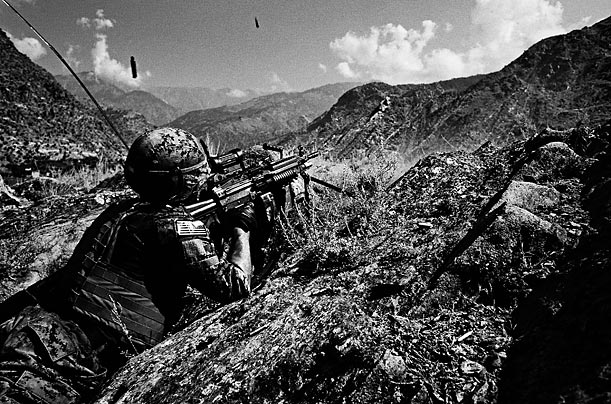
Marine_Watapor_Valley

A U.S. Marine fires at Taliban fighters during an insurgent attack on U.S. and Afghan troops in the Watapor Valley.

Did ROE Lead to Marine Deaths?

16 years, 5 months ago

Uncle Jimbo at Blackfive is at the same time entertaining, sardonic, witty, and when he wants to be, quite serious.  He is an asset to the Milblogging community, certainly more so than I.  But occasionally we must disagree, and I’m sure that James is okay with that.  Today is one of those times.  He writes:

The answer is no. Michelle Malkin has a post up now titled “Report: Rules of engagement led to soldiers’ deaths”. I wrote her to explain why this is not the case.

When Gen. McChrystal released his new Tactical Directive there was much consternation about the fact that there were strict limitations about when strikes against civilian locations were authorized. This was done to change our methods of dealing with enemy activity from dropping a bomb or indirect fire on them, to disengaging if possible to avoid killing civilians. This is a wise move if we are ever to gain the trust and help of the Afghan people. The new directive specifically states that if a unit cannot safely disengage, then they can use fire support against civilian locations.

But it was not the Rules of Engagement (ROE) that caused their deaths. If this report from a McClatchy journalist is accurate then mistakes were made. But the mistakes were in improperly applying the ROE and in disregarding the commander on the ground saying that there were no civilians in jeopardy regardless. If as reported they were denied this fire support due to an overly tight and wrong interpretation of the ROE, and worse if the chain of command failed to listen to the unit in contact advising that the call for fire would not harm civilians, then heads should roll. But let’s find out if that is the case before we jump to judgment. And you will pardon me if I decline to take a story published by one journalist as the gospel truth on this. None of this, however, points to the ROE as the cause of these Marines deaths.

Where Michelle has been is an enigma.  I covered this eight days ago.  But without rehearsing again the idea that there are unintended consequences to every action we ever take or decision we ever make (including ROE), we’ll tackle only the issue of this specific engagement.

First, as for the McClatchy reporter, I see no reason to doubt his account.  I wasn’t there.  Second, based on direct reports on ROE experiences from a certain Marine with whom I am close, an Army intelligence contact based in Ramadi several years ago, and extensive interviews of other Marines, I just don’t think it’s as clear as follow the written ROE and if you fail to provide support for your troops you’re an incompetent toad and should be flogged.  Things that are made out to be black and white are in reality under the stress and pressure and fog of battle only shades of gray.

Based on all indications, there is no question that the ROE contributed to this catastrophe.  It may not have been the only contributing cause, but it weighs large in the scheme of things.  A different decision, i.e., to support the Marines with artillery, might have averted the deaths of four Marines.  That decision was made based on the rules as they commanders understood them.  The communications they had directly from the battle had to be sifted through “what ifs,” and “is it possible that,” and the knowledge that Lt. Col. Chessani was brought up on charges for merely failing to conduct an investigation over the incidents at Haditha, Iraq.

So it’s one thing to demand that heads roll, and quite another to acknowledge that the formal rules by which our warriors are charged with crimes might have led to being hamstrung during battle.  As I have observed before, the counsel to consider the holistic consequences of actions in battle should never have been dealt with as a set of rules or a tactical directive.

Generals should teach, enable, inspire, create strategy, and lead.  When they issue tactical directives to Lance Corporals and Sergeants in the field, our military establishment has lost its way in a morass of micromanagement and unnecessary details.

Cyber Exploitation

16 years, 5 months ago

Today at The Captain’s Journal:

Cyber_Exploitation

Take careful note.  This is a visit from the Chinese Army, searching the terms “cyber exploitation and offensive operations.”

Now recall TCJ articles:

China’s Escalating Unrestricted Warfare Against the U.S.

China and U.S. at War

China’s Unrestricted Warfare Against the U.S.

Knife Blogging

16 years, 5 months ago

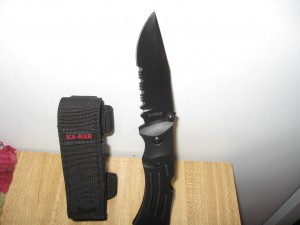
I have had my eyes on a knife at the MCX (Marine Corps Exchange) at Camp Lejeune for a while, and Sunday it was purchased for me.

2009C 398

This is considered by Ka-Bar to be a utility knife (at least, it is included under the rubric “utility” on their web site).  But I must admit that in a long history of ownership of knives I have never held such a solid, hefty knife with such close machining precision in the action.  It has a stainless steel blade with a partially serrated edge, and it is extremely sharp.  Its folder is heavy enough that it has the feel of something special – something different than the simple camping and hiking knife.  It has a no-slip grip.

The sheath shows that Ka-Bar knows that this is more than a utility knife.  It holds the knife tight and has a belt loop or two loops for molle strap attachment to a tactical vest, vertical or horizontal orientation with Velcro and snap closure.  This would be a good gift for a Soldier or Marine deploying to Iraq or Afghanistan.

Ka-Bar has their own description.  They call it the Mule Folder, Serrated Edge.  I’m not saying anything about the price at the MCX compared to commercial price.

Taliban IEDs as TTPs

16 years, 5 months ago

From The Washington Times:

The Taliban has been building simpler, cheaper anti-personnel bombs made of hard-to-detect nonmetal components, increasing the number of lethal attacks on NATO forces in Afghanistan, according to a confidential military report.

The shift in the use of improvised explosive devices (IEDs) away from larger anti-armor bombs has allowed the Taliban to produce more weapons and hide them in more places as they strive to kill larger numbers of American forces in southern Afghanistan’s Helmand province and other contested regions.

The change in production from metal-dominated explosives to devices made of plastic is making it more difficult for ground troops to detect the buried IEDs with portable mine-detectors, creating an “urgent need” inside the Pentagon for better detection devices, the report said.

The new Taliban tactics are disclosed in a confidential report from the Pentagon’s Joint Improvised Explosive Device Defeat Organization, portions of which were obtained by The Washington Times.

The area around Now Zad, northwest of Kandahar, has experienced some of the most ferocious fighting for control of southern Afghanistan since the surge of 21,000 U.S. troops began last spring. News reports and military bloggers say Marines on patrol face a constant threat from hidden IEDs.

“Although the Taliban still fights with small-arms, rocket-propelled grenades and improvised explosive devices, they have increasingly focused the role of IEDs as antipersonnel devices,” the report said. “Smaller, lighter, more quickly constructed and quite often triggered by a victim-operated switch [booby trap], these antipersonnel IEDs have been a significant factor in labeling Now Zad the most dangerous location with the highest U.S. casualty rate in either the Afghan or Iraq theaters.”

The Aug. 11 report, titled, “The Taliban’s Emerging IED TTPs in the Proving Grounds of Now Zad, Helmand Province,” was written by an analyst at U.S. Central Command, which oversees troops in the Middle East and Afghanistan. TTPs is short for tactics, techniques and procedures …

In the past two months, more than half of the battlefield deaths suffered by NATO troops were caused by IEDs. This month, of 31 fatalities, 15 came from IEDs; in August, 46 of the 77 coalition deaths resulted from these devices, according to icasualties.org.

The Pentagon report said the Taliban IED research-and-development program used the Now Zad region to show that smaller, more numerous IEDs kill more people. The rate for dead and wounded for the 2nd Battalion, 7th Marine Regiment stood at one-third of the unit in August, the report said. A typical Marine battalion has 800 to 1,000 troops.

A military official, who monitors Afghanistan and asked not to be named because he was not authorized to speak to the media, said the Taliban is shifting to small IEDs for a number of reasons.

“You’ve got the fear factor,” the source said. “It’s also less costly. It’s easier for them to build those things and use them as opposed to running the risk of getting in firefights and losing people. The cost is relatively low. We’re fighting guys who from all appearances are from three centuries ago, but we can’t figure out how to beat them.”

The Pentagon report said the Taliban has become adept at mining a road called the “Pakistani Alley” — so-named because Taliban militants use it to ferry in new fighters from the neighboring country.

“U.S. troop movements are split between foot and mounted patrols,” the report said. “The terrain and deplorable road conditions often necessitate that foot patrols be conducted on uneven terrain. The Taliban have taken advantage of this by littering the area north of ‘Pakistani Alley’ with numerous antipersonnel IEDs to maintain control over their northern buffer-zone.”

Robert Maginnis, a military analyst and Army adviser, said IEDs are tailor-made for Afghanistan.

“IEDs are effective in Afghanistan in part because of the terrain,” Mr. Maginnis said. “There are few paved roads, which means planting a device in or near a road is easier and harder to detect by visual inspection. The increase in Taliban use of IEDs is due to the increased coalition forces in country, which forced the relatively small Taliban force to adjust its tactics. It stretches the force’s impact.”

Lt. Col. Edward Sholtis, a spokesman for Gen. Stanley McChrystral, the top commander in Afghanistan, told The Times the general has stepped up efforts to disrupt networks before they can plant bombs, and get better intelligence on where they are embedded in light of “the weapons’ increasing use against coalition forces and because of the impact of a larger number of indiscriminate, victim-operated IEDs on the Afghan people.”

I would like to get a copy of this report, but my web-based e-mail for the web site (contact information) isn’t currently working.  No one has covered Now Zad like I have, and that merits some consideration.  Either way, it’s good to get better intelligence, and the article ends with technological advancements that may help in the detection of IEDs of this kind, but these are only half-way measures.  As we discussed in On the Front Lines with the Marine in Helmand, there aren’t enough Marines in place to prevent Taliban brutality towards the Afghans who would otherwise want to cooperate.  Intelligence to shut down the traffickers in IEDs will only go so far.  Force Projection is necessary.

We must go after them where they live, where they traffic their supplies, and where they recruit and train.  We must shut down their logistics, kill their fighters, and cause them to live in fear.  We must cause them to stay on the run such that they have neither the time nor supplies to construct or emplace IEDs.  Only then will they be so preoccupied with staying alive that they forget the population.  Then we will have won.  IEDs will no longer be a problem because the Taliban aren’t a problem.  They go hand in hand, and one will not be defeated without the other.  We cannot first defeat IEDs and then the Taliban – just like it was in Iraq.

Insurgents Emplacing IED Blow Themselves Up

16 years, 5 months ago

A group of insurgents emplacing a makeshift bomb in a dirt road in southern Afghanistan inadvertantly blow themselves up while U.S. Apaches from the 82nd Combat Aviation Brigade look on.

On the front lines with the Marines in Helmand

16 years, 5 months ago

The Independent has an informative article on U.S. Marine Corps operations in Helmand.  Much of it is reproduced below.

Battling through the dense, towering corn fields, the heavily armed US marines trudged through Taliban territory, every arduous step sinking into deep cloying mud. In the background, the thunder of artillery rounds boomed.

Suddenly, a burst of Pashtu emanated from the radio set monitoring Taliban chatter. “They say they have got eyes on. They are waiting on us,” translated one of the marines. “Can we ask them where they are?” another replied sardonically.

The think tank International Council on Security and Development (Icos) announced last week that there had, yet again, been an increase in Taliban activity across Afghanistan. Its research revealed the insurgents had a permanent hold in 80 per cent of the country, up from 72 per cent last year and 54 per cent in 2007.

In this remote part of the green zone bordering the Helmand river, their defiant presence is blatant. As the marine patrol approached the tiny hamlet of Herati, they were greeted by a volley of bullets before an agonising pause. The troops sat as the day turned into a furnace, beads of sweat sliding down their faces, listening to the Taliban prepare their assault. Huey and Cobra attack helicopters circled overhead.

Suddenly rounds from rifles and Russian machine guns began raining down from a collection of compounds just a few hundred yards away over a small canal. The marines dropped on to their bellies and returned fire. Enemy bullets cracked over their heads and danced in the dust, but none hit their targets and the other side eventually fell back. The scream of a Harrier fast jet, low over the compounds, provided a parting warning.

It was one of three fire fights the 2nd Platoon endured during a seven-hour patrol on Friday 11 September, a symbolic anniversary of the terrorist attack that led these young servicemen to Afghanistan.

But worse was to come. As they made their way back through the corn fields, Corporal Andrew Bryant halted abruptly, his foot caught. He looked down to find it was tangled in two copper command wires, which an explosives team discovered were linked to a daisy chain of IEDs (improvised explosive devices) along the patrol’s route. If it had detonated, Cpl Bryant would not have been the only victim.

“I thought, ‘Oh my God. This is going to be it, right here.’ I am not scared of a fire fight. They can shoot at me all day. But the IEDs you have no idea when it is going to come at you. You never have any idea when your time is up,” said the 21-year-old New Yorker. “We have already had problems with them. My friend lost his legs, and two others were killed [when a vehicle hit a roadside bomb]. “That’s the best way they can get at us. They know they can’t beat us with conventional arms” …

While recent reports show that the insurgency has grown in the north and Kabul, it is in its traditional strongholds in the south and east that it remains at its deadliest. On 2 July, 4,000 US marines were dropped at key points in Garmsir district, Helmand, a staging post for the Taliban moving north from the Pakistani border.

Echo Company, 2nd Battalion, 8th Marines were ordered to take the southernmost point. After four days of intense fighting, they established combat operating Post (COP) Sharp – named after Lance Corporal Charles “Seth” Sharp, 20, who was killed on the first day – in Mian Poshtay. For the past two months, in daily battles, they have attempted to purge the area of a defiant Taliban while trying to convince the locals that they are here to help and, more importantly, to stay …

Slowly, some of the local farmers have started to listen, but fear of retribution is everywhere. After the battle on Friday, a man appeared from nowhere to give the marines information on the Taliban positions before disappearing into the fields once more.

In nearby Lakari market, Taliban stroll with impunity through stalls that sell opium and ammunition as well as fruit and vegetables. From the dialect that can be heard over the radio chatter during a fight, it is obvious that many are from Pakistan, where they have training camps near the border. This is the main supply route into Helmand, through which smugglers bring drugs, weapons and fighters to battle the British and American troops to the north. Once over the border into Baramcha, they move up to Safaar, where they receive weapons and orders, before heading into Lakari.

The locals in Mian Poshtay, either through fear or a strong sense of traditional Pashtunwali that demands they welcome them into their homes, continue to feed and harbour them. Others are interwoven in the community. As Captain Eric Meador, commanding officer of Echo Company, explained, the village tractor mechanic may also be a local fighter.

The Americans have put on a show of force, sending out patrols, meeting ambushes with overwhelming power. When four armed men were spotted by surveillance a few days ago laying an IED, mortars obliterated the team. The Americans informed the locals that those waging this un-Islamic war would meet the same fate. But they know they face a chicken-and-egg situation: to provide security to local people, they must cut off the Taliban supply line. But to convince farmers to co-operate, they must provide security. The locals, the Americans insist, are tiring of the insurgents. In the past couple of weeks, people have tentatively come forward with information and requests for medical help.

A boy of eight turned up at the gate yesterday with his three smaller brothers and his sick baby sister. As the doctor tended the youngest, Captain Meador gave the children liquorice and toys. “They are expecting you to be these big mean people the Taliban tell them the Americans are and I sat down and blew soap bubbles with them. Their faces just lit up,” said the officer.

“We are keeping the enemy away from population areas that are a little bit better – neutral to positive. I think the people around here want change but there has not been enough time.”

Last Monday, 20 elders turned up at shura, a meeting organised by the US marines. Among them were suspected Taliban sympathisers. Others genuinely appeared to want to co-operate. Many more would have liked to attend, they said, but were too afraid. One of them, Mirza, explained: “The Taliban said we will cut off your head, your fingers, if you go to the shura. But we had to come. The most important thing is peace, prosperity and security and no civilians are killed.”

Two days later, when the governor of Garmsir made a rare trip to the region, only a handful of old men came. The reason became obvious 24 hours later when one of the original attendees turned up at COP Sharp to display the wounds on his legs; he had been whipped. The elders who had attended the first shura, he said, had been taken to Lakari and beaten.

First off, I find it annoying that professional journalists cannot seem to follow proper grammatical rules and capitalize the word Marine.  The word marine refers to inhabiting, related to or formed by the sea.  Marines are the subject of the article.  The difference is in a letter, and journalists should get it right.

But getting on to the major points of the article, it’s obvious that although the Taliban are, generally speaking, tactically sound fighters compared to insurgents in Iraq, they are lousy shots (unlike many in Iraq).  This report follows the same theme as just about every other report from Afghanistan, whether ANA or Taliban.  Their roadside bombs and IEDs are lethal, their shooting not so much.

The campaign is winnable, but note that as we have observed before, there aren’t enough Marines or logistics to engage in the chase.  With only 4000 U.S. Marines in Helmand, the Taliban easily have enough terror on their side to prevent the locals from siding too easily with the Marines.  Beatings and whippings are commonplace with the Taliban, and the best way to ensure that the Taliban don’t have the time or wherewithal to brutalize the population is to chase them, kill their fighters, interdict their lines of logistics, and police the terrain.  In short, aggressive military and policing action is the only solution, and that requires more Marines.

I recently had an extended conversation (one of many such) with a certain Marine about his experiences in Fallujah in 2007, and while I was reminded at how heavy the kinetics was early on, I was also reminded of how much interaction the Marines had with the population.  In addition to heavy combat operations, their time in Fallujah may be said to have been policing on steroids.  The same will have to hold true for Helmand or we will not win it.

Finally, recall that we recently discussed Discerning the Way Forward in Afghanistan where I addressed – wearily, for the hundredth time – the small footprint model for Afghanistan, what a miserable failure it has been, and how it cannot hope to succeed.  Is this report from The Independent anything other than confirmation in the superlative that the hunter killer teams concept will not work?  Intelligence suffers because the Marines are not plentiful enough to protect the population from the Taliban, and they are 4000 strong in Helmand.  What happens if we bring the Marines home and send a few teams of Rangers to the Helmand Province?  Answer: the Rangers die within days.

Discerning the Way Forward in Afghanistan

16 years, 5 months ago

General Charles Krulak wrote George Will a letter in response to his invective on the current campaign.  Will wants to withdraw, and Krulak supports that idea with the exception of a few SOF troopers.  I won’t address every one of Krulak’s points, but several observations are in order.

Krulak notes that U.S. troops are being run ragged and the armed forces cannot support the real surge needed for Afghanistan – more like hundreds of thousands, not thousands.  Furthermore, there are equipment repairs and rebuilds, and this bill is likely to be large.

Krulak is of course right in his assertion that there are serious equipment issues, and it would have been wise to spend more of the “free money” Timothy Geithner has been printing to support the armed forces.  It’s not that the equipment concerns are not within the power and ability for the U.S. to bear.  It’s that the administration has chosen to do other things.  Let’s be clear – this is a political decision rather than a financial impossibility.

But we shouldn’t press this issue of the armed forces being incapable of bearing the burden too far.  There are so many Marines currently at Camp Lejeune that they are building more barracks, and that construction isn’t happening fast enough.  The Marines are no longer in Anbar (for the most part).  They are one of three places: (Camp Pendleton, Camp Lejeune, or on board amphibious assault docks as part of MEUs – with a few in Afghanistan and also a very few in Anbar).  I have never believed that the ratio of troops to population outlined in FM 3-24 obtains for every situation, and the Marines are a force multiplier.  With so many Marine infantry sitting on board ships or garrisoned in the U.S., it’s not hard to envision many more deployed to Afghanistan in support of the campaign.  This is especially true since the policy of MEUs relies on the possibility of actually using our forces in readiness, and throughout the history of this concept we have not.

But eventually in his somewhat rambling letter General Krulak hits his real problem, and it isn’t that we can’t sustain the effort.  It’s that he doesn’t see the strategic value of the effort.  Who is the enemy?  Is it al Qaeda?  Why?  Is it the Taliban?  Why?  Those questions must be posed and answered immediately, says Krulak.

He closes with an odd observation given that he just before said it wasn’t obvious that we had any enemies in Afghanistan.  He wants to deploy HK (hunter-killer) teams to kill the enemy he says doesn’t exist.  He is apparently a proponent of the small footprint high value target (HVT) model which we have implemented for the last eight years.

Next comes Paul Yingling who responds to General Krulak with an absolute affirmative that AQ and affiliates pose a threat to the West; that developing a host nation security force is a cornerstone of counterinsurgency operations; and that most of the troops that protect the population will come from indigenous forces.

We will deal first with several comments directed at Yingling, next at Krulak’s basic argument, and then finally at Yingling’s basic argument.  In my opinion, all three are flawed.  I will lead off with my good friend Gian Gentile, whose thoughts I always follow and whose demeanor and scholarship I always admire.  Responding to Yingling, Gian comments:

I find it deeply ironic that you of all people, Paul, the author of that most important article of two years ago, “A Failure of Generalship” would find fault with one of our most ablest generals and to be sure one of the first on Afghanistan to finally start talking strategy and not the mind-numbing repetitions of the catechisms of nation building. I have been tempted to have a shot at writing a sequel to your important first essay, but this one would be titled “A Failure of Generalship Version 2: What Population Centric Counterinsurgency and Nation Building has done to the American Army’s General Officer Corps and its Inability to do Strategy.”

As you know Paul, it was not failure at tactics and operations that lost the war for us in Vietnam, but a failure at strategy. So too today do we walk down that same road with dysfunctional strategy in Afghanistan. General Krulak was taking a realistic view of our policy objectives in Afghanistan, he considered alternatives based on a realistic expectation of available resources, then applied a deep knowledge of military experience, and concluded that there are other and better ways to proceed in Afghanistan that still get at our interests there. Yet for once, when we finally have a general officer talking strategy, you chose instead to pummel him for apparently falling out of your cherished “gets it” club of General Officers.

If nothing else Paul, at least you might consider embracing the argument of this great marine General for stirring an important debate ON STRATEGY that is vitally needed.

I agree with Gian that counterinsurgency is “a set of tactics rolled up into a discrete form of military operation.”  Counterinsurgency can never be a strategy.  It can only be a set of tactics and procedures.  If implemented, it must be so within the larger context of a strategy, and that’s what has been lacking for Afghanistan – or so the charge goes.  Mark O’Neill makes a few silly claims regarding Gian’s comments, and Schmedlap rather sardonically asks “It appears that Ghazni province is falling to the Taliban. Should we brace for an imminent terrorist attack upon our nation?”

Yingling the weighs in with a response, which includes this precursor to my own response:

If one rejects the premises that we are threatened by al-Qaeda and have an interest in a stable Afghanistan, then the ‘hunter-killer’ approach is unnecessary. The logical policy prescription for those who hold these views is withdrawal of our forces from Afghanistan.

There have been no attacks on the American homeland since those of 9/11 because al Qaeda and affiliates have been rather busy in both Iraq and Afghanistan.  But it’s wrong to say that foreign fighters aren’t being trained or coming to Afghanistan to train and export that violence.  The Northern Provinces are even coming back under the sway of the Taliban, and those fighters are transnational.  A police officer in the Kunduz Province said ” the Taliban in his region included fighters from Pakistan, Uzbekistan and Russia’s rebel region of Chechnya, adding they were gaining strength across the entire northern belt where Afghanistan borders ex-Soviet Central Asia.”

In fact, Afghanistan is gradually falling back under the control of the Taliban.  The International Council on Security and Development recently released this statement.

The Taliban now has a permanent presence in 80% of Afghanistan, up from 72% in November 2008, according to a new map released today by the International Council on Security and Development (ICOS). According to ICOS, another 17% of Afghanistan is seeing ‘substantial’ Taliban activity. Taken together, these figures show that the Taliban has a significant presence in virtually all of Afghanistan.

“The unrelenting and disturbing return, spread and advance of the Taliban is now without question,” said Norine MacDonald QC, President and Lead Field Researcher for ICOS.

Previous ICOS maps showed a steady increase in the Taliban’s presence throughout Afghanistan. In November 2007, ICOS assessed that the Taliban had a permanent presence in 54% of Afghanistan, and in November 2008, using the same methodology; the result was a finding of a permanent Taliban presence in 72% of the country.

The new map indicates that the Taliban insurgency has continued to expand its influence across Afghanistan. “The dramatic change in the last few months has been the deterioration of the situation in the north of Afghanistan, which was previously one of the most stable parts of Afghanistan. Provinces such as Kunduz and Balkh are now heavily affected by Taliban violence. Across the north of Afghanistan, there has been a dramatic increase in the rate of insurgent attacks against international, Afghan government, and civilian targets“, stated Mr. Alexander Jackson, Policy Analyst at ICOS.

“Eight years after the 9/11 attacks, the Taliban has returned to touch almost every corner of Afghanistan”, said Jackson.

As to what the Taliban might do if they regain control over Afghanistan, the burden of that answer must be shouldered by those who claim that it means nothing for the security of the U.S. and balance of the West.  The Hamburg cell initially intended to attack inside Germany, but upon arrival for training in Afghanistan, AQ persuaded them to attack the U.S. instead.  The Taliban either included globalists (The shura council of the Afghan Taliban, currently the Quetta shura), or those who were allied with the globalists and therefore aided them.  The globalists also included AQ, and there is no indication whatsoever that their intent has changed or their hatred been mollified.  In fact, with the time for AQ to influence the Taliban, their alignment has come into clearer focus, not diminished.  If AQ and the Taliban are not enemies of the U.S., it is incumbent upon the detractor to explain why not?  Further, it is incumbent for them to explain why the same or analogous things to 9/11 will not happen if Afghanistan is left unchecked.

Given the presupposition that something must be done about the globalists and those who harbor them, the question then reverts to strategy and eventually tactics.  As for Krulak’s counsel, I respectfully disagree with Gian.  Krulak has fallen into the same trap that Gian set for the counterinsurgency proponents.  They talk tactics as if it was strategy, and though Gian praised Krulak’s counsel, Krulak does the same thing.  HK teams are not a strategy – they are a tactic.

If the strategy of which HK teams are a part involves counterterrorism operations against HVT to hold AQ in check, then I have responded to this elsewhere (many times over).

The Hindu Kush and areas South of there (Helmand) harbors AQ and other globalists and also their enablers.  Don’t think for one minute that we can simply launch clinical raids with pristine intelligence supported by operators who have all they need when they need it, with combined arms including air support that has air controllers who have all of the logistics that they need while they target only know HVTs with verifiable accuracy.

This is simply a myth – a strategic daydream.  The small footprint model has led us to where we are in Afghanistan, and claiming that we should do more of the same will continue the diminution of the campaign.  We can withdraw or we can go big, but what we cannot do is hope that more of the same saves us.

With a small footprint of only SOF located in Afghanistan, logistics would be the first to go, and our troops wouldn’t have supplies for more than a couple of months.  Every person who has ever driven a fuel supply truck for us will have been beheaded.  The Afghan National Police will be killed by the population within a few months as retribution for the corruption, and the Afghan National Army will last a little longer – maybe three months.  Rescues will be attempted as a means of egress for the American HK teams lest they die.

The small footprint model has indeed led us to this point in the campaign.  I have not previously advocated specifically counterinsurgency model outlined in FM 3-24 which involves some large degree of national building (so much as I have advocated killing the enemy just as does Gentile).  Whatever strategy one does advocate, HK teams would be the ones killed for lack of logistics, and prior to that their efforts would fail because of lack of intelligence.  This model simply won’t work.

Destroying the existing powers that threaten America, leaving and do it again when the threat returns is an appropriate and acceptable strategy.  It may not be the best approach, but it’s workable.  It doesn’t have to be nation building or counterinsurgency viz. FM 3-24.  The problem with this model is that we have almost returned to that very state in Afghanistan today.  In order to dissuade me from advocating involvement in Afghanistan,Krulak has got to do much better than HK teams whose starvation or beheadings would make for awful Television news in the states.  He needs to talk strategy rather than tactics, as Gian has so aptly pointed out of the counterinsurgency advocates.  But if Krulak needs to talk strategy, Yingling needs to avoid myth-telling.  A quick survey of our coverage of the Afghan National Army yields the conclusion that they cannot be relied upon any time soon for security.

As a concluding thought, we should all be savvy to the condition of the infrastructure in America.  Without much effort I could easily put together a plan that, if successfully implemented, would decimate the economy of the country.  Using ordnance with enough power to take out both small and large step-up / step-down electrical transformers, terrorists could attack the power distribution system of the country.  These transformers are not in stock in the quantity needed to respond to such an attack, and without electricity the industry to fabricate them would be absent.  The U.S. without electrical power for four or five months would mean that hospitals wouldn’t even function and food would not be distributed.  The stock market would be the last concern for most Americans.  And this plan doesn’t even involve other sensitive infrastructure such as potable water supplies.  U.S. infrastructure hasn’t been hardened.  First responder training has occurred, but we are still as vulnerable as we were prior to 9/11, except for the fact that the fight with the globalists is occurring everywhere except home soil.

Weekend Reading #2

16 years, 5 months ago

First, let me mention that if you haven’t read First Sergeant John Bernard’s view on the circumstances surrounding his son’s death in Afghanistan, you must drop by and spend a minute with a fine man.  I have had the opportunity to discuss this and other issues with him, and while I can be pessimistic at times, it’s men like Joshua Bernard who make me have faith that all is not lost with America.  And it’s men like John Bernard who raise men like Joshua.

Take note that this issue isn’t closed for me.  The AP has made certain claims regarding what they said to Mr. Bernard and what they didn’t.  I also have some detractors who have questioned what I claimed in Publishing the Marine Photo: Remember the Words of Christ (Then again, I have had some serious, well-meaning and hard nosed questions flow in from friends as well).  I am corresponding with certain military public relations contacts to ascertain just what the formal agreements stipulated.  I will eventually publish a followup to this article that clarifies my original post (and where I possibly further hammer the AP for their decision).  Stay tuned.

Second, take a few minutes and read a letter from a narcissistic, self-important person who objected to a funeral procession for a fallen Soldier.  Then read the Sheriff’s response.  My only objection is that the procession wasn’t slower, with a horse-drawn carriage (h/t Blackfive).

Third, read the Reuters blog on the U.S. Air Force turning it’s pilots into “drone jockeys.”  I support the Air Force supporting the counterinsurgency campaigns in which we find ourselves, but this is turning a bit creepy.  This is faddish, and sooner or later we need to return to the notion of pilots flying aircraft that can perform the roles of fighter and fighter-bomber.  Conventional warfare is not gone forever, and control over the skies is necessary for both conventional war and hybrid warfare / counterinsurgency.

Fourth, roadside bombs took the lives of four U.S. troopers recently in Iraq.  The danger has not passed in Iraq, and the longer we avoid confronting Iran as the root of all problems in the Middle East, the longer there will be instability.  I fully expect, however, the Obama administration to pander to the radical Mullahs.

Fifth, our friend Myra MacDonald is talking about a thaw in relations between India and Pakistan (and also here).  Myra follows Pakistan very closely and is well informed, but frankly I have grave doubts as to the intent.  I’ll believe the gestures develop into something substantive when I see it.  Even Myra waxes negative by the end of her analysis.

Sixth, if you haven’t tackled the rules of engagement articles this week, they are must-reading.

More on Marine Deaths and Rules of Engagement

Taliban Ambush in Eastern Kunar Kills Four U.S. Marines

Finally, I am spending much time training my new Doberman, the historic U.S. Marine Corps dog.

2009F 394

Internet sites say that you can’t teach this breed properly to walk on a lead (heel) before six months.  Wrong.  I have her doing it now, and she is only three months old and I have had her eleven days.  Give me six months and I will have her discussing the history of dogs in the military.

But questions remain.  Do I have incisional gastropexy done?  It isn’t cheap, and it’s also not a painless recovery for the dog.  Dobermans are a large breed, subject to this problem along with other large breeds.  I’m open to input.

Prior:

Weekend Reading #1


26th MEU (10)
Abu Muqawama (12)
ACOG (2)
ACOGs (1)
Afghan National Army (36)
Afghan National Police (17)
Afghanistan (704)
Afghanistan SOFA (4)
Agriculture in COIN (3)
AGW (1)
Air Force (41)
Air Power (10)
al Qaeda (83)
Ali al-Sistani (1)
America (22)
Ammunition (304)
Animals (322)
Ansar al Sunna (15)
Anthropology (3)
Antonin Scalia (1)
AR-15s (393)
Arghandab River Valley (1)
Arlington Cemetery (2)
Army (91)
Assassinations (2)
Assault Weapon Ban (29)
Australian Army (7)
Azerbaijan (4)
Backpacking (4)
Badr Organization (8)
Baitullah Mehsud (21)
Basra (17)
BATFE (246)
Battle of Bari Alai (2)
Battle of Wanat (18)
Battle Space Weight (3)
Bin Laden (7)
Blogroll (3)
Blogs (24)
Body Armor (23)
Books (3)
Border War (18)
Brady Campaign (1)
Britain (39)
British Army (36)
Camping (5)
Canada (19)
Castle Doctrine (1)
Caucasus (6)
CENTCOM (7)
Center For a New American Security (8)
Charity (3)
China (19)
Christmas (18)
CIA (30)
Civilian National Security Force (3)
Col. Gian Gentile (9)
Combat Outposts (3)
Combat Video (2)
Concerned Citizens (6)
Constabulary Actions (3)
Coolness Factor (3)
COP Keating (4)
Corruption in COIN (4)
Council on Foreign Relations (1)
Counterinsurgency (218)
DADT (2)
David Rohde (1)
Defense Contractors (2)
Department of Defense (220)
Department of Homeland Security (26)
Disaster Preparedness (5)
Distributed Operations (5)
Dogs (15)
Donald Trump (27)
Drone Campaign (4)
EFV (3)
Egypt (12)
El Salvador (1)
Embassy Security (1)
Enemy Spotters (1)
Expeditionary Warfare (18)
F-22 (2)
F-35 (1)
Fallujah (17)
Far East (3)
Fathers and Sons (2)
Favorite (1)
Fazlullah (3)
FBI (39)
Featured (192)
Federal Firearms Laws (18)
Financing the Taliban (2)
Firearms (1,867)
Football (1)
Force Projection (35)
Force Protection (4)
Force Transformation (1)
Foreign Policy (27)
Fukushima Reactor Accident (6)
Ganjgal (1)
Garmsir (1)
general (15)
General Amos (1)
General James Mattis (1)
General McChrystal (44)
General McKiernan (6)
General Rodriguez (3)
General Suleimani (9)
Georgia (19)
GITMO (2)
Google (1)
Gulbuddin Hekmatyar (1)
Gun Control (1,717)
Guns (2,406)
Guns In National Parks (3)
Haditha Roundup (10)
Haiti (2)
HAMAS (7)
Haqqani Network (9)
Hate Mail (8)
Hekmatyar (1)
Heroism (5)
Hezbollah (12)
High Capacity Magazines (16)
High Value Targets (9)
Homecoming (1)
Homeland Security (3)
Horses (2)
Humor (72)
Hunting (60)
ICOS (1)
IEDs (7)
Immigration (123)
India (10)
Infantry (4)
Information Warfare (4)
Infrastructure (4)
Intelligence (23)
Intelligence Bulletin (6)
Iran (171)
Iraq (379)
Iraq SOFA (23)
Islamic Facism (64)
Islamists (98)
Israel (19)
Jaish al Mahdi (21)
Jalalabad (1)
Japan (3)
Jihadists (82)
John Nagl (5)
Joint Intelligence Centers (1)
JRTN (1)
Kabul (1)
Kajaki Dam (1)
Kamdesh (9)
Kandahar (12)
Karachi (7)
Kashmir (2)
Khost Province (1)
Khyber (11)
Knife Blogging (7)
Korea (4)
Korengal Valley (3)
Kunar Province (20)
Kurdistan (3)
Language in COIN (5)
Language in Statecraft (1)
Language Interpreters (2)
Lashkar-e-Taiba (2)
Law Enforcement (6)
Lawfare (14)
Leadership (6)
Lebanon (6)
Leon Panetta (2)
Let Them Fight (2)
Libya (14)
Lines of Effort (3)
Littoral Combat (8)
Logistics (50)
Long Guns (1)
Lt. Col. Allen West (2)
Marine Corps (281)
Marines in Bakwa (1)
Marines in Helmand (67)
Marjah (4)
MEDEVAC (2)
Media (68)
Medical (146)
Memorial Day (6)
Mexican Cartels (47)
Mexico (71)
Michael Yon (6)
Micromanaging the Military (7)
Middle East (1)
Military Blogging (26)
Military Contractors (5)
Military Equipment (25)
Militia (9)
Mitt Romney (3)
Monetary Policy (1)
Moqtada al Sadr (2)
Mosul (4)
Mountains (25)
MRAPs (1)
Mullah Baradar (1)
Mullah Fazlullah (1)
Mullah Omar (3)
Musa Qala (4)
Music (25)
Muslim Brotherhood (6)
Nation Building (2)
National Internet IDs (1)
National Rifle Association (97)
NATO (15)
Navy (31)
Navy Corpsman (1)
NCOs (3)
News (1)
NGOs (3)
Nicholas Schmidle (2)
Now Zad (19)
NSA (3)
NSA James L. Jones (6)
Nuclear (63)
Nuristan (8)
Obama Administration (222)
Offshore Balancing (1)
Operation Alljah (7)
Operation Khanjar (14)
Ossetia (7)
Pakistan (165)
Paktya Province (1)
Palestine (5)
Patriotism (7)
Patrolling (1)
Pech River Valley (11)
Personal (76)
Petraeus (14)
Pictures (1)
Piracy (13)
Pistol (4)
Pizzagate (21)
Police (672)
Police in COIN (3)
Policy (15)
Politics (998)
Poppy (2)
PPEs (1)
Prisons in Counterinsurgency (12)
Project Gunrunner (20)
PRTs (1)
Qatar (1)
Quadrennial Defense Review (2)
Quds Force (13)
Quetta Shura (1)
RAND (3)
Recommended Reading (14)
Refueling Tanker (1)
Religion (499)
Religion and Insurgency (19)
Reuters (1)
Rick Perry (4)
Rifles (1)
Roads (4)
Rolling Stone (1)
Ron Paul (1)
ROTC (1)
Rules of Engagement (75)
Rumsfeld (1)
Russia (37)
Sabbatical (1)
Sangin (1)
Saqlawiyah (1)
Satellite Patrols (2)
Saudi Arabia (4)
Scenes from Iraq (1)
Second Amendment (708)
Second Amendment Quick Hits (2)
Secretary Gates (9)
Sharia Law (3)
Shura Ittehad-ul-Mujahiden (1)
SIIC (2)
Sirajuddin Haqqani (1)
Small Wars (72)
Snipers (9)
Sniveling Lackeys (2)
Soft Power (4)
Somalia (8)
Sons of Afghanistan (1)
Sons of Iraq (2)
Special Forces (28)
Squad Rushes (1)
State Department (23)
Statistics (1)
Sunni Insurgency (10)
Support to Infantry Ratio (1)
Supreme Court (79)
Survival (214)
SWAT Raids (58)
Syria (38)
Tactical Drills (38)
Tactical Gear (17)
Taliban (168)
Taliban Massing of Forces (4)
Tarmiyah (1)
TBI (1)
Technology (21)
Tehrik-i-Taliban (78)
Terrain in Combat (1)
Terrorism (96)
Thanksgiving (13)
The Anbar Narrative (23)
The Art of War (5)
The Fallen (1)
The Long War (20)
The Surge (3)
The Wounded (13)
Thomas Barnett (1)
Transnational Insurgencies (5)
Tribes (5)
TSA (25)
TSA Ineptitude (14)
TTPs (4)
U.S. Border Patrol (8)
U.S. Border Security (22)
U.S. Sovereignty (29)
UAVs (2)
UBL (4)
Ukraine (10)
Uncategorized (105)
Universal Background Check (3)
Unrestricted Warfare (4)
USS Iwo Jima (2)
USS San Antonio (1)
Uzbekistan (1)
V-22 Osprey (4)
Veterans (3)
Vietnam (1)
War & Warfare (432)
War & Warfare (41)
War Movies (4)
War Reporting (21)
Wardak Province (1)
Warriors (6)
Waziristan (1)
Weapons and Tactics (80)
West Point (1)
Winter Operations (1)
Women in Combat (21)
WTF? (1)
Yemen (1)

February 2026
January 2026
December 2025
November 2025
October 2025
September 2025
August 2025
July 2025
June 2025
May 2025
April 2025
March 2025
February 2025
January 2025
December 2024
November 2024
October 2024
September 2024
August 2024
July 2024
June 2024
May 2024
April 2024
March 2024
February 2024
January 2024
December 2023
November 2023
October 2023
September 2023
August 2023
July 2023
June 2023
May 2023
April 2023
March 2023
February 2023
January 2023
December 2022
November 2022
October 2022
September 2022
August 2022
July 2022
June 2022
May 2022
April 2022
March 2022
February 2022
January 2022
December 2021
November 2021
October 2021
September 2021
August 2021
July 2021
June 2021
May 2021
April 2021
March 2021
February 2021
January 2021
December 2020
November 2020
October 2020
September 2020
August 2020
July 2020
June 2020
May 2020
April 2020
March 2020
February 2020
January 2020
December 2019
November 2019
October 2019
September 2019
August 2019
July 2019
June 2019
May 2019
April 2019
March 2019
February 2019
January 2019
December 2018
November 2018
October 2018
September 2018
August 2018
July 2018
June 2018
May 2018
April 2018
March 2018
February 2018
January 2018
December 2017
November 2017
October 2017
September 2017
August 2017
July 2017
June 2017
May 2017
April 2017
March 2017
February 2017
January 2017
December 2016
November 2016
October 2016
September 2016
August 2016
July 2016
June 2016
May 2016
April 2016
March 2016
February 2016
January 2016
December 2015
November 2015
October 2015
September 2015
August 2015
July 2015
June 2015
May 2015
April 2015
March 2015
February 2015
January 2015
December 2014
November 2014
October 2014
September 2014
August 2014
July 2014
June 2014
May 2014
April 2014
March 2014
February 2014
January 2014
December 2013
November 2013
October 2013
September 2013
August 2013
July 2013
June 2013
May 2013
April 2013
March 2013
February 2013
January 2013
December 2012
November 2012
October 2012
September 2012
August 2012
July 2012
June 2012
May 2012
April 2012
March 2012
February 2012
January 2012
December 2011
November 2011
October 2011
September 2011
August 2011
July 2011
June 2011
May 2011
April 2011
March 2011
February 2011
January 2011
December 2010
November 2010
October 2010
September 2010
August 2010
July 2010
June 2010
May 2010
April 2010
March 2010
February 2010
January 2010
December 2009
November 2009
October 2009
September 2009
August 2009
July 2009
June 2009
May 2009
April 2009
March 2009
February 2009
January 2009
December 2008
November 2008
October 2008
September 2008
August 2008
July 2008
June 2008
May 2008
April 2008
March 2008
February 2008
January 2008
December 2007
November 2007
October 2007
September 2007
August 2007
July 2007
June 2007
May 2007
April 2007
March 2007
February 2007
January 2007
December 2006
November 2006
October 2006
September 2006
August 2006
July 2006
June 2006
May 2006

about · archives · contact · register

Copyright © 2006-2026 Captain's Journal. All rights reserved.