Articles by Herschel Smith


The “Captain” is Herschel Smith, who hails from Charlotte, NC. Smith offers news and commentary on warfare, policy and counterterrorism.


Will the U.S. Marine Corps Become A Second Land Army?

15 years, 4 months ago

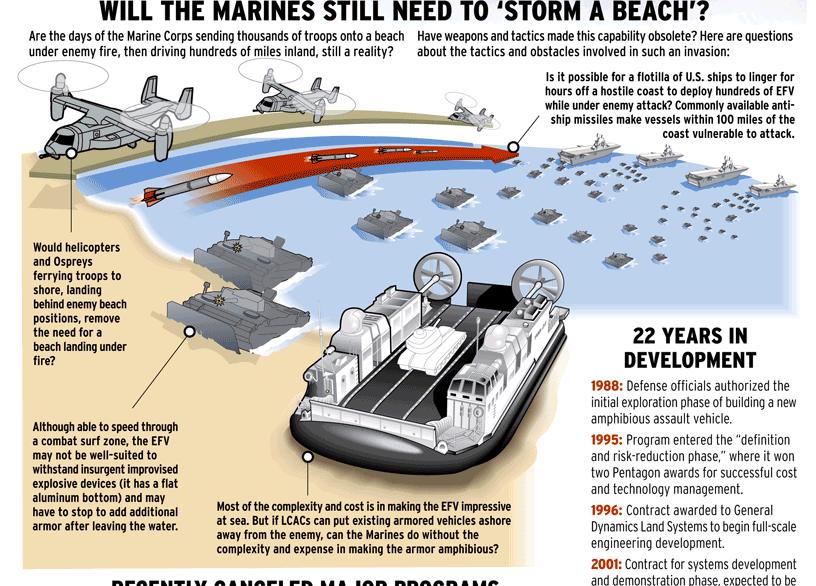
The U.S. Marines are allegedly trying not to become a second land army by focusing on sea-based forcible entry via the EFV.  But recall the view expressed here at TCJ?  The Orange County Register shows it pictorially.

Note the question at the left.  “Would helicopters and Ospreys ferrying troops to shore, landing behind enemy beach positions, remove the need for a beach landing under fire?”  Yes, we had better hope that it does.  And I haven’t seen any advocate of this position except here at TCJ.

But the hugely expensive and troublesome EFV and the concept of forcible entry under heavy fire is the only differentiating factor now in its vision and the Army’s vision.  The return to the sea apparently requires the EFV according to current Marine Corps doctrine, and without it, the Marines are dead – or so we are told by the U.S. Marine Corps thinkers.

In every other way the Marines are doing everything in their power to ensure that they become a second land army.  Lose their rifleman skills?  Sure.  Start up some heretofore unneeded cyber command within the Marine Corps?  Sure.  Why the Marine Corps needs a cyber command is anyone’s guess.  What these Marines are going to do is anyone’s guess, and they as much as say so.  The balance of the branches have robotic stuff, so how about the Marines?  Sure.  After all, the Corps must stay up with the other branches, right?

Where is the strategic and innovative thinking?  Where are the original concepts?  Where are the scholar-officers in the Corps?  While the Corps turns to robotic mules, heavy equipment, cyber warfare and green power, and turns away from being able to get fresh water from their own environment when dropped into the battle space, the nation continues to turn more to special operations forces and the SOCOM chain of command to perform its expeditionary and irregular warfare.

So be it.  The stubbornness and lack of adaptability of the old and outdated Marine Corps vision will ensure its irrelevancy and expendability.

Treating Battlefield Injuries with Nanoemulsions

15 years, 4 months ago

Imagine that you are in Iraq and you receive this letter from your father.

If you become wounded – especially on your extremities but also even on your whole body – and a doctor begins to discuss rapidly propagating infection, or amputation of limbs, you need immediately to request that he administer 50 Rads of gamma or x-ray radiation to the affected area.  If the infection doesn’t begin to retreat within 12 hours, request another 50 Rads.  If the doctor doesn’t understand or wants to talk about this, have him call me.  You know how to reach me at any hour, night or day.”

The idea has to do with radiation hormesis, and at least to practitioners and those familiar with it, it’s science is well known and well understood.  But there is help coming in the form of treatment of battlefield injuries with nanoemulsions.

In the combat zones of Afghanistan and Iraq, soldiers often suffer shrapnel wounds and burns as a result of improvised explosive device blasts.

But other threats – bacteria, viruses and fungi – linger in the air and soil. Contact with the soldiers’ broken skin can lead to debilitating and potentially life-threatening infections.

With the goal of developing a treatment that can be applied to soldiers’ wounds at battle zones and hospitals to prevent infections, the U.S. Department of Defense allocated a $1.5 million grant to researchers at the University of Michigan and the NanoBio Corporation, the university announced Tuesday.

Researchers at the university’s Michigan Nanotechnology Institute for Medicine and Biological Sciences and the Ann Arbor-based NanoBio Corp., a biopharmeceutical company, will use the money to study the effects of nanoemulsion-based therapies on curbing wound and burn infections in combat situations.

“A broadly effective nanoemulsion-based wound treatment that can be safely and easily applied at the time of injury, without causing pain or interfering with wound healing, would have great value to prevent infection, increase survival and enable more rapid healing of wounded United States military personnel,” Dr. James R. Baker, the principal investigator for the grant, said in prepared remarks.

Nanoemulsions are made up of soybean oil, alcohol, water and surfactants emulsified into droplets 200 to 600 nanometers in diameter, according to the release. Research shows that nanoemulsions are effective in combating various bacteria and viruses.

The two research entities will develop 10 new nanoemulsion formulations against bacteria, fungi and spores in lab culture studies. The formulations will then be studied on animals for safety and effectiveness before moving on to human trials.

Nanoemulsions have shown promising results in other aspects of health care. The application of nanoemulsions for the treatment of cold sores is currently undergoing phase 3 clinical trials. Nanoemulsions have also been studied to treat cystic fibrosis infections and develop vaccines against influenza and bioterrorism agents.

The $1.5 million grant will be distributed to the University of Michigan and NanoBio Corp. over a three-year period.

Faster please!

Odd Things in Counterinsurgency

15 years, 4 months ago

There are two examples of what I consider to be odd behavior for our forces in Afghanistan.  The first comes from C. J. Chivers, who gives us a mixed report on the Afghan National Army.

… the Pentagon must overcome a persistent problem in the Afghan security forces: attrition. Official estimates put attrition across the force at roughly 3 percent each month. Attrition is a powerful drain that makes growth difficult. Police officers and soldiers simply disappear, even as replacements flow in.

For this reason, for the army to grow by 36,000 more soldiers, the government must recruit and train 83,000 Afghans, according to projections released by NATO. Similarly, for the police to reach the hoped-for increase of 14,000, the government must train 50,000 more officers. This drives up costs to Westerners paying the bill.

The training mission in Afghanistan also labors under a legacy of unfulfilled past promises, inadequate training even in basic skills like marksmanship and driving military vehicles, and a pattern of overstating how ready or skilled the forces are.

Early this year, the Pentagon and senior Afghan and American officers in Kabul insisted that the complex operation to re-establish a government presence in Marja, a Taliban stronghold, was “Afghan led.”

It was not. And many Afghan units, by the accounts of many Americans present, performed poorly. Some units openly shirked combat duty — refusing to patrol, or sending a bare minimum of soldiers on American patrols, sometimes only a pair of soldiers to accompany an American platoon. The remaining Afghans stayed behind, lounging in the relative safety of outposts the Americans secured.

In the operations under way in Kandahar, reports continue to indicate that American forces are almost always in the lead.

This is backwards from the way I would have implemented the garrisoning and training of the ANA.  Catching the ANA willingly refuse the go on patrol, get high on hashish, or sit in the safety of a FOB while one of their own goes outside the wire is reason for dismissal.  It’s a good thing.  Furthermore, the vetting and recruiting of ANA should be stricter and more involved.  We should be striving for a smaller force, not a larger one.  A smaller force where the Soldiers are well trained, more reliable and more mature should be the goal, not large numbers to put down on paper.

The second example comes directly from Cali Bagby who is with the Marines in Marjah.  This will be fairly lengthy to get the full picture.

MARJAH, Afghanistan – As the Marines run across a main road, there are no men on mopeds or children hanging out in crowds.

“There is no one is outside today,” says Sgt. Michael Brattole, squad leader, several times as he passes through wadis and fields.

“Is that good or bad?” I ask, already knowing the answer.

The Taliban rarely fire when the streets are busy with people. After three months in Marjah and three casualties in their company, the Marines from Echo Company are all too familiar with the nature of warfare.

The mission is to confirm the location of Akhmed Shah’s home. Shah, an elder, could be the key player in securing the area called the Qasaab Block, located outside of Echo Company’s base.

The section of land the Marines are maneuvering is populated predominately by the Alokzi tribe. Shah’s father stood as the leader for the tribe, but war and the Taliban has created a people without a leader.

Shah’s oldest brother is the rightful tribal leader of the Alokzi, but he chooses to live in Lashker Gah, located about 10 miles away. The Marines would like to help Shah stand as a leader – but first they have to find his house.

This task seems simple enough, but simple tasks in Afghanistan can be deceiving.

The Marines start their search with the first elder they come across on their patrol. His beard is white with shades of blackened gray. In the shadows in one of the dark rooms inside his compound, he holds a mound of cotton and speaks with the Marines.

Outside,  security is provided from the 3rd Squad, 2nd Platoon. Inside, one Marine who wishes to remain anonymous, asks the questions.

“We do support Akhmed Shah, he is my nephew. Why not help him?” Haji Torjan says. “Everyone supports Akhmed Shah.”

When the Marines asks if Torjan will send one of his boys with the squad to point out Shah’s home, the elder refuses.

“There are no men, just women and children, in our culture it will be bad,” says Torjan.

There are several more exchanges between the Marine and the Afghan. The Marines try to get the elder to point to the house on a map, or just walk outside ahead of the Marines or at least describe the surrounding area, but the man is of no help.

“If you find it by yourself that’s fine, but I can’t help you,” says Torjan.

“We need your help, to help you,” says Brattole, stepping in for a moment to warn the Marine that the more time they stay in one spot the more time the Taliban has to set up an ambush.

The Marines try a few more tactics with the elder, explaining that if he doesn’t show them they will have to go around asking for Shah’s home, alerting the whole block they are working together.

“You can detain me, take me anywhere you want, but I won’t show you where he lives,” says Torjan.

The Marines are forced to head back out into the other compounds and see if they can get more information from other Afghans. They stay off the road, where they are most likely to get shot at by Taliban.

In order to take the back roads, they must climb over a series of tall and crumbling walls with heavy guns and packs.

The Afghans willing to talk to the Marines have similar answers. Either they have never heard of Shah, or they know who he is and where he lives but refuse to point out the house.

Instead they say, it’s very far away. A few young men suggest the Marines head up farther on the road and surely someone will point out the house.

“If you won’t show me, why would anyone else show me?” asks the Marine. The Afghans smile and nod their heads, as if to say they can’t help him any further.

When children trail the patrol, a Marine pulls aside one of children and asks him about the block’s elder and where he lives. The small boy laughs, chewing on a plastic yellow toy, and shakes his head.

As the Marines push forward, they encounter more locals along the way – and ask the same questions, again.

“We’re just farmers, we don’t know anything,” says a local man. “We have to go back to work.”

Minutes later the same man is across the field bathing in a pump from a nearby well.

Some of the locals give descriptions of Shah’s home: it’s by a canal, near a mosque with speakers over the two-story building, and it’s very far away. The Marines follow the breadcrumbs of information climbing over more walls, questioning more men and children.

After three hours outside the wire, Marines receive a tip that the Taliban is setting up an ambush in the very direction the patrol is headed. Brattole and a few other Marines head farther up the road to inspect the news as the rest of the squad hangs back listening for the sound of gunfire.

After 30 minutes, it’s getting late in the day and the Marines decide to return to the base – without locating Shah’s home. Climbing over the same walls and fields, another long day is over. Sweat covers the brow of the men, and they walk with few words.

After passing a compound, shots are fired from the north. The Marines turn and run towards the gunfire, over the wall, alongside a wadi and towards the main road. By the time they make their way back to their last position, the gunfire has ended. The Marines question four young Afghan men who matched the identities of those firing weapons during the firefight.

The young men want to know what the Marines want with them.

“You were just running away from a firefight,” says the Marine. “”How do I know you weren’t the ones firing?”

“Ask the owner of this compound, when the firefight started we were with them,” says one of the young Afghan men.

Without further evidence the Marines can’t hold the men.

The firefight has ended, the sun is setting deeper into the landscape and the patrol returns to the base.

This effort is misplaced.  It would have been more effective to kill insurgents, make their presence known, meet villagers, find weapons caches, question young men, and interrogate prisoners (or potential prisoners).  They have given no reason for this tribal leader to ally himself with the Marines.  The Marines haven’t yet shown that they are there to win.  When the Marines get the Taliban on the defensive, the tribal leader will more than likely come to the Marines rather than the Marine searching him out.

The next patrol should focus on those fighters who were setting up the ambush.  Send a few Scout Snipers that direction.  Flank the insurgents with a squad or fire team, and approach the area where these men are supposed to be doing their nefarious deeds.  Find them, kill them.  Do this enough and the Marines won’t have to search out the leaders.  Then it will be time to sit down and drink tea.  This is the recipe for success.

We needn’t do things backwards.  It only lengthens the campaign and makes it costlier.

Marines in Marjah Face Full Blown Insurgency

15 years, 4 months ago

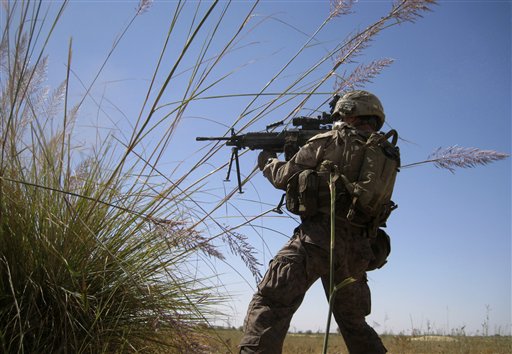
Lance Cpl. Wesley Samuels, of Winter Haven, Fla., with the 2nd Battalion, 9th Marines’ Echo Company, fires at Taliban insurgents during as gunbattle in Marjah, Afghanistan.

AP reporter Todd Pitman and I have exchanged e-mail before during his embeds in Ramadi.  He felt at the time that a comment he left here at TCJ might have gotten him into trouble with AP for potentially representing formal AP position.  Hopefully this was an earlier time and a different atmosphere, before AP learned the value of interacting with the new media.  Or have they?  Does AP still cling to its policy of disallowing any copying of text into posts?  In either case, while AP might have poor policies, Todd Pitman is a very good reporter and his most recent article provides anecdotal accounts and some analysis of the situation the Marines face in Marjah.

MARJAH, Afghanistan — The young Marine had a simple question for the farmer with the white beard: Have you seen any Taliban today?

The answer came within seconds — from insurgents hiding nearby who ended the conversation with bursts of automatic rifle fire that sent deadly rounds cracking overhead.

It was a telling coincidence — and the start of yet another gunbattle in Marjah, the southern poppy-producing hub which U.S. forces wrested from Taliban control in February to restore government rule.

Eight months on, the Taliban are still here in force, waging a full-blown guerrilla insurgency that rages daily across a bomb-riddled landscape of agricultural fields and irrigation trenches.

As U.S. involvement in the war enters its 10th year, the failure to pacify this town raises questions about the effectiveness of America’s overall strategy. Similarly crucial operations are now under way in neighboring Kandahar province, the Taliban’s birthplace.

There are signs the situation in Marjah is beginning to improve, but “it’s still a very tough fight,” said Capt. Chuck Anklam, whose Marine company has lost three men since arriving in July. “We’re in firefights all over, every day.”

“There’s no area that’s void of enemy. But there’s no area void of Marines and (Afghan forces) either,” said Anklam, 34, of Fort Lauderdale, Florida. “It’s a constant presence both sides are trying to exert.”

That day, militants in his zone of operations alone had attacked Marines in four separate locations by mid-afternoon.

[ … ]

… the end of Taliban control in Marjah has sown the seeds of an entrenched guerrilla war that has tied down at least two U.S. Marine battalions and hordes of Afghan police and army troops.

The result, so far at least: Residents say the town is more insecure than ever.

[ … ]

Coalition forces are also trying to win over the population by organizing the delivery of solar panels to businessmen, and refurbishing shops, wells and mosques, Anklam said. But residents are weary: One Marine simply trying to give away a lollipop to children at a checkpoint tried three times before finding one who would take it.

Todd includes this nugget of gold.

Anklam has spread the Marines of Echo company as much as possible. The squads are now based at 13 small outposts — twice as many as in July. As a result, Marines say that although firefights occur daily, violence has decreased overall.

Several observations are in order.  First, to say that the insurgency has “tied down” ANA and ANP probably embellishes what they have accomplished, which has been problematic at best (as we have discussed many times in the ANA and ANP categories).  It is the Marines who are being tied down.  The ANA is at the very best being mentored by the Marines, at the worst are high on opium or hashish.

Second, as if we needed any more indication that the British notion of the government in a box doesn’t work, Todd’s article should be about the last nail in the coffin of that debacle of a strategy (and make no mistake about it, we brought this “government in a box” to Marjah at the behest of the British, in a tip of the hat to their approach to COIN).

Finally, notice what the Marines are doing.  A single company is spread out at 13 outposts.  A single infantry company.  This is remarkable.  It’s a tribute to the tactics employed by the U.S. Marines, and should be an embarrassment to the folks who spend all of their time at FOBs, including the SOF boys with ZZ Top beards wearing backwards ball caps and T-shirts who ride to the fight in helicopters and bed down back at the base after a hot meal and shower.  They are adding  nothing to the campaign.

It isn’t the work of the U.S. Marines that is in question.  Given time, they will win.  The questions are: (1) do they have it, (2) will we give them the resources, and (3) will we get out of the way and let them do what they have to do?

Concerning Cartoons and the Chinese Military

15 years, 4 months ago

I was watching cartoons over the weekend (don’t ask me the context, please), and spent a couple of minutes on one very special one about the bears and foxes.

Kai-lan and her friends are playing in the backyard when they get a visit from their superhero friend, the Monkey King, who really needs their help! There’s trouble in a kingdom far away–the foxes and bears who live there won’t talk to each other and there’s only one person who can help them become friends–Kai-lan! Kai-lan and her friends set off on a magical adventure with the Monkey King to help the Fox King and Bear Queen (voiced by Lucy Liu) work out their differences.

As it turns out, the bears danced and shook the ground, while the foxes sang and polluted the environment with noise.  All they really needed was to talk to each other.  The solution to their differences was for the bears to dance while the foxes sang, and they were both happy!

It was all very sweet – for a two or three year old.

In our very own, real life version of the bears and foxes, Secretary Gates must figure that we just need to communicate better with the Chinese military.

Defense Secretary Robert M. Gates met his Chinese counterpart, Liang Guanglie, in Vietnam on Monday for the first time since the two militaries suspended talks with each other last winter, calling for the two countries to prevent “mistrust, miscalculations and mistakes.”

His message seemed directed mainly at officers like Lt. Cmdr. Tony Cao of the Chinese Navy.

Days before Mr. Gates arrived in Asia, Commander Cao was aboard a frigate in the Yellow Sea, conducting China’s first war games with the Australian Navy, exercises to which, he noted pointedly, the Americans were not invited.

Nor are they likely to be, he told Australian journalists in slightly bent English, until “the United States stops selling the weapons to Taiwan and stopping spying us with the air or the surface.”

The Pentagon is worried that its increasingly tense relationship with the Chinese military owes itself in part to the rising leaders of Commander Cao’s generation, who, much more than the country’s military elders, view the United States as the enemy. Older Chinese officers remember a time, before the Tiananmen Square protests in 1989 set relations back, when American and Chinese forces made common cause against the Soviet Union.

The younger officers have known only an anti-American ideology, which casts the United States as bent on thwarting China’s rise.

“All militaries need a straw man, a perceived enemy, for solidarity,” said Huang Jing, a scholar of China’s military and leadership at the National University of Singapore. “And as a young officer or soldier, you always take the strongest of straw men to maximize the effect. Chinese military men, from the soldiers and platoon captains all the way up to the army commanders, were always taught that America would be their enemy.”

The stakes have increased as China’s armed forces, once a fairly ragtag group, have become more capable and have taken on bigger tasks. The navy, the centerpiece of China’s military expansion, has added dozens of surface ships and submarines, and is widely reported to be building its first aircraft carrier. Last month’s Yellow Sea maneuvers with the Australian Navy are but the most recent in a series of Chinese military excursions to places as diverse as New Zealand, Britain and Spain.

China is also reported to be building an antiship ballistic missile base in southern China’s Guangdong Province, with missiles capable of reaching the Philippines and Vietnam. The base is regarded as an effort to enforce China’s territorial claims to vast areas of the South China Sea claimed by other nations, and to confront American aircraft carriers that now patrol the area unmolested.

Even improved Chinese forces do not have capacity or, analysts say, the intention, to fight a more able United States military. But their increasing range and ability, and the certainty that they will only become stronger, have prompted China to assert itself regionally and challenge American dominance in the Pacific.

That makes it crucial to help lower-level Chinese officers become more familiar with the Americans, experts say, before a chance encounter blossoms into a crisis.

It’s almost as if the Chinese military is already studying cyber exploitation within the context of offensive operations; it’s almost as if they already practice it; it’s almost as if the Chinese military has been trained up in the art of unrestricted warfare; it’s almost as if, in a different time, the recent Chinese saber-rattling in the South Pacific would have caused Japan to seek stronger military ties with the U.S. Oh, wait.  They have already done that.

Perhaps Japan needs to watch the cartoon about the bears and foxes.  Then we could all understand everyone’s point of view and get along.

The Logistical Magnitude of the Campaign in Afghanistan

15 years, 4 months ago

In what will not be read closely or widely enough, the Montgomery Advertiser gives us a view to the magnitude of the logistical problem that is campaign for Afghanistan.

Clouds of dust rise to meet a descending Blackhawk at Kan­dahar Airfield. Before the heli­copter’s wheels settle, the crew chief and gunner climb through windows just behind the pilots and begin urging soldiers to hustle on board.

Carrying heavy trunks and duffels, these men are destined for forward operating bases and combat outposts in the most ac­tive area of Afghanistan, Re­gional Command-South, which this summer recorded the high­est death toll since the war be­gan in 2002.

With an escort Blackhawk hovering nearby, the crew mem­bers urge the soldiers to strap in — ideally, the helicopters won’t be on the ground for more than a couple of minutes before they offload, onload and take off. When they do, the same red dust cloud chases the helicopter as it ascends, headed for the moun­tain range in the distance, then to parts unknown.

For each man on that Black­hawk, as well as any Chinook or cargo plane routing soldiers to their battle areas, one man is re­sponsible for the supplies that will support them in Afghanis­tan — Brig. Gen. Reynold Hoo­ver of the Alabama National Guard.

Hoover, commander of the joint sustainment command in Afghanistan and commander of the 135th sustainment com­mand (expeditionary), is in charge of supplies from food that fuels the troops’ nutritional needs to fuel that runs the mine-resistant MRAP vehicles that protect them from the constant threat of IEDs.

When the 135th took charge of the Joint Sustainment Com­mand on Dec. 28, 2009, it became the first one-star general com­mand from the Alabama Nation­al Guard since World War II. The task is daunting — deliver­ing supplies throughout a coun­try the size of Texas and thwart­ing Taliban attempts to destroy supply lines.

Hoover, who earned his mas­ter’s degree in public and pri­vate management from Bir­mingham-Southern College in 1992, has long held ties to Alaba­ma.

Since 1988, he has returned to Alabama for his once monthly Guard obligation. Since the 135th took command, it has de­livered more than 27.5 million pounds of mail, delivered 88 mil­lion meals and used enough fuel to drive a Honda Civic to the sun and back 68 times.

The 135th sustains approxi­mately 70,000 soldiers in Afgha­nistan and can deliver 504,000 bottles of water each week and more than 210,000 meals each day.

[ … ]

“Movement is a challenge here. We’re in a landlocked country where we don’t control the road. But we’re determined for every trooper to have a hot meal and a canteen.”

Add to that the number of aircraft, both rotary and fixed wing, required to move troops and supplies, and what emerges is an incredible supply and de­mand — all controlled by the Alabama National Guard.

As regular readers know, infantry rules the battle space, while logistics rules everything else, including capability to support and sustain the infantry and air power, financial burden to deploy troops, the ability to conduct distributed operations, the geographical reach of the campaign, and the timeliness of battle space decisions and actions.

Besides the issues surrounding international logistical lines, there are the more immediate and localized logistical issues with which we must deal.  I continue to assert that IEDs are a problem (they are responsible for the majority of U.S. casualties) mainly because we haven’t deployed the troops necessary to find, chase and kill those responsible for building and planting them.

Technology and gizmos are slick and always demand the lion’s share of the defense dollars.  What we need are more Marines, more snipers, more door kicking, more census-taking and more biometrics.  We need to be in their face, in their homes, in their streets, in their markets, isolating the insurgents and destroying them – not putting them into the rotating “catch-and-release” prisons only to see them kill more U.S. servicemen.

And what would all of this gain us?  It’s an oddity to see a General make the following claim in public:     ” … we don’t control the road.”  Indeed.  Control the roads and we will begin to see the end of the insurgency.  No, not check points, not isolated patches of road, but control the roads.  All of them.  Beginning to end, front to back, top to bottom.  From the very beginning the Taliban strategy has been to target logistics, just as I said it would be.  Go after the perpetrators, not the IEDs.

James Jones Out as National Security Adviser

15 years, 4 months ago

James Jones is out as National Security Adviser:

President Obama will announce Friday that retired Gen. James L. Jones is resigning as national security advisor, to be replaced by deputy national security advisor Tom Donilon, an administration official confirmed.

Jones’ departure comes amid a larger turnover of staffers in the Obama White House this fall. Just a week ago, Obama announced in the East Room that Chief of Staff Rahm Emanuel was leaving.

Several other changes in personnel are forthcoming, the result of what White House Press Secretary Robert Gibbs called the “natural life expectancy” in the administration’s pressure-cooker jobs.

Pressure cooker jobs.  That’s the spin.  Michelle Malkin notes that Jones was critical of the administration lackeys who surrounded Obama.  In Woodward’s recent book Jones is quoted as privately referring to Obama’s political aides as “the water bugs,” the “Politburo,” the “Mafia,” or the “campaign set.”

But let’s recall just a bit about Jones and his involvement in the troop deployment decision-making process.  During a briefing with General Nicholson (then in Helmand, Afghanistan with his Marines), the following exchange took place.

… Jones recalled how Obama had initially decided to deploy additional forces this year. “At a table much like this,” Jones said, referring to the polished wood table in the White House Situation Room, “the president’s principals met and agreed to recommend 17,000 more troops for Afghanistan.” The principals — Secretary of State Hillary Rodham Clinton; Gates; Mullen; and the director of national intelligence, Dennis C. Blair — made this recommendation in February during the first full month of the Obama administration. The president approved the deployments, which included Nicholson’s Marines.

Soon after that, Jones said, the principals told the president, “oops,” we need an additional 4,000 to help train the Afghan army.

“They then said, ‘If you do all that, we think we can turn this around,’ ” Jones said, reminding the Marines here that the president had quickly approved and publicly announced the additional 4,000.

Now suppose you’re the president, Jones told them, and the requests come into the White House for yet more force. How do you think Obama might look at this? Jones asked, casting his eyes around the colonels. How do you think he might feel?

Jones let the question hang in the air-conditioned, fluorescent-lighted room. Nicholson and the colonels said nothing.

Well, Jones went on, after all those additional troops, 17,000 plus 4,000 more, if there were new requests for force now, the president would quite likely have “a Whiskey Tango Foxtrot moment.” Everyone in the room caught the phonetic reference to WTF — which in the military and elsewhere means “What the [expletive]?”

Nicholson and his colonels — all or nearly all veterans of Iraq — seemed to blanch at the unambiguous message that this might be all the troops they were going to get.

Jones looked at his brothers in arms, currently under fire, and who had no input to the decision whatsoever, and told them that they would get no more resources than they were told that they would need by men who sat in the safety of their plush offices – and then ridiculed the idea that they would demur.

WTF? indeed.  Jones was part of that Politburo which set into motion the current situation in Afghanistan.  It may be a little too hard to rehabilitate that image now that the campaign is not faring so well and Obama is not the savior of the world any more.  I called for him to resign more than one year ago.  It’s a shame that it took him this long.  As for his replacement, Michelle also notes his crony ties with Obama’s past (and looking at his credentials and previous involvement with Obama’s decisions on Afghanistan, it’s hard to envision that he is actually qualified for the job).

Very well.  One down, another to go.  Reload, aim …

Prior:

Afghanistan: The WTF? War

Calling on NSA James L. Jones to Resign

This is your National Security Adviser

Taliban and Iranian Spies Do Force Protection for U.S. Troops

15 years, 4 months ago

From ABC News:

A scathing Senate report says US contractors in Afghanistan have hired warlords, “thugs,” Taliban commanders and even Iranian spies to provide security at vulnerable US military outposts in Afghanistan. The report, published by the Senate Armed Services Committee, says lax oversight and “systemic failures” have led to “grave risks’ to US forces, including instances where contractors have employed Afghan subcontractors who were “linked to murder, kidnapping and bribery, as well as Taliban and anti-coalition activities.” The chairman of the committee, Sen. Carl Levin, D.-Michigan, said the report was evidence that the US needs to reduce its reliance on contractors. “We need to shut off the spigot of US dollars flowing into the pockets of warlords and power brokers who act contrary to our interests,” said Sen. Levin. The committee reviewed roughly 125 unclassified Department of Defense security contracts between 2007 and 2009, and found that there are some 26,000 private security contractors operating in Afghanistan, the majority of whom are Afghan nationals. The review found “systemic failures” of the military oversight for contracts, including the hiring of what Levin called “many too many” security contractors who had been improperly vetted, improperly trained or were not provided weapons.

In some cases, companies were awarded contracts though they had no ability to provide the services needed. In those cases, companies then quickly hired local nationals without proper vetting or security checks. The chaotic system left US facilities and personnel vulnerable to attack. The report found that some Afghan security guards simply walked off their posts at remote forward operating bases.

In Operation Iraqi Freedom, the notion of hiring locals to perform force protection for the Marines would have been met with laughter and scoffing.  To be sure, the Marines embedded with the IPs, and hired Iraqis as interpreters.  They also hired the so-called Sons of Iraq to perform neighborhood watch and guard duty for gated communities.  But as for force protection proper, the Marines used Marines.

The Senator can pontificate all he wants about the need to stop the flow of dollars into the pockets of untrustworthy Afghans.  The troubled and troubling Hamid Karzai has already made illegal the hiring of non-Afghan contractors for anything except embassy force protection.  The puppet, as the Taliban call him, doesn’t very much like answering to the puppet master.  It’s almost as if he knows that the puppet master is looking for an exit.

You know there aren’t enough troops when you hire foreign spies to perform your force protection.  We should end all discussion of military doctrine surrounding force protection in our military schools.  It’s meaningless.  And no, just because I’m discussing force protection doesn’t mean that I don’t believe in force projection.  One doesn’t exclude the other, and the exercise of a little more force projection and killing the enemy while off of huge FOBs would mean the need for less force protection of U.S. troops by foreign spies.

In other words, if we were off of FOBs and if we didn’t have such a bloated support to infantry ratio, do you think this discussion would be happening right now?

Marine Dust-Off in Nimroz Province

15 years, 4 months ago

Michael Yon has a must read on a great many subjects with several interesting themes, so drop by and pay him a visit – and then hit the tip jar for his good work.  One particularly interesting paragraph reads thusly:

Recently a mission was launched to Nimroz Province.  American Marines hovered in on two Osprey aircraft, secured the airfield (or at least brought a lot of guns), and later a British general landed in another Osprey and the meetings began.  The bottom line of the meetings was that we are not going to do much to help Nimroz Province.  It’s out of sight and out of mind.  The American way of doing things, along with British moral support, is to give money to people who are blowing you up and to ignore those who are neutral or helping you.  The meeting was as impressive as it was meaningless.  Swoop in on the loud Opsreys, set up machine gun positions, make a show of how nice it is to take off your body armor, talk a lot with nice words, and leave in the loud Ospreys.  Waste of time.  And if you dare try to calculate the hard and soft costs of that mission, it had to have cost well over a million dollars.

Well, Michael’s article is informative and compelling as always, but this part is depressing.  I have long feared – and written – that the Marines are losing the perspective and experience base they gained in the Anbar Province.  All I can say is that this sounds very much indeed like a worthless exercise.  And it also sounds like the British have affected the Marine perspective way too much.

Taking body armor off is irrelevant.  I know, General Petraeus asks the boys to show respect and take off their wrap arounds to talk to the elders, and so be it.  But I don’t really care that deeply about that issue either.  The same thing applied to Iraq, and the Marines regularly did what they wanted to do in Anbar.

Michael says that the American way of doing things is to give money to those who are blowing you up.  Well, maybe so, at least right now, and in Afghanistan.  It wasn’t so in Iraq, and it certainly wasn’t so with the Marines in the Anbar Province.  Remember Recon by Fire?  And I won’t recount the experiences of a certain Marine I know.  And just to give a little Army take on their action in Iraq:

One thing that I think many people forget about Iraq (or maybe it wasn’t reported?) is that in 2007 and 2008 we were killing and capturing lots of people on a nightly basis. Protecting the populace was A priority. When speaking to the folks back home, in order to sell the war, perhaps we said that it was the priority. But on the ground, I do not recall a single Commander’s Update Brief spending any time at all discussing what we had done to protect anyone. We were focused on punching al-Qaeda in the nuts at every opportunity and dismantling their networks. The reconcilables got the message loud and clear that they could take money and jobs in return for cooperation, or they would die a swift death when we came knocking down their doors in the middle of the night. The rest of the populace made it clear to them that they should take the offer. The only protection that the population got from us was good fire discipline so that we did not kill non-combatants. We made it clear that the government intended to win this thing and we did not send that message by delivering governance or digging wells. We shot motherf******s in the face.  Pop-COIN blasphemers, your scripture is false teaching. Here is some truth:

To every thing there is a season, and a time to every purpose under the heaven: A time to be born, and a time to die; a time to plant, and a time to pluck up that which is planted; A time to kill, and a time to heal; a time to break down, and a time to build up; – Ecclesiastes 3:1-3 (KJV)

It’s time to kill.

True enough, there is the tea drinking, the sit-downs, the meetings, and the making nice with the locals.  My son did a lot of that in Anbar as well.  He also killed a lot of people.  It’s important which aspect comes first.  It means everything to the campaign.

Take off your wrap-arounds, remove your body armor, or shoot insurgents in the face?

Just saying.

Should All Infantry Soldiers and Marines Carry a Pistol?

15 years, 4 months ago

From the BBC:

Five UK soldiers killed by a “rogue” Afghan police officer did not have enough pistols to defend themselves, one soldier’s father has said.

Adrian Major, of Cleethorpes, North East Lincs, whose 18-year-old son Jimmy was shot last year in Helmand, said he had been told it was too expensive to issue every soldier with a pistol.

“If I had known that, I would have bought him a side arm myself,” he said.

The MoD said cost was not an issue and not all troops carried a pistol.

But the BBC has learned this policy has now been reviewed.

Five servicemen died in the attack by Gul Buddin at a police outpost in Helmand, southern Afghanistan last November.

Radio 4’s File on 4 programme has also learned that the gunman should not have even been at the police post.

He had been employed unofficially by the local police commander, who is now under arrest.

The Taliban subsequently claimed they had carried out the attack.

The soldiers, who had been mentoring the Afghan police, had become concerned about their inability to verify the identity of some of the people they were working alongside.

The troops from the Grenadier Guards and the Royal Military Police had just returned from a morning patrol.

Once inside their defended compound, they put down their main weapons and removed their body armour, as Army rules allow.

A policeman known as Gul Buddin, who was on guard duty, stepped aside from his position and opened fire at close range on British soldiers sitting in a group.

Mr Major, from Cleethorpes, Lincolnshire, and other bereaved families have been briefed by British military personnel.

“Jimmy was on guard on the roof. He had just been relieved for five minutes and they were sat at the end of the building on a step and the Afghan policeman was in the corner and he just walked over and just opened up on them all as they were all just sat down chilling out,” he said.

“[The soldiers] are there to help the people. It’s like any soldier – if you are going to die, you want to die in combat. To be murdered in cold blood, it beggars belief,” he added.

“I think if they’d had side arms and body armour on, I don’t think he would have done it.

“He had the ideal opportunity – they were sat and relaxed and he took great advantage of it.”

The MoD said: “This is absolutely not an issue of cost – not all British troops routinely carry side arms.

“There are enough side arms in theatre, should individuals require them, and they will be carried if individuals are trained to do so and their roles require it.”

However, the BBC understands the MoD has investigated the possibility of issuing all its soldiers with side arms, with priority being given to troops involved in mentoring operations. It’s understood extra pistols have been bought and sent to Afghanistan.

It would seem questionable whether pistols would have stopped the attack if the attack was premeditated and it was conducted inside the wire.  Maybe so.  But let’s put aside that issue for a moment.  The MoD has a point, at least as it concerns standard protocol for issuing pistols.

Pistols are issued in the U.S. to fire team members who carry the SAW, of Squad Automatic Weapon.  It is also issued to squad leaders, even though those squad leaders also have their carbine (M4) or rifle (M16A4).  All of the Soldiers or Marines in infantry have the same MOS (military occupational specialty), but for those who have duties which require them to carry a SAW or be a squad leader, they also qualify on the pistol before being formally issued that pistol.  Soldiers and Marines who are infantrymen who do not carry a SAW or have the duties of squad member are not typically issued a pistol.

But what would be wrong with issuing a pistol to every Soldier or Marine who has the infantry MOS?  If we limit this to infantry, a small fraction of the overall force given the bloated ratio of support to infantry, cost is not a prohibitive concern.  Qualification on a pistol is not that time intensive or attention consuming.  Furthermore, being in infantry, they have been taught muzzle discipline and fire team and squad member responsibilities.

There is no good reason that I can think of not to issue pistols to all Soldiers and Marines who have the infantry MOS.


26th MEU (10)
Abu Muqawama (12)
ACOG (2)
ACOGs (1)
Afghan National Army (36)
Afghan National Police (17)
Afghanistan (704)
Afghanistan SOFA (4)
Agriculture in COIN (3)
AGW (1)
Air Force (41)
Air Power (10)
al Qaeda (83)
Ali al-Sistani (1)
America (22)
Ammunition (304)
Animals (321)
Ansar al Sunna (15)
Anthropology (3)
Antonin Scalia (1)
AR-15s (393)
Arghandab River Valley (1)
Arlington Cemetery (2)
Army (90)
Assassinations (2)
Assault Weapon Ban (29)
Australian Army (7)
Azerbaijan (4)
Backpacking (4)
Badr Organization (8)
Baitullah Mehsud (21)
Basra (17)
BATFE (246)
Battle of Bari Alai (2)
Battle of Wanat (18)
Battle Space Weight (3)
Bin Laden (7)
Blogroll (3)
Blogs (24)
Body Armor (23)
Books (3)
Border War (18)
Brady Campaign (1)
Britain (39)
British Army (36)
Camping (5)
Canada (19)
Castle Doctrine (1)
Caucasus (6)
CENTCOM (7)
Center For a New American Security (8)
Charity (3)
China (19)
Christmas (18)
CIA (30)
Civilian National Security Force (3)
Col. Gian Gentile (9)
Combat Outposts (3)
Combat Video (2)
Concerned Citizens (6)
Constabulary Actions (3)
Coolness Factor (3)
COP Keating (4)
Corruption in COIN (4)
Council on Foreign Relations (1)
Counterinsurgency (218)
DADT (2)
David Rohde (1)
Defense Contractors (2)
Department of Defense (220)
Department of Homeland Security (26)
Disaster Preparedness (5)
Distributed Operations (5)
Dogs (15)
Donald Trump (27)
Drone Campaign (4)
EFV (3)
Egypt (12)
El Salvador (1)
Embassy Security (1)
Enemy Spotters (1)
Expeditionary Warfare (18)
F-22 (2)
F-35 (1)
Fallujah (17)
Far East (3)
Fathers and Sons (2)
Favorite (1)
Fazlullah (3)
FBI (39)
Featured (192)
Federal Firearms Laws (18)
Financing the Taliban (2)
Firearms (1,866)
Football (1)
Force Projection (35)
Force Protection (4)
Force Transformation (1)
Foreign Policy (27)
Fukushima Reactor Accident (6)
Ganjgal (1)
Garmsir (1)
general (15)
General Amos (1)
General James Mattis (1)
General McChrystal (44)
General McKiernan (6)
General Rodriguez (3)
General Suleimani (9)
Georgia (19)
GITMO (2)
Google (1)
Gulbuddin Hekmatyar (1)
Gun Control (1,717)
Guns (2,405)
Guns In National Parks (3)
Haditha Roundup (10)
Haiti (2)
HAMAS (7)
Haqqani Network (9)
Hate Mail (8)
Hekmatyar (1)
Heroism (5)
Hezbollah (12)
High Capacity Magazines (16)
High Value Targets (9)
Homecoming (1)
Homeland Security (3)
Horses (2)
Humor (72)
Hunting (60)
ICOS (1)
IEDs (7)
Immigration (123)
India (10)
Infantry (4)
Information Warfare (4)
Infrastructure (4)
Intelligence (23)
Intelligence Bulletin (6)
Iran (171)
Iraq (379)
Iraq SOFA (23)
Islamic Facism (64)
Islamists (98)
Israel (19)
Jaish al Mahdi (21)
Jalalabad (1)
Japan (3)
Jihadists (82)
John Nagl (5)
Joint Intelligence Centers (1)
JRTN (1)
Kabul (1)
Kajaki Dam (1)
Kamdesh (9)
Kandahar (12)
Karachi (7)
Kashmir (2)
Khost Province (1)
Khyber (11)
Knife Blogging (7)
Korea (4)
Korengal Valley (3)
Kunar Province (20)
Kurdistan (3)
Language in COIN (5)
Language in Statecraft (1)
Language Interpreters (2)
Lashkar-e-Taiba (2)
Law Enforcement (6)
Lawfare (14)
Leadership (6)
Lebanon (6)
Leon Panetta (2)
Let Them Fight (2)
Libya (14)
Lines of Effort (3)
Littoral Combat (8)
Logistics (50)
Long Guns (1)
Lt. Col. Allen West (2)
Marine Corps (281)
Marines in Bakwa (1)
Marines in Helmand (67)
Marjah (4)
MEDEVAC (2)
Media (68)
Medical (146)
Memorial Day (6)
Mexican Cartels (46)
Mexico (70)
Michael Yon (6)
Micromanaging the Military (7)
Middle East (1)
Military Blogging (26)
Military Contractors (5)
Military Equipment (25)
Militia (9)
Mitt Romney (3)
Monetary Policy (1)
Moqtada al Sadr (2)
Mosul (4)
Mountains (25)
MRAPs (1)
Mullah Baradar (1)
Mullah Fazlullah (1)
Mullah Omar (3)
Musa Qala (4)
Music (25)
Muslim Brotherhood (6)
Nation Building (2)
National Internet IDs (1)
National Rifle Association (97)
NATO (15)
Navy (31)
Navy Corpsman (1)
NCOs (3)
News (1)
NGOs (3)
Nicholas Schmidle (2)
Now Zad (19)
NSA (3)
NSA James L. Jones (6)
Nuclear (63)
Nuristan (8)
Obama Administration (222)
Offshore Balancing (1)
Operation Alljah (7)
Operation Khanjar (14)
Ossetia (7)
Pakistan (165)
Paktya Province (1)
Palestine (5)
Patriotism (7)
Patrolling (1)
Pech River Valley (11)
Personal (76)
Petraeus (14)
Pictures (1)
Piracy (13)
Pistol (4)
Pizzagate (21)
Police (672)
Police in COIN (3)
Policy (15)
Politics (998)
Poppy (2)
PPEs (1)
Prisons in Counterinsurgency (12)
Project Gunrunner (20)
PRTs (1)
Qatar (1)
Quadrennial Defense Review (2)
Quds Force (13)
Quetta Shura (1)
RAND (3)
Recommended Reading (14)
Refueling Tanker (1)
Religion (499)
Religion and Insurgency (19)
Reuters (1)
Rick Perry (4)
Rifles (1)
Roads (4)
Rolling Stone (1)
Ron Paul (1)
ROTC (1)
Rules of Engagement (75)
Rumsfeld (1)
Russia (37)
Sabbatical (1)
Sangin (1)
Saqlawiyah (1)
Satellite Patrols (2)
Saudi Arabia (4)
Scenes from Iraq (1)
Second Amendment (708)
Second Amendment Quick Hits (2)
Secretary Gates (9)
Sharia Law (3)
Shura Ittehad-ul-Mujahiden (1)
SIIC (2)
Sirajuddin Haqqani (1)
Small Wars (72)
Snipers (9)
Sniveling Lackeys (2)
Soft Power (4)
Somalia (8)
Sons of Afghanistan (1)
Sons of Iraq (2)
Special Forces (28)
Squad Rushes (1)
State Department (23)
Statistics (1)
Sunni Insurgency (10)
Support to Infantry Ratio (1)
Supreme Court (79)
Survival (214)
SWAT Raids (58)
Syria (38)
Tactical Drills (38)
Tactical Gear (17)
Taliban (168)
Taliban Massing of Forces (4)
Tarmiyah (1)
TBI (1)
Technology (21)
Tehrik-i-Taliban (78)
Terrain in Combat (1)
Terrorism (96)
Thanksgiving (13)
The Anbar Narrative (23)
The Art of War (5)
The Fallen (1)
The Long War (20)
The Surge (3)
The Wounded (13)
Thomas Barnett (1)
Transnational Insurgencies (5)
Tribes (5)
TSA (25)
TSA Ineptitude (14)
TTPs (4)
U.S. Border Patrol (8)
U.S. Border Security (22)
U.S. Sovereignty (29)
UAVs (2)
UBL (4)
Ukraine (10)
Uncategorized (105)
Universal Background Check (3)
Unrestricted Warfare (4)
USS Iwo Jima (2)
USS San Antonio (1)
Uzbekistan (1)
V-22 Osprey (4)
Veterans (3)
Vietnam (1)
War & Warfare (432)
War & Warfare (41)
War Movies (4)
War Reporting (21)
Wardak Province (1)
Warriors (6)
Waziristan (1)
Weapons and Tactics (80)
West Point (1)
Winter Operations (1)
Women in Combat (21)
WTF? (1)
Yemen (1)

February 2026
January 2026
December 2025
November 2025
October 2025
September 2025
August 2025
July 2025
June 2025
May 2025
April 2025
March 2025
February 2025
January 2025
December 2024
November 2024
October 2024
September 2024
August 2024
July 2024
June 2024
May 2024
April 2024
March 2024
February 2024
January 2024
December 2023
November 2023
October 2023
September 2023
August 2023
July 2023
June 2023
May 2023
April 2023
March 2023
February 2023
January 2023
December 2022
November 2022
October 2022
September 2022
August 2022
July 2022
June 2022
May 2022
April 2022
March 2022
February 2022
January 2022
December 2021
November 2021
October 2021
September 2021
August 2021
July 2021
June 2021
May 2021
April 2021
March 2021
February 2021
January 2021
December 2020
November 2020
October 2020
September 2020
August 2020
July 2020
June 2020
May 2020
April 2020
March 2020
February 2020
January 2020
December 2019
November 2019
October 2019
September 2019
August 2019
July 2019
June 2019
May 2019
April 2019
March 2019
February 2019
January 2019
December 2018
November 2018
October 2018
September 2018
August 2018
July 2018
June 2018
May 2018
April 2018
March 2018
February 2018
January 2018
December 2017
November 2017
October 2017
September 2017
August 2017
July 2017
June 2017
May 2017
April 2017
March 2017
February 2017
January 2017
December 2016
November 2016
October 2016
September 2016
August 2016
July 2016
June 2016
May 2016
April 2016
March 2016
February 2016
January 2016
December 2015
November 2015
October 2015
September 2015
August 2015
July 2015
June 2015
May 2015
April 2015
March 2015
February 2015
January 2015
December 2014
November 2014
October 2014
September 2014
August 2014
July 2014
June 2014
May 2014
April 2014
March 2014
February 2014
January 2014
December 2013
November 2013
October 2013
September 2013
August 2013
July 2013
June 2013
May 2013
April 2013
March 2013
February 2013
January 2013
December 2012
November 2012
October 2012
September 2012
August 2012
July 2012
June 2012
May 2012
April 2012
March 2012
February 2012
January 2012
December 2011
November 2011
October 2011
September 2011
August 2011
July 2011
June 2011
May 2011
April 2011
March 2011
February 2011
January 2011
December 2010
November 2010
October 2010
September 2010
August 2010
July 2010
June 2010
May 2010
April 2010
March 2010
February 2010
January 2010
December 2009
November 2009
October 2009
September 2009
August 2009
July 2009
June 2009
May 2009
April 2009
March 2009
February 2009
January 2009
December 2008
November 2008
October 2008
September 2008
August 2008
July 2008
June 2008
May 2008
April 2008
March 2008
February 2008
January 2008
December 2007
November 2007
October 2007
September 2007
August 2007
July 2007
June 2007
May 2007
April 2007
March 2007
February 2007
January 2007
December 2006
November 2006
October 2006
September 2006
August 2006
July 2006
June 2006
May 2006

about · archives · contact · register

Copyright © 2006-2026 Captain's Journal. All rights reserved.