Articles by Herschel Smith


The “Captain” is Herschel Smith, who hails from Charlotte, NC. Smith offers news and commentary on warfare, policy and counterterrorism.


Swedish Gun Control Coming To The U.S.?

14 years, 5 months ago

Daniel Hammarberg, writing at American Daily Herald, gives us an absolutely must-read article and commentary on Swedish gun control, its laws, the evolution of the thinking behind Swedish gun control, and lastly, a serious warning.  After outlining the recent history of the laws, Hammarberg discusses the push for still stricter controls.

Though most people would consider these laws outright draconian, there are plenty of calls for even more strict legislation; something that just as in the USA also takes place in Sweden when there’s a tragedy involving guns, such as the recent massacre by Norwegian terrorist Anders Breivik. On the 9th of August, an opinion piece by a child physician published in one of Sweden’s largest newspapers, called for a complete ban even on pistols. Measures such as these have strong support in the country’s medical community and among the political establishment. After another man had gone on a shooting spree last year in Malmö, with five attempted murders and one actual homicide, there was a complete media frenzy, and Minister of Justice Beatrice Ask took the opportunity to present her view on how one could come to terms with the problem of gun violence.

“Beatrice Ask also feels that an overhaul has to be made of the weapons regulations, that gun permits for example have to be subject to inspection and review.”

The health authorities also added their two cents:

“The National Board of Health and Welfare has previously forwarded requests both for review of gun permits and that everyone applying for one shall also have to present a doctor’s certificate. There the Minister feels that mental illness is a factor that shall mean that you’re denied a gun permit.”

Following this, on 16 November, Ask also announced before the parliament that a new, stricter weapons law was in the works. To quote:

“The police shall also be able to request a statement from the social welfare board and the prison service along with a doctor’s certificate to determine whether someone is fit to own firearms.”

Hence, what this means is that you might have to show your criminal record sheet, whatever journal notes the social services has kept on you (and they play a significant role in Swedish society), as well as produce a certificate from a psychiatrist that you are indeed mentally competent (guilty until proven innocent).

In order to obtain a Concealed Handgun Permit in my home state of North Carolina, a background check was conducted, and I had to sign over rights to my medical records to the Sheriff of my county.  Any history of substance abuse or mental illness would have disqualified me.  Of course, there were no problems and I have the permit, but this is really beyond agreeable limits as far as I am concerned.  It places the decision-making for suitableness to carry a weapon for self defense in the hands of someone who may adjudicate the matter based on subjective feelings, variable rules for mental health from county to county or state to state, or for any number of other non-scientific, non-quantifiable reasons.  Yet, Sweden now requires a psychiatric evaluation, and without clearer opinions from the Supreme Court, the U.S. may be headed there.  Continuing with Hammarberg’s analysis (and this is the important part).

In spite of the tyrannical control of firearms, this has had little effect on the explosion in the violent crime rate the country has been suffering from during the last couple of decades, with a homicide rate that’s now at an historic all-time high, with 333 reported cases during 2010, or about 2/3 of the American rate; rape and assault rates are over twice as high as the American ones (Editorial note: Gun control never really accomplishes the stated justification of reducing violence; this is always a veneer or pretense for the laws).

And whilst the government has always attempted to tighten the noose around legal gun owners after every incident of this sort, the vast majority of violent crimes are committed through the use of illicit weapons. The control of these illicit weapons isn’t nearly as successful as the one of their legal counterparts, as admitted in a police interview from 2005. To quote:

“The police estimate that thousands of firearms are smuggled into Sweden ever year. Every day on average, three serious crimes are committed with illicit firearms. Yet Customs has a hard time intercepting the gun smugglers. During 2003 and 2004, fewer than twenty firearms were seized by Swedish Customs workers.”

One of the most publicized shooting sprees in Swedish history, during which a man in mass media labeled Lasermannen — “The Laser Man” – shot at eleven immigrants and killed one of them, was also committed with an illicit weapon, and hence would not have been affected by these control efforts. This doesn’t seem to bother the police though — somehow everything becomes a matter of preventing any sort of unlicensed gun ownership:

“According to Sonny Björk at the Stockholm county police, the cooperation is necessary. But he also feels the law needs to change to get at the growing smuggling.

“We have to up the sentencing guidelines for illicit weapons ownership so it doesn’t become appealing carrying a firearm. Today you gladly accept a prison sentence for the advantage of owning a firearm, Sonny Björk says.”

One thing you can count on never hearing in the public debate is criticism of the gun laws in place here. There is lamentation over that big crazy country in the west, however, where the people own all of these guns. In an editorial in Sydsvenskan shortly after Seung-Hui Cho shot up Virginia Tech, Lennart Pehrson expresses his grievances over what he believes is essentially unrestricted gun ownership in the USA. Sweden is also the country where the infamous Michael Moore is hailed as a truth-teller and a hero, where the state-TV is always keen on showing his documentaries repeatedly, and with Bowling for Columbine being one of the movies promoted on its web page.

Hammarberg then warns about Swedish style gun control laws coming to the shores of America.  There are various commentaries asserting the need for ratification of the coming U.S. arms control treaty, some of them simply indignant and insulting.  But here is a fact that none of the advocates of the U.S. arms treaty will admit.  In order to interdict illegal arms sales and control proliferation of arms into second and third world countries, they do not need for the U.S. government to know the location of and register every serial number for every weapon in the U.S.  It’s simply an unnecessary intrusion into U.S. constitutional protections.  A national register is a possible first step towards confiscation, and the U.N. doesn’t actually need any other information or controls in the U.S. to accomplish their stated goals.  The U.S. is not the problem.

Confiscation.  Could such a think happen?  Would such a thing happen?  Well, it’s important to realize where we are.  The lower courts have piled on the SCOTUS for failure to explain the extent to which ownership of a firearm is legal and constitutional beyond the confines of one’s domicile.  According to the lower courts, all the decisions in Heller and McDonald accomplished was to justify ownership of a weapon within your own home, not outside the home – not anywhere – not anytime – not for any reason whatsoever.

And these decisions passed by a bare 5-4 vote.  Note.  Four justices on the U.S. Supreme Court (and that tally will probably hold with Kagan’s history of disrespect for the second amendment) do not even believe that U.S. citizens have a right to own a weapon within their own homeWithin their own home.

We truly are one vote away from loss of the second amendment.  No further intrusions by the U.N. are needed.  The U.N. should concern itself with … oh, I don’t know … underwater basket weaving or something to occupy its time so that it won’t be a hazard to the balance of the world.

Afghan National Police Defections

14 years, 5 months ago

From The Sacramento Bee:

A local policing venture in Afghanistan’s northeastern Kapisa province is faltering as men leave the force because their wages have been cut.

The men are part of the Afghan Local Police, originally village militias that have been brought under a centralized command structure since last year. They remain distinct from the regular Afghan National Police, ANP.

In Kapisa’s Tagab and Alasai districts, around 40 men are said to have left the force after effective command shifted six months ago from France’s NATO contingent stationed in the area to the Afghan interior ministry.

Until the changeover, they say, they were paid good wages by the French army, which also supplied weapons and conducted joint operations with them.

“The French troops stationed in Kapisa used to provide us with all kinds of assistance. They paid our salaries and gave us arms and ammunition. But once we were transferred to the interior ministry, everything became disorganized,” Nazir Ahmad, who has resigned from the local police in Tagab, said.

He added that although the local police created security over large swathes of territory, they were more or less ignored by the Afghan authorities.

“The government pays wages of 150 dollars (a month), but the payments have been held up for several months. And it’s a low wage,” Nazir Ahmad said. “The (ANP) police headquarters doesn’t care about us. Even if the Taliban kill us all, police headquarters isn’t going to help us.”

His concerns were echoed by Mazar, deputy commander of Afghan Local Police unit in Tagab’s Landakhel area, who said the French had paid wages of $500 a month, not the $150 the government was offering.

“We’re unhappy about this process. Ever since we were incorporated into the interior ministry, we’ve had no supplies and our wages have been delayed for months,” he said.

He said lack of resources meant his police were unable to perform as effectively as they used to. In one recent clash with the Taliban, their Kalashnikov rifles proved no match for the heavier weapons deployed by the insurgents.

Under French control, Mazar said, “We had trained up some people behind the Taliban lines … to inform us about their movements, in return for payment. We provided good security in the region, but now we can’t do anything. Our militia members are having to leave their jobs and go into some other business.”

If their rifles proved no match for the “heavier weapons deployed by the insurgents,” it’s likely that the Taliban are utilizing crew served weapons against the police.  The French left Taliban using crew served weapons, and the ANP to maintain security and combat the Taliban.  The French are back home enjoying good wine and food, while the “system” they set up is collapsing and leading to an exodus of the ANP and even death in some cases.

Honestly, this reads like a bad joke.  But it isn’t, and it is a sign of things to come as we draw down forces in Afghanistan.

The Moral Case Against SWAT Raids

14 years, 5 months ago

From The MetroWest Daily News:

FRAMINGHAM — Officer Paul Duncan was trained to have his M4 rifle in safety mode unless he was ready to fire. But the SWAT team member wasn’t necessarily wrong to have the safety off when he went to search Eurie Stamps Sr. for weapons during an early-morning drug raid, an expert has found.

In his review of the Jan. 5 fatality released yesterday, Steve Ijames found that Duncan and the rest of the SWAT team may have been operating under conflicting rifle-handling guidelines.

The team’s M4 rifle instructor told Ijames that officers are trained to keep their rifles on “safe” until they perceive a threat.

Lt. Michael Hill, in an internal Police Department report related to Stamps’ death, recalled slightly different instructions: for the first officers entering a room to have safeties off – and rifles in semi-automatic mode – if they perceived a “possible” threat.

That qualifier is important, Ijames suggested.

“The key consideration here is that Officer Duncan removed his weapon from safe moments after entering 26 Fountain St.” early on Jan. 5, Ijames wrote.

Authorities say Duncan shot and killed Stamps, a 68-year-old grandfather, when he lost his balance and accidentally pulled the trigger.

Stamps, who wasn’t a target of the raid, was face-down in a dark hallway, and Duncan was moving to secure the man’s hands behind his back when the shot was fired.

Ijames wrote, “The mechanical safety is what stands between good intentions and a potentially deadly outcome – but it can only do so when engaged.”

Police Chief Steven Carl sought an outside review of the tactical and technical aspects of the Stamps shooting from Ijames, a SWAT expert and retired assistant police chief from Missouri.

The town’s lawyer released Ijames’ report yesterday, as well as Hill’s internal report.

Ijames determined that Duncan and the other SWAT team members were well-trained, and that it was appropriate to use the heavily armed team to search 26 Fountain St.

He criticized the team, however, for failing to calculate a written formula (known as a SWAT threat-assessment matrix) beforehand to determine whether it needed to use that stealth. In the matrix, points are assigned based on questions such as whether targeted suspects have a record of violence, resisting arrest, drug use, mental problems, gang ties or a law enforcement or military background.

Using a SWAT team is considered optional under that formula if the tally is 1 to 16 points, while the commander weighs in if it totals 17 to 24 points. Team activation is considered necessary if the total is 25 or higher.

Analysis & Commentary

Take careful note of the foci of Ijames’ criticism: the position of the safety, and failure to use the threat assessment properly.  So apparently it is acceptable, even verging on “well trained,” for these officers to enter a home with their finger on the trigger of their weapon, but not acceptable for them to do so without the safety engaged.

This position is so odd as to be bizarre (and perhaps even dishonest).  Every responsible firearms owner, and especially every Concealed Handgun Permit holder, knows the importance of proper trigger discipline to his life, his family’s safety, and the safety of those around him.  He has had it drilled into him, night and day, through classes, practice, observation, time at the range, and so on.   There are reasons for this, and it has to do with more than just accidental discharge.  It pertains to sympathetic and involuntary muscle contractions.  There are three scenarios that may elicit involuntary muscle contractions that are sufficiently strong to bring about the involuntary discharge of a firearm: sympathetic contractions, loss of balance and startle reaction. Dr. Roger Enoka, one of the most renowned sports physiologists and director of the Human Performance Research Laboratories in Arizona (USA), was invited to testify in a court case held in Frankfurt, Germany in 1995, concerning involuntary discharges.  Here is part of his findings.

The term sympathetic contraction refers to the fact that an involuntary contraction may occur in the muscles of one limb when the same muscles in the other limb are performing an intended forceful action. In physiology literature this effect is known as a mirror movement, with the intensity of the sympathetic contraction depending on the amount of force exerted during the intended action. In policing, a common situation that may evoke such a sympathetic contraction would be, for example, a law enforcement officer attempting to restrain a struggling suspect with one hand while holding a handgun in the other.

The second scenario described by Enoka involves loss of balance. When balance is disturbed the human body evokes rapid involuntary contractions to return itself to a position of equilibrium. Thereby the involuntary contractions used to prevent a fall depend on the options available to counteract the disturbance of balance. Usually, compensatory movements following gait perturbations primarily involve correcting movements of the lower limbs to keep the body in balance, whereas movements of the arms are restricted to their extension forwards as a safeguard to counter an eventual fall. When an individual is holding a handle for support, there is, however, a tendency to use the arm muscles to maintain balance rather than the leg muscles. Under such circumstances the focal point of automatic postural activity is any contact point an individual has with his or her surroundings. In other words, if an individual’s posture is disturbed while grasping an object, for instance a handgun, he or she is likely to grasp it more forcefully.

Startle reaction, the third scenario identified by Enoka, is a whole-body reflex-like response to an unexpected stimulus, possibly a loud noise. It evokes rapid involuntary contractions that begin with the blink of an eye and spread to all muscles throughout the body. The reaction of the hands occurs less than 200ms after the stimulus and leads to individuals clenching their fists. Enoka concludes: “Accordingly, an officer who is startled by a loud, unexpected noise while searching for a suspect with his weapon drawn would surely increase the grip force on the weapon, perhaps enough to cause an involuntary discharge.”

Responsible firearms owners know this.  That’s why most firearms owners have worked so hard, and are so hard on each other, concerning proper trigger discipline.  The investigator in this so-called “independent” investigation knows this too.  That he didn’t bring it up is informative.  This officer is guilty of malfeasance by entering a home such as this with his finger on the trigger.  Moreover, take particular note of the circumstances.  Not only had this poor man surrendered, he was on the floor.  The officer in question was attempting to secure him, and this … with his finger on the trigger of a rifle with a round chambered.  The officer lost his balance, and lo and behold, he discharged his weapon.  Not only is this officer inept, his trainer(s) and supervision is inept, and perhaps even dishonest, to have accepted such a slanted “independent” assessment of the incident, and to allow this SWAT team out with weapons to terrorize citizens with their ineptitude.

But this all points to a larger problem.  Seldom is a police officer held accountable (or a better way to say it is that s/he will always get the benefit of the doubt no matter how significant the doubt it), and this goes double for SWAT teams.  If it offends our sensibilities for the Phoenix Tucson police department to have forcefully entered Jose Guerena’s home and shot him to death without due process, then that is true in the superlative for this poor man, Mr. Stamps, an innocent man, lying on the floor at the time he was shot to death.

But this last point about due process is really the crux of the issue.  We should see SWAT raids as a high risk evolution.  Risk is technically consequences times probability (C x P), and the product is used to make comparative judgments between alternatives.  Something with a high probability but low consequence can be high risk, something a low probability but a high consequence can be high risk.  As for SWAT raids, the evolving historical record shows them to have at least a moderately high probability of violence, with that violence having significant consequences.  The tactic is an extremely high risk evolution, and it will remain so.  The risk may be reduced by better training and competent officers, but in every case, management has made the decision to place the lives of suspects at high risk by use of the tactic.

In America, a man’s home is his castle.  Thus, the castle doctrine has passed into law (in various forms) in many states, and will enjoy continued success in the courts and legislatures of the states.  Rightly so.  The fact that the inhabitant of a home is a suspect in a crime doesn’t (or shouldn’t) mitigate the fact that he has a right to self defense, and defense of his loved ones.  And home invasion by criminals pretending to be police officers is becoming commonplace.

As to this last issue, by use of military tactics on American citizens, the police have bypassed legitimate constitutional protections and right to a trial by jury by placing the suspect in a position where he or his family may be in danger no matter whether he surrenders or not (a criminal will simply take his life with no remorse, while a police officer may do it with no accountability).  Moreover, SWAT tactics are routinely used on suspects who have no involvement with capital crimes.  Yet by the use of military tactics on these suspects, the police may be perpetrating capital punishment on criminals (or suspects) who do not deserve it.  The police have become judge, jury and executioner in this circumstance without regard to the nature of the crime.

While military tactics used against U.S. citizens may in fact currently be legal, such tactics are immoral in the vast majority of circumstances.  This isn’t meant to rule out the occasional use of such tactics when hostages are in play, or gun shots have already been taken, or other such exigent conditions.  But I have cataloged the evolution of tactics and danger level in SWAT raids and home invasions for a while now (and will continue to do so), and the police departments in the various cities and counties of the country – while they may be legally exonerated of wrongdoing – have some soul-searching to do.  It will be done now or in eternity, but it will be done.

New Approach in the Pech River Valley?

14 years, 5 months ago

From CSM:

Nestled in a lush but mean valley on the banks of the Pech River, Camp Blessing was no longer the sort of place, US commanders decided in February, that warranted the bloodshed of American soldiers.

Instead, the US war effort would benefit from focusing its limited resources on population centers, they concluded, and away from the Pech’s brutal terrain and rather xenophobic citizenry, ready and more than willing to skillfully take up arms against outsiders.

Better, they concluded, to leave this sparsely settled region – where Afghan fighters mustered to make the first successful stand against Soviet occupation – to the Afghan Army.

So soldiers from the 101st Airborne Division towed away the modern toilet trailers and stripped Camp Blessing of its amenities – air-conditioning units, flat-screen monitors, and the covered plywood porch where senior US troops convened to smoke cigars and discuss the news of the day.

In March, they rechristened the base “Nangalam” and turned it over to Afghan forces.

Today, however, US soldiers are back. The conditions at the once built-up outpost are now spartan. Troops bathe with baby wipes and bottled water and sleep on the floors of buildings that, they discovered upon their return in late July, were littered with human feces.

Insurgents had advanced so steadily since March that the Afghan Army could lose the base itself, say a new crop of US commanders.

They see the return as an opportunity to forge a new model for cooperation and mentoring with the Afghan security forces. But while the Pech is admittedly one of Afghanistan’s toughest assignments, the Afghan Army’s failed four-month attempt take the reins of security illustrates its shortfalls – and how far there is to go, US officers say, if NATO is to turn all security responsibilities over to Afghan forces by 2014.

The troops who have come back to this jagged spine of mountain peaks are under no illusions about the difficulty of the task that awaits them. Their code name for this operation: “Hotel California.”

“It’s like the lyrics,” says 2nd battalion intelligence officer Maj. Marcus Wright of the Eagles song: “ ‘You can check out any time you like, but you can never leave.’ ”

When US forces moved back into Camp Blessing in late July, they were greeted with mortars and rocket-propelled grenades, one of which hit the underbelly of a US Chinook carrying supplies for the base. That marked the first shoot-down of a Chinook this year. The pilot was able to land relatively gently without any serious injuries, though passengers were forced to sprint when thousands of rounds of ammunition caught fire and ignited, causing shrapnel injuries and destroying the helicopter.

It was a pattern of hostility repeatedly encountered by US forces. “We really had to reoccupy the base,” says Maj. Glenn Kozelka, executive officer for the 2nd battalion, 3rd brigade combat team of the 25th Infantry Division.

Security had deteriorated rapidly after US forces departed. Within weeks, the Afghan battalion commander at Nangalam could not safely get to meetings in a Asadabad, Kunar’s bustling capital 25 miles east. The Taliban overran and occupied the capital of a nearby district center.

At the same time, insurgents routinely attacked Afghan National Army (ANA) patrol routes. By May, the Afghan commander stationed at Nangalam had abandoned the outpost, along with his top staff.

“It was better before” the US left, says Afghan commander Col. Adam Khan Matin. “When the coalition forces left, the [insurgent] training camps came back.”

Stopping for a moment for some observations on insurgent bases, U.S. commanders (specifically, McChrystal and his staff) might have argued for a population-centric approach to counterinsurgency, but regular readers know that I didn’t.  Continuing with the CSM article.

Lt. Col. Colin Tuley, the top US commander at Nangalam, grappled with how to address the regression. His battalion now had responsibility for an area that had previously needed two. His 800-plus soldiers were spread out across multiple forward operating bases and command posts.

Simply holding that ground would be challenge enough. After evaluating the capabilities of the ANA at Nangalam, Col. Tuley came to a conclusion. “We needed to do something else.”

In his idea is a hope central to the American exit strategy: If US troops focused more intently on creating a workable partnership with the Afghans, perhaps the mentoring could make up for the diminished number of US troops and ensure that a decade’s worth of US battles are for not for naught.

So began what Tuley calls a “permanent embedded partnership” – or PEP – an experiment that could hold lessons for the American war effort in Afghanistan.

The PEP will revolve around 40 US troops at Nangalam working with multiple companies of the Afghan Army. Most immediately, with a stronger base here, Tuley hopes US forces “can come in and do operations as necessary,” allowing NATO to extend its reach farther into the valley. Perhaps more long-term, he adds, the PEP “is a great kind of interim phase to get the ANA to where [the transition is] not as abrupt.”

The US platoon will run workshops on basics from marksmanship to first aid – lessons that have been taught before, Tuley acknowledges, but bear repeating.

“If you think about it, this [Afghan commander at Nangalam] never had a partnership, Tuley adds. “It was. ‘Here’s your battlespace.’ ”

The first order of business – and lesson for Afghan commanders – is to bolster base defenses. When the US was here, Nangalam had early-attack warning systems, including towers with cameras that sent images to screens in a base defense center, which allowed troops to monitor the perimeter.

When Tuley returned, no vestige of those defenses remained. “The security definitely wasn’t at the level that I would ever feel too comfortable having my soldiers out there,” he says.

In response, he has assigned a US platoon of about 30 soldiers to patrol the surrounding area, and he stationed a single US soldier with night-vision goggles at each Afghan guard post along the perimeter of the base.

Beyond base defenses, Tuley must help the Afghans carry out their own missions more effectively.

The PEP’s first big test: A humanitarian mission into one of the more isolated and government-averse areas of the country.

PEP teams.  It’s permanent now, except that it’s not.  U.S. troops will be leaving, and leaving the ANA in a lurch without the cultural framework, logistical know-how, equipment or honesty to run an army.  And they don’t understand force protection.  Furthermore, historically, only Western armies can field high quality NCOs.  And it doesn’t really produce much confidence that a humanitarian mission is the first really big test of the ANA.  During the battle of Kamdesh at COP Keating, ANA soldiers were found curled up in fetal positions in bed under blankets.  We’ve got larger problems than whether the ANA can pull off humanitarian missions.  Continuing.

Afghans also lack equipment, including night-vision goggles. “That’s a pretty critical piece of equipment to provide security,” says Tuley. US officials worry, however, that if they give night-vision goggles to the Afghans, particularly with ANA attrition rates remaining high, they could fall into insurgents’ hands.

Yes, expensive equipment will end up in enemy hands.  Said one ANA soldier about his conditions, “Some of the guys wear sandals at the border because their boots have been taken by officers who sell them.”

Finally, the most important part of the report.

For now … the US troop presence at Nangalam is likely only to increase.

As the first week of partnership at Nangalam winds to a close, Tuley is increasingly convinced that rather than the 40-plus soldiers currently taking part in the PEP, he will need closer to 200.

He knows, too, that this plan comes with opportunity costs. With US forces set to draw down across Afghanistan, he can only bolster the American presence at Nangalam by closing a combat outpost or a forward operating base.

After the PEP’s first big mission, though, he believes that expanding US forces here is key to US troops being able to one day go home for good.

This is important enough to bear repeating.  He needs more troops (or a higher ratio of U.S. forces to ANA).  The only way he can accomplish that is to close COPs or FOBs.  I repeat.  Marines to Kunar.

NATO Rushes To Seal Afghan Border

14 years, 5 months ago

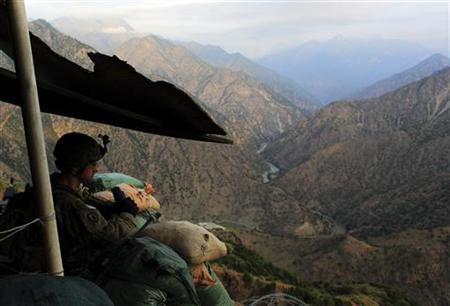
A U.S. Army soldier from Alpha Company 2nd battalion 27th infantry (the Wolfhounds), Task Force NO FEAR watches out from OP Mace in eastern Afghanistan Naray district, Kunar province near the border of Pakistan early August 27, 2011.  From Reuters

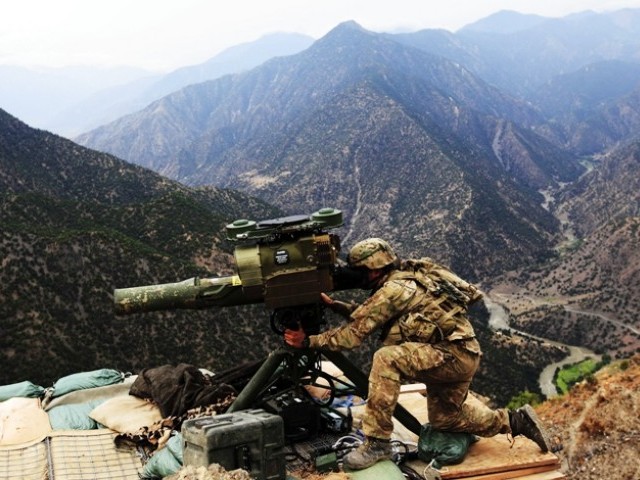
U.S. soldier Staff Sergeant Frankie Berdecia of Alpha Company 2nd battalion 27th infantry (the Wolfhounds), Task Force NO FEAR from Puerto Rico, operates a TOW missile system at Observation Post Mace in eastern Afghanistan’s Kunar province near the border with Pakistan August 28, 2011.  From IHT.

Romney Set To Attack Perry In South Carolina

14 years, 5 months ago

From Marc Thiessen:

Rick Perry may have jumped to the front of the GOP pack in national polls, but here in first-in-the-nation New Hampshire Mitt Romney still holds an 18-point lead. When I asked Romney about Perry during a recent campaign swing through the Granite State, he replied, “I don’t know what all of his positions are, you’ll have to ask him . . . I don’t spend a lot of time looking at [other candidates’] positions.”

That may be, but Romney’s campaign strategists are certainly spending a lot of time poring over Perry’s positions — and developing a plan to stop the surging Texas governor.

Romney has been criticized for refusing to engage Perry, but his campaign advisers see no need to do so now. They point out that the Democratic National Committee is going after Perry, hundreds of reporters hoping to make names for themselves are scouring his life and record, and other candidates that Perry has passed in the polls are determined to take him down. Why should Romney attack Perry directly when the Democrats, the liberal media and Michele Bachmann will do it for him? Romney’s strategists note that Perry will have to survive five debates in six weeks — ample opportunity for Bachmann to “rip his eyes out” (as she did to Tim Pawlenty) or for Perry to blow himself up.

If Perry fails to implode and continues to surge in the polls, Romney eventually will have to go on the attack — an assault his advisers say will commence “at a time of our choosing.” Romney strategists are quick to note that in his book, “Fed Up!,” Perry writes that “By any measure, Social Security is a failure” and calls the program “something we have been forced to accept for more than 70 years now” that was created “at the expense of respect for the Constitution and limited government.”

Look at what happened to Paul Ryan when he proposed a plan to save Medicare, they say. Romney’s campaign will argue that Perry is against the very idea of Social Security and Medicare, and that he will use Perry’s book to scare seniors in early-primary states with large retiree populations, such as Florida and South Carolina.

Very bad idea.  South Carolina is currently Perry country, but that’s not because Perry is untested, or Romney  hasn’t yet gone on the attack, or the fact that Rick Perry has a Southern accent.  These ideas are far too dumbed down to do S.C. and its people justice.

Governor Pawlenty dropped in the polls when he went on the attack against  Michele Bachmann, Senator Santorum is still tanking even as he attacks Perry, and Huntsman’s attacks against Perry brought him absolutely no benefit (but to be honest, he wasn’t a serious contender anyway).  Romney will drop in the polls when he goes on the attack against a fellow Republican.  Watch it happen and remember that I predicted it.

I know something about S.C.  When Romney swept into S.C. for the 2008 campaign he made some fatal mistakes.  But first, let’s discuss Jim Anthony.   Jim Anthony is a developer who promised the world and delivered problems to the people of S.C.  He purchased huge tracts of land in the upper part of the state with borrowed money, gated it off to the people of S.C., and sold it to very wealthy people – people like Oprah Winfrey who is never there.  This land was and is pristine, with flora and fauna not to be found anywhere else on earth.  The people of S.C. used it for hiking, camping, hunting, shooting, and just about everything imaginable (without destroying or significantly altering the land).  After Jim Anthony they will never see this land again.  Jim Anthony is seen in S.C. as a robber baron.  Just ask anyone in S.C.

Yet Mitt Romney’s sense of things brought him into S.C. and into a relationship with big money, and … you guessed it … Jim Anthony.  While McCain shook hands with just about every veteran in S.C., Romney was seen across every TV screen in the state with Jim Anthony.  Today Jim Anthony faces foreclosure on much of his property, and is now suing his bank and partners.

But whether Romney has the bad sense of things to hook up with Jim Anthony again, he did so in the beginning because he is a big money man.  South Carolinians aren’t impressed with this.  In fact, the strategy of invoking a government program is a bad, bad sign of his continued intransigence regarding his understanding of the South in general.  If Romney is down in the polls enough that he has to go into S.C. with big government proposals, he is doomed.

In fact, Romney cannot win in S.C.  It is impossible.  And if Romney temporarily surges when he begins campaigning in S.C.,  all Governor Perry has to do is show up at the shooting range in Pickens County, S.C., where I often shoot, carry along some reporters with him, and then inform his fellow shooters that Governor Romney signed an assault weapons ban in Massachusetts (and would do so again).

Romney will be seen as a big government republican who opposes guns, and he won’t have the libertarian vote.  He cannot win in S.C.  Remember that I told you so.

Obama Allows Mexican Police To Violate U.S. Sovereignty

14 years, 5 months ago

From St. Louis Today:

President Barack Obama’s administration has expanded its role in Mexico’s fight against organized crime by allowing the Mexican police to stage cross-border drug raids from inside the United States, according to senior administration and military officials.

Mexican commandos have discreetly traveled to the U.S., assembled at designated areas and dispatched helicopter missions back across the border aimed at suspected drug traffickers. The U.S. Drug Enforcement Administration provides logistical support on the U.S. side of the border, officials said, arranging staging areas and sharing intelligence that helps guide Mexico’s decisions about targets and tactics.

Officials said these so-called boomerang operations were intended to evade the surveillance — and corrupting influences — of the criminal organizations that closely monitor the movements of security forces inside Mexico. And they said the efforts were meant to provide settings with tight security for U.S. and Mexican law enforcement officers to collaborate in their pursuit of criminals who operate on both sides of the border.

Former U.S. law enforcement officials who were once posted in Mexico described the boomerang operations as a new take on an old strategy that was briefly used in the late 1990s when the DEA helped Mexico crack down on the Tijuana Cartel by letting the specially vetted Mexican police to stage operations out of Camp Pendleton in San Diego.

Recall that I recommended combined and even unilateral military operations against the cartels by U.S. forces.  Do you reckon that Mr. Obama bargained for unilateral U.S. operations against the cartels?  Or perhaps was it just a one-way agreement?  Which is most likely?

Bill Keller’s Idiotic Questions

14 years, 5 months ago

Bill Keller wants to get down and dirty into the weeds of the candidate’s faith.  I’ll let you read his list of questions if you want, but of particular interest to me was this one posed to Michele Bachmann.

You have said that watching the film series “How Should We Then Live?” by the evangelist Francis Schaeffer was a life-altering event for you. That series stresses the “inerrancy” ­— the literal truth — of the Bible. Do you believe the Bible consists of literal truths, or that it is to be taken more metaphorically?

Good grief.  Keller isn’t educated enough even to pose the question the right way.  As he has posed it he blunders into the fallacy of the false dilemma.  Let’s see if I can help out.  Any thinking Christian has to answer Keller’s question, yes and yes.  It is both-and, not either-or.

The Bible contains simile, metaphor (which is extended simile), allegory, data and facts, parables (Jesus taught us in stories), wisdom literature (Psalms and Proverbs, Song of Solomon) and so on and so forth.  Different rules of hermeneutics must be followed based on the kind of literature.  Isaiah 46:9-10 and Ephesians 1:4-5,11 must be taken quite literally.  The book of Daniel, quite obviously, is comprised of much that has to be taken figuratively.

If Keller is referring to whether one believes in the historicity of miracles, then he should have posed the question specifically that way.  Asking whether one believes in the inerrancy of the Bible is, equally stolid and incomplete.  The Christian doctrine pertains to the infallibility of the autographs.  These kinds of things – hermeneutics, doctrine – are taught in classes usually held in places such as seminaries.  Keller might want to attend one before he tries to play ball in the major league again.  He struck out this time.

But I’m glad that Keller opened up the floor for discussion.  Now it’s my turn.  Mr. Keller is no defender of the second amendment, and the New York Times is usually considered to be the enemy of gun ownership.  Very well.  Here is the set of questions for Keller.

Do you believe in individual gun ownership?  If you don’t, is it based on a belief that mankind is too variable and prone to fits of rage to prevent himself from being a danger to those around him?  Depending upon the answer to this last one, there are two followup questions.  If the answer is yes, then please explain the moral flaw in your character that makes you this way.  If the answer is no, then please explain to us why you would relinquish a tool that could be used to defend your family and loved ones from danger and death if in fact your are not susceptible to this moral flaw (also explain why this moral flaw affects everyone else but not you).  As a related issue, why would you force others to relinquish these same tools to defend and protect their loved ones unless you were certain that they too suffered from moral flaws.  Finally, if you do not believe in any system of faith at all, please explain your conception of this moral flaw.  What is a moral flaw?

I’m glad that we could have this conversation.  I look forward to your responses.

Revisiting the Second Amendment Right to Bear Arms

14 years, 5 months ago

David Savage with The LA Times:

The 2nd Amendment’s “right to keep and bear arms” is proving to be a right to keep a gun at home, but so far not a right to bear a loaded firearm in public.

The Supreme Court breathed new life into the amendment when it struck down strict handgun bans in Washington and Chicago and spoke of the “inherent right of self-defense.”

But to the dismay of gun rights advocates, judges in recent months have read those decisions narrowly and rejected claims from those who said they had a constitutional right to carry a loaded gun on their person or in their car. Instead, these judges from California to Maryland have said the “core right” to a gun is limited to the home.

Now, the National Rifle Assn. is asking the high court to take up the issue this fall and “correct the widespread misapprehension that the 2nd Amendment’s scope does not extend beyond the home.”

Stephen Halbrook, an NRA lawyer, said “some judges have buried their heads in the sand and have refused to go one step further” than saying there is a right to have a gun at home.

The Brady Center to Prevent Gun Violence hailed the trend and called the high court’s rulings a “hollow victory” for gun enthusiasts. “The gun lobby has tried to expand [the 2nd Amendment] into a broad right to carry any type of gun anywhere. And they have been almost unanimously rejected by the courts,” said Jonathan Lowy, director of legal action. He conceded, however, that “this battle is far from over.”

The uncertainty began with the Supreme Court itself. In 2008, Justice Antonin Scalia said the history of the 2nd Amendment shows it “guarantees the individual right to possess and carry weapons in case of confrontation.” But other parts of his 5-4 opinion stressed there is no right to “carry any weapon in any manner,” and that bans on “carrying concealed weapons were lawful” in the 19th century.

Since then, hundreds of lawsuits have been filed to challenge gun restrictions. In California, federal judges in San Diego and Yolo counties rejected suits from law-abiding gun owners who were denied “concealed carry” permits.

“The 2nd Amendment does not create a fundamental right to carry a concealed weapon in public,” U.S. District Judge Morrison England ruled in May.

“That’s the cutting-edge issue: whether the 2nd Amendment applies outside the home,” said Chuck Michel, an NRA lawyer in Long Beach who has appealed the question to the U.S. 9th Circuit Court of Appeals.

State judges in Illinois, Maryland, Massachusetts and New York have also ruled recently that there is no constitutional right to carry a loaded gun for self-defense. And in Virginia, the U.S. 4th Circuit Court of Appeals upheld the federal conviction of a man who fell asleep in his car near Washington’s Reagan National Airport with a loaded gun.

So what is Savage talking about?  The best summary statement can be found directly in the Petition for Write of Certiorari to the Supreme Court on behalf of Sean Masciandaro.

Heller and McDonald left open important questions regarding the scope of the self-defense right beyond the home and the appropriate method for evaluating government regulations affecting it. The lower courts have struggled mightily with these issues. See, e.g., Masciandaro, 638 F.3d at 467 (“But a considerable degree of uncertainty remains as to the scope of that right beyond the home and the standards for determining whether and how the right can be burdened by governmental regulation.”); United States v. Skoien, 614 F.3d 638, 640 (7th Cir. 2010) (en banc) (“Skoien II”) (Heller creates an individual right that includes keeping operable handguns at home for self-defense but “[w]hat other entitlements the Second Amendment creates, and what regulations legislatures may establish, were left open.”), cert. denied, 131 S. Ct. 1674 (2011).

The highest state courts that have considered the issue unanimously decided that the Second Amendment right is limited to the home. Maryland, the District of Columbia, Illinois, Massachusetts, New York, and Kansas have all limited Heller to its holding. 9 For example, the Maryland Court of Appeals upheld Maryland’s firearm permitting statute, concluding that the right is unavailable outside the home. Williams v. State, 417 Md. 479, 496 (Md. 2011) (stating that “[i]f the Supreme Court, in this [Heller] dicta, meant its holding to extend beyond home possession, it will need to say so more plainly”), petition for cert. filed, 79 U.S.L.W. 3594 (Apr. 5, 2011). That court noted that Illinois, the District of Columbia, and California also limited the right in similar cases. Id. at 496-99. Given this trend, state courts that confront Second Amendment issues in the future will likely limit its protection to the home.

Other state and federal courts have held that even if the right might exist outside the home, it is substantially weaker than the right enjoyed in the home.

So there are massive problems with Heller and McDonald.  While I am a huge fan of Justice Scalia, he let America down on the issue of gun rights.  Heller was too narrowly decided.  To be sure, there is a second amendment right, and it applies to individuals, personally, and not just in the home, but everywhere else as well.  I see bans on concealed carry, bans on high capacity magazines (e.g., California), bans on firearms based on type or function, bans on carry in places of worship, and so on, in the same category.  They all violate the Second Amendment.

The lower courts’ confusion is simply because they are confused.  The Supreme Court shouldn’t have to spell it out that this extent.  But moderately vague language in the SCOTUS decisions, progressive tendencies among the judiciary, and laziness of the American people to assert their constitutional rights, have led us to the point again where the stolid judges, lawyers, politicians and law enforcement officials everywhere must be told that Americans have a God-given right to self defense, at all times, in all circumstances, and by any means.

Man Kills Grizzly, Fights For His Freedom In Court

14 years, 6 months ago

In what could masquerade as a sad Orwellian novel if it weren’t true, an Idaho man defended his family from a potential grizzly bear attack, and is now in court defending his freedom.

A man charged with unlawfully shooting and killing a grizzly bear had so many supporters at his arraignment Tuesday in federal court that the judge had to move the hearing to a larger courtroom.

Even there, every seat was taken as his family, friends and neighbors, young and old, squeezed in.

Jeremy M. Hill, 33, pleaded not guilty in U.S. District Court to killing the animal with a rifle on his 20-acre property near Porthill, Idaho, at the Canadian border. He lives five miles from the closest grizzly bear recovery zone.

The grizzly bear is classified as a threatened species in the lower 48 states, according to the Endangered Species Act, and protected by federal law. Hill’s charge is a misdemeanor.

Magistrate Judge Candy Dale set trial, at least for now, for Oct. 4.

Hill has declined comment. His lawyer, Marc Lyons of Coeur d’Alene, said he plans to defend Hill on the basis of self-defense and protection of family.

Following the hearing, his father, Mike Hill, of Athol, said, “This whole thing is a waste of taxpayer money.”

He said his son was concerned for the safety of his children playing outside when a mother grizzly and two cubs wandered onto his property on May 8.

Jeremy Hill has six kids, ranging in age from 14 years old to 10 months old. At least five were home when the grizzly was killed, Mike Hill said.

The bears had gone after some pigs in a pen that the kids had been raising, Mike Hill said.

He said his son shot one of the bears, then called authorities to notify them of the kill. The other two bears ran off.

He said his son could have just buried the animal and not said anything to law enforcement. He said his son is being penalized for coming forward.

State Sen. Shawn Keough, R-Sandpoint, attended the hearing in full support of Jeremy Hill.

“The charges are simply unjust,” she said following the hearing. “Hopefully common sense will prevail. It’s clearly an issue of protecting the family.”

She predicted that punishing someone who reported killing a grizzly will damage government efforts to protect the animals.

She said nearly $20,000 was raised by community members for Hill’s defense.

Rep. Raul Labrador, R-Idaho was asked about the case while appearing in Sandpoint on Tuesday.

While Labrador said he needed to be careful in dealing with the prosecutorial side of things, he did have this to say:

“Clearly, we have a problem with the ESA when situations like this happen.” He later added, “We’re doing everything we can to make sure this man is treated fairly.”

Based on a subsequent report, it isn’t clear whether it was Jeremy Hill or one of his sons who killed the bear, or if it was the mother or a cub.  It doesn’t matter.  There is a lot of local support for Jeremy, and in fact, Idaho Governor Butch Otter is appealing to Obama to look into the facts of the case.

It’s ridiculous that it has gotten this far.  The fact of the matter is that regardless of whether the federal government comes to its senses now or soon, some federal prosecutor (U.S. Attorney Wendy Olson?) made the sophomoric decision to carry this case forward.  How embarrassing this decision must be for this attorney.

It is said that exception makes bad law.  Perhaps.  But failure to address the exception makes for bad justice.  Jeremy isn’t a poacher hunting bear in this area.  He is a father and husband, defending his children and wife.  It hurts progressives to hear it, but man is made in God’s image.  Animals are not.  The only evil that could possibly have happened that day would have been if Jeremy had failed to defend his family.

When the framework for righteousness is found in the myriad rules and regulations that pass through the Federal Register every day as lawyers promulgate an increasingly burdensome bureaucracy on a hapless American public, America has lost its way, and has forgotten what true righteousness is all about.  The justification for regulations has become deonotological, needing no foundation outside themselves, and the means has become the end without regard for consequences or affect.  And it is all without heart or soul.


26th MEU (10)
Abu Muqawama (12)
ACOG (2)
ACOGs (1)
Afghan National Army (36)
Afghan National Police (17)
Afghanistan (704)
Afghanistan SOFA (4)
Agriculture in COIN (3)
AGW (1)
Air Force (41)
Air Power (10)
al Qaeda (83)
Ali al-Sistani (1)
America (22)
Ammunition (304)
Animals (321)
Ansar al Sunna (15)
Anthropology (3)
Antonin Scalia (1)
AR-15s (393)
Arghandab River Valley (1)
Arlington Cemetery (2)
Army (90)
Assassinations (2)
Assault Weapon Ban (29)
Australian Army (7)
Azerbaijan (4)
Backpacking (4)
Badr Organization (8)
Baitullah Mehsud (21)
Basra (17)
BATFE (246)
Battle of Bari Alai (2)
Battle of Wanat (18)
Battle Space Weight (3)
Bin Laden (7)
Blogroll (3)
Blogs (24)
Body Armor (23)
Books (3)
Border War (18)
Brady Campaign (1)
Britain (39)
British Army (36)
Camping (5)
Canada (19)
Castle Doctrine (1)
Caucasus (6)
CENTCOM (7)
Center For a New American Security (8)
Charity (3)
China (19)
Christmas (18)
CIA (30)
Civilian National Security Force (3)
Col. Gian Gentile (9)
Combat Outposts (3)
Combat Video (2)
Concerned Citizens (6)
Constabulary Actions (3)
Coolness Factor (3)
COP Keating (4)
Corruption in COIN (4)
Council on Foreign Relations (1)
Counterinsurgency (218)
DADT (2)
David Rohde (1)
Defense Contractors (2)
Department of Defense (220)
Department of Homeland Security (26)
Disaster Preparedness (5)
Distributed Operations (5)
Dogs (15)
Donald Trump (27)
Drone Campaign (4)
EFV (3)
Egypt (12)
El Salvador (1)
Embassy Security (1)
Enemy Spotters (1)
Expeditionary Warfare (18)
F-22 (2)
F-35 (1)
Fallujah (17)
Far East (3)
Fathers and Sons (2)
Favorite (1)
Fazlullah (3)
FBI (39)
Featured (192)
Federal Firearms Laws (18)
Financing the Taliban (2)
Firearms (1,866)
Football (1)
Force Projection (35)
Force Protection (4)
Force Transformation (1)
Foreign Policy (27)
Fukushima Reactor Accident (6)
Ganjgal (1)
Garmsir (1)
general (15)
General Amos (1)
General James Mattis (1)
General McChrystal (44)
General McKiernan (6)
General Rodriguez (3)
General Suleimani (9)
Georgia (19)
GITMO (2)
Google (1)
Gulbuddin Hekmatyar (1)
Gun Control (1,717)
Guns (2,405)
Guns In National Parks (3)
Haditha Roundup (10)
Haiti (2)
HAMAS (7)
Haqqani Network (9)
Hate Mail (8)
Hekmatyar (1)
Heroism (5)
Hezbollah (12)
High Capacity Magazines (16)
High Value Targets (9)
Homecoming (1)
Homeland Security (3)
Horses (2)
Humor (72)
Hunting (60)
ICOS (1)
IEDs (7)
Immigration (123)
India (10)
Infantry (4)
Information Warfare (4)
Infrastructure (4)
Intelligence (23)
Intelligence Bulletin (6)
Iran (171)
Iraq (379)
Iraq SOFA (23)
Islamic Facism (64)
Islamists (98)
Israel (19)
Jaish al Mahdi (21)
Jalalabad (1)
Japan (3)
Jihadists (82)
John Nagl (5)
Joint Intelligence Centers (1)
JRTN (1)
Kabul (1)
Kajaki Dam (1)
Kamdesh (9)
Kandahar (12)
Karachi (7)
Kashmir (2)
Khost Province (1)
Khyber (11)
Knife Blogging (7)
Korea (4)
Korengal Valley (3)
Kunar Province (20)
Kurdistan (3)
Language in COIN (5)
Language in Statecraft (1)
Language Interpreters (2)
Lashkar-e-Taiba (2)
Law Enforcement (6)
Lawfare (14)
Leadership (6)
Lebanon (6)
Leon Panetta (2)
Let Them Fight (2)
Libya (14)
Lines of Effort (3)
Littoral Combat (8)
Logistics (50)
Long Guns (1)
Lt. Col. Allen West (2)
Marine Corps (281)
Marines in Bakwa (1)
Marines in Helmand (67)
Marjah (4)
MEDEVAC (2)
Media (68)
Medical (146)
Memorial Day (6)
Mexican Cartels (46)
Mexico (70)
Michael Yon (6)
Micromanaging the Military (7)
Middle East (1)
Military Blogging (26)
Military Contractors (5)
Military Equipment (25)
Militia (9)
Mitt Romney (3)
Monetary Policy (1)
Moqtada al Sadr (2)
Mosul (4)
Mountains (25)
MRAPs (1)
Mullah Baradar (1)
Mullah Fazlullah (1)
Mullah Omar (3)
Musa Qala (4)
Music (25)
Muslim Brotherhood (6)
Nation Building (2)
National Internet IDs (1)
National Rifle Association (97)
NATO (15)
Navy (31)
Navy Corpsman (1)
NCOs (3)
News (1)
NGOs (3)
Nicholas Schmidle (2)
Now Zad (19)
NSA (3)
NSA James L. Jones (6)
Nuclear (63)
Nuristan (8)
Obama Administration (222)
Offshore Balancing (1)
Operation Alljah (7)
Operation Khanjar (14)
Ossetia (7)
Pakistan (165)
Paktya Province (1)
Palestine (5)
Patriotism (7)
Patrolling (1)
Pech River Valley (11)
Personal (76)
Petraeus (14)
Pictures (1)
Piracy (13)
Pistol (4)
Pizzagate (21)
Police (672)
Police in COIN (3)
Policy (15)
Politics (998)
Poppy (2)
PPEs (1)
Prisons in Counterinsurgency (12)
Project Gunrunner (20)
PRTs (1)
Qatar (1)
Quadrennial Defense Review (2)
Quds Force (13)
Quetta Shura (1)
RAND (3)
Recommended Reading (14)
Refueling Tanker (1)
Religion (499)
Religion and Insurgency (19)
Reuters (1)
Rick Perry (4)
Rifles (1)
Roads (4)
Rolling Stone (1)
Ron Paul (1)
ROTC (1)
Rules of Engagement (75)
Rumsfeld (1)
Russia (37)
Sabbatical (1)
Sangin (1)
Saqlawiyah (1)
Satellite Patrols (2)
Saudi Arabia (4)
Scenes from Iraq (1)
Second Amendment (708)
Second Amendment Quick Hits (2)
Secretary Gates (9)
Sharia Law (3)
Shura Ittehad-ul-Mujahiden (1)
SIIC (2)
Sirajuddin Haqqani (1)
Small Wars (72)
Snipers (9)
Sniveling Lackeys (2)
Soft Power (4)
Somalia (8)
Sons of Afghanistan (1)
Sons of Iraq (2)
Special Forces (28)
Squad Rushes (1)
State Department (23)
Statistics (1)
Sunni Insurgency (10)
Support to Infantry Ratio (1)
Supreme Court (79)
Survival (214)
SWAT Raids (58)
Syria (38)
Tactical Drills (38)
Tactical Gear (17)
Taliban (168)
Taliban Massing of Forces (4)
Tarmiyah (1)
TBI (1)
Technology (21)
Tehrik-i-Taliban (78)
Terrain in Combat (1)
Terrorism (96)
Thanksgiving (13)
The Anbar Narrative (23)
The Art of War (5)
The Fallen (1)
The Long War (20)
The Surge (3)
The Wounded (13)
Thomas Barnett (1)
Transnational Insurgencies (5)
Tribes (5)
TSA (25)
TSA Ineptitude (14)
TTPs (4)
U.S. Border Patrol (8)
U.S. Border Security (22)
U.S. Sovereignty (29)
UAVs (2)
UBL (4)
Ukraine (10)
Uncategorized (105)
Universal Background Check (3)
Unrestricted Warfare (4)
USS Iwo Jima (2)
USS San Antonio (1)
Uzbekistan (1)
V-22 Osprey (4)
Veterans (3)
Vietnam (1)
War & Warfare (432)
War & Warfare (41)
War Movies (4)
War Reporting (21)
Wardak Province (1)
Warriors (6)
Waziristan (1)
Weapons and Tactics (80)
West Point (1)
Winter Operations (1)
Women in Combat (21)
WTF? (1)
Yemen (1)

February 2026
January 2026
December 2025
November 2025
October 2025
September 2025
August 2025
July 2025
June 2025
May 2025
April 2025
March 2025
February 2025
January 2025
December 2024
November 2024
October 2024
September 2024
August 2024
July 2024
June 2024
May 2024
April 2024
March 2024
February 2024
January 2024
December 2023
November 2023
October 2023
September 2023
August 2023
July 2023
June 2023
May 2023
April 2023
March 2023
February 2023
January 2023
December 2022
November 2022
October 2022
September 2022
August 2022
July 2022
June 2022
May 2022
April 2022
March 2022
February 2022
January 2022
December 2021
November 2021
October 2021
September 2021
August 2021
July 2021
June 2021
May 2021
April 2021
March 2021
February 2021
January 2021
December 2020
November 2020
October 2020
September 2020
August 2020
July 2020
June 2020
May 2020
April 2020
March 2020
February 2020
January 2020
December 2019
November 2019
October 2019
September 2019
August 2019
July 2019
June 2019
May 2019
April 2019
March 2019
February 2019
January 2019
December 2018
November 2018
October 2018
September 2018
August 2018
July 2018
June 2018
May 2018
April 2018
March 2018
February 2018
January 2018
December 2017
November 2017
October 2017
September 2017
August 2017
July 2017
June 2017
May 2017
April 2017
March 2017
February 2017
January 2017
December 2016
November 2016
October 2016
September 2016
August 2016
July 2016
June 2016
May 2016
April 2016
March 2016
February 2016
January 2016
December 2015
November 2015
October 2015
September 2015
August 2015
July 2015
June 2015
May 2015
April 2015
March 2015
February 2015
January 2015
December 2014
November 2014
October 2014
September 2014
August 2014
July 2014
June 2014
May 2014
April 2014
March 2014
February 2014
January 2014
December 2013
November 2013
October 2013
September 2013
August 2013
July 2013
June 2013
May 2013
April 2013
March 2013
February 2013
January 2013
December 2012
November 2012
October 2012
September 2012
August 2012
July 2012
June 2012
May 2012
April 2012
March 2012
February 2012
January 2012
December 2011
November 2011
October 2011
September 2011
August 2011
July 2011
June 2011
May 2011
April 2011
March 2011
February 2011
January 2011
December 2010
November 2010
October 2010
September 2010
August 2010
July 2010
June 2010
May 2010
April 2010
March 2010
February 2010
January 2010
December 2009
November 2009
October 2009
September 2009
August 2009
July 2009
June 2009
May 2009
April 2009
March 2009
February 2009
January 2009
December 2008
November 2008
October 2008
September 2008
August 2008
July 2008
June 2008
May 2008
April 2008
March 2008
February 2008
January 2008
December 2007
November 2007
October 2007
September 2007
August 2007
July 2007
June 2007
May 2007
April 2007
March 2007
February 2007
January 2007
December 2006
November 2006
October 2006
September 2006
August 2006
July 2006
June 2006
May 2006

about · archives · contact · register

Copyright © 2006-2026 Captain's Journal. All rights reserved.