New York Sun on Nuclear Iran
Nuclear yield within six to twelve months.
McNeill ties length to Pakistan tribal region, likely to be protracted anyway.
Multinational force press release on Sadr City operations and seizure of weapons and munitions.
"We will fight them to the end."
War on terror not popular with Pakistani population.
U.S. presence expanding Southward in Iraq.
Its full steam ahead for Iran.
And SECDEF Gates continues to press this issue.
Pajamas Media exclusive: how your tax dollars fund terror.
Southwestern Baptist Theological Seminary Graduate executed in Afghanistan.
Nearly 1000 dead from harshest Afghan winter in 30 years.
Attacks in Baghdad down 80% according to Iraqi Army.
Lack of appropriate defense spending a grave situation.
Olmert claims Iran still on target to construct nuclear weapon.
Promoted to Army Vice Chief of Staff. Well deserved.
Must read on Israeli Army shame and lawyer happiness with war against Hezbollah.
Libyans joining jihad in increasing numbers.
How relevant will Maliki be to Iraq's future?
Maj. Gen. Gaskin: "The positive trends are permanent."
Abizaid questions whether Maliki can bring unity to Iraq.
From the Multinational Force, more on Operation Lion Pounce.
An important ally in Iraq has been assassinated.
Israel to show Chairman of Joint Chiefs of Staff nuclear intelligence on Iran.
Cabinet approves proposed agreement with U.S.
Prof. Kingsley Browne on his new book.
Major General Robert Scales: "Outcome is irreversible"
Mullen says military needs larger slice of GNP to modernize.
For siding with the U.S. against al Qaeda.
Terrorist poses as bride. Ugh!
Legislation in trouble.
Al Qaeda documents discovered near Syrian border.
Shameful people jeer disabled veterans in swimming pool.
Saudi jihadist in Iraq tells his personal story.
Concerning Iranian meddling and Quds.
Michael Yon breaks bread with General Petraeus.
Ralph Peters on the advancements in Iraq.
War between al Qaeda and Hezbollah.
Traumatic brain injury not recognized.
Ballistic Sensor Fused Munition.
High intensity electronic warfare.
Iranian weapons are a sign of continued Iranian meddling in Iraq.
U.S. forces in Iraq are using a high-resolution, thermal/infrared sensor system.
Washington Post profiles AQI (al Qaeda in Iraq, or al Qaeda in Mesopotamia).
Taiwan may not be as secure as we would like to think.
Be thankful your daughter isn't be raised in Basra.
Pastor discusses rules of engagement and sacrificial U.S. deaths.
In counterinsurgency (COIN), patience is a virtue. But violence has decreased so fast in
There has been recent chatter over jihadist web sites that point to yet another attempt at consolidation of insurgent forces. SITE Intel gives us the translation.
Following both the announcement of the Mujahideen Shura Council’s establishment as an amalgamated insurgency group in Iraq and Sheikh Abdullah Rashid al-Baghdadi selected as its Emir in mid-January 2006, there has been much chatter amongst the online jihadist community on this issue. Following the announcement about the Council, the Jihadi forums ran a “Thousand signature campaign on supporting the Mujahideen Shura Council,” which indeed, the online jihadists posted their signatures. Members stressed the unification of the mujahideen under one flag as a boon for the insurgency; one suggesting that Ansar al-Sunnah join the Council to further bolster the unification, and another in an interview on a forum, Hani el-Sibaei, a former leader of the outlawed Egyptian group Islamic Jihad, who now runs an Islamic affairs research center in London, who congratulates the Council.
Another member of a jihadist forum addressed the seeming disappearance of Sheikh Abu Musab al-Zarqawi, Emir of al-Qaeda in Iraq, stressing that the Muslims should not follow Western pundits and analysts who equate jihad in Iraq with one man in Zarqawi. He congratulates the founding of the Mujahideen Shura Council and its Emir, Sheikh Abdullah Rashid al-Baghdadi, and states: “The jihad did not stop and what it proves is that jihad is continuous until now with the Grace of Allah”.
The Mujahideen Shura Council is composed of eight insurgency groups in Iraq: al-Qaeda in Iraq, Victorious Army Group, the Army of al-Sunnah Wal Jama’a, Jama’a al-Murabiteen, Ansar al-Tawhid Brigades, Islamic Jihad Brigades, the Strangers Brigades, and the Horrors Brigades, collaborating to meet the “unbelievers gathering with different sides” and defend Islam.
It is noteworthy that the jihadists are calling for a combination of forces, these same forces battling each other in the earlier days of the insurgency in Ramadi, as we covered from Army intelligence sources in Al Qaeda, Indigenous Sunnis and the Insurgency in Iraq. For instance, it was never al Qaeda which controlled the hospital in Ramadi. Rather, it was Ansar al Sunna, and al Qaeda stayed out of the innermost parts of Ramadi due to the inherent danger. Each sect of Sunni insurgency fought with all other sects, and this inability to combine forces is part of its failure.
Just as remarkable is the followup press release of al Qaeda in Iraq (the internet swarm was obviously preliminary to this more formal action by al Qaeda), in that the strategy is only ostensibly one of jihad against the evil Crusader Americans, and is in reality one of the power and cultural identity of Sunnis.
The purported leader of al-Qaida’s affiliate in Iraq called in a new Internet audiotape Tuesday on Sunni fighters who switched sides and joined the American push to pacify Sunni areas of the country, to return to the insurgency.
In the recording, Abu Omar al-Baghdadi, who allegedly heads the Islamic State of Iraq, called on Sunni unity and urged Sunnis in the Iraqi army, police and the so-called “Awakening Councils” to abandon fighting the mujahideen, and instead turn their guns toward the “Crusader” enemy shorthand for U.S. troops in Iraq.
The 30-minute audio was posted on Islamic Web sites known as clearing houses for militant messaging. Its authenticity could not be independently confirmed. Washington-based SITE Institute which monitors militant Internet messaging, also intercepted the recording.
No photo has ever appeared of al-Baghdadi, whom the U.S. describes as a fictitious character used to give an Iraqi face to an organization dominated by foreigner al-Qaida fighters. The U.S. has said that under interrogation, a top al-Qaida member revealed that speeches by al-Baghdadi who often echo the messages of his patron, Osama bin Laden are read by an actor.
“The scholars of the faith and the honorable sheiks of the tribes are charged with calling and urging the children of the Sunni sheikdoms to leave the army and the police … and the Awakening Councils, on the basis that all arms … be directed at the Crusaders and those who support them,” al-Baghdadi said in the latest recording.
The Sunni fighters who went to the American and Iraqi government side have contributed nothing to benefit the Sunni nation in Iraq, al-Baghdadi claimed, and were themselves deceived by unfulfilled promises of payments and contracts with the U.S. and Iraqi forces.
The Awakening Councils first surfaced last year in the Sunni province of Anbarwest of Baghdad, but have since also spread to other Sunni-populated areas in central Iraq.
Al-Qaida has never publicly acknowledged losing control in the Anbar to the U.S.-Iraqi anti-insurgency push, but al-Baghdadi has in the past blasted the Awakening Council’s “collaboration” with the U.S. troops in the region.
Noting that five years have passed since the U.S.-led invasion of Iraq, al-Baghdadi claims the “enemy has reaped humiliation and loss” and faces an “exceptional state” of economic collapse.
Meanwhile, the al-Qaida affiliate will remain firm on the path of jihad, al-Baghdadi said.
Allegedly motivated by Sunni tribesmen wishing an end the Sunni infighting, al-Baghdadi claimed a project has been agreed upon in which a committee of scholars will intervene to resolve conflicts in Sunni areas between tribes, mujahideen, and others.
Referring to the recent U.S.-Iraqi drive to flush al-Qaida out of northern Iraqi strongholds around the city of Mosul, al-Baghdadi warns Sunnis there to exercise “caution.”
“The malice against you is great, and you will see humiliation if you abandon your children, the mujahideen. They are from you and for you. They are the source of your pride and honor. They are the secret of your power,” he said.
There is no call for the Shi’a to abandon the fight against al Qaedain the name of jihad. The fight, says the spokesman, is about the source of their pride and honor, the secret of the Sunni power. The days when the Sunni believes that he will return to power in Iraq as part of the majority party are gone, and the appeal of al Qaeda to this quaint notion is a sign of its waning power.
The Sunnis in the Anbar Province have taken a rapid ride from enemy of the United States, to tepid ally, to strong ally, and finally to full partner. In Operations in Northern Iraq we discussed the movement of the last of al Qaeda North to Mosul, Tikrit and outlying areas. In Last Stand in Mosul we expanded this discussion to include the diehard Ba’athists and Fedayeen Saddam who will not reconcile; they also have retreated to the North. In light of these developments, it is important that the “awakening” has finally expanded to the North.
HAWIJA, Iraq (AP) - Nearly 6,000 Sunni Arab residents joined a security pact with American forces Wednesday in what U.S. officers described as a critical step in plugging the remaining escape routes for extremists flushed from former strongholds.
The new alliance—called the single largest single volunteer mobilization since the war began—covers the “last gateway” for groups such as al-Qaida in Iraq seeking new havens in northern Iraq, U.S. military officials said.
U.S. commanders have tried to build a ring around insurgents who fled military offensives launched earlier this year in the western Anbar province and later into Baghdad and surrounding areas. In many places, the U.S.-led battles were given key help from tribal militias—mainly Sunnis—that had turned again al-Qaida and other groups.
Extremists have sought new footholds in northern areas once loyal to Saddam Hussein’s Baath party as the U.S.-led gains have mounted across central regions …
The ceremony to pledge the 6,000 new fighters was presided over by dozen sheiks—each draped in black robes trimmed with gold braiding—who signed the contract on behalf of tribesmen at a small U.S. outpost in north-central Iraq.
For about $275 a month—nearly the salary for the typical Iraqi policeman—the tribesmen will man about 200 security checkpoints beginning Dec. 7, supplementing hundreds of Iraqi forces already in the area.
But a cautionary note is in order. We have strongly advocated and supported the strategy of “concerned citizens” and paid neighborhood watch and auxiliary police, but they must eventually be integrated into the the Iraqi government - either police or Iraqi Security Forces. Anthony Cordesman states.
A change in US tactics, and the Sunni tribal uprising in Anbar province, have sharply reduced the level of violence in some important parts of Iraq. The violence and numbers of dead are down to the levels of spring 2006, before the escalation of civil violence that tore the country apart. The worst fighting is now concentrated in and around the mixed areas in Diyala. Large parts of Baghdad and many formerly hostile towns in the west are relatively secure. The number of improvised explosive device attacks has also declined. How much of that is due to Iranian restraint, improved US tactics and technology or less active Shia hostility to coalition forces is as unclear as how long the drop will last.
US and Iraqi forces are scoring important, if regional, tactical victories. However, these cover only western and central Iraq and may well be temporary. For all the claims that the “surge” worked, it is clear that it did not work purely on its own. The build-up of US forces and change in tactics from staying in bases to “win and hold” have accomplished a great deal. However, it was only the combination of the tribal uprising in Anbar, the build-up of troops and the change in US tactics that prevented al-Qaeda and its supporters from dispersing to the areas around Baghdad and intensifying the fighting in central Iraq.
The US team in Iraq deserves great credit for reacting to the Sunni tribal uprising in Anbar, supporting and co-opting it and broadening it to other areas. But that effort may be wasted if the Iraqi government continues to equivocate in allowing the Sunnis to join the police and security services, and if Iraq’s factions cannot agree on how to share the nation’s power and wealth. Everything depends on converting a US-led military success into Iraqi political accommodation.
Cordesman’s words echoes the sentiments of the Sunnis. An eerie warning was recently issued by a top Sunni cleric concerning the fate of the Sunni fighters who sided with the U.S.
A top Iraqi Sunni cleric called on Wednesday for the tens of thousands of Sunni Arab militants allied to US forces in the fight against Al-Qaeda to be integrated into the regular security forces.
Sheikh Ahmed Abdul Ghafour al-Samarraie, head of the Sunni endowment, told AFP that the fate of around 70,000 Sunni Arab men fighting against Al-Qaeda in Iraq militants must be decided by Baghdad soon.
“The fate of these 70,000 men is not defined and it must be decided soon,” said Samarraie, whose organisation oversees the management of all Sunni shrines across Iraq.
“These fighters must be integrated into the police and army,” he said.
It is clear that the Anbaris in particular desire a long term U.S. presence in terms of investment and financing. It is also clear that they desire the eventual departure of U.S. forces - at least in terms of military authority, even if a force presence is kept for years to ensure the security of Iraq (perhaps with bases in the Kurdish region). What is not clear is just how long the surge can be maintained or troops can continue to patrol through the streets without being seen as the occupier rather than the ally.
The situation is proceeding apace in Iraq, and the government has an opportunity to integrate the Sunni forces into the nation-state. Failure to do so may bring catastrophy, but success will bring a stand down of a significant number of U.S. forces in Iraq and their possible redeployment to Afghanistan.
We have carefully noted the difference between indigenous insurgents in Iraq and foreign fighters who perpetrate terror, as well as the gradual defeat of al Qaeda in Iraq, which is comprised of fighters from Saudi Arabia, Syria, Jordan, Chechnya, Africa, Western China, and other locations across the globe, those fighters battling the U.S. for religious reasons, among others. Why is it important to make the delineation between the two categories? Because one must know the enemy before he can know what approach to use. It has meant everything to the battle for Anbar to know the parties to the struggle. Some local insurgents, upon watching the defeat of the foreigners in the battle that the 2/6 Marines conducted for Fallujah in Operation Alljah, simply stood down and went home to Al-Qaim, a far Western Province of Anbar, where they were carefully reintegrated into society. Yet a foreign fighter who has travelled half way across the globe to fight America and who has injected himself with Epinephrine isn’t likely to stand down because you offer him a promise, a paycheck and peace. Knowing the human terrain means everything in counterinsurgency.
Yet there is a hard core element of indigenous insurgents who will not reconcile with the current government, whether regional or national. Azzaman reports that they have congregated in Mosul.
A split in the ranks of the Islamic Army of Iraq is certain to reverse the successes U.S. occupation troops allege to have made in the country in the past few months.
The Mosul sector has severed ties with the Islamic Army whose leaders have agreed to cooperate with U.S. troops and turn their guns against Qaeda fighters and elements in the country.
The Mosul sector is one of the most effective and battle hardened of the insurgent group which once claimed the execution of almost daily attacks on U.S. troops.
Mosul – Iraq’s second largest city and the districts within the borders of the Province of Nineveh, of which the city is the capital – was the hometown of army generals and senior officers of former leader Saddam Hussein’s armed forces.
From Mosul came the largest number of volunteers of the former Republican Guards, Saddam Hussein’s elite forces, the Special Security and intelligence.
These disgruntled officers and security and army personnel are the commanders of the Islamic Army and the split of Mosul is bound to complicate matters for both the U.S. an the Iraq government.
While the Islamic Army has pledged to suspend all operations against U.S. troops, its Mosul sector has vowed to proceed ahead with anti-U.S. operations.
For the past three days, hundreds of leaflets have been distributed in Mosul, confirming the split and declaring that the city and its environs no longer receive their instructions form (sic) the leaders of the Islamic Army.
The Islamic Army combatants have given themselves a new name al-fatih al-Mubeen and the leaflets said the new formation had nothing to do with the alliances the Islamic Army has entered into recently.
Recall that when al Qaeda utilized brutality to subjugate the population thus engendering hatred for them and what they stood for, various other groups parted ways with them. Al Qaeda reorganized into what they call the Islamic State of Iraq, while the hard core Ba’athists, Fedayeen Saddam and other Sunni fighters from the previous regime who refused to reconcile created what they call the Islamic Army of Iraq (more than likely a surrogate name for many of them since they didn’t start their fight for religious motivation). The Islamic State of Iraq (al Qaeda) and Islamic Army of Iraq are not only enemies of the current state of Iraq along with the U.S., but of each other as well.
Azzaman cannot but let its bias be put on display with every commentary they author (anti-Maliki, anti-U.S.), as with the comment about “the successes U.S. occupation troops allege to have made in the country.” Yet when the bias can be effectively ignored, they have proven accurate in much of their reporting on Iraq. Assuming the accuracy of this report, the diehard holdouts from the former regime appear to be making their last stand in Mosul (they cannot move further North into Kurdish territory, and Mosul itself is large part Kurdish). The irony of this is not wasted. Mosul is where General David Petraeus and the 101st Airborne Division had so much success in 2003. General Petraeus will get his chance very soon to finally stamp out the Ba’athists and provide what might be a lasting security for the people of Mosul.
In the Saturday, October 20, 2007 edition of the Wall Street Journal, Michael Ledeen wrote an interesting and compelling commentary entitled Victory is Within Reach in Iraq, in which he quote me from an article here at TCJ entitled Reorganizations and Defections Within the Insurgency in Iraq: “There is no point in fighting forces (U.S. Marines) who will not be beaten and who will not go away.”
On January 23, 2004, a letter was captured in a safe house in Baghdad from Abu Mus’ab al-Zarqawi to senior al Qaeda leadership, in which he said (in part) that “America, however, has no intention of leaving, no matter how many wounded nor how bloody it becomes. It is looking to a near future, when it will remain safe in its bases, while handing over control of Iraq to a bastard government.” While Zarqawi’s letter pointed to strategical problems he observed of the U.S. forces at the time, this letter might have sounded somewhat different if he had written it after the Marines were handed responsibility for Anbar.
Following this handover was the first and second battles for Fallujah, dangerous and deadly kinetic operations in the balance of Anbar, tribal negotiations in Ramadi, sand berms around Haditha, and integral to it all, combat outposts everywhere the Marines were to ensure the sustaining of risk along with the population. Nibras Kazimi has commented of the tribal awakening in Anbar that “tribes are a barometer of power; they swarm around whoever has the upper hand.” The so-called “awakening” didn’t happen in a vacuum. Its backdrop involved blood and toil on the part of the Marines and Soldiers in Anbar, and just the right set of circumstances to persuade the population and tribal leadership that al Qaeda was a loser.
Bill Ardolino had a recent interview with an interpreter for the 2nd Battalion, 6th Marines in Fallujah, the last significant battle for Anbar (Operation Alljah). The interpreter had this interesting observation about the Marines with whom he had spent much of the last seven months of his life: “They are so patient. And they can fight outside of their country overseas, and I don’t think al Qaeda or someone else can fight like Marines, overseas and so distant from home.”
Ledeen concludes his perspective on the reasons for the winning strategy in Anbar, by saying that “We were the stronger horse, and the Iraqis recognized it.” Ledeen is not merely bragging about the capabilities or accomplishments of the Marines in Anbar, although there are plenty of reasons to do that. The point goes further, and is the hinge upon which all of counterinsurgency turns. Winning hearts and minds has to be about showing and using the strength to pacify a population, bring security to its people, and surgically defeat the enemies amongst them.
Other sources, Dave Dilegge at the Small Wars Journal Blog, Hearts and Minds:
The components of “Hearts” and “Minds”:
Hearts: The population must be convinced that our success is in their long-term interests.
Minds: The population must be convinced that we actually are going to win, and we (or a transition force) will permanently protect their interests.
Essential to these two components is the perceived self-interest of the population, not about whether the population likes COIN forces / government. The principle emotive content is respect, not affection. Support based on liking does not survive when the enemy applies fear, intimidation trumps affection. Disappointment, unreliability, failure and defeat are deadly – preserving prestige and popular respect through proven reliability, honoring promises and following through, is key. Smacking the enemy hard (kinetic operations), publicly, when feasible (and no innocents are targeted) is also key. The enemy’s two key assets are cultural understanding of the target population, and longevity (he will be around when we leave).
James Janega with the Chicago Tribune follows up the reporting that I and Bill Ardolino have done on the campaign in and around Fallujah area of operations.
The last car bomb in Fallujah exploded in May.
On that warm evening, insurgents drove a vehicle packed with explosives into mourners for a slain local tribal leader as they wound through a ramshackle corner of the city, killing 20. The next day, Fallujah’s mayor banned all vehicles from city streets.
If there were no cars, reasoned Mayor Saad Awad Rashid, there could be no car bombs.
“It stopped,” said Lt. Col. William Mullen, commander of a shrinking force of U.S. Marines in the city who have watched the insurgency melt into the encircling countryside. “The ’significant events’ in the city stopped. I think a lot of [the insurgents] left.”
The Americans are not far behind: After surrounding the city with walls and improving security on its streets, the Marines are pulling back from the one-time insurgent bastion of Fallujah. They are redeploying to surrounding areas as the U.S. troop “surge” allows them to consolidate progress made largely by tribal leaders and local officials in security and civil works.
They leave behind a city devastated by years of fighting and starved for reconstruction, as well as questions about whether Fallujah — a place infamous for the 2004 mob killings of four American contractors and two resulting U.S. offensives — can now serve as a model of stability for a wider American troop withdrawal from Iraq in the months and years to come.
It has been a workable but messy solution, with successes like the reduction in car bombings coming as much from the mayor’s spur-of-the-moment decisions as any military planning.
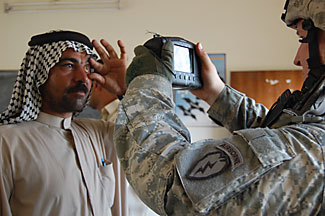
A partially trained Iraqi police force and bands of armed volunteers now work under American supervision, carefully preserving peace on streets covered by years of trash and rubble. To live under this new protection, most of Fallujah’s 250,000 residents submitted fingerprints and retina scans to get identification cards that let them stay in the city.
As a point of fact, Lt. Col. Mullen is now a Colonel, one of thirty two promoted to Colonel effective October 1, 2007, prior to the publication of the Tribune article. Also, there aren’t a quarter of a million residents left in Fallujah. The article does go to show that the Marines in the Fallujah area of operations are currently primarily engaged in reconstruction, rebuilding and public affairs. The article also reminds the reader that more work needs to be done.
It is a place under 24-hour lockdown, surrounded by berms and barbed wire. But that’s a price Fallujah’s war-weary residents say they are willing to pay for now.
“The last four months, things have been going better,” said Khamis Auda Najim, a 38-year-old cabinet-maker in Fallujah’s Andalus neighborhood. “But the changes are just on the security side. The street surfaces, the sewage, the electricity, the water? Those aren’t as good.”
U.S. forces promise those services are coming, along with U.S.-funded reconstruction projects and more money from the federal and provincial governments. But nothing in Fallujah moves quickly. As they face impatient city residents, the Americans are learning that everything is important now.
“I’ve been an infantry officer for 10 years. Since I’ve been here, I’ve learned more about water treatment and sewage than I’ve ever wanted to know,” said Marine Capt. Jeff Scott McCormack, 32, a company commander from Oak Forest, Ill.
Quick transitions have been made from the U.S. forces that established security to civilian Iraqi forces deployed to preserve it. The last Iraqi army troops left a month ago; the streets are now in the hands of 1,500 volunteers and police officers, some of whom have completed abbreviated training courses.
Heavy kinetic operations in May and June of 2007 were followed on by gated communities and biometrics, and involvement of the local Iraqi police along with paid individuals engaged in community watch. Marines filled sand bags and constructed joint combat outposts - Police Precincts, and patrolled with Iraqi Police in order to give them confidence. With the comparative irrelevance of tribal leaders in the Fallujah area, Muktars were engaged to provide leadership of and communication with the communities.
Upon pacification of Hit, Haditha, and Ramadi (all by different means, Haditha with sand berms, curfew and a ban on vehicular traffic, Ramadi with tribal engagement), the insurgency fled to Fallujah, where kinetic operations routed them from the area in the second quarter of 2007. Many of them left and went home to Lt. Col. Bohm’s area of operation, where they are being carefully assimilated back into society.
Col. Richard Simcock who commands Regimental Combat Team 6 is measured and careful, yet honest with where he believes Anbar currently stands.
U.S. Marine Colonel Richard Simcock, who commands the 6th Marine Regiment, says his forces have successfully routed the insurgents in Anbar province.
“There are still attacks in Fallujah and surrounding areas,” said Colonel Simcock. “We have not killed or captured every single al-Qaida member that is here. But their capabilities are greatly diminished. I would characterize them as a defeated force from my perspective.”
Speaking to reporters in Washington via satellite from Iraq, Colonel Simcock says the surge of more U.S. forces in Anbar and Baghdad has allowed Marines to stay in areas where al-Qaida in Iraq terrorists have fled to prevent insurgents from returning.
He also credits the cooperation of the Iraqi army and police, as well as local tribal leaders in the effort to defeat al-Qaida in Iraq and bring security to Anbar.
“That has been the building block that has allowed the people to come out and participate in governance,” he said. “But, probably more importantly, it allows them to come out and do the things that a lot of the citizens here in al-Anbar have not been able to do because of murder and intimidation that al-Qaida was doing. We have made great strides in regards to that, and we are very, very pleased with the progress that we are making.”
Measured, careful and honest. There are still attacks - we have not killed or captured every single AQI member - but they are a defeated force. Exporting this model is complicated and nuanced, and involves more than just the participation and approval of tribal shiekhs, no matter what the current narrative says. Nibras Kazimi has crafted a smart analysis of tribes and their saliency in Iraq for the New York Sun.
Does it really matter, whether tribes were the primary factor in defeating Al Qaeda or not, given that the story coming out of Iraq is more and more hopeful? Yes it does: the implication is that if you don’t know why and how you’ve won, then you won’t be able to replicate victory. The tribes, like the American troop surge, were catalysts that sped up the demise of the insurgency, but they did not trigger the process the insurgency’s failure predated the surge and any tribal strategies.
I believe the insurgency failed because it had bad ideas and unrealistic expectations. When the price paid by the local population for these ideas and expectations — fighting the Shiites and re-establishing Sunni hegemony — became too steep, Sunnis turned against the insurgents and tried to find shelter, yet again, under the central government This latter trend is the one that should be reinforced: Sunnis should be encouraged to throw in their lot with the New Iraq, rather than falling back into the tribal identities of Iraq’s past.
Once tribal leaders realized that Al Qaeda was losing, they turned towards Baghdad for guidance. As one Iraq observer put it to me, “Tribes are a barometer of power; they swarm around whoever has the upper hand.” The danger now is that Americans are trying to resuscitate a clannish social system that had withered away in Iraq, and turning it into a power in of itself.
We agree with Kazimi. Nonetheless, the U.S. has worked with tribes where it suited our needs, and community Muktars where it suited our needs. Given the constricted time frame that the U.S. public will allow for this counterinsurgency campaign, efficacy and expediency is the order of the day. Thus, following the model in Fallujah, do we see retinal scans being taken by Army troopers south of Baghdad.

The Christian Science Monitor has an article in which they examine the export of the Anbar model to Shi’ite parts of Iraq.
Forward Operating Base Iskan, Iraq - The violence has dropped dramatically, say US commanders, in the towns surrounding this base in northern Babil Province, south of Baghdad.
In May, four improvised explosive device (IED) attacks targeted the battalion; none in August, says Maj. Craig Whiteside, executive officer of the 1st Battalion of the 501st Infantry Regiment. Fewer undetonated IEDs have been found – five in May and two in August. Indirect fire and small-arms violence have also dropped from about a dozen incidents in May to less than three in August.
The reason, they say, is that the same approach that won success in Anbar Province, where the Marines gained support of Sunni tribesmen against Al Qaeda, is taking hold in mixed-sectarian areas. But here, Americans have enlisted Shiites frustrated with extremists from such groups as the Mahdi Army, run by Moqtada al-Sadr.
Across the Euphrates River Valley, known to the military as the southern belts of Baghdad, about 14,000 Shiite and Sunni “concerned citizens” are being paid to man checkpoints and patrol roads in an effort to prevent attacks from violent extremism of either sect.
Largely untrained and armed with weapons they already own, the citizens wear armbands and monitor traffic along the roads, keeping watch to ensure no outsiders or other extremist elements come through to bury roadside bombs. If they fail to keep violence out, they could lose their monthly paycheck. Ultimately, the idea is that they will become members of the Iraq security forces.
“They are making their community safe,” says Army Capt. Charles Levine, one of the company commanders here. His battalion has recruited more than 1,300 participants since mid-September. A little less than half of them are Shiite.
Concerned citizens and turnover to the local communities is the key to the current counterinsurgency strategy in Iraq. If the hope is that people are taking responsibility for reasons other than their tribal Shiekh says to do so, this strategy is seeing some success.
A 72-year-old man stopped a suspected suicide bomber from detonating himself at a checkpoint in Arab Jabour Oct. 14.
The man approached a checkpoint where Mudhehr Fayadh Baresh was standing guard, but did not make it very far.
Baresh, a tribal commissioner and member of the Arab Jabour Concerned Citizens program, said he ordered the man to lift his shirt - using training received from Coalition Forces - when he did not recognize him as a local villager.
The suspect refused to lift his shirt. Baresh repeated the command again, and the suspect exposed his suicide vest, running toward the checkpoint.
Baresh opened fire which caused the vest to detonate, killing the suspect.
“I did it for the honor of my family and the honor of my country,? said Baresh, when he met with Col. Terry Ferrell, commander of the 2nd Brigade Combat Team, 3rd Infantry Division.
All counterinsurgency is local, and whether it is for family, tribe, remuneration or simply for personal safety, the enemy is being defeated in Iraq. There are fights remaining, and a precipitous departure of U.S. forces might turn a positive situation into a negative one. Yet it is impossible to ignore the gains on the ground in Iraq.
Other sources:
TCJ, Payment to Concerned Citizens: Strategy of Genius or Shame.
TCJ, Reorganizations and Defections Within the Insurgency in Iraq.
TCJ, Iraq: Al Qaeda’s Quagmire.
TCJ, Al Qaeda’s Miscalculation.
TCJ, Operation Alljah and the Marines of 2nd Battalion, 6th Regiment.
Bill Ardolino, Operation Alljah: The Swarm.
Bill Ardolino, Confidence is Key: The Evolution of the Fallujah Police Department.
Bill Ardolino: Shuffling Paperwork to Victory: The Evolution of the Fallujah Police Department.
Prev | List | Random | Next · Join Powered by RingSurf! |