Myths About Afghanistan
Victor Davis Hanson on whether Afghanistan is really the "graveyard of empires ..."
Ernie Pyle's timeless wartime columns ...
No July 4 hot dogs with the Iranian Mullahs ...
Mark Steyn, U.S. sclerotic and ineffectual, declining into societal dementia ...
Nicholas Schmidle asks some hard questions about Nawaz Sharif ...
The CIA's war against President Bush was motivated by ass covering, or by political
NSA Director Keith Alexander, a three-star general, is expected to earn a fourth star when he
Providing electronic devices for IEDs ...
Police watched from a distance and did not intervene ...
Been there, done that in the Middle East ...
Matt Sanchez - repealing DADT would be a disaster.
Too much U.S. largesse has created corruption in Afghan government.
Dan Riehl weighs in on language, thinking and security from terrorism ...
The U.S. is seeking to hire a merchant ship to deliver hundreds of tonnes of arms to Israel
Sharif brothers on Baitullah Mehsud's hit list.
No Georgian destruction of Tskhinvali, contrary to lying Russian claims.
Nuclear yield within six to twelve months.
McNeill ties length to Pakistan tribal region, likely to be protracted anyway.
Multinational force press release on Sadr City operations and seizure of weapons and munitions.
"We will fight them to the end."
War on terror not popular with Pakistani population.
U.S. presence expanding Southward in Iraq.
Its full steam ahead for Iran.
And SECDEF Gates continues to press this issue.
Pajamas Media exclusive: how your tax dollars fund terror.
Southwestern Baptist Theological Seminary Graduate executed in Afghanistan.
Nearly 1000 dead from harshest Afghan winter in 30 years.
Attacks in Baghdad down 80% according to Iraqi Army.
Lack of appropriate defense spending a grave situation.
Olmert claims Iran still on target to construct nuclear weapon.
Promoted to Army Vice Chief of Staff. Well deserved.
Must read on Israeli Army shame and lawyer happiness with war against Hezbollah.
Libyans joining jihad in increasing numbers.
How relevant will Maliki be to Iraq's future?
Maj. Gen. Gaskin: "The positive trends are permanent."
Abizaid questions whether Maliki can bring unity to Iraq.
From the Multinational Force, more on Operation Lion Pounce.
An important ally in Iraq has been assassinated.
Israel to show Chairman of Joint Chiefs of Staff nuclear intelligence on Iran.
Cabinet approves proposed agreement with U.S.
Prof. Kingsley Browne on his new book.
Major General Robert Scales: "Outcome is irreversible"
Mullen says military needs larger slice of GNP to modernize.
For siding with the U.S. against al Qaeda.
Terrorist poses as bride. Ugh!
Legislation in trouble.
Al Qaeda documents discovered near Syrian border.
Shameful people jeer disabled veterans in swimming pool.
Saudi jihadist in Iraq tells his personal story.
Concerning Iranian meddling and Quds.
Michael Yon breaks bread with General Petraeus.
Ralph Peters on the advancements in Iraq.
War between al Qaeda and Hezbollah.
Traumatic brain injury not recognized.
Ballistic Sensor Fused Munition.
High intensity electronic warfare.
Iranian weapons are a sign of continued Iranian meddling in Iraq.
U.S. forces in Iraq are using a high-resolution, thermal/infrared sensor system.
Washington Post profiles AQI (al Qaeda in Iraq, or al Qaeda in Mesopotamia).
Taiwan may not be as secure as we would like to think.
Be thankful your daughter isn't be raised in Basra.
Pastor discusses rules of engagement and sacrificial U.S. deaths.
In counterinsurgency (COIN), patience is a virtue. But violence has decreased so fast in
Pakistan has supported a robust U.S. drone campaign against the Pakistan Taliban, or Tehrik-i-Taliban, because they see them at least somewhat as an existential threat. The Afghan Taliban led by Mullah Omar is a different story. The leadership is primarily in Pakistan, at first in Quetta and eventually scattered as necessary to avoid detection. There has been no drone campaign against them because the Pakistani leadership and Army has a quaint but wrongheaded notion of using them (throughout Afghanistan and Kashmir) as a counterbalance against what they view as Indian hegemony. That is, until recently.
Their top military commander, Mullah Abdul Ghani Baradar, was recently captured in the port city of Karachi. There is a bit of intrigue surrounding his capture, including the highly plausible hypothesis that Pakistan wants a place at the bargaining table if and when the Taliban ask for negotiations. Whatever the reason(s), they are still salient, as half of the Quetta Shura has now been arrested in Pakistan.
Plain clothed police move a Pakistan Taliban commander from the Bajaur region through the halls of the Police Crime Investigation Department on Feb. 17. Akhtar Soomro/Reuters
Pakistan has arrested nearly half of the Afghanistan Taliban’s leadership in recent days, Pakistani officials told the Monitor Wednesday, dealing what could be a crucial blow to the insurgent movement.
In total, seven of the insurgent group’s 15-member leadership council, thought to be based in Quetta, Pakistan, including the head of military operations, have been apprehended in the past week, according to Pakistani intelligence officials.
Western and Pakistani media had previously reported the arrest of three of the 15, but this is the first confirmation of the wider scale of the Pakistan crackdown on the Taliban leadership, something the US has sought.
“This really hurts the Taliban in the short run,” says Wahid Muzjda, a former Taliban official turned political analyst, based in Kabul. Whether it will have an effect in the long run will depend on what kind of new leaders take the reins, he says.
News of the sweep emerged over the past week, with reports that Pakistani authorities had netted Mullah Abdul Ghani Baradar, the movement’s second in command, as well as Maulavi Abdul Kabir, a prominent commander in charge of insurgent operations in eastern Afghanistan, and Mullah Muhammad Younis.
Pakistan has also captured several other Afghan members of the leadership council, called the Quetta Shura, two officials with the Pakistani Intelligence Bureau, and a United Nations official in Kabul told the Monitor.
These include: Mullah Abdul Qayoum Zakir, who oversees the movement’s military affairs, Mullah Muhammad Hassan, Mullah Ahmed Jan Akhunzada, and Mullah Abdul Raouf.
At least two Taliban shadow provincial governors, who are part of the movement’s parallel government in Afghanistan, have also been captured.
A Taliban spokesman denied the arrests, saying that they were meant to hide the difficulties that United States and NATO forces were having in Afghanistan.
Our favorite Taliban propagandist working for the Asia Times, Syed Saleem Shahzad, tells us that the importance of these high value target (HVT) hits may be exaggerated.
Taliban sources tell Asia Times Online on the condition of anonymity that the appointment will be largely symbolic and primarily for coordination purposes as Taliban leader Mullah Omar, following difficulties in recent years, has decentralized the Taliban’s command structure. The idea is to give commanders in the field greater flexibility and allow for the possibility that should even Mullah Omar be seized or killed, the resistance would continue to function …
“Mansoor’s appointment is very likely, but so far there has been no confirmed decision,” a mid-ranking Taliban official told Asia Times Online. “However, the position of supreme commander is now ceremonial and for the purposes of coordination. In the new setup, military operations have been completely decentralized and are in the hands of local commanders who have been given broad policies. It is up to them to sort out their own tactics,” the Talib said.
“For this reason, Mullah Baradar’s arrest did not have much effect on military operations, including at Marjah [the ongoing major offensive against the Taliban in Helmand province] where the Taliban continue to provide tough resistance to the occupation forces. And whoever is appointed [supreme commander], it won’t make much difference on military operations.”
We’ll see how much operations are affected. The Taliban have a HVT campaign of their own, so switching sides is problematic. I have been on the forefront with denials that the HVT campaign is useful enough to justify its effort and expense. But neither should we deny the usefulness of taking out half of the Taliban Shura.
Either way, it won’t end the insurgency in Afghanistan or Pakistan, and it certainly will not end the globalist intentions of the Tehrik-i-Taliban. Since different brands of the Taliban swim in the same waters and cross pollinate ideas, something so simple as a HVT campaign won’t end the war in spite of its usefulness.
Of the recent capture of Mullah Abdul Ghani Baradar, Dana Perino and Bill Burck observed:
Today, the Times is reporting that the real story behind Baradar’s capture is that Pakistan wanted to gain a place at the table in negotiations between the U.S. and Karzai and the Taliban.
Specifically, Baradar, it turns out, was one of Karzai’s main contacts with the Taliban for years, and he was at the center of efforts to negotiate a peace with the Taliban. Pakistan was frustrated at being excluded from the talks, so it snatched up Baradar to gain an advantage.
The Times quotes an unnamed American intelligence official: “I know that our people had been in touch with people around [Baradar] and were negotiating with him. So it doesn’t make sense why we bite the hand that is feeding us. And now the Taliban will have no reason to negotiate with us; they will not believe anything we will offer or say.” If this is true, then the capture of Baradar is not exactly what it first appeared. And if Baradar was as central to Karzai’s and America’s efforts to negotiate with the Taliban as the article suggests, then there appears to be significant costs to the capture. Perhaps it was even unhelpful to Karzai and the U.S.
Does capturing Baradar really further U.S. strategy? (Perhaps the administration did not view him as a valuable contact and thought he would be more useful in custody and subject to interrogation.) Or does it actually harm U.S. strategy? Was it forced on the Obama administration by the Pakistanis? If so, does the administration’s triumphant tone reflect its true feelings about the importance of capturing Baradar, or is it a smokescreen?
The fact that the New York Times, not known for its strength of objectivity in covering the Obama administration, is reporting this suggests to us that there’s a better-than-even chance that the administration is trying to turn a lemon into lemonade.
So this analysis relies on the notion that this is more Pakistani duplicity. Ralph Peters, on the other hand, sees the world with much more intrigue (I must quote at length).
The capture of Mullah Abdul Ghani Baradar — the Taliban’s equivalent of Gen. Stan McChrystal — by Pakistani agents and CIA operatives is a big win.
Subordinate only to Mullah Omar, the Taliban’s CEO, Baradar ran the Taliban’s military operations in Afghanistan. Responsible for the upgrade in insurgent tactics — fighting smart, rather than just fighting — he also created the Taliban’s hearts-and-minds campaign.
For two weeks, he’s been under interrogation by Pakistan’s Inter Services Intelligence agency. The CIA’s also involved in the questioning on some level — but the ISI always holds back some chips.
The grab won’t affect the ongoing fight for Marjah in Afghanistan, but the loss of Baradar’s operational savvy could degrade future Taliban operations. And if he sings — as we’re told he’s doing — it could be the biggest anti-Taliban bonanza since 2001.
Or maybe not. While it’s excellent news that Baradar’s been nabbed, his capture in Pakistan’s largest city, Karachi, raises questions Washington yearns to ignore:
* Why did the ISI and its overseers agree to bust him now? They’ve known his whereabouts for years — intermittently, if not consistently — just as they monitor the movements of most insurgent bigwigs.
* Did the Pakistanis act at last because the CIA cornered them into it? Or is this a deeper tale of rivalries, betrayals and Pakistan’s long-term ambitions? Perhaps Baradar was too effective a commander for Islamabad’s plans — or too independent for the ISI.
Reportedly, Baradar had been defying commands from Mullah Omar, who the ISI has backed for almost 20 years. Was this the intel equivalent of a gangland hit?
And what role did the other insurgent groups play? Pledged to cooperate with the Taliban, the savage Haqqani network based in North Waziristan is protective of its turf. Was Baradar’s growing power a threat to Maulavi Jalajuddin Haqqani and his bloodthirsty son, Sirajuddin? Did they rat him out?
Then there’s the Hezb-e-Islam, the durable mujaheddin outfit of warlord Gulbuddin Hekmatyar, a ruthless survivor of decades of Afghan conflict. He spent years fighting the Taliban (and just about everybody else), but has cooperated with the Taliban in the wake of 9/11 on the principle of “the enemy of my enemy is my friend.”
Behind his displays of Muslim piety, Hekmatyar’s an opportunist out for Hekmatyar. He’s also the figure the ISI is most confident it can control (the Taliban’s become annoyingly independent). The Pakistanis may foresee a deal between Hekmatyar and President Hamid Karzai, which would get the Americans out — then leave the hapless Karzai dangling from a lamp post like Najibullah, Moscow’s last man in Kabul.
To make that work, the Taliban would have to be under control: still a menace to Americans, but manageable for Pakistan, once our troops and NATO’s go home (the Obama administration would leap at the chance to recognize “Afghan reconciliation”).
This is a crime-family power struggle — “The Godfather,” AfPak style. The ISI may have pretended to roll over for us on Baradar, when Pakistan’s generals wanted him out of the picture, anyway. If he turns stoolie (angered by his betrayal) and the ISI finally does move against the Taliban, it signals they’ve tipped decisively toward Hekmatyar.
This is a lot of complex intrigue, but a cursory review of my advocacy shows that not only have I not supported “negotiations” with the Taliban, I have not supported the same with Hekmatyar. It may take a long time for the truth to be told concerning this capture and surrounding events – or, we may never know the complete truth. Either way, I still don’t buy into the notion of the high value of high value targets.
I see all of this mainly as a momentarily intriguing distraction. We might get some good intelligence for a while, at least until his knowledge base becomes dated and useless. The Pakistani ISI (and some Army) is duplicitous, regardless of whether Peters’ account is correct. Hekmatyar is trouble, and negotiations with him will come to no good end. Anyone in Mullah Omar’s circle cannot be trusted, and negotiations with his shura will come to no good end.
If the sum total of Baradar’s capture is to end these juvenile and ill-conceived negotiations with the Taliban and ensure that they don’t trust us, then so much the better. As I said before, I’m in the school which advocates killing the enemy in large numbers.
Prior:
Mullah Abdul Ghani Baradar has been captured.
The Taliban’s top military commander was captured several days ago in Karachi, Pakistan, in a secret joint operation by Pakistani and American intelligence forces, according to American government officials.
The commander, Mullah Abdul Ghani Baradar, is an Afghan described by American officials as the most significant Taliban figure to be detained since the American-led war in Afghanistan started more than eight years ago. He ranks second in influence only to Mullah Muhammad Omar, the Taliban’s founder and a close associate of Osama bin Laden before the Sept. 11 attacks.
Mullah Baradar has been in Pakistani custody for several days, with American and Pakistani intelligence officials both taking part in interrogations, according to the officials …
American officials believe that besides running the Taliban’s military operations, Mullah Baradar runs the group’s leadership council, often called the Quetta Shura because its leaders for years have been thought to be hiding near Quetta, the capital of Baluchistan Province in Pakistan.
One of the more intriguing elements of this report is where he has been detained: Karachi. I can be counted among that group who believes that the Quetta Shura is based in Quetta. But the theory has been floated for a while now that Mullah Omar was in Karachi, and now his second in command has been detained there.
This follows on soon after logistics attacks occurred in Karachi, not too long after attacks directly against Christians, shootouts between the Taliban and Pakistani police, and about a year and a half after I noted the Talibanization of Karachi. This is yet another data point arguing for the importance of focus on Karachi, the port city through which the vast majority of logistics flows to Afghanistan.
The other interesting thing about this detainment is that it is of a Taliban leader in Pakistan, not a Tehrik-i-Taliban, or Pak-Taliban. This is actually a good sign from Pakistan.
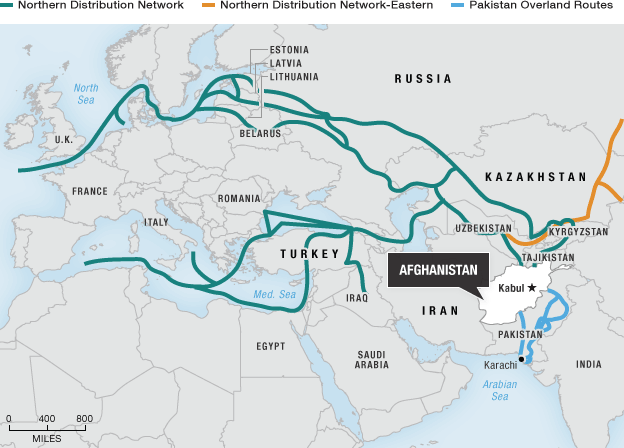
There is more logistical trouble with the supply lines through Pakistan (lines which supply approximately 85% – 90% of our needs in Afghanistan). The first report has to do with a bridge near Peshawar.
Suspected terrorists on Thursday blew up a bridge on a link road connecting Peshawar’s Badbher village to Khyber Agency’s Bara town, officials and locals said. A police official said the blast took place at around 1:30am. The bridge over the Frontier Road was blown up as police personnel travelled through the area, the official said, adding that the terrorists escaped the scene. He said that a search was being conducted to trace the perpetrators of the blast.
The second report pertains to a tanker attack near Peshawar.
Taliban blew up a tanker carrying oil supply to NATO forces in Afghanistan on the ring road in the Chamkani police precincts early on Monday, police said. Chamkani police officials told Daily Times that an Afghanistan-bound tanker carrying oil supply for NATO forces was attacked by armed men on Monday morning. They said the assailants fired at the tanker and destroyed it with a magnet bomb.
The third report is even more important for where it occurred – the port city of Karachi.
A NATO convoy came under assault Thursday while carrying supplies through Pakistan to Afghanistan in a rare ambush inside Karachi, the relatively secure port city from which 300 to 400 of the coalition’s trucks leave each day.
Any assault on the Pakistani supply route is worrisome to the US-led forces in Afghanistan, who use it to ship three-quarters of their materials and will need it even more as the surge of 30,000 US troops progresses.
But the attack in Karachi – which is the commercial capital of Pakistan, and has largely escaped the bomb attacks troubling other major cities and the northwest – raises particular concern, especially if it marks the beginning of a trend.
From the beginning to end of the supply lines, logistics is under attack. It still isn’t too late to do the right thing, and engage the Caucasus.
We have discussed before the notion of the Pakistani pathological preoccupation with India, coupled at least in part with its negligence to see the existential threat to its own state by the Taliban. But every once in a while a report comes along that almost needs no other data, commentary or elucidation in order to demonstrate the point. The Sri Lanka Guardian has such a report.
Waziristan is a rugged mountainous area in the remote part of Pakistan. Its inhabitants, tribal people, have been devout Muslims. Over the years they learnt to blend their centuries old tribal traditions with Islamic teachings and thus their life was shaped both by Islam and tribal traditions.
As fiercely independent people they maintained their own legal system based on tribal traditions for centuries and the Pakistani laws do not apply there. However their loyalty to Pakistan remain unquestioned .Under such circumstances the question is how come these peace loving people suddenly became radicals and militants to fight their own country’s armed forces killing their own Muslim brothers and sisters.
The answer lies in the shocking discovery by the Pakistani armed forces of sophisticated weapons, besides large amount of foreign currencies, from United States, NATO, Israel and India following recent military operations to flush out what the West describe as Pakistani Talebans. However the most startling discovery was the presence of uncircumcised, non Muslim, Talebans among those killed raising eye brows though everyone knows who they are and what they were doing in South Waziristan.
An Islamabad datelined report by Akhtar Jamal on Wednesday, 21 October 2009 disclosed that hundreds of militants from Tehreek-i-Taliban Pakistan (TTP) and other associated groups are equipped with most sophisticated American, Indian and German weapons.
The weapons in their possession included U.S. made M249 automatic machine guns, and Glock pistols, Indian hand guns, FN Browning GP35 9mmx19mm, Indian automatic machine pistols GLOCK 17 9mmx19mm, Indian machine guns Heckler & Koch MP5A3 9mmx19mm, Indian made Sterling L2A1 sub machine guns, Israeli licensed Indian made UZI 9mmx19mm sub machine guns and German Walther-P1 pistols.
Pakistanis in general believe that the “Americans are not interested in Pakistan or its people despite their so called generous aid packages. The American strategy in Pakistan is to put Pakistani government against Pakistanis, provoke civil war and plunge the country into chaos to neutralize its nuclear arsenal that has been US neoconservatives’ urgent priority”.
Under the circumstance Pakistanis consider America to be the greatest threat, worse than the arch rival India, to their sovereignty and independence .They are aware that already a map showing a truncated Pakistan has been in circulation and the ever growing collaborations among India, Afghanistan US, Europe and Israel …
Recently, in the officer’s mess in Bajaur, the northern tribal region where the Pakistani Army is tied down fighting the militants, one officer told a visiting journalist that” Osama bin Laden does not exist”. It was something extremely exaggerated by Anglo American war mongers to justify their conspiracies to destabilize Muslim countries and loot their wealth. This is the reason why Pakistanis suspect that the wave of disappearances, torture and death squad assassinations in Pakistan are also “made in the US”.
Meanwhile American mercenaries were accused of bombing and killing innocent Pakistanis in their drive to put the Pakistani armed forces and the people of South Waziristan against each other in their design to do what they did in Iraq and Afghanistan-aggravate the conflict.
It is worthy to note that ,according to a former employee, Erik Prince, the founder and the boss of Blackwater, world’s most powerful mercenary army, accused in court papers of seeking to wipe out Muslims, views himself as a Christian crusader tasked with eliminating Muslims and the Islamic faith from the planet. These Blackwater mercenaries are in Pakistan and many suspect that they were behind most of the deadly attacks blamed on the Pakistani Taleban who promptly denied responsibility.
Thus the name of the game is same-destabilize Pakistan in the way Anglo American warmongers destabilized and virtually turned Iraq and Afghanistan into wastelands under the guise of fighting terrorism.
Meanwhile in a report presented to the UN General Assembly on Tuesday 26 October 2009, UN Special Rapporteur on Extrajudicial Executions Philip Alston described US drone strikes against suspected terrorists in Afghanistan and Pakistan may well violate international humanitarian law and international human rights law …
It is common knowledge that India wanted to destabilize and partition Pakistan from the day it came into being in 1947.India played a crucial role in breaking up Pakistan and creating Bangladesh in its eastern wing exploiting the blunders of the Pakistani’s ruling elite.
Three decades later today India, hand in glove with American installed Hamid Karzai’s puppet regime, has 14 consulates in Afghanistan from which RAW operates The US has turned a blind eye. Pakistan has stockpiles of evidence against Indian consulates in Afghanistan used to fund terrorism in Pakistan through Baitullah Mehsud’s TTP as well as Brahamdagh Bugti and his Baluch Liberation Army-BLA.
According to Pakistani daily DAWN, a dossier containing proof of India’s involvement in “subversive activities” in Pakistan was handed over by Prime Minister Yousuf Raza Gilani to his Indian counterpart Manmohan Singh during their meeting at Sharm el-Sheikh in July 2009.The dossier, broadly covering the Indian connection in terror financing in Pakistan, is also said to list the safe houses run by RAW in Afghanistan where terrorists are trained and launched for missions in Pakistan. The dossier also mentions an India-funded training camp in Kandahar where Baluch insurgents were being trained and provided arms and ammunition for sabotage activities in the Pakistani province.
Confirming the Indian support to TTP in Pakistan the Foreign Policy magazine said: “the Indians are up to their necks in supporting the Taliban against the Pakistani government in Afghanistan and Pakistan. “The same anti-Pakistani forces in Afghanistan also shoot at American soldiers getting support from India which should close its diplomatic establishments in Afghanistan and get the Christ out of there.”
“Afghan officials have also confirmed that India is using Afghanistan to stir trouble and destabilize Pakistan and Afghan security agencies are unable to stop Indian intervention due to absence of centralized government mechanism”, said Afghan Government’s Advisor, Ehsanullah Aryanzai on sidelines of Pak-Afgan Parliamentary Jirga at a local hotel on April 2, 2009.
The RAW is operating out of U.S. bases, Erik Prince is a Christian crusader on a mission to kill Muslims (rather than a clever businessman), the U.S. is funding the Mehsuds (while we also killed Baitullah by a drone strike), the U.S. (who already has quite enough nuclear weapons) is after Pakistan’s nuclear arsenal, UBL doesn’t exist but is a fabricated figment of our imaginations as a surrogate for a war that is really designed to destroy Pakistan – and so on – and on – and on.
One wonders when the author is going to claim that he was abducted by Martians and taken for interrogation by green men with big heads. This is so bad that it should be embarrassing, and I actually wonder why the Sri Lanka Guardian published it, except to demonstrate the extreme pathologies that reside just next door in Pakistan.
Prev | List | Random | Next · Join Powered by RingSurf! |