Withdraw From Afghanistan

Herschel Smith · 22 Jan 2012 · 14 Comments

Michael Yon has written a short note entitled Time To Leave Afghanistan.  I concur, but for somewhat different reasons, or at least, I will state my reasons somewhat differently.  I had been pondering going public with my counsel to withdraw from Afghanistan, and then I read possibly the most depressing entry on Afghanistan I have ever seen, from Tim Lynch.  Some of it is repeated below. Ten years ago, Afghans were…… [read more]


New Approach in the Pech River Valley?

BY Herschel Smith
4 months, 4 weeks ago

From CSM:

Nestled in a lush but mean valley on the banks of the Pech River, Camp Blessing was no longer the sort of place, US commanders decided in February, that warranted the bloodshed of American soldiers.

Instead, the US war effort would benefit from focusing its limited resources on population centers, they concluded, and away from the Pech’s brutal terrain and rather xenophobic citizenry, ready and more than willing to skillfully take up arms against outsiders.

Better, they concluded, to leave this sparsely settled region – where Afghan fighters mustered to make the first successful stand against Soviet occupation – to the Afghan Army.

So soldiers from the 101st Airborne Division towed away the modern toilet trailers and stripped Camp Blessing of its amenities – air-conditioning units, flat-screen monitors, and the covered plywood porch where senior US troops convened to smoke cigars and discuss the news of the day.

In March, they rechristened the base “Nangalam” and turned it over to Afghan forces.

Today, however, US soldiers are back. The conditions at the once built-up outpost are now spartan. Troops bathe with baby wipes and bottled water and sleep on the floors of buildings that, they discovered upon their return in late July, were littered with human feces.

Insurgents had advanced so steadily since March that the Afghan Army could lose the base itself, say a new crop of US commanders.

They see the return as an opportunity to forge a new model for cooperation and mentoring with the Afghan security forces. But while the Pech is admittedly one of Afghanistan’s toughest assignments, the Afghan Army’s failed four-month attempt take the reins of security illustrates its shortfalls – and how far there is to go, US officers say, if NATO is to turn all security responsibilities over to Afghan forces by 2014.

The troops who have come back to this jagged spine of mountain peaks are under no illusions about the difficulty of the task that awaits them. Their code name for this operation: “Hotel California.”

“It’s like the lyrics,” says 2nd battalion intelligence officer Maj. Marcus Wright of the Eagles song: “ ‘You can check out any time you like, but you can never leave.’ ”

When US forces moved back into Camp Blessing in late July, they were greeted with mortars and rocket-propelled grenades, one of which hit the underbelly of a US Chinook carrying supplies for the base. That marked the first shoot-down of a Chinook this year. The pilot was able to land relatively gently without any serious injuries, though passengers were forced to sprint when thousands of rounds of ammunition caught fire and ignited, causing shrapnel injuries and destroying the helicopter.

It was a pattern of hostility repeatedly encountered by US forces. “We really had to reoccupy the base,” says Maj. Glenn Kozelka, executive officer for the 2nd battalion, 3rd brigade combat team of the 25th Infantry Division.

Security had deteriorated rapidly after US forces departed. Within weeks, the Afghan battalion commander at Nangalam could not safely get to meetings in a Asadabad, Kunar’s bustling capital 25 miles east. The Taliban overran and occupied the capital of a nearby district center.

At the same time, insurgents routinely attacked Afghan National Army (ANA) patrol routes. By May, the Afghan commander stationed at Nangalam had abandoned the outpost, along with his top staff.

“It was better before” the US left, says Afghan commander Col. Adam Khan Matin. “When the coalition forces left, the [insurgent] training camps came back.”

Stopping for a moment for some observations on insurgent bases, U.S. commanders (specifically, McChrystal and his staff) might have argued for a population-centric approach to counterinsurgency, but regular readers know that I didn’t.  Continuing with the CSM article.

Lt. Col. Colin Tuley, the top US commander at Nangalam, grappled with how to address the regression. His battalion now had responsibility for an area that had previously needed two. His 800-plus soldiers were spread out across multiple forward operating bases and command posts.

Simply holding that ground would be challenge enough. After evaluating the capabilities of the ANA at Nangalam, Col. Tuley came to a conclusion. “We needed to do something else.”

In his idea is a hope central to the American exit strategy: If US troops focused more intently on creating a workable partnership with the Afghans, perhaps the mentoring could make up for the diminished number of US troops and ensure that a decade’s worth of US battles are for not for naught.

So began what Tuley calls a “permanent embedded partnership” – or PEP – an experiment that could hold lessons for the American war effort in Afghanistan.

The PEP will revolve around 40 US troops at Nangalam working with multiple companies of the Afghan Army. Most immediately, with a stronger base here, Tuley hopes US forces “can come in and do operations as necessary,” allowing NATO to extend its reach farther into the valley. Perhaps more long-term, he adds, the PEP “is a great kind of interim phase to get the ANA to where [the transition is] not as abrupt.”

The US platoon will run workshops on basics from marksmanship to first aid – lessons that have been taught before, Tuley acknowledges, but bear repeating.

“If you think about it, this [Afghan commander at Nangalam] never had a partnership, Tuley adds. “It was. ‘Here’s your battlespace.’ ”

The first order of business – and lesson for Afghan commanders – is to bolster base defenses. When the US was here, Nangalam had early-attack warning systems, including towers with cameras that sent images to screens in a base defense center, which allowed troops to monitor the perimeter.

When Tuley returned, no vestige of those defenses remained. “The security definitely wasn’t at the level that I would ever feel too comfortable having my soldiers out there,” he says.

In response, he has assigned a US platoon of about 30 soldiers to patrol the surrounding area, and he stationed a single US soldier with night-vision goggles at each Afghan guard post along the perimeter of the base.

Beyond base defenses, Tuley must help the Afghans carry out their own missions more effectively.

The PEP’s first big test: A humanitarian mission into one of the more isolated and government-averse areas of the country.

PEP teams.  It’s permanent now, except that it’s not.  U.S. troops will be leaving, and leaving the ANA in a lurch without the cultural framework, logistical know-how, equipment or honesty to run an army.  And they don’t understand force protection.  Furthermore, historically, only Western armies can field high quality NCOs.  And it doesn’t really produce much confidence that a humanitarian mission is the first really big test of the ANA.  During the battle of Kamdesh at COP Keating, ANA soldiers were found curled up in fetal positions in bed under blankets.  We’ve got larger problems than whether the ANA can pull off humanitarian missions.  Continuing.

Afghans also lack equipment, including night-vision goggles. “That’s a pretty critical piece of equipment to provide security,” says Tuley. US officials worry, however, that if they give night-vision goggles to the Afghans, particularly with ANA attrition rates remaining high, they could fall into insurgents’ hands.

Yes, expensive equipment will end up in enemy hands.  Said one ANA soldier about his conditions, “Some of the guys wear sandals at the border because their boots have been taken by officers who sell them.”

Finally, the most important part of the report.

For now … the US troop presence at Nangalam is likely only to increase.

As the first week of partnership at Nangalam winds to a close, Tuley is increasingly convinced that rather than the 40-plus soldiers currently taking part in the PEP, he will need closer to 200.

He knows, too, that this plan comes with opportunity costs. With US forces set to draw down across Afghanistan, he can only bolster the American presence at Nangalam by closing a combat outpost or a forward operating base.

After the PEP’s first big mission, though, he believes that expanding US forces here is key to US troops being able to one day go home for good.

This is important enough to bear repeating.  He needs more troops (or a higher ratio of U.S. forces to ANA).  The only way he can accomplish that is to close COPs or FOBs.  I repeat.  Marines to Kunar.

NATO Rushes To Seal Afghan Border

BY Herschel Smith
4 months, 4 weeks ago

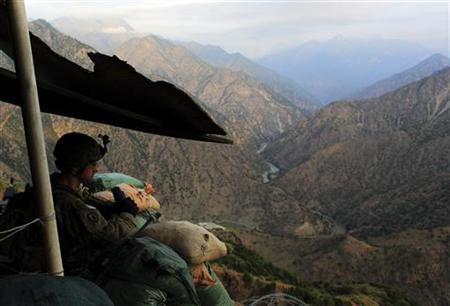
A U.S. Army soldier from Alpha Company 2nd battalion 27th infantry (the Wolfhounds), Task Force NO FEAR watches out from OP Mace in eastern Afghanistan Naray district, Kunar province near the border of Pakistan early August 27, 2011.  From Reuters

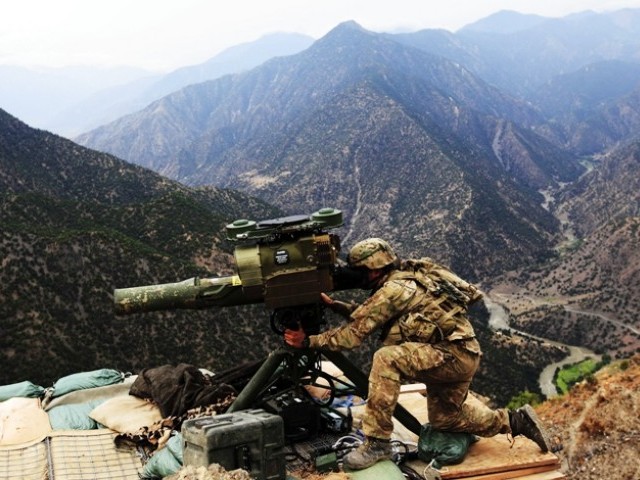
U.S. soldier Staff Sergeant Frankie Berdecia of Alpha Company 2nd battalion 27th infantry (the Wolfhounds), Task Force NO FEAR from Puerto Rico, operates a TOW missile system at Observation Post Mace in eastern Afghanistan’s Kunar province near the border with Pakistan August 28, 2011.  From IHT.

Romney Set To Attack Perry In South Carolina

BY Herschel Smith
4 months, 4 weeks ago

From Marc Thiessen:

Rick Perry may have jumped to the front of the GOP pack in national polls, but here in first-in-the-nation New Hampshire Mitt Romney still holds an 18-point lead. When I asked Romney about Perry during a recent campaign swing through the Granite State, he replied, “I don’t know what all of his positions are, you’ll have to ask him . . . I don’t spend a lot of time looking at [other candidates’] positions.”

That may be, but Romney’s campaign strategists are certainly spending a lot of time poring over Perry’s positions — and developing a plan to stop the surging Texas governor.

Romney has been criticized for refusing to engage Perry, but his campaign advisers see no need to do so now. They point out that the Democratic National Committee is going after Perry, hundreds of reporters hoping to make names for themselves are scouring his life and record, and other candidates that Perry has passed in the polls are determined to take him down. Why should Romney attack Perry directly when the Democrats, the liberal media and Michele Bachmann will do it for him? Romney’s strategists note that Perry will have to survive five debates in six weeks — ample opportunity for Bachmann to “rip his eyes out” (as she did to Tim Pawlenty) or for Perry to blow himself up.

If Perry fails to implode and continues to surge in the polls, Romney eventually will have to go on the attack — an assault his advisers say will commence “at a time of our choosing.” Romney strategists are quick to note that in his book, “Fed Up!,” Perry writes that “By any measure, Social Security is a failure” and calls the program “something we have been forced to accept for more than 70 years now” that was created “at the expense of respect for the Constitution and limited government.”

Look at what happened to Paul Ryan when he proposed a plan to save Medicare, they say. Romney’s campaign will argue that Perry is against the very idea of Social Security and Medicare, and that he will use Perry’s book to scare seniors in early-primary states with large retiree populations, such as Florida and South Carolina.

Very bad idea.  South Carolina is currently Perry country, but that’s not because Perry is untested, or Romney  hasn’t yet gone on the attack, or the fact that Rick Perry has a Southern accent.  These ideas are far too dumbed down to do S.C. and its people justice.

Governor Pawlenty dropped in the polls when he went on the attack against  Michele Bachmann, Senator Santorum is still tanking even as he attacks Perry, and Huntsman’s attacks against Perry brought him absolutely no benefit (but to be honest, he wasn’t a serious contender anyway).  Romney will drop in the polls when he goes on the attack against a fellow Republican.  Watch it happen and remember that I predicted it.

I know something about S.C.  When Romney swept into S.C. for the 2008 campaign he made some fatal mistakes.  But first, let’s discuss Jim Anthony.   Jim Anthony is a developer who promised the world and delivered problems to the people of S.C.  He purchased huge tracts of land in the upper part of the state with borrowed money, gated it off to the people of S.C., and sold it to very wealthy people – people like Oprah Winfrey who is never there.  This land was and is pristine, with flora and fauna not to be found anywhere else on earth.  The people of S.C. used it for hiking, camping, hunting, shooting, and just about everything imaginable (without destroying or significantly altering the land).  After Jim Anthony they will never see this land again.  Jim Anthony is seen in S.C. as a robber baron.  Just ask anyone in S.C.

Yet Mitt Romney’s sense of things brought him into S.C. and into a relationship with big money, and … you guessed it … Jim Anthony.  While McCain shook hands with just about every veteran in S.C., Romney was seen across every TV screen in the state with Jim Anthony.  Today Jim Anthony faces foreclosure on much of his property, and is now suing his bank and partners.

But whether Romney has the bad sense of things to hook up with Jim Anthony again, he did so in the beginning because he is a big money man.  South Carolinians aren’t impressed with this.  In fact, the strategy of invoking a government program is a bad, bad sign of his continued intransigence regarding his understanding of the South in general.  If Romney is down in the polls enough that he has to go into S.C. with big government proposals, he is doomed.

In fact, Romney cannot win in S.C.  It is impossible.  And if Romney temporarily surges when he begins campaigning in S.C.,  all Governor Perry has to do is show up at the shooting range in Pickens County, S.C., where I often shoot, carry along some reporters with him, and then inform his fellow shooters that Governor Romney signed an assault weapons ban in Massachusetts (and would do so again).

Romney will be seen as a big government republican who opposes guns, and he won’t have the libertarian vote.  He cannot win in S.C.  Remember that I told you so.

Obama Allows Mexican Police To Violate U.S. Sovereignty

BY Herschel Smith
5 months ago

From St. Louis Today:

President Barack Obama’s administration has expanded its role in Mexico’s fight against organized crime by allowing the Mexican police to stage cross-border drug raids from inside the United States, according to senior administration and military officials.

Mexican commandos have discreetly traveled to the U.S., assembled at designated areas and dispatched helicopter missions back across the border aimed at suspected drug traffickers. The U.S. Drug Enforcement Administration provides logistical support on the U.S. side of the border, officials said, arranging staging areas and sharing intelligence that helps guide Mexico’s decisions about targets and tactics.

Officials said these so-called boomerang operations were intended to evade the surveillance — and corrupting influences — of the criminal organizations that closely monitor the movements of security forces inside Mexico. And they said the efforts were meant to provide settings with tight security for U.S. and Mexican law enforcement officers to collaborate in their pursuit of criminals who operate on both sides of the border.

Former U.S. law enforcement officials who were once posted in Mexico described the boomerang operations as a new take on an old strategy that was briefly used in the late 1990s when the DEA helped Mexico crack down on the Tijuana Cartel by letting the specially vetted Mexican police to stage operations out of Camp Pendleton in San Diego.

Recall that I recommended combined and even unilateral military operations against the cartels by U.S. forces.  Do you reckon that Mr. Obama bargained for unilateral U.S. operations against the cartels?  Or perhaps was it just a one-way agreement?  Which is most likely?

Bill Keller’s Idiotic Questions

BY Herschel Smith
5 months ago

Bill Keller wants to get down and dirty into the weeds of the candidate’s faith.  I’ll let you read his list of questions if you want, but of particular interest to me was this one posed to Michele Bachmann.

You have said that watching the film series “How Should We Then Live?” by the evangelist Francis Schaeffer was a life-altering event for you. That series stresses the “inerrancy” ­— the literal truth — of the Bible. Do you believe the Bible consists of literal truths, or that it is to be taken more metaphorically?

Good grief.  Keller isn’t educated enough even to pose the question the right way.  As he has posed it he blunders into the fallacy of the false dilemma.  Let’s see if I can help out.  Any thinking Christian has to answer Keller’s question, yes and yes.  It is both-and, not either-or.

The Bible contains simile, metaphor (which is extended simile), allegory, data and facts, parables (Jesus taught us in stories), wisdom literature (Psalms and Proverbs, Song of Solomon) and so on and so forth.  Different rules of hermeneutics must be followed based on the kind of literature.  Isaiah 46:9-10 and Ephesians 1:4-5,11 must be taken quite literally.  The book of Daniel, quite obviously, is comprised of much that has to be taken figuratively.

If Keller is referring to whether one believes in the historicity of miracles, then he should have posed the question specifically that way.  Asking whether one believes in the inerrancy of the Bible is, equally stolid and incomplete.  The Christian doctrine pertains to the infallibility of the autographs.  These kinds of things – hermeneutics, doctrine – are taught in classes usually held in places such as seminaries.  Keller might want to attend one before he tries to play ball in the major league again.  He struck out this time.

But I’m glad that Keller opened up the floor for discussion.  Now it’s my turn.  Mr. Keller is no defender of the second amendment, and the New York Times is usually considered to be the enemy of gun ownership.  Very well.  Here is the set of questions for Keller.

Do you believe in individual gun ownership?  If you don’t, is it based on a belief that mankind is too variable and prone to fits of rage to prevent himself from being a danger to those around him?  Depending upon the answer to this last one, there are two followup questions.  If the answer is yes, then please explain the moral flaw in your character that makes you this way.  If the answer is no, then please explain to us why you would relinquish a tool that could be used to defend your family and loved ones from danger and death if in fact your are not susceptible to this moral flaw (also explain why this moral flaw affects everyone else but not you).  As a related issue, why would you force others to relinquish these same tools to defend and protect their loved ones unless you were certain that they too suffered from moral flaws.  Finally, if you do not believe in any system of faith at all, please explain your conception of this moral flaw.  What is a moral flaw?

I’m glad that we could have this conversation.  I look forward to your responses.


26th MEU (10)
Abu Muqawama (12)
ACOG (1)
Afghan National Army (29)
Afghan National Police (14)
Afghanistan (640)
Afghanistan SOFA (3)
Agriculture in COIN (3)
AGW (1)
Air Force (28)
Air Power (9)
al Qaeda (81)
Ali al-Sistani (1)
America (4)
Animals in War (3)
Ansar al Sunna (15)
Anthropology (3)
Arghandab River Valley (1)
Arlington Cemetery (2)
Army (27)
Assassinations (2)
Australian Army (5)
Azerbaijan (4)
Backpacking (1)
Badr Organization (8)
Baitullah Mehsud (21)
Basra (17)
BATFE (22)
Battle of Bari Alai (2)
Battle of Wanat (14)
Battle Space Weight (3)
Bin Laden (7)
Blogroll (2)
Blogs (2)
Body Armor (15)
Books (1)
Border War (2)
Brady Campaign (1)
Britain (24)
British Army (35)
Canada (1)
Caucasus (6)
CENTCOM (7)
Center For a New American Security (8)
Charity (3)
China (9)
Christmas (3)
CIA (12)
Civilian National Security Force (3)
Col. Gian Gentile (8)
Combat Outposts (3)
Combat Video (2)
Concerned Citizens (6)
Constabulary Actions (3)
Coolness Factor (2)
COP Keating (4)
Corruption in COIN (3)
Council on Foreign Relations (1)
Counterinsurgency (210)
DADT (2)
David Rohde (1)
Defense Contractors (1)
Department of Defense (103)
Distributed Operations (5)
Dogs (3)
Drone Campaign (2)
EFV (3)
Egypt (9)
Enemy Spotters (1)
Expeditionary Warfare (15)
F-22 (2)
F-35 (1)
Fallujah (17)
Far East (3)
Fathers and Sons (1)
Favorite (1)
Fazlullah (3)
Featured (135)
Federal Firearms Laws (11)
Financing the Taliban (2)
Firearms (51)
Football (1)
Force Projection (33)
Force Protection (4)
Force Transformation (1)
Foreign Policy (16)
Fukushima Reactor Accident (6)
Garmsir (1)
general (14)
General Amos (1)
General James Mattis (1)
General McChrystal (35)
General McKiernan (5)
General Rodriguez (3)
General Suleimani (4)
Georgia (19)
GITMO (2)
Google (1)
Gulbuddin Hekmatyar (1)
Guns (15)
Haditha Roundup (10)
Haiti (2)
HAMAS (6)
Haqqani Network (8)
Hate Mail (7)
Hekmatyar (1)
Heroism (4)
Hezbollah (9)
High Value Targets (9)
Homecoming (1)
Homeland Security (1)
Horses (1)
Humor (10)
ICOS (1)
IEDs (6)
Immigration (18)
India (10)
Infantry (3)
Information Warfare (2)
Infrastructure (2)
Intelligence (18)
Intelligence Bulletin (6)
Iran (156)
Iraq (374)
Iraq SOFA (23)
Islamic Facism (27)
Islamists (24)
Israel (15)
Jaish al Mahdi (21)
Jalalabad (1)
Japan (2)
Jihadists (69)
John Nagl (5)
Joint Intelligence Centers (1)
JRTN (1)
Kabul (1)
Kajaki Dam (1)
Kamdesh (7)
Kandahar (12)
Karachi (7)
Kashmir (2)
Khost Province (1)
Khyber (11)
Knife Blogging (1)
Korea (4)
Korengal Valley (3)
Kunar Province (18)
Kurdistan (2)
Language in COIN (5)
Language in Statecraft (1)
Language Interpreters (2)
Lashkar-e-Taiba (2)
Law Enforcement (1)
Lawfare (6)
Leadership (5)
Lebanon (6)
Let Them Fight (2)
Lines of Effort (3)
Littoral Combat (7)
Logistics (44)
Long Guns (1)
Lt. Col. Allen West (2)
Marine Corps (218)
Marines in Bakwa (1)
Marines in Helmand (66)
Marjah (4)
Media (17)
Memorial Day (2)
Mexican Cartels (14)
Mexico (11)
Michael Yon (2)
Micromanaging the Military (7)
Middle East (1)
Military Blogging (25)
Military Contractors (3)
Military Equipment (23)
Mitt Romney (1)
Monetary Policy (1)
Moqtada al Sadr (2)
Mosul (4)
Mountains (5)
MRAPs (1)
Mullah Baradar (1)
Mullah Fazlullah (1)
Mullah Omar (3)
Musa Qala (4)
Music (15)
Muslim Brotherhood (5)
Nation Building (1)
National Internet IDs (1)
National Rifle Association (2)
NATO (15)
Navy (17)
Navy Corpsman (1)
NCOs (3)
News (1)
NGOs (2)
Nicholas Schmidle (2)
Now Zad (19)
NSA James L. Jones (6)
Nuclear (46)
Nuristan (6)
Obama Administration (104)
Offshore Balancing (1)
Operation Alljah (7)
Operation Khanjar (14)
Ossetia (7)
Pakistan (163)
Paktya Province (1)
Palestine (5)
Patriotism (6)
Patrolling (1)
Pech River Valley (11)
Personal (12)
Petraeus (13)
Philip Smucker (2)
Pictures (1)
Piracy (13)
Police (9)
Police in COIN (2)
Policy (13)
Politics (81)
Poppy (2)
PPEs (1)
Prisons in Counterinsurgency (10)
Project Gunrunner (20)
PRTs (1)
Qatar (1)
Quadrennial Defense Review (2)
Quds Force (13)
Quetta Shura (1)
RAND (3)
Recommended Reading (8)
Refueling Tanker (1)
Religion (46)
Religion and Insurgency (18)
Reuters (1)
Rick Perry (4)
Roads (4)
Rolling Stone (1)
Ron Paul (1)
ROTC (1)
Rules of Engagement (70)
Rumsfeld (1)
Russia (25)
Sabbatical (1)
Sangin (1)
Saqlawiyah (1)
Satellite Patrols (2)
Saudi Arabia (3)
Scenes from Iraq (1)
Second Amendment (37)
Second Amendment Quick Hits (1)
Secretary Gates (9)
Sharia Law (3)
Shura Ittehad-ul-Mujahiden (1)
SIIC (2)
Sirajuddin Haqqani (1)
Small Wars (72)
Snipers (9)
Sniveling Lackeys (1)
Soft Power (4)
Somalia (8)
Sons of Afghanistan (1)
Sons of Iraq (2)
Special Forces (19)
Squad Rushes (1)
State Department (15)
Statistics (1)
Sunni Insurgency (10)
Support to Infantry Ratio (1)
SWAT Raids (9)
Syria (28)
Taliban (162)
Taliban Massing of Forces (4)
Tarmiyah (1)
TBI (1)
Technology (16)
Tehrik-i-Taliban (77)
Terrain in Combat (1)
Terrorism (82)
Thanksgiving (3)
The Anbar Narrative (23)
The Art of War (5)
The Fallen (1)
The Long War (18)
The Surge (3)
The Wounded (13)
Thomas Barnett (1)
Transnational Insurgencies (5)
Tribes (5)
TSA Ineptitude (4)
TTPs (1)
U.S. Border Patrol (2)
U.S. Border Security (4)
U.S. Sovereignty (7)
UAVs (2)
UBL (3)
Ukraine (2)
Uncategorized (30)
Unrestricted Warfare (4)
USS Iwo Jima (2)
USS San Antonio (1)
Uzbekistan (1)
V-22 Osprey (4)
Veterans (2)
War & Warfare (206)
War & Warfare (40)
War Movies (1)
War Reporting (16)
Wardak Province (1)
Warriors (5)
Waziristan (1)
Weapons and Tactics (53)
West Point (1)
Winter Operations (1)
Women in Combat (9)
WTF? (1)
Yemen (1)


Prev | List | Random | Next · Join Powered by RingSurf!

Featured in Alltop

about · archives · contact · register

Copyright © 2006-2012 Captain's Journal. All rights reserved.