Withdraw From Afghanistan

Herschel Smith · 22 Jan 2012 · 14 Comments

Michael Yon has written a short note entitled Time To Leave Afghanistan.  I concur, but for somewhat different reasons, or at least, I will state my reasons somewhat differently.  I had been pondering going public with my counsel to withdraw from Afghanistan, and then I read possibly the most depressing entry on Afghanistan I have ever seen, from Tim Lynch.  Some of it is repeated below. Ten years ago, Afghans were…… [read more]


COP Bari Alai

BY Herschel Smith
1 year, 9 months ago

We have discussed the difficulty of combat outposts in the mountainous Eastern part of Afghanistan, and the tactical problems caused by attempting to defend low terrain.  This contributed in no small part to the casualties at Wanat and Kamdesh.  A fire fight around Kamdesh typically looked something like this (the scene is of COP Keating from OP Fritschie).

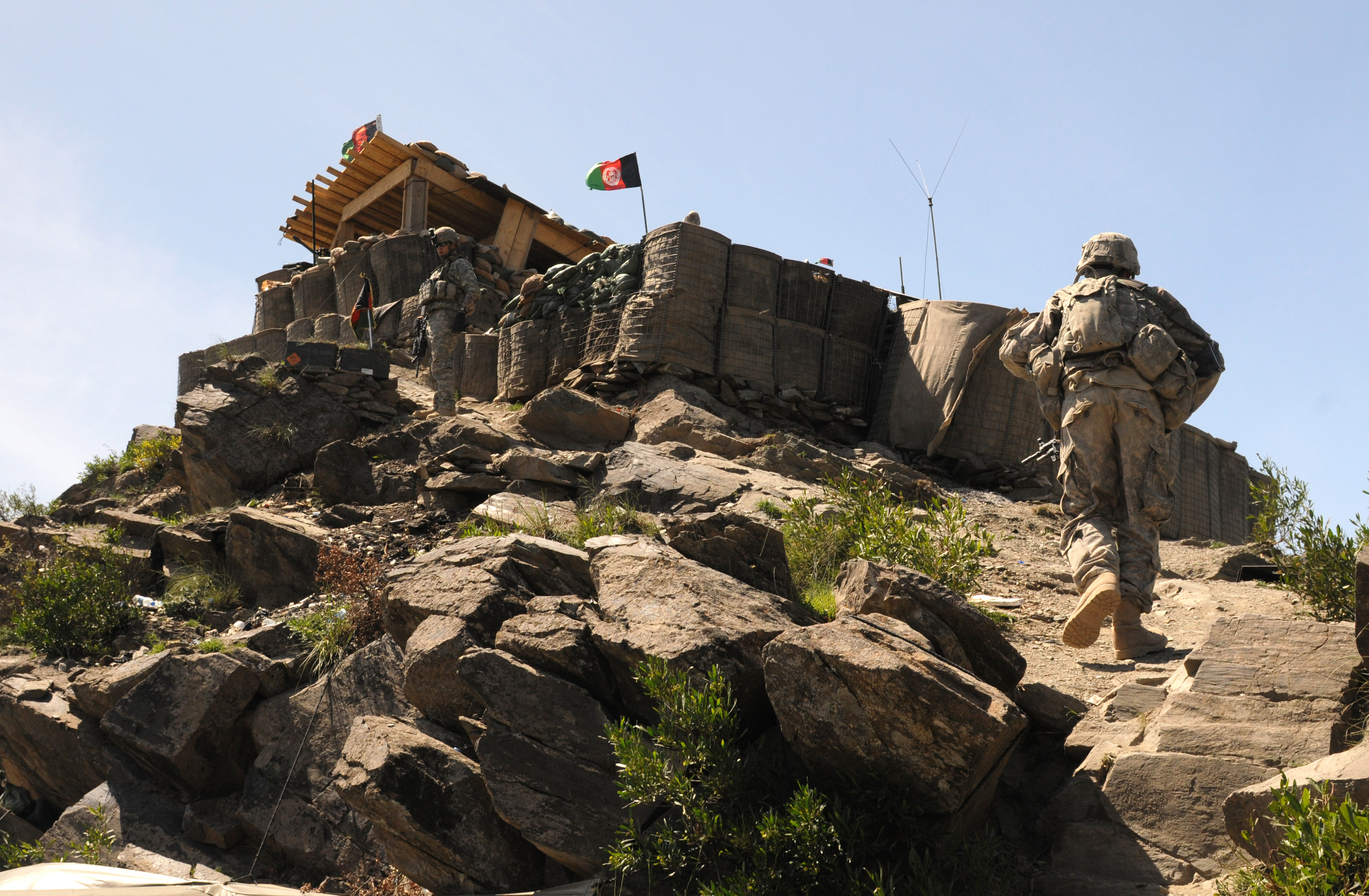
The terrain surrounding COP Bari Alai is different.

Hostile sniper and automatic weapon fire is a normal part of life here, provided by an enemy who strains to dislodge Afghan National Army and International Security Assistance Forces from the mountaintop in eastern Afghanistan’s Kunar province.

For example, in a 74-day period starting in February there were more than 50 recorded attacks against the base, U.S. Army officials said. The Soldiers who live here are well aware of how contested the base is.

“If you freeze up in combat, you’re either not ready to be a leader or you aren’t ready for a place like this,” said U.S. Army Spc. Shawn D. Hufford, of Evansville, Ind., the mortar noncommissioned officer attached to 2nd Platoon, Troop C, 3rd Squadron, 61st Cavalry Regiment, Task Force Destroyer.

The base was set on its high summit in the Ghazibad district in March 2009 and manned by the Afghan National Army. Officials named it for an ANA Soldier killed earlier that year.

It has been almost a year since a subsequent attack killed five Afghan soldiers, five ISAF advisors and a civilian interpreter, causing a fire that levelled much of the post. Despite persistent efforts, the enemy has not been able to duplicate that act since.

The base – 3,000 feet above sea level – oversees three valleys and at least ten major villages, providing a vast overlook of the surrounding territory, according to U.S. Army 1st Lt. Richard R. Rowe, 2nd platoon’s leader.

“It’s all about terrain,” Rowe said. “It’s a pretty volatile stretch.”

This position helps provide protection for neighbouring communities, the nearby district center and Afghanistan National Security Forces – as well as ISAF – as they conduct business with area residents.

The relative isolation of the post is an illusion, as ANA Soldiers at the post maintain contact with Afghan National Police who secure the communities below.

“We have a good partnership between the ANA and ANP,” Rowe said. “Now that it’s established, I can’t imagine not having it.”

Although there are taller mountains nearby, the post’s position is high enough to protect the Soldiers and low enough to help protect the community, Rowe said.

But recall that this is also the scene, approximately one year ago, of around 100 Taliban fighting uphill towards the COP, resulting in the deaths of three U.S. Soldiers due to collusion between the Taliban and Afghan National Army soldiers.  Terrain is important, but it cannot overcome treachery.  When possible though, the physical positioning of COP Bari Alai is an example of a wise tactical choice.

Marine Corps Distributed Operations in Afghanistan

BY Herschel Smith
1 year, 9 months ago

Those who follow military doctrine closely know about Commandant Conway’s push to distributed operations within the context of smaller units.  Heretofore, the Battalion Landing Team was the smallest unit fielded from ship to shore for which the Corps was prepared to provide logistical and communications support.  The combined arms concept has generally been applied at the Marine Air Ground Task Force level.  Defensetech recently had an interesting article on The Incredible Shrinking Marine Air Ground Task Force.

The Marines appear to be leading the innovation and thought experimentation on adapting small units to battle hybrid enemies – state and non-state armed groups mixing guerrilla tactics with advanced weaponry.

Down at the Marine Corps Warfighting Laboratory in Quantico, they’re fleshing out an emerging warfighting concept called “distributed operations”: small units operating independently, at a fast paced, fluid tempo when either dispersed or concentrated. Think here of German sturmtruppen tactics from World War I, or, more recently, Hezbollah fighters operating in small dispersed, yet highly lethal, groups in the 2006 Lebanon war.

The director of the Marine’s thought lab, ret. Col. Vincent Goulding, has a piece in the new Proceedings (subscription only) discussing the experimental Marine company landing team (CLT), a reinforced rifle company intended to be the “centerpiece” of future Marine operations, along with a good TO&E. Although, missing from the chart is a 155mm M777 towed howitzer platoon.

The CLT is off to Hawaii in July where it will maneuver from the sea onto some lush, tropical simulated battlefield to conduct distributed operations against a hybrid threat. Tests will look for capability gaps and whether the company headquarters can handle calling in fires, handling logistics and directing the company’s platoons.

[ ... ]

Marine Lt. Col. Roger Galbraith asks whether the CLT is the right size, and has a good comments going in the comments thread. “This is a big deal for us because we normally think only of battalion-sized units as being able to operate independently. In addition, we’ll be launching the CoLT from over the horizon (20+ miles out), that’s the first time we’re doing this over the horizon thing, although we first talked about it in 1997.…what took us so long?”

Looking at the TO chart, there does appear to be a glaring lack of direct fire weapons; it doesn’t include a Javelin anti-tank missile section. Perhaps the idea is that on-call fires will substitute for direct fire capability. It’s hard to see how that pans out though. Engagement ranges in complex terrain are often too close to effectively use artillery or air strikes.

In reality, teams smaller than a company are now being distributed throughout the battle space in Helmand, whether doctrine has caught up with the idea or not.

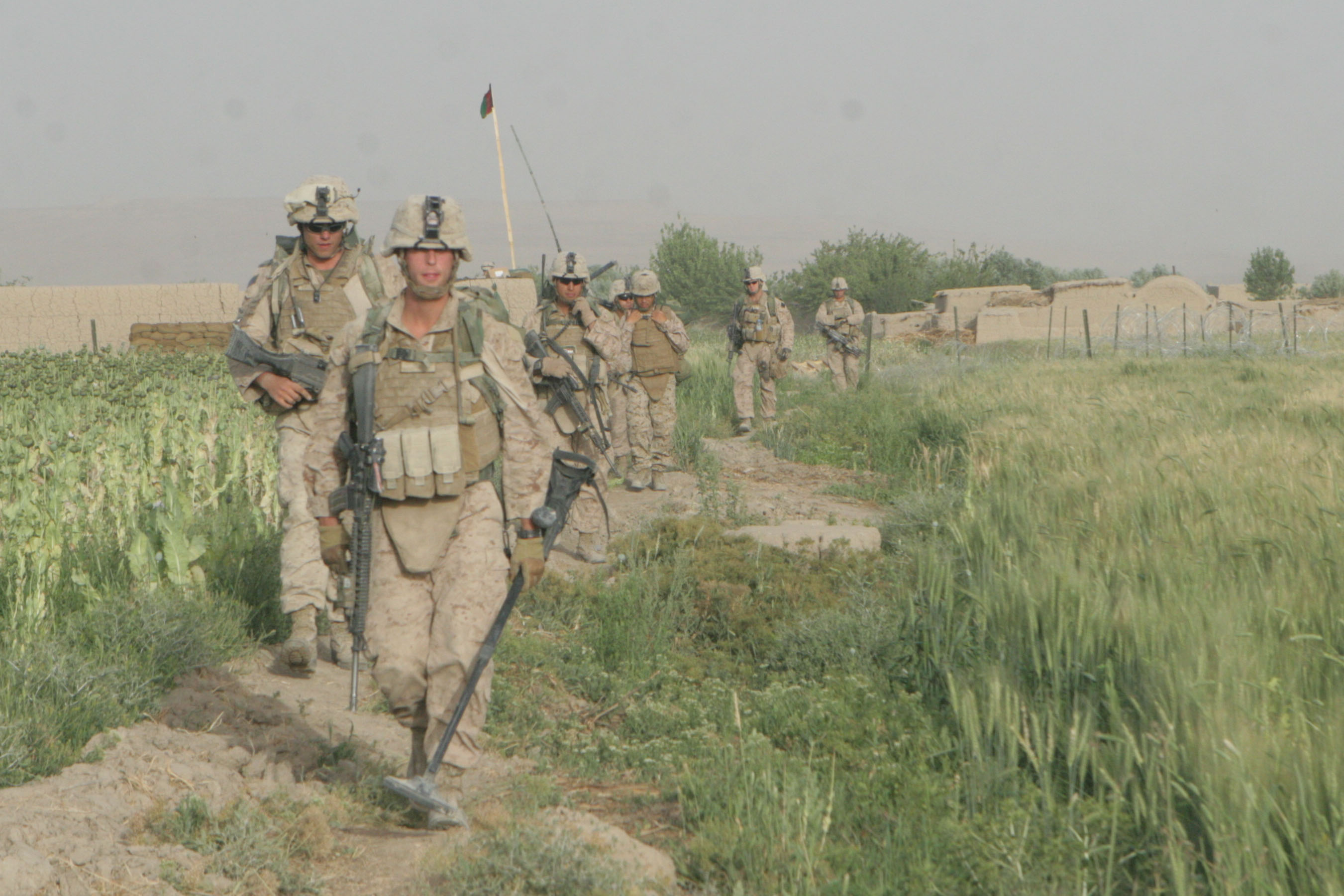
From inside of a small compound, known as Patrol Base Khodi Rhom, the Marines of Easy Company, 2nd Battalion, 2nd Marine Regiment, alongside a section of Afghan national army soldiers, patrol an area once known for large amounts of enemy activity in Garmsir District, Helmand province, Afghanistan.

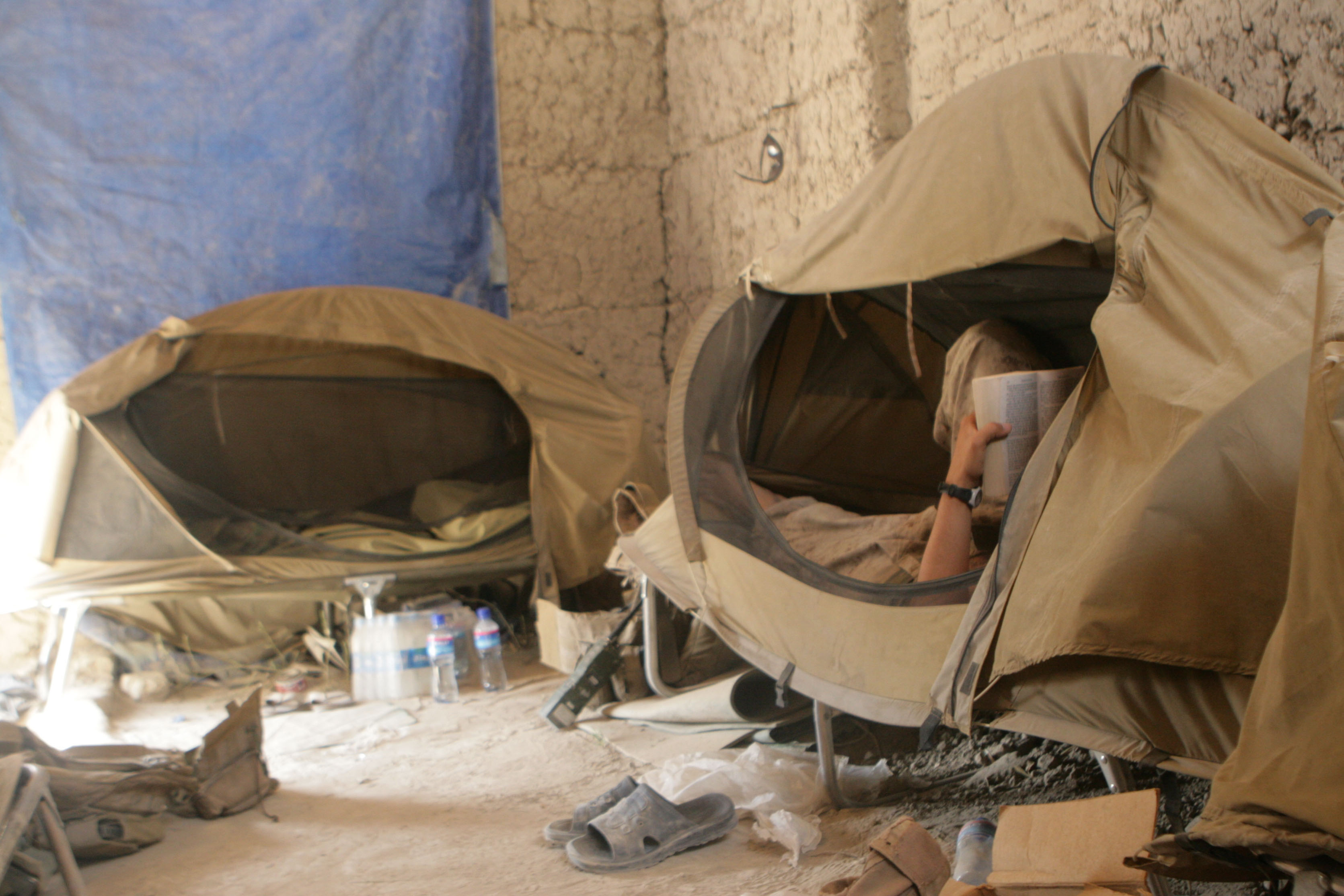
Marines sleep inside of one-man tents perched on top of cots, some stand post at different corners of the compound. One of the Marines pulls a tab on a unit ration to heat up the squad’s breakfast of biscuits, gravy, ham and raspberry swirls-the same breakfast they’ve been eating the past few days. Some Marines conduct physical training on a makeshift pull-up bar made from a tent pole; they do push-ups and jump rope on a cardboard mat.

On April 20, the Marines, along with their regular duties of post and patrol, had a simple mission; to walk two M-240G machine guns to a nearby observation post known as observation post two.

Normally vehicles would be used to move the machine guns from post to post, but because the road nearby Khodi Rhom had not yet been cleared of roadside bombs, the Marines must move most supplies by foot.

“If something happens like communication gear goes down, we need more batteries or need to move things like crew-served weapons, we have to hump it out there,” said Cpl. Aukai I. Arkus, a team leader for Easy Company, 2/2.

Helicopters have brought in food and water lately, but before they made the landing zone safer, the Marines had to carry it in.

To get the machine guns to the OP, the Marines have to move across rough fields full of wheat and poppy and through canals. There are bridges to cross the canals, but the Marines don’t use them due to greater risk of encountering an improvised explosive device.

“In that area, explosive ordnance disposal exploited lots of IEDs,” said Lance Cpl. Derek A. Tomlin, a designated marksman with Easy Co., 2/2. “They went to town blowing up and collecting IEDs.”

Once the Marines have moved the weapons, they return to the PB, crossing over the same kilometer of rough terrain that it took to get there.

The Marines quickly launched another patrol, this time to a small village near the PB, where they had established relationships with local shopkeepers before.

The Marines buy goods from the local shops, which pays off in other ways, since the relationships have been useful for gathering information on the area. They are willing to help out the shopkeepers who are more cooperative by buying more goods from them.

The Marines bring the rice and potatoes they purchase back to the base where a cook from the ANA prepares it, allowing the Marines to take a break from their usual unitized group ration dinner of chicken breast.

“It’s a nice change,” said Tomlin. “What we’ll do is get rice and potatoes and then we’ll have the ANA cook for us since none of us know how to cook.”

The Marines had manned the position for approximately five days and had planned to be relieved the next.

Though the landing zone has been declared safe, the Marines are rarely moved by air, so they have to walk back to Combat Outpost Koshtay once relieved of their duty by another squad.

They are returning to the relative comfort of Koshtay; though that is not to say that they hated their time spent at Khodi Rhom.

“The best thing about being out there is operating at our own pace,” said Arkus. “We can be as aggressive with it as we want. It leaves time for the squad leader to know what’s going on and make decisions. Also, being isolated like that allows the squad to pull together in more instances.”

The PB has allowed the Marines to saturate the surrounding area causing a significant decrease in enemy activity and an increase in locals’ willingness to assist in improving of their villages.

This is a squad-size unit operating away from the FOB.  In Fallujah 2007 squad-size units (and even smaller, fire team-size units) were in operation alone.  Squads would safely deliver a Scout sniper to his location and pick him up several days later, and a fire team would routinely embed with the Iraqi Police in Fallujah for weeks at a time.  This is small – four men.

I don’t think any of this means the end of the Battalion Landing Team or MEUs. but it does mean a lighter Marine Corps.  For those who would claim that this is a focus on counterinsurgency in lieu of conventional warfare, I would argue that it is a return to what the Marines have always been.  World Wars I and II were anomalies in the history of the Corps.

Over at Defensetech, a commenter named Sven Ortmann shows his ass and makes completely useless, asinine and combative comments.  After reading them, I know nothing more about anything, and I want that five minutes of my life back.  Sven owes me, and if I ever see him I’ll take it from him.  It’s called being pedantic, and commenters like this is why I don’t frequent Defensetech.  But commenter Byron Skinner gives us some useful information after suffering through Sven’s hysteria.

This is the Marines getting back to being Marines and not Army clones. Before WWII this is what the marine looked like, small, fast and light. The current enemies are using speed, mobility and terrain knowledge and are winning in Afghanistan.

Technology is the force multiplier here not heavy iron. The Corp. knows that it’s going to be losing personal as the war in Afghanistan winds down. The Corps best NCO’s and Officers are now being cycled through Afghanistan, already 1,300 enlisted and 115 officers have been told they don’t have a career slot in the post Afghanistan Corps, those that don’t go voluntarily, will be RIF’ed.. General Conway is being up front and very Marine about what he is doing.

If some enterprising Marine Corps officer wants to send me a confidential note explaining whether this is on the level, that would be good.  Finally, take particular note of this one man tent in Patrol Base Khodi Rhom.

I want one.  I really, really want one.  Can this be purchased down at the Marine Corps Exchange (MCX) at Camp Lejeune?  Anyone?  Anyone know of a civilian version of this same tent?  I really, really want one.

Update on Afghan National Army Water Polo

BY Herschel Smith
1 year, 9 months ago

Note in my in-box concerning Counterinsurgency and Water Polo.

I thought your blog was very interesting and I enjoyed reading it.  I have seen many different sides to the war and many other things in Afghanistan.

The program in Shorabak was what I did in my off duty time (The few hours that I had since I worked many hours every day).  It is not something that was planned or a set job, it was just something that I did on my own.  It is my own outreach into the local community.

Please call me if you ever want to chat or get more insight into the program.

The only correction to your blog I would suggest that you make to your blog is that there are Marine officers (Not NCOs) working this project…

Keep on writing!

Sincerely,

Jeremy B. Piasecki
Executive Director/Head Coach
Afghanistan Water Polo
(760) 451-1783 (USA) Office
contactus@afghanistanwaterpolo.com
www.afghanistanwaterpolo.com
afghanistanwaterpolo.blogspot.com

I stand corrected.  These were officers and not NCOs.  Also, in the original article I wasn’t knocking Water Polo.  I have never played and know nothing about it.  But I maintain by disappointment in the ANA, and still believe that sports are a poor replacement for good training, discipline and esprit de corps.

Chasing the Enemy

BY Herschel Smith
1 year, 9 months ago

In The Strategy of Chasing the Taliban I outlined the arguments against the application of strictly a population-centric approach in Afghanistan.  We discussed how the ROE was preventing U.S. troops from engaging the insurgency when it was possible that noncombatants could be involved, and that this tactical approach had caused the need to chase the insurgents when they took cover in civilian areas and then later escaped.  We must chase the Taliban and kill every last one of them, we are told by some Afghanis.

But we don’t have the troops, helicopters or logistics to continue the chase into the valleys, mountains and fields of Afghanistan.  From Lt. Col. Scott Cunningham, commander of the 1st Squadron, 221st Cavalry, of the Nevada National Guard, we have another indication of insurgent tactics that brings up the issue of chasing the enemy.

The enemy in Afghanistan is elusive. They will rarely attack unless they have absolute superiority. Because of that, we usually maneuver with enough soldiers and firepower to defeat any potential threat we may encounter. Getting cut off by a superior force is a recipe for disaster. A TIC, or “Troops in Contact” is unlikely in any given patrol, but essentially inevitable over the course of an entire deployment. It can be either an IED, long-distance harassing fire or a close-up ambush. Depending on the enemy tactic, the maneuver unit will immediately attempt to pin the enemy down, and then use artillery, helicopters, or aircraft weapons on him, or flank them with maneuver forces.

The enemy has the tendency to attack from long range and then run away, often into villages, where our rules of engagement prevent us from effectively engaging him, or into the mountains where the weight of our gear prevents rapid pursuit.

The Marines have also had to address this same issue in Helmand.  With too few troops, the tactic of fire and melt away must be addressed through different means than saturation of troops.  Quite literally, the insurgents can do this forever, and we can’t stay that long.  The U.S. Marines have heard my counsel (actually, they probably got to it first) and responded with the implementation of a quick reaction force.

CAMP LEATHERNECK, Helmand province, Afghanistan — When Marines kick in doors and begin to put rounds down range, some insurgents flee — a Huey pilot helped create a way to stop them before they slip through the cracks.

Capt. Bret W. Morriss, a pilot with Marine Light Attack Helicopter Squadron 367, “Scarface,” 3rd Marine Aircraft Wing (Forward), used the capabilities of the new UH-1Y Huey to create a concept to aid in the capture of insurgents.

Capt. Kevin Kinkade, the platoon commander for B Company, 3rd Reconnaissance Detachment, worked with Morriss to develop a way to effectively pursue insurgents who flee.

It can be dangerous for troops on the ground to chase fleeing insurgents because the enemy uses mines and improvised explosive devices to protect their routes of escape, explained Morriss.

Morriss and Kinkade created a concept called an aerial reaction force by adapting the concept of a quick reaction force. A QRF is a rapid response force commonly used to reinforce or investigate areas of interest. By combining the time-tested tactics of the QRF and the capabilities of the new Huey, the Marines created ARF — a force with strength in a couple of prime areas.

“ARF proves the capabilities of the Huey,” said Morriss. “It improves abilities of the [ground combat element] giving the Marines more flexibility and maneuverability.”

The new Huey can keep up with the demands of the ARF concept because of the improved lifting power of the helicopter. It can carry 6-8 combat-loaded Marines, plus the helo’s crew, into and out of tactical zones at high altitudes and in hot weather. The previous helicopter the Marine Corps used was the UH-1N Huey that did not have the power to carry such a load. Morriss’ squadron is the first HMLA to use the new Huey in combat.

The new helicopter provides outstanding economy of force, giving close air support and reconnaissance support for the Marines that it inserts. Historically, Marines used a heavy or medium lift helicopter to bring in the reinforcements, and flew attack helicopters for close air support.

By employing these new Hueys, Marines can use ARF to quickly capture a person of interest or small group of insurgents, or they can be used as an addition to a larger ground operation. The UH-1Y has brought back true utility to the Marine Corps supporting a wide variety of assault support missions.

When HMLA-367 heads home to Marine Corps Base Camp Pendleton, Calif., in the next few months, they will pass on the new tactics to the incoming squadron, Marine Light Attack Helicopter Squadron 369, the “Gunfighters.”

“What Capt. Morriss developed keeps Marines safer by giving them the flexibility to close with the enemy with less risk of hitting a mine or being ambushed,” said Maj. Thomas Budrejko, the operations officer for the squadron. “It also improves the operational capabilities of the units on the ground.”

Morriss, a graduate of Virginia Tech, received a Navy and Marine Corps Achievement Medal for his part in creating and executing ARF.

Just as Marines have done throughout history, Morriss and Kinkade adapted to the war at hand and developed new Marine Corps tactics that will likely save Marines’ lives and ensure the capture or elimination of the enemy.

This is adaptation at its finest.  It’s what the U.S. Marines do, and it’s what is needed in this geophysical space at this moment in time given the circumstances.

Counterinsurgency and Water Polo

BY Herschel Smith
1 year, 9 months ago

As a preface for discussing counterinsurgency and water polo, recall our observations of the Afghan National Army over the past months.

We have watched the ANA engage in drug abuse, smoke hashish before patrols, collude with Taliban fighters to kill U.S. troops, themselves claim that they cannot hold Helmand without Marines and fear being killed if they even go out into the streets, be relatively ineffective against Taliban fighters, sleep on their watch, and claim to be on vacation in the Helmand Province.

This video is of immeasurable value.

C. J. Chivers updates us with a view to the ANA’s tactical capabilities (or even basic soldiering abilities).  They don’t aim their weapons.  They point them.  The ANA is not even capable enough to be considered the first line of defense against the insurgency.  Across Afghanistan, being in the Afghan National Police is considered to be more dangerous than being in the ANA.

Now to water polo.

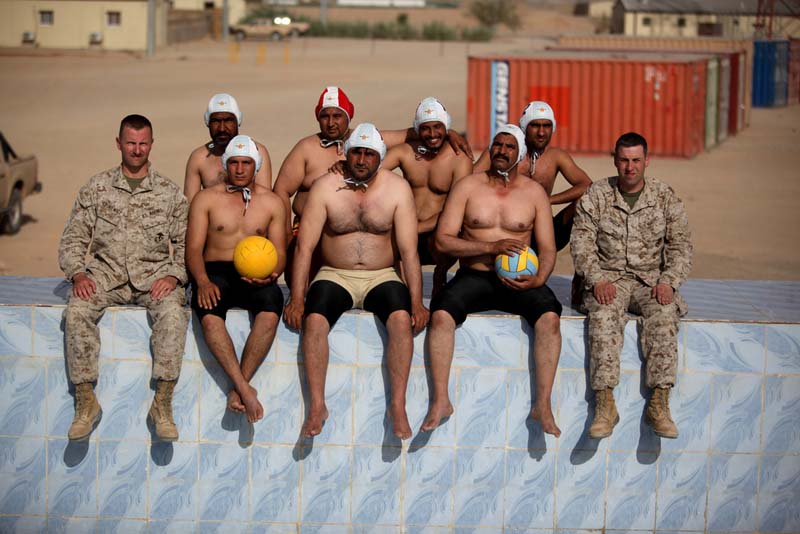
Afghanistan may be landlocked, and pools may be scarce, but soldiers with the Afghan National Army aren’t letting these minor obstacles put a damper on their Olympic water polo dreams.

Under the Marine Corps’ tutelage, these soldiers are training at the ANA’s Camp Shorabak in Helmand province. The ultimate goal is to secure an Afghan team for the 2016 summer games in Rio de Janeiro. For most, if not all, the training has been their first experience in a pool.

Chief Warrant Officer 2 Jeremy Piasecki, a reservist with Marine Corps Forces Command, says leading Afghanistan’s water polo program is a unique way to further the counterinsurgency mission.

“The great things that the athletes will learn out of this program are hard work, dedication, leadership, camaraderie … ” Piasecki said. “In addition … it further builds bridges and trust between coalition forces and the Afghan people.”

Piasecki, a youth water polo coach in the U.S. since 2004, was tapped by the Afghanistan Olympic committee in 2008 around the time Afghanistan secured its first Olympic champion, Rohullah Nikpai, who won bronze in a taekwondo event in Beijing. With Afghanistan wanting more medal opportunities, water polo was named a national sport, Piasecki said, and he formed the country’s national water polo team in August 2008.

The Shorabak team, Helmand province’s first, only recently formed. The base, located minutes from the Corps’ Camp Leatherneck, was ideal because it actually had a pool.

Unfortunately, the water is untreated and nonpotable — one reason you may not see Marines in the pool.

Though his tour downrange is now done, Piasecki plans to continue coaching. He already operates a California-based nonprofit called “Afghanistan Water Polo” and has a website. He hopes to fund a trip for the Afghan athletes to train in the U.S.

Now to be sure, I am on one side of the counterinsurgency equation with Colonel Gian Gentile (holding that the population isn’t necessarily the center of gravity of a counterinsurgency campaign), and folks like Andrew Exum are on the other.  But this is a different order of magnitude entirely.

Has our cheese slid off of our cracker?  We now have U.S. Marine Corps NCOs extolling the virtues of water polo to the practice of counterinsurgency.  Do you think that maybe we have overdone it just a little?  Perhaps learning to fire a weapon and standing duty would be a better use of their time.

Or perhaps not, depending upon what these soldiers are like.  But why do we have U.S. Marine Corps NCOs busying themselves with this?    Where is the State Department or some other part of the U.S. government that can apply the soft side of COIN?  Or perhaps the State Department doesn’t believe in the mission.


26th MEU (10)
Abu Muqawama (12)
ACOG (1)
Afghan National Army (29)
Afghan National Police (14)
Afghanistan (640)
Afghanistan SOFA (3)
Agriculture in COIN (3)
AGW (1)
Air Force (28)
Air Power (9)
al Qaeda (81)
Ali al-Sistani (1)
America (4)
Animals in War (3)
Ansar al Sunna (15)
Anthropology (3)
Arghandab River Valley (1)
Arlington Cemetery (2)
Army (27)
Assassinations (2)
Australian Army (5)
Azerbaijan (4)
Backpacking (1)
Badr Organization (8)
Baitullah Mehsud (21)
Basra (17)
BATFE (22)
Battle of Bari Alai (2)
Battle of Wanat (14)
Battle Space Weight (3)
Bin Laden (7)
Blogroll (2)
Blogs (2)
Body Armor (15)
Books (1)
Border War (2)
Brady Campaign (1)
Britain (24)
British Army (35)
Canada (1)
Caucasus (6)
CENTCOM (7)
Center For a New American Security (8)
Charity (3)
China (9)
Christmas (3)
CIA (12)
Civilian National Security Force (3)
Col. Gian Gentile (8)
Combat Outposts (3)
Combat Video (2)
Concerned Citizens (6)
Constabulary Actions (3)
Coolness Factor (2)
COP Keating (4)
Corruption in COIN (3)
Council on Foreign Relations (1)
Counterinsurgency (210)
DADT (2)
David Rohde (1)
Defense Contractors (1)
Department of Defense (103)
Distributed Operations (5)
Dogs (3)
Drone Campaign (2)
EFV (3)
Egypt (9)
Enemy Spotters (1)
Expeditionary Warfare (15)
F-22 (2)
F-35 (1)
Fallujah (17)
Far East (3)
Fathers and Sons (1)
Favorite (1)
Fazlullah (3)
Featured (135)
Federal Firearms Laws (11)
Financing the Taliban (2)
Firearms (51)
Football (1)
Force Projection (33)
Force Protection (4)
Force Transformation (1)
Foreign Policy (16)
Fukushima Reactor Accident (6)
Garmsir (1)
general (14)
General Amos (1)
General James Mattis (1)
General McChrystal (35)
General McKiernan (5)
General Rodriguez (3)
General Suleimani (4)
Georgia (19)
GITMO (2)
Google (1)
Gulbuddin Hekmatyar (1)
Guns (15)
Haditha Roundup (10)
Haiti (2)
HAMAS (6)
Haqqani Network (8)
Hate Mail (7)
Hekmatyar (1)
Heroism (4)
Hezbollah (9)
High Value Targets (9)
Homecoming (1)
Homeland Security (1)
Horses (1)
Humor (10)
ICOS (1)
IEDs (6)
Immigration (18)
India (10)
Infantry (3)
Information Warfare (2)
Infrastructure (2)
Intelligence (18)
Intelligence Bulletin (6)
Iran (156)
Iraq (374)
Iraq SOFA (23)
Islamic Facism (27)
Islamists (24)
Israel (15)
Jaish al Mahdi (21)
Jalalabad (1)
Japan (2)
Jihadists (69)
John Nagl (5)
Joint Intelligence Centers (1)
JRTN (1)
Kabul (1)
Kajaki Dam (1)
Kamdesh (7)
Kandahar (12)
Karachi (7)
Kashmir (2)
Khost Province (1)
Khyber (11)
Knife Blogging (1)
Korea (4)
Korengal Valley (3)
Kunar Province (18)
Kurdistan (2)
Language in COIN (5)
Language in Statecraft (1)
Language Interpreters (2)
Lashkar-e-Taiba (2)
Law Enforcement (1)
Lawfare (6)
Leadership (5)
Lebanon (6)
Let Them Fight (2)
Lines of Effort (3)
Littoral Combat (7)
Logistics (44)
Long Guns (1)
Lt. Col. Allen West (2)
Marine Corps (218)
Marines in Bakwa (1)
Marines in Helmand (66)
Marjah (4)
Media (17)
Memorial Day (2)
Mexican Cartels (14)
Mexico (11)
Michael Yon (2)
Micromanaging the Military (7)
Middle East (1)
Military Blogging (25)
Military Contractors (3)
Military Equipment (23)
Mitt Romney (1)
Monetary Policy (1)
Moqtada al Sadr (2)
Mosul (4)
Mountains (5)
MRAPs (1)
Mullah Baradar (1)
Mullah Fazlullah (1)
Mullah Omar (3)
Musa Qala (4)
Music (15)
Muslim Brotherhood (5)
Nation Building (1)
National Internet IDs (1)
National Rifle Association (2)
NATO (15)
Navy (17)
Navy Corpsman (1)
NCOs (3)
News (1)
NGOs (2)
Nicholas Schmidle (2)
Now Zad (19)
NSA James L. Jones (6)
Nuclear (46)
Nuristan (6)
Obama Administration (104)
Offshore Balancing (1)
Operation Alljah (7)
Operation Khanjar (14)
Ossetia (7)
Pakistan (163)
Paktya Province (1)
Palestine (5)
Patriotism (6)
Patrolling (1)
Pech River Valley (11)
Personal (12)
Petraeus (13)
Philip Smucker (2)
Pictures (1)
Piracy (13)
Police (9)
Police in COIN (2)
Policy (13)
Politics (81)
Poppy (2)
PPEs (1)
Prisons in Counterinsurgency (10)
Project Gunrunner (20)
PRTs (1)
Qatar (1)
Quadrennial Defense Review (2)
Quds Force (13)
Quetta Shura (1)
RAND (3)
Recommended Reading (8)
Refueling Tanker (1)
Religion (46)
Religion and Insurgency (18)
Reuters (1)
Rick Perry (4)
Roads (4)
Rolling Stone (1)
Ron Paul (1)
ROTC (1)
Rules of Engagement (70)
Rumsfeld (1)
Russia (25)
Sabbatical (1)
Sangin (1)
Saqlawiyah (1)
Satellite Patrols (2)
Saudi Arabia (3)
Scenes from Iraq (1)
Second Amendment (37)
Second Amendment Quick Hits (1)
Secretary Gates (9)
Sharia Law (3)
Shura Ittehad-ul-Mujahiden (1)
SIIC (2)
Sirajuddin Haqqani (1)
Small Wars (72)
Snipers (9)
Sniveling Lackeys (1)
Soft Power (4)
Somalia (8)
Sons of Afghanistan (1)
Sons of Iraq (2)
Special Forces (19)
Squad Rushes (1)
State Department (15)
Statistics (1)
Sunni Insurgency (10)
Support to Infantry Ratio (1)
SWAT Raids (9)
Syria (28)
Taliban (162)
Taliban Massing of Forces (4)
Tarmiyah (1)
TBI (1)
Technology (16)
Tehrik-i-Taliban (77)
Terrain in Combat (1)
Terrorism (82)
Thanksgiving (3)
The Anbar Narrative (23)
The Art of War (5)
The Fallen (1)
The Long War (18)
The Surge (3)
The Wounded (13)
Thomas Barnett (1)
Transnational Insurgencies (5)
Tribes (5)
TSA Ineptitude (4)
TTPs (1)
U.S. Border Patrol (2)
U.S. Border Security (4)
U.S. Sovereignty (7)
UAVs (2)
UBL (3)
Ukraine (2)
Uncategorized (30)
Unrestricted Warfare (4)
USS Iwo Jima (2)
USS San Antonio (1)
Uzbekistan (1)
V-22 Osprey (4)
Veterans (2)
War & Warfare (206)
War & Warfare (40)
War Movies (1)
War Reporting (16)
Wardak Province (1)
Warriors (5)
Waziristan (1)
Weapons and Tactics (53)
West Point (1)
Winter Operations (1)
Women in Combat (9)
WTF? (1)
Yemen (1)


Prev | List | Random | Next · Join Powered by RingSurf!

Featured in Alltop

about · archives · contact · register

Copyright © 2006-2012 Captain's Journal. All rights reserved.