Confused Narratives on Marjah

Herschel Smith · 11 Mar 2010 · 5 Comments

From Gareth Porter at the Asia Times. For weeks, the United States public followed the biggest offensive of the Afghanistan war against what it was told was a "city of 80,000 people" as well as the logistical hub of the Taliban in that part of Helmand. That idea was a central element in the overall impression built up in February that Marjah was a major strategic objective, more important than other district centers in…… [read more]


Distinguishing Between Good and Bad Taliban?

BY Herschel Smith
1 year, 1 month ago

In an interesting and rather strange Asia Times article on the intertwined relationship between Iran, the U.S., Afghanistan and Pakistan, pro-Iranian commentator Kaveh L Afrasiabi sees possible cooperation between Iran and the U.S. on logistical supply routes to Afghanistan and other things associated with Operation Enduring Freedom.  If one can get by the dreaming, he makes this interesting statement.

“The difference between then and now is that the US officials are now distinguishing between the ‘good Taliban’ versus the ‘bad Taliban’ and hoping to sow divisions between them and reach a compromise with the former, perhaps as part of an emerging post-Karzai scenario,” said a Tehran University political scientist. The scholar added that he believes Iran does not like this “new approach” and finds it “simplistic and defeatist”.

He adds that the existing Karzai regime is backed by Iran.  The Captain’s Journal is no fan of Karzai, and we have already mentioned that a break with his administration might be necessary.  But it’s unlikely that Iran and the U.S. have mutual interests in anything.  For every U.S. interest, there is a corollary counter-interest by Iran, with regional Persian hegemony being the ultimate aim.

But of interest is that it is now understood worldwide that the U.S. is trying to delineate between “good” and “bad” Taliban.  True enough, there will be some amount of adolescents, teenagers and ne’er-do-wells who got sucked into the Taliban and might be able to be separated from the pack.  But we believe that this fraction is somewhere between very small and vanishingly small.  Hear carefully the words of one Taliban.

Abdul Shafiq is around 30 years old and has sacrificed his family life for two things: reading the Koran and fighting.

After years in exile following the 2001 US-led invasion of Afghanistan, this Taliban commander is back in the mountains of his birth, having left behind his old life with his family for one mission: chasing out the “infidel” Americans.

Abdul Shafiq — an assumed name — looks like any other Afghan, except that he has never been as unhappy as in times of peace.

In hiding in Kabul, he rarely spends two nights in the same place, taking a break before returning to the fight.

In the mountains, he heard of new US President Barack Obama “who will change nothing” and of Palestine “where something is happening”.

His future seems set: “As long as the Americans are here, we will fight them,” says the Taliban militant, whom AFP could only meet through local intermediaries …

It was in the northern mountains that he heard, over Taliban combat radio, on September 11, 2001 that planes sent by Al-Qaeda, had struck at the heart of the United States.

That was beautiful, delicious to hear, everyone was happy,” the warrior says with a smile.

But when the United States invaded Afghanistan the following month, Shafiq and his comrades soon realised they could not withstand the deluge of US bombs and fled. Some went to Pakistan. Others, like Shafiq, went west to Iran.

The Iranian government and the Taliban may have little in common, but they shared virulent opposition to the United States.

Iran took in Taliban in their thousands … In Kabul, the US army, sure of itself, branded the Taliban finished.

It was then that Shafiq slipped quietly home to Wardak. “They told us that the Americans were stopping the Taliban much less,” he says.

He took charge of a group of 30 men who lived on the move, going from one safehouse to another, he says.

Even before then, the Taliban started to regroup. “Everything is structured. The orders come from our leaders in Pakistan

So much for Iran’s suspicion of the Taliban as suggested by Kaveh L Afrasiabi.  There are many lessons wrapped up in this one interview, only parts of which are included above.  Iran supports the Taliban.  The hard core Taliban will fight until they die or we lose.  They get their orders from leaders Pakistan.  They believe that the U.S. has stood down in the effort to roust the Taliban.

As for the Tehrik-i-Taliban in Pakistan, another Asia Times article gives us what The Captain’s Journal believes to be a correct snapshot of the evolution in their thinking.

In some places they aim to enforce strict sharia law. In others, the Taliban want to establish bases from which to work in support of the resistance against foreign forces in Afghanistan.

In yet other areas, the purpose is simply to create chaos and anarchy so that militants can engage the Pakistani armed forces and deter them from supporting the global “war on terror”.

However, the ultimate mission of the groups is steadily harmonizing, that is, to support the regional war and then the global war against Western hegemony; this is the concept driving the neo-Taliban.

Whether the Afghan Taliban who are committed to war against the U.S. in Afghanistan, or the TTP who are committed to war against the West from Afghanistan to New York and London, the goals and aims of the “Taliban” are gradually dovetailing.  There will be fewer and fewer “good” ones left, if there ever were any to begin with.

2/6 Marines Counterpiracy Mission

BY Herschel Smith
1 year, 1 month ago

Battalion Landing Team 2/6, Golf Company, 3rd Platoon, a unit with which The Captain’s Journal is intimately familiar, is now engaged in counterpiracy.

Members of the 26th Marine Expeditionary Unit are participating in counter-piracy operations off the coast of Somalia, a spokesman for Marine Corps headquarters said Thursday.

Amphibious transport dock San Antonio, the flagship for Combined Task Force 151, is carrying a reinforced Marine platoon, said 2nd Lt. Josh Diddams. Officials will not say how many Marines are on the ship, which left Camp Lejeune, N.C., in late August with the Norfolk, Va.-based Iwo Jima Expeditionary Strike Group. A typical Marine infantry platoon consists of about 40 troops.

Task Force 151 is a multinational force recently organized to conduct land and air attacks on pirate bases along Somalia’s coast, where last year more than 40 vessels were hijacked, including a Saudi tanker carrying $100 million worth of crude oil and a Ukrainian ship loaded with tanks and other weapons bound for Kenya. The task force is operating in the Gulf of Aden, Arabian Sea, Indian Ocean and Red Sea.

Sailors and Marines on the San Antonio spent weeks preparing the ship for its role as the command ship and afloat forward staging base for the task force, according to a Navy report. Marines on the ship include those with 3rd platoon, Golf Infantry Company, a military police detachment and intelligence personnel, according to the report.

The MEU, which recently left Kuwait after two weeks of training at Camp Buehring, did not respond to questions about the anti-piracy mission.

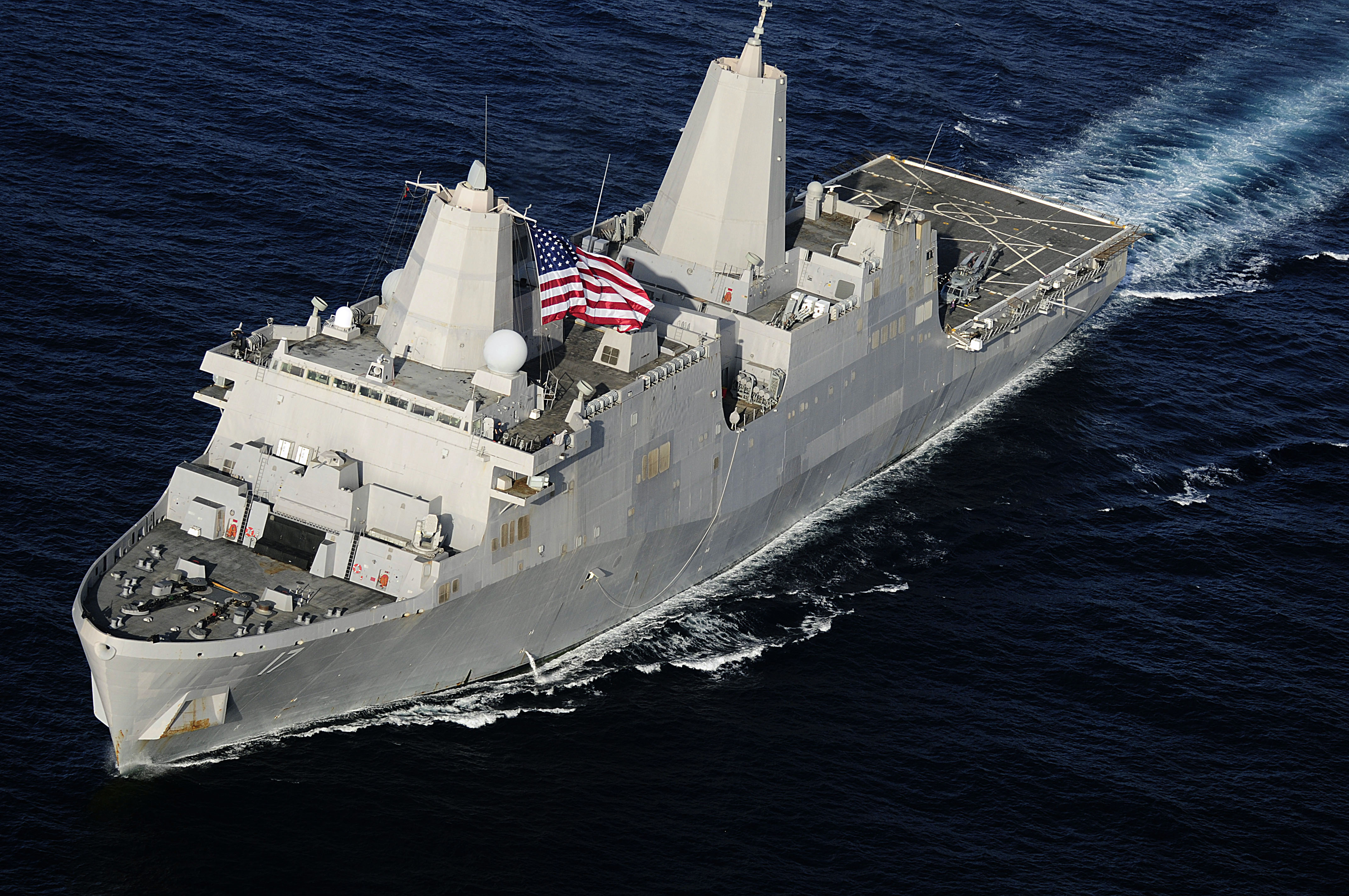
The Marines are currently (or were) on board the amphibious dock USS San Antonio.
The amphibious transport dock ship USS San Antonio transits the Gulf of Aden to serve as command ship for Combined Task Force 151. The task force conducts counter-piracy operations in and around the Gulf of Aden, Arabian Sea, Indian Ocean and the Red Sea and was established to create a lawful maritime order and develop security in the maritime environment.

The folks at Information Dissemination are engaged in some hand wringing over comments made by Tom Ricks.

I was disappointed when I read Thomas Ricks strategic assessment regarding the Navy’s approach to piracy.

Tom Ricks is an astute observer of military strategy, and if he sees the pirate situation off Somalia as simply a way to take a cheap shot at the disaster called naval shipbuilding strategy, then I’m afraid nobody in the media may understand what is and has happened. I’d like to welcome Thomas Ricks to the blogosphere by suggesting that when it comes to maritime strategy as it relates to the issue of Somali piracy, he doesn’t appear to know what he is talking about. Thomas Ricks writes:

Better late that never to be going after the Somalia pirates. To me, this is a strategic issue. Keeping the sea lanes open, especially for oil, should be a top priority for the U.S. military. Instead we seemed to defer to the Indians, Chinese and others, letting them take the lead. The Navy may feel that all its special operators — the guys trained to board and take over ships — are busy in Iraq and Afghanistan. So, admiral, does that tell you that you probably need more ship boarders, and maybe fewer aircraft carriers or anti-missile systems? You think maybe?

I noted that Yankee Sailor left a comment on the thread. I’m betting Thomas Ricks has no idea who Yankee Sailor is, nor why Yankee Sailor’s opinion is more informed. We know better. I have a lot of problems with the assessment Tom is making here, starting with what the top priority for the US military should be. If the top priority of the US military, including the Navy, isn’t winning the war in Iraq and Afghanistan, then something is wrong. There is a reason why there are more sailors deployed on land in the CENTCOM area of operations than at sea, and that reason is absolutely valid.

This is a strategic issue as Tom contends, but with the assertion of “better late than never” and the suggestion that “Indians, Chinese and others” taking leadership roles is somehow representative of a failure of maritime strategy, Tom Ricks is essentially admitting to me that he has never actually read the US Navy’s maritime strategy.

They go on to fret over comprehensive modifications of strategy and the question whether the Navy has the “right equipment” to address piracy.  This is a boring and wasteful discussion, and Ricks’ counsel is just fine.  The Navy has the right equipment in theater right now to address piracy.  An Amphibious Landing Dock, Amphibious Assault Ships, and Marines with guns who want to kill people.  Nothing else is necessary.

There have been other articles here and there questioning the need for the U.S. to address piracy in the Gulf of Aden.  Again, boring discussions, one and all.  Ships with weapons, ships with oil, and ships with other strategically important materiel were and are being taken hostage for huge sums of money, making Somalia a haven not only for pirates, but a wealthier place to boot, this largesse perhaps falling into hands that may later provide safe haven for Islamic militants.

Even if the pirates and militants do not currently get along, largesse flowing into a country without a government and under the control of warring factions cannot possibly be good for U.S. interests in the region.  If the Marines, as soldiers of the sea, cannot tackle the issue of piracy, then we are surely lost in a strategic malaise with too many pedantic people saying too many wasteful words.

One more point is in order.  The constant worry and hand-wringing over the legalities of counterpiracy operations and rules of engagement makes the Navy – and the law of the sea lawyers – and Information Dissemination – look weak and fragile.  Is this a nice way of saying it?

The problem is easy to tackle, and Ralph Peters, Lt. Col. P and TCJ have weighed in before concerning the methodology.  It involves killing pirates, dumping bodies overboard, and destroying their domiciles and enablers.  The prose is not for shock effect.  It’s serious, with recommendations that, if followed, would save lives and be a catalyst for safe seas.  This is the best strategy of all.  No need to retool ships, worry over strategic vision or call the lawyers.  It’s best when problems driven to the simplest solutions.

Miliband Encourages Terrorism

BY Herschel Smith
1 year, 1 month ago

Sanjeev Miglani with Reuters gives us the news about the visit of British Foreign Secretary David Miliband to India.

British Foreign Secretary David Miliband may yet end up achieving the opposite of what he intended in India when he called for a resolution of the Kashmir dispute in the interests of regional security.

To some Indians, linking the attacks in Mumbai - which New Delhi says originated from Pakistan – to the issue of Kashmir is not just insensitive, it is also a wake-up call. The lesson they have drawn is this: for all the world’s sense of outrage over Mumbai, India will have to deal with Pakistan on its own, and not expect foreign powers to lean on its neighbour in the manner it wants.

Miliband’s visit was a “jarring reminder to India to stop off-shoring its Pakistan policy,” writes Indian security affairs analyst Brahma Chellaney in the Asian Age. He then goes on to call for a set of measures including a military option short of war to weaken Pakistan …

But this may well be a pointer to a stiffening mood in India as it heads into an election that could bring the Hindu nationalist Bharatiya Janata Party into power. And then all bets would be off as to what would be India’s policy towards Pakistan.

Over the weekend, the BJP’s prime ministerial candidate Lal Krishna Advani gathered a bunch of military chiefs, security analysts and party bosses, and the verdict from that meeting was India had been too soft on Pakistan.

“After Mumbai, any self-respecting government would have adopted a much more robust response which alone could compel Pakistan to not only bring to book those behind the incident but also to wind down the infrastructure of terror,” the BJP said in a statement. “Instead India adopted the mildest of response, not like an emerging global player.”

Thanks to Miglani for a good report.  So that the import of what Miliband has done in India doesn’t escape, let’s rehearse a bit.

Miliband has taken the terrorist attacks in Mumbai, India, recently conducted out of Karachi, Pakistan, and connected them to the solution to Kashmir.  This is simply breathtaking.  In order to placate Pakastan and ensure regional stability, Miliband counsels coming to an understanding over Kashmir.

But the fact that such a tactic would encourage exactly the opposite escapes Miliband.  We have discussed the Pakistani duplicity before, where the ISI and Pakistan Army has used and is currently using the Taliban as a buffer for what it sees as its real enemies, Afghanistan and especially India.  Coming to a “mutual understanding” over Kashmir, especially as it relates to the connection of Mumbai with Kashmir, would only encourage the strategy of use of the Taliban and the terror tactics they promulgate.  When success is achieved, the action is confirmed.

Regardless of whether a mutual understanding is achieved over Kashmir, the connection of it to the Mumbai attacks is the worst possible foreign policy imaginable for Britain or any Western country.  And what Miliband accomplished was not the connection of Kashmir to Mumbai, but rather, the hardening of India and its worldview.

Nice job.  The law of unintended consequences.  Learn it.  As for Miliband, the Brits have an administration that perfectly follows in the footsteps of Neville Chamberlain.  Chamberlain didn’t think about unintended consequences either.

Afghanistan: Lies, Damned Lies and Statistics

BY Herschel Smith
1 year, 1 month ago

Even when significant U.S. casualties have been sustained as in the Battle of Wanat, the anti-Afghan forces have suffered greater losses.  In fact, in one recent engagement with the Marines, the Taliban suffered 50 losses as compared to none by the U.S. Marines.  This lends prima facie credibility to the notion that the Taliban are reverting to standoff tactics such as IEDs.  DoD data indicates that roadside bomb attacks are up sharply.

Afghan militants directed 3,276 roadside bomb attacks at Western troops last year, a 45 percent increase from 2007, U.S. Defense Department figures indicate.

The jump in the use of the bombs, or improvised explosive devices, highlights the more aggressive tactics being employed by militants against U.S. and NATO troops in Afghanistan, USA Today reported Monday.

Some 161 troops from U.S.-led coalition forces in Afghanistan were killed by IEDs last year, more than doubling in 2007 death toll of 75, Pentagon data show.

In Afghanistan, “an emboldened, increasingly aggressive enemy has increased the use of IEDs,” Defense Department spokeswoman Irene Smith told the newspaper.

But it was Mark Twain who popularized the phrase that there are three kinds of lies: lies, damned lies and statistics.  It isn’t just roadside bomb attacks that are up sharply.

Taliban fighters are increasingly hitting their targets directly instead of relying on bombs, according to a year-end statistical review that contradicts a key NATO message about the war in Afghanistan.

Public statements from Canadian and other foreign troops have repeatedly emphasized the idea that the insurgents are losing momentum because they can only detonate explosives, failing to confront their opponents in combat.

But an analysis of almost 13,000 violent incidents in Afghanistan in 2007 and 2008, prepared by security consultant Sami Kovanen and provided to The Globe and Mail, shows a clear trend toward open warfare.

By far the most common type of incident, in Mr. Kovanen’s analysis, is the so-called “complex attack,” meaning ambushes or other kinds of battle using more than one type of weapon. The analyst counted 2,555 such attacks in 2008, up 117 per cent from the previous year.

Bombings also increased, but only by 63 per cent year-on-year for a total of 2,384 successful and attempted strikes in 2008.

Mr. Kovanen has spent years tracking the conflict in Afghanistan, first as a NATO officer and most recently at the newly established Kabul-based consultancy Tundra Strategic Security Solutions. The latest trends are disturbing, he says, because the Taliban need more manpower to launch complex ambushes.

“Clearly they are not as weak as the military claims,” Mr. Kovanen said.

The Globe and Mail then provides the following metrics.

IED attack
2007, 779
2008, 1,266

IED attempt/discovery
2007, 681
2008, 1,118

Complex attack
2007, 1,180
2008, 2,555

Total 2007, 5,113
Total 2008, 7,791

This data indicates what The Captain’s Journal has claimed for one one year now.  The security situation is degrading in Afghanistan.  There are fairly routine reports of how bad it is for the Taliban, usually from sources such as the Strategy Page with this report.  But the Strategy Page gets some of its information and analysis from official intelligence sources, the same ones which allow the damned lies to cloud the lies.  In the case of the Globe and Mail report, precise and comprehensive statistics cleared up the mess for us.

The U.S. Marines gave us a picture of what counterinsurgency can look like during their operations in the Helmand Province, and the statistics showed what the population knew about the campaign.  The security improved with the Marines in place.  The ISAF is yet to take up the challenge.

John Nagl on Afghanistan

BY Herschel Smith
1 year, 1 month ago

At a New York Times blog John Nagl weighs in on Afghanistan.

In 2007, the chairman of the Joint Chiefs of Staff, Adm. Michael Mullen, was very blunt before the Senate Armed Services Committee. He admitted, “In Iraq, we do what we must.” Of America’s other war, he said, “In Afghanistan, we do what we can.”

Doing what we can has been insufficient in Afghanistan. Fortunately, an improving security situation and an increasingly capable Iraqi government now allow the United States to shift the balance of effort east, to America’s forgotten war.

This shift comes in the nick of time. The Taliban has been growing stronger in the poorly administered Pashtun tribal areas on either side of the Afghanistan-Pakistan border. Last year was the bloodiest year on record for the international coalition, and service in Afghanistan is far more dangerous on a per-soldier basis than is service in Iraq. It is clearly time for a change in strategy.

The essence of success is counterinsurgency, which requires boots on the ground, and plenty of them — 20 to 25 counterinsurgents for every 1,000 people, or some 600,000 for all of Afghanistan, a country larger and more populous than Iraq. The additional 30,000 American forces on tap for deployment to Afghanistan over the next year are sorely needed, but obviously insufficient to protect all 30 million people in the country.

However, insurgencies are not defeated by foreign forces. They are defeated by the security services of the afflicted nation. Thus the long-term answer to the Taliban’s insurgency has to be a much expanded Afghan National Army. Currently 70,000 and projected to grow to 135,000, the Afghan army is the most respected institution in that troubled country. It may need to reach 250,000, and be supported by a similarly sized police force, to provide the security that will cause the Taliban to wither. Building such an Afghan Army will be a long-term effort that will require American equipment and advisers for many years, but since the Afghans can field about 70 troops for the cost of one deployed American soldier, there is no faster, cheaper or better way to win.

Would it hurt Nagl’s reputation for The Captain’s Journal to agree?  We might quibble slightly over the number of troops (Nagl hits the high side), and Afghanistan is a campaign that will evolve in the coming months.  We’ll see if it really takes that many.  But we have argued for more troops for over a year, along with the jettisoning of the notion that we can engineer a cheap “awakening” to prevent the necessity of actually conducting COIN.

As for the idea of reliance on the Afghan Army, recall what we said in The Likely Failure of Tribal Miltias in Afghanistan, where we point out the population had the highest confidence in the Afghan Army and lowest in tribal fighters.  Nagl is right.  The Army (and to a lesser degree the Afghan National Police) are our best bet for pacification of the countryside.

There is another entry in this same post that deserves a few words, that being from Parag Khanna.

Even if an additional 30,000 American and NATO troops were deployed in southern and eastern Afghanistan, the Taliban problem would not be reduced. It would merely be pushed back over the Pakistan border, destabilizing Pakistan’s already volatile North-West Frontier Province, which itself is more populous than Iraq. This amounts to squeezing a balloon on one end to inflate it on the other.

It doesn’t have to be this way, and this argument amounts to nothing more than the idea that we cannot militarily defeat the Taliban because they cannot be cordoned.  While the SOF high value target campaign with small footprint and low force projection cannot stop the ingress and egress of fighters, an adequate increase in the number of troops can indeed be successful, at least in terms of a deliberate, methodical approach to counterinsurgency.  The Afghan Taliban and the TTP both clearly believe that the first fight is their jihad is the U.S. forces in Afghanistan.

The refusal to engage Syria and Iran concerning the influx of fighters into Iraq was problematic, and it is true enough that Pakistan must be engaged sooner or later, whether by soft power, additional resources, political and diplomatic pressure, targeted raids and UAV strikes, and even eventually military operations if necessary.  But the first step is to increase troop presence in Afghanistan.  There is no need to engage in endless debates over Pakistan when the first steps haven’t even been taken for Afghanistan.

This is not a call to neglect regional strategy.  But it is a call to prevent the desire for perfection from being the enemy of progress.  We endorse Nagl’s counsel concerning Afghanistan, and he will just have to live down the connection with us.


26th MEU (10)
Abu Muqawama (12)
ACOG (1)
Afghan National Army (22)
Afghan National Police (9)
Afghanistan (459)
Afghanistan SOFA (3)
Agriculture in COIN (3)
Air Force (27)
Air Power (7)
al Qaeda (73)
America (1)
Animals in War (3)
Ansar al Sunna (15)
Anthropology (3)
Arlington Cemetery (2)
Army (25)
Australian Army (3)
Azerbaijan (2)
Backpacking (1)
Badr Organization (8)
Baitullah Mehsud (21)
Basra (17)
Battle of Bari Alai (1)
Battle of Wanat (9)
Battle Space Weight (2)
Blogroll (2)
Blogs (1)
Body Armor (14)
Books (1)
Britain (17)
British Army (28)
Caucasus (2)
CENTCOM (5)
Center For a New American Security (4)
Charity (3)
China (6)
Christmas (1)
CIA (6)
Civilian National Security Force (3)
Col. Gian Gentile (6)
Combat Outposts (3)
Combat Video (1)
Concerned Citizens (6)
Constabulary Actions (3)
COP Keating (4)
Corruption in COIN (1)
Council on Foreign Relations (1)
Counterinsurgency (164)
DADT (2)
Defense Contractors (1)
Department of Defense (92)
Distributed Operations (3)
Dogs (2)
EFV (1)
Egypt (1)
Expeditionary Warfare (4)
F-22 (2)
F-35 (1)
Fallujah (16)
Far East (3)
Fathers and Sons (1)
Favorite (1)
Fazlullah (3)
Featured (112)
Financing the Taliban (2)
Force Projection (27)
Force Protection (2)
Force Transformation (1)
general (14)
General McChrystal (21)
General McKiernan (5)
General Suleimani (3)
Georgia (16)
GITMO (2)
Google (1)
Gulbuddin Hekmatyar (1)
Haditha Roundup (10)
Haiti (1)
HAMAS (5)
Hate Mail (7)
Hekmatyar (1)
Heroism (2)
Hezbollah (6)
Homecoming (1)
Humor (6)
ICOS (1)
IEDs (4)
Immigration (17)
India (7)
Infantry (3)
Information Warfare (2)
Infrastructure (2)
Intelligence (15)
Intelligence Bulletin (6)
Iran (131)
Iraq (344)
Iraq SOFA (18)
Islamic Facism (24)
Islamists (14)
Israel (10)
Jaish al Mahdi (21)
Japan (1)
Jihadists (63)
John Nagl (4)
Joint Intelligence Centers (1)
Kabul (1)
Kajaki Dam (1)
Kamdesh (6)
Kandahar (4)
Karachi (7)
Kashmir (2)
Khyber (11)
Knife Blogging (1)
Korea (3)
Korengal Valley (1)
Kunar Province (6)
Language in COIN (3)
Language in Statecraft (1)
Language Interpreters (2)
Lawfare (6)
Leadership (3)
Lebanon (5)
Let Them Fight (2)
Lines of Effort (1)
Littoral Combat (7)
Logistics (34)
Lt. Col. Allen West (1)
Marine Corps (177)
Marines in Bakwa (1)
Marines in Helmand (48)
Marjah (4)
Media (10)
Memorial Day (2)
Micromanaging the Military (4)
Military Blogging (20)
Military Equipment (22)
Mosul (4)
Mountains (4)
MRAPs (1)
Mullah Baradar (1)
Mullah Fazlullah (1)
Mullah Omar (2)
Musa Qala (2)
Music (13)
NATO (14)
Navy (14)
Navy Corpsman (1)
NCOs (2)
NGOs (1)
Nicholas Schmidle (2)
Now Zad (18)
NSA James L. Jones (5)
Nuclear (29)
Nuristan (4)
Obama Administration (36)
Offshore Balancing (1)
Operation Alljah (7)
Operation Khanjar (14)
Ossetia (7)
Pakistan (140)
Palestine (3)
Patriotism (3)
Patrolling (1)
Personal (7)
Petraeus (6)
Philip Smucker (2)
Pictures (1)
Piracy (11)
Police in COIN (2)
Policy (6)
Politics (65)
Poppy (2)
Prisons in Counterinsurgency (1)
Qatar (1)
Quadrennial Defense Review (1)
Quds Force (12)
Quetta Shura (1)
RAND (2)
Recommended Reading (5)
Refueling Tanker (1)
Religion (36)
Religion and Insurgency (14)
Reuters (1)
Roads (4)
Rules of Engagement (49)
Rumsfeld (1)
Russia (21)
Sabbatical (1)
Saqlawiyah (1)
Satellite Patrols (2)
Saudi Arabia (2)
Scenes from Iraq (1)
Secretary Gates (6)
Shura Ittehad-ul-Mujahiden (1)
SIIC (2)
Small Wars (72)
Snipers (9)
Soft Power (4)
Somalia (7)
Sons of Afghanistan (1)
Sons of Iraq (2)
Special Forces (11)
Squad Rushes (1)
State Department (8)
Statistics (1)
Sunni Insurgency (10)
Syria (25)
Taliban (138)
Tarmiyah (1)
TBI (1)
Technology (16)
Tehrik-i-Taliban (74)
Terrain in Combat (1)
Terrorism (76)
Thanksgiving (2)
The Anbar Narrative (22)
The Art of War (5)
The Fallen (1)
The Long War (16)
The Surge (2)
The Wounded (10)
Thomas Barnett (1)
Transnational Insurgencies (5)
Tribes (4)
TSA Ineptitude (1)
U.S. Sovereignty (4)
UAVs (1)
UBL (1)
Ukraine (2)
Uncategorized (14)
Unrestricted Warfare (4)
USS Iwo Jima (2)
USS San Antonio (1)
Uzbekistan (1)
V-22 Osprey (4)
Veterans (2)
War & Warfare (199)
War & Warfare (37)
War Movies (1)
War Reporting (14)
Wardak Province (1)
Warriors (4)
Waziristan (1)
Weapons and Tactics (46)
West Point (1)
Winter Operations (1)
Women in Combat (8)
WTF? (1)
Yemen (1)


Prev | List | Random | Next · Join Powered by RingSurf!

Featured in Alltop

about · archives · contact · register

Copyright © 2006-2010 Captain's Journal. All rights reserved.