Confused Narratives on Marjah

Herschel Smith · 11 Mar 2010 · 5 Comments

From Gareth Porter at the Asia Times. For weeks, the United States public followed the biggest offensive of the Afghanistan war against what it was told was a "city of 80,000 people" as well as the logistical hub of the Taliban in that part of Helmand. That idea was a central element in the overall impression built up in February that Marjah was a major strategic objective, more important than other district centers in…… [read more]


Taliban Continue Fronts in Pakistan and Afghanistan

BY Herschel Smith
2 years, 1 month ago

In U.S. Intelligence Failures: Dual Taliban Campaigns, we provided the analysis showing that there has been a split in the Taliban organization with Baitullah Mehsud (or By’atullah Mahsoud) the leader of the Pakistan wing and Mullah Mohammed Omar the leader of the Afghanistan wing.  Taliban insurgency is planned for Afghanistan, and an insurrection is planned for Pakistan.  This analysis, proven correct, was directly contrary to the analysis given by Army Major General David Rodriguez who claimed that the front in Pakistan would prevent the Taliban from conducting a “spring offensive” in Afghanistan in 2008.  But Mullah Mohammed Omar has recently said through a spokesman that the Taliban doesn’t align themselves with the fight in Pakistan.  Their’s is an Afghani struggle.

Mehsud’s reach extends far throughout Pakistan.  Only yesterday, the port city of Karachi saw combat that had its roots in Mehsud’s plans for Pakistan.  “At least three members of Jundullah (Army of God) were killed in the clash with police and paramilitary forces. Two policemen also died. One of the dead militants was the suspected leader of the cell, Qasim Toori, who was wanted in connection with previous deadly attacks in Pakistan.  Jundullah was founded in the South Waziristan tribal area in 2004 and is now led by Pakistani Taliban Baitullah Mehsud and Tahir Yuldashev, head of the Islamic Movement of Uzbekistan. In recent weeks, Jundullah has become estranged from the main Taliban movement led by Mullah Omar, who insists that militant activities should be confined to Afghanistan, and not directed against Pakistan.  A senior police officer told Asia Times Online soon after the militants’ hideout in a residential area had been seized, “I was stunned watching so much weaponry [being used], ranging from RPGs [rocket propelled grenades] to light machine guns. It appeared they were preparing for a war.”

Preparing for war indeed.  Mehsud recently laid out his plans for Musharraf and Pakistan.  “We will teach him a lesson that will be recorded in the pages of history in letters of gold. The crimes of these murderers, who were acting at Bush’s command, are unforgivable. Soon, we will take vengeance upon them for destroying the mosques. The pure land of Pakistan does not tolerate traitors. They must flee to America and live there. Here, Musharraf will live to regret his injustice towards the students of the Red Mosque. Allah willing, Musharraf will suffer great pain, along with all his aides. The Muslims will never forgive Musharraf for the sin he committed.”  Just to make the global aspirations of the Taliban clear, he continues: “We want to eradicate Britain and America, and to shatter the arrogance and tyranny of the infidels. We pray that Allah will enable us to destroy the White House, New York, and London.”

In addition to cross-border operations, the connection between the Afghanistan and Pakistan goes deeper.  There is a symbiotic connection of the Pakistani ports to the counterinsurgency campaign in Afghanistan in that Afghanistan is land-locked and dependent on supply routes through Pakistan.  Mehsud’s forces have begun to effectively target these supply routes.

Their latest target was a supply convoy outside the town of Dera Ismail Khan on the Indus Highway, one of Pakistan’s main arteries.

“They managed to single out the most important lorries, removed the drivers and then vanished the consignment lock stock and barrel,” said the official.

“Among the booty they discovered trucks carrying cargos of pristine 4×4 military vehicles, fitted with the most modern communications and listening technology,” he added.

The official added that Mehsud’s gunmen lacked the expertise to operate the equipment. So they enlisted the help of Uzbek and other foreign militants who are based in Pakistan’s lawless tribal areas lining the north-west frontier.

In Afghanistan U.S. forces are both battling a Taliban insurgency and attempting to rebuild infrastructure and provide jobs.  But it is difficult in insurgent-held territory.  “This has been a Taliban area for years,” said Lt. Col. Dave Woods, who commands U.S. Forces in Paktia, one of the eastern provinces in Afghanistan which shares a small slice of border with Pakistan.  Roadside bombs in this area have killed two American soldiers, wounded more than 60, and destroyed as many as 30 military vehicles. They are often pressure plate devices made of anti-tank mines, sometimes stacked two or three high to create more force. They are planted on the very dirt roads the U.S. military hopes to rebuild, to improve the lives of the villagers here and turn them against the Taliban.

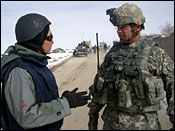
Already, 400 local men have been put to work. They line one main road, armed with shovels. U.S. commanders admit the work is labor intensive for a reason.  “We’re giving these men an opportunity to work this winter versus going to Pakistan or put in IEDs,” said Woods, seen at left talking to CBS News correspondent Cami McCormick. He believes his most powerful weapon is the ability to provide jobs. “It’s something the Taliban can’t do.” The workers are paid five dollars a day. The Taliban tried to stop the project, issuing threats over its radio station and through “night letters”, which appeared on residents’ doorsteps, warning that them and their families would be killed if they participated. But the men showed up for work anyway. In the months ahead, the road will be paved. It is an important trade route.

Contrary to the notion that the Taliban have stood down due to the winter weather, the tactics of intimidation and IEDs are being implemented by the Taliban in a winter so cold that as many as 300 Afghanis have recently died from exposure.  Taliban violence continues throughout Afghanistan.  Targets of the violence continue to be the Afghanis who work to construct infrastructure.

Taliban insurgents beheaded four Afghan road-workers in the northeast of the country after their families failed to pay a ransom for their release, the Interior Ministry said on Wednesday.

Afghanistan has seen a sharp rise in violence over the past two years as Taliban insurgents have stepped up their fight to overthrow the pro-Western Afghan government and eject foreign troops. Taliban insurgents have often targeted workers on government and foreign-backed infrastructure projects …

More than 6,000 people were killed last year in Afghanistan, many of them civilians, the worst year of violence since the Taliban were ousted from power in 2001 for failing to give up al Qaeda leaders in the wake of the September 11 attacks.

The violence against NATO supplies is not limited to the Taliban in Pakistan; these routes are in danger in Afghanistan.

Roadside bombings and a suicide attack have killed three people and wounded nine others in southern Afghanistan.

Police say a suicide bomber in a vehicle tried to attack a NATO convoy in Kandahar province’s Zhari district Wednesday. But the bomber hit a private car instead, wounding four civilians inside. There were no casualties among NATO troops.

Separately, a newly planted mine exploded under another civilian vehicle in the same district Tuesday, killing two civilians and wounding four others.

Also Tuesday, a vehicle carrying an Afghan road-working crew hit a mine in Kandahar’s Panjwaii district, killing one labourer and wounding another.

Kandahar’s police chief, Sayed Agha Saqib, blamed Taliban insurgents for the attacks, which occurred on roads often used by Afghan and western military forces.

The Taliban are engaged on two fronts.  They have continued unabated, and will increase in intensity throughout 2008.  Jobs for workers and other assistance programs are a good plan and anthropologically sound ideas, especially since Afghanistan has the highest number of widows per capita of any country in the world.  But it will take more than jobs to counter the Taliban offensives.  The exercise of military power and force projection are the necessary pre-conditions for successful reconstruction.  3200 U.S. Marines are soon headed for Afghanistan.  More will be needed.

Prior:

U.S. Intelligence Failures: Dual Taliban Campaigns

Baitullah Mehsud: The Most Powerful Man in Waziristan

Taliban Campaigns in Afghanistan and Pakistan

Musharraf Chides U.S. for Lack of Force

U.S. Intelligence Failures: Dual Taliban Campaigns

BY Herschel Smith
2 years, 1 month ago

In Taliban Campaigns in Afghanistan and Pakistan, we analyzed the Asia Times report that “Mullah Omar has sacked his own appointed leader of the Pakistani Taliban, Baitullah Mehsud, the main architect of the fight against Pakistani security forces, and urged all Taliban commanders to turn their venom against North Atlantic Treaty Organization (NATO) forces.”  Mullah Omar hasn’t forgotten about Afghanistan, and his ultimate aim is to govern her again.  The focus on Pakistan internal struggles by Baitullah Mehsud is to Mullah Omar a distraction from what the real aim of the Taliban should be.

Our brief analysis of the data concluded that “both Mullah Omar and Baitullah Mehsud will likely continue operations, even if Omar intends to focus on Afghanistan and Mehsud intends to carry out operations first in Pakistan.  Even if there are fractures at the top levels of the organization, the loyalty of the fighters to the cause will supersede and overcome personality differences.  The fight, they say, will continue unabated, having temporarily subsided in the winter.”

Yet there were discouraging signs of U.S. intelligence failures, as Army Major General David Rodriguez stated that he didn’t believe that there would be a Taliban offensive in the spring of 2008, because “the Taliban and al-Qaida fighters see new opportunities to accelerate instability inside Pakistan.”  Much is also being made of the apparent lack of a spring 2007 Taliban offensive, but we also discussed the report by the Afghanistan NGO security office which totally disagrees “with those who assert that the spring offensive did not happen and would instead argue that a four-fold increase in armed opposition group initiated attacks between February to July constitutes a very clear-cut offensive.”

In Baitullah Mehsud: The Most Powerful Man in Waziristan, we followed up this report by studying the man and his beliefs and followers in Waziristan, and then provided further analysis regarding the future of the Taliban: “This power and ‘moral authority’ will prevent Mullah Omar’s attempt to sack him and regain control of the Pakistan Taliban from succeeding.  This data still points to multiple Taliban fronts in 2008: one in Afghanistan, and the other in Pakistan.”

These analyses are very clear and run directly contrary to the analysis of Major General David Rodriguez regarding the nature of the Taliban and their intentions.  Just today, Dawn provides us with the following analysis and reporting on the Taliban organizational split and what we can expect them to focus on in the coming months.

The Taliban in Afghanistan have distanced themselves from Pakistani militants led by Baitullah Mehsud, saying they don’t support any militant activity in Pakistan.

“We do not support any militant activity and operation in Pakistan,” Taliban spokesman Zabihullah Mujahid told Dawn on telephone from an undisclosed location on Monday.

The spokesman denied media reports that the Taliban had expelled Baitullah Mehsud, the head of the Tehrik-i-Taliban Pakistan.

“Baitullah is a Pakistani and we as the Afghan Taliban have nothing to do with his appointment or his expulsion. We did not appoint him and we have not expelled him,” he said.

A spokesman for Baitullah Mehsud has already denied the expulsion report in a Hong Kong magazine and said that the militant leader continued to be the amir of Tehrik-Taliban Pakistan.

“He has not been expelled and he continues to be the amir of Pakistani Taliban,” Baitullah’s spokesman Maulavi Omar said.

The Asia Times Online in a report last week claimed that the Taliban supreme leader Mullah Mohammad Omar had removed Baitullah from the leadership of the Taliban movement for fighting in Pakistan at the expense of ‘Jihad’ in Afghanistan.

“We have no concern with anybody joining or leaving the Taliban movement in Pakistan. Ours is an Afghan movement and we as a matter of policy do not support militant activity in Pakistan,” the Taliban spokesman said.

“Had he been an Afghan we would have expelled him the same way we expelled Mansoor Dadullah for disobeying the orders of Mullah Omar. But Baitullah is a Pakistani Talib and whatever he does is his decision. We have nothing to do with it,” Mr Mujahid maintained.

“We have nothing to do with anybody’s appointment or expulsion in the Pakistani Taliban movement,” he insisted.

Baitullah, who has been accused of plotting the assassination of Ms Benazir Bhutto, told Al Jazeera in an interview that he had taken baya’h (oath of allegiance) to Mullah Muhammad Omar and obeyed his orders.

But the Taliban spokesman said the oath of allegiance did not mean that Pakistani militants were under direct operational control of Mullah Omar.

“There are mujahideen in Iraq who have taken baya’h to Mullah Omar and there are mujahideen in Saudi Arabia who have taken baya’h to him. So taking baya’h does not mean that Mullah Omar has direct operational control over them,” the spokesman said.

This places a clean face on the organizational split and allows the powerful Baitullah Mehsud to pursue his own (and al Qaeda’s) ambitions of overthrow of Musharraf’s government, while also focusing Mullah Omar and his fighters on their real aim of re-taking Afghanistan.  This follows and is entirely consistent with our own analyses.

The Bush administration isn’t satisfied with intelligence on the groups operating out of Pakistan’s Waziristan province.  The top NATO commander has also recently weighed in on Afghanistan, requesting better intelligence-gathering systems for the campaign, including “surveillance and reconnaissance capabilities,” Craddock said during an interview with The Associated Press. “I think we’re seeing now the value to cross check and reference different sensors and make sure we’ve got a better perspective.”  But sensors are of little value when basic intelligence analysis by a Military Blog such as the Captain’s Journal proves to be better than that of a Major General and his intelligence assets.

Baitullah Mehsud: The Most Powerful Man in Waziristan

BY Herschel Smith
2 years, 1 month ago

Three days ago in my article Taliban Campaigns in Afghanistan and Pakistan, I cited an Asia Times article in which it was reported that Baitullah Mehsud was sacked by Taliban leader Mullah Omar.

With the Taliban’s spring offensive just months away, the Afghan front has been quiet as Taliban and al-Qaeda militants have been heavily engaged in fighting security forces in Pakistan’s tribal regions.

But now Taliban leader Mullah Omar has put his foot down and reset the goals for the Taliban: their primary task is the struggle in Afghanistan, not against the Pakistan state.

Mullah Omar has sacked his own appointed leader of the Pakistani Taliban, Baitullah Mehsud, the main architect of the fight against Pakistani security forces, and urged all Taliban commanders to turn their venom against North Atlantic Treaty Organization (NATO) forces, highly placed contacts in the Taliban told Asia Times Online. Mullah Omar then appointed Moulvi Faqir Mohammed (a commander from Bajaur Agency) but he refused the job. In the past few days, the Pakistani Taliban have held several meetings but have not yet appointed a replacement to Mehsud.

Only now is the Hindustan Times and the Tehran Times catching up and reporting on this important development.  However, I also discussed Mehsud’s power in Pakistan and suggested that he would retain control of some of his troops, with Mullah Omar retaining control of his fighters and re-entering the campaign in Afghanistan with heavy insurgency.  The Taliban will become factious, but it will not disintegrate.

mehsud.jpg

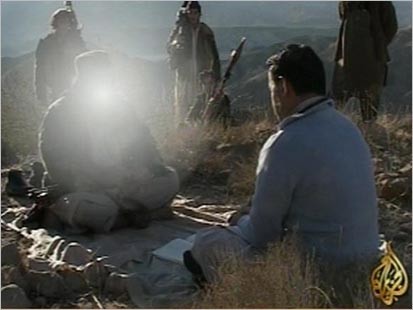
Baitullah Mehsud, the chosen leader of a militant coalition known as the “Taliban Movement of Pakistan,” a collection of 26 groups that have come together to battle the Pakistani army, sits down with al Jazeera’s bureau chief in Islamabad from an undisclosed location in northwest Pakistan.  (Al Jazeera)

Some analysts believe that Baitullah Mehsud is more powerful than Osama bin Laden; he is said to be the single most important man in Pakistan’s future.  For the time being, he has certainly become the most powerful man in Waziristan.

He has kept his face hidden from journalists, meaning that few outsiders even know what he looks like, although locals report that he receives treatment for diabetes. “Despite the fact that he is a diabetic, he is a very active man,” says Hussein Barki, a local tribal chief. “He changes his hide-outs so frequently, leaving the intelligence agencies clueless about him.”

Mehsud began his rise a decade ago, when he headed off to Afghanistan to fight with the Taliban. He comes from the Mehsud tribe, the largest in South Waziristan, but he, like most of his jihadist counterparts, did not have any stature in traditional tribal leadership. “They came up outside the tribal structure through the meritocracy of jihad,” says Fair. “They raised money harboring al Qaeda and other elements” in Pakistan’s tribal regions …

Mehsud has become deeply entrenched in Waziristan. The immediate source of his power is a corps of several hundred foreign fighters, mostly Uzbeks and other Central Asians, whom he commands. Along with his tribal followers, Mehsud is estimated to command several thousand armed militiamen, although he has claimed higher numbers.

Either way, Mehsud has established himself as someone locals respect, as well as fear. “He is no doubt the most influential and powerful person of South and North Waziristan,” says Barki, the tribal chief. “He has restored law and order in the area. But people also believe that there are many bad people in his militia.”

Pakistani forces have tried to strike back at Mehsud and his followers, but the most visible results have been significant casualties on the government side. With the powerful traditions of tribal loyalty, Mehsud also appears to have benefited from the local reaction to the government’s assault on him. “Those who are not supporters of Osama [bin Laden] or Baitullah, even they have been forced by the indiscriminate military operations to harbor sympathies for them,” says Momin Khan, the owner of a small trucking company in South Waziristan.

Still, Mehsud is a “ferocious enforcer” of his harsh interpretation of Islamic law, according to one U.S. intelligence official, and his zealotry has begun to alienate many locals. “He has enforced his own rules in the area binding men not to shave their beards,” says Naseeb Khan, who runs a small public telephone office in Wana, the capital of South Waziristan. “Playing music and watching videos are against the law here.”

Still, Khan adds that if he needs to settle any kind of legal issue, he will go to Mehsud and not the local courts. Says Khan, “He is the law here.”

Our analysis: This power and ‘moral authority’ will prevent Mullah Omar’s attempt to sack him and regain control of the Pakistan Taliban from succeeding.  This data still points to multiple Taliban fronts in 2008: one in Afghanistan, and the other in Pakistan.  As we have pointed out before (and as pointed out by Lt. Gen. Douglas Lute), the fates of Afghanistan and Pakistan are inextricably linked.  An increase in force size for Afghanistan of only 3200 Marines is a small commitment given the stakes.

Why are we succeeding in Iraq – or are we?

BY Herschel Smith
2 years, 1 month ago

For all those readers who care about counterinsurgency – how to wage it, what we have done wrong in Iraq, what we have done (and are doing) right in Iraq, and what the campaign in Iraq does for our doctrine – there is a discussion thread at the Small Wars Journal that in our opinion is the most important one that has been started.  Without hesitation and in no holds barred fashion, it became a fascinating and most useful strategic slug-fest of competing ideas and narrative accounts of the campaign in Iraq.  If the main stream media reports have become boring and repetitious and the blogs have become outlets for talking points, this kind of discussion is at the same time professional, honest, forthright and intellectually complex, and should be engaged by all professional military who want to learn about both making war and peace.  This dialogue should be studied in war college classrooms across the nation.  We are linking it here (and also providing comments concerning this thread) because we have a number of readers who do not routinely traffic the Small Wars Journal.  While we will give some background, for the comments here to be in their proper context, the discussion thread must be studied.

The discussion began when the Small Wars Journal editor linked a commentary by Lt. Col. Gian Gentile, who is currently on staff at the United States Military Academy, and who also commanded a combat battalion in Baghdad in 2006.  Gentile’s commentary was entitled Our Troops Did Not Fail in 2006, as was the Small Wars Council dicussion thread.  Gentile says:

During the year I commanded a combat battalion in West Baghdad in 2006, some of the soldiers in our outfit were wounded and some were killed, but we did not fail. In my opinion we succeeded.

We cleaned up garbage, started to establish neighborhood security forces, rebuilt schools and killed or captured hostile insurgents, both Shiite and Sunni. Our fundamental mission was to protect the people. Other combat outfits we served alongside did the same.

In this sense there is little difference between what American combat soldiers did in 2006 and what they are now doing as part of the “surge.” The only significant change is that, as part of the surge strategy, nearly 100,000 Sunnis, many of them former insurgents, were induced to stop attacking Americans and were put on the U.S. government payroll as allies against Al Qaeda.

This cash-for-cooperation tactic with our former enemies in no way diminishes the contribution of the soldiers and marines who are on the ground now. On the contrary, soldiers, sergeants, lieutenants and captains are struggling harder than ever to bring stability and peace to a complex society scarred by years of brutal violence.

Much talk has come from expert analysts, army officers and U.S. presidential candidates touting the success of the effort implemented by General David Patraeus. Many of these individuals compare the success of the surge in 2007 with what they see as the failure of American forces in Iraq in 2006.

One proponent of the surge, the neoconservative writer Clifford May, has written that by 2006, American forces had pretty much quit the country and were “cooped up in well-guarded Forward Operating Bases” – FOBS in military jargon – while “foreign terrorists slaughtered innocents” and the Iraq civil war raged around them. A senior officer who this past summer was a staff member for a very senior American leader in Iraq matter-of-factly characterized the nature of American forces in Iraq in 2006 as “Fob Rats.” Senator John McCain, now running for president, wrote in a recent opinion article that, prior to the surge, American strategy at the highest levels in Iraq was “mismanaged.”

But the combat battalion that I commanded in the 4th Infantry Division was a part of that so-called mismanagement, or what other, perhaps more direct critics, have referred to as failure.

On one level, my response to such statements is admittedly raw and visceral: If I was hunkered down on Fobs and if I and my men had pretty much quit the country in 2006, then how did soldiers under my command “just get dead?” What now am I to tell their families?

I remember a medic in our battalion, his combat patrol hit by multiple roadside bombs, moving under potential enemy fire to save the life of a local Iraqi man who had been seriously wounded in the attack. This medic was decorated for valor. He understood our primary purpose in Iraq was to protect the people.

I know from experience that the accuracy of reports that tout differences between counterinsurgency methods in 2006 and in 2007 are mostly off the mark …

The main difference was a decision by senior American leaders in 2007 to pay large amounts of money to Sunni insurgents to stop attacking Americans and join the fight against Al Qaeda. Coupled with this was the decision by the Shiite militia leader, Moktada al-Sadr, to refrain from attacking coalition forces.  The dramatic drop in violence, especially toward Americans, that occurred in Baghdad from June to July 2007 can mainly be explained by these new conditions …

But we should call a spade a spade and acknowledge why violence has dropped. Politicians and political analysts may make false comparisons.

The political motivations for such assertions are obvious. Yet American soldiers who fought bravely and bled in Iraq in in the years before the surge have become victims of American politics. We deserve fairer treatment.
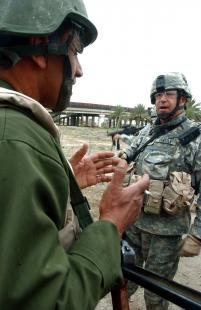
LTC Gian Gentile, squadron commander, 8th Squadron, 10th Cavalry, inspects Iraqi checkpoint operations in Southwest Baghdad. The Iraqi Security Forces working the checkpoint outside the Al Amarriya Mulhalla, or neighborhood, are dealing with Anti-Iraqi Forces attempting to disrupt security in their area by using snipers and planting Improvised Explosive Devices in the local communities. U.S. and Iraqi Forces are working together in South and Central Baghdad, conducting combined patrols in efforts to maintain security for the communities and defeat AIF activity in Baghdad. Pic: SSG Brent Williams

The responses in the discussion thread have a broad range, beginning with the short and (we think) correct observation by Professor Steve Metz that “the position that U.S. troops are now doing something different than before is a minority one. What I hear is that most people who know anything about Iraq recognize that by 2005 at the latest, our units were doing the right things. There just wasn’t enough of them.”  This is an important comment, and one to which we will return later.

The very next comment in this thread is also smart, saying in part that “I think that beyond the simple increase of troop numbers, the surge represented a political statement of will to continue the fight in Iraq at a time when we were signalling transition and withdrawal.  Contrary to many accounts, the Sunni awakening and the emergence of CLCs (”concerned Local Citizens”) was not merely a case of us buying off Iraqi tribes. If it were just a matter of money, we could simply keep paying for a long time. The cost-benefit case could be easily made between paying them and maintaining troops here. There were multiple reasons for this phenomenon, among them: extremists overplaying their hands, the relentless pressure of Coalition and Iraqi military operations (current efforts build off of previous efforts), and the signal from the surge that we were not leaving anytime soon (commitment to stay in Iraq).”

From here the discussion takes on a more spirited nature, with points and counterpoints being made by both commenters and Lt. Col. Gian Gentile.  One significant point is made that perhaps Lt. Col. Gentile’s unit wasn’t affected by the previous strategy, but his own unit was, that affect being FOB consolidation rather than in being near to or with the population.  Gentile later responds again with a lengthy rejoinder, including this gem: “Getting at the primary mechansim for the lowering of violence in Summer 2007 is absolutely critical here. Most assume that it was American military power using new doctrine and more troops that did it.”

At the Captain’s Journal we also hold the truth in high regard, and because there has been such disagreement on the Anbar campaign, we started the category Anbar Narrative.  In order to address some of Gentile’s points, we will use an operation with which we are intimately familiar: Operation Alljah, begun in April and essentially ending in October of 2007 with the return of 2/6 (although officially ending prior to that).

The middle and subsequent phases of the operation used many modern techniques to inhibit the insurgency, such as gated communities, biometrics (retinal scans, fingerprints), and census taking.  However, it is clear that the early stages of the operation and going into the middle stages involved heavy kinetic operations and force projection.  To be absolutely clear, military power set the pretext for the campaign and allowed the balance of the methods to be successful.  The force projection included combat operations, intelligence-driven raids, constant dismounted patrols, heavy contact with, questioning and deposing of the population, and high visibility within Fallujah proper and the Euphrates river basin towards Baghdad.

Prior to Operation Alljah there had been moderate to significant success in counterinsurgency efforts in the balance of Anbar, depending upon the location.  Foreign fighters (Arabs, Africans, Chechens and Far Eastern fighters) and some indigenous insurgents had been driven to Fallujah as the last relatively safe place for them in Anbar.  They owned the streets of Fallujah in the first quarter of 2007 and were protecting a very large weapons cache in the industrial area (which included small arms, heavier weapons and chlorine).  They were also using Fallujah as a base of operations from which to launch operations into Baghdad.  The unit 2/6 replaced had flatly stated that Fallujah could not be won.

Into this came the Marines of the 2nd Battalion, 6th Regiment.  As Bill Ardolino cites from the Marines he interviewed, the Marines with 2/6 came in hard (”the whole persona of the 2/6 [Marines], the way they’re running operations, is to provide for the citizens. The IPs [Iraqi Police] are like that too, they’re out there engaging the people. They [used to get] attacked so much that they were a military force, doing military-type operations. When they showed up, they showed up hard. Now it’s more ‘Hey what’s going on? How are you doing? What can we do for you?’ It’s yielded huge gains.”).  They found transition to food bags and civil affairs missions hard and boring, but made the change and eventually turned over a relatively stable and safe city to their replacements.  The indigenous insurgents went home (many to Lt. Col. Bohm’s AO in Western Anbar), and the foreign fighters – the ones who weren’t killed by the Marines – made their way North to Mosul, Kirkuk and other areas of the Diyala Province.  The deployment of 2/6 to Fallujah was planned prior to the so-called surge, and yet contrary to the well worn notion of tribal leaders, Operation Alljah didn’t make use of or have any reference to tribes.  The Marines made significant use of the muktars, or city leaders and block captains.

The populist understanding of the campaign in Anbar involves tribes “flipping” to support the U.S.  A Google search on the words “sheikhs turn against al Qaeda” yields more than 300,000 sources, and the year 2007 is rich with main stream media reports of the Anbar awakening.  To be sure, the tribal revolt against al Qaeda was important, and without it, Anbar may not be as safe as it is today.  Another (still incomplete) narrative of the Anbar campaign involves what Gentile discusses – the U.S. implemented a strategy to pay off the indigenous insurgents.  This narrative is only slightly more sophisticated than the populist version, and sees the strategy to pay the indigenous fighters as without pretext and disconnected from the previous two or three years of combat operations.

Even in areas in which tribal leaders were important, e.g., Ramadi, there was force projection and combat operations as the pretext for the awakening.  As we have stated before at the SWJ Blog:

It has become in vogue to characterize the Anbar narrative as the “awakening,” and nothing more than this, as if it was all about getting a tribe to “flip.” To be sure, we needed Captain Travis Patriquin’s observations sooner than we got them, and I have argued almost nonstop for greater language training before deployment and payment to so-called “concerned citizens” and other erstwhile insurgents. You can qualify expert on the rifle range, but if you can’t speak the language, you’re going in ‘blind’ (to play on words).

But just to make it clear, to see the Anbar narrative as all about tribes “flipping” is an impoverished view of the campaign. It’s a Johnny-come-lately view. Hard and costly kinetic operations laid the groundwork for the tribal realignments. Sheikh Sattar had to have his smuggling lines cut and dismembered by specially assigned units conducting kinetic operations in order to ‘see the light’ and align with U.S. forces. Then, a tank had to be parked outside his residence to provide protection against the insurgents in order to keep him alive and aligned with the U.S.

The pundits talk about the tribes, but the Marines talk about kinetic operations inside Ramadi to provide the window of opportunity for the tribes to realign their allegiance.

Costa … dedicated a portion of his time to cracking the insurgents’ methods of communication.

“Generally there was a guy putting up gang signs, which could either send a rocket-propelled grenade through your window or some other attack your way,” said Costa, who began to realize the significance of unarmed people on Ramadi’s streets providing information via visual cues.

“You’re watching something on the street like that happening, and you’re like, ‘What the hell is that guy doing?’” he recalled. “And then the next thing you know, insurgents start coming out of the woodwork.”

“Signalers” — the eyes and ears of insurgent leaders — informed the insurgent strategists who commanded armed fighters by using hand and arm gestures. “You could see the signaler commanding troops,” Costa recalled. “He just doesn’t have a weapon.”

To curb insurgents’ ability to communicate, Costa decided on a revolutionary move: He and his unit would dismantle the enemy’s communication lines by neutralizing the threat from signalers. Sparing no time, he set a tone in Ramadi that signalers would be dealt with no differently from their weapon-wielding insurgent comrades.

“We called it in that we heard guys were signaling, and the battalion would advise from there,” he said, recalling the first day of the new strategy. “We locked that road down pretty well that day.”

In ensuing weeks, coalition forces coordinated efforts to dismember the insurgent signal patterns entrenched in Ramadi. This helped tamp down violence and create political breathing room, which in turn allowed the forging of key alliances between local tribal sheiks and coalition operators. The subsequent progress was later dubbed the “Anbar Awakening,” a societal purging of extremism by Anbaris that ushered in a level of stability unprecedented since U.S. operations in Iraq began.

“In the end, it turned out that Ramadi did a complete 180,” Costa said. “I got pictures in September from the unit that had relieved us, and I just couldn’t believe it. I didn’t think I was looking at the same city.”

Ironically, in Ramadi — the city formerly paralyzed by insurgents, where Costa was unable to set foot in public during daylight hours upon arrival — citizens participated in a 5K “Fun Run” in September.

Regarding the payment to concerned citizens, a tactic we have strongly advocated here, it wasn’t as if U.S. strategists awoke one day and realized that payment might help to pacify their area of operations.  Rather, as observed by one commenter to this discussion thread, “relentless pressure” by coalition troops and the psychological affect of the surge (to convince them that the U.S. had no intention of leaving) were pre-conditions to successful implementation of this strategy.  While payment to sheikhs is larger, the payment to individual citizen’s watch members is no more than a pittance.

Whether tribal leaders, muktars, payment to concerned citizens, or operations from a combat outpost or FOB, there are many narratives coming from OIF.  Even when the 2/6 Marines pushed al Qaeda from Fallujah, there was still some degree of “whack-a-mole” counterinsurgency as they deployed to Diyala.  And hence, we are back to the comment left by Steve Metz at the beginning.  We never had enough troops to successfully implement counterinsurgency across Iraq.  In many ways the Marines in Anbar didn’t either, and took the losses associated with this lack of forces.

Intelligence-driven raids, close contact with the population, and constant dismounted patrols can be implemented from FOBs or combat outposts.  The location where Marines or Soldiers live takes on secondary or even tertiary importance to intelligence-driven operations, intensive contact with the population and enemy, and force projection.  Gentile is correct if his objection to the populist narrative is that it should not be seen as an exclusive narrative.  The campaign is much more complex than that.  However, before long in the discussion thread, Gentile digresses into a common meme over which we have engaged (that Iraq is in a civil war).  We have the utmost respect for Gentile, but if there can be no comprehensive and all-inclusive narrative for the campaign for him and his reports, then the comprehensive narrative of civil war cannot apply either.

There is no doubt that there was a low grade civil war in Gentile’s AO, and perhaps there still is in parts of Iraq.  Perhaps upon the eventual drawdown of U.S. troops there will be a return to factious warfare.  Then again, perhaps not.  But as for Anbar, there never was and is not now a civil war.  Of the many Marines we have debriefed following Operation Alljah, the consistent report is that “We killed Chechens, Africans, and men with slanted eyes – we don’t know where they were from.  But we didn’t kill a single Iraqi.”  Lt. Col. Gentile’s battalion was engaged in combat operations and protection of the population, no matter the populist narrative of troops sitting at FOBs eating ice cream.  Payment to concerned citizens and tribal participation in their own defense required a pretext and are good and wholesome and anthropologically sound tactics, no matter that the populist narrative chides the U.S. for “buying off” insurgents.  Civil war can describe parts of Iraq, but certainly not all of it.  The AOs are too diverse, and after all, the campaign for Iraq remains a complex affair that has proven unfriendly to populist narratives.

Prior:

The Strong Horse in Counterinsurgency

The Anbar Narrative (category)

Can the Anbar Strategy Work in Pakistan?

The Role of Force Projection in Counterinsurgency

Major General Benjamin Mixon Reports on Counterinsurgency

Our Deal with Mullah Abdul Salaam

Musharraf Chides U.S. for Lack of Force

BY Herschel Smith
2 years, 1 month ago

President Pervez Musharraf recently discussed the relationship between U.S. and Pakistani military forces.

Pakistan’s president said Friday U.S. troops cannot do a better job than his forces in routing the Taliban and al-Qaida, and the United States should increase its presence in Afghanistan instead to deal with the growing insurgency there.

Pervez Musharraf reiterated that Pakistan opposes any foreign forces on its soil and said “the man in the street will not allow this — he will come out and agitate.”

Musharraf was responding to a question about reports that the U.S. government was considering far more aggressive covert operations in Pakistan along the border with Afghanistan, and Defense Secretary Robert Gates’ offer Thursday to send a small number of combat troops to Pakistan to help fight the insurgency there if Pakistani authorities ask for help.

“This cannot be done by any U.S. force,” Musharraf told several hundred VIPs at a breakfast on the sidelines of the World Economic Forum. “Please don’t think that the U.S. forces have some kind of a magic wand and they’ll come and lead to success.”

“This environment is worse than what they’re facing in Afghanistan. The mountains are higher, and there is no communications infrastructure,” he said.

Musharraf said President Bush told him he respects Pakistan’s sovereignty and “is not asking me, and he’s the most important.”

He stressed that there is “total” U.S.-Pakistani cooperation on military tactics and strategy on both sides of the border, and “good coordination” on intelligence.

“They wouldn’t be able to achieve anything that we haven’t been able to achieve, so let them handle Afghanistan,” Musharraf said. “They need more force there, by the way. So therefore, please add force there before you think of sending them across into our borders,” he said.

Musharraf is chiding the U.S. strategy for lack of force projection, something we have discussed here before for Afghanistan and also for the Iraq counterinsurgency campaign (focusing also on the Anbar Province as its strategy relates to Pakistan).  But this is a pitiful instance of the pot calling the kettle black.  At the moment, Musharraf’s army has sent 600 troops against Baitullah Mehsud’s forces in the tribal region, less than a battalion.

But Pakistan has suffered ”more than 50 suicide bombings in the past 12 months, killing at least 800 people.”  She is in the middle of a full blown insurgency, this insurgency affecting the U.S. as well since the Taliban and al Qaeda have safe haven inside Pakistan to regroup after attacks and terrorist operations in Afghanistan.  Furthermore, supplies intended for use by NATO are being attacked inside Pakistan with Mehsud’s well-crafted network of roadway interdiction.  Force projection is needed by the U.S. in Afghanistan, but Musharraf has no room to chide the U.S.  The Pakistani army should practice what Musharraf preaches.

Prior: Taliban Campaigns in Afghanistan and Pakistan


26th MEU (10)
Abu Muqawama (12)
ACOG (1)
Afghan National Army (22)
Afghan National Police (9)
Afghanistan (459)
Afghanistan SOFA (3)
Agriculture in COIN (3)
Air Force (27)
Air Power (7)
al Qaeda (73)
America (1)
Animals in War (3)
Ansar al Sunna (15)
Anthropology (3)
Arlington Cemetery (2)
Army (25)
Australian Army (3)
Azerbaijan (2)
Backpacking (1)
Badr Organization (8)
Baitullah Mehsud (21)
Basra (17)
Battle of Bari Alai (1)
Battle of Wanat (9)
Battle Space Weight (2)
Blogroll (2)
Blogs (1)
Body Armor (14)
Books (1)
Britain (17)
British Army (28)
Caucasus (2)
CENTCOM (5)
Center For a New American Security (4)
Charity (3)
China (6)
Christmas (1)
CIA (6)
Civilian National Security Force (3)
Col. Gian Gentile (6)
Combat Outposts (3)
Combat Video (1)
Concerned Citizens (6)
Constabulary Actions (3)
COP Keating (4)
Corruption in COIN (1)
Council on Foreign Relations (1)
Counterinsurgency (164)
DADT (2)
Defense Contractors (1)
Department of Defense (92)
Distributed Operations (3)
Dogs (2)
EFV (1)
Egypt (1)
Expeditionary Warfare (4)
F-22 (2)
F-35 (1)
Fallujah (16)
Far East (3)
Fathers and Sons (1)
Favorite (1)
Fazlullah (3)
Featured (112)
Financing the Taliban (2)
Force Projection (27)
Force Protection (2)
Force Transformation (1)
general (14)
General McChrystal (21)
General McKiernan (5)
General Suleimani (3)
Georgia (16)
GITMO (2)
Google (1)
Gulbuddin Hekmatyar (1)
Haditha Roundup (10)
Haiti (1)
HAMAS (5)
Hate Mail (7)
Hekmatyar (1)
Heroism (2)
Hezbollah (6)
Homecoming (1)
Humor (6)
ICOS (1)
IEDs (4)
Immigration (17)
India (7)
Infantry (3)
Information Warfare (2)
Infrastructure (2)
Intelligence (15)
Intelligence Bulletin (6)
Iran (131)
Iraq (344)
Iraq SOFA (18)
Islamic Facism (24)
Islamists (14)
Israel (10)
Jaish al Mahdi (21)
Japan (1)
Jihadists (63)
John Nagl (4)
Joint Intelligence Centers (1)
Kabul (1)
Kajaki Dam (1)
Kamdesh (6)
Kandahar (4)
Karachi (7)
Kashmir (2)
Khyber (11)
Knife Blogging (1)
Korea (3)
Korengal Valley (1)
Kunar Province (6)
Language in COIN (3)
Language in Statecraft (1)
Language Interpreters (2)
Lawfare (6)
Leadership (3)
Lebanon (5)
Let Them Fight (2)
Lines of Effort (1)
Littoral Combat (7)
Logistics (34)
Lt. Col. Allen West (1)
Marine Corps (177)
Marines in Bakwa (1)
Marines in Helmand (48)
Marjah (4)
Media (10)
Memorial Day (2)
Micromanaging the Military (4)
Military Blogging (20)
Military Equipment (22)
Mosul (4)
Mountains (4)
MRAPs (1)
Mullah Baradar (1)
Mullah Fazlullah (1)
Mullah Omar (2)
Musa Qala (2)
Music (13)
NATO (14)
Navy (14)
Navy Corpsman (1)
NCOs (2)
NGOs (1)
Nicholas Schmidle (2)
Now Zad (18)
NSA James L. Jones (5)
Nuclear (29)
Nuristan (4)
Obama Administration (36)
Offshore Balancing (1)
Operation Alljah (7)
Operation Khanjar (14)
Ossetia (7)
Pakistan (140)
Palestine (3)
Patriotism (3)
Patrolling (1)
Personal (7)
Petraeus (6)
Philip Smucker (2)
Pictures (1)
Piracy (11)
Police in COIN (2)
Policy (6)
Politics (65)
Poppy (2)
Prisons in Counterinsurgency (1)
Qatar (1)
Quadrennial Defense Review (1)
Quds Force (12)
Quetta Shura (1)
RAND (2)
Recommended Reading (5)
Refueling Tanker (1)
Religion (36)
Religion and Insurgency (14)
Reuters (1)
Roads (4)
Rules of Engagement (49)
Rumsfeld (1)
Russia (21)
Sabbatical (1)
Saqlawiyah (1)
Satellite Patrols (2)
Saudi Arabia (2)
Scenes from Iraq (1)
Secretary Gates (6)
Shura Ittehad-ul-Mujahiden (1)
SIIC (2)
Small Wars (72)
Snipers (9)
Soft Power (4)
Somalia (7)
Sons of Afghanistan (1)
Sons of Iraq (2)
Special Forces (11)
Squad Rushes (1)
State Department (8)
Statistics (1)
Sunni Insurgency (10)
Syria (25)
Taliban (138)
Tarmiyah (1)
TBI (1)
Technology (16)
Tehrik-i-Taliban (74)
Terrain in Combat (1)
Terrorism (76)
Thanksgiving (2)
The Anbar Narrative (22)
The Art of War (5)
The Fallen (1)
The Long War (16)
The Surge (2)
The Wounded (10)
Thomas Barnett (1)
Transnational Insurgencies (5)
Tribes (4)
TSA Ineptitude (1)
U.S. Sovereignty (4)
UAVs (1)
UBL (1)
Ukraine (2)
Uncategorized (14)
Unrestricted Warfare (4)
USS Iwo Jima (2)
USS San Antonio (1)
Uzbekistan (1)
V-22 Osprey (4)
Veterans (2)
War & Warfare (199)
War & Warfare (37)
War Movies (1)
War Reporting (14)
Wardak Province (1)
Warriors (4)
Waziristan (1)
Weapons and Tactics (46)
West Point (1)
Winter Operations (1)
Women in Combat (8)
WTF? (1)
Yemen (1)


Prev | List | Random | Next · Join Powered by RingSurf!

Featured in Alltop

about · archives · contact · register

Copyright © 2006-2010 Captain's Journal. All rights reserved.