Dean Weingarten has a good find at Ammoland.
Judge Eduardo Ramos, the U.S. District Judge for the Southern District of New York, has issued an Opinion & Order that a ban on stun guns is constitutional. A New York State law prohibits the private possession of stun guns and tasers; a New York City law prohibits the possession and selling of stun guns. Judge Ramos has ruled these laws do not infringe on rights protected by the Second Amendment of the United States Constitution.
Let's briefly…… [read more]
The commander of British forces in Afghanistan has recently said that the Taliban are in very deep trouble.
Missions by special forces and air strikes by unmanned drones have “decapitated” the Taliban and brought the war in Afghanistan to a “tipping point”, the commander of British forces has said.
The new “precise, surgical” tactics have killed scores of insurgent leaders and made it extremely difficult for Pakistan-based Taliban leaders to prosecute the campaign, according to Brig Mark Carleton-Smith.
In the past two years an estimated 7,000 Taliban have been killed, the majority in southern and eastern Afghanistan. But it is the “very effective targeted decapitation operations” that have removed “several echelons of commanders”.
This in turn has left the insurgents on the brink of defeat, the head of Task Force Helmand said.
These are strong words, and they markedly disagree with other official reports. On May 15, 2008, a NATO spokesman stated that “attacks by insurgents in eastern Afghanistan have risen sharply,” and on May 20, 2008, Admiral Michael Mullen, Chairman of the Joint Chiefs of Staff, reported to Congress that violence in Afghanistan is increasing. He also stated:
“In short, a stable Iraq and Afghanistan that are long-term partners and share our commitment to peace will be critical to achieving regional stability and security,” he said.
“This will require years, not months, and will require the support of the American people, our regional allies and concerted action by the Iraqi and Afghan people and their leaders.”
These radically divergent reports are not atypical of NATO behavior in Afghanistan. We are accustomed to well-rehearsed strategy and clear, consistent communication from the Multinational Force in Iraq. NATO performs more like a multi-headed creature with different countries not only failing to ensure consistency in communication, but following very different strategies (most remarkably the British at all levels of the government).
The 24th MEU deployed to Afghanistan in February 2008 to battle the Taliban in the Helmand province, and there is current discussion of deployment of more Marines to replace the 24th MEU. Marines aren’t deployed to the campaign when the enemy is defeated. Common sense should be applied, and effusive reports of both victory and defeat should generally be rejected in favor of seeing counterinsurgency as a protracted but necessary process.
In lieu of the British good news of imminent victory (the Brits simply got a little too emotional), we can say that the campaign in Afghanistan is winnable. The realistic view is that force projection is required, and that, for a protracted period of time.
While purveying propaganda, al Qaeda and Taliban spokesmen often unintentionally relinquish information that points to vulnerabilities and infighting within their organization. An interview with a jihadist is used below, along with a question and answer session by Ayman al-Zawahiri, to supply the broad outlines of two specific vulnerabilities.
Background & Report
In spite of the U.S. objections to negotiations with the Tehrik-i-Taliban, there has been enough British and Canadian support, as well as internal support within Pakistan, that the authorities were persuaded to continue the process. They want more time.
This week the top NATO commander in Afghanistan, U.S. General Dan McNeil said any deal must include stopping fighters from crossing the two countries’ shared border.
“We have gone back and looked at the data we have over a long period of time when there have been other peace deals,” he said. “And the fact is each time the talks resulted in a peace deal we have an increased level of activity.”
Pakistani officials insist that unlike previous agreements the new peace talks involve elected government representatives – not the military – and those representatives have more credibility with tribal leaders …
Pakistan’s former spy agency chief Asad Durrani says people living near the disputed border known as the Durand line who are sympathetic to the Taliban will not immediately change their behavior because of a peace agreement.
“If we expect that these people will completely prevent the crossings of the Durand line – that cannot be done, simply impossible,” he said. “If we think that we can prevent those people who feel motivated to go on the other side and help the Afghan resistance – that again is mission impossible.”
Despite U.S. criticism of the deal and pessimism even among Pakistanis about finding a lasting peace agreement, negotiator Arshad Abdullah says that after more than six years of failed policies, critics should give the new approach time.
“With these agreements hopefully Afghanistan will be better off. It is a trial. Basically we want the world community to give us a chance and see how successful we are,” he said. “It is a matter of three or four months and within six months hopefully we will have an even better situation.”
But is more time going to matter? Understanding the enemy is crucial in the struggle against the global insurgency. An Asia Times journalist gives us a glimpse into the nature of the enemy in a recent article, and it behooves us to listen as he describes a conversation with a jihadi.
Seven months ago I visited Bajaur and Mohmandagencies. As my taxi driver headed from Peshawar, the capital of North-West Frontier Province, he was played some Pashtu music on the car’s CD. Quickly, though, he changed it for jihadi songs.
“The militants have not only brought guns to the tribal areas, they have also brought a culture which has transformed tribal society,” commented a passenger traveling with me.
Syed Saleem Shahzad (with Asia Times) then goes on to describe a more recent meeting with a jihadi in the context of thinking about this “culture which has transformed” society. He talks with a fighter who converses with him under the psuedonym “S.”
S is the son of a Pakistani military officer and left his home after completing school at the age of 17. Ever since, he has been an active jihadi, and in eight years he has only seen his family once.
He joined al-Qaeda training camps in Afghanistan before September 11, 2001 – even serving for bin Laden – but soon after that event he went to the South Waziristan tribal area in Pakistan with Arab-Afghans such as Sheikh Ahmad Saeed Khadr and Sheikh Essa.
S said his association with Arab-Afghan militants turned him from an ordinary jihadi into an astute trainer. “In my early 20s, I was training big names of this region, including young Arabs and Uzbeks who were many years older than me,” said S.
S could have earned a monthly stipend to devote himself to being a jihad, but he chose to work as a trader in Pakistani cities to earn extra money. He then returned to the mountain vastness of Afghanistan to join the Taliban’s fight against NATO (North Atlantic Treaty Organization) in Afghanistan.
A turning point in S’s life came when, returning from Khost province in Afghanistan where he ran a training camp, he was arrested by Pakistani Frontier Corps.
“I was passed on from one security agency to another, and each time the interrogation methods changed. My pre-9/11 association with bin Laden and Zawahiri and occasional meetings with Zawahiri after 9/11 boosted me as an ‘al-Qaeda associate’ in the eyes of my Pakistani examiners. For one-and-half years I did not see a single ray of sunlight. After thorough interrogations, they concluded that I was just a fighter and a trainer against NATO troops who happened to be a ‘renegade’ son of an army officer,” said S.
“They contacted my father and despite that he had abandoned me a long time ago, when he heard about my situation all his fatherly affection returned and he agreed to become my guarantor that I would not take part in any jihadi activities.
“So I was released in front of Peshawar railway station, blindfolded, and when my blinds were removed there was my old father in front of me. I was standing with my hands and feet chained, and when my guards removed these my father hugged me and wept profusely.
“That was the only brief interaction between me and my family as I once again went into my own world of jihad. It was me and my gun, and I never looked back to see if there was any family, a father or a mother, waiting for me … though I miss them a lot,” S related in a sad, soft voice.
Syed Saleem Shahzad goes on to discuss the location of Bin Laden and other things, but a meaningful exchange occurs late in the interview.
S said he is against the use of suicide attacks. “I do not know the exact status of such attacks in Islamic law, but certainly in my manuals of war it is prohibited. I have argued with all the top commanders that any target can be hit without the use of suicide attacks,” S said.
On strategic matters, S is clear that attacks on Pakistani security forces in the tribal areas can only add up to problems. “I always argued with top ideologues like Sheikh Essa that the more success we get in Afghanistan, the more we will gain support from Pakistan. If NATO remains strong in Afghanistan, it will put pressure on Pakistan. If NATO remains weaker in Afghanistan, it will dare [encourage] Pakistan to support the Taliban, its only real allies in the region,” S said.
Analysis & Commentary
Two very remarkable vulnerabilities have been accidentally divulged in this last exchange. It is obvious that S is religiously motivated. Not only does he say so, but the hold and sway this has over him is enough to break with a weeping father to go back to his commanders. Its power is complete with this jihadist.
This same religious commitment is also causing a problem within the movement. Note what S says about the tactics of suicide attacks. “I do not know the exact status of such attacks in Islamic law, but certainly in my manuals of war it is prohibited. I have argued with all the top commanders that any target can be hit without the use of suicide attacks.”
There may be a couple of reasons for the difficulty, one of which is the certain death of the jihadist. But the most significant objection doubtless has to do with death of noncombatant Muslims due to these attacks. They would like to believe that the suicide bomb is the Taliban equivalent of the JDAM targeted with GPS. Innocents are spared, or so the claim goes. Baitullah Mehsud recently had his own press conference in which he says that suicide attacks are “our most destructive weapon … out atom bomb,” but better than the enemy’s atom bomb because our bomb targets only the enemy while the enemy’s kills innocents.
But this isn’t true, and there is work ongoing within their ranks to backfit a justification for their tactics. The Combating Terrorism Center at West Point has an interesting analysis of Ayman al-Zawahiri’s recent Q&A session, and suicide tactics play a prominent role, having been brought up in the questions posed to Zawahiri. The problem is also summarized in the most recent issue of the CTC Sentinel.
In the course of defending al-Qa`ida against charges of unjustly killing innocent Muslims during his April 2, 2008 “open interview,” Dr. Ayman al-Zawahiri reintroduced Hukm al-Tatarrus (the law on using human shields) into the debate.1 A relatively unfamiliar term to non-Muslims and Muslims alike, al-Tatarrus refers to God’s sanctioning of Muslim armies that are forced to kill other Muslims who are being used as human shields by an enemy during a time of war.2 Al-Tatarrus is a religiously legitimate, albeit obscure, Islamic concept that al-Qa`ida ideologues have been increasingly using in order to exculpate themselves from charges of apostasy. The method in which al-Qa`ida is promoting al-Tatarrus, however, seeks to facilitate the sacrifice of Muslim lives in contravention of 14 centuries of religious teachings.
Al Qaeda has turned to Abu Yahya for scholarly analysis, but his scholarship is nothing short of revolutionary, and he turns out not to be much of a scholar after all.
While the Qur’anic and hadith restrictions on killing innocent Muslims were appropriate during the early days of Islam, he suggests, they should have no bearing on warfare today because modern warfare is qualitatively different. Whereas early Islamic thinkers had to consider the implications of using a catapult against an enemy fortress in which Muslims were residing, or conducting night raids against an enemy household in which Muslims were likely present, the nature of contemporary warfare is one where the enemy uses “raids, clashes and ambushes, and they hardly ever stop chasing the mujahidin everywhere and all the time, imprisoning them, their families and their supporters.” What it means to be “directly engaged in combat,” Abu Yahyaargues, has changed. By positing that Islam is in a state of constant and universal warfare, he implicitly lowers the threshold for proving that one’s killing of innocent Muslims is just.
In short, the nature of today’s all-encompassing warfare means that the jihadist movement must find a “new perception of different ways of modern shielding which were probably not provided for by the scholars of Islam who knew only of the weapons used during their era.” In these few sentences, Abu Yahya attempts to wipe the slate clean of the most sacred and defining texts with regard to the issue of killing human shields.
They are obviously struggling with the justification for what Baitullah Mehsud calls his “most destructive weapon.” The brutality of al Qaeda in the Anbar province helped to turn the population against them. A well aimed information campaign outlining the noncombatant casualties and suffering resulting from suicide attacks is appropriate and would possibly be effective in weakening the enemy’s tactical position. In Anbar the U.S. had to prove themselves to be the stronger horse (to use a phrase made popular by Bin Laden). There is no magic, and the necessary context for a rejection of jihad is its battlespace defeat. But the battlespace defeat might be assisted by a good information campaign targeting this vulnerability.
The second important thing we learn from the interview of S is that the campaign in Afghanistan and Pakistan is, in the words of The Captain’s Journal, inextricably tied. “If NATO remains strong in Afghanistan, it will put pressure on Pakistan. If NATO remains weaker in Afghanistan, it will dare [encourage] Pakistan to support the Taliban, its only real allies in the region,” S said.
The corollary to the the tribal region of Pakistan being a safe haven for the Taliban is that strong action in Afghanistan will affect Pakistan. It is one campaign, a fight against a transnational insurgency, and seeing the campaign through the lens of borders and nation-states is wrongheaded. The surest way to put pressure on the tribal region within Pakistan is to continue the chase in Afghanistan. There is no replacement for kinetic operations to kill or capture the enemy. We know this not only because it is common sense, but also because the enemy has told us so.
By now it isn’t news that the MARSOC Marines who were deployed to Afghanistan and accused of wrongdoing will not be charged.
The Marines of Marine Special Operations Company F “acted appropriately” when they fired in response to an attack March 4, 2007, in Afghanistan, Lt. Gen. Samuel Helland said Friday.
The written statement from the commanding general of Marine Corps Central Command came in response to a January court of inquiry into the shootings, which Army officials said killed Afghan civilians. Army Lt. Gen. Frank Kearney with Special Operations Command Central expelled the Marine special operations company from Afghanistan after the incident.
Two Marines, Maj. Fred Galvin and Capt. Vincent Noble, were named in the court of inquiry into the events in Afghanistan’s Nangahar province on March 4 and March 9, 2007.
Both men were accused, but not charged, with conspiracy to make a false official statement, dereliction of duty, failure to obey a lawful order and making a false official statement.
“Appropriate administrative actions based on the findings of the court of inquiry” will be taken against Galvin, who served as the company commander at the time of the incidents; Noble, the platoon commander at the time; and Capt. Robert Olsen, the unit’s intelligence officer and second-in-command, according to the press release from Marine Corps Forces Central Command.
Appropriate administrative actions? Just what does this mean? The Captain’s Journal will try to follow this to see where it goes. W. Thomas Smith, Jr., has some interesting observations.
Galvin’s Marines were ordered out of Afghanistan – far too hastily in my professional opinion – pending an investigation that dragged on far too long, and in which too much political correctness and perhaps (based on my own personal musing) a bit of inter-service rivalry were infused: Not to mention the fact that the word of the locals, and a human rights group that was not there at the time, was considered more believable than that of the Marines.
The locals, whose stories often conflicted with one anothers,’ never could come up with a firm casualty count (though U.S. Army officers reportedly made cash payments to Afghans who said they were survivors or members of survivors’ families).
Fact is, there is no proof – much less evidence – that any civilians were killed: No bodies or forensic evidence, except for that of the suicide bomber, were recovered.
But there is a 900 pound gorilla in the room, and The Captain’s Journal will point it out if no one else will. We still aren’t convinced that the Marine Corps should have Marines dedicated to special operations. Force Recon? Sure. Someone needs to be qualified to perform reconnaissance operations (jump qualifications, etc.). Someone in a company must be qualified as the DM, and someone must be qualified as a combat lifesaver, and so on.
But the notion of special operations has morphed – probably due to stupid television depictions – from one of specialized troops to one of supermen. Up until now that has been the Army’s problem. Marines are supposed to be self sufficient, hence the notion of a MEU. Marines stick with Marines, and Force Recon supports its unit. Otherwise, it has no function.
When Galvin’s Marines were deployed to Afghanistan months ago, they were only special operations. They weren’t connected to any unit except MARSOC. As for kinetic operations, if you want force projection, turn loose a company of Marine infantry. Special operations, to Marines, means support of that company.
We’re open to compelling argument, but we still fail to see the need or the mission for MARSOC. Does someone want to convince us?
An Afghan boy collects resin from poppies in an opium poppy field in Arghandab district of Kandahar province, south of Kabul, Afghanistan on May 23, 2008. Afghanistan will ask international donors next month for over US$4 billion to revive its farming sector as it struggles with wheat shortages and skyrocketing food prices. (AP Photo)
Seven months ago and before the Marines deployed to Afghanistan, The Captain’s Journal laid waste to the argument that the Marines should be in the business of destroying poppy crops. Dumb idea, said we, and it runs counter to one of the main ideas behind counterinsurgency.
The Marines have flatly stated that they aren’t after poppy. They’re after Taliban. Rock on. Whether the Marines are just smart or they listened to The Captain’s Journal – which is smart – doesn’t matter. They have performed well in Helmand without destroying the living of the farmers. The war on terror has no business being confused with the war on drugs.
But General McNeill sees things differently and has some of his troops engaged in doing exactly that.
NATO troops in Afghanistan have made significant progress eradicating the country’s poppy fields, an officer for the military alliance said Monday.
Speaking from his headquarters in Kabul, U.S. Army Gen. Dan K. McNeill said opium poppy cultivation remains a major threat to Afghanistan, the U.S. Defense Department said in a news release.
“In some portions of the country right now, mostly in the south, the cultivation of poppy is a far greater threat to the Afghan government — to the security and stability here — than the insurgency,” McNeill said.
The Afghan government must head up the elimination of opium poppy cultivation as the country’s economic base, McNeill said, estimating that the Taliban and al-Qaida receive between 20 percent and 40 percent of their money from the drug trade.
The United Nations estimates the terrorist groups receive closer to 60 percent from drugs.
“We are in there fighting insurgents who are as much narco-dealers as they are insurgents,” McNeill said. “In some cases, we are fired upon by people doing narco-business.”
So what? The Captain’s Journal doesn’t get the connection. What if the farmers were growing gizmos that sold for good money down the road in Iran or Turkey or wherever. Suppose that the Taliban forcibly took a cut of the profits. What’s the difference between doing it with gizmos and doing it with poppy? General McNeill could very well have been in the position of saying “We are in there fighting insurgents who are as much gizmo profiteers as they are insurgents.” So? The problem is still with the insurgents, not the gizmos … or the poppy.
We still believe that the best solution to all of this is to capture or kill the insurgents and then let market forces deal with poppy. What’s that we hear? It’s already happening?
In one of the most important developments since the war in Afghanistan began in late 2001, opium production has declined in the country. Over 20 of the country’s 34 provinces will be opium-free this year according to a report by the United Nations that has now been corroborated by Afghanistan’s counter-narcotics minister, General Khodaidad.
Among the provinces with remaining opium cultivation, the Taliban-dominated Helmand province ranks high, but even here it is being seen that the humble wheat crop has replaced poppy. Some newspapers that sent reporters to Helmand province, over the course of April and May this year, have independently verified this assertion. A European television program on the subject was among the most-forwarded news items on the Internet last week.
Interestingly, it is not the efforts of the Afghan government alone that have caused the reduction in opium production but something much more mundane, namely the increased price of wheat, that has pushed up production of the grain in many parts of the country. Therein lies a tale of so-called market manipulation that actually goes back to one of the central points about rural poverty alleviation in the region, namely the strength of economics.
The Captain’s Journal is out front again, and we don’t even charge the Department of Defense for this analysis. But our Marine boys will probably keep listening to us.
We covered the surrender plea from David Miliband, and while pusillanimous and pitiful, at least Miliband was either duplicitous or didn’t know what he was talking about. Specifically, he advocated “negotiations between Pakistan’s new civilian government and Pashtun leaders in the Federally Administered Tribal Areas (Fata).”
If he was referring to tribal elders in FATA, then he was merely confused, as there are no negotiations with “Pashtun leaders.” Further, they would be irrelevant if these talks existed, as the tribal elders do not control FATA. They have no security from the Taliban, and thus hard core Taliban fighters control FATA and NWFP. If he is referring to the Taliban as “Pashtun leaders,” then he is intentionally avoiding naming the enemy and stating that we should negotiate with them. He is either stupid or a liar.
As for Des Browne, no such charge can be made. He is a coward and specifically advocates surrender to the enemy.
Defence Secretary Des Browne endorsed peace talks between Pakistan and Taliban militants on Wednesday despite concerns from Afghanistan that the talks will allow the Taliban to regroup and launch more attacks.
Browne said Britain supported any moves that would encourage militants to put down their weapons and stop violence, and said Pakistan and Afghanistan needed to work together on problems with their border, much of which is controlled by Taliban insurgents.
He said reconciliation should be a part of any strategy, although it was clear some militants had no intention of putting down their weapons.
“But you can’t kill your way out of these sorts of campaigns,” Browne told journalists at Australia’s National Press Club on Wednesday.
Faced with a wave of suicide attacks, Pakistan has begun talks with Taliban militants who control much of the country’s 2,700 km (1,670 miles) mountain border with Afghanistan.
The Taliban, however, said it would fight in Afghanistan until all foreign troops were driven out of the country, and Afghanistan has expressed concerns about any peace deals.
Browne, in Australia for talks with Australian Defence Minister Joel Fitzgibbon, said sovereign countries had the right to welcome insurgents back into society if they agreed to obey the rule of law and recognise democratic governments.
“If people are prepared to give up violence, put down their weapons, accept and recognise legitimate and democratic government … then the sovereign governments from both countries are entitled to say we will welcome you to become part of our society,” he said.
But the British sensibilities are offended and shout out “How is it that Browne is advocating surrender when all he is really doing is offering the chance to put down their weapons? Have we not been too hard on our man in London?”
The Taliban in South Afghanistan (and coming from Quetta) are hard core fighters who didn’t relent when fighting the Soviet Union, and will not suddenly decide that the fight should be over. They fight for religious reasons, and thus laying down weapons would be seen as irreligious. As for the Pakistani Taliban, Tehrik-i-Taliban, they are in many ways just as brutal as the original Taliban, but without the strictures against suicide bombings and other such tactics. They are a new breed of enemy whom Nicholas Schmidle calls Next-Gen Taliban.
This brand of fighter is in large measure controlled by the Tehrik-i-Taliban, and ultimately by Baitullah Mehsud. As for what Mehsud thinks about this idea of a cease and desist order on his operations, let’s hear him in his own words.
The ceasefire, it seems, is already starting to take effect.
But will it last, or go the way other deals have gone before?
In our garden meeting, “Amir Sahib” (honoured leader) – as Baitullah Mehsud is affectionately called by his men – smiles and shakes his head when this query is raised.
Around us, dozens of militants armed to the teeth listen intently to their leader.
“The Taleban are committed to their word,” he says.
“The onus is now on the government – whether they hold to their word, or remain in the alliance with the US.”
If that persists, Commander Mehsud says, the militants will have no choice but return to their path of resistance.
“We do not want to fight Pakistan or the army. But if they continue to be slaves to US demands, then we our hands will be forced.
“There can be no deal with the US.”
The idea is that NATO and the U.S. leave Afghanistan or violence will continue against the Pakistani government. As for Afghanistan, Baitullah intends to send in more fighters to help in the insurgency effort, regardless of and unrelated to the negotiations. In other words, the most powerful man in Waziristan has said that the insurgency in Afghanistan will continue unabated no matter what, while it will resume in Pakistan unless the U.S. leaves.
Browne is smart enough to know that the Taliban will not surrender their weapons or aspirations. He is advocating negotiations in spite of the fact that he knows that NATO and the U.S. cannot win concessions. Given this level of bravery and commitment by the British, it’s a wonder that the Taliban don’t march up Whitehall and into the MOD Headquarters. It may not be very tough.
In an astonishing announcement today carried by the AP and other sources, Marine General James Mattis said that “we should immediately begin negotiations with both al Qaeda in Iraq and the Taliban and al Qaeda in the tribal areas of Afghanistan and Pakistan. Military action can only carry us so far, and eventually political reconciliation is necessary to address the root cause of the problems that cause the jihadists.” “I sincerely believe,” continued Mattis, “that with the right grievance amelioration, participation and representation in the government and infrastructure, our erstwhile enemies – al Qaeda and the Taliban – can be our friends.” Finally, in a statement that brought stares of disbelief from the audience at Quantico, Mattis wrapped up by saying that “there just seems to be no military solution to any of these problems.” For a once confident warrior among the Sunni insurgency, Mattis appeared tired and disheveled.
Er … maybe not. If Mattis had said this he would have been rushed to the hospital, or perhaps sent to for-cause drug testing. The Marines are warrior enough to have defeated al Qaeda, knowing that men who travel across the globe to wage holy war against you, while high on Epinephrine, must be killed. They are also warriors enough to have battled the indigenous Sunni insurgency to exhaustion, making reconciliation with U.S. forces seem a delightful proposition.
From the top down, the Marines don’t engage in hand-wringing because any group, civilian or military, takes on the personality of its leadership. The British have a pitiful example in David Miliband (blogs here) who today made a mockery of British warfighting capabilities and the backbone of the U.K. when he pitifully prostrated himself before the world asking for peace and happiness all around, along with complete capitulation by NATO.
David Miliband will today argue there is “no military solution” to the spread of extremism in Afghanistan and Pakistan’s tribal areas, and back the pursuit of political reconciliation in both countries.
In a speech the foreign secretary is due to deliver in Washington, a draft of which has been obtained by the Guardian, he will say that Pakistan and Afghanistan “top the list of UK foreign policy priorities”, and both represent fragile democracies facing huge challenges.
He will underline Britain’s commitment to pursuing parallel military and political strategies in Helmand province’s Gereshk valley, where 8,000 British troops are fighting the Taliban. More controversially from Washington’s point of view, Miliband will also offer British support for negotiations between Pakistan’s new civilian government and Pashtun leaders in the Federally Administered Tribal Areas (Fata). The region bordering Afghanistan has become a haven for Afghan and Pakistani militants, as well as al-Qaida elements.
US officials have privately expressed growing alarm at the talks, telling journalists the accompanying drop in Pakistani counter-insurgency operations has given militants a breathing space. However, addressing the Centre for Strategic and International Studies today, Miliband will reject “the false choice” of political reconciliation or military action “Afghanistan and Pakistan need effective security forces. They need to take on, with international help where necessary, those committed to violence. But there is no military solution to the problems of the Fata or the Gereshk valley.
Rather than ousting the Taliban from Helmand, the U.S. Marines are having to do that job for them. Miliband seems not to acknowledge the success that the Marines are having, nor the poor experience the British had with “talking” to the Taliban in Musa Qala. In Musa Qala the British struck a deal with whom they considered to be a “moderate” Taliban to rise up like the Anbar awakening when the British and U.S. troops began their assault on the town. Rather than rising up against the hard core Taliban fighters, the “moderate” commander sat in a home ten miles away and screamed for help.
No, there is no acknowledgement of the facts on the ground, including the fact that Taliban and al Qaeda will not reconcile, the very idea of this being a moral evil to their world view. To be sure, the soft power of counterinsurgency must be applied to the population, but security comes first, as the Afghanis have themselves told us.
This capitulation is not only intellectually unsound, it is also very bad form by Miliband. How the British can put such a shameful politician in office speaks volumes of what was once a great kingdom. Neville Chamberlain has a modern day friend. Meanwhile, General Mattis doubtless will not recommend reconciliation with the Taliban. To be friends with the Afghan people, surely. To have the population engaged in the political process, of course. But not the Taliban and al Qaeda. And there is no peace without victory.
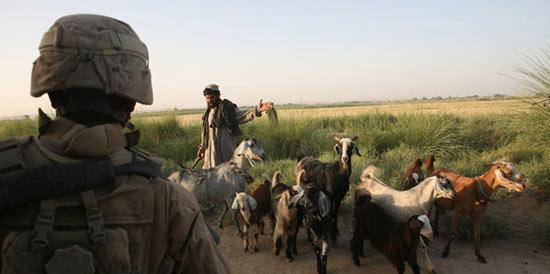
The 24th Marine Expeditionary Unit patrolled the southern Afghanistan village of Hazarjoft on May 21. The unit is planning to move on in the next few weeks. (Tyler Hicks/The New York Times)
For two years British troops staked out a presence in this small district center in southern Afghanistan and fended off attacks from the Taliban. The constant firefights left it a ghost town, its bazaar broken and empty but for one baker, its houses and orchards reduced to rubble and weeds.
But it took the U.S. Marines, specifically the 24th Marine Expeditionary Unit, about 96 hours to clear out the Taliban in a fierce battle in the past month and push them back 10 kilometers, or six miles …
The marines’ drive against the Taliban in this large farming region is certainly not finished, and the Taliban have often been pushed out of areas in Afghanistan only to return in force. But for the British forces and for Afghan residents, the result of the recent operation has been palpable …
Major Neil Den-McKay, the officer commanding a company of the Royal Regiment of Scotland based here, said of the U.S. Marine’s assault: “They have disrupted the Taliban’s freedom of movement and pushed them south, and that has created the grounds for us to develop the hospital and set the conditions for the government to come back.” People have started coming back to villages north of the town, he added, saying, “There has been huge optimism from the people.”
For the marines, it was a chance to hit the enemy with the full panoply of their firepower in places where they were confident there were few civilians. The Taliban put up a tenacious fight, rushing in reinforcements in cars and vans from the south and returning again and again to the attack. But they were beaten back in four days by three companies of marines, two of which were dropped in by helicopter to the south east …
Marines from Charlie Company said the reaction from the returning population, mostly farmers, has been favorable. “Everyone says they don’t like the Taliban,” said Captain John Moder, 34, commander of Charlie Company. People had complained that the Taliban stole food, clothes and vehicles from them, he said …
The U.S. commander of NATO forces in Afghanistan, General Dan McNeill, had a checklist of tasks around the country for the 3,200 marines when they arrived in March. But the majority of them have spent a month in Garmser after changing their original plan to secure a single road here, when they realized how important the area was to the Taliban as an infiltration and supply route to fighters in northern Helmand Province.
“This is an artery and we did not realize that when we squeezed that artery, it would have such an effect,” said First Lieutenant Mark Matzke, the executive officer of Charlie Company.
The whole area was unexpectedly welcoming to the U.S. forces, and eager for security and development, Moder of Charlie Company said.
“Us pushing the Taliban out allows the Afghan National Army to come in,” he said. “This is a real bread basket here. There’s a lot of potential here.”
This southern part of Helmand Province, along the Helmand River valley, is prime agricultural land and still benefits from the grand irrigation plan started by U.S. government assistance in the 1950s and 1960s. It has traditionally been the main producer of wheat and other crops for the country, but in 30 years of war has given way to poppies, providing a large percentage of the crop that has made Afghanistan the producer of 98 percent of the world’s opium.
The region has long been an infiltration route for insurgents coming across the southern border with Pakistan, crossing the border from Baluchistan via an Afghan refugee camp, known as Girdi Jungle, notorious for its drug smuggling and gun running.
The Taliban, and the drug runners, then race across a region known ominously as the desert of death until they reach the river valley, which provides ideal cover of villages and greenery.
With such a large area under their control, they were able to gather in numbers, stockpile weapons and provide a logistics route to send fighters and weapons into northern Helmand and the provinces of Kandahar and Uruzgan beyond.
The Taliban, who kicked out villagers and took over their farmhouses, sometimes even bringing their families from Pakistan to join them, were joined by Arabs and Pakistanis, Den-McKay said.
“The majority of elements in this area are Arab and Pakistani, and the locals detest them,” he said. Some of the Arabs were specialist trainers and some young jihadists from different countries. The commanders were Iranians, which shares a border with Afghanistan to the southwest, as well as Saudis and Pakistanis, he asserted …
The local people complained that the Taliban taxed them heavily on the opium harvest. They demanded up to 13 kilos of opium from every farmer, which was more than the entire harvest of some, so they were forced to go and buy opium to meet the demand, said one farmer Abdul Taher, 45.
“We had a lot of trouble these last two years,” said Sher Ahmad, 32.
His father, Abdul Nabi, the elder of a small hamlet in the village of Hazarjoft, a few miles south of Garmser, said: “We are very grateful for the security. We don’t need your help, just security.”
Villagers were refusing foreign aid because the Taliban were already infiltrating back and threatening anyone who took it, said Matzke, the first lieutenant of Charlie Company …
But the bigger test will come in the next few weeks as the marines move on, the Afghans take over, supported by the British, and the Taliban try to blend in with the returning population and orchestrate attacks, as everyone here expects them to do.
Analysis & Commentary
Take particular note of the words of town elder Abdul Nabi: “We are grateful for the security. We don’t need your help, just security.” Similar words were spoken at a meeting in Ghazni with the U.S. Ambassador to Afghanistan: ““We don’t want food, we don’t want schools, we want security!” said one woman council member.”
Again, similar words were spoken upon the initial liberation of Garmser by the U.S. Marines: “The next day, at a meeting of Marines and Afghan elders, the bearded, turban-wearing men told Marine Capt. Charles O’Neill that the two sides could “join together” to fight the Taliban. “When you protect us, we will be able to protect you,” the leader of the elders said.”
The narrative emerging is not one of largesse, roads, education, crop rotation, irrigation and all of the other elements of the soft side of counterinsurgency. To be sure, these elements are necessary and good, but sequentially they come after security.
But the Marines are leaving to pursue the wish list of accomplishments while in Afghanistan. Garmser, it is already known, will see the Taliban again. Why the British believe that without the Marines they can hold the terrain is not clear. Without the continuation of force projection there is no difference between the campaign now and two months ago. Effecting the conditions for security doesn’t happen instantaneously.
Whack-a-mole counterinsurgency was fought in Iraq prior to the surge, and much of it unsucessfully. Will the same mistake be repeated in Afghanistan?
In Command Structure Changes for Afghanistan we discussed the possibility that Secretary of Defense Gates would demand changes in the strategic alignment of U.S. forces in Afghanistan. Promotion of General Petraeus to Commander of CENTCOM without a realignment of U.S. troops to his direct command (they currently report to NATO command) removes the possibility for any strategic changes needed to make the campaign successful.
There are further developments in the potential realignment of forces, and General McNeill has made his position known.
The top NATO commander in Afghanistan said on Wednesday he favored talks to end the rotating command among allied forces in the violent south of the country, where the United States has added more troops.
U.S. Army Gen. Dan McNeill also said he still needed more troops and aircraft for his 50,000-strong force, declaring he was a “fairly frugal dude” and only asked for what he needed.
“I am in favor of a dialogue by the policymakers and the politicians about the consideration of one country leading a multinational headquarters in the south,” McNeill told reporters in Washington by videolink from Kabul.
NATO will continue to rotate command of its troops in the violent South of Afghanistan despite U.S. generals’ concerns that the arrangement disrupts operations, the Pentagon said on Wednesday.
To minimize problems caused by the changeovers, each nation with major troop contingents in the South will take command for one year rather than the current nine months, Pentagon press secretary Geoff Morrell told reporters.
The announcement appeared to end a debate within NATO that some diplomats saw as an attempt by the United States to take charge of southern Afghanistan, the scene of the heaviest fighting between allied troops and Taliban insurgents.
The new arrangement does mean the United States will command NATO forces in the South — but not until late 2010. The Netherlands and Britain will each have a year in charge first after Canada’s command ends this November.
So the debate has ended with politics as the winner, and the U.S. will take over in the South where the Marines were recently deployed, but not until 2010. Next in the tortured story, the Marines may be looking at a realignment of forces to focus on Afghanistan.
The Marine Corps may begin shifting its major combat forces out of Iraq to focus on Afghanistan in 2009 if greater security in Iraq allows a reduction of Marines there, top Pentagon officials said yesterday.
Defense Secretary Robert M. Gates and Adm. Michael G. Mullen, chairman of the Joint Chiefs of Staff, said that the proposal by the Marine Corps commandant, Gen. James Conway, to focus his force on Afghanistan — which they rejected late last year — could be reconsidered.
“Should we be in a position to move forces into Afghanistan, I think that certainly would come back into consideration,” Mullen said at a Pentagon briefing. He said that he understands it is challenging for the Marines to have “a foot in both countries” and that Conway seeks to “optimize the forces that he has,” but stressed that any shift is likely to occur “down the road.”
Gates said he agrees that the Marine Corps shift is “a possibility” for next year. He explained that when he earlier said the change “wouldn’t happen on my watch,” that was not an unchangeable policy decision — he meant it would not unfold until 2009, when he plans to step down.
But by then the Afghan troops are supposed to take over operations. “Afghanistan’s national army will have the manpower to take the lead in fighting the Taliban by early 2009, helping NATO forces move toward a support role, the general in charge of Afghan troop training said.”
So NATO stays in charge, while more U.S. Marines are deployed to Afghanistan – under NATO control without a coherent strategy – and the U.S. takes over operations in the South in 2010, but this is irrelevant because by this time the Afghan troops will have taken charge.
Got it? Actually, with this plan, The Captain’s Journal has a different prediction in mind. The Taliban win because of our inept vacillations and political games.
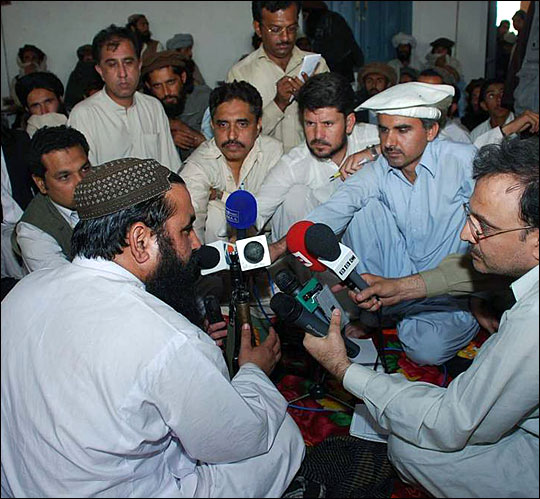
Pakistan’s top Taliban leader, Baitullah Mehsud, left with cap, tells reporters on Saturday he is sending fighters to battle U.S. troops in Afghanistan as he seeks a peace deal with the Pakistani government (NPR).
In featured article Taliban and al Qaeda Strategy in Pakistan and Afghanistan we discussed the dual pronged approach of the Taliban, one aimed directly at Pakistan and led by Baitullah Mehsud, the other aimed at Afghanistan led by Mullah Omar. The Taliban in Afghanistan are more disaggregated than they were even a year or two ago, but there is still at least loosely coupled leadership, even if not immediate communication for fear of cell phone tracking. The Pakistani Taliban are not loosely coupled. They are well led and tightly controlled.
This loosely coupled leadership has charted the exact course that The Captain’s Journal predicted. Not all of the kinetic encounters in Afghanistan have been with Taliban, but the presence of rogue elements other than the Taliban make the security situation even more difficult. As for the Taliban, they have used guerrilla tactics (fire and melt away), suicide bombings, intimidation tactics directed at the population, and standoff weapons such as VBIEDs and roadside bombs.
Baitullah Mehsud has also directed the Taliban campaign inside Pakistan. Baitullah Mehsud has recently reached an agreement with the Pakistani government (the text of which can be found at Pakistan’s Daily Times). It is doubtful that any of the stipulations of the agreement can be verified, since the Pakistani Army will be withdrawing. The Pakistani people and Army are tired of the violence, but Baitullah Mehsud is talking as if a man who has won his sought-after prize.
The leader of the Pakistani Taliban vowed on Saturday to carry on fighting NATO and U.S.-led forces in Afghanistan regardless of negotiations for a peace deal with the government of Pakistan.
Baitullah Mehsud told a group of journalists, invited to his stronghold in the tribal lands of South Waziristan, that he wanted to stop fighting the Pakistan army.
“Fighting between the Taliban and Pakistan is harming Islam and Pakistan. This fighting should come to an end immediately,” Mehsud said.
But he made no commitment about halting attacks in Afghanistan, and said the jihad, or holy war, would carry on.
“Islam does not recognize frontiers and boundaries. Jihad in Afghanistan will continue,” Mehsud said, as guards carrying Kalashnikov assault rifles looked on.
Mark Laity, NATO spokesman in Kabul, said: Such comments come as no surprise to us. Mehsud is a very dangerous man and everybody knows that.”
Just as we discussed in Why is there Jihad?, Mehsud reiterates that they do not recognize boundary lines (or even they thing they represent, nation-states) as legitimate. If the Pakistan Taliban, or Tehrik-i-Taliban, can accomplish their mission by capitulation of Pakistan rather than costly military operations, then they will take advantage of that.
In Afghanistan, NATO-led troops say recent peace agreements between the Taliban and the government of neighboring Pakistan are already having a negative impact on security on the Afghan side of the border.
NATO officials say over the past three to four weeks, Taliban attacks along Afghanistan’s eastern border have jumped from 60 to 100 incidents a week.
A spokesman for the NATO-led coalition in Kabul says the spike in insurgent attacks is the result of decreased activity by the Pakistani army on the Pakistan side of the border.
Whenever force projection is implemented and the small footprint model for counterinsurgency is rejected, U.S. forces have had success. The Marines have recently had such success in and around Garmser. The initial phases of Taliban operations are complete. Pakistan has succombed to Taliban pressure. Tehrik-i-Taliban will soon be turning their attention more fully to Afghanistan. Will we reciprocate?