New York Court Holds Stun Gun Ban is Not Unconstitutional, in Contravention of Caetano

Herschel Smith · 30 Mar 2025 · 2 Comments

Dean Weingarten has a good find at Ammoland. Judge Eduardo Ramos, the U.S. District Judge for the Southern District of New York,  has issued an Opinion & Order that a ban on stun guns is constitutional. A New York State law prohibits the private possession of stun guns and tasers; a New York City law prohibits the possession and selling of stun guns. Judge Ramos has ruled these laws do not infringe on rights protected by the Second Amendment of the United States Constitution. Let's briefly…… [read more]

Escalation in Afghanistan

BY Herschel Smith
18 years, 1 month ago

Both the size of the ISAF and the insurgency are growing in Afghanistan, but the the rates of growth are disparate.

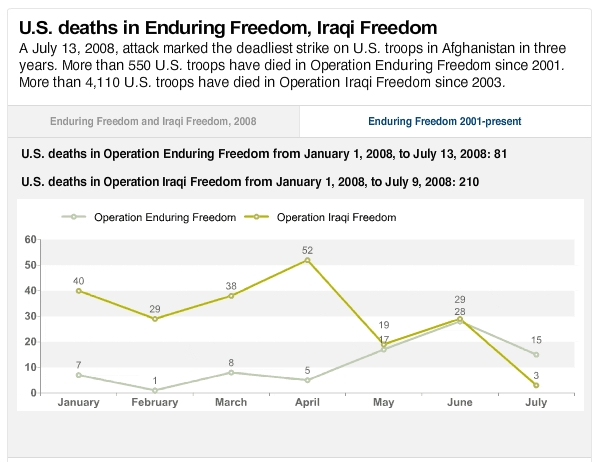
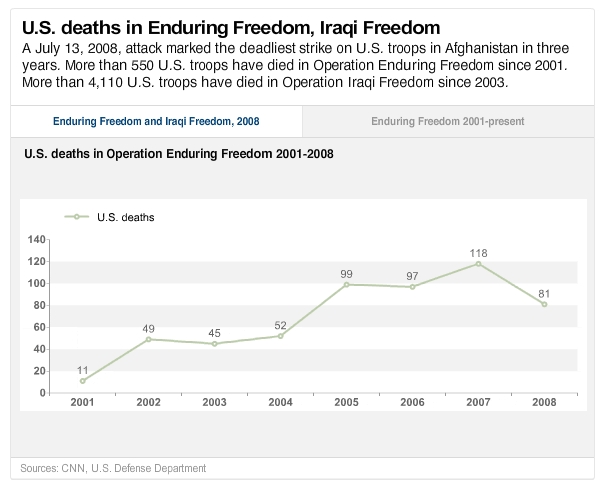
Each year since 2002, the number of U.S. and allied troops in Afghanistan has grown. And each year, during the “fighting season” of spring and summer, the number of attacks by the Taliban has also increased, prompting commanders to conclude that still more troops are needed. This year is no exception. There are 66,000 foreign troops from 40 countries in Afghanistan, including 37,500 Americans; the force under NATO command has grown by 20,000 in 18 months. But Taliban attacks are up 40 percent in eastern provinces this year compared with 2007, and there has been another spike in coalition casualties. In May and June, more Western soldiers died in Afghanistan than in Iraq. Adm. Michael G. Mullen, chairman of the Joint Chiefs of Staff, says that “at least” three additional brigades, or about 10,500 more troops, are needed for combat operations and training of the Afghan army.

Will the escalation never end? The war in Afghanistan sometimes appears to suffer from a syndrome that also plagued the United States in Vietnam: incremental increases in troops that are never enough to turn the situation around. Had former defense secretary Donald H. Rumsfeld deployed 60,000 troops in 2002 — rather than 5,000 — Afghanistan might have been pacified. Now it seems that a “surge” of troops, like that successfully applied to Iraq last year, might be needed to turn the tide of the war.

The problem is that large numbers of fresh troops are unavailable. The U.S. military currently lacks the reserves, and NATO nations can’t or won’t provide them. Germany, Britain and France have recently pledged more soldiers, but the numbers are relatively small.

There have been more U.S. and NATO troops killed in Afghanistan in June than in Iraq for the second straight month.  But more to the point, many of the NATO troops aren’t allowed in kinetic engagements, so deploying more German troops doesn’t help if their mission is unnecessary.  To comprehend the full force of the report, it should be realized that some troops are taking a disproportionate level of the burden (e.g., U.S. troops), and the Marines’ deployment to Afghanistan has been bloody.

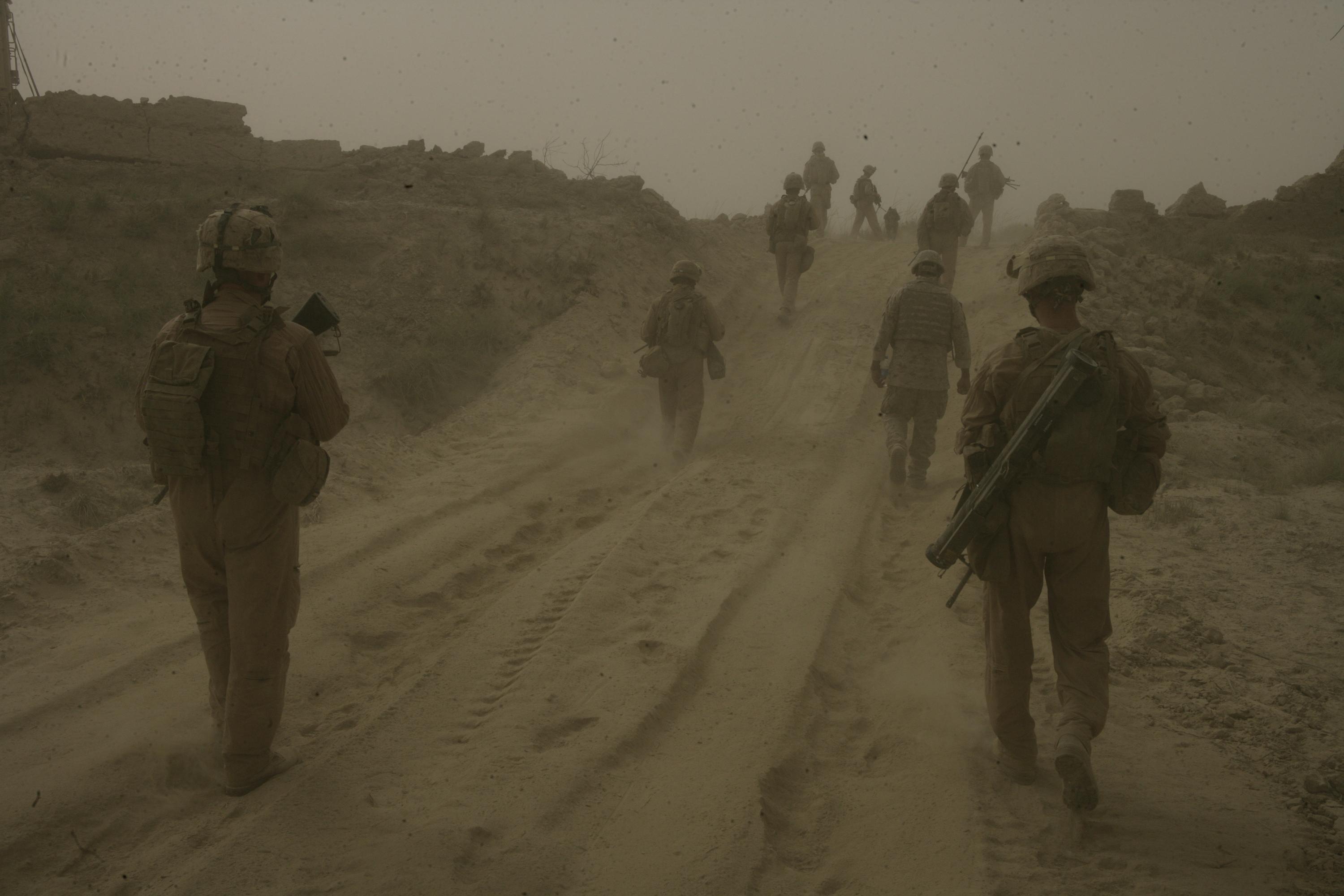
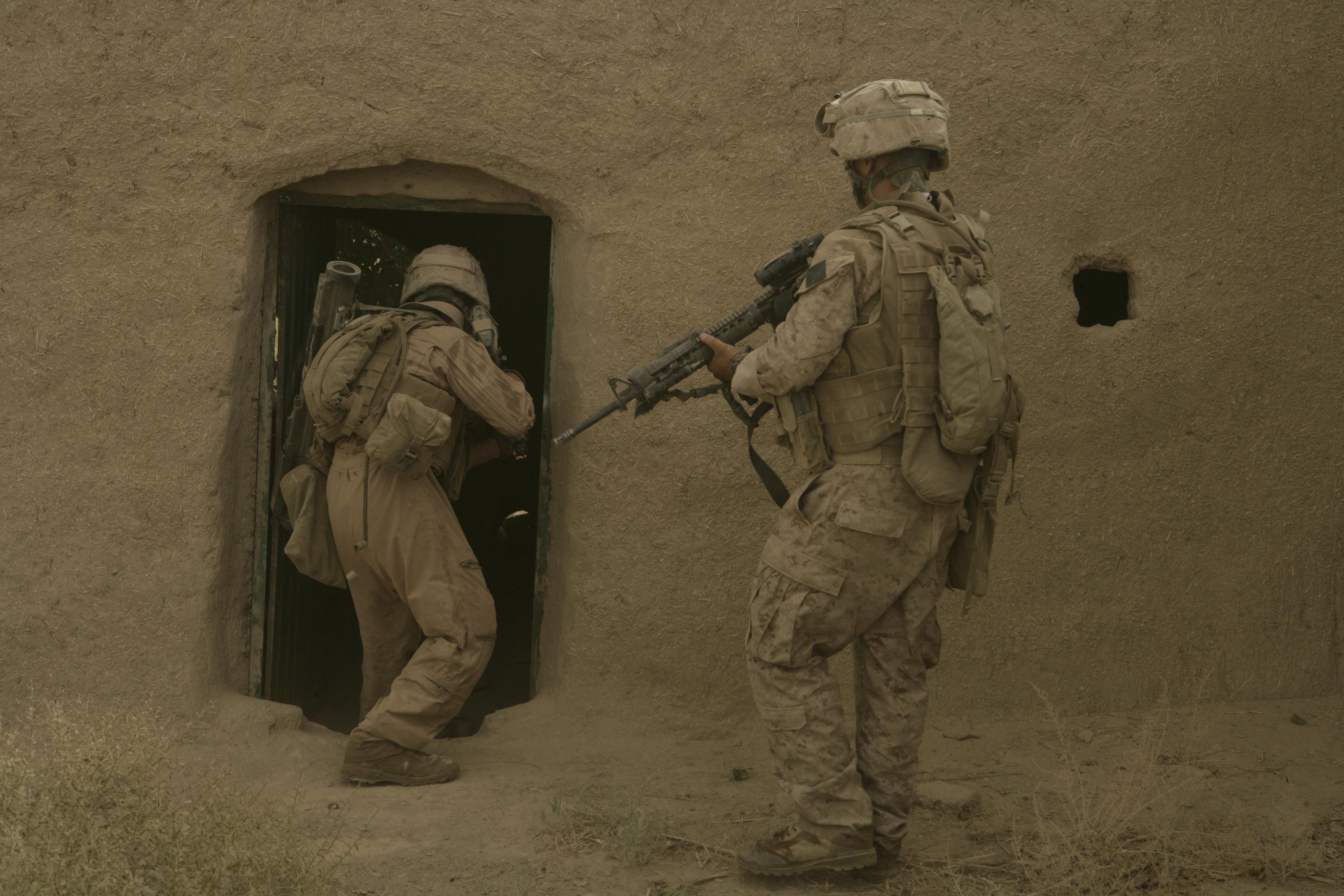
For the Marine Corps this year Afghanistan has proven a deadly and treacherous place.

Whereas 18 months ago the service was absorbing dozens of casualties per month in attacks throughout the once-restive al Anbar province in Iraq, today the bloodletting is in Afghanistan, where a resurgent Taliban insurgency and an undermanned, politically-constrained NATO force has lead to a sharp rise in leathernecks killed or wounded.

In June alone — when seasonal thaws lead to increased attacks from insurgent groups — the force of some 3,200 Marines there suffered 10 killed in action, including one Navy corpsman. By comparison, of the 23,000 Marines in Iraq, six were killed in June.

So far this year 13 Marines have been killed in combat in Afghanistan while 17 have been killed in Iraq. 

And for the Marine battalion commander in Afghanistan who lost nine of those killed in action in June, the deaths are hitting his unit hard.

Note again that the Marine Corps had in Afghanistan 167% of the casualties it took in Iraq, with roughly seven times as many Marines deployed in Iraq.  This is a remarkable statistic, and states clearer than any other argument where the “tip of the spear” should be deployed.

There is action on the political front with Pakistan, who is apparently getting edgy with their territorial rights (seasoned with a big dose of fear of the Tehrik-i-Taliban).

When Prime Minister Yousuf Raza Gilani meets President George W. Bush at the White House on June 28, he will tell the US leader that Islamabad will tolerate a US incursion into Fata if it is directed specifically against Al Qaeda leaders Osama bin Laden or Ayman Al Zawahiri – but nobody else, says a report published on Friday.

Quoting senior US and Pakistani officials, the Time magazine reported that the prime minister, however, would also tell Mr Bush that Pakistan would not allow incursions into its territory for any other Al Qaeda or Taliban leaders.

“If they do a raid and they find No. 3 or No. 4 or No. 5 but don’t get Bin Laden, it’s going to be a realproblem,” said the report, quoting a senior Pakistani official.

Ahead of the events again, The Captain’s Journal had previously said that Afghanistan would remain the focal point for kinetic operations against the Taliban, and that Pakistan could not be counted as allies in the fight.  This remains true despite arguments to the contrary.  “Expert” Jeremy Shapiro (Brookings Institution, RAND, Georgetown) stated to Spiegel that there is no need for additional troops.

SPIEGEL ONLINE: Policy-makers in the US and Europe are shocked by the gloomy Pentagon assessment for Afghanistan. You, however, are pleading for more optimism. Why?

Shapiro: There is ample reason for gloom, but we need to keep in mind that in the best of circumstances, Afghanistan is a long-term mission. We are talking about a commitment of 10 or 20 years. I believe we have fundamentally the right strategy in place, but even if that is so it will take some time to show progress. I don’t believe we need the major review people are talking about.

SPIEGEL ONLINE: Everyone seems to be asking for more troops in Afghanistan, though. President George W. Bush, John McCain, even Barack Obama.

Shapiro: More soldiers could be put to good use there, but they wouldn’t fundamentally change the situation. Let’s assume we would send in 10,000 more, as is contemplated: They could improve the local situation in a few areas for a time, but they would not rectify the problem of the Pakistani border areas and their ability to infiltrate insurgents into Afghanistan. As long as we don’t solve that problem, you could put 100,000 soldiers into Afghanistan and you would still have asymmetric attacks in various parts of Afghanistan and a rate of civilian and military casualties similar to the current one. And I have not yet heard viable suggestions on how to deal with the problem of the Pakistani border areas.

SPIEGEL ONLINE: But isn’t it understandable that security is paramount to people in Afghanistan?

Shapiro: Of course, but we can’t solve that problem simply by increasing forces. Achieving overall security in Afghanistan will be a slow process and unfortunately we will have to tolerate violence in the country for a long time.

Some expert.  So that there is no confusion, The Captain’s Journal unequivocally states that the argument above is idiotic.  The population will not “tolerate violence in the country for a long time,” and this is ridiculous counterinsurgency policy.  Additionally, it is immoral and counterproductive.  NATO (and the U.S.) will not be welcome for a “long time” if we continue to tolerate violence.  Shapiro doesn’t understand the ebb and flow of counterinsurgency campaigns.  Also, recognizing that the nature of insurgencies is to engage in asymmetric warfare is correct and has absolutely no relevance to the argument concerning force size.  Shapiro should stay on point.

Again, Syria has been a problem with respect to infiltration of foreign fighters into Iraq, but the surge and security plan (along with other events such as the Anbar awakening) has slowed the river of fighters to a trickle.  While harder and more costly, it is possible to fight a transnational insurgency in a local battlespace, as long as global pressure is brought to bear.

Pakistan is a thorny problem, and obviously their pact with the Taliban cannot be honored by the U.S.  But Pakistan’s recalcitrance is no argument for under-resourcing the campaign in Afghanistan.  Recall the words of one Taliban commander: “If NATO remains strong in Afghanistan, it will put pressure on Pakistan. If NATO remains weaker in Afghanistan, it will dare [encourage] Pakistan to support the Taliban.”

We’ll take the admonition of the Taliban over the pontification of Jeremy Shapiro.  More troops will indeed “fundamentally change the situation.”  Similar to other RAND studies (which advocate a very small footprint for COIN), Shapiro behaves as if the last two years in Iraq never occurred and the gains never happened.  The quickest gains in Iraq were at the hands of the U.S. Marines (the experience on which, at least in part, the security plan in Baghdad was based).  They now stand ready to be at the tip of the spear in Afghanistan.

The “Economy of Force Campaign”

BY Herschel Smith
18 years, 1 month ago

Marines do seven month tours.  Changing this is a big deal.  A big deal has occurred, and the 24th MEU has had their tour of Afghanistan extended by one month.

In a decision reflecting the shortage of available combat troops, more than 2,000 Marines fighting the Taliban will be kept in Afghanistan 30 days beyond their original seven-month tour, the Marine Corps said yesterday.

The decision by Defense Secretary Robert M. Gates to extend the Marines’ tour was confirmed a day after Adm. Mike Mullen, chairman of the Joint Chiefs of Staff, said that more troops are needed in Afghanistan but that he didn’t have more troops to send.

Gates had said several times in recent months that he had “no plans” to extend the Marines’ tour. But U.S. officials, including Mullen, have said recently that the situation in Afghanistan is worsening and that the Taliban-led insurgency is gaining ground and influence.

At present there are 32,000 U.S. troops in Afghanistan, of which 14,000 are assigned to work under the International Security Assistance Force, the 40-nation coalition led by U.S. Army Gen. David McKiernan.

The other 18,000 U.S. troops are fighting directly under U.S. command, mostly in eastern Afghanistan along the border with Pakistan, where violent attacks by insurgents have risen 40 percent from a year ago, according to a U.S. commander there.

In addition to U.S. forces, about 29,000 troops from 40 countries are serving in Afghanistan, although some are restricted by their home commands from combat.

Maj. David Nevers, a Marine Corps spokesman, confirmed that Gates had authorized an extension for up to 30 days for the 24th Marine Expeditionary Unit, an air-ground task force that deployed to Afghanistan in February and March.

The unit’s air squadron of jet fighters and attack helicopters, and its reinforced infantry battalion, the 1st Battalion, 6th Marine Regiment, have been fighting Taliban and other extremists around the southern Helmand province town of Garmser, a major poppy-growing region and insurgent stronghold, since late March.

Nevers said the Marines are needed “to continue full-spectrum operations as they have been doing” in southern Afghanistan.

The Captain’s Journal has noted too many times to cite that Operation Enduring Freedom needs forces and force projection.  The more acceptable way to say it this.

The nation’s top military officer said yesterday that more U.S. troops are needed in Afghanistan to tamp down an increasingly violent insurgency, but that the Pentagon does not have sufficient forces to send because they are committed to the war in Iraq.

Navy Adm. Michael G. Mullen, chairman of the Joint Chiefs of Staff, said insurgent Taliban and extremist forces in Afghanistan have become “a very complex problem,” one that is tied to the extensive drug trade, a faltering economy and the porous border with Pakistan. Violence in Afghanistan has increased markedly over recent weeks, with June the deadliest month for U.S. troops since the war began in 2001.

“I don’t have troops I can reach for, brigades I can reach, to send into Afghanistan until I have a reduced requirement in Iraq,” Mullen told reporters at the Pentagon. “Afghanistan has been and remains an economy-of-force campaign, which by definition means we need more forces there.”

This sounds so much nicer than the way we have described it.  “Economy of force.”  But then Mullen, who cares about both the troops and the campaigns, felt that he needed to say it bluntly like The Captain’s Journal does … “which by definition means we need more forces there.”

While The Captain’s Journal has many tears invested in Iraq (specifically, Anbar), there is a half life to insurgencies – and conversely, counterinsurgencies.  They can only go on so long.  Columbia hates the FARC, and their doom is sure to come.  Marines have handed over control of Anbar to Iraq, and while we have noted our objections to the failure of the Maliki administration to reconcile with the Sunni awakening movement, the Marines have completed their work in Anbar.  There will be no further Marine engagement in that province.  It isn’t a matter of wishes or needs.  It’s a matter of the nature of the campaign.  It’s finished in Anbar.

The Marines must move on, and while the Commandant wants an MEU focus (and we understand this desire), Afghanistan needs the troops.  A month won’t do it.  One month might close out the summer fighting where the Taliban won’t come back in during 2008 and kill those in the Helmand province who cooperated with the Marines.  Maybe.  But we’re talking about slicing the salami pretty thin here.  Economy of force indeed.  It’s time for Gates and Mullen to recognize that the Marines’ mission in Iraq is essentially completed, and to turn them loose in Afghanistan.  The world will understand.

Anticipating the Insurgency

BY Herschel Smith
18 years, 1 month ago

So I’m reading Robert D. Kaplan’s Imperial Grunts.  The Prologue – Injun Country – might very well be the best twelve pages I have ever read.  It should be required reading in all professional military training.  No matter how much reading you have done, no matter who you have met, no matter what your experiences have been, there is no replacement for a careful study of this Chapter.  You cannot understand the current state of affairs in the world today, the so-called global war on terror, until you have read these pages.  Kaplan sums up in a tidy and small package a wealth of knowledge and wisdom concerning the nature of imperial defense of the homeland.  Enough said.  Buy the book and read it.

Kaplan also has much wisdom concerning the nature of embedded reporters and journalists in later pages of the book, but this is a dialogue for another time.  Being an aficionado of the Small Wars Journal myself, I am disappointed that it took reading Kaplan’s book to remind me of several important observations found therein.  On page 270 of Kaplan’s book we read the following:

As if foreseeing the situation in Iraq, the Manual notes that after major fighting:

… hostile forces will withdraw into the more remote parts of the country, or will be dispersed into numerous small groups which continue to oppose the occupation.  Even though the recognized leaders may capitulate, subordinate commanders often refuse to abide by the terms of the capitulation.  Escaping to the hinterland, they assemble heterogeneous armed groups of patriotic soldiers, malcontents, notorious outlaws … and by means of guerrilla warfare, continue to harass and oppose the intervening force in its attempt to restore peace and good order throughout the country as a whole.

Then Kaplan notes other sections of the Small Wars Manual, citing it to recommend that:

To countervail such hostile forces, numerous presence patrols must be organized with the help of the native militias, and outposts erected that are “dispersed over a wide area, in order to afford the maximum protection to the peaceful inhabitants of the country.”

So much for the detractors of the Small Wars Manual.  Seriously.  Summed up in these words are reasons for rejecting any supposed lack of knowledge or anticipation of a developing insurgency after toppling the Iraqi regime, foresight into dismounted patrols, and prediction of the utility of combat outposts.  All the planners had to do was read the Small Wars Manual.  Further, the Marines were the first to employ the concept of combat outposts in Iraq (specifically in Ramadi), and while this evolved to combination outposts / police precincts in Fallujah in 2007, the idea was basically the same (and even more in tune with the Small Wars Manual than in Ramadi).

There is nothing new under the sun.  Combat outposts are not new to Iraq COIN.  They have been employed by the Marines for decades.  And recollecting the nature of the initial combat operations, major urban areas were avoided and bypassed.  MOUT (military operations on urban terrain) has always been hard on any armed forces, and it was left to the subsequent counterinsurgency effort.  Ramadi, Fallujah, Mosul, and many other areas were left untouched for months while the assumed center of gravity was targeted – Baghdad and the center of government.

No matter how much group think was present in the Pentagon prior to the invasion of Iraq, there is simply no excuse for not anticipating the insurgency.  It’s right there in the Small Wars Manual.

Inside the Taliban Jailbreak

BY Herschel Smith
18 years, 1 month ago

We have previously discussed the Kandahar jailbreak by the Taliban (including the subsequent combat action in and around Kandahar), but at the time there were many unanswered questions.  While the main stream media foolishly focused their attention on the evolution of the Taliban into well-organized guerrilla fighters, The Captain’s Journal likened it more to a Mad Max movie.  The Taliban relied on a few RPGs, a small amount of command and control on the ground, and 30 or so motorcyclists with rifles.  The fault was with the Afghan police and ISAF forces, we surmised.  We posed the question(s):

Where was the force protection?  Where were the vehicle barriers (you know, those mechanically operated devices that flatten your tires if you go over them the wrong way)?  Where were the concrete truck barricades?  Where was the training?  Where was the supervision?  Forget expensive UAVs and road construction for a minute.  What about spending a little money on teaching the Afghan police about combat and force protection.  Failure to do so has cost us the freedom of 400 Taliban – and potentially U.S. lives to capture or kill them again.

Many of these questions have been answered in a recent Globe and Mail article entitled Inside the Taliban Jailbreak.  Read carefully near the end of the citation below to see just how the Canadians have approached management of this prison.

The prison cells that once held Taliban sit almost empty, with little remaining except rubbish: plates of rice ready for meals never eaten, and sandals discarded by fugitives who ran away in bare feet. Some of the debris inside Sarpoza prison offer hints about what happened amid the chaos last month when the Taliban accomplished one of the largest jailbreaks in modern history, freeing at least 800 prisoners and rampaging into Kandahar without facing any serious resistance from Canadian troops or the other forces assigned to protect the city.

A chunk of metal the size of a picnic table sits 125 metres away from the site where a truck bomb hit the gate, testifying to the force of the explosion. In a room where prison officials believe the inmates planned their escape, bullet casings on the floor suggest the prisoners had smuggled at least one handgun into the cells.

With those scattered bits of evidence, and a dozen interviews with witnesses, a picture emerges of the way security collapsed in the largest city in southern Afghanistan on the evening of Friday, June 13. Details of the attack show not only why the city defences fell apart; they also illustrate how the notorious problems of the Afghan mission – corruption, poor intelligence, a distrustful population, weak Afghan security forces, a lack of foreign troops – made the ingredients of a disaster.

The Canadian military has not escaped blame. In a private session two days after the attack, Kandahar’s provincial council strongly criticized the foreign troops for arriving at Sarpoza roughly two hours after the jailbreak started. They demanded to know why Canadian soldiers watched the prisoners run away and failed to chase them. Witnesses say that hundreds of inmates spent their first night of freedom camping in the fields only a few kilometres south of the prison, within easy reach of the Canadian soldiers sent to investigate.

Brigadier-General Denis Thompson, the top Canadian commander in Kandahar, confirmed that NATO surveillance tracked the fugitives as they fled. But he said it’s not Canada’s job as part of the International Security Assistance Force to hunt down escaped prisoners.

“You can ask yourself the rhetorical question, what if we find 100 fugitives in the fields?” Gen. Thompson said. “What is ISAF’s duty in that circumstance? Is it to go arrest people?”

The commander continued: “We’re not policing this country, right? It’s not our role to police this country. Our role is to stand behind our Afghan partners and assist them.”

But the Afghan forces stationed nearby did not consider themselves capable of standing up to the Taliban that evening, as police in three outposts around the prison hunkered down behind their fortifications and refused to intervene.

Local and foreign intelligence agencies also failed to understand glaring signs of trouble at the jail in the weeks before the attack, including a mass poisoning of prison guards just eight days beforehand. Taliban fighters warned local shopkeepers about an impending battle in the hours before they struck, but nobody passed the warning to the correct authorities.

Corruption likely helped the Taliban that night, too, as some indications have implicated a senior Afghan official in the jailbreak planning.

Sifting through the rubble at Sarpoza prison, it’s obvious that the attack was not just a successful Taliban operation. It was a failure of the institutions that protect Kandahar city, despite the Canadian money and lives expended to build a zone of security here in the past two years …

Let’s stop this sorry and pitiful tale for a moment and play “what wrong with this picture?”  It is certainly the case that there is corruption and ineptitude within the Afghan police.  It is currently more a cabal than an institution.  “The effectiveness of the police and other local officials is growing in importance as the Taliban moves to regain territory in southern Afghanistan this summer. Afghan and North Atlantic Treaty Organization troops battled the Taliban on Wednesday for control of villages around the city of Kandahar, about 220 miles east of Farah.  Throughout the country, police officers often have been little more than hired guns who raise money for local warlords through illegal taxes, shakedowns and corruption. Many policemen and district officials sell weapons and opium. Some collude with the Taliban.”

But even with the wild card of the Afghan police, the event never had to occur – or at least, it could have been mitigated.  The Canadian military made the same mistake seen in the early phases of Operation Iraqi Freedom.  For much of the campaign in Iraq the byline was to stand down when the Iraqis stood up.  Security was not assumed to be the precondition for the construction of institutional infrastructure.  Rather, the assumption was that the institutional infrastructure was there to begin with, and the mission is to assist it.

Of course, this is wrongheaded, but seeing the results of such an assumption (the prison break) won’t even allow mission creep, much less a complete revisiting of the doctrine brought to the theater.  There is an intransigence in NATO that refuses to allow a consistent or comprehensive strategy.  This will consume the nighttime thoughts of General Petraeus for months into the future.

This intransigence caused the Canadians to rhetorically question why they should apprehend the enemy.  This statement sounds stunning to the casual observer, and indeed, it requires daily numbing by a recalcitrant command to be so cynical.  But the enemy sat in a field after escape, at least long enough to catch a little sleep (according to the Globe and Mail report).  But wait.  There are problems further upstream in the chain of events.

… the Canadians could not be accused of neglecting the prison itself. One of the key tenets of “clear, hold, and build,” as a method of counterinsurgency is the idea that investing money and improving the lives in a particular spot will make the locals more likely to deliver useful intelligence. By that measure, the guards and prisoners at Sarpoza should have been excellent sources for the Canadians, who had been pouring money into the jail.

In the year before the prison break, the Canadians paid for new septic systems, solar-powered lighting, new doors and windows, an infirmary, landscaping, guard towers and washroom facilities, among other improvements. Painted walls replaced the rough stone surfaces; where chunks of masonry used to fall on prisoners as they slept, the ceilings now arched smoothly.

The current budget for all prison upgrades stands at $4-million, and Canadian officials visited the jail regularly to check on the progress.

Despite the Canadians’ focus on the prison, however, they failed to understand the trouble brewing inside.

A report by the U.S. magazine Newsweek claimed that the planning started when a disgruntled prisoner telephoned insurgent leader Mullah Berader and complained about prison conditions, but that story was dismissed by Taliban spokesman Qari Yousef Ahmadi.

“The Taliban in jail were always calling us, asking us to release them,” Mr. Ahmadi said. “Especially our commanders who were sentenced to 20 years or execution.”

Several sources say the planning started in earnest after accused Taliban prisoners launched a hunger strike in May, trying to obtain sentences in cases that remained undecided. Some suspected insurgents had languished in the prison for years without a conviction, and they described themselves as frustrated with a justice process that they claimed was designed to keep them in jail indefinitely.

They struck a committee of seven Taliban prisoners, who gathered every day inside one of the nicest cells of the national-security wing, a sunny room on the north side with a view of a garden.

They posted a sign on their door, saying: “No interruptions from 4 p.m. to 6 p.m.”

So now The Captain’s Journal has had our questions answered.  Rather than concrete barriers, concertina wire, vehicle immobilizers, mentoring and supervision of the police, the Canadians spent their money on landscaping, paint and solar-powered lighting.

Said one Taliban of the operation, “I thought that there would be big fighting, aerial bombardments, and many Taliban would be killed some arrested,” said a Taliban fighter, now enjoying freedom with his family in Kandahar city. “But when we reached our safe houses we were surprised, because there was no fighting, nothing.”  He added: “I didn’t think we would succeed like we did.”

Actually, it isn’t surprising at all.  It’s Like Mad Max and the Keystone Cops.  Mad Max will win every time.  Unless and until NATO acquiesces to a comprehensive and sensible strategic approach to Operation Enduring Freedom, we should expect to see more of the same.

RAND Monograph: Prewar Planning and Occupation of Iraq

BY Herschel Smith
18 years, 1 month ago

RAND has published a monograph entitled After Saddam: Prewar Planning and the Occupation of Iraq.  Similar to the Leavenworth study On Point II (which The Captain’s Journal could only review it in small bites), a few citations will be made below.  Similar to the Leavenworth study, some of the RAND report focuses on organizational issues.  This bores us.  To be sure, there are some issues of organizational instransigence that become so burdensome that change must occur in order to accomplish the mission.  This is seldom the case.

Corporate America has a habit of reorganizing.  It reorganizes when the organization fails, and sometimes even when it succeeds.  It reorganizes when the management wants to, or for financial gain.  It reorganizes in order to grant promotions, and in order to take them away.  The U.S. military might do well to study corporate America concerning some things, but organizational structure (and change of such) is not one of them.  The workers go on working in spite of the organization – and its constant change.  The story of Iraq is not one of organization.  It is one of heart, soul and mind.

We’ll supply a few quotes and then offer some comments.

Page xx: Two particular sets of assumptions guided U.S. prewar planning for the postwar period. First, administration officials assumed that the military campaign would have a decisive end, and would produce a stable security situation. They intended to shrink the U.S. military presence down to two divisions—between 30,000 and 40,000 troops—by the fall of 2003. Deputy Secretary of Defense Paul Wolfowitz succinctly expressed this assumption during congressional testimony on February 27, 2003, when he stated, “It’s hard to conceive that it would take more forces to provide stability in post-Saddam Iraq than it would take to conduct the war itself and to secure the surrender of Saddam’s security forces and his army.”  Second, they assumed that the Iraqi population would welcome U.S. forces. Three days before the war, Vice President Richard Cheney clearly articulated this view by stating, “My belief is we will, in fact, be greeted as liberators.” Iraqi exiles supported this belief by emphasizing that the Iraqis would greet U.S. forces with “sweets and flowers.”

Page xxvi: Looking back, we can see that the failure to plan for and adequately resource stability operations had serious repercussions that affected the United States throughout the occupation period and continue to affect U.S. military forces in Iraq. Because U.S. forces were not directed to establish law and order—and may not have had enough forces for this mission anyway—they stood aside while looters ravaged Iraq’s infrastructure and destroyed the facilities that the military campaign had taken great pains to ensure remained intact. Because Iraq’s own police and military evaporated shortly after Saddam fell, ordinary Iraqis lived in a basically lawless society for months, during which, among other things, insurgents, terrorists, and criminal gangs assembled with impunity. And because U.S. forces have had to focus on providing security for their own personnel (both military and civilian) as much as for Iraqis, the buildup of coalition forces did not bring the degree of safety and security it might have brought had order been imposed from the start.

Page xxvii: … few military voices besides that of Army Chief of Staff General Eric K. Shinseki called attention to the possibility of a major, long-term security challenge in post-Saddam Iraq. One reason other military voices remained muted was that the military operated within the prevailing assumptions set by senior civilian officials, which did not identify security as a problem. Also, as General Franks makes clear in his memoirs, the senior Army planner for OIF was reluctant to take responsibility for security and stabilization missions in the aftermath of major combat. This was not seen as the military’s role or mission.

Page xviii: Although CENTCOM’s commander, General Tommy Franks, refers to Phase IV frequently in his memoirs, for example, he never identifies the specific mission that U.S. forces should have had during that time. To the contrary: He expresses the strong sentiment that his civilian superiors should focus on postwar operations while he focused on the war itself. He goes on to argue that civic action sets the preconditions for security rather than the other way around. And he justifies his decision to retire right after combat ended because the mission was changing and a new commander should be there throughout Phase IV.

What the hell is Wolfowitz talking about?  Where did he hear that assertion?  Who taught him that?  It isn’t at all difficult to imagine that it would take more troops to maintain order than to topple the regime.  Wolfowitz simply asserted axioms in his testimony and took them to be fact.  Actually, it’s worse than that.  Wolfowitz had heard before that it would take more troops than planned from General Eric Shinseki and General Anthony Zinni, and then had to go back in front of the press again and insult Shinseki in order to save his axiom.

There were two failures here.  The first was with Rumsfeld and Wolfowitz and their group think mentality in which they bullied generals to agree (or at least stay silent).  What is indeed difficult to imagine is that men would have reached the age Wolfowitz, Rumsfeld and Cheney were and still have been unable to think critically.  The second failure is with generals who are equally unable to think critically.  Jumping to the last quote, the notion (viz. Tommy Franks) that civic actions set the preconditions for security is directly contrary to what we have argued in too many articles to cite: security sets the preconditions for civic actions and reconstruction.  This seems so basic that any child experienced at playing on a schoolyard would know it.

A test was performed by criminals immediately upon the fall of the regime.  This test ascertained whether the U.S. troops could maintain security, law and order.  It is easy to argue that more troops would have been better early on (and we have many times argued just that point), but this issue requires a more nuanced understanding.  The ROE (rules of engagement) and RUF (rules for the use of force) essentially follow the SCOTUS decision in Tennessee v. Garner, and disallow deadly force for anything but self defense.

Here, more troops to watch as looters took what they wanted wouldn’t have helped.  It was left to individual property owners to take up arms and – you guessed it – use deadly force to protect their belongings.  Thus, since nothing will change regarding the ROE or RUF, the Iraq experience has shown us a gaping hole in our ability to provide law and order in a society which is accustomed to the use of deadly force (like Iraq).  The notions of restrictive ROE/RUF and maintenance of post-invasion law and order in a society such as Iraq (or many other Middle East or African countries) might be irreconcilable.  To date, The Captain’s Journal is the only voice speaking on this issue.  In the future, it should be understood that the ROE/RUF will change, or there will be anarchy after a regime is toppled.  Take your pick.

The one place that the military can learn from corporate America is rejection of the notion of group think and also of unchallenged assumptions.  It was too easy for Tommy Franks.  Given the military assets in the possession of the U.S. at the time of the invasion, our grandmother could have led the toppling of the Saddam regime.

Critical thinking, challenging of assumptions, elevation and highlighting of disagreements rather than agreements, and scholarship.  These are the elements of the Armed Forces of tomorrow – if it is to be successful, whether in near-peer or counterinsurgency warfare.

Kinetic and Nonkinetic Versus Lethal and Nonlethal Operations

BY Herschel Smith
18 years, 1 month ago

In the article concerning On Point II we supplied preliminary observations on the voluminous report concerning unpreparedness for post-invasion Iraq.  One nuance of doctrine and terminology stands out in the crowd of ideas in the report, and is worthy of a bit of unpacking.  On page 87 we read:

To face this evolving and complex threat, American Soldiers began conducting full spectrum operations designed to directly and indirectly engage the insurgent enemy. This response is the subject of the second part of this chapter. At times, US Army units launched focused combat operations—often described using the unofficial term “kinetic operations”—to destroy insurgent forces and capabilities. However, from the very beginning of the full spectrum campaign, US forces also mounted broader efforts to build popular support for the new Iraqi Government and the Coalition project in Iraq. These operations, sometimes called “nonkinetic” operations, concentrated on the reconstruction of the Iraqi infrastructure, the establishment of representative government, the training of ISF, and general efforts to improve the quality of life for the population.

With the following doctrinaire footnote: The 2008 version of FM 3-0, Operations, uses the terms “lethal” and “nonlethal” actions instead of “kinetic” and “nonkinetic.”

This isn’t the first occasion we have noticed the distinction between kinetic versus nonkinetic operations and lethal versus nonlethal operations.  We had previously discussed this with another interested party who brought up the same thing in response to one (or more) of our articles.

The definition of kinetic is “relating to or characterized by motion – supply motive force.”  This seems to be an apt definition of numerous tactics employed in the battle space.  For instance, a satellite patrol conducted for the purpose of finding the enemy or ridding the streets of gangs, criminals and/or insurgents, should count as kinetic operations, whether there was force employed or even whether that force was lethal or nonlethal.  Similarly, an intelligence-driven raid where no shot was fired and the target surrendered without resistance should be considered a very dynamic operation, and thus a part of kinetics.

A leisurely stroll by a squad down a street in Fallujah to meet and greet the citizens and assess atmospherics should be considered nonkinetic operations, and would only transition to kinetic operations if shots were taken.  Also, the transition to kinetic operations would become effective whether or not a shot was fired in response, and whether there was any lethality involved on either part.

The distinction we are drawing is this.  Lethal and nonlethal should be seen as subsets of kinetic operations, not replacements for the concept, no matter which phrase came first historically.  Nonkinetic operations by definition can only be nonlethal.

On the other hand, to opt for lethal and nonlethal as replacements for kinetic and nonkinetic operations would imply the following: a patrol where no shots were fired, and yet casualties sustained due to shots being taken from the enemy, would have to be categorized as nonlethal operations if the casualty survived (and perhaps even if not, since no lethality was employed by U.S. forces).  This is absurd.

Regarding common, ordinary, everyday usage (regardless of how they may be described in an Army Field Manual), the terms lethal and nonlethal are poor terms to describe the totality of U.S. operations.  They are very wooden and un-malleable terms which cannot hope to encompass all potential actions or reactions in the battle space.  The Captain’s Journal recommends that the doctrinaire writers go back to the drawing board on this one.

Will the Sons of Iraq Re-emerge as Insurgents?

BY Herschel Smith
18 years, 1 month ago

As background, recall not too many months ago that U.S. forces rolled out a plan to split off the indigenous insurgents from al Qaeda, Ansar al Sunna, former Ba’athists and Fedayeen Saddam.  We offered to pay them for services rendered, these services specifically being the provision of security for neighborhoods and intelligence gathering.  Basically, we co-opted their services.

The Captain’s Journal strongly supported this move, initially called the concerned citizens, but we knew at the time that nothing was cast in stone.  Nothing was irreversible, and the progress was tentative.  The Iraqi government had to reconcile and incorporate them into the system, and this was pointed out to us by contacts from field grade officers in Iraq at the time.  The warnings from these contacts were rather dire.  We knew the risks, but supported the program anyway as the best and wisest approach to counterinsurgency at the time and in this situation.

Now comes a report from the LA Times that hints at a potential re-emergence of the Sons of Iraq as insurgents, entitled The rise and fall of a sons of Iraq warrior.

Abu Abed in his Amman apartment holds a picture of him and General David Petraeus from last year when the Sunni fighter was celebrated for leading a then unthinkable revolt against Al Qaeda in Iraq in Baghdad.  Photo courtesy of the LA Times, Ned Parker

A year ago, Sunni Arab fighter Abu Abed led an improbable revolt against Al Qaeda in Iraq. As he killed its leaders and burned down hide-outs, he became a symbol of a new group called the Sons of Iraq — the man who dared to stand up to the extremists in Baghdad when it still ranked as a suicidal act.

Today, Abu Abed is chain-smoking cigarettes in Amman, betrayed by his best friend, on the run from a murder investigation in his homeland. He once walked the streets of Baghdad wearing wraparound sunglasses and surrounded by a posse of men in matching fatigues like something out of “Reservoir Dogs,” but now he shouts futilely for speeding taxis to halt, a slight figure in jeans and a button-down short-sleeve shirt.

Abu Abed’s rise and fall encapsulates the complexities of the U.S.-funded Sons of Iraq program. Although the Shiite-led Iraqi government has regarded the Sons of Iraq as little more than a front for insurgent groups, the Sunni fighters’ war helped end the cycle of car bombings and reprisal killings by Shiite militias that had sent Baghdad headlong into civil war. America’s new friends also helped bring down the death rate of U.S. forces in Iraq.

The Defense Department’s report to Congress last week emphasized the vital nature of the program, saying, “The emergence of the Sons of Iraq to help secure local communities has been one of the most significant developments in the past 18 months in Iraq.”

Abu Abed’s flight into exile shines a light on a violent power struggle pitting upstart leaders like him against Iraq’s entrenched Sunni political elite and its Shiite-dominated government. The frictions could easily shatter the Sons of Iraq — and open the door to Al Qaeda in Iraq’s resurgence.

In the cramped Amman apartment he shares with his family, Abu Abed opens a folder with pictures of him and American officials — Army Gen. David H. Petraeus and others. He holds up the medals they awarded him, the letters commending him.

But his eyes glaze over at a photo of Iraqi officials from a reconciliation conference he attended in mid-June. “They pat you on the back with one hand and stab you with the other,” he says bitingly.

Abu Abed doesn’t reveal his identity to people in Amman. He tells them he sells cars. His skin is grayer and his cheeks, once plump, are noticeably gaunt. The family has already moved once, after his 8-year-old son was handed a threatening letter at school.

He worries that his fate will serve as a warning to others who gambled their lives fighting Al Qaeda in Iraq. “Al Qaeda will come back and the government and Iraqi army will be helpless to defeat them. People will have lost their faith in the government because of the way they treated me and others.”

The government considers Abu Abed a former militant with blood on his hands.

“If he has done something, let the legal system take its course. It is not just with Abu Abed, but all the people,” said Tahseen Sheikhly, an Iraqi government spokesman for Baghdad military operations. “They were part of the major problem of violence in Iraq.”

Abu Abed’s defenders, including some U.S. military officers, suggest that the fighter earned enemies for upsetting Baghdad’s status quo as he brought former insurgents into an alliance with the Americans.

In recent months, Abu Abed had been organizing like-minded fighters around Baghdad and northern Iraq for provincial elections in the fall. U.S. officers believe his transition to politics could have proved the last straw for the government.

“Certainly you can draw the conclusion because he was getting involved in the political process to engage Sons of Iraq leaders to form a political party, the Iraqi government actively targeted him,” said a U.S. military officer, who declined to give his name because of the subject’s sensitivity. “I don’t know that I can say it outright, but it certainly does seem that way.”

Amid the political skirmishing, the committee set up to integrate U.S.-backed Sunni fighters into the security forces and public works jobs has stalled.

We always knew that reconciliation would be necessary for the real gains to obtain.  Maliki has a once in a generation opportunity to bring peace to Iraq.  He demands that his people reconcile, but refuses to entertain the idea himself, perhaps beholden to Iranian influence.  If he continues this path, he might very well plunge Iraq into civil war upon the eventual departure of U.S. forces.

If this happens, nothing – including Maliki and the ISF – will be able to stop it.  The Sunnis may make up only 15% of the population, but aligned with al Qaeda would become as formidable as they were before.  Maliki will sit at the top of a crumbling government and nation-state.  Thus he will have proven himself to be the ultimate fool.  This is not inevitable, but probable if his administration doesn’t ensure that all parties are properly incorporated into the government.  The U.S. will have no leverage with the Sunnis next time if Maliki’s administration doesn’t produce.  Our wallet has been shot on this one chance.

Taliban Set to Expand Violence

BY Herschel Smith
18 years, 1 month ago

Army intelligence said that there would be no Afghanistan spring offensive by the Taliban not more than half a year ago.  The Captain’s Journal said that there would be, and also claimed that it would be mostly asymmetric.  In a stark admission and direct contradiction of the position of Army intelligence, the Department of Defense is saying that the insurgency will grow and expand the violence.

In its first formal report on the situation in Afghanistan, the U.S. Defense Department says the Taliban is “a resilient insurgency” and is expected to expand its challenges to the Afghan government. VOA’s Al Pessin reports from the Pentagon.

The report required by Congress says the Taliban “is likely to maintain or even increase the scope and pace of its terrorist attacks and bombings” this year, and to move beyond the south and east, where most of the fighting has been happening. It says the activity “will challenge the control of the Afghan government in rural areas” throughout the country. The report says the Taliban is able to do this even though U.S., Afghan and allied operations have killed many insurgent leaders and forced the group out of former safe havens.

But the report calls the Taliban safe haven in Pakistan “the greatest challenge to long-term security” in Afghanistan. It calls for better Afghan-Pakistani military cooperation, and laments a reduction in Pakistani military operations against insurgents in the border areas, which have decreased cross-border attacks in the past. The Pentagon report also expresses concern about a new round of agreements the Pakistani government is considering with local tribal leaders, saying past agreements have led to an increase in cross-border attacks.

The period covered by the report ended in early April, but U.S. Defense Secretary Robert Gates expressed similar concerns during a news conference on Thursday. He was asked about the 40 percent increase in violence in Afghanistan during the first five months of the year, compared to the same period last year.

“Well, I think it is a matter of concern, of real concern,” he said. “And I think that one of the reasons that we’re seeing the increase is more people coming across the border from the frontier area. And I think it’s an issue that clearly we have to pursue with the Pakistani government.”

Secretary Gates also welcomed a newly announced Pakistani initiative to get control of the border area.

The “newly announced Pakistani initiative” will redound to more wasted time, and the only solution to the dilemma is force projection in Afghanistan.  One wonders if the U.S. Marines are not the coming answer to the problem.  The Corps has just placed an order for 19,000 pairs of mountain cold weather boots.

LaCrosse Footwear Inc. announced Tuesday its Danner subsidiary received a $3 million delivery order as part of the Mountain Cold Weather Boot contract awarded by the U.S. Marine Corps in 2006.

Danner will supply the U.S. Marines with 19,000 pairs of the Mountain Cold Weather Boot in several shipments in the second half of 2008. To date, this is the largest delivery order related to the 2006 contract. The Mountain Cold Weather Boot is produced in the Portland-based LaCrosse’s (NASDAQ: BOOT) manufacturing facility in Portland.

Danner has a description of their boot here.  Whether it is the Marines or some other branch, force projection is the only answer to the problem of Operation Enduring Freedom.

On Point II & Lack of Planning for Iraq: Preliminary Thoughts

BY Herschel Smith
18 years, 1 month ago

The U.S. Army Combined Arms Center at Fort Leavenworth has produced a comprehensive study of the failure to plan for the post-invasion insurgency in Iraq.  It is entitled On Point II, Transition to the New Campaign: The United States Army in Operation Iraqi Freedom May 2003-January 2005.  It is a very lengthy and detailed study, so there is no way to analyze it within the context of a weblog.  This is left to others who have the professional honor and assignment to study such things.  However, a few preliminary thoughts are outlined below.  They cannot hope to be comprehensive or even connected.  They are presented in stream of consciousness fashion.

First, it seems that it would have been wise to have incorporated the other branches of the armed forces in the scope of the study.  For example, it might have been informative to have the Marine Corps perspectives to dovetail together with those of the Army, even though managing such an endeavor would have been much more difficult.

Second, on page 87 we read “As the United States moved closer to confrontation with Iraq in 2002 and early 2003, the US Government began conducting a series of studies intended to help understand what might occur after a military defeat of the Saddam regime. None of the organizations involved in this effort came to the conclusion that a serious insurgent resistance would emerge after a successful Coalition campaign against the Baathist regime.”  True, perhaps, but this sidesteps important issues, such as the fact that there was copius analysis that came to the conclusion that many more troops were needed (General Anthony Zinni and his team concluded 400,000 men) in order to maintain order once the regime was defeated.

Third, on page 92 and following, there is much discussion of de-Ba’athification and disbanding the Iraqi Army in the development of the Sunni insurgency.  Later on page 103 there is a good Venn Diagram showing a breakdown in the trouble-makers, including foreign Islamic extremists, gangs, opportunists and criminals, the unemployed, aggrieved tribes, and so on.  It is commonly understood that the insurgency included more than just al Qaeda, but rather, was composed of a large indigenous element, many subsets of which were fighting for different reasons.  However, one glaring omission is the absence of the discussion and analysis of Iranian elements (Quds, money, IRG) prior to the war (see Michael Rubin, AEI, Bad Neighbor).

Fourth, on page 103 in the section on Shi’a insurgency groups, the discussion seems very truncated with little to no real analysis of the affect of Moqtada al Sadr on the subsequent months and years.  It is of significance that in 2004 Sadr was actually in the custody of the 3/2 Marines, and ordered by coalition authorities, at the behest of the British, to let him go.  This significance of this cannot be overestimated, and yet the discussion lacks any acknowledgement of the event or its context.

Fifth, on page 116 the study notes that “While relatively few American Soldiers in Iraq in 2003 were familiar with counterinsurgency warfare and its theorists, it did not take long before many of the basic concepts of counterinsurgency made their way into US Army planning and operations. This process was indirect and based on immediate requirements rather than experience or doctrine.”  This seems basically correct, since necessity is the mother of invention.  A Soldier or Marine cannot grow up in the complex environment that is America without being familiar with a basic understanding of humans and how they interact, even if there is an overall lack of knowledge of the Iraqi culture.  Human terrain mapping isn’t just for professional anthropologists.  Every warrior is an anthropologist.

The sixth point may be the most critical of all, and the one closest to our heart.  The Captain’s Journal is noncommittal on Paul Bremer.  He did some good things.  He also did some nonproductive things.  But The Captain’s Journal is not noncommittal on Donald Rumsfeld.  We watched closely as he told jokes and acted coy in Pentagon press briefings while warriors died and lost arms and legs, brain function and eyesight.  In the most stunning revelation of the report, we learn that:

Critical to the understanding of the troop strength issue is that, as the senior US official in Iraq, the CPA Chief had the final say over US policy in Iraq. Bremerat times expressed displeasure to Coalition military leaders about the inadequate security situation and its relation to troop levels. Those concerns, however, did not persuade him to significantly change the CPA-led programs to train new Iraqi police and military forces or to agree that Iraqi military forces should have a role in internal security matters. Ultimately, neither Sanchez nor Bremer had the finalword on troop levels. That authority rested inside the Pentagon. Bremer remembered that the al-Sadr uprising and Sunni attacks of April 2004 conclusively demonstrated to him that Coalition troops were stretched too thin and that led him to send a written request for one or two more divisions—25,000 to 45,000 troops—to Secretary of Defense Rumsfeld. The CPA chief confirmed that in mid-May 2004 Rumsfeld received the request and that the Secretary of Defense passed it on to the Service Chiefs. According to Bremer, he never received an official response to his request.

If we began OIF with too few troops, at least Bremer noticed that we needed greater force projection early on and requested an increase in force size.  Rumsfeld must have been bored with the request, as he simply ignored it, choosing instead to smile and be clever with the press.

There are many more revelations, and some information that is commonly known among persons who have followed or been involved with Operation Iraqi Freedom.  There will be more to come on this from The Captain’s Journal.  This report is well worth the time and will take its place among required reading in professional military circles.   It is a good thing that such honesty and scholarship is forthcoming from Leavenworth.

From Whence Cometh Pakistan?

BY Herschel Smith
18 years, 1 month ago

The Captain’s Journal admires Secretary of Defense Robert Gates, and he can consider us to be in his corner.  But we would be willing to bet that his position on Pakistan is “swing and a miss – full count now.”  So where are we?  Gates said Thursday that he has “real concern” about a sharp rise in attacks by insurgent forces in eastern Afghanistan and says it reflects infiltration of fighters from Pakistan.

Gates was asked at a Pentagon news conference what he thought of a report by a senior U.S. general in Afghanistan on Tuesday that insurgent attacks in the east have increased by 40 percent this year.

“It is a matter of concern — real concern,” Gates replied.

“It’s an issue that clearly we have to pursue with the Pakistani government,” he added.

The defense secretary said one reason for the jump in insurgent attacks in that part of Afghanistan is that fighters have been able to cross the border without facing sufficient pressure by Pakistani troops.

“It actually was not bad until a few months ago,” he said, when the Pakistani government began negotiating peace or ceasefire deals with a variety of militant groups in areas bordering Afghanistan.

“The pressure was taken off these people,” as a result of such deals, he added. And that has meant fighters are freer to cross the border and create problems for us,” Gates said.

In Truth or Consequences: Closing the Pakistan Border, TCJ is ahead of the game.  We have already acquiesced to the fact that we aren’t going to get much help from Pakistan.  We have pointed out that the Iraqi borders were problematic too, especially with Syria.  But the insurgency is defeated, or almost so, and while more difficult, it is not impossible to fight a transnational insurgency in a singular battle space.  It requires force projection, something that Gates doesn’t believe we have for Afghanistan as long as Operation Iraqi Freedom is ongoing.  Gates is in a bit of a spot.  But we have no trust in Pakistan, while Gates still places his eggs in their basket.  What do we know that he doesn’t?

It’s not what we know, it’s a matter of listening and gaining perspective.  The Asia Times gives us a glimpse into internal Pakistani politics and culture.

Washington saw the writing on the wall immediately after the February polls when former premier Nawaz Sharif’s Pakistan Muslim League won more seats than was expected. The anticipation had been that the US-friendly Pakistan People’s Party, headed by former premier Benazir Bhutto until her assassination last December, would romp home.

Amid the political uncertainty that this result caused, allied with terror attacks in the country, the military delayed operations in the tribal areas. The military’s position was hardened when on June 10 the US attacked militants in Pakistan’s Mohmand Agency but killed several Pakistani security forces.

Washington’s plan, which had been in the making for two years, is now in ruins, that is, the ideal of a compliant elected government, an accommodating military and a friendly president (Pervez Musharraf) acting in unison to further the US’s interests.

The crux is, while America was playing its game, so too was al-Qaeda. Through terror attacks, al-Qaeda was able to disrupt the economy, and by targeting the security forces, al-Qaeda created splits and fear in the armed forces, to the extent that they thought twice about dancing to the US’s tune.

Unlike Musharraf, when he wore two hats, of the president and of army chief, the new head of the military, professional soldier General Ashfaq Kiani, had to listen to the chatter of his men and the intelligence community at grand dinners.

What he heard was disturbing. Soldiers from the North-West Frontier Province region were completely in favor of the Taliban, while those from the countryside of Punjab – the decisive majority in the armed forces – felt guilty about fighting the Taliban and reckoned it was the wrong war. Therefore, Kiani decided it was necessary to support peace talks with the militants to create some breathing space for his men.

At the same time, the dynamics in the war theater have changed, providing Pakistan with more options and more room to play in its Afghan policy. Pakistan’s former ally in Afghanistan, the Taliban, are no longer irrelevant; they have emerged as the single-largest Pashtun opposition group.

The Pakistani people have rejected the U.S.-led war on terror.  The Pakistani Army doesn’t want to fight the Taliban, and it isn’t just about fear or cowardice.  They believe it’s the “wrong war.”  Military defeat of the Taliban will occur primarily in Afghanistan rather than Pakistan, and it will occur mainly at the hands of U.S. forces, or not at all.  All is not lost.  We have pointed out before based on the Taliban’s own words that “If NATO remains strong in Afghanistan, it will put pressure on Pakistan. If NATO remains weaker in Afghanistan, it will dare [encourage] Pakistan to support the Taliban.”

Afghanistan is now and will remain the central point for the fight against the Taliban, and it behooves us to deploy forces and engage the fight as quickly as possible.  TIme is of the essence.

Prior: Pashtun Rejection of the Global War on Terror


26th MEU (10)
Abu Muqawama (12)
ACOG (2)
ACOGs (1)
Afghan National Army (36)
Afghan National Police (17)
Afghanistan (704)
Afghanistan SOFA (4)
Agriculture in COIN (3)
AGW (1)
Air Force (42)
Air Power (10)
al Qaeda (83)
Ali al-Sistani (1)
America (23)
Ammunition (305)
Animals (336)
Ansar al Sunna (15)
Anthropology (3)
Antonin Scalia (1)
AR-15s (397)
Arghandab River Valley (1)
Arlington Cemetery (2)
Army (91)
Assassinations (2)
Assault Weapon Ban (29)
Australian Army (7)
Azerbaijan (4)
Backpacking (4)
Badr Organization (8)
Baitullah Mehsud (21)
Basra (17)
BATFE (247)
Battle of Bari Alai (2)
Battle of Wanat (18)
Battle Space Weight (3)
Bin Laden (7)
Blogroll (3)
Blogs (24)
Body Armor (23)
Books (3)
Border War (18)
Brady Campaign (1)
Britain (39)
British Army (36)
Camping (5)
Canada (20)
Castle Doctrine (1)
Caucasus (6)
CENTCOM (7)
Center For a New American Security (8)
Charity (3)
China (19)
Christmas (18)
CIA (30)
Civilian National Security Force (3)
Col. Gian Gentile (9)
Combat Outposts (3)
Combat Video (2)
Concerned Citizens (6)
Constabulary Actions (3)
Coolness Factor (3)
COP Keating (4)
Corruption in COIN (4)
Council on Foreign Relations (1)
Counterinsurgency (218)
DADT (2)
David Rohde (1)
Defense Contractors (2)
Department of Defense (220)
Department of Homeland Security (26)
Disaster Preparedness (5)
Distributed Operations (5)
Dogs (15)
Donald Trump (27)
Drone Campaign (4)
EFV (3)
Egypt (12)
El Salvador (1)
Embassy Security (1)
Enemy Spotters (1)
Expeditionary Warfare (18)
F-22 (2)
F-35 (1)
Fallujah (17)
Far East (3)
Fathers and Sons (2)
Favorite (1)
Fazlullah (3)
FBI (39)
Featured (192)
Federal Firearms Laws (18)
Financing the Taliban (2)
Firearms (1,876)
Football (1)
Force Projection (35)
Force Protection (4)
Force Transformation (1)
Foreign Policy (27)
Fukushima Reactor Accident (6)
Ganjgal (1)
Garmsir (1)
general (15)
General Amos (1)
General James Mattis (1)
General McChrystal (44)
General McKiernan (6)
General Rodriguez (3)
General Suleimani (9)
Georgia (19)
GITMO (2)
Google (1)
Gulbuddin Hekmatyar (1)
Gun Control (1,730)
Guns (2,416)
Guns In National Parks (3)
Haditha Roundup (10)
Haiti (2)
HAMAS (7)
Haqqani Network (9)
Hate Mail (8)
Hekmatyar (1)
Heroism (5)
Hezbollah (12)
High Capacity Magazines (16)
High Value Targets (9)
Homecoming (1)
Homeland Security (3)
Horses (2)
Humor (72)
Hunting (65)
ICOS (1)
IEDs (7)
Immigration (123)
India (10)
Infantry (4)
Information Warfare (4)
Infrastructure (4)
Intelligence (23)
Intelligence Bulletin (6)
Iran (171)
Iraq (379)
Iraq SOFA (23)
Islamic Facism (64)
Islamists (98)
Israel (19)
Jaish al Mahdi (21)
Jalalabad (1)
Japan (3)
Jihadists (82)
John Nagl (5)
Joint Intelligence Centers (1)
JRTN (1)
Kabul (1)
Kajaki Dam (1)
Kamdesh (9)
Kandahar (12)
Karachi (7)
Kashmir (2)
Khost Province (1)
Khyber (11)
Knife Blogging (7)
Korea (4)
Korengal Valley (3)
Kunar Province (20)
Kurdistan (3)
Language in COIN (5)
Language in Statecraft (1)
Language Interpreters (2)
Lashkar-e-Taiba (2)
Law Enforcement (6)
Lawfare (14)
Leadership (6)
Lebanon (6)
Leon Panetta (2)
Let Them Fight (2)
Libya (14)
Lines of Effort (3)
Littoral Combat (8)
Logistics (50)
Long Guns (1)
Lt. Col. Allen West (2)
Marine Corps (281)
Marines in Bakwa (1)
Marines in Helmand (67)
Marjah (4)
MEDEVAC (2)
Media (68)
Medical (146)
Memorial Day (6)
Mexican Cartels (48)
Mexico (72)
Michael Yon (6)
Micromanaging the Military (7)
Middle East (1)
Military Blogging (26)
Military Contractors (5)
Military Equipment (25)
Militia (9)
Mitt Romney (3)
Monetary Policy (1)
Moqtada al Sadr (2)
Mosul (4)
Mountains (25)
MRAPs (1)
Mullah Baradar (1)
Mullah Fazlullah (1)
Mullah Omar (3)
Musa Qala (4)
Music (25)
Muslim Brotherhood (6)
Nation Building (2)
National Internet IDs (1)
National Rifle Association (97)
NATO (15)
Navy (31)
Navy Corpsman (1)
NCOs (3)
News (1)
NGOs (3)
Nicholas Schmidle (2)
Now Zad (19)
NSA (3)
NSA James L. Jones (6)
Nuclear (63)
Nuristan (8)
Obama Administration (222)
Offshore Balancing (1)
Operation Alljah (7)
Operation Khanjar (14)
Ossetia (7)
Pakistan (165)
Paktya Province (1)
Palestine (5)
Patriotism (7)
Patrolling (1)
Pech River Valley (11)
Personal (77)
Petraeus (14)
Pictures (1)
Piracy (13)
Pistol (4)
Pizzagate (21)
Police (673)
Police in COIN (3)
Policy (15)
Politics (999)
Poppy (2)
PPEs (1)
Prisons in Counterinsurgency (12)
Project Gunrunner (20)
PRTs (1)
Qatar (1)
Quadrennial Defense Review (2)
Quds Force (13)
Quetta Shura (1)
RAND (3)
Recommended Reading (14)
Refueling Tanker (1)
Religion (501)
Religion and Insurgency (19)
Reuters (1)
Rick Perry (4)
Rifles (1)
Roads (4)
Rolling Stone (1)
Ron Paul (1)
ROTC (1)
Rules of Engagement (76)
Rumsfeld (1)
Russia (37)
Sabbatical (1)
Sangin (1)
Saqlawiyah (1)
Satellite Patrols (2)
Saudi Arabia (4)
Scenes from Iraq (1)
Second Amendment (715)
Second Amendment Quick Hits (2)
Secretary Gates (9)
Sharia Law (3)
Shura Ittehad-ul-Mujahiden (1)
SIIC (2)
Sirajuddin Haqqani (1)
Small Wars (72)
Snipers (9)
Sniveling Lackeys (2)
Soft Power (4)
Somalia (8)
Sons of Afghanistan (1)
Sons of Iraq (2)
Special Forces (28)
Squad Rushes (1)
State Department (23)
Statistics (1)
Sunni Insurgency (10)
Support to Infantry Ratio (1)
Supreme Court (84)
Survival (216)
SWAT Raids (58)
Syria (38)
Tactical Drills (38)
Tactical Gear (17)
Taliban (168)
Taliban Massing of Forces (4)
Tarmiyah (1)
TBI (1)
Technology (21)
Tehrik-i-Taliban (78)
Terrain in Combat (1)
Terrorism (96)
Thanksgiving (13)
The Anbar Narrative (23)
The Art of War (5)
The Fallen (1)
The Long War (20)
The Surge (3)
The Wounded (13)
Thomas Barnett (1)
Transnational Insurgencies (5)
Tribes (5)
TSA (25)
TSA Ineptitude (14)
TTPs (4)
U.S. Border Patrol (8)
U.S. Border Security (22)
U.S. Sovereignty (29)
UAVs (2)
UBL (4)
Ukraine (10)
Uncategorized (107)
Universal Background Check (3)
Unrestricted Warfare (4)
USS Iwo Jima (2)
USS San Antonio (1)
Uzbekistan (1)
V-22 Osprey (4)
Veterans (3)
Vietnam (1)
War & Warfare (435)
War & Warfare (41)
War Movies (4)
War Reporting (21)
Wardak Province (1)
Warriors (6)
Waziristan (1)
Weapons and Tactics (80)
West Point (1)
Winter Operations (1)
Women in Combat (21)
WTF? (1)
Yemen (1)

August 2026
July 2026
June 2026
May 2026
April 2026
March 2026
February 2026
January 2026
December 2025
November 2025
October 2025
September 2025
August 2025
July 2025
June 2025
May 2025
April 2025
March 2025
February 2025
January 2025
December 2024
November 2024
October 2024
September 2024
August 2024
July 2024
June 2024
May 2024
April 2024
March 2024
February 2024
January 2024
December 2023
November 2023
October 2023
September 2023
August 2023
July 2023
June 2023
May 2023
April 2023
March 2023
February 2023
January 2023
December 2022
November 2022
October 2022
September 2022
August 2022
July 2022
June 2022
May 2022
April 2022
March 2022
February 2022
January 2022
December 2021
November 2021
October 2021
September 2021
August 2021
July 2021
June 2021
May 2021
April 2021
March 2021
February 2021
January 2021
December 2020
November 2020
October 2020
September 2020
August 2020
July 2020
June 2020
May 2020
April 2020
March 2020
February 2020
January 2020
December 2019
November 2019
October 2019
September 2019
August 2019
July 2019
June 2019
May 2019
April 2019
March 2019
February 2019
January 2019
December 2018
November 2018
October 2018
September 2018
August 2018
July 2018
June 2018
May 2018
April 2018
March 2018
February 2018
January 2018
December 2017
November 2017
October 2017
September 2017
August 2017
July 2017
June 2017
May 2017
April 2017
March 2017
February 2017
January 2017
December 2016
November 2016
October 2016
September 2016
August 2016
July 2016
June 2016
May 2016
April 2016
March 2016
February 2016
January 2016
December 2015
November 2015
October 2015
September 2015
August 2015
July 2015
June 2015
May 2015
April 2015
March 2015
February 2015
January 2015
December 2014
November 2014
October 2014
September 2014
August 2014
July 2014
June 2014
May 2014
April 2014
March 2014
February 2014
January 2014
December 2013
November 2013
October 2013
September 2013
August 2013
July 2013
June 2013
May 2013
April 2013
March 2013
February 2013
January 2013
December 2012
November 2012
October 2012
September 2012
August 2012
July 2012
June 2012
May 2012
April 2012
March 2012
February 2012
January 2012
December 2011
November 2011
October 2011
September 2011
August 2011
July 2011
June 2011
May 2011
April 2011
March 2011
February 2011
January 2011
December 2010
November 2010
October 2010
September 2010
August 2010
July 2010
June 2010
May 2010
April 2010
March 2010
February 2010
January 2010
December 2009
November 2009
October 2009
September 2009
August 2009
July 2009
June 2009
May 2009
April 2009
March 2009
February 2009
January 2009
December 2008
November 2008
October 2008
September 2008
August 2008
July 2008
June 2008
May 2008
April 2008
March 2008
February 2008
January 2008
December 2007
November 2007
October 2007
September 2007
August 2007
July 2007
June 2007
May 2007
April 2007
March 2007
February 2007
January 2007
December 2006
November 2006
October 2006
September 2006
August 2006
July 2006
June 2006
May 2006

about · archives · contact · register

Copyright © 2006-2026 Captain's Journal. All rights reserved.