ZCQOTD: “A carry gun without a reasonable amount of wear on it should be a source of shame, not pride.”
I’ve blogged before about how I feel that a gun with a bellicose name like the “Wilson Combat CQB” or “Springfield Armory Professional” that looks like it never gets used deserves the epithet “Minnie Pearl gun”.
An inanimate object isn’t deserving of anything. It just is.
I’ve put thousands upon thousands of rounds through pistols, and I try to take good care of them, inside and out. I don’t always pull that off, and there are scratches, normal wear and usage marks, dulling of the finish, etc., but generally I try.
I’ve explained before why I try. When a smartass salesman at a gun store once told me that he shouldn’t have to spray any gun with aluminum parts down with Rem oil or any other kind of protectant because aluminum doesn’t rust, I replied, “Aluminum doesn’t rust, but it does corrode in the presence of salt, and your body has numerous salts. Corrosion and rust are different chemical processes in that rust only oxidizes iron and its alloys, whereas corrosion occurs with other metals. Rust is a subset of corrosion.” High pressures (such as would be experienced in the chamber / barrel) can also lead to IGSSC (intergranular stress corrosion cracking) due to the stretching of grain boundaries and crystalline structures.
So rather than be a fashion Nazi and assume that the appearance of your firearms says something about your soul, I prefer to let you decide how clean, scratch-free and pristine you keep your firearms. If you do better than I do, then more power to you. The better you take care of your machines, the better they take care of you. I hate machines that don’t work, almost as much as I hate it when people abuse machines. We are in a continual fight against the second law of thermodynamics, whether with your automobile, your HVAC or your firearms. I don’t consider it an article of shame to take care of yours. Entropy always increases. Why help it along? Why not slow it down when we can?
I consider John Moses Browning and Eugene Stoner to be the two premier weapons designers in American history, and certainly, Browning much more prolific.
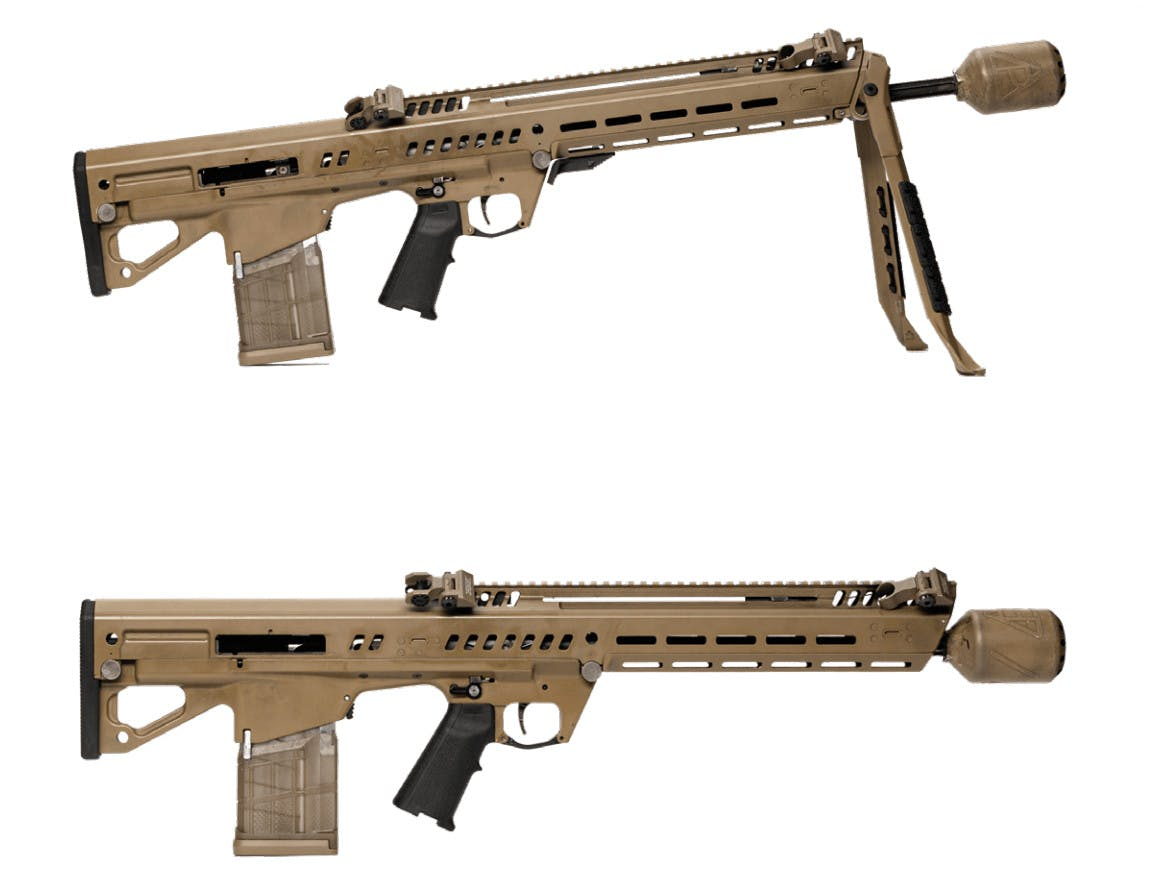
The “Extreme Defender” did very well. I thought it would, and had blogged on this in the past. The nose flute is designed, combined with the spinning bullet, to cause localized hydrostatic shock with velocities lower than that caused by bullet velocity alone would with a FMJ, whether pointed or flat nose (which is somewhere near 2200 FPS).
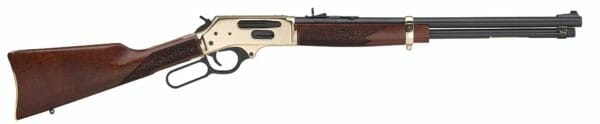
For now, available only in .35 Remington, .38-55 Winchester, and .30-30 Winchester.
I saw a comment from Matt Bracken a few days ago with which I agreed. There is a good argument for having a wheel gun and a lever gun in the same caliber (and I don’t have to point out that it has to do with ammunition compatibility, with the rifle round having a somewhat higher muzzle velocity than the revolver).
But for me to become interested, they’re going to have to expand the line to include other calibers, e.g., .44 magnum.
The famous command given to Revolutionary War soldiers at the Battle of Bunker Hill – “Don’t fire until you see the whites of their eyes” – resulted in forever identifying the musket credited with the first shot fired against British troops on that fateful day in June of 1775. John Simpson, a Private in the 1st New Hampshire Regiment, was court martialed for disobeying orders, successfully documenting the gun that fired the first shot in the historic battle. However, Simpson was lightly punished and went on to serve in the rest of the war with distinction.
The Revolutionary War musket belonged to John Simpson, a Private in the 1st New Hampshire Regiment who fought during the historic battle in Charlestown, Massachusetts on June 17, 1775.
As the British troops advanced, Simpson fired his weapon prematurely – disobeying the famous order given to American soldiers not to fire “until you see the white of their eyes”.
Having been passed down by Simpson’s descendents for almost 250 years, the historic weapon will now be offered for sale for the first time, and is expected to sell for up to $300,000.
“We have the privilege of auctioning a firearm that symbolizes one of the most important battles leading to American independence,” said Dan Morphy, President of Morphy Auctions.
“It will be exciting to see whether the Simpson musket ends up in a private or institutional collection.”
In the comments one person says that “The father of the soldier testified for its authenticity.” I do wonder about authenticity and traceability.
I think I would rather have a rifle used by one of Francis Marion’s men. On another front and probably easier to prove authenticity, I had forgotten that Singer made 1911s.
As for the 500 Singer 1911s, those handguns went to arming Army Air Force aircrews, and today are among the most desirable guns in the world of arms and armor collecting. The small number produced, their high quality, and the even smaller number of guns that survived the war make them extremely rare. In December 2017, a Singer 1911 sold at auction for an eye-popping $414,000, one of the highest prices ever paid at auction for a handgun.
Yep. I’ll take a couple with sequential serial numbers, please.

 6 years, 4 months ago