Continuing with the things we are progressively learning about the shooting in Aurora, Colorado, the shooter’s weapon jammed.
The semiautomatic assault rifle used by the gunman in a mass shooting at a midnight showing of the latest Batman movie jammed during the attack, a federal law enforcement official told The Associated Press, which forced the shooter to switch to another gun with less fire power.
The official, who spoke on condition of anonymity to in order to discuss the investigation, said the disabled weapon had a high-capacity ammunition magazine. Police have said that a 100-round drum magazine was recovered at the scene and that such a device would be able to fire 50 to 60 rounds a minute.
As I have pointed out, the rifle wasn’t an “assault rifle” (since it didn’t have selective fire capability) and the phrase “semiautomatic assault rifle” is nonsensical. It is a contradiction, since a semiautomatic rifle cannot be an assault rifle. The police and media are both to blame for sloppy work.
“… the most frequent choice for such shooters in order to achieve effectiveness seems not to rely on magazine capacity, but having multiple weapons and magazines.”
Unlike me, he had a crappy rifle and his jammed. He also had a high capacity magazine. It didn’t matter. He reverted to use of multiple weapons. It also won’t matter to the anti-gun lobby. They will continue to use this as yet another example of why high capacity magazines should be banned.
My readers know better, and you’re among the first to learn the right definitions, in the right context, the right way.
The Phoenix New Times reports on “assault rifles” found by hikers in the desert of Arizona, and the three weapons – two SKS’s and an AK-47 – according to the news report, “could have come from almost anywhere, considering the hundreds of gun stores in Arizona that sell such weapons.” The report is followed by another which again calls the guns “assault rifles.”
Northescambia.com reports that a man was charged with discharging an AK-47, later citing a witness who saw “what appeared to be a clip connected to an automatic weapon in a back passenger floorboard.” Without knowing any better, one would be tempted to think that rogue New Yorkers were running around with machine guns given this news report about a recent shooting in the Springfield Gardens area of Queens. It shows a picture of an AK-47 take from Wikipedia, with the following caption: “The AK-47 is a deadly assault rifle that can fire 10 rounds per second.”
Most main stream media reports concering “assault rifles” and “assault weapons” become badly confused, with terms conflated with other, and with competing (and oftentimes incorrect) terms. Thus does the Firearm Owners Protection Act of 1986 become important in our discussion. Among other things, this act banned the sale of machine guns manufactured after the date of enactment to civilians, inflating the cost of fully automatic weapons then in circulation to $10,000 or more (far beyond their actual worth). For most people, it is cost prohibitive to own a fully automatic weapon, and purchase of one requires registration and approval with the ATF and local law enforcement (oftentimes not granted).
Why is this important? The answer hinges on the technical, formal, official definition for “assault rifle.” The correct definition comes from the U.S. Military.
Assault rifles are short, compact, selective-fire weapons that fire a cartridge intermediate in power between submachinegun and rifle cartridges … Assault rifles have mild recoil characteristics and, because of this, are capable of delivering effective full-automatic fire at ranges up to 300 meters.
When understanding the phrase “assault rifle,” one needs to imagine U.S. Marine Corps squad rushes; the fire team member using the Squad Automatic Weapon fires area suppressing fire while the other three fire team members run forward. After a certain distance has been covered, the three Marines carrying the M4s or M16s go prone and lay down suppressing fire with their rifles (capable of selective fire) while the SAW gunner runs forward, goes prone, and then the rush continues in like manner until the enemy position has been assaulted and overrun.
So assault rifles have at least three characteristics: (1) capable of selective fire (which includes fully automatic fire), (2) fire an intermediate cartridge, and (3) mild recoil. My Rock Rivers Arms rifle has two of the three characteristics, and so it is not an assault rifle. The confused phrase “assault weapon” pertains to weapons that were banned and later allowed because of the sunset provision on September 13, 2004, and have to do with weapons that look scary because they have collapsible (or telescoping) stocks, forend grips, high capacity magazines, and so forth. The expiration of the assault weapons ban doesn’t have any affect on the continued ban on fully automatic weapons in the Firearm Owners Protection Act.
The phrases “assault rifle” and “assault weapon” (now a defunct and outdated definition) are used interchangeably in the main stream media, and sloppiness is to blame, even if firearms owners refer to their weapons as ARs (AR is shorthand for ARmalite). One humorous example refers to .50 caliber assault rifles, a contradiction in terms and an impossibility.
But not all media is as ignorant or reluctant to be precise as the dozens of examples I find daily. For one such report headlined with the phrase assault rifle, I contacted the author, Jessica Schrader, with the following note.
Jessica,
I am a gun rights and second amendment blogger. I strongly suspect that the use of an “assault rifle” is incorrect (to fully meet the definition of “assault rifle” it must be capable of select(ive) fire, which includes fully automatic fire). The phrase “assault weapon” is purely a political definition, and went out when the federal “assault weapons” ban … because of the sunset provision on September 13, 2004. It pertains mostly to weapons that look “scary,” not to fully automatic weapons.
I strongly suspect that the shooting was done with a semi-automatic rifle of some kind, of which there are 50 million plus in the U.S. Can you confirm that a semi-automatic rifle was used, or was it in actual fact a machine gun capable of fully automatic fire? The wording in the headline may have been a function of sloppy police department communications, so I am not attempting to place blame on anyone, just get to the facts.
To which she responded:
Thanks for your note. That is a good point- actually, in the follow up we published yesterday, police used the term semi-automatic. We will update the other one. Thanks again!
So even though the police are sometimes to blame for sloppy word usage, they occasionally get it right too. We may not ever win the battle, but words mean something, and it’s important to be precise. Jessica Schrader knows this and serves as an example for how the rest of the main stream media should cover the facts.
Much will be learned about the tragic shooting in Aurora, Colorado in the coming days. There will be ready-made diatribes, crafted for the ignorant, for the purpose of advocating increased gun control. But for those who do not choose to be ignorant (e.g., my readers), listen carefully.
“The gunman was armed with a rifle, a shotgun and two handguns …”
“… the most frequent choice for such shooters in order to achieve effectiveness seems not to rely on magazine capacity, but having multiple weapons and magazines.”
I do not know if the gunman had what would qualify as high capacity magazines. It likely doesn’t matter, because he had four weapons with him. So in the coming days when you hear more calls for banning high capacity magazines because of this event, remember that those calls are from people who don’t care about whether the facts comport with their agenda. They just don’t care.
As regular readers know, I am an advocate of open carry. I openly carry a firearm for several reasons, none of which is to “make a point.” I hate the feel of so-called “inside the waistband” carry, I hate sweating my weapon (especially in the summer), and my weapon simply hangs better if I use a good tactical holster and carry it on my side. My home state of North Carolina is an open carry state, and has no stop and identify statute. I have observed before that no one screams and runs for cover, and all of the boogeymen under the bed that people imagine when they think of open carry simply do not obtain. They aren’t real.
So as you can imagine, I couldn’t resist a chuckle when I read this paragraph in a commentary somewhat friendly to open carry.
If you do carry in an exposed manner, have you considered what would happen if someone snatched your pistol while you were distracted? Don’t give me that line about always being in condition yellow, or how you are never distracted. Everyone can be, and everyone is at various points throughout the day. You do your best, but your best ain’t perfect.
Sometimes, spotting a criminal is obvious. Many times it is not. Sometimes the person grabbing your gun isn’t a criminal at all, but that nice lady in the grocery store line behind you who just lost her job, found out her husband is cheating on her and thinks life is not worth living. She smiles at you, but she is thinking about death. If someone grabs that exposed gun, can you defend it?
Here in my home state, nice ladies don’t snatch guns out of holsters and go on rampages. Nonetheless, thinking about weapon retention is usually in order. What kind of holster do you have, how difficult would it be to unholster your weapon, and so forth.
But the notion about people going berserk and freaking out and spuriously going on killing sprees and rampages is just the monster in the closet. Give it some thought. If you suspect a monster of being in your closet, have your weapon ready, open the door, and if he’s not there, relax. Be prepared, but don’t be paranoid about it. Fearing monsters and boogeymen after you’ve already looked under the bed and in the closet is just being paranoid.
Capital Hill is under pressure to adopt the approaching U.N. arms treaty, from the New York Times, to Reuters, to confused and goofy Christians who forgot all about their theology and think that a new regulation, law or treaty will bring peace on earth and good will toward men.
We have been informed that this administration will not allow the U.N. to impose any restrictions on American’s gun rights. But then again, this is the same administration that: [1] Sent Donald Verrilli and Lanny Breuer to argue against Sean Masciandaro concerning the possession of firearms on National Park land, [2] Nominated Justice Sonia Sotomayor to the Supreme Court (who testified that Heller was settled law, and then dissented in McDonald versus Chicago, agreeing with Breyer who argued for overturning Heller), and [3] Named Rose Gottemoeller to head the U.S. delegation to the U.N. arms control negotiations, the very same Rose Gottemoeller who informed Moscow that the U.S. was open to significant compromise on U.S. missile defense.
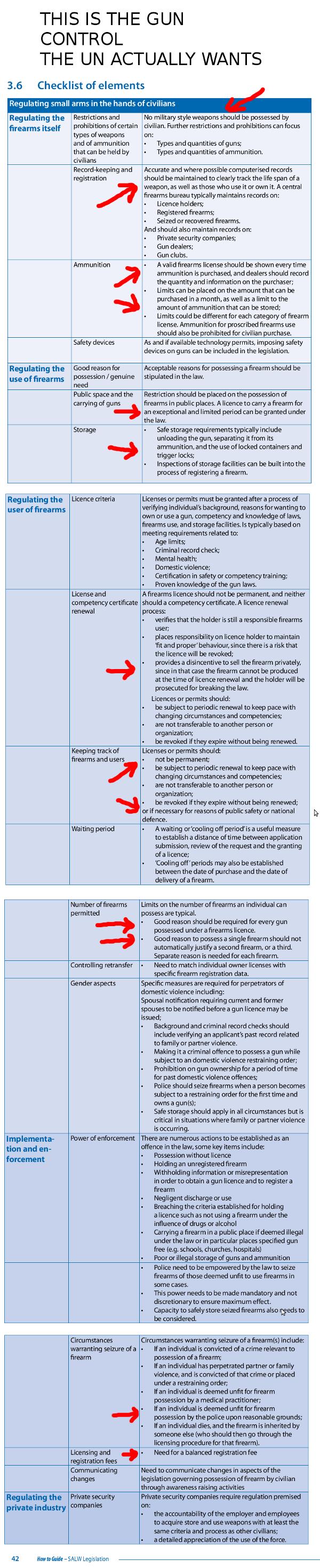
In fact, a short tour through the U.N. schemes shows that international tracing, combined with nationalized regulations and controls on the manufacture, transfer and sell of small arms, is the central feature of the plan. The U.N. program for implementation includes such requirements as no “military style” weapons should be possessed by civilians, a registered and traceable lifetime for every weapon, and so on. Courtesy of reddit/guns, here is a marked-up listing of the kinds of regulations envisioned by the U.N.
As we have discussed before, the distinction between civilian and military weapons is meaningless today, and wasn’t ever very useful. Bolt action rifles, semi-automatic rifles, tactical shotguns and a whole host of other kinds of weapons are being used in both civilian and military applications, and have been for a very long time. A U.N. distinction between civilian and military weapons would yield regulations more onerous than the assault weapons ban (sunset provision on September 13, 2004) ever could. A U.N. distinction between civilian and military owners achieves nothing beyond what the U.N. already wants, i.e., an international gun registry and lack of weapons transferability, and thus is this distinction a disingenuous subterfuge. Promises to exempt “civilians” – whatever that means – doesn’t make this treaty any less dangerous to firearms ownership in America.
Missives on why treaties do not obviate or supersede the constitution, while well intentioned and informative, miss the point entirely. Even in the wake of the Heller and McDonald rulings, there are still four justices on the Supreme Court who fundamentally do not believe in the second amendment, and then at least one who sees reversal of Heller on the horizon with a “future, wiser court.” Furthermore, the decisions in Heller and McDonald do not address issues such as a gun registry, further controls on transfer of weapons across state lines or even within states, or other meaningless and intrusive ATF regulations. There is a pregnant field of un-litigated second amendment issues in America, and the existence of an international treaty only complicates gun ownership. It isn’t obvious that any court, much less the Supreme Court, would find stipulations similar to the ones in the U.N. treaty to be unconstitutional.
Finally, take note that international luminaries such as Iran – known to supply weapons to insurgents in Afghanistan, Iraq and Syria – have been appointed to a post negotiating the treaty. The very real possibility exists that legitimate weapons sales from the U.S. to allies (such as Israel) would become problematic under the treaty. Taiwan, for instance, is concerned that the treaty could undercut weapons imports.
The silliness of the treaty and its effect on other nations is outlined fairly well by David Bosco at Foreign Policy (even if Bosco is willing to overlook its silliness).
There was a lot of talk at the session about the absurdity that sales of bananas are more regulated internationally than sales of assault rifles and about the need for more states to enact domestic legislation regulating arms transfers. The assembled activists did leaven their optimism with a dose of reality. They acknowledged that the treaty almost certainly would not contain any binding language or enforcement mechanisms. Instead, every country will determine for itself whether an arms sale or transfer is likely to contribute to human rights violations. (Under the ATT likely to emerge, Russia could report that it has duly considered whether arming Syrian forces would lead to violations and decided that it would not. Nobody would be able to gainsay the Kremlin, at least not through the treaty mechanism.) What’s more, the treaty negotiations will be conducted on a consensus basis (Washington insisted on that), which means that any state can block adoption of a text it doesn’t like.
So civilians in America would be subject to onerous new regulations since America is a law abiding nation, while rogue nations would be free to export weapons as they see fit. Or in other words, the criminals have the guns while the law abiding citizens are disarmed, sort of like gun control in America. As I have previously observed, the U.N. arms treaty is a solution in search of a problem.
Not only does this treaty intrude on the second amendment rights of American citizens, and not only is it hypocritical in its intent, it would target the very country who abides by its laws and allow the perpetrators justification for their own actions. The treaty is just one more progressive, micromanaging, over-controlling, statist solution to a problem that doesn’t exist. We’ve seen ten thousand like it, and as long as the U.N. gets funding and a home from the U.S. government, we will see many more instances of this kind of busy-body meddling into the affairs of American citizens.
Regardless of what kind of language is included in the treaty concerning military and civilian weapons, it does nothing to address the real problem of weapons traffickers such as Iran, and there is no reason to ratify it.
UPDATE: Thanks to David Codrea for the attention to this.
Oklahoma Governor Mary Fallin has just signed Senate bill 1733 into law allowing open carry in the state of Oklahoma. More specifically, Oklahoma is now a licensed open carry state.
The measure, Senate Bill 1733, allows those who are licensed to carry a firearm under the Oklahoma Self Defense Act to openly carry a weapon or conceal it.
It also allows a property owner to openly carry a handgun on his or her land. No concealed carry permit would be required.
To receive a license under the Oklahoma Self Defense Act, applicants must take a firearms safety and training course and submit to a background check by the Oklahoma State Bureau of Investigation. Those convicted of felonies and certain misdemeanors may not receive a handgun license.
The measure takes effect Nov. 1.
Oklahoma is the 25th state with either “permissive open carry” laws, or no permit required, or “licensed open carry,” which requires a permit. Oklahoma now joins Utah, North Dakota, Minnesota, Iowa, Indiana, Tennessee, Georgia, Mississippi, New Jersey, Connecticut, Rhode Island, Hawaii and Massachusetts as a “licensed open carry” state.
“As a strong supporter of the Second Amendment and a gun owner myself, I’m happy to sign this bill into law and grant law-abiding citizens the ability to openly carry firearms,” Fallin said. “Senate Bill 1733 sends a strong message that Oklahoma values the rights of its citizens to defend themselves, their family and their property. It does so in a responsible way, by requiring those citizens who choose to ‘open carry’ to undergo both firearms training and a background check.”
As I have discussed, I both conceal and open carry, and still prefer the way it is in my home state of North Carolina. I must have a concealed handgun permit to conceal, and open carry is legal without a permit (and we have no “stop and identify” statute). However, this qualifier to open carry in Oklahoma is minor, and doesn’t trouble me. In North Carolina as in every state, a background check is necessary for purchase of a gun anyway, and the only additional requirement to open carry in this case is the day-long class. Every gun owner should take such a class whether s/he carries or not.
As with those of us who already recognize these civil rights, Oklahomans will find that women and children don’t run in fear, screaming for their lives once they see a weapon. And the Charlotte-Mecklenburg Police smile and wave at me when they observe me. Your state won’t turn into the Wild, Wild West, and the only real requirement is that the Police departments be properly educated on the new law so that they can recognize these rights. On rare occasions, dispatchers might have to inform callers that it is legal to open carry.
So with those stipulations, Oklahoma is hereby welcomed to the club as a “free” state.
U.S. News is hosting a debate over open carry. First, Lindsay Nichols.
Private citizens should not be allowed to carry firearms openly in public. The open carrying of firearms on the street and in places like restaurants and parks intimidates the public, wastes law enforcement resources, and increases the risk that someone will be injured or killed from the accidental or intentional use of firearms. In response to these dangers and an aggressive “open carry movement” in California, in 2011 the California Legislature banned the open carrying of handguns. Other states should consider similar action.
When individuals openly carry firearms in public, other citizens may become concerned about impending crime and contact the police. In this way, the open carrying of firearms causes a waste of law enforcement resources, but more importantly, it threatens public safety.
How the risk of an inadvertent or accidental discharge is greater with open carry than concealed carry Ms. Nichols doesn’t say. Besides, the notion that it may be inconvenient for folk would not seem to be a promising line of argument before most courts. Whether something is legal would be the more important question. Not much there to see. On to Mr. Ralph Shortey.
The debate over how some may carry a firearm for protection can only be discussed when the foundation for the carry provisions has been fairly set. Most conceal and carry laws restrict a right that is guaranteed by the Constitution. To say that you may only carry a firearm if you have paid a certain amount of money to the government for a licensing fee and then submit to regulation would be equivalent to telling the press that they must abide by certain rules and pay for the right of free speech.
I recently had a debate with a friend who told me that everyone has the right to defend themselves and that gun control does nothing to infringe on that. The issue this brings up is a very simple one. If you are attacked by an unarmed assailant, and you are yourself unarmed, then for the most part you have the right to self-defense. However, if the assailant is armed or is otherwise stronger, bigger, or faster than you, then the government has guaranteed through regulation that you are not only unarmed but also an easy target. “The right to keep and bear arms shall not be infringed.” It seems like this should be easy enough to understand.
Let’s assume, however, that the carry provisions we are talking about are fair in their access to every citizen. The first question that must be answered is, “Why does the government think it has the right to tell a law-abiding citizen how they may go about protecting themselves?” Some may feel that the best way to defend yourself is by letting the criminals know that you are not an easy target. Most criminals look for the easiest and quickest route to their goal. There is nothing that will slow a criminal down faster than seeing a loaded gun at the ready.
And here, law abiding citizen is the key. Courts have upheld the idea that states have the right to examine the background of a would-be firearms owner to ensure that they are in fact law-abiding. McDonald versus Chicago seems to indicate that the requirements cannot be obstructionist, but must be the minimal regulations that accomplish the goal.
I’ve already discussed my own experiences with open carry. “I open carry, and as I have mentioned before, and women and children don’t run off screaming in fear, and the Charlotte-Mecklenburg Police, who are well-educated and comprehensively trained, simply wave and smile as they go past me while openly carrying my weapon. The issue has to do with bigotry and prejudice, not concocted or fabricated problems that it causes.”
I open carry because I simply hate IWB holsters and sweating my weapon like I do when I go outside in the summer with my weapon concealed. I am not trying to prove a point so much as I simply find it much more convenient to open carry than conceal carry. The people I’m around never seem to mind.
If people mind, it’s usually the police. Witness an open carry club in Missouri.
The only issue I have with this example is that, unfortunately in a very strange decision, the Supreme Court upheld the constitutionality of stop and identify statutes, and Missouri is a stop and identify state.
But the real issue doesn’t have anything to do with open or concealed carry. The real issue is that this debate is yet another subterfuge to the real aim of the anti-firearms extremists, i.e., the eradication of all firearms from the possession of law abiding people.
At National Review, Robert VerBruggen does a nice job of fisking Jill Lepore’s piece in The New Yorker on the history of the second amendment and gun control. I’ll leave it to Robert to supply you with the data on how firearms and the second amendment were seen and interpreted in early America. But the mistake I see with most second amendment detractors is that the claim that the right to firearms ownership resides with the states because of the word “militia” dismisses the context and thus miss the point.
The second amendment makes no sense whatsoever if individuals didn’t own firearms. The militias were made up of individuals who owned firearms and thus brought them to bear on issues of the state and oppressive authorities. The ubiquity of firearms in colonial America means that individual ownership was presupposed with the second amendment, even if not specifically addressed.
But as to the warp and woof of Lepore’s piece, all you need to know about it is this silly quote:
Inside, there’s a shop, a pistol range, a rifle range, a couple of classrooms, a locker room, and a place to clean your gun. The walls are painted police blue up to the wainscoting, and then white to the ceiling, which is painted black. It feels like a clubhouse, except, if you’ve never been to a gun shop before, that part feels not quite licit, like a porn shop.
Seriously? This passes for serious journalism these days? The best part of [VerBruggen’s] piece was the following comment: “The most shocking part of this article is that people still read the New Yorker.” Apparently, people still do. Lepore’s piece is breathlessly fawned over and pushed at The Daily Beast, The Atlantic Wire and other sites.
There seems to be no end to the articles, discussion threads and posts pointing to the fact that Obama has not issued any new firearms laws since his administration took over in Washington. This cynical post is but one more example. True enough, Romney, as I have pointed out, has a bad reputation with second amendment advocates like me. So when Romney recently addressed the NRA, it leaves the door open for charges of duplicity and – let’s go ahead and say it – flip flop.
Mitt Romney drew a warm reception from the National Rifle Assn. on Friday as he attacked President Obama for “employing every imaginable ruse and ploy” to restrict gun rights, which Romney pledged not to do if elected in November …
“In a second term, he would be unrestrained by the demands of re-election,” Romney told a crowd estimated at 6,000 in the cavernous Edward Jones Dome. “As he told the Russian president last month when he thought no one else was listening, after a re-election he’ll have a lot more, quote, ‘flexibility’ to do what he wants. I’m not exactly sure what he meant by that, but looking at his first three years, I have a very good idea.”
Referring specifically to the right to bear arms, Romney said: “If we are going to safeguard our 2nd Amendment, it is time to elect a president who will defend the rights President Obama ignores or minimizes. I will.”
But there is this:
Even before Romney’s speech, the Obama campaign hit back with a statement attacking the presumptive GOP nominee, along with a hefty file of news clippings intended to show that he had a checkered history on gun rights.
“The president’s record makes clear the he supports and respects the 2nd amendment, and we’ll fight back against any attempts to mislead voters,” said campaign press secretary Ben LaBolt. “Mitt Romney is going to have difficulty explaining why he quadrupled fees on gun owners in Massachusetts then lied about being a lifelong hunter in an act of shameless pandering. That varmint won’t hunt.”
Again, true enough. Romney has some explaining to do on the campaign trail. But understanding why Romney is speaking before the NRA and Obama is not requires only that one understand the people with whom Obama has surrounded himself. The President cannot pass laws, but the President can do two things that are unique to the office. He can appoint judges, and he can fill positions in the executive branch of government.
Forgetting for a moment scandals such as Fast and Furious, there are four individuals that define Obama’s views of firearms and the second amendment. First, let’s consider Supreme Court justice Sonia Sotomayor.
Perhaps the most startling aspect of the Supreme Court opinions in McDonald v. Chicago was the dissenters’ assault on District of Columbia v. Heller. Not only did Justice Stephen G. Breyer vote against extending the Second Amendment to state and local governments, he also argued forcefully and at length for overturning Heller and, therefore, for turning the Second Amendment into a practical nullity. Ominously, Justice Sonia Sotomayor joined the Breyer dissent – contradicting what she told the U.S. Senate and the American people last summer.
Regarding the key issue in McDonald – whether the 14th Amendment makes the Second Amendment enforceable against state and local governments – Justice Sotomayor resolutely refused to tell the senators how she might vote. So in voting against incorporating the Second Amendment, Justice Sotomayor was not inconsistent with what she had told the Senate. But regarding Heller, her actions as a justice broke her promises from last summer.
The Breyer-Sotomayor-Ruth Bader Ginsburg dissent urged that Heller be overruled and declared, “In sum, the Framers did not write the Second Amendment in order to protect a private right of armed self defense.”
Contrast that with her Senate testimony: “I understand the individual right fully that the Supreme Court recognized in Heller.” And, “I understand how important the right to bear arms is to many, many Americans” …
To the SenateJudiciary Committee, Justice Sotomayor repeatedly averred that Heller is “settled law.” The Associated Press reported that Sen. Mark Udall, Colorado Democrat, “said Sotomayor told him during a private meeting that she considers the 2008 ruling that struck down a Washington, D.C., handgun ban as settled law that would guide her decisions in future cases.”
Next, consider Obama’s nominee for head of the ATF, Andrew Traver. John Richardson does a good job of examining the larger aspects of the Traver nomination within the context of his history. But the single most telling thing about Andrew Traver is his work with the Joyce Foundation, and specifically, his positions in the report entitled Taking A Stand: Reducing Gun Violence In Our Communities. Among the other onerous regulations on firearms manufacturers and owners, they would require ballistic fingerprinting of all firearms, otherwise called “microstamping.” But the single most bracing position taken by this study group has to do with federal oversight of the firearms manufacturing industry.
Congress should enact legislation to allow federal health and safety oversight of the firearms industry.
Unlike other consumer products, domestically manufactured firearms are not subject to any design standards to reduce risk to the user or protect the safety of the general public and those sworn to protect them. Moreover, unlike other consumer products, no federal agency is empowered to require a remedy in the case of a defectively designed or manufactured firearm.
The lack of health and safety oversight is particularly worrisome given the manufacture and sale of firearms that pose a unique threat to law enforcement and the general public, such as high-caliber handguns that can penetrate bullet-resistant vests, anti-personnel military-style assault weapons and .50 caliber sniper rifles that can penetrate armor plating from a mile away.
This oversight and regulation would involve the Centers for Disease Control, ATF, Justice Department and other federal organizations. However controlling and oppressive this would be, the third example that should interest us involves Obama nominee for the D.C. Circuit Court of Appeals, Caitlin J. Halligan, who in her tenure as Solicitor General of the State of New York, attempted to hold firearms manufactures and retailers responsible for crimes committed with guns. In 2006, Halligan also filed a brief arguing that handgun manufacturers were guilty of creating a public nuisance. This caused an almost incredulous rejection by the New York Court of Appeals.
“The New York Court of Appeals has never recognized a common-law public nuisance cause of action based on allegations like those in this complaint. Moreover, other jurisdictions have dismissed public nuisance claims against firearms manufacturers on similar or other grounds… In light of the foregoing, we believe it is legally inappropriate, impractical and unrealistic to mandate that defendants undertake, and the courts enforce, unspecified measures urged by plaintiff in order to abate the conceded availability and criminal use of illegal handguns.” (People Of The State Of New York v. Sturm & Ruger Co., 309 A.D.2d 91, 2003).
Finally, there is the example of Eric Holder, who believes the following about firearms.
From rejection of the Supreme Court decision in Heller v. D.C., to advocacy for federal control over firearms manufacturers, to attempts to bankrupt firearms manufacturers with lawsuits, Obama’s friends have a storied and ugly history concerning their views on the second amendment.
The NRA knows full well Romney’s history on firearms and the second amendment. But the circumstances that give credibility to Obama’s promises to implement gun control “under the radar,” or explain the ATF’s rejection of the import of almost 800,000 M1 Carbines from South Korea aren’t speculative either. Obama is certainly aware of the anti-firearms positions of his appointments and nominees, for the contrary is simply impossible. And people in such positions can effect policy, regulations and legal decisions for a generation.
This is Obama’s intent – at least, there is no other explanation. To the NRA, Romney is a slightly to moderately uncomfortable ally. Because of his chosen company, Obama must be seen as the enemy.
UPDATE: Thanks to Glenn Reynolds for the attention.
H. Lee Sarokin, writing at Huffington Post,waxes emotional over the effects of gun violence in America, using the example of Trayvon Martin as the springboard. Rather, he wants you to wax emotional. The comments range from the delusional (e.g., more regulation would mean less gun violence), to the badly mistaken (people hunt with fully automatic weapons – can you imagine such a thing?). Sarokin himself mixes in some bad statistics, or allusion to things that statistics in fact do not prove, but the beginning paragraph is the best part of the commentary.
When innocent people are gunned down in schools or offices or when someone like George Zimmerman shoots and kills Trayvon Martin, how do members of the NRA and gun-advocates truly feel? I really want to understand. I think I understand the desire to have a gun for self-defense or sport. But when a gun owner sees statistics such as these, how do they react?
A tip to Crimeline has led to the arrests of two men in a brutal beating that occurred a week ago in the Midway community east of Sanford.
Julius Ricardo Bender, 18, and Yahaziel Isaac Israel, 19, face charges of attempted first-degree murder, burglary with assault or battery and armed burglary.
The victim, a 50-year-old Winter Springs man whose name has not been released, is on life-support at Orlando Regional Medical Center.
Deputies were called to the area of Lincoln Street and Beardall Avenue about 6:30 p.m. March 26 to investigate a report of a man being beaten, Seminole County Sheriff’s spokeswoman Heather Smith said.
They found the victim in the woods on the north side of Lincoln Street.
According to arrest affidavits:
A witness told deputies he heard someone screaming for help and saw two men pull the victim from his vehicle. He said he watched as one man held the victim and the other beat him in the head with a hammer.
After they dragged the victim into the woods, the men drove away in his sport utility vehicle, which was later found abandoned about a half-mile away on Garbo Jack Lane.
In order to obtain my concealed handgun permit, I had to give the Sheriff of Mecklenburg County permission to access all of my medical records. Any admisions to any hospital for substance abuse or mental health issues would have been reason to have denied my permit. I also had to have a background check and have many other records examined for the sake of public safety.
Given the easy availability of hammers – I can go to Home Depot, Lowes, or even Walmart and purchase a hammer with no background check whatsoever – I am calling for the increased regulation of carpentry tools. Given the outrage of hammers and the fact that anyone can purchase them just about anywhere, what reasonable person could oppose such a thing? And finally, studying these cases of beatings with hammers actually made me sick to my stomach. I want to know how everyone feels about all of these senseless acts of violence perpetrated with the weapon to which we commonly refer as hammer? How does it make you truly feel?
Emily Miller has documented quite a fiasco at The Washington Times concerning her attempt to legally procure a handgun in D.C., even after the Supreme Court Heller decision. The most recent direction to her from the D.C. police (concerning ammunition) was incorrect, as was their counsel concerning whether she could conceal or open carry her weapon into Virginia (I could give much better counsel). But even though the D.C. council recently voted to relax firearms regulations (a rare victory for gun owners in D.C.), the contumacious atmosphere in D.C. towards gun owners remains. Now, officials want D.C. residents simply to become victims.
But one doesn’t have to go all the way to D.C. to find such things. Recall Sheriff Wright in Spartanburg County, S.C., who after a sexual assault recommended that women obtain guns and concealed carry permits? Well, not all is well in Spartanburg politics.
In late October, Sheriff Chuck Wright, reacting to recent violent crime, told Spartanburg residents to arm themselves, but have those comments impacted crime rates?
Numbers provided by the sheriff’s office tell two different stories when it comes to crime trends.
For instance, from October 31, 2011 (when the sheriff urged people to get guns) through January 24, 2012, certain violent crimes spiked, while others stayed the same or even dropped, as compared to the same time period the year before.
From 10/31/2011 – 1/24/2012 there was one murder, 21 forcible rapes, 28 robberies, and 95 aggravated assaults (any assault where a weapon was used or where there was a serious injury).
A year earlier between 10/31/2010 – 1/24/2011 there were four murders, 21 forcible rapes, 42 robberies, but 66 aggravated assaults.
So after the sheriff’s comments, the murder rate decreased, the rape rate stayed the same, robberies decreased, but aggravated assaults spiked.
Whether the dramatic increase (450%) of concealed weapon permits since the sheriff’s comments played a role in those numbers, no one can be for sure, not even the sheriff.
“But I guarantee you there are fewer victims out there,” Wright said Wednesday.
But Wright has begun to receive criticism from other elected officials who say the sheriff is sending the wrong message.
“To continue to promote a climate in which we’re asking or even advocating for an increase in concealed weapons permits then you’re asking for an increase in weapons themselves,” said Spartanburg County Councilman Michael Brown.
Brown called the sheriff’s continued remarks “irresponsible” and said law enforcement should be the ones enforcing the laws.
Brown further said “I think it’s irresponsible, irreprehensible (sic) and of course incendiary if you keep on making these types of comments.”
Now, I’m fully capable of finding the first and second moments of a set of statistical data, as well as inferring conclusions from it. But to do this is the play the social engineer’s game. When they invoke groups of people and social affects rather than personal liberties and rights, they require something that even God Himself doesn’t require (Exodus 22:2). They require that you sacrifice your personal safety and security for the benefit of select interest groups.
Because this invades your personal rights and the security of your family in order to effect certain socially engineered ends (those ends themselves being in question), this is fundamentally an evil thing. It is redistribution from one segment of society to another, but this time on the most personal and valuable level imaginable. Your own life.

 14 years, 1 month ago