Articles by Glen Tschirgi


Glen is on the great Journey and sharing this stretch of the road with an amazing wife and four children. When forced to admit it, he earns his keep practicing civil litigation in Maryland through his own law office which allows him the flexibility to blog, coach football, play live music, write screenplays and take an interest in all sorts of extraneous matters.


The Great Decline of 2011

15 years, 3 months ago

After tracking the news swirling around the debt ceiling debate, it has been a challenge to remain upbeat about the prospects for America’s future.  But when I saw the Powerline blog write-up on a Wall Street Journal Online opinion piece (subscribers only) by Fred Fleitz about the CIA’s latest thinking about Iranian nuclear ambitions, the camel’s back officially broke.

If Fleitz is to be believed, the CIA and other intelligence agencies are prepared to issue another National Intelligence Estimate on Iran that, essentially, reaffirms the ridiculous (and politically motivated) finding that Iran suspended its nuclear weapons activities in 2003.

According to Fleitz, who has read the estimate, the American intelligence community stands by its collective assessment, first made in 2007, that Iran halted its nuclear weapons program in 2003 and has not restarted it since:

In February, the 17 agencies of the U.S. intelligence community issued a highly classified National Intelligence Estimate updating their 2007 assessment. That estimate had been politicized by several officials who feared how President George W. Bush might respond to a true account of the Iranian threat. It also was affected by the wave of risk aversion that has afflicted U.S. intelligence analysis since the 2003 Iraq War. Intelligence managers since then have discouraged provocative analytic conclusions, and any analysis that could be used to justify military action against rogue states like Iran.

I read the February 2011 Iran NIE while on the staff of the House Intelligence Committee. I believe it was poorly written and little improvement over the 2007 version.

Fleitz baldly states that, in pre-publication review of his column, the intelligence agencies censored his criticisms of the NIE analysis, including his serious concern that it manipulated intelligence evidence.

It is so patently ludicrous to conclude that Iran halted its nuclear weapons work in 2003 and has not resumed that work that I can only wonder whether Tehran is making deposits in the bank accounts of the intelligence officers.  No one who has paid any attention to the progress of the Iranian nuclear program can have any doubts about their intentions and substantial efforts to have a working nuclear weapon in short order.

Surveying the American landscape in 2011, we are a nation beset by “enemies without, enemies within.”   And we render ourselves defenseless to both.

We have a political party that refuses to stop spending hundreds of billions of dollars that we do not have regardless of the certain fiscal collapse approaching.   And we have an intelligence community that has completely lost its sense of direction, seeking to manipulate policy choices by elected leaders rather than giving an honest assessment of the threats facing our nation.

This cannot continue.   And it won’t for much longer.

How Democracy Crumbles: Implosion of the Jury System

15 years, 4 months ago

By now, almost everyone is aware of the controversial acquittal of Casey Anthony in Orlando, Florida.

Unlike many people (and despite being a lawyer by trade), I did not follow this case and I have been only casually following its results.

But there are two, critical points that need to be made and understood here.

First, in our system of criminal justice, the State must prove its case.  This is such a fundamental concept for the American system that it is almost embarrassing to mention.   Nonetheless, it seems that many people in the media and protesters outside of the courthouse have forgotten that all-important concept.   But this idea that the State must prove the guilt of the accused, and prove it beyond a “reasonable doubt” to a jury of peers is the key stone that protects us from arbitrary oppression by the State.  The Founding Fathers considered this an essential bulwark of liberty.   So when the jurors in the Casey Anthony case explain that they could not convict Ms. Anthony because the State had not proven the allegations, that is an extremely serious charge and one that indicates that the system is working.

The fact that the public perceives that “justice” was not carried out illustrates: (A) that the public is never shy about condemning people without all the facts that were available to the jury, and; (B) that the public has lost sight of this key responsibility of the State to prove its case.   As Americans, we must accept that there will be cases where, for whatever reason, the State cannot meet its burden to prove guilt and a criminal may escape punishment for a crime committed.   That is the serious price of liberty, however, and until someone devises a better method to protect us from the oppressive force of the State, we run a grave risk when we undercut that protection by demanding the condemnation of persons that the State could not prove were guilty.

Which brings me to my second point, as illustrated by this article in The Daily Mail.

A juror in the Casey Anthony trial has told how she received death threats and has been unable to work since she was cleared of murder.

The woman, known only as juror number 12 left her job and went into hiding fearing co-workers would ‘want her head on a platter’.

Her husband said before leaving she told him: ‘I’d rather go to jail than sit on a jury like this again.’

And this:

One, Jennifer Ford, 32, said there was not evidence to convict the 25-year-old mother.

She said: ‘I did not say she was innocent, I just said there was not enough evidence.

‘If you cannot prove what the crime was, you cannot determine what the punishment should be.’

The nursing student told ABC news: ”Everyone wonders why we didn’t speak to the media right away.

‘It was because we were sick to our stomach to get that verdict.

Another, Russell Huekler said the jury only saw evidence that Anthony was a good mother.

He said: ‘‘The first number of witnesses were Casey’s friend and every time that they said they saw Casey with Caylee, it was a loving relationship and no one provided evidence to the contrary.’

When we reach the point that jurors cannot serve without fearing for their lives if they dare to hold the State accountable for proving guilt, the jury system collapses.  At that point, jurors compelled to serve will become little better than rubber-stamps for the State, voting to convict out of fear of mob violence and the complete disruption of their lives.   And when the State can count on guilty verdicts, no matter how sloppy or non-existent the evidence, the door is wide open to tyranny.   And, lest anyone think that tyranny cannot happen in these United States, just look at the Fast and Furious/Gunwalker scandal for a sample of government run amok.

The Hard Lessons Keep Coming: Iran’s Leap in Missile Technology

15 years, 4 months ago

The only thing worse than being wrong about something of great importance is being right about something of great importance and not being able to crow about it because the reality is so awful.

So when conservatives warned that Obama’s naive policy of the “open hand” of diplomacy to the mad mullahs of Iran was a quick path to a nuclear Iran, there is absolutely no joy in seeing these predictions take place before our very eyes.

First there was the news some weeks ago which we covered in the post, “Game Over.” That post dealt with the estimation of an Iranian nuke perhaps as soon as this Fall.

Those in denial insisted that Iran was still at least one year or more away from developing its own nuclear weapon and that Iran could not field even a missile of 2000 km range until 2015 at the earliest.

Now comes the news via Newsmax and Ken Timmerman that the Iranians have successfully tested three, different missile technologies, two of which appear to directly relate to nuclear weaponization.

Iran has made dramatic progress in its ballistic missile programs over the past year, unveiling three new missiles it claims are already in production, including an innovative design that could be a “game-changer” if used against U.S. aircraft carriers, an Israeli expert widely considered one of the world’s top authorities on Iranian missile programs says.

Also significant were three unannounced tests of longer-range missiles most experts believe were designed to carry a nuclear warhead.

The longer-range missiles are the Shahab-3 and the Sejiel-2.   The Shahab-3, modified, can strike up to 1600 km away, more than enough to hit major U.S. military bases in the region as well as Israel.   The Sejiel-2 is a solid-fuel rocket that has a 2,000 km range.  These missiles were tested several times, secretly, which is odd behavior for the regime:

In the past, Iran has announced all of its missile tests, often with great fanfare, even when they were a failure, said Uzi Rubin, the father of Israel’s “Arrow” anti-missile program.

One of the unannounced missile tests involved a variant of the Shahab-3, which has been successfully test-fired many times since it was first flown in 1998 and is now in active deployment with Revolutionary Guards Air Force units.

Because the missile has been tested successfully so many times, Rubin believes failure was not why the longer-range missile tests were kept quiet. “I believe it was policy,” he told a breakfast meeting on Capitol Hill hosted by the National Defense University Foundation.

The latest United Nations Security Council resolution imposing sanctions on Iran, which passed in June 2010, expressly forbids Iran from conducting tests of “nuclear-capable” missiles.

“The fact that Iran did not disclose those tests is tantamount to admitting they were of nuclear-capable missiles,” Rubin said.

In October 2010, Iran carried out an unannounced test of its Sejil-2 missile, sometimes known as the “Ashura.” The Sejil is a solid propellant missile with a range of approximately 2,000 kilometers (1,200 miles) that was first flown successfully in November 2008.

So the despots of Iran are taking enormous pains to have at least two, reliable missile systems ready that, by all accounts, can carry a nuclear warhead.  Not only that, the despots now have missiles (although not, presumably, in any great quantity as yet) that can directly threaten large parts of Europe.

The map below, while outdated, nonetheless shows the effective coverage of a 2,000 km-range missile based in Iran.

Funny.  That missile defense system that the U.S. had promised to provide to eastern European allies like Poland and the Czech Republic would have come in handy.  Too bad Obama caved in to the Russians and decided that Iranian missiles posed no threat to Europe.

Or as Timmerman puts it:

Both China and Russia are believed to have intervened with the U.N. Security Council to suppress the report by the U.N. experts panel investigating violations of U.N. Security Council sanctions on Iran.

Uzi Rubin believes the Obama administration has abstained from revealing Iran’s recent long-range missile tests “in support of Russia’s claim that Iran cannot threaten Europe.”

The lack of an Iranian missile threat was a key justification used by the Obama White House to cancel plans in early 2009 to deploy missile-defense radar and ground-based interceptors in Poland and the Czech Republic.

Cancelling U.S.-made missile defense in Europe was a major demand of the Russian government, and was touted by Secretary of State Hillary Clinton as a key factor in her “reset” of U.S.-Russian relations.

Rubin also speculated that the Obama administration “wants to say that sanctions are working, so if they say that Iran’s missile tests have been successful, they wouldn’t look too good.”

But not to worry.  According to the story and headline in The Washington Post on this subject, a “senior” Revolutionary Guard commander promised that Iran won’t manufacture missiles with ranges beyond 2,000 km.

Growing up, I had an almost morbid fascination with the time period between the end of World War I and the beginning of World War II.  I could never understand how Great Britain, France and the U.S. allowed Germany to violate the clear terms of the armistice by re-arming, taking control of the Rhineland and stoking again the fires of militarism.  Hitler and the Nazis seemed like such an obvious threat.  How could the victors of World War I put their collective heads in the sand to such an absurd degree?

Now I am beginning to understand.

No one seems to be paying any, real attention to the steady, remorseless march of the Mad Mullahs to deploy nuclear weapons.  We hear nothing from the President– of course not, that would serve only to point out his international fecklessness even further.  We hear nothing from the Government Media outlets like the New York Times or Washington Post, except a dry note on a back page.  There is no worry.  No reaction.   No sense of crisis.  Indeed, from my recollection of the last Republican debate, not a single candidate mentioned the threat of Iran.  We have time for Libya and Egypt and Syria and even a tiny, terrorist outpost called Gaza, but the real menace to peace in the 21st century is completely ignored.   Worse yet, there are serious political leaders, people aspiring to the presidency, who are openly calling for defense cuts and a pared down military capability.

Another hard lesson learned that will cost us dearly in the near future.

Mark Steyn and the Perfect Summary of 21st Century American Frustration

15 years, 4 months ago

For anyone who is not acquainted with the work of Mark Steyn, you have an awful lot of catching up to do on a treasure trove of witty, insightful and provocative reading.

I have been a huge fan of Steyn for years but this piece, originally appearing in National Review, is, perhaps, his best, at least in regards to the current predicament of America in the 21st Century.

What predicament?

For any American who is knowledgeable about the extraordinary capabilities of the U.S. military, it is a constant source of frustration to contemplate the consistently mediocre results we get from employing those forces.   It is a classic case of underpeformance.   It is like, well, the Miami Heat:  stocked with arguably the NBA’s best talent, they cannot manage to roll over the Dallas Mavericks in the recent NBA championship series.    This was the team that was supposed to dominate like the Chicago Bulls of the Michael Jordan era.

But, to be fair to the Miami Heat, this is a poor analogy.   A more accurate one would be to imagine the College Football National Champion Auburn Tigers going up against the Rec League, Ellicott City Patriots B-Team.  Comprised of 11-year olds.   That’s how stark the difference is between the U.S. military and the kind of adversaries we have been going up against since the end of World War II.  When the Auburn Tigers can’t seem to put away the Patriots’ B-Team and it is dragging into overtime and a possible tie-game, the Auburn fans are understandably frustrated.

Or as Steyn puts it:

Why can’t America win wars? It’s been two-thirds of a century since we saw (as President Obama vividly put it) “Emperor Hirohito coming down and signing a surrender to MacArthur.” And, if that’s not quite how you remember it, forget the formal guest list, forget the long-form surrender certificate, and try to think of “winning” in a more basic sense.

After summarizing Iraq, Afghanistan and Libya, he remarks:

According to partisan taste, one can blame the trio of current morasses on Bush or Obama, but in the bigger picture they’re part of a pattern of behavior that predates either man, stretching back through non-victories great and small — Somalia, Gulf War One, Vietnam, Korea. On the more conclusive side of the ledger, we have . . . well, lemme see: Grenada, 1983. And, given that that was a bit of post-colonial housekeeping Britain should have taken care of but declined to, one could argue that even that lone bright spot supports a broader narrative of Western enfeeblement. At any rate, America’s only unambiguous military triumph since 1945 is a small Caribbean island with Queen Elizabeth II as head of state. For 43 percent of global military expenditure, that’s not much bang for the buck.

Inconclusive interventionism has consequences. Korea led to Norks with nukes. The downed helicopters in the Iranian desert led to mullahs with nukes. Gulf War One led to Gulf War Two. Somalia led to 9/11. Vietnam led to everything, in the sense that its trauma penetrated so deep into the American psyche that it corroded the ability to think clearly about war as a tool of national purpose.

Steyn exactly identifies the source of the problem.   It is not that our military is incapable of decisive victory, the problem lies with our national leadership.  To return to the sports analogy, it is as if the Auburn coaches decided that it would not look good to grind those 11-year olds into the dirt, so the Tigers go to unbelievable lengths to not win but not lose either. That may be fine when it is simply a game of  football, but when it involves a deadly contest where Americans are being killed or maimed, handicapping yourself in such a way is criminal.   Or as Steyn puts it:

But in the nuclear age, all-out war — war with real nations, with serious militaries — was too terrible to contemplate, so even in proxy squabbles in Third World backwaters the overriding concern was to tamp things down, even at the price of victory. And, by the time the Cold War ended, such thinking had become ingrained. A U.S.–Soviet nuclear standoff of mutual deterrence decayed into a unipolar world of U.S. auto-deterrence. Were it not for the brave passengers of Flight 93 and the vagaries of the Oval Office social calendar, the fourth plane on 9/11 might have succeeded in hitting the White House, decapitating the regime, leaving a smoking ruin in the heart of the capital and delivering the republic unto a Robert C. Byrd administration or some other whimsy of presidential succession. Yet, in allowing his toxic backwater to be used as the launch pad for the deadliest foreign assault on the U.S. mainland in two centuries, Mullah Omar either discounted the possibility of total devastating destruction against his country, or didn’t care.

If it was the former, he was surely right. After the battle of Omdurman, Hilaire Belloc offered a pithy summation of technological advantage:

Whatever happens
We have got
The Maxim gun
And they have not.

But suppose they know you’ll never use the Maxim gun? At a certain level, credible deterrence depends on a credible enemy. The Soviet Union disintegrated, but the surviving superpower’s instinct to de-escalate intensified: In Kirkuk as in Kandahar, every Lilliputian warlord quickly grasped that you could provoke the infidel Gulliver with relative impunity. Mutually Assured Destruction had curdled into Massively Applied Desultoriness.

Here I part company somewhat from my National Review colleagues who are concerned about inevitable cuts to the defense budget. Clearly, if one nation is responsible for near half the world’s military budget, a lot of others aren’t pulling their weight. The Pentagon outspends the Chinese, British, French, Russian, Japanese, German, Saudi, Indian, Italian, South Korean, Brazilian, Canadian, Australian, Spanish, Turkish, and Israeli militaries combined. So why doesn’t it feel like that?

Well, for exactly that reason: If you outspend every serious rival combined, you’re obviously something other than the soldiery of a conventional nation state. But what exactly? In the Nineties, the French liked to complain that “globalization” was a euphemism for “Americanization.” But one can just as easily invert the formulation: “Americanization” is a euphemism for “globalization,” in which the geopolitical sugar daddy is so busy picking up the tab for the global order he loses all sense of national interest. Just as Hollywood now makes films for the world, so the Pentagon now makes war for the world. Readers will be wearily familiar with the tendency of long-established pop-culture icons to go all transnational on us: Only the other week Superman took to the podium of the U.N. to renounce his U.S. citizenship on the grounds that “truth, justice, and the American way” no longer does it for him. My favorite in recent years was the attempted reinvention of good ol’ G.I. Joe as a Brussels-based multilateral acronym — the Global Integrated Joint Operating Entity. I believe they’re running the Libyan operation.

This is it precisely.   The U.S. has, for whatever reason, decided that winning is unacceptable.  This is Barack Obama in the 2008 campaign stating that he does not like to use the word victory.   For all practical purposes, the U.S. has unilaterally disarmed.  Sure, we still have all those weapons and sophisticated arsenals of death lying around, and we may parade them about and fly them over the heads of Taliban fighters to try to put a good scare into them, but we have decided that actually using those weapons in the way that they were designed to be used, in the national interest of the U.S., is unacceptable.

Instead, Steyn points out, the U.S. has given in to what he terms, “Transnational do-gooding.”

Transnational do-gooding is political correctness on tour. It takes the relativist assumptions of the multiculti varsity and applies them geopolitically: The white man’s burden meets liberal guilt. No wealthy developed nation should have a national interest, because a national interest is a selfish interest. Afghanistan started out selfishly — a daringly original military campaign, brilliantly executed, to remove your enemies from power and kill as many of the bad guys as possible. Then America sobered up and gradually brought a freakish exception into compliance with the rule. In Libya as in Kosovo, war is legitimate only if you have no conceivable national interest in whatever conflict you’re fighting. The fact that you have no stake in it justifies your getting into it. The principal rationale is that there’s no rationale, and who could object to that? Applied globally, political correctness obliges us to forswear sovereignty. And, once you do that, then, as Country Joe and the Fish famously enquired, it’s one-two-three, what are we fighting for?

When you’re responsible for half the planet’s military spending, and 80 percent of its military R&D, certain things can be said with confidence: No one is going to get into a nuclear war with the United States, or a large-scale tank battle, or even a dogfight. You’re the Microsoft, the Standard Oil of conventional warfare: Were they interested in competing in this field, second-tier military powers would probably have filed an antitrust suit with the Department of Justice by now. When you’re the only guy in town with a tennis racket, don’t be surprised if no one wants to join you on center court — or that provocateurs look for other fields on which to play. In the early stages of this century’s wars, IEDs were detonated by cell phones and even garage-door openers. So the Pentagon jammed them. The enemy downgraded to more primitive detonators: You can’t jam string. Last year, it was reported that the Taliban had developed metal-free IEDs, which made them all but undetectable: Instead of two hacksaw blades and artillery shells, they began using graphite blades and ammonium nitrate. If you’ve got uniformed infantrymen and tanks and battleships and jet fighters, you’re too weak to take on the hyperpower. But, if you’ve got illiterate goatherds with string and hacksaws and fertilizer, you can tie him down for a decade. An IED is an “improvised” explosive device. Can we still improvise? Or does the planet’s most lavishly funded military assume it has the luxury of declining to adapt to the world it’s living in?

In the spring of 2003, on the deserted highway between the Jordanian border and the town of Rutba, I came across my first burnt-out Iraqi tank — a charred wreck shoved over to the shoulder. I parked, walked around it, and pondered the fate of the men inside. It seemed somehow pathetic that, facing invasion by the United States, these Iraqi conscripts had even bothered to climb in and point the thing to wherever they were heading when death rained down from the stars, or Diego Garcia, or Missouri. Yet even then I remembered the words of the great strategist of armored warfare, Basil Liddell Hart: “The destruction of the enemy’s armed forces is but a means — and not necessarily an inevitable or infallible one — to the attainment of the real objective.” The object of war, wrote Liddell Hart, is not to destroy the enemy’s tanks but to destroy his will.

Instead, America has fallen for the Thomas Friedman thesis, promulgated by the New York Times’ great thinker in January 2002: “For all the talk about the vaunted Afghan fighters, this was a war between the Jetsons and the Flintstones — and the Jetsons won and the Flintstones know it.”

But they didn’t. They didn’t know they were beaten. Because they weren’t. Because we hadn’t destroyed their will — as we did to the Germans and Japanese two-thirds of a century ago, and as we surely would not do if we were fighting World War II today. That’s not an argument for nuking or carpet bombing, so much as for cool clear-sightedness. Asked how he would react if the British army invaded Germany, Bismarck said he would dispatch the local police force to arrest them: a clever Teuton sneer at the modest size of Her Britannic Majesty’s forces. But that’s the point: The British accomplished much with little; at the height of empire, an insignificant number of Anglo-Celts controlled the entire Indian subcontinent. A confident culture can dominate far larger numbers of people, as England did for much of modern history. By contrast, in an era of Massively Applied Desultoriness, we spend a fortune going to war with one hand tied behind our back. The Forty-Three Percent Global Operating Industrial Military Complex isn’t too big to fail, but it is perhaps too big to win — as our enemies understand.

So on we stagger, with Cold War institutions, transnational sensibilities, politically correct solicitousness, fraudulent preening pseudo–nation building, expensive gizmos, little will, and no war aims . . . but real American lives. “These Colors Don’t Run,” says the T-shirt. But, bereft of national purpose, they bleed away to a grey blur on a distant horizon. Sixty-six years after V-J Day, the American way of war needs top-to-toe reinvention.

The worst news, however, is that we are such a divided nation in our sense of national purpose that I do not see any way that “the American way of war” will get anything like a “reinvention” as Steyn prescribes.   The American people are living in a fantasy world where we can continue to lavish entitlement spending on ourselves (and heap more on top of that with Obamacare) while contemplating a substantially reduced military, as if evil does not exist and America will never be threatened (and anyone who raises that specter is simply trying to scare the public for the benefit of the military-industrial complex).

But we know how these things end.    The Dot Com Bubble was created by the fantasy that internet companies with no revenues were, nonetheless, worth ridiculous share prices.   That Bubble burst.    The Housing Bubble grew from the fantasy that trillions of dollars could be lent to persons with bad credit and little prospect for repayment.   That Bubble burst.    The current fantasy about the nature of the world and America’s invulnerability will end, too.   And when it does we will finally regain the will to win.   I pray that we will still have the means.

When It Comes to Pakistan, We Just Can’t Handle the Truth

15 years, 5 months ago

Here is yet another example of the now infamous double-game being played by Pakistan, our so-called ally in the war against Islamic fundamentalism:

Twice in the last few weeks, US intelligence officials have provided the Pakistanis with the coordinates of bomb factories in the rugged tribal region of Waziristan, on the Afghan border — only to see the info leak to the enemy, who evacuated the sites before the Pakistani military arrived.

***

Incoming Defense Secretary Leon Panetta arrived in Pakistan Friday to discuss “rebuilding” the Pakistan-US relationship, and reportedly confronted his hosts with the evidence that they’d tipped off the Taliban about the bomb sites.

This is just getting tiresome beyond words.

Is it even worth keeping score any longer?  Why does the U.S. continue to allow the Pakistanis to get away with this kind of thing?

There is only one reason I can find: we just can’t face the consequences of putting the screws to Pakistan.

The Obama Administration is afraid that even a hint or threat of even reduced aid will push the Pakistanis over the edge and into the arms of the Islamofascists.   Which is to say that Pakistan would openly embrace the terrorists rather than just discreetly.

As the Captain pointed out years ago, if the U.S. had any strategic sense, it would have developed alternative logistical routes to Afghanistan that did not depend upon Pakistan.   As it is, we are precariously reliant upon the Pakistanis keeping the land route open for the bulk of supplies coming into Afghanistan.

Other than having to find a new route to keep the campaign supplied, the other consequence of denying aid to Pakistan would be the loss of what little presence Pakistan still allows to CIA operatives who help to track down and target terrorists inside Pakistan.  Is this limited capability so vitally important that we are willing to fund a government that actively works against us as much as it does with us?  Given the increasing restrictions placed on operations within Pakistan, it is doubtful that the gains at this point are worth the losses.   Would a drone strike from a CIA base in Pakistan really have much of an effect on the Afghan Campaign?   If the death of Bin Laden made no impact, what would?

Then there is the benefit of clarity.   Having Pakistan as a declared enemy in the Afghan Campaign would certainly not be welcome, but at least the U.S. could take actions in the porous border areas that it cannot with an “ally” that acts like an enemy.   Clarity can be a wonderful thing.   Ambiguity in this regard has left us in strategic knots, knowing where the Taliban are getting re-supplied and trained but unable to effectively do anything about it.

Finally, the U.S. may have far more to gain by cutting Pakistan loose and allying closely with India.  As it is, the U.S. must temper its cooperation and policies with India due to Pakistani sensitivities.   If Pakistan is determined to act like a rogue state, then the U.S. is far better off developing closer ties to India, not only in regard to Afghanistan (where India could become a major player and partner) but also as a strategic counterweight to China and Russia.

It is high time for Pakistan to decide whether it belongs to civilization or to the barbarians.  By the same token, it is high time that the U.S. faced up to the hard truth:  Pakistan, for whatever reason, is not willing to remove the terror bases from their territory and must be treated accordingly.

Gates Indicts NATO While U.S. Stands in the Dock

15 years, 5 months ago

A fascinating speech by outgoing Secretary of Defense, Robert Gates, on June 10 in Berlin at the Security and Defense Agenda think tank.

From this AP article:

BRUSSELS (AP) – America’s military alliance with Europe – the cornerstone of U.S. security policy for six decades – faces a “dim, if not dismal” future, U.S. Defense Secretary Robert Gates said Friday in a blunt valedictory address.

In his final policy speech as Pentagon chief, Gates questioned the viability of NATO, saying its members’ penny-pinching and lack of political will could hasten the end of U.S. support. The North Atlantic Treaty Organization was formed in 1949 as a U.S.-led bulwark against Soviet aggression, but in the post-Cold War era it has struggled to find a purpose.

“Future U.S. political leaders – those for whom the Cold War was not the formative experience that it was for me – may not consider the return on America’s investment in NATO worth the cost,” he told a European think tank on the final day of an 11-day overseas journey.

The Washington Post summarized it this way:

BERLIN — Defense Secretary Robert M. Gates rebuked some of America’s staunchest allies Friday, saying the United States has a “dwindling appetite” to serve as the heavyweight partner in the military order that has underpinned the U.S. relationship with Europe since the end of World War II.

In an unusually stinging speech, made on his valedictory visit to Europe before he retires at the end of the month, Gates condemned European defense cuts and said the United States is tired of engaging in combat missions for those who “don’t want to share the risks and the costs.”

“The blunt reality is that there will be dwindling appetite and patience in the U.S. Congress, and in the American body politic writ large, to expend increasingly precious funds on behalf of nations that are apparently unwilling to devote the necessary resources … to be serious and capable partners in their own defense,” he said in an address to a think tank in Brussels.

There are several points worth noting in Gates’ speech. The most obvious one is aptly noted in both articles: European members of NATO have been starving their defense budgets for years and it is finally becoming painfully, no, embarrassingly clear to everyone by the Afghanistan and Libya campaigns. The AP story notes the contrast between the “mightiest military alliance in history” and the patent failure of this alliance to bring about any kind of victory against a third-rate, tin-pot dictator in Libya:

To illustrate his concerns about Europe’s lack of appetite for defense, Gates noted the difficulty NATO has encountered in carrying out an air campaign in Libya.

“The mightiest military alliance in history is only 11 weeks into an operation against a poorly armed regime in a sparsely populated country, yet many allies are beginning to run short of munitions, requiring the U.S., once more, to make up the difference,” he said.

Is it any wonder that the Taliban have adopted a strategy of attrition? The only, credible military force in the field seems to be the U.S., the Canadians and the British and the latter, two have already indicated that they will be pulling out of Afghanistan entirely in the near future.

Add to this the assessment by Gates that, while all NATO member countries voted in favor of intervention in Libya, fewer than half those members have made any contribution toward the effort.

On a political level, the problem of alliance purpose in Libya is even more troubling, he said.

“While every alliance member voted for the Libya mission, less than half have participated, and fewer than a third have been willing to participate in the strike mission,” he said. “Frankly, many of those allies sitting on the sidelines do so not because they do not want to participate, but simply because they can’t. The military capabilities simply aren’t there.”

Afghanistan is another example of NATO falling short despite a determined effort, Gates said.

He recalled the history of NATO’s involvement in the Afghan war – and the mistaken impression some allied governments held of what it would require of them.

“I suspect many allies assumed that the mission would be primarily peacekeeping, reconstruction and development assistance – more akin to the Balkans,” he said, referring to NATO peacekeeping efforts there since the late 1990s. “Instead, NATO found itself in a tough fight against a determined and resurgent Taliban returning in force from its sanctuaries in Pakistan.”

So, to sum up what we have learned from Secretary Gates, the chasm between the military and political capabilities of the U.S. and its NATO allies has become so large that, for all practical purposes, NATO has become a toothless organization that cannot even fight a meager enemy like Qaddafi for any length of time without substantial help from the U.S. and cannot be counted on to supply meaningful levels of troops in hot zones like Afghanistan. And despite the strong punch delivered by Gates, at least some in Europe, according to The Washington Post are glad that it is being delivered:

[Jonathan]Eyal, of London’s Royal United Services Institute, said the speech would be “very welcome” in Britain and France, however, because “privately this is what officials have articulated for years.” Gates “identified the key problem, which remains Germany,” he said. “You can argue that there are many countries that do not contribute their fair share, but most of the others don’t matter, and smaller ones would likely fall into line if Germany did.”

Eyal said: “It’s a shame politicians say what they think only when they are about to depart, but the Europeans needed this cold shower, and if it’s up to Gates to administer it, so be it.”

The speech amounted to “an outburst of frustration that is bigger than bottom line of defense cuts,” he said. “It’s about the lethargic way the Europeans walk on the world stage,” lacking a sense of urgency and thinking that “at the end of the day the Americans will always be there and do Europe’s bidding.”

But the speech “hasn’t caused a great rift,” Eyal said. “Deep down, there is no one in Europe that doesn’t think that what Gates said is absolutely the truth. No one argues he’s exaggerating problem. It’s not a rift. It’s worse. It’s an act of indifference.” The missing reaction in Europe, he said, is to reconsider burden-sharing and “how the Europeans can contribute more to the common pot.”

All this is very well and needed to be said. But I cannot help but speculate that perhaps Gates had more than just the Europeans in mind when he made these statements.

Could it be that Gates was placing a shot across the bow of those in the U.S. (both in and outside of the Obama Administration) calling for reductions in U.S. military spending? Looking at Gates’ remarks as a rebuke to U.S. policymakers makes equal sense.

How did Europe become so militarily defenseless? It happened as an irresistible, default choice when European capitals opted for heavy social spending at a time of declining birthrates and economic productivity.

This is the very same choice that is facing the U.S. today. The U.S. Congress is at this very moment locked in a bitter struggle against an inescapable reality: there is simply not enough money coming into the U.S. Treasury to fund the present, enormous welfare entitlements and a robust military. The decision must be made and it must be made now to either gut our military or seriously reform the welfare state as we know it. In all likelihood, given the rate at which the budget deficit is growing (due in large part to a terrible compromise on the 2011 Budget and less-than-expected revenues from a stalling economy), the markets and foreign lenders will not be content to wait until the 2012 elections for a responsible plan to control the deficit.

So, whatever satisfaction we get, whatever approval we may have for Secretary Gates’ jabs at NATO members for their pathetic military budgets, the U.S. seems to be taking the very same road as Europe. There are already too many in Congress and in the political class class who gladly concede that the Defense budget should be subjected to deep cuts in order to preserve our welfare state. Here is a typical example from Rep. Barney Frank and Rep. Ron Paul. While this is expected from Democrats, even “conservatives” have been making similar noises. See this piece on Haley Barbour for example.

This is not to say that any cuts to the Defense budget are out of the question. The Captain’s Journal has long advocated smarter spending, as with the proposed, new landing craft for the Marines. Savings can certainly be found in better management and prioritizing. In light of Gates’ speech, it is worth re-examining the costs of keeping troops stationed in Europe versus the benefits of having troops pre-deployed close to the Middle East and to Russia. But, in the end, these savings will never amount to enough to reduce the Federal deficit in any meaningful way or balance the Federal budget.

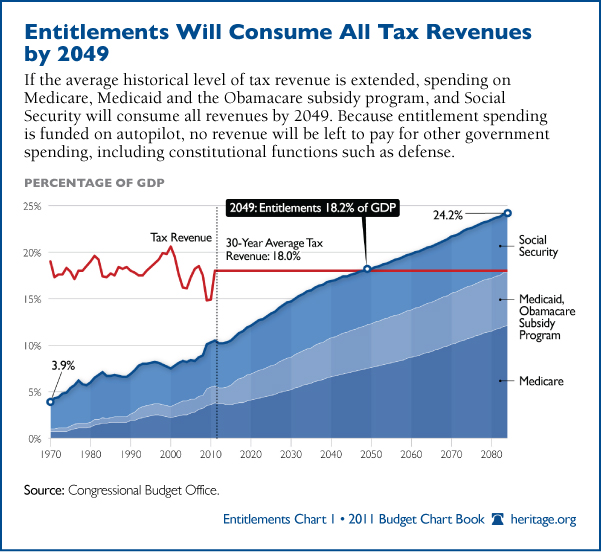
The only way to do that is to either gut Defense or gut Entitlements.

I do not believe that the U.S. can make moderate cuts to both for the simple reason that the trajectory of Entitlement spending is such that it will eat up the entire Federal tax revenues by 2049. As shown in this chart from The Heritage Foundation (click to enlarge):

The U.S. faces now the very same choices that the Europeans faced some 50 years ago: guns or butter; continue funding social spending or provide for a credible military. We simply cannot do both and, as noted above, it is no longer possible to delay the decision. If we elect to cut Defense spending (and it will mean significant cuts) there should be no illusion about the results. We will soon be in the same position as Britain and France, sharing aircraft carriers; we will be unable to protect any national interest beyond our borders for any real length of time; we will be consigned to watching as thugs and fanatics remake the world into one of their liking. And you can be sure that such a world will not be to our liking. Unlike the Europeans, however, there will be no United States to come to the rescue.

The only answer, in the end, is to radically alter the welfare society that we have become.   Even if we were to gut Defense spending, that would be merely a sacrificial lamb to the ever-growing appetite of entitlements.  For proof we need only look to Europe to see that their decades of sacrificing Defense for social benefits has left them now facing the stark reality that there is nothing left to cut except the social spending.  But any attempt to do so results in riots and anarchy by a people too long accustomed to pampering and privilege.    God forbid that the U.S. reaches that stage of decay.
(more…)

Game Over? Iran Within “Weeks” of Nuclear Weapon

15 years, 5 months ago

From Ynet News, this article:

The Iranian regime is closer than ever before to creating a nuclear bomb, according to RAND Corporation researcher Gregory S. Jones.

At its current rate of uranium enrichment, Tehran could have enough for its first bomb within eight weeks, Jones said in a report published this week.

The full RAND Corporation report is available here.

The report, titled, “Iran’s Nuclear Future, Critical U.S. Policy Choices,” was prepared specifically for the U.S. Air Force.  The report takes a four-step approach and in the first three steps it analyzes Iran’s nuclear program in the context of the Middle East and suggests broad policy options before getting to specifics relevant to the Air Force.   From my review of the report, it is assumed that Iran has or will soon have, at the very least, latent nuclear capabilities, i.e., the ability to quickly assemble a nuclear device while not openly demonstrating or testing that ability.   The report suggests several approaches for trying to dissuade Iran from fully developing a nuclear capability and, in the event that Iran does proceed with nukes, various approaches for containing or dissuading their use.

The significance of the Ynet article is the indication by one of the RAND researchers that it is already too late to stop the Iranian nuclear program by air power alone.   According to Gregory S. Jones:

He added that despite reports of setbacks in its nuclear program, the Iranian regime is steadily progressing towards a bomb. Unfortunately, Jones says, there is nothing the US can do to stop Tehran, short of military occupation.

The researcher based his report on recent findings by the International Atomic Energy Agency (IAEA), published two weeks ago. Making the bomb will take around two months, he says, because constructing a nuclear warhead is a complicated step in the process.

Jones stresses that stopping Iran will require deploying forces on the ground, because airstrikes are no longer sufficient. The reality is that the US and Israel have failed to keep Iran from developing a nuclear warhead whenever it wants, Jones says.

If this is an accurate assessment, then the world has gotten far more dangerous and America will pay a very steep price for having elected a President who was willing to allow the Iranian Regime an additional two years for nuclear development.   This does not absolve, by any means, George W. Bush for his malfeasance on this issue.  He should never have declared that Iran would not be allowed to develop a nuclear weapon if he meant to simply kick the can down the road to the next President.  Nonetheless, there is no denying that Obama was handed a golden opportunity to fundamentally change the Middle East in 2009 when the Iranian people rose up to demand their political freedom from the brutal regime.  Allowing that regime to crush the uprising was an unforgivable error and no amount of Bush bashing will ever change that fact.

If there is any hope in the current predicament it lies in the 2012 U.S. elections and the possibility that a new President will have the skill and determination to support regime change in Iran.   After all the false promises of the so-called “Arab Spring,” Iran may be the one place in the Middle East where a true, Western democracy can actually emerge, one that no longer poses a grave threat to the U.S. and its allies in the region.

NYT Attempts to Plug Huge, New Oil Find in Texas (and other disinformation campaigns)

15 years, 5 months ago

To amend the proverb slightly, what the The New York Times giveth, The New York Times taketh away.

In this weekend story online, we see once again the duplicitous nature of the State Run Media:

CATARINA, Tex. — Until last year, the 17-mile stretch of road between this forsaken South Texas village and the county seat of Carrizo Springs was a patchwork of derelict gasoline stations and rusting warehouses.

Now the region is in the hottest new oil play in the country, with giant oil terminals and sprawling RV parks replacing fields of mesquite. More than a dozen companies plan to drill up to 3,000 wells around here in the next 12 months.

The Texas field, known as the Eagle Ford, is just one of about 20 new onshore oil fields that advocates say could collectively increase the nation’s oil output by 25 percent within a decade — without the dangers of drilling in the deep waters of the Gulf of Mexico or the delicate coastal areas off Alaska.

There is only one catch: the oil from the Eagle Ford and similar fields of tightly packed rock can be extracted only by using hydraulic fracturing, a method that uses a high-pressure mix of water, sand and hazardous chemicals to blast through the rocks to release the oil inside.

The technique, also called fracking, has been widely used in the last decade to unlock vast new fields of natural gas, but drillers only recently figured out how to release large quantities of oil, which flows less easily through rock than gas. As evidence mounts that fracking poses risks to water supplies, the federal government and regulators in various states are considering tighter regulations on it.

This article uses the well-worn rhetorical technique that grudgingly acknowledges a seemingly good bit of news that runs counter to the Left’s narrative while seeking to undermine it entirely.   In this case, the NYT announces the incredible news of oil field discoveries within the continental U.S. that have the potential to exceed the daily output of entire, major oil producers but, alas, must point out that these gains may never be realized because (sigh) the process for extracting the oil “poses risks to water supplies.”   It is the poison pill.    Concede that which can no longer be concealed but include just enough disinformation or obfuscating facts as to render the entire portion unpalatable.   And so the NYT inserts the specious claim that “evidence mounts that fracking poses risks to water supplies…”  This is pure nonsense by the NYT.

A recent article by the Institute for Energy Research contains a good explanation of the process of fracking (or “hydraulic fracturing”) and points out that there the controversy over fracking is largely misleading if not fabricated.   My intention here, however, is not to explore the merits of the process itself and settle one way or another whether fracking is ultimately safe.   The aim here is to point out the dishonest approach that the Left uses in attempts to negate developments that threaten their narrative.

Powerline recently noted how The NYT was caught distorting the record on fracking.  Notice how the NYT article uses insinuation to mislead here as well.   Having been caught in their prior article claiming that there were “numerous documented cases” of water contamination caused by fracking, the NYT in this story resorts to the claim that “evidence mounts” with regard to the evils of fracking without stating any, actual instances where it has been documented or revealing that, in their own correction, the NYT stated that there are “few documented cases.”   The IER article goes further and states that there are no documented cases.

The Left’s narrative for America includes the notion that domestic energy supplies are non-existent.   If confronted on this fable, the Left claims that our resources are quickly shrinking and any newly discovered resources are too difficult, hazardous, expensive, or environmentally catastrophic to extract.   In essence, the Left’s narrative is for Americans to get used to expensive and scarce energy supplies that will necessarily mean a dramatic restructuring of society (loss of individual freedoms) that can only be accomplished by a domineering, central government.

When Obama says that we cannot “drill our way out of” high gasoline prices, he is engaging in this subterfuge.   When the lease of new oil wells in the Gulf of Mexico remains at a standstill for over a year with no, legitimate explanation, it is due in large part to the commitment of the Left in stopping all hydrocarbon use which forms a central tenet in their environmental religion.

Considering the diametrically opposed views of the Left and Right in this country, it may not be too much of an exaggeration to say that we are in the midst of a Cold Civil War in which each election cycle offers another critical battle.  It is becoming increasingly clear that there is very little room for compromise with the Left.   Their vision for the U.S. is so foreign, so un-American (a phrase itself that used to have a clear meaning but has now been rendered ambiguous by the Left) that there can only be one side or the other that will survive.

Continuing Fallout from Bin Laden Raid: Growing Chinese Role in Pakistan?

15 years, 5 months ago

The raid to kill Bin Laden in Abbatabad, Pakistan, like a nuclear blast, has fallout beyond the immediate event.

One of those effects is the apparent impetus for closer relations between Pakistan and China.

The Economist noted earlier this month that Pakistan made no secret of praising its relations with China in the aftermath of the Bin Laden raid.

PAKISTAN’S ambassador to Beijing, Masood Kahn, was this week fully armed with metaphors to describe the robust friendship between the two countries. “We say it is higher than the mountains, deeper than the oceans, stronger than steel, dearer than eyesight, sweeter than honey, and so on.”

The relationship is indeed a geopolitical keystone for both countries. Pakistan serves as China’s closest friend both in South Asia and among Islamic countries. So close, indeed, that many suspect China has asked Pakistan for the valuable remains of the American stealth helicopter abandoned during the bin Laden raid. Meanwhile, China can help counterbalance Pakistan’s arch-rival, India, including in Afghanistan.

Pakistan seems keen to foster the impression that new tensions with America might nudge it even closer towards China. In his blustery speech to parliament on May 9th Prime Minister Yusuf Raza Gilani struck out on an odd tangent to praise China as an “all-weather friend”, providing Pakistan with strength and inspiration. Not to be outdone, President Asif Zardari issued an effusive statement of his own about a friendship “not matched by any other relationship between two sovereign countries”.

Others have noted the attempts by Pakistan to curry favor with China as well.   The Wall Street Journal Online has this:

BEIJING—Pakistan’s defense minister said China has agreed to take over operation of the strategically positioned but underused port of Gwadar, and that Islamabad would like the Chinese to build a base there for the Pakistani navy.

Ahmad Mukhtar gave no clear timetable on the possible change at Gwadar, on Pakistan’s western coast, which is currently managed by a Singaporean government company. But his statement Saturday is the latest illustration of how Pakistan is portraying China as a powerful alternative ally and aid source if the U.S. scales down military assistance for Islamabad in the aftermath of Osama bin Laden’s killing.

On the whole, given the duplicity of Pakistan and the inevitable conflict in the Pakistani tribal areas, putting some distance between the U.S. and Pakistan may be beneficial in the long run.   In other words:  if you want to jump into bed with China, good luck with their cold feet.

Both The Economist and The Wall Street Journal Online note the decidedly ambivalent feelings about Pakistan by the Chinese.  The Economist cautions:

But if Islamabad is worried about falling out with Washington and hopes to get more out of Beijing, it may be in for disappointment. According to Zhu Feng of Peking University, such calculations based on “the traditional mentality of power politics” are misplaced. China’s robust, longstanding ties with Pakistan stand on their own merits, he says, and owe nothing to America’s standing in Pakistan. Both China and America want a stable Pakistan.

For all that, China’s dealings with Pakistan have always been conducted with one eye on India. Last year Beijing chose to supply Pakistan with two new civilian nuclear reactors, even though the deal appeared to violate Chinese non-proliferation commitments. It was a boon not only for Pakistan’s energy-starved economy. It was, as Mr Zhu points out, also a way for China to counterbalance a controversial nuclear deal reached earlier between America and India.

China and Pakistan have a lustily growing trade relationship, worth almost $9 billion last year. China provides military gear, including fighter jets and frigates. Some Chinese infrastructure projects in Pakistan have strategic implications. They include ports on the Arabian Sea and a proposed rail project which has yet to be approved, but which would arouse controversy, and Indian ire, by running through contested territory in Kashmir.

Still, China’s commitment to Pakistan has its limits. After devastating floods last year, America gave Pakistan $690m, 28% of all international aid. China’s contribution was a mere $18m. According to Andrew Small of the German Marshall Fund, an American policy institute, Pakistan may be “talking up the ‘China option’ beyond where the Chinese are willing to go.” China, he reckons, will be reluctant to tilt too far towards what might look like an anti-India alliance”. Despite border disagreements, China wants to keep its relations with India in reasonable order.

What is more, Pakistan’s chronic instability and its failure, whether by design or incompetence, to suppress extremism make Pakistan as hard a partner for China to trust as for America. “Sweeter than honey” may be plenty sweet enough.

The WSJ sounds a similar note:

China is eager to expand its influence in Pakistan over the long term, but is wary of the country’s chronic instability, which was highlighted late Sunday when a Pakistani naval base was attacked in the western port of Karachi, about 300 miles southeast of Gwadar.

Indeed.  In some ways, Pakistan and China are made for each other.  One is chronically unstable and in dire need of constant foreign aid while the other is infamously stingy and calculating in its foreign affairs.   May they enjoy each others’ company for many years.  We can certainly use the money wasted in foreign aid to Pakistan for better purposes such as freeing us from our dependence on foreign oil.

At the same time, there is no doubt that India feels the pressure of a nuclear Pakistan and nuclear China on its borders.   The U.S. has everything to gain by pursuing closer ties with India, the rising power of the Near East.   Trading Pakistan for India would be like trading Hillary Clinton for Sarah Palin.   I think we can live with that exchange.

But we should be under no illusions that, whatever happens to the American-Pakistani relationship, China is increasingly in the mood to flex its muscles in the region.   According to an article flagged at Hot Air, China has reportedly given the U.S. something of an ultimatum regarding any future border incursions into Pakistan:

Barack Obama says that if the US has another chance to get a high-value terrorist target like Osama bin Laden in Pakistan, he’ll make the same call as he did earlier this month.  Not so fast, says China.  According to a report from India a few days ago, China has warned that an “attack” on Pakistan will be taken as an attack on China (via Pundit Press):

In the wake of the US raid in Abbottabad that killed Osama bin Laden, China has “warned in unequivocal terms that any attack on Pakistan would be construed as an attack on China”, a media report claimed today.

The warning was formally conveyed by the Chinese foreign minister at last week’s China-US strategic dialogue and economic talks in Washington, The News daily quoted diplomatic sources as saying. China also advised the USa to “respect Pakistan’s sovereignty and solidarity”, the report said.

Chinese Premier Mr Wen Jiabao informed his Pakistani counterpart Mr Yousuf Raza Gilani about the matters taken up with the US during their formal talks at the Great Hall of the People yesterday. The report said China “warned in unequivocal terms that any attack on Pakistan would be construed as an attack on China”. The two premiers held a 45-minute one-on-one meeting before beginning talks with their delegations.

The Chinese leadership was “extremely forthcoming in assuring its unprecedented support to Pakistan for its national cause and security” and discussed all subjects of mutual interest with Mr Gilani, the report said. Mr Gilani described Pakistan-China relations and friendship as “unique”. Talking to Pakistani journalists accompanying him, he said that China had acknowledged his country’s contribution and sacrifices in the war against terrorism and supported its cause at the international level. “China supported Pakistan’s cause on its own accord,” Mr Gilani said with reference to the Sino-US strategic dialogue where the Chinese told the US that Pakistan should be helped and its national honour respected. Mr Gilani said China had asked the US to improve its relations with Pakistan, keeping in view the present scenario.

It it difficult to believe that China would truly be willing to go to war over, say, a Predator drone attack or even a SOF incursion into the FATA, but uncertainty over China’s reaction to any future missions of a similar nature will only add to the difficulty of having an ally with whom you are, in some measure, at war.

Entitlement Spending: Time For Feds to Punt to the States

15 years, 5 months ago

According to this article in The Washington Examiner, the prospects for the 2012 Federal Budget are bleak.

There are just 10 weeks remaining until an Aug. 2 debt ceiling deadline set by Treasury Secretary Tim Geithner. It’s a seemingly generous amount of time but too short in the eyes of some lawmakers, who are wrestling with how deeply to cut the budget and whether to increase the debt ceiling, the amount of money the government is allowed to borrow.

Scores of Republicans have pledged to vote against raising the nation’s debt ceiling if spending is not cut drastically, imperiling the measure in Congress and possibly forcing the government to default on its loans for the first time.

Despite months of debate, only one proposal has been advanced to address spending cuts, and that plan — written by House Budget Committee Chairman Paul Ryan, R-Wis. — may come to the Senate floor for a vote this week.

Ryan’s proposal would reduce spending by $6 trillion over 10 years and reform Medicare and Medicaid. But it isn’t expected to muster the 60 votes needed to pass, mostly because senators, including Republicans, are fearful of tackling popular entitlement programs with the 2012 elections looming.

The Federal Government is deadlocked, plain and simple.

According to every conventional way of approaching entitlement spending, it is an impossible conundrum.  Conservatives have many ideas about reforming or replacing such programs, but Republicans refuse to embrace them for fear of being tarred as heartless killers of old ladies and the poor.   Liberals know in their hearts that these programs cannot, under any realistic scenario, continue as they are, but no Democrat is willing to even consider mild reforms such as the one posed by Rep. Paul Ryan for fear of being hacked to death by the Left as a sell-out or traitor to the People.   So Republicans dither and delay while Democrats (and their media allies) demagogue the issue and distort the facts.

In fact, entitlement spending demonstrates, perhaps better than any other issue, the inherent weakness and fatal attraction in a central government that has badly strayed from its original, limited role.   There is simply no way for the Federal government to make the required changes to Social Security, Medicare and Medicaid that will keep the Federal Government from falling off the financial cliff with Democrats in control of the Senate and White House and Republicans in control of the House.   And it is not an option to wait until the 2012 elections possibly give control of all three branches to the Republicans.    America’s fiscal problems will not stay put until then (and Republicans may not be trustworthy on spending reforms considering the last time they held all three branches).

With this impasse in view and the very real prospect that the Democrat-controlled Senate will go yet another year without passing a fiscal budget, I offer this suggestion as a way for Democrats and Republicans alike to escape their chains:  turn entitlement spending over the States.

This is the perfect situation for punting the football and it makes absolute and total sense.   It is the right thing to do.   The ball is deep in our own territory, it is fourth and 50 yards to go and the coaches cannot make up their minds on any suitable play to call.   “Punting” to the States is the only answer.

“Punting” in this context means that the Federal government recognizes it is simply not in a good position to administer programs such as Social Security, Medicaid and Medicare and, worse, is completely incapable of controlling them.    The Federal government is far too big, too prone to waste and inefficiency and, most importantly, was never intended by the Founders to occupy the role of National Philanthropist.    “Punting” means, too, that the States are far better equipped in many ways to decide what level of care and support to accord to their citizens and implement the corresponding programs.

So, for example, if California wants to endow all of its seniors with generous retirement and health benefits, let them do so as long as the burden for funding those lavish benefits falls squarely on the shoulders of Californians alone.

Consider entitlement spending in terms of a business:  each State has to decide what benefits it can and cannot afford to dole out.  If the State is too generous, it will eventually go “out of business” as millions move in to enjoy the generosity while millions more move out as their taxes inevitably skyrocket.   If a State is too stingy, it will cease being an attractive place to work and live.  Between the extremes is an enormous range of policy options and solutions that can be crafted to fit the unique circumstances inherent in every State.  And, since most States are forced to balance their budgets each year by law, the State government will undertake entitlement spending with sobriety.

How could it work?

Such a change could not be done overnight, but it need not be terribly complex either. The first step would be along the lines of what Rep. Paul Ryan suggests in his proposal for Medicaid reform:  block grants to the States.   Florida, for example, might get a much larger grant based on 2010 Census numbers of its elderly population (and specifically its indigent population) than a demographically younger state.  According to the 2000 Census, Utah is the “youngest” state, i.e., the one with the smallest percentage of elderly persons, while Florida is the oldest.

The block grants should also factor in existing poverty levels and not just the percentage of elderly in a given State.  West Virginia has one of the higher percentages of elderly people but it also has one of the poorest populations.  Other factors could be considered as well, such as populations of disabled or other, at-risk populations.

With this grant money, each state can use it as they see fit to provide for their at-risk populations.

This kind of block granting has the unique advantage of incentivizing better care for these at-risk populations.  Say, for example, that Maryland develops a better, more efficient way of educating handicapped children.  (This happens to be true).  As this fact is known, more parents with handicapped children will move to Maryland which, in turn, will warrant more grant aid to Maryland to coincide with the higher, handicapped population.  Resources get allocated to those locations that do the best job of serving their populations at the local level.   Conversely, if another State does a terrible job with its care for handicapped children, then those parents will have every incentive to move to Maryland rather than remain in sub-optimal care elsewhere.   A key feature would have to be some method for tracking the subject populations in each State to determine the block grant levels.

But can States be trusted with a large, no-strings-attached, grant of money?  To continue the example, what if Maryland chooses to use the billions in Federal aid to plug the notorious gap in its annual budget?  I submit that even a liberal, tax and spend haven like Maryland would never do this precisely because the Governor and state legislature are far more sensitive and accountable to Maryland voters than the U.S. Congressional delegation will ever be.   Consider that, under the 2000 Census, the average Congressional district was comprised of 646,952 persons– far too many persons for individual citizens to hold the politicians accountable.  Politicians are much more easily held accountable to their local constituency simply by virtue of the smaller numbers contained in each, State legislative district.  It will, of course, be up to each State to decide how to best use the grant money and tough decisions will need to be made, but those decisions will be made far better at the state level where it is far more difficult for AARP to mobilize its members and bully politicians.

Giving entitlement spending to the States also makes sense in terms of perspective.    When we look at Social Security spending, for example, at a national level, the sheer size and scope of the spending is completely disorienting.   When speaking of hundreds of billions of dollars, it is nearly impossible to put the choices into concrete terms: who are these “millions of elderly” who will starve or go without medications?  Why can’t we afford another $200 million for this program when we are already spending $800 billion?   But when the debate is put at the state level, and more importantly, MY state level, things become much more focused.   Supposing that Maryland receives $6 billion in grant money to cover social security, medicare and medicaid for Maryland citizens for the next year, how should that money be used?  Am I willing to pay more in state taxes in order to ensure, for example, that 65 year-old Aunt Mary gets a social security check every month even though I know that she has an adequate retirement income from the Maryland Teachers Pension?  Maybe.  Maybe not.  And will Aunt Mary join in marching on the state capitol to get that extra money even if it means higher taxes for me and her neighbors, friends, colleagues?

Some States will give that money to Aunt Mary and raise taxes to do so.  Others may not.  In the end, however, it will be far easier to come to grips with the many issues involved when we are dealing with specific populations in our own state and with the direct ramifications of those decisions in our own state.

Consider, too, the enormous savings to the Federal budget when the huge bureaucracies associated with Social Security, Medicare and Medicaid are allowed to shrivel up and die.  The people employed at these federal agencies are not, necessarily, joining a bread line, however.   With the block granting of funds to each State it is likely that persons with pension and healthcare experience will be in demand (hopefully by private firms that provide services rather than bloated State bureaucracies, but that is another topic).  In any event, a reduction in federal personnel should be welcome relief to taxpayers everywhere.

Finally, the greatest benefit of transferring entitlements to the States is the effect upon Federal power and interference in the lives of ordinary citizens.   When the Federal government holds the power of health care in its hands, it induces an unhealthy obeisance to the central power.   This power needs to be split up among the 50 states so that ordinary citizens are empowered to hold their State officials accountable and rein in abuses.    This principle can, of course, be applied across a wide spectrum of federal activities.

Hopefully the politicians in Washington, D.C. will pass the buck in this instance which would, ironically, be the right thing for once.


26th MEU (10)
Abu Muqawama (12)
ACOG (2)
ACOGs (1)
Afghan National Army (36)
Afghan National Police (17)
Afghanistan (704)
Afghanistan SOFA (4)
Agriculture in COIN (3)
AGW (1)
Air Force (43)
Air Power (10)
al Qaeda (83)
Ali al-Sistani (1)
America (23)
Ammunition (306)
Animals (343)
Ansar al Sunna (15)
Anthropology (3)
Antonin Scalia (1)
AR-15s (399)
Arghandab River Valley (1)
Arlington Cemetery (2)
Army (91)
Assassinations (2)
Assault Weapon Ban (29)
Australian Army (7)
Azerbaijan (4)
Backpacking (4)
Badr Organization (8)
Baitullah Mehsud (21)
Basra (17)
BATFE (249)
Battle of Bari Alai (2)
Battle of Wanat (18)
Battle Space Weight (3)
Bin Laden (7)
Blogroll (3)
Blogs (24)
Body Armor (23)
Books (3)
Border War (18)
Brady Campaign (1)
Britain (39)
British Army (36)
Camping (5)
Canada (20)
Castle Doctrine (1)
Caucasus (6)
CENTCOM (7)
Center For a New American Security (8)
Charity (3)
China (20)
Christmas (18)
CIA (30)
Civilian National Security Force (3)
Col. Gian Gentile (9)
Combat Outposts (3)
Combat Video (2)
Concerned Citizens (6)
Constabulary Actions (3)
Coolness Factor (3)
COP Keating (4)
Corruption in COIN (4)
Council on Foreign Relations (1)
Counterinsurgency (218)
DADT (2)
David Rohde (1)
Defense Contractors (2)
Department of Defense (220)
Department of Homeland Security (26)
Disaster Preparedness (5)
Distributed Operations (5)
Dogs (15)
Donald Trump (27)
Drone Campaign (4)
EFV (3)
Egypt (12)
El Salvador (1)
Embassy Security (1)
Enemy Spotters (1)
Expeditionary Warfare (18)
F-22 (2)
F-35 (1)
Fallujah (17)
Far East (3)
Fathers and Sons (2)
Favorite (1)
Fazlullah (3)
FBI (39)
Featured (192)
Federal Firearms Laws (18)
Financing the Taliban (2)
Firearms (1,883)
Football (1)
Force Projection (35)
Force Protection (4)
Force Transformation (1)
Foreign Policy (27)
Fukushima Reactor Accident (6)
Ganjgal (1)
Garmsir (1)
general (15)
General Amos (1)
General James Mattis (1)
General McChrystal (44)
General McKiernan (6)
General Rodriguez (3)
General Suleimani (9)
Georgia (19)
GITMO (2)
Google (1)
Gulbuddin Hekmatyar (1)
Gun Control (1,742)
Guns (2,423)
Guns In National Parks (3)
Haditha Roundup (10)
Haiti (2)
HAMAS (7)
Haqqani Network (9)
Hate Mail (8)
Hekmatyar (1)
Heroism (5)
Hezbollah (12)
High Capacity Magazines (16)
High Value Targets (9)
Homecoming (1)
Homeland Security (3)
Horses (2)
Humor (72)
Hunting (67)
ICOS (1)
IEDs (7)
Immigration (123)
India (10)
Infantry (4)
Information Warfare (4)
Infrastructure (4)
Intelligence (23)
Intelligence Bulletin (6)
Iran (171)
Iraq (379)
Iraq SOFA (23)
Islamic Facism (64)
Islamists (98)
Israel (19)
Jaish al Mahdi (21)
Jalalabad (1)
Japan (3)
Jihadists (82)
John Nagl (5)
Joint Intelligence Centers (1)
JRTN (1)
Kabul (1)
Kajaki Dam (1)
Kamdesh (9)
Kandahar (12)
Karachi (7)
Kashmir (2)
Khost Province (1)
Khyber (11)
Knife Blogging (7)
Korea (4)
Korengal Valley (3)
Kunar Province (20)
Kurdistan (3)
Language in COIN (5)
Language in Statecraft (1)
Language Interpreters (2)
Lashkar-e-Taiba (2)
Law Enforcement (6)
Lawfare (14)
Leadership (6)
Lebanon (6)
Leon Panetta (2)
Let Them Fight (2)
Libya (14)
Lines of Effort (3)
Littoral Combat (8)
Logistics (50)
Long Guns (1)
Lt. Col. Allen West (2)
Marine Corps (281)
Marines in Bakwa (1)
Marines in Helmand (67)
Marjah (4)
MEDEVAC (2)
Media (68)
Medical (146)
Memorial Day (6)
Mexican Cartels (48)
Mexico (72)
Michael Yon (6)
Micromanaging the Military (7)
Middle East (1)
Military Blogging (26)
Military Contractors (5)
Military Equipment (25)
Militia (9)
Mitt Romney (3)
Monetary Policy (1)
Moqtada al Sadr (2)
Mosul (4)
Mountains (25)
MRAPs (1)
Mullah Baradar (1)
Mullah Fazlullah (1)
Mullah Omar (3)
Musa Qala (4)
Music (25)
Muslim Brotherhood (6)
Nation Building (2)
National Internet IDs (1)
National Rifle Association (97)
NATO (15)
Navy (31)
Navy Corpsman (1)
NCOs (3)
News (1)
NGOs (3)
Nicholas Schmidle (2)
Now Zad (19)
NSA (3)
NSA James L. Jones (6)
Nuclear (63)
Nuristan (8)
Obama Administration (222)
Offshore Balancing (1)
Operation Alljah (7)
Operation Khanjar (14)
Ossetia (7)
Pakistan (165)
Paktya Province (1)
Palestine (5)
Patriotism (7)
Patrolling (1)
Pech River Valley (11)
Personal (77)
Petraeus (14)
Pictures (1)
Piracy (13)
Pistol (4)
Pizzagate (21)
Police (674)
Police in COIN (3)
Policy (15)
Politics (999)
Poppy (2)
PPEs (1)
Prisons in Counterinsurgency (12)
Project Gunrunner (20)
PRTs (1)
Qatar (1)
Quadrennial Defense Review (2)
Quds Force (13)
Quetta Shura (1)
RAND (3)
Recommended Reading (14)
Refueling Tanker (1)
Religion (501)
Religion and Insurgency (19)
Reuters (1)
Rick Perry (4)
Rifles (1)
Roads (4)
Rolling Stone (1)
Ron Paul (1)
ROTC (1)
Rules of Engagement (76)
Rumsfeld (1)
Russia (37)
Sabbatical (1)
Sangin (1)
Saqlawiyah (1)
Satellite Patrols (2)
Saudi Arabia (4)
Scenes from Iraq (1)
Second Amendment (715)
Second Amendment Quick Hits (2)
Secretary Gates (9)
Sharia Law (3)
Shura Ittehad-ul-Mujahiden (1)
SIIC (2)
Sirajuddin Haqqani (1)
Small Wars (72)
Snipers (9)
Sniveling Lackeys (2)
Soft Power (4)
Somalia (8)
Sons of Afghanistan (1)
Sons of Iraq (2)
Special Forces (28)
Squad Rushes (1)
State Department (23)
Statistics (1)
Sunni Insurgency (10)
Support to Infantry Ratio (1)
Supreme Court (87)
Survival (216)
SWAT Raids (58)
Syria (38)
Tactical Drills (38)
Tactical Gear (17)
Taliban (168)
Taliban Massing of Forces (4)
Tarmiyah (1)
TBI (1)
Technology (21)
Tehrik-i-Taliban (78)
Terrain in Combat (1)
Terrorism (96)
Thanksgiving (13)
The Anbar Narrative (23)
The Art of War (5)
The Fallen (1)
The Long War (20)
The Surge (3)
The Wounded (13)
Thomas Barnett (1)
Transnational Insurgencies (5)
Tribes (5)
TSA (25)
TSA Ineptitude (14)
TTPs (4)
U.S. Border Patrol (8)
U.S. Border Security (22)
U.S. Sovereignty (29)
UAVs (2)
UBL (4)
Ukraine (10)
Uncategorized (108)
Universal Background Check (3)
Unrestricted Warfare (4)
USS Iwo Jima (2)
USS San Antonio (1)
Uzbekistan (1)
V-22 Osprey (4)
Veterans (3)
Vietnam (1)
War & Warfare (436)
War & Warfare (41)
War Movies (4)
War Reporting (21)
Wardak Province (1)
Warriors (6)
Waziristan (1)
Weapons and Tactics (80)
West Point (1)
Winter Operations (1)
Women in Combat (21)
WTF? (1)
Yemen (1)

November 2026
October 2026
September 2026
August 2026
July 2026
June 2026
May 2026
April 2026
March 2026
February 2026
January 2026
December 2025
November 2025
October 2025
September 2025
August 2025
July 2025
June 2025
May 2025
April 2025
March 2025
February 2025
January 2025
December 2024
November 2024
October 2024
September 2024
August 2024
July 2024
June 2024
May 2024
April 2024
March 2024
February 2024
January 2024
December 2023
November 2023
October 2023
September 2023
August 2023
July 2023
June 2023
May 2023
April 2023
March 2023
February 2023
January 2023
December 2022
November 2022
October 2022
September 2022
August 2022
July 2022
June 2022
May 2022
April 2022
March 2022
February 2022
January 2022
December 2021
November 2021
October 2021
September 2021
August 2021
July 2021
June 2021
May 2021
April 2021
March 2021
February 2021
January 2021
December 2020
November 2020
October 2020
September 2020
August 2020
July 2020
June 2020
May 2020
April 2020
March 2020
February 2020
January 2020
December 2019
November 2019
October 2019
September 2019
August 2019
July 2019
June 2019
May 2019
April 2019
March 2019
February 2019
January 2019
December 2018
November 2018
October 2018
September 2018
August 2018
July 2018
June 2018
May 2018
April 2018
March 2018
February 2018
January 2018
December 2017
November 2017
October 2017
September 2017
August 2017
July 2017
June 2017
May 2017
April 2017
March 2017
February 2017
January 2017
December 2016
November 2016
October 2016
September 2016
August 2016
July 2016
June 2016
May 2016
April 2016
March 2016
February 2016
January 2016
December 2015
November 2015
October 2015
September 2015
August 2015
July 2015
June 2015
May 2015
April 2015
March 2015
February 2015
January 2015
December 2014
November 2014
October 2014
September 2014
August 2014
July 2014
June 2014
May 2014
April 2014
March 2014
February 2014
January 2014
December 2013
November 2013
October 2013
September 2013
August 2013
July 2013
June 2013
May 2013
April 2013
March 2013
February 2013
January 2013
December 2012
November 2012
October 2012
September 2012
August 2012
July 2012
June 2012
May 2012
April 2012
March 2012
February 2012
January 2012
December 2011
November 2011
October 2011
September 2011
August 2011
July 2011
June 2011
May 2011
April 2011
March 2011
February 2011
January 2011
December 2010
November 2010
October 2010
September 2010
August 2010
July 2010
June 2010
May 2010
April 2010
March 2010
February 2010
January 2010
December 2009
November 2009
October 2009
September 2009
August 2009
July 2009
June 2009
May 2009
April 2009
March 2009
February 2009
January 2009
December 2008
November 2008
October 2008
September 2008
August 2008
July 2008
June 2008
May 2008
April 2008
March 2008
February 2008
January 2008
December 2007
November 2007
October 2007
September 2007
August 2007
July 2007
June 2007
May 2007
April 2007
March 2007
February 2007
January 2007
December 2006
November 2006
October 2006
September 2006
August 2006
July 2006
June 2006
May 2006

about · archives · contact · register

Copyright © 2006-2026 Captain's Journal. All rights reserved.