Articles by Herschel Smith


The “Captain” is Herschel Smith, who hails from Charlotte, NC. Smith offers news and commentary on warfare, policy and counterterrorism.


Marines Find Afghan Insurgents Bolder Than Iraqi Insurgents

16 years, 7 months ago

From the NYT:

In three combat tours in Anbar Province, Marine Sgt. Jacob Tambunga fought the deadliest insurgents in Iraq.

But he says he never encountered an enemy as tenacious as what he saw immediately after arriving at this outpost in Helmand Province in Afghanistan. In his first days here in late June, he fought through three ambushes, each lasting as long as the most sustained fight he saw in Anbar.

Like other Anbar veterans here, Sergeant Tambunga was surprised to discover guerrillas who, if not as lethal, were bolder than those he fought in Iraq.

“They are two totally different worlds,” said Sergeant Tambunga, a squad leader in Company C, First Battalion, Fifth Marines.

“In Iraq, they’d hit you and run,” he said. “But these guys stick around and maneuver on you.”

They also have a keen sense of when to fight and when the odds against them are too great. Three weeks ago, the American military mounted a 4,000-man Marine offensive in Helmand — the largest since President Obama’s troop increase — and so far in many places, American commanders say, they have encountered less resistance than expected.

Yet it is also clear to many Marines and villagers here that Taliban fighters made a calculated decision: to retreat and regroup to fight where and when they choose. And in the view of troops here who fought intensely in the weeks before the offensive began, fierce battles probably lie ahead if they are to clear the Taliban from sanctuaries so far untouched.

“It was straight luck that we didn’t have a lot more guys hit,” said Sgt. Brandon Tritle, another squad leader in Company C, who cited the Taliban’s skill at laying down a base of fire to mount an attack.

“One force will put enough fire down so you have to keep your heads down, then another force will maneuver around to your side to try to kill you,” he said. “That’s the same thing we do.”

For now, the strategy of the Taliban who used to dominate this village, 15 miles south of the provincial capital of Lashkar Gah, is to watch and wait just outside, villagers and Marines here say.

“They all escaped,” said Sardar Gul, a shopkeeper at the Nawa bazaar. Mr. Gul and others who reopened stores after the Marines arrived estimate that 300 to 600 Taliban fled to Marjah, 15 miles to the west and not under American control, joining perhaps more than 1,000 fighters.

Marine commanders acknowledge that they could have focused more on cutting off escape routes early in the operation, an issue that often dogged offensives against insurgents in Iraq.

“I wish we had trapped a few more folks,” the commander of First Battalion, Fifth Marines, Lt. Col. William F. McCollough, told the top American commander in Afghanistan, Gen. Stanley A. McChrystal, who visited Nawa. “I expected there to be more fighting.”

So Marines are bracing for a fight against guerrillas who, they discovered in June, are surprisingly proficient at tactics the Marines themselves learned in infantry school.

“They’d flank us, and we’d flank them, just like a chess match,” said Sgt. Jason Lynd, another squad leader in Company C.

Analysis & Commentary

So why weren’t we better prepared for Taliban tactics?  I have detailed at least half a dozen instances of massing of troops against smaller-sized U.S. units, while their hit and run, guerrilla-style warfare is well known.  It is a smart enemy that counts the cost of whatever tactic they employ at the time.  But the real context for the question of preparedness goes deeper.

About five months ago, this generation’s Ernie Pyle, Michael Yon, posted a very important PowerPoint presentation is a post entitled The Eagle Went Over the Mountain.  This post got plenty of readership, as it was linked by Glenn Reynolds at Instapundit.  Glenn titled his link IED attacks in Afghanistan, and the initial parts of the PowerPoint presentation were indeed about IEDs.  But the balance of the presentation was so much more than that, and upon reading it I exchanged e-mail with Michael about it.

We agreed that this presentation might very well be the most significant and important tactical advice coming out of Afghanistan in the past two or three years – lives would be saved if this advice got into the hands of NCOs and officers preparing troops for the field.  Michael didn’t feel that I was stepping on his work at all.  As quickly as possible, I copied down the presentation and created my own post, Marines, Taliban and Tactics, Techniques and Procedures (and Jules Crittenden linked my post).

I summarized some of the findings of the report: the Taliban had fire control, were able to develop interlocking fields of fire, were experienced in the use of combined arms, fire and maneuver warfare, and many other important observations.  The penultimate point of the presentation is stunning.

Iraq has allowed us to become tactically sloppy as the majority of fighters there are unorganized and poorly trained.  This is not the case in Afghanistan.  The enemy combatants here will exploit any mistake made by coalition forces with catastrophic results.  Complacency and laziness will result in mass causalities.

Concluding, the report advises the Marines to remember the tactics, techniques and procedures taught in School of Infantry.  This report serves as a primer for preparation for kinetic engagements in Afghanistan.

There are a number of Milblogs, but not too many well-visited Milblogs.  This is a small community.  Within a couple of days of release of this report, the author of the report contacted me and gave me a veritable ass whipping for release of the report.  You see, the report is FOUO – “for official use only.”  I also took it on the chin in blog comments over release of this report.  But the context of this fight is interesting, as I compared my release of a report on enemy tactics to the release of a new Army field manual describing in detail U.S. satellite patrols in urban terrain (a tactic that I understood but discussed only in the broadest of terms given the sensitivity of the subject – that is, up until the description of it in an Army Field Manual).  I described enemy tactics, Leavenworth described U.S. tactics in a field manual on a federal web site.

Furthermore, my release of the PowerPoint presentation coincided with Michael Yon’s release and Glenn Reynold’s link of it, providing more site visits that Michael or I could ever hope to bring alone (with Michael’s web authority justifiably far outweighing my own).

So I, Michael Yon, Glenn Reynolds and Jules Crittenden are all in it together when the feds come for us.  Or maybe this perspective is all wrong.  After all, Taliban fighters already know how to maneuver to develop enfilade fire.  No Taliban is going to sit in Southern Helmand (let’s say, Garmsir where there is no electricity), and read my web site to find out how to fight the U.S. Marines.  But what discussion of this presentation can do is assist military planners and trainers to do their jobs.

Do we really need to perform this function?  Well, why are the Marines currently in Southern Helmand surprised at the tactical ability of the Taliban fighters?  Apparently the U.S. military across the board is not very good at sharing lessons learned.  Maybe it has to do with something called FOUO.  As it turns out, it would have been better had this presentation gotten an even wider distribution than it did.  The right people still didn’t see it.

Follow and Kill Every Single Taliban

16 years, 7 months ago

Readers know our position regarding the changes to the rules of engagement for Afghanistan.  While there is much to be said for the protection of the population in the development and deployment of the new revisions to the ROE, we have observed that there are operations that wouldn’t have been conducted under the recent revisions, including the highly successful operations by the 24th MEU in Helmand in 2008 (and including certain tactics in the Anbar Province of Iraq).  Their highly kinetic assault on Garmsir would not have occurred due to the fact that it could not be proven that non-combatants were not still resident in the town.

The Strategy Page gives us their view of the situation in which the Marines are engaged in the Helmand Province.

The U.S. Marine advance into Helmand province is being slowed down by the new Rules Of Engagement (ROE), which forbid the use of bombs or missiles in any situation where there might be civilians. The Taliban will typically spend the night, or longer, in a village or walled compound, and that’s where U.S. troops will typically trap them. But bombs and missiles cannot be used on these places, so U.S. troops have to besiege the place, or just move on, leaving the Taliban alone. Some marines get creative, like having the jet fighters or bombs make a high speed pass over the Taliban held buildings. The fearsome noise will sometimes unnerve the Taliban and cause a surrender, but not as much as it used to. Another favorite tactic is having the fighter (usually an F-16 or F-18) come in low and use its 20mm cannon. But these air craft only carry a few seconds worth of ammunition. Moreover, having these jets fly that low makes them liable to crashing (this has happened, at least once) or being brought down by enemy fire (has not happened yet). But the cannon fire sometimes induces the Taliban to give up, or try to flee.

The other option, when you have the Taliban cornered, and using human shields, is to go in and fight them room-to-room. That gets more Americans killed, as well as putting the Afghan civilians in danger. This room-to-room tactic has not been used much, as commanders don’t want to take the heat for losing troops in that kind of fighting. If there is a lot more of this house to house fighting, and civilians get killed, the ROE may be changed again to forbid any kind of combat if civilians are present. This reduces the anger of locals from civilian deaths involving U.S. forces, but makes it much more difficult to hunt down and destroy the Taliban gunmen. The Taliban are still vulnerable, as they have to move in order to operate, and the Afghan Army or police can often negotiate a surrender, or go in and root them out by force. But the best troops available for chasing down the Taliban gunmen are the U.S. and NATO ones.

Room clearing tactics are costly to the Marines (viz. Fallujah), and aversion to this approach is understandable.  But the best troops are of course the U.S. and NATO, since the police are mainly corrupt and the Afghan National Army is mainly drug-addicted and inept.  The police and the ANA cannot be relied upon to chase the hard core Taliban.  Regarding the Taliban that are allowed to escape because of this change to the ROE, locals have some words to the wise.

“People are withholding judgment,” said the political analyst in Lashkar Gah. “They cannot say whether this operation is good or bad. They are afraid that the (U.S.) forces will stay here for some days and then leave, so we will be alone with the Taliban again.” Many are also waiting to see what the Americans can bring in the way of real development.

“It is still just the beginning,” said Mullah Shin Gul from Nad Ali district. “The Americans need to begin reconstruction, by agreement with the people. They should establish centers here in the districts, and they should follow every single Taliban and kill him. In a short while it will be too late. The people will lose trust.”

The doctrine of population centric counterinsurgency believes, in part, that focus on the population will marginalize the insurgents, causing them to wilt away and eventually rejoin the population and side with the government.  True enough for low level insurgents, men who have willingly taken up arms for political and religious motivations don’t usually willingly lay them down.

Because of the new ROE there has been a reluctance to engage locations in which known Taliban are located, allowing them to escape and fight another day.  Such tactics may gain the support of the locals for the time being, but they ensure the continuation of the fight.  Like the locals said, we must follow and kill every single Taliban.  Taking prisoners is not productive.

Prior:

Obama Administration Searching for an Exit Strategy

Marine Take the Fight to the Enemy in Now Zad

Taliban Tactics: Massing of Troops

The Coming War in the Caucasus

Update:

Over at Fabius Maximus, a site I know little if anything about, a commenter and the author presume to know something about the intentions of this article.  Let’s listen in for a few minutes.

I totally disagree with this guy’s belief that the US has no choice but to exterminate the Taliban, or even that this is a good goal: “Follow and Kill Every Single Taliban“, Herschel Smith, The Captain’s Journal, 26 July 2009.

At the same time, his analysis of how the Taliban is funded (here) seems probably correct to me …

Fabius Maximus replies: They sound just like governments everywhere. Heroin is the primary product of Helmand Province. Mother Nature made it so, and only vast sums of money wil change that. Recent US history shows that we would rather spend 10x that amount on fighting to control the area rather than a smaller sum to change its economy.

The real question is why folks read trash like “The Captain’s Journal”. There are many real experts writing about the situation in central asia, but America’s bloodlust is stirred by nutjobs yelling “Follow and Kill Every Single Taliban.” It’s a symptom of a nation increasingly ruled by its own paranoia and hubris.

Alas, so much confusion, so little time to work through the problems.  The comment was left by someone calling themselves atheist, and Fabius Maximum takes off of the remark to invite himself to criticize someone he doesn’t know and has never read.

This question of globalists and hermeneutics within Islam is a complicated issue, one I have addressed before with Professor Steve Metz of the U.S. Army War College.  The set of those who are irreconcilable enemies is certainly a subset of Islam, and even a subset of those currently engaged in fighting U.S. forces in Afghanistan.  Recall that The Captain’s Journal strongly supported the notion of concerned citizens in Anbar, later to become Sons of Iraq.

Many of the Sons of Iraq were former insurgents, but fighting for money, boredom, political views or whatever.  Certainly a subset of the so-called Taliban fighters are fighting for the same things.  The question is not one of killing irreconcilable enemies.  War, including counterinsurgency, means doing violence.  Irreconcilable enemies must be killed, and in Afghanistan this set of fighters is comprised of globalists and those who would harbor them.

The only real question is how big is this subset of fighters?  Joshua Foust and I have politely disagreed before, with me viewing this group as moderately larger than him, and yet in the recent months it would appear that Foust’s view is that the size of this group is edging upwards, while my view is that the size might be edging downwards.  Perhaps we will eventually meet in the middle.  But all thinking men know that the insurgency is bifurcated.

Now to the specific post and its title.  I have found that it’s very hard to keep readers for more than a few minutes.  Even when linked at a large venue such as Instapundit, statistics show that most readers want to read an article within less than about three minutes.  Many of mine are longer, and the more difficult issue is that my posts comprise a narrative.  My readers are usually very sophisticated, and it appears that the readers over at Fabius Maximus haven’t paid attention very well.

Recall the issues surrounding modifications to the ROE for Afghanistan.  Without getting into the weeds on this issue again, recall that in subsequent posts I had pointed out that according to objective evidence, the highly successful Marine Corps operations in the Helmand Province (specifically, in Garmsir) in 2008 by the 24th MEU would not have been conducted under the revised ROE.  When you can point to successful operations that wouldn’t be conducted under ROE, there is a problem.

This points to unintended consequences.  Subsequent to this we pointed out that the revised ROE had allowed Taliban fighters to escape Marine Corps operations with the Marines unable to give chase because of lack of logistics.  Finally, in the article above we pointed out that the local residents had stated that the Marines would have to hold the area and chase and kill every last Taliban for the area to be safe.  This is the most amusing point of the comments left at Fabius Maximus.  They ascribe a comment made by a local in Afghanistan to me since I chose it as the title to an article.  Get the picture?  They didn’t even read the article.  I suppose that the commenter and Mr. Maximus know more about Afghanistan and the Taliban than the locals do.

There is a chain of thoughts necessary to follow my prose, from ROE to giving chase and required logistics and unintended consequences to tactical directives and local views on what it will take to make the area safe.  My prose is simply not intended for idiots.  Readers .. must .. work .. hard .. and .. try .. to .. stay .. up.

As for Fabius Maximus’ disparaging of The Captain’s Journal, we might remark at what bad form it is and what gross, hillbilly etiquette it takes to trash someone you don’t know, have never communicated with, and whose prose you have never read.  It sounds very much like he is the nutjob.  His readers can do better.

Patrolling Now Zad

16 years, 7 months ago

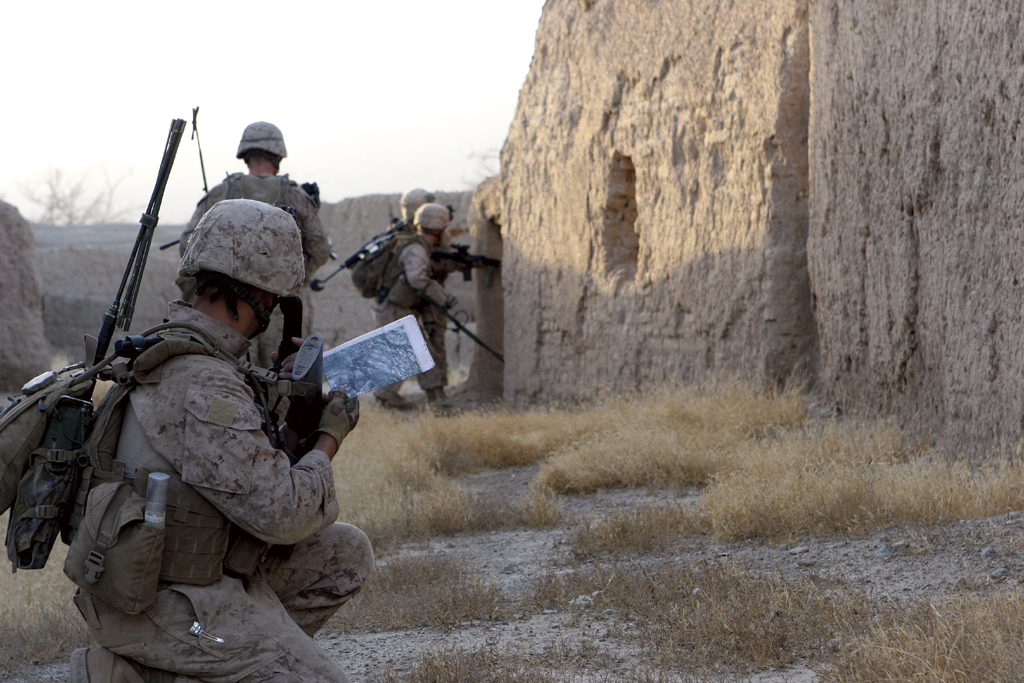
U.S. Marines with 2nd Battalion, 3rd Marine Regiment, Company G, 3rd Marine Division, conduct a patrol the morning of June 26.

From the USMC:

The Marines conduct both day and night operations in Now Zad because the difference can be advantageous to varying missions. The consensus among the Marines is that the eerie feeling that comes with patrolling through the mine-littered streets of an abandoned city increases exponentially at night as the wind howls through the alleyways and visibility decreases. But, they overcome any existing fears with the confidence they have in one another, and they press forward.

“As each day goes by, we get more intelligence on the enemy than they get on us – that is comforting,” said Forte.

Their patrols are not only dangerous, they require a leader with intelligence and tactical proficiency. The many natural and man-made obstacles across the battlefield in addition to the Taliban-made mines bring further complexity to their area of operation.

“Finding the best route and maneuvering the patrol through areas that could have mines anywhere is the hardest part,” according to Forte who has lead more than 25 patrols here in the last two months. “I try to think clearly and do what seems best. I just want to keep my guys alive.”

The Marines in Now Zad know what sacrifice is all about. They understand it. They live it. Their way of life is summarized in a saying that is posted in the 3rd Plt. headquarters – “I have not ceased to be fearful, but I have ceased to let fear control my life.”

I can only continue to point out the sheer lunacy of continued patrols through deserted towns which have enough of a Taliban presence to mine the town to this degree, the Taliban having cordoned themselves off from the population in order to engage in kinetic operations with the Marines.

In counterinsurgency we pray for such engagements.  With this area so dangerous that they are the only Marine unit to bring along two trauma doctors, the question why we continue to under-resource this particular location with Marines while we field entire an Battalion of Marine infantry aboard Amphibious Assault Docks in the Persian Gulf and elsewhere is unanswered, and the situation leaves me simply dumbfounded.

The Taliban are begging for a fight.  The Marines oblige, but we refuse them the troops they need to do the job.

Prior:

Combat Action in Nuristan and Now Zad

No Excuse: Marines Losing Legs in Now Zad

What Now Zad Can Teach Us About Counterinsurgency

Combat Video From Now Zad

Marines Take the Fight to the Enemy in Now Zad

Video of Marine Operations in Helmand and Now Zad

Now Zad Category

Scenes From Operation Khanjar VI

16 years, 7 months ago

David Guttenfelder/Associated Press. Marines made their way through corn fields and over irrigation ditches in Helmand Province, to avoid the heavily mined roads. “I like this because it’s the moment the work day started” – Guttenfelder.

The Sorry State of the Afghan National Police

16 years, 7 months ago

Tim Lynch gives us this update on the state of the Afghan Police from his perspective.

There is not much good to report from Afghanistan at the moment. With armed criminality reaching epidemic proportions there is a flood of stories about the dismal state of the Afghan National Police (ANP). The Afghan police are not just ineffective – they are despised by rural people who will take the hard tyranny of the Taliban over being preyed upon by the police. This article puts the blame for Afghanistan’s dysfunctional police force on the Germans but that is BS. The Department of State has spent over 10 BILLION on their cookie cutter law enforcement training program which I have written about before. There is only one way to get the police to perform and that is to live with them, mentor them daily, and make them perform. Mentor teams who live on FOB’s and commute to the job become targets because their routine is fixed and predictable. The civilian contractors who work out of the gigantic regional training centers are essential worthless inflicting death by PowerPoint on their students.  What can they teach an Afghan cop about being an Afghan cop? Afghanistan cops are functioning as a paramilitary organization and are trained, armed and deployed as such. But some, perhaps a great many have retained the thuggish ways of warlord sponsored foot soldiers and that is obviously not too good.

The Marines continue to hold all the area they claimed in their massive operation and they too are finding the Afghan security forces to be their biggest problem.

Examining the Azcentral.com article a little more.

Afghan villagers had complained to the U.S. Marines for days: The police are the problem, not the Taliban. They steal from villagers and beat them. Days later, the Marines learned firsthand what the villagers meant.

As about 150 Marines and Afghan soldiers approached the police headquarters in the Helmand River town of Aynak, the police fired four gunshots at the combined force. No larger fight broke out, but once inside the headquarters the Marines found a raggedy force in a decrepit mud-brick compound that the police used as an open-pit toilet.

The meeting was tense. Some police were smoking pot. Others loaded their guns in a threatening manner near the Marines.  The U.S. troops ousted the police two days later and installed a better trained force they had brought with them on their recently launched operation into southern Helmand. The original force was sent away for several weeks of training the U.S. is conducting across Afghanistan to professionalize the country’s police.

What were these men thinking?  The worst thing a man can do in this situation is make U.S. Marines believe that they are under threat, and that you are the cause of it.  Yet … sending them away for training?  Really?

We have detailed the Institutional Problems with the Afghan National Police.  “The police are just worthless,” fumed Fulat Khan, 20, when Haight said his troops were backing up the local cops. “Anytime there is a fight in the community, the police just laugh and watch it. We need an organization or a number we can call so somebody can come here and help us.”

Obama is searching for an exit strategy from Afghanistan, the cornerstone apparently being the Afghan National Army and the Afghan National Police.  Given the pitiful state of the ANA and the problems with the Afghan National Police we have seen here, his exit strategy is worse than mere wishful thinking.  It’s deceptive.  Afghanistan will be the longest campaign of the long war.

Redux on U.S. Troop Restrictions in Iraq

16 years, 7 months ago

Remember in Iraqi Commanders Move to Restrict U.S. Troops Under SOFA we said:

The notion that the U.S. would be restricted to logistical operations only during certain hours is outrageous, and a manifest increase in risk to the force.  When the fundamentals of force protection are being targeted by Iraq, it has come time for some hard lessons.

The WSJ gives us the view of some commanders in Iraq:

American troops withdrew from Iraq’s urban areas on June 30 as part of a security agreement that requires all American forces to leave Iraq by the end of 2011. But some U.S. officers said in recent days that the Iraqi government has been overly restrictive in applying the terms.

The officers said Baghdad had sharply reduced the numbers of joint patrols with the U.S., made it harder for the American military to move troops and supplies around the country, and effectively banned the U.S. from conducting raids with time-sensitive intelligence. “The basic message is, ‘you’re not wanted, go back to your base,’ ” an Army captain in Baghdad said by email.

Some U.S. officers believe the restrictions endanger the safety of their troops by making it harder to prevent insurgent attacks on the U.S. bases that sit outside many Iraqi cities. The officers also worry that advance information about the routes of U.S. convoys, which American commanders are increasingly being asked to provide to the Iraqis, could wind up in the hands of militants.

The reason for the increased risk is because information on logistical routes and times is OPSEC, and this kind of information is not divulged to anyone, especially Iraqi Security Forces who may still be badly affected by sectarianism and the presence of insurgents.

Maliki has made noises of extending the SOFA beyond 2011.

Speaking to an audience at the U.S. Institute of Peace in Washington, Maliki said the accord, known as the Status of Forces Agreement, would “end” the American military presence in his country in 2011, but “nevertheless, if Iraqi forces required further training and further support, we shall examine this at that time based on the needs of Iraq,” he said through translation in response to a question from The Washington Independent. “I am sure that the will, the prospects and the desire for such cooperation is found among both parties.”

Maliki continued, “The nature of that relationship – the functions and the amount of [U.S.] forces – will then be discussed and reexamined based on the needs” of Iraq…

The chances of the SOFA being extended beyond 2011 are nonexistent given the conditions under which it is being applied.  Any re-negotiation of the SOFA must provide maximum latitude to U.S. troops.

Prior:

House Arrest for U.S. Forces in Iraq

Iraqi Commanders Move to Restrict U.S. Troops Under SOFA

Prisons in Afghanistan

16 years, 7 months ago

From Reuters:

A U.S. military report on detainees in Afghanistan calls for changes in both U.S. and Afghan prison systems to prevent Islamist radicalization behind bars, U.S. military officials said on Monday.

As authorities in Afghanistan brace for a new wave of detainees from stepped-up U.S. and NATO military operations, officials said the report recommends that detention facilities separate militant religious extremists from each other and the general prison population.

The report by Marine Major General Douglas Stone also calls for vocational training for other detainees, as well as religious instruction from moderate Muslim clerics who reject the harsh theology of the Taliban.

Officials said the policy changes could help reconcile many Taliban fighters with the government of Afghan President Hamid Karzai, a step viewed as vital for stabilizing the war-torn country.

We’ve seen it before in Iraq.  Radicalization behind prison bars.  But in Afghanistan we have noted our doubt that the hard core Taliban fighters will “reconcile” with Afghanistan.  Control it, sure.  Reconcile to being merely a part of it – no.  These bad boys are in prison, some of them, and the question now is what to do with them?

It’s gets worse.

Reports today that the U.S. military is calling for an overhaul of the Bagram prison in Afghanistan follow weeks of little-reported protests by prisoners there, who since July 1 have refused to leave their cells or participate in video-phone calls with family members, all to protest their indefinite detention, says the International Committee of the Red Cross, which informed families of the protests. Prisoners are reportedly refusing even to meet with the ICRC.

Do tell?  Protests of indefinite detention, you say?  Our position?  Same as Old Trooper who comments at Blackfive.  “Taking prisoners is not productive.”  The problem started when we took prisoners.

Scraping the F-22?

16 years, 7 months ago

This commentary by K T McFarland has become typical of the current F-22 bloodsport.

If we had an infinite amount of money to spend on defense, of course, the F-22 would be great. But we don’t. We need to increase the size of the Army and Marines. We need to increase resources devoted to intelligence. So let’s do the same job the Raptor would do but with cheaper weapons systems.

The F-22 Raptor: The Air Force doesn’t want it. The Secretary of Defense doesn’t want it. Security experts say we don’t need it. And fiscal hawks say there are much less expensive and better alternatives. Yet the pork barrel spenders in Congress insist on putting the Raptor back in the Defense Budget.

Why? Because incumbents figure they can buy votes by bragging to their constituents that they brought home the bacon with defense spending in the district. That’s why the Raptor’s subcontracts were sprinkled across 44 states — to insure Congress would add it back in the the budget even if the Pentagon cut it out. They’ve figured out a simple but fundamental truth — they can bribe the public with the public’s money. The incumbents get to keep their jobs but to the nation’s detriment.

If we had an infinite amount of money to spend on defense, of course, the F-22 would be great. But we don’t. We need to increase the size of the Army and Marines. We need to increase resources devoted to intelligence. So let’s do the same job the Raptor would do but with cheaper weapons systems — pilotless combat drones like the Predator and its successor the Reaper ($8 million each) — which have proven effective and lethal in Iraq, Afghanistan and Pakistan.

I was in the Pentagon in the early 1980’s when we first ordered the Raptor — at $60 million apiece. But so far the Raptor has taken almost thirty years to produce and come in at $350 million per plane, with future orders at $167 million a piece.

The original plan for the Raptor was to deal with anything the Soviets could put in the air. But the Soviet Union is no more and its successor, the Russian Air Force, can be bested with something far less costly and more reliable than the Raptor.

And while no one disputes that the Raptor has lots of bells and whistles, only half of the current fleet are flight-ready, and none of them have been used in combat missions Iraq or Afghanistan.
We should scrap plans for more Raptors in favor of the F-35 Joint Strike Fighter aircraft — which is cheaper, more flexible and represents the next generation of technology. It is a better investment in national security. But it’s not as good for pork barrel spending, so Congress CUT $530 million from the Joint Strike Fighter’s budget!

The only thing we should do with the F-22 Raptor is rename it — The White Elephant.

She’s just making stuff up.  The only reason that Gates has had to make the tough call to limit the production of F-22s is because at least some in the Air Force do indeed want it.  Granted, this seems to point otherwise.

It’s official: The USAF did want more F-22s and considered a 180-some force to be a high risk approach, but after the Defense Department provided the service with a new assessment of future wars, the USAF changed its mind. That’s what the service’s top leaders say in a signed piece in this morning’s Washington Post.

The most important fact about this story is that it had to be written at all. Gates said on Monday that the AF had fully supported the decision to close the F-22 line. Nobody with any great power and influence (current or retired officers, for example) has spoken against it, except for the usual suspects on the Hill. Maybe Gates is reading the all-time-record comment thread on Ares.

The second important piece is here: First, based on warfighting experience over the past several years and judgments about future threats, the Defense Department is revisiting the scenarios on which the Air Force based its assessment.

Read this in conjunction with the paragraph before it, which states that Donley and Schwartz concluded last summer that a 381-aircraft force was “low-risk” and that 243 was “moderate risk”. It’s not a huge logical leap to say that 183 was termed “high risk” – that is, likely to prove deficient against future threats.

The USAF has not changed its methodology, but the DoD “is revisiting the scenarios” – that is, changing the inputs to the process. That is of course the DoD’s job; but the Gates team seems to have done this in only one specific case. And when was it done? As we’ve reported before, the USAF in March was saying that it needed more F-22s.

Basically, this amounts to crafting a model of hybrid wars as the primary mission (along with jettisoning the two-war paradigm under the QDR), and telling the Air Force to plan for it.  This is circular, and proves little if anything regarding whether the F-22 is needed.  It may not matter, since Obama has apparently won this victory, calling the F-22 wasteful and threatening a veto of any legislation that includes more F-22s.  Sidebar comment: when the Obama administration is spending the U.S. into oblivion with waste and wealth redistribution, this claim on the F-22 is so hypocritical that it’s laughable.  It’s a tough call for Gates because he has no other option given the need for more ground troops.  Obama left him with Hobson’s choice.  Diabolical – and shortsighted.

The Captain’s Journal would feel better about the F-35 as the next generation all purpose fighter aircraft if it had seen production and flying hours.  But it is inferior in air-to-air combat and yet to be flown by U.S. AF pilots.  Also note that in spite of what the QDR might conclude, we have recommended replacement of the sea-based expeditionary model for forcible entry with a combined sea-based and air-based approach that doesn’t rely on the Expeditionary Fighting Vehicle.

We have recommended heavier reliance, not less reliance, on manned air power both from land bases and sea-based craft as an important leg of conventional, expeditionary, counterinsurgency and hybrid warfare.  We will grant the point that the VTOL F-35 will be a mainstay in the Marines’ model rather than the F-22, but if the skies are controlled by rockets and enemy aircraft, the sinking of an Amphibious Assault Dock with an entire Battalion of Marine infantry on board would end whatever expeditionary entry that was planned.  Air power is critical to the success of every form of warfare mentioned above.

It may be that the F-35 will come along in time to contribute to interim needs, and that its inferiority to the F-22 won’t do harm to the conduct of its mission.  But this hasn’t been proven to our standards.  Either way, while bashing the F-22 has become oh so posh and in vogue, we here at The Captain’s Journal don’t get into posh. We trust only in hard analysis.

Marines Meet Taliban Resistance in Garmsir

16 years, 7 months ago

The Washington Post has an update on Operation Khanjar, specifically Marine Corps operations in the Garmsir District.  Most of the article will be reproduced followed by some brief commentary.

Marines pushing deep into a Taliban stronghold in Afghanistan’s southern Helmand province battled insurgents in a day of firefights around a key bazaar Sunday, as an operation designed as a U.S. show of force confronted resistance from Taliban fighters as well as constraints on supplies and manpower.

Insurgents at times showed unexpected boldness as they used machine guns, mortars and rocket-propelled grenades to fight the advancing Marine forces. Although the Marines overpowered the Taliban with more sophisticated weapons, including attack helicopters, the clashes also indicated that the drive by about 4,500 Marines to dislodge the Taliban from its heartland in Helmand is running up against logistical hurdles.

The firefights erupted a day after the Marines raided Lakari Bazaar in Garmsir district, a market that the Taliban has long used to store and make weapons and drugs, as well as to levy taxes on civilians. The Taliban until now had free rein in the area because there had been virtually no Western or Afghan government presence.

“This has been their turf for a long time, and now we are in here, invading their space,” said Capt. John Sun, Fox Company commander, at his makeshift headquarters in a fabric stall inside the bazaar. “The bazaar was a huge financial and logistics base for the Taliban, and they want to get that back.”

The Marine advance began Friday when Fox Company, a unit of roughly 200 Marines, traveled in open-back trucks on a grueling, overnight journey east and south through the desert to avoid routes implanted with bombs. The Taliban has littered the main routes in Garmsir with roadside bombs, called improvised explosive devices or IEDs, forcing U.S. commanders to bar most travel by military vehicles on those roads. The number of IED attacks in southern Afghanistan has surged 78 percent over the past year, with much of the increase in Helmand.

Arriving at Lakari Bazaar at daybreak Saturday for the raid, the Marines went door to door, using explosives, rifles and axes to break into each store.

“Breaching!” yelled Lance Cpl. Travis Koehler, 21, of Fountain Valley, Calif., as he shot off a lock with his MK-12 marksman’s rifle and kicked open the door for a team of Marines to enter. “All clear!

Afghan soldiers advised by British troops searched the market and together with the Marines uncovered mortars, grenades, ammunition, and thousands of 100-pound bags of opium poppy and bomb-making materials, as well as facilities where the bombs and drugs were produced. They found tax receipts and recruiting leaflets calling on young men to join the Taliban and kill British and U.S. troops.

“The bazaar has been used by the Taliban as a staging area, weapons cache and profit base,” by taxing local vendors, Sun said.

The Taliban had left the market before the raid, however, and only a handful of shopkeepers were around, leaving it deserted but for a few cats and donkeys.

Late Saturday, Sun received word that the Taliban was regrouping in a nearby village across a canal to the west. At 3 a.m. Sunday, he launched 2nd Platoon, which includes dozens of Marines, on a foot patrol to investigate. At about 8, the patrol moved into an open field, where it was ambushed by Taliban fighters positioned in two tree lines to the south and east.

When Taliban fighters fired the first shot with an AK-47 assault rifle, Sgt. Benjamin Pratt thought one of his Marines had discharged a round accidentally, he recounted. “Hey, who shot?” he called back to his squad. But within seconds, the men realized they were under fire.

“Where is the . . . fire coming from?!” shouted Lance Cpl. James Faddis, 21, of Annapolis, Md. Faddis, in his first firefight, was the M-240 machine gunner for a weapons team that had advanced farther across the field than any other Marines and initially took the most direct fire from Taliban rifles and machine guns. Bullets were cracking around their heads and kicking up dust nearby.

“Get your gun up!” yelled Cpl. Jonathan Kowalski, 25, of Erie, Pa., ordering the Marines to fire toward the tree line to the south, where he saw muzzle flashes and Taliban fighters in dark dishdashas running between positions.

The insurgents began firing mortar rounds, honing their aim until one landed just 150 yards from the Marines. The Marines called in mortars of their own, which were fired from the bazaar onto the tree line, causing a few minutes’ lull in the fighting.

Faddis and his team scrambled and crawled to a better position, but on the way Kowalski dropped his radio. So he and the other machine gunners had to shout to the infantrymen to indicate they could move forward.

Sgt. Deacon Holton bounded into the soggy field along with Cpl. Clayton Bowman and other Marines, running and slipping through knee-deep mud saturated from recent irrigation.

As the Marines maneuvered, a Huey and a Cobra attack helicopter flew in low overhead, circling above to spot the fighters. Capt. Brian Hill, the forward air controller, put on a bright orange panel and wore it like a cape to identify the Marine position.

Often Taliban fighters flee when helicopters arrive, Sun said, but this time they stayed, and attempted to fire a rocket-propelled grenade at one of the aircraft. The Huey made two strafing runs with its Gatling guns over the tree lines, while the Cobra fired missiles, finally ending the firefight. The helicopter crew spotted at least two dead Taliban fighters.

Although the Marines asked to pursue the Taliban fighters south, more senior commanders denied the request. Sun said he thinks the problem was a lack of helicopters to provide air power and to evacuate any possible casualties, as well as roads that had not been cleared of bombs.

“Due to the limited numbers of helicopters available, it would not have been in our best interest to get decisively engaged,” Sun said. In addition, moving south would leave the bazaar open to attack, he said.

But some Marines voiced disappointment at not being able to track the Taliban, saying that decision may have allowed the insurgents to stage fresh attacks on the bazaar later in the afternoon. Faddis, Kowalski and their machine-gunning team were on guard duty in a mud-brick structure in the market that had a window facing fields to the south when shots broke out from a nearby compound. Faddis spotted a target and fired back. “They’re moving out of the compound!” one Marine yelled, unleashing another volley of machine-gun fire.

The gun battle was complicated by the presence of women, children and shepherds in adjacent fields. Having staked out a claim in Lakari Bazaar, Sun said, the question remains whether his company should continue to hold this relatively strung-out position or pull back, knowing such a move would allow the Taliban to return, at least temporarily. “That’s a dilemma,” Sun said.

Analysis & Commentary

We’ll cover two main points.  First, this report is remarkable in that it could have been written exactly one year ago during the tenure of the 24th MEU in the Garmsir District in 2008.  During that operation, the U.S. Marine Corps had taken over from the British who were not able to force the Taliban out of Garmsir, and after a major gun battle took over the Garmsir area from the Taliban.  The primary concern of the residents during this operation was that the Marines would leave, allowing the Taliban to re-enter the district and punish those who had cooperated with the Marines.

The Marines turned operations back over to the British, who were then unable to maintain control of the Garmsir District, and now the U.S. Marines are back again in Helmand generally and Garmsir particularly.  It’s not that the British are unable to fight, but rather that they aren’t supplied well enough, equipped well enough or provided with enough troops (we might add that their officer corps seems mostly to be sidetracked and confused with a version of counterinsurgency doctrine taken from their experience in Northern Ireland).

Second, as we have discussed with respect to the new ROE for Afghanistan, civilian casualties are strictly forbidden.  But the reluctance to chase the Taliban may prove to be the undoing of the operation.  Separating the insurgents from ther population and killing them is the ultimate goal, and when they run we must give chase because they have abandoned their main protection.  This may mean engagement in distributed operations and thus sustaining increased risk because of lack of rapid support for the chasing troops.  But we must not allow the desire to protect the population from clouding the other line of operation – killing the enemy who is the group who endangers the population to begin with.  We must remember our lines of effort and lines of operation.

House Arrest for U.S. Forces in Iraq

16 years, 7 months ago

Prior: Iraqi Commanders Move to Restrict U.S. Troops Under SOFA

U.S. forces in Iraq may as well be under house arrest according to one Iraqi Colonel.

The Iraqi military has turned down requests from American forces to move unescorted through Baghdad and conduct a raid since the transition of responsibility for urban security at the end of last month, an Iraqi military commander said Monday …

Col. Ali Fadhil, a brigade commander in Baghdad, said the transfer had occurred with minor friction in the capital where violence has dropped dramatically since the sectarian bloodletting and insurgent attacks that swept much of the country in past years.

Fadhil told The Associated Press about two occasions in which Iraqi troops turned down U.S. requests to move around the capital until they had Iraqi escorts, and one instance to conduct a raid, which the Iraqis carried out themselves.

“They are now more passive than before,” he said of U.S. troops. “I also feel that the Americans soldiers are frustrated because they used to have many patrols, but now they cannot. Now, the American soldiers are in prison-like bases as if they are under house-arrest.”

Outside urban areas, where U.S. troops are still free to move without Iraqi approval, Americans are assisting with the search and arrest of insurgents, manning checkpoints and continuing ongoing efforts to train Iraqi forces — from medics to helicopter pilots. U.S. soldiers recently advised Iraqi soldiers during a seven-hour humanitarian aid drop in Diyala province.

In Washington, Defense Secretary Robert Gates and the highest-ranking U.S. military officer, Joint Chiefs of Staff Adm. Mike Mullen, downplayed reports of tension. Both said cooperation is going well, and Gates said he has heard nothing to suggest that U.S. forces are in greater danger.

“There clearly are challenges, but I think the leadership is working its way through each one of those challenges,” Mullen said. “So I’m encouraged.”

Gates said he received a report on the issue Monday from the U.S. ground commander, Gen. Ray Odierno.

“He said that the level of cooperation and collaboration with the Iraqi security forces is going much better than is being portrayed publicly and in the media,” Gates told reporters at a Pentagon press conference.

As to whether U.S. forces are under “house arrest,” Gates offered a sly smile.

“It is perhaps a measure of our success in Iraq that politics have come to the country,” Gates said …

Hadi al-Amiri, a lawmaker and member of the parliament’s security and defense committee, said the Americans’ withdrawal from the cities went very smoothly — “like removing a hair from dough.”

Outside of cities, Americans are free to move without Iraqi approval, he said. “They have the right to respond to any attack. In Basra, the Americans have the right to return fire.”

On July 11, an American soldier shot and killed a truck driver, an Iraqi citizen, who did not respond to warnings to stop on a highway north of Baghdad. On July 9, a civilian Iraqi motorist died in a head-on collision with a U.S. Army Stryker vehicle, the lead vehicle of a joint U.S.-Iraqi convoy in western Diyala province.

But things are different under the restrictions in Baghdad.

Fadhil said an American patrol wanted to pass through an area in west Baghdad during daytime hours.

“I prevented them and told them they were not allowed unless they had approval, and even if they had approval, Iraqi forces had to accompany them,” Fadhil said. They were allowed to continue with Iraqi vehicle escorts.

Another time, Fadhil said a U.S. patrol wanted to leave the walled-off Green Zone, which houses the U.S. embassy and Iraqi government headquarters, to travel less than a mile to nearby Muthana Air Base. Again, they were allowed through, but only after Iraqi troops accompanied them.

When an American patrol wanted to arrest an enemy target in a Sunni area of west Baghdad, Fadhil said he told them: “No, you cannot.” He said he told the U.S. troops they had to hand over the tip about the target to Iraqi troops, who later made the arrest.

Iraqi military spokesman Maj. Gen. Qassim al-Moussawi cited three other incidents in early July when he said U.S. patrols violated the security pact in parts of Baghdad. He said these incidents were addressed at a committee of top U.S. and Iraqi officials, who meet regularly to resolve disagreements that surface about U.S. and Iraqi troop movements.

At the meeting on July 2 — two days after the new rules took effect — the Iraqis were annoyed, said al-Moussawi, who was told details of the tense discussion. The Iraqis complained that U.S. troop patrols in Taji and Shaab in northern Baghdad and Ur in northeast Baghdad were violations of the security pact, Moussawi said. The Iraqis told the Americans that they could conduct patrols only at night and only with permission from the Iraqis.

Minutes of the meeting read by an AP reporter, stated: “The Americans cannot move except from midnight until 5 a.m.”

We learned while previously addressing this issue of Maj. Gen. Daniel P. Bolger’s (commander of the Baghdad division) indignation at these new interpretations of the SOFA.

“Our [Iraqi] partners burn our fuel, drive roads cleared by our Engineers, live in bases built with our money, operate vehicles fixed with our parts, eat food paid for by our contracts, watch our [surveillance] video feeds, serve citizens with our [funds], and benefit from our air cover.”

Time to stop, said we.  Let them clear their own roads, develop their own intelligence, provide their own logistics support and do their own operations management.  If the ISF fails, then their next overtures to U.S. forces won’t be so haughty.  If they succeed, then it’s time to leave Iraq.

But there is something larger in this subsequent report by Iraqi Colonel Ali Fadhil.  The reputation of U.S. forces is at stake.  If the Iraqi people see U.S. forces as weak, impotent or otherwise in a subservient role to Iraqi forces, then the future of this and all other counterinsurgency campaigns has been placed on the bartering table for turnover and subsequent withdrawal.  Eventually U.S. forces must withdraw and the ISF must take over all operations.  But in the mean time, for U.S. forces to be in a situation in which they appear to be under effective “house arrest” is not conducive to appearing as the stronger horse (harkening back to UBL’s views that the people naturally gravitate to the stronger horse).

It isn’t good for the morale of the troops, the qualifications of the Army, or the reputation of America for troops to be sitting on FOBs waiting for permission to move from place to place.  The best option is to turn over operations in these areas fully and completely (except for force protection, logistics and transit of American nationals), and let the ISF succeed or fail without U.S. air support or logistics.  U.S. forces are better off in areas where there is no dispute concerning their authority.

The upshot of this is that U.S. forces have been given a reprieve in their training.  The debate rages on concerning training in counterinsurgency tactics versus more conventional warfare.  Three U.S. Colonels have written a paper questioning field artillery’s ability to provide fire support to maneuver commanders in more conventional operations.  Rather than waste time sitting in FOBs waiting for permission to conduct operations while accompanied by Iraqi Security Forces, the solution is to redeploy to the more rural areas, inform the ISF that they are conducting training operations, and then re-train and qualify at the things that have been languishing during Operation Iraqi Freedom.

The Iraqi Security Forces can sink or swim on their own until they muzzle their haughty commanders.  The benefits of this approach are threefold: (1) The ISF demonstrates whether they are capable of fully independent operations, (2) the U.S. troops cross train in conventional operations that have been languishing, and (3) the reputation of U.S. forces is preserved.

Even if we don’t make the choice to train in fire and maneuver warfare and use of combined arms, U.S. forces can always better themselves by increasing their skill set in language, field medicine (e.g., combat lifesaver), marksmanship and even online college courses.  Anything is better than the damage done to American reputation by asking for permission to conduct operations in urban areas.

Finally, the lesson concerning Status of Forces Agreements is don’t enter into them, and even though the bit of history surrounding the Iraq-U.S. SOFA cannot be recapitulated, we can refuse such agreements in Afghanistan because we have seen the debacle it can become.

Prior: Iraqi Commanders Move to Restrict U.S. Troops Under SOFA


26th MEU (10)
Abu Muqawama (12)
ACOG (2)
ACOGs (1)
Afghan National Army (36)
Afghan National Police (17)
Afghanistan (704)
Afghanistan SOFA (4)
Agriculture in COIN (3)
AGW (1)
Air Force (41)
Air Power (10)
al Qaeda (83)
Ali al-Sistani (1)
America (22)
Ammunition (304)
Animals (322)
Ansar al Sunna (15)
Anthropology (3)
Antonin Scalia (1)
AR-15s (393)
Arghandab River Valley (1)
Arlington Cemetery (2)
Army (91)
Assassinations (2)
Assault Weapon Ban (29)
Australian Army (7)
Azerbaijan (4)
Backpacking (4)
Badr Organization (8)
Baitullah Mehsud (21)
Basra (17)
BATFE (246)
Battle of Bari Alai (2)
Battle of Wanat (18)
Battle Space Weight (3)
Bin Laden (7)
Blogroll (3)
Blogs (24)
Body Armor (23)
Books (3)
Border War (18)
Brady Campaign (1)
Britain (39)
British Army (36)
Camping (5)
Canada (19)
Castle Doctrine (1)
Caucasus (6)
CENTCOM (7)
Center For a New American Security (8)
Charity (3)
China (19)
Christmas (18)
CIA (30)
Civilian National Security Force (3)
Col. Gian Gentile (9)
Combat Outposts (3)
Combat Video (2)
Concerned Citizens (6)
Constabulary Actions (3)
Coolness Factor (3)
COP Keating (4)
Corruption in COIN (4)
Council on Foreign Relations (1)
Counterinsurgency (218)
DADT (2)
David Rohde (1)
Defense Contractors (2)
Department of Defense (220)
Department of Homeland Security (26)
Disaster Preparedness (5)
Distributed Operations (5)
Dogs (15)
Donald Trump (27)
Drone Campaign (4)
EFV (3)
Egypt (12)
El Salvador (1)
Embassy Security (1)
Enemy Spotters (1)
Expeditionary Warfare (18)
F-22 (2)
F-35 (1)
Fallujah (17)
Far East (3)
Fathers and Sons (2)
Favorite (1)
Fazlullah (3)
FBI (39)
Featured (192)
Federal Firearms Laws (18)
Financing the Taliban (2)
Firearms (1,867)
Football (1)
Force Projection (35)
Force Protection (4)
Force Transformation (1)
Foreign Policy (27)
Fukushima Reactor Accident (6)
Ganjgal (1)
Garmsir (1)
general (15)
General Amos (1)
General James Mattis (1)
General McChrystal (44)
General McKiernan (6)
General Rodriguez (3)
General Suleimani (9)
Georgia (19)
GITMO (2)
Google (1)
Gulbuddin Hekmatyar (1)
Gun Control (1,717)
Guns (2,406)
Guns In National Parks (3)
Haditha Roundup (10)
Haiti (2)
HAMAS (7)
Haqqani Network (9)
Hate Mail (8)
Hekmatyar (1)
Heroism (5)
Hezbollah (12)
High Capacity Magazines (16)
High Value Targets (9)
Homecoming (1)
Homeland Security (3)
Horses (2)
Humor (72)
Hunting (60)
ICOS (1)
IEDs (7)
Immigration (123)
India (10)
Infantry (4)
Information Warfare (4)
Infrastructure (4)
Intelligence (23)
Intelligence Bulletin (6)
Iran (171)
Iraq (379)
Iraq SOFA (23)
Islamic Facism (64)
Islamists (98)
Israel (19)
Jaish al Mahdi (21)
Jalalabad (1)
Japan (3)
Jihadists (82)
John Nagl (5)
Joint Intelligence Centers (1)
JRTN (1)
Kabul (1)
Kajaki Dam (1)
Kamdesh (9)
Kandahar (12)
Karachi (7)
Kashmir (2)
Khost Province (1)
Khyber (11)
Knife Blogging (7)
Korea (4)
Korengal Valley (3)
Kunar Province (20)
Kurdistan (3)
Language in COIN (5)
Language in Statecraft (1)
Language Interpreters (2)
Lashkar-e-Taiba (2)
Law Enforcement (6)
Lawfare (14)
Leadership (6)
Lebanon (6)
Leon Panetta (2)
Let Them Fight (2)
Libya (14)
Lines of Effort (3)
Littoral Combat (8)
Logistics (50)
Long Guns (1)
Lt. Col. Allen West (2)
Marine Corps (281)
Marines in Bakwa (1)
Marines in Helmand (67)
Marjah (4)
MEDEVAC (2)
Media (68)
Medical (146)
Memorial Day (6)
Mexican Cartels (47)
Mexico (71)
Michael Yon (6)
Micromanaging the Military (7)
Middle East (1)
Military Blogging (26)
Military Contractors (5)
Military Equipment (25)
Militia (9)
Mitt Romney (3)
Monetary Policy (1)
Moqtada al Sadr (2)
Mosul (4)
Mountains (25)
MRAPs (1)
Mullah Baradar (1)
Mullah Fazlullah (1)
Mullah Omar (3)
Musa Qala (4)
Music (25)
Muslim Brotherhood (6)
Nation Building (2)
National Internet IDs (1)
National Rifle Association (97)
NATO (15)
Navy (31)
Navy Corpsman (1)
NCOs (3)
News (1)
NGOs (3)
Nicholas Schmidle (2)
Now Zad (19)
NSA (3)
NSA James L. Jones (6)
Nuclear (63)
Nuristan (8)
Obama Administration (222)
Offshore Balancing (1)
Operation Alljah (7)
Operation Khanjar (14)
Ossetia (7)
Pakistan (165)
Paktya Province (1)
Palestine (5)
Patriotism (7)
Patrolling (1)
Pech River Valley (11)
Personal (76)
Petraeus (14)
Pictures (1)
Piracy (13)
Pistol (4)
Pizzagate (21)
Police (672)
Police in COIN (3)
Policy (15)
Politics (998)
Poppy (2)
PPEs (1)
Prisons in Counterinsurgency (12)
Project Gunrunner (20)
PRTs (1)
Qatar (1)
Quadrennial Defense Review (2)
Quds Force (13)
Quetta Shura (1)
RAND (3)
Recommended Reading (14)
Refueling Tanker (1)
Religion (499)
Religion and Insurgency (19)
Reuters (1)
Rick Perry (4)
Rifles (1)
Roads (4)
Rolling Stone (1)
Ron Paul (1)
ROTC (1)
Rules of Engagement (75)
Rumsfeld (1)
Russia (37)
Sabbatical (1)
Sangin (1)
Saqlawiyah (1)
Satellite Patrols (2)
Saudi Arabia (4)
Scenes from Iraq (1)
Second Amendment (708)
Second Amendment Quick Hits (2)
Secretary Gates (9)
Sharia Law (3)
Shura Ittehad-ul-Mujahiden (1)
SIIC (2)
Sirajuddin Haqqani (1)
Small Wars (72)
Snipers (9)
Sniveling Lackeys (2)
Soft Power (4)
Somalia (8)
Sons of Afghanistan (1)
Sons of Iraq (2)
Special Forces (28)
Squad Rushes (1)
State Department (23)
Statistics (1)
Sunni Insurgency (10)
Support to Infantry Ratio (1)
Supreme Court (79)
Survival (214)
SWAT Raids (58)
Syria (38)
Tactical Drills (38)
Tactical Gear (17)
Taliban (168)
Taliban Massing of Forces (4)
Tarmiyah (1)
TBI (1)
Technology (21)
Tehrik-i-Taliban (78)
Terrain in Combat (1)
Terrorism (96)
Thanksgiving (13)
The Anbar Narrative (23)
The Art of War (5)
The Fallen (1)
The Long War (20)
The Surge (3)
The Wounded (13)
Thomas Barnett (1)
Transnational Insurgencies (5)
Tribes (5)
TSA (25)
TSA Ineptitude (14)
TTPs (4)
U.S. Border Patrol (8)
U.S. Border Security (22)
U.S. Sovereignty (29)
UAVs (2)
UBL (4)
Ukraine (10)
Uncategorized (105)
Universal Background Check (3)
Unrestricted Warfare (4)
USS Iwo Jima (2)
USS San Antonio (1)
Uzbekistan (1)
V-22 Osprey (4)
Veterans (3)
Vietnam (1)
War & Warfare (432)
War & Warfare (41)
War Movies (4)
War Reporting (21)
Wardak Province (1)
Warriors (6)
Waziristan (1)
Weapons and Tactics (80)
West Point (1)
Winter Operations (1)
Women in Combat (21)
WTF? (1)
Yemen (1)

February 2026
January 2026
December 2025
November 2025
October 2025
September 2025
August 2025
July 2025
June 2025
May 2025
April 2025
March 2025
February 2025
January 2025
December 2024
November 2024
October 2024
September 2024
August 2024
July 2024
June 2024
May 2024
April 2024
March 2024
February 2024
January 2024
December 2023
November 2023
October 2023
September 2023
August 2023
July 2023
June 2023
May 2023
April 2023
March 2023
February 2023
January 2023
December 2022
November 2022
October 2022
September 2022
August 2022
July 2022
June 2022
May 2022
April 2022
March 2022
February 2022
January 2022
December 2021
November 2021
October 2021
September 2021
August 2021
July 2021
June 2021
May 2021
April 2021
March 2021
February 2021
January 2021
December 2020
November 2020
October 2020
September 2020
August 2020
July 2020
June 2020
May 2020
April 2020
March 2020
February 2020
January 2020
December 2019
November 2019
October 2019
September 2019
August 2019
July 2019
June 2019
May 2019
April 2019
March 2019
February 2019
January 2019
December 2018
November 2018
October 2018
September 2018
August 2018
July 2018
June 2018
May 2018
April 2018
March 2018
February 2018
January 2018
December 2017
November 2017
October 2017
September 2017
August 2017
July 2017
June 2017
May 2017
April 2017
March 2017
February 2017
January 2017
December 2016
November 2016
October 2016
September 2016
August 2016
July 2016
June 2016
May 2016
April 2016
March 2016
February 2016
January 2016
December 2015
November 2015
October 2015
September 2015
August 2015
July 2015
June 2015
May 2015
April 2015
March 2015
February 2015
January 2015
December 2014
November 2014
October 2014
September 2014
August 2014
July 2014
June 2014
May 2014
April 2014
March 2014
February 2014
January 2014
December 2013
November 2013
October 2013
September 2013
August 2013
July 2013
June 2013
May 2013
April 2013
March 2013
February 2013
January 2013
December 2012
November 2012
October 2012
September 2012
August 2012
July 2012
June 2012
May 2012
April 2012
March 2012
February 2012
January 2012
December 2011
November 2011
October 2011
September 2011
August 2011
July 2011
June 2011
May 2011
April 2011
March 2011
February 2011
January 2011
December 2010
November 2010
October 2010
September 2010
August 2010
July 2010
June 2010
May 2010
April 2010
March 2010
February 2010
January 2010
December 2009
November 2009
October 2009
September 2009
August 2009
July 2009
June 2009
May 2009
April 2009
March 2009
February 2009
January 2009
December 2008
November 2008
October 2008
September 2008
August 2008
July 2008
June 2008
May 2008
April 2008
March 2008
February 2008
January 2008
December 2007
November 2007
October 2007
September 2007
August 2007
July 2007
June 2007
May 2007
April 2007
March 2007
February 2007
January 2007
December 2006
November 2006
October 2006
September 2006
August 2006
July 2006
June 2006
May 2006

about · archives · contact · register

Copyright © 2006-2026 Captain's Journal. All rights reserved.