CHARLOTTE, N.C. — Coyote sightings across the Carolinas are on the rise, including in the Charlotte area. A wildlife consultant says it’s because this is the time of year when the animals are on the move.
Bill Crowder, a consultant also known as Coyote Bill, said the coyote population has increased and they are being spotted just as much in the daytime as they are at night. The increased sightings are raising concerns for some local neighborhoods but there are ways to protect your home and family.
“Everything is moving, they are searching for territory, and as soon as they find those territories they focused on those territories and stay there into the mating season,” said Crowder.
It’s migration season, and Crowder said this is when humans will see the most coyotes roaming around. He adds during this time, the current year’s pups are released and dispersed from their families to make it on their own.
Yorkshire neighborhood resident Jon Lovelace caught one running across his yard.
“I caught it on the cameras on my home, just passing through, heading from the street side of my house towards the creek side in the back,” he said.
Linda Allen also lives in Yorkshire and has her own worries.
“My backyard backs up to an empty farm and wooded area, and my biggest fear is that a coyote gets interested in my dog,” she said.
Working with Crowder, Allen makes sure she has all the deterrents she needs when out on a stroll.
“I have my horn, a whistle around my neck, and I have the stick. We don’t go out at night unless we have to,” said Allen.
“The objective of the air horn is to keep the coyote at a distance. You don’t want the coyote coming close to you,” said Crowder.
The stick is to make yourself look larger. The idea is to wave it around aggressively and make yourself appear more threatening.
Crowder said his calls have quadrupled.
“Yesterday was very distressing for me. We got a call from one of our neighbors who we’ve been helping and she had seven of her turkeys attacked and killed,” he said.
Crowder notes it’s important to determine the coyotes’ motivation for being in your yard. Once you know why they are roaming around it, makes it easier to get rid of them.
Dear Lord.
Somebody named “Coyote Bill” is doing Coyote psychology, and has women blowing horns and waving sticks around.
I have a better idea before her pet gets attacked and eaten.
Buy a pistol or wheel gun, preferably a large bore gun, go to the range and learn to shoot it, always carry it, even to the grocery store, and kill the Coyotes if she sees them.
I’m not a prophet, but I’m 100% certain that killing it will keep it from coming back.
Well, regardless of what he concludes, I don’t think I want to shoot a 45-70 with a muzzle device. Muzzle brakes throw gas back in your direction, and sound too. So for a bit of reduced recoil, you pick up sound and gas jets. If your plan is always to wear electronic hearing protection, then maybe a muzzle brake is for you.
Speaking of electronic hearing protection, for folks who are a bit hard of hearing, like me, not only can it save the rest of your hearing, turning the volume up can introduce you to a world of sound to which you had been unaware. In fact, amplifying that sound can be to your advantage in the bush if you can rapidly distinguish one sound from another.
I like the idea. Keep the wood grain, but beef it up in areas where it needs it, making a new concept for chassis rifles.
The same concept, by the way, is used in engineered floor joists, i.e., press wood using glues, and there is no way the historic Southern White Pine floor joists can compete with engineered joists in strength.
Looking on their web site, it doesn’t appear to me that they sell this with the barrel or action – it only comes as a stock.
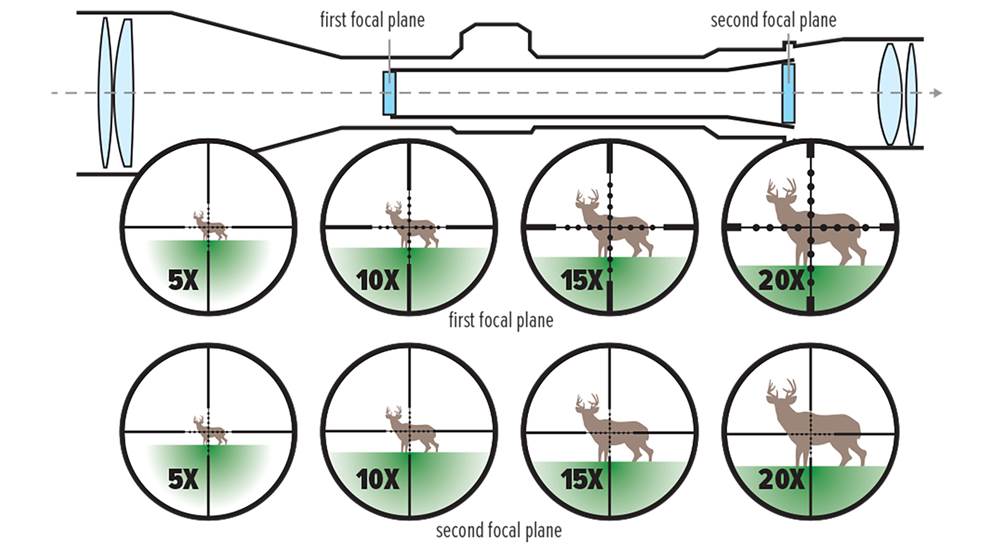
Had this scope been a first-focal-plane (FFP) scope, it would not have mattered at what magnification the scope was set, and we likely would have had 300 pounds of meat to haul out. In a FFP optic, as the reticle is etched or marked on a forward lens in the scope, the holdover hash marks below the crosshair would have been the same value, placing a bullet in the same place at 4X as they would have at 12X. However, this was a second-focal-plane scope, which means the reticle was marked or etched on a lens in the rear, closer to where you look into the scope.
Being a SFP scope, the reticle on my 4X-12X Bushnell will always appear the same size as the magnification is adjusted, but changing the magnification does change the hash marks on the reticle in relation to the target. This is where some of you readers may want to start looking through your scope and twisting that magnification ring. In the story above, at 300 yards, the second hashmark represents approximately 10.5 inches (3.5 inches x 300 yards) of drop at 12X magnification. At 4X magnification, that second hashmark just turned into 31.5 inches (12X = 10.5 inches; 12X/4X = 3 times more value; 10.5 inches x 3 = 31.5 inches). This hold at 4X put the bullet 20 inches over the intended point of impact.
With a FFP scope, the reticle will grow and shrink as you adjust the power ring. This does little good on a scope with a standard duplex reticle, as your only holding mark is the crosshair itself, centered at any power. Where FFP is a help is when you have a drop reticle with hashmarks for simple holdover or when you are using a system such as MIL-DOT. If the scope on that rifle had been a FFP scope with MIL-DOT subtensions, the magnification power would not have mattered as the second hashmark would always be a 10.5-inch value at 300 yards.
That’s all well and good, but that reticle sure does appear small on any power for a FFP scope. If you plan on shooting from one ridge to another, a FFP scope is the best bet. If you plan on shooting east of the Mississippi, you’re probably better off with a SFP scope. I’ve had a FFP scope mounted and wished I had a SFP scope.
I wouldn’t choose to replace the beautiful wood stocks on any legacy JM stamped Marlin 336, any of the modern Marlins, or any Henry. We’ve discussed this before. Fine Walnut stocks are too pretty to replace, and they make heirloom guns for the family.
On the other hand, if you have one of the polymer stock Henry rifles, it makes sense to consider something like this for hunting season for multiple reasons, e.g., water swelling of wood stocks in the rain, banging the stock around, etc.
Sorry, I can’t embed the YouTube shorts, just link them.
One can only hope that 35 Remington is next in line for Marlin. Think 200 grains moving at around the same speed as the 30-30 160 grains, or in other words, 30-30 on steroids.
I like it.
But I do find it a bit off-putting that Marlin won’t formally announce their plans. We shouldn’t be left to the vicissitudes of the rumor mill.
Watch the video. Words couldn’t do better than he demonstrates in the video.
Whenever someone says to you, “Such-and-such piece of equipment is malfunctioning because you haven’t broken it in,” run for the hills. Don’t buy it. If you bought it, sell it.
You don’t do that with the brakes or other safety equipment for your vehicle. Don’t do it with guns.
What a stupid thing to say to someone who purchased this firearm.
If I purchase a firearm, it’s going to work, and work correctly, immediately, or I won’t have it for long. This failure not only puts the person at risk of needing it and not having it, but also of an inadvertent discharge, specifically not the fault of the owner.
Good grief. I don’t do Sig anyway. I see now for good reason.
These observations will be brief and to the point, and they apply to the A400 Xtreme Plus and 1301 (but I suspect to all their newest line of shotguns excluding over-unders).
The bolt carrier is very similar in design to that of an AR-15, with a firing pin held in place by a retaining pin, a cam, and the bolt carrier. There are differences of course including dimensions, the spring on the fire pin, and the lack of gas return to operate the bolt (the Beretta gas system follows the tube).
But it has the look and feel of maintaining and cleaning an AR-15 at times.
Either Beretta learned from Eugene Stoner’s design and liked it and decided that it would lead to increased cycling speed, or they wanted American buyers to feel more accustomed to the system (or both).
There are numerous YouTube videos on this design.
Their over-unders are absolutely beautiful, but very pricey.
Rifled slugs are designed to be used in smoothbore shotguns. The rifled slug’s defining feature is a set of exterior grooves that resemble barrel rifling. Unlike barrel rifling, the slug’s grooves do not spin the projectile. Instead, the channels allow the slug to compress slightly so it can fit through a shotgun’s choke tube.
Sabot slugs lack the rifled slug’s exterior grooves because they are designed to be used in shotguns with rifled barrels or with a smoothbore paired with a rifled choke.
They go on to discuss various brands, including Remington Sabot slugs, Federal TruBall rifled slugs, Hornady American White Tail slugs, Winchester Super-X, and Brennecke Black Magin and Hefty Slugs.
I wouldn’t want to be behind a shotgun shooting Brennecke slugs unless my life was in danger.
The Hornady slug is 325 grains. I’m left wondering why anyone would choose to shoot that over 45-70 at 325 grains. Oh yea, stupid states like Illinois where shotgun and bow hunting are the only legal ways to harvest deer.
“We are talking about cartridges that are as powerful as you need to cleanly harvest the animal without being excessively powerful so that there is accidental damage at distant targets that you can’t see,” Dale said.
Dummies. South Carolina is a much more densely populated state than Illinois and this has never been a concern there. The gigantic woods and corn fields of Illinois are the last place one should be concerned about “targets you can’t see.”
I know The Alaskan prefers Brennecke for dangerous animals. If I lived there I’d probably practice with that – for one or two shots anyway.



 3 years, 4 months ago