Myths About Afghanistan
Victor Davis Hanson on whether Afghanistan is really the "graveyard of empires ..."
Ernie Pyle's timeless wartime columns ...
No July 4 hot dogs with the Iranian Mullahs ...
Mark Steyn, U.S. sclerotic and ineffectual, declining into societal dementia ...
Nicholas Schmidle asks some hard questions about Nawaz Sharif ...
The CIA's war against President Bush was motivated by ass covering, or by political
NSA Director Keith Alexander, a three-star general, is expected to earn a fourth star when he
Providing electronic devices for IEDs ...
Police watched from a distance and did not intervene ...
Been there, done that in the Middle East ...
Matt Sanchez - repealing DADT would be a disaster.
Too much U.S. largesse has created corruption in Afghan government.
Dan Riehl weighs in on language, thinking and security from terrorism ...
The U.S. is seeking to hire a merchant ship to deliver hundreds of tonnes of arms to Israel
Sharif brothers on Baitullah Mehsud's hit list.
No Georgian destruction of Tskhinvali, contrary to lying Russian claims.
Nuclear yield within six to twelve months.
McNeill ties length to Pakistan tribal region, likely to be protracted anyway.
Multinational force press release on Sadr City operations and seizure of weapons and munitions.
"We will fight them to the end."
War on terror not popular with Pakistani population.
U.S. presence expanding Southward in Iraq.
Its full steam ahead for Iran.
And SECDEF Gates continues to press this issue.
Pajamas Media exclusive: how your tax dollars fund terror.
Southwestern Baptist Theological Seminary Graduate executed in Afghanistan.
Nearly 1000 dead from harshest Afghan winter in 30 years.
Attacks in Baghdad down 80% according to Iraqi Army.
Lack of appropriate defense spending a grave situation.
Olmert claims Iran still on target to construct nuclear weapon.
Promoted to Army Vice Chief of Staff. Well deserved.
Must read on Israeli Army shame and lawyer happiness with war against Hezbollah.
Libyans joining jihad in increasing numbers.
How relevant will Maliki be to Iraq's future?
Maj. Gen. Gaskin: "The positive trends are permanent."
Abizaid questions whether Maliki can bring unity to Iraq.
From the Multinational Force, more on Operation Lion Pounce.
An important ally in Iraq has been assassinated.
Israel to show Chairman of Joint Chiefs of Staff nuclear intelligence on Iran.
Cabinet approves proposed agreement with U.S.
Prof. Kingsley Browne on his new book.
Major General Robert Scales: "Outcome is irreversible"
Mullen says military needs larger slice of GNP to modernize.
For siding with the U.S. against al Qaeda.
Terrorist poses as bride. Ugh!
Legislation in trouble.
Al Qaeda documents discovered near Syrian border.
Shameful people jeer disabled veterans in swimming pool.
Saudi jihadist in Iraq tells his personal story.
Concerning Iranian meddling and Quds.
Michael Yon breaks bread with General Petraeus.
Ralph Peters on the advancements in Iraq.
War between al Qaeda and Hezbollah.
Traumatic brain injury not recognized.
Ballistic Sensor Fused Munition.
High intensity electronic warfare.
Iranian weapons are a sign of continued Iranian meddling in Iraq.
U.S. forces in Iraq are using a high-resolution, thermal/infrared sensor system.
Washington Post profiles AQI (al Qaeda in Iraq, or al Qaeda in Mesopotamia).
Taiwan may not be as secure as we would like to think.
Be thankful your daughter isn't be raised in Basra.
Pastor discusses rules of engagement and sacrificial U.S. deaths.
In counterinsurgency (COIN), patience is a virtue. But violence has decreased so fast in
From Reuters:
Sanctions against Iran are biting hard and triggering divisions among its leadership, Defense Secretary Robert Gates said on Tuesday, as he argued against a military strike over Tehran’s nuclear program.
Iran has agreed to meet with a representative of the six big powers for the first time in more than a year over its uranium enrichment drive, but diplomats and analysts see little chance of a breakthrough in the long-running dispute.
Gates said he saw little choice, however, to pursuing a political strategy that includes sanctions and renewed his concerns that a military strike would only delay Iranian nuclear capabilities by two or three years.
He added that sanctions “have really bitten much harder than (Iranian leadership) anticipated,” and suggested Iranian President Mahmoud Ahmadinejad was increasingly at odds with Supreme Leader Ayatollah Ali Khamenei.
“We even have some evidence that Khamenei, now, (is) beginning to wonder if Ahmadinejad is lying to him about the impact of the sanctions on the economy. And whether he’s getting the straight scoop in terms of how much trouble the economy really is in,” Gates told the Wall Street Journal CEO Council in Washington.
[ ... ]
Although he acknowledged on Tuesday that Iranian leaders “are still intent on acquiring nuclear weapons,” he said military action was not a long-term answer.
“A military solution, as far as I’m concerned … it will bring together a divided nation. It will make them absolutely committed to obtaining nuclear weapons. And they will just go deeper and more covert,” Gates said.
“The only long-term solution in avoiding an Iranian nuclear weapons capability is for the Iranians to decide it’s not in their interest. Everything else is a short-term solution.”
Oh goodness. Gates has bought into the notion that Iran is pursuing nuclear weapons because they seek a deterrent to aggression against Iran. Convincing Iran to relinquish its pursuit of nuclear weapons is synonymous with convincing them that no one intends Iran harm. Military action only pushes they into the very decision point we wish to avoid. Or so the narrative goes.
It’s the same mistake made by most of the secular, post-modernist Western elite who sees things mainly through Western, secular eyes. It’s all about self preservation viz. Darwin, and upon being assured that they are safe, and since there is no such thing as real evil in the world and no absolute against which to measure such a thing as right or wrong, there is only the pragmatic. The Iranian rulers will be pragmatic and see the error of their pursuit and act in the defense of themselves and their own people. Altruistically, of course. It’s all about diplomacy. It just means saying the right things.
Except the world and mankind don’t work that way, and objective evil does in fact exist. Seeing things through eschatological eyes is uncomfortable to the Western secularists, but absolutely necessary in order to understand the radical Mullahs, who believe that:
“We do not worship Iran. We worship Allah. For patriotism is another name for paganism. I say let this land [Iran] burn. I say let this land go up in smoke, provided Islam emerges triumphant in the rest of the world.”
To be sure, military action is undesirable. There is always another way, involving covert operations, intelligence warfare, fomenting an internal Iranian insurgency, and catalyzing regime change. But with eyes through which the Western secularists see the problem, this will never occur. This virtually ensures war with Iran, sooner or later. Our own desire to avoid confrontation is at least a contributing cause to such an exigency.
This is the second awful decision Gates has made within a week. Does this set the expectations for the remainder of his tenure? Will it be two per week?
Via Federal Eye, U.S. Marine Corps General James Mattis, newly nominated to head CENTCOM, gives an unvarnished opinion of the enemy.
“Especially hard to overcome,” huh? The only bone I have to pick with General Mattis is that the prosecution of the Haditha Marines began under his watch. But this has worked itself out okay (except for one more Marine).
But it would seem to me that given the volatility and importance of the region and the obvious failure of soft diplomacy with Iran for 25 years, we need a moderately heavier hand at the helm. Trust is not what is needed with the radical Mullahs or their apparatchiks in Syria and Lebanon.
I can’t speak for everyone, but I like the idea of having a general who likes to kill the enemy. Let the politicians do the politics and let the warriors be warriors. I like what he said five years ago, and Gates should just stuff a sock in it and let the general speak for himself.
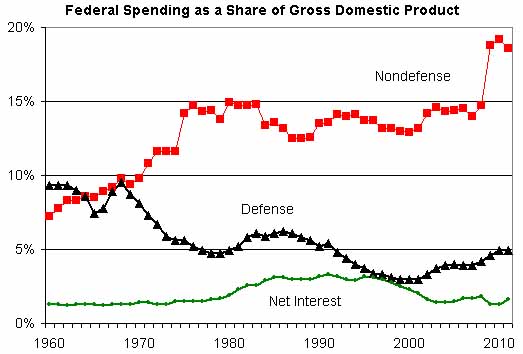
Before we address the issue of Secretary of Defense Robert Gates’ position on the sea services, let’s debunk the mythical notion that either the military or the campaigns in Iraq and Afghanistan is bankrupting the country (or even demanding the lion’s share of money). From CATO (h/t Glenn Reynolds at Instapundit).
That’s quite enough said about that. On to the sea services.
“Our current plan is to have eleven carrier strike groups through 2040,” Gates said. But a look at the facts is warranted, he added. The United States now has 11 large, nuclear-powered carriers, and there is nothing comparable anywhere else in the world.
“The U.S. Navy has 10 large-deck amphibious ships that can operate as sea bases for helicopters and vertical-takeoff jets,” he said. “No other navy has more than three, and all of those navies belong to allies or friends.”
The U.S. Navy can carry twice as many aircraft at sea as the rest of the world combined, Gates said. Under the sea, he told the group, the United States has 57 nuclear-powered attack and cruise-missile submarines – more than the rest of the world combined, and 79 Aegis-equipped surface ships that carry about 8,000 vertical-launch missile cells.
“In terms of total-missile firepower, the U.S. arguably outmatches the next 20 largest navies,” Gates said. “All told, the displacement of the U.S. battle fleet – a proxy for overall fleet capabilities – exceeds, by one recent estimate, at least the next 13 navies combined, of which 11 are our allies or partners.”
The United States must be able to project power overseas, Gates said. “But, consider the massive overmatch the U.S. already enjoys,” he added. “Consider, too, the growing anti-ship capabilities of adversaries. Do we really need 11 carrier strike groups for another 30 years when no other country has more than one?”
The Marine Corps is now 202,000 strong. It is the largest force of its type in the world, and exceeds in size most nations’ armies. Between the world wars, the Marine Corps developed amphibious warfare doctrine and used it to great effect against the Japanese during World War II. Whether that capability still is needed, however, is worthy of thought, the secretary said.
“We have to take a hard look at where it would be necessary or sensible to launch another major amphibious landing again – especially as advances in anti-ship systems keep pushing the potential launch point further from shore,” Gates said. “On a more basic level, in the 21st century, what kind of amphibious capability do we really need to deal with the most likely scenarios, and then how much?”
The Expeditionary Fighting Vehicle (EFV) will take a particularly tough beating over the course of the next several months and years, but the Marines have rolled out their case.
The Marine Corps unveiled its new $13 billion landing-craft program on Tuesday, a day after Defense Secretary Robert Gates questioned the Pentagon’s need for it …
“Secretary Gates has placed his marker, and he’s not in favor of continuing the program,” said Dakota Wood, a military analyst at the Center for Strategic and Budgetary Assessments and a retired Marine officer. “The Marine Corps is going to have to come up with a whale of a rationale to convince him otherwise.”
The need, the Marines say, stems from their need to replace its Nixon-era Amphibious Assault Vehicles. The new vehicle will allow Marines to land on a hostile shore, a capability needed, for example, in the withdrawal of U.S. forces from Somalia in the 1990s and civilians from Lebanon in 2006, said Lt. Gen. George Flynn, who leads the Marine Corps Combat Development Command. The amphibious capability also forces adversaries to undertake “costly defensive measures,” Flynn said.
Analysis & Commentary
The issue of expense of military hardware, systems and size has nothing to do with overspending. It pertains to the relative commitment of this particular administration to national defense as opposed to government-run, government-administered programs and subsidies. We have the economy to support an even larger military than we currently have. What we don’t have is the national will.
Aircraft carriers, as much or more than any other military hardware, is a way of projecting power across the globe. My support of them is well known, and my support for the F-22 program has been made clear. In fact, I have proposed an increase rather than a decrease in Carrier battle groups. The size of the Marine Corps is not a problem for the national economy, and it’s easy to question expenditures for a strong national defense while comfortably enjoying the peace and security that it has brought.
But this isn’t the same thing as questioning the need for the EFV and the forcible entry doctrine of the Marine Corps. I have taken the doctrine to task.
I do not now and have never advocated that the Marine Corps jettison completely their notion of littoral readiness and expeditionary warfare capabilities, but I have strongly advocated more support for the missions we have at hand.
Finally, it occurs to me that the debate is unnecessary. While Conway has famously said that the Corps is getting too heavy, his program relies on the extremely heavy Expeditionary Fighting Vehicle, that behemoth that is being designed and tested because we want forcible entry capabilities – against who, I frankly don’t know.
If it is a failing state or near failing state, no one needs the capabilities of the EFV. If it is a legitimate near peer enemy or second world state, then the casualties sustained from an actual land invasion would be enormous. Giving the enemy a chance to mine a beach, build bunkers, arm its army with missiles, and deploy air power, an infantry battalion would be dead within minutes. 1000 Marines – dead, along with the sinking of an Amphibious Assault Dock and its associated EFVs.
No one has yet given me a legitimate enemy who needs to be attacked by an EFV. On the other hand, I have strongly recommended the retooling of the expeditionary concept to rely much more heavily on air power and the air-ground task force concept. It would save money, create a lighter and more mobile Marine Corps (with Amphibious Assault Docks ferrying around more helicopters rather than LCACs), and better enable the Marines to perform multiple missions. I have also recommended an entirely new generation of Marine Corps helicopters.
This is not suggesting that the Marine Corps in any way needs to have its funding cut or decrease its size. It is to suggest that the money might be more wisely spent in other areas. The mission still isn’t clear. Above it has been suggested that the Corps needs the EFV for withdrawal of forces (such as from Somalia) or evacuation of civilians (such as from Lebanon). But this explanation doesn’t comport with the facts of the program. “The Corps aims to buy a total of 573 EFVS. This would give it the capacity to amphibiously transport eight infantry battalions of about 970 Marines and sailors per battalion, the Congressional Research Service said in a report dated August 3, 2009.”
We don’t need 573 EFVs and eight infantry Battalions to evacuate civilians from Lebanon. The Corps obviously plans to replace its amphibious transport of Marines (currently with the LCAC) with the EFV. The Corps also plans to continue its doctrine of amphibious-based forcible entry. But as I have pointed out, there is no reason that this cannot be done via air and a new helicopter fleet. If the plan is to be prepared to invade a near-peer via an amphibious landing, this is lunacy and madness. If the plan is to save ships by allowing them to be 25 miles offshore, this is naive and sophomoric. The Navy had better be designing better counter-measures.
While there is every good reason to be more efficient in both military spending and non-defense spending, there is no good reason to cut funding to the Corps. But the Corps needs to rethink its basic doctrine and reassess the real need for the EFV. Going in the direction of a lighter, air-sea-based, rapid reaction force has its merits, and should warrant some attention. Gates should hear fresh thinking from the U.S. Marine Corps, not warmed over 60 year old doctrine. It’s too bad that the QDR, that brainchild of Michelle Flourney, is such an incredible waste of ink and paper. It would have been a good repository for fresh thinking.
Secretary Gates is again pressing Pakistan to see the Taliban and al Qaeda (one presumes he means here both the Pak-Taliban and Afghan-Taliban) as our common enemy.
RAWALPINDI, PAKISTAN — Defense Secretary Robert M. Gates made an unannounced trip here Thursday to urge Pakistan to expand its crackdown against the Taliban as well as to counter skepticism about the Obama administration’s new war strategy for Afghanistan.
But there is an increasing symbiosis between the Pak-Taliban, the Afghan-Taliban and al Qaeda, and launching strikes against one is like strikes against them all. While Pakistan may see the Tehrik-i-Taliban as a potential enemy of the state, it still sees the Afghan-Taliban (the Quetta Shura) as its balance against India.
Myra MacDonald has an interesting article on “strategic depth” that warrants attention. She begins by citing a Pakistani commentator, and then discusses her own personal perspective given her history in the region. This is an extended read, but well worth the time.
Kamran Shafi has a column up at Dawn mocking Pakistan’s old strategy of seeking “strategic depth” – the idea that in the event of war with India its military would be able to operate from Afghanistan to offset its disadvantage as a small country compared to its much bigger neighbour:
“Let us presume that the Indians are foolish enough to get distracted from educating their people, some of whom go to some of the best centres of learning in the world. Let us assume that they are idiotic enough to opt for war instead of industrialising themselves and meeting their economic growth targets which are among the highest in the world. Let us imagine that they are cretinous enough to go to war with a nuclear-armed Pakistan and effectively put an immediate and complete end to their multi-million dollar tourism industry. Let us suppose that they lose all sense, all reason, and actually attack Pakistan and cut our country into half.
“Will our army pack its bags and escape into Afghanistan? How will it disengage itself from the fighting? What route will it use, through which mountain passes? Will the Peshawar Corps gun its tanks and troop carriers and trucks and towed artillery and head into the Khyber Pass, and on to Jalalabad? Will the Karachi and Quetta Corps do likewise through the Bolan and Khojak passes? And what happens to the Lahore and Sialkot and Multan and Gujranwala and Bahawalpur and other garrisons? What about the air force? Far more than anything else, what about the by now 180 million people of the country? What ‘strategic depth’ do our Rommels and Guderians talk about, please? What poppycock is this?
“More importantly, how can Afghanistan be our ‘strategic depth’ when most Afghans hate our guts, not only the northerners, but even those who call themselves Pakhtuns?”
Pakistan’s policy of seeking strategic depth in Afghanistan has been up for discussion since 9/11, when it was forced to abandon the Taliban regime it had backed to try to contain Indian influence there and give itself the space that it felt was so lacking on its eastern border. I have heard Pakistanis saying it was a stupid idea; others saying that even within the Pakistan Army there was a recognition that strategic depth nowadays was best achieved through building a strong domestic economy. Unlike 1971, when Pakistan was cut in two after Bangladesh, then East Pakistan, won independence with Indian military support, the notion that it might be split in half by an Indian offensive pretty much became outdated when both countries announced they had tested nuclear weapons in 1998.
So is Shafi tilting at windmills? Attacking an idea that belonged to the last century?
Not entirely. Strategic depth has become ingrained in the narrative of relations between India, Pakistan and Afghanistan — so taken for granted that I remember being rather surprised myself when a subeditor, quite rightly, asked me to explain what it meant. It may no longer apply in the pure military sense of providing a space to which the army can fall back and where reserves and supplies can be stored, but as a theoretical and emotional concept it lingers.
Notice the idea of Pakistan being forced to abandon their support for the Afghan-Taliban after 9/11. If we wish once again to force Pakistan to abandon their investment in the Taliban, half-way measures won’t do. The AfPak theater of operations must be seen as the focal point of the battle against the transnational Islamic insurgency, and we must resource the campaign with this in mind.
Did Secretary Gates’ admonition accomplish its mission? Not even nearly.
Pakistan’s army has said it will launch no new offensives on militants in 2010, as the US defence secretary arrived for talks on combating Taliban fighters.
Army spokesman Athar Abbas told the BBC the “overstretched” military had no plans for any fresh anti-militant operations over the next 12 months.
Our correspondent says the comments are a clear snub to Washington.
But it gets worse. Pakistan is even worried that the buildup of U.S. troops in Afghanistan will send fleeing Taliban across the so-called border into their territory. This is a fairly rudimentary issue to be so far and so many years into the campaign – this notion that the intent is for the Pakistanis to press the Taliban from their side while we press them from the Afghan side.
This all points to a Pakistan that still doesn’t see the Taliban as an existential threat, a Pakistan that can still use the Taliban as a balance to Indian power (however quaint the notion), and a Pakistan that simply wants to see it all go away – and believes that a cessation in military operations will accomplish this.
Asking the question whether al Qaeda and the Taliban are in Pakistan or Afghanistan is like asking whether the water is on the right or the left side of a swimming pool.
The conversation on Pakistan versus Afghanistan presupposes that the Durand Line means anything, and that the Taliban and al Qaeda respect an imaginary boundary cut through the middle of the Hindu Kush. It doesn’t and they don’t. If our engagement of Pakistan is to mean anything, we must understand that they are taking their cue from us, and that our campaign is pressing the radicals from the Afghanistan side while their campaign is pressing them from the Pakistani side.
Advocating disengagement from Afghanistan is tantamount to suggesting that one front against the enemy would be better than two, and that one nation involved in the struggle would be better than two (assuming that Pakistan would keep up the fight in our total absence, an assumption for which I see no basis). It’s tantamount to suggesting that it’s better to give the Taliban and al Qaeda safe haven in Afghanistan as Pakistan presses them from their side, or that it’s better to give them safe haven in Pakistan while we press them from our side. Both suggestions are preposterous.
The administration has recently pressed for the release of both the interrogation memos and the associated photographs. Regarding this information:
“They should have fought it all the way; if they lost, they lost,” said Lowenthal, who retired from the Agency in 2005. “There’s nothing to be gained from it. There’s no substantive reason why those photos have to be released.”
Lowenthal said the president’s moves in the last week have left many in the CIA dispirited, based on “the undercurrent I’ve been getting from colleagues still in the building, or colleagues who have left not that long ago.”
“We ask these people to do extremely dangerous things, things they’ve been ordered to do by legal authorities, with the understanding that they will get top cover if something goes wrong,” Lowenthal says. “They don’t believe they have that cover anymore.” Releasing the photographs “will make it much worse,” he said.
Setting aside the issue of whether water-boarding is torture or whether certain interrogation techniques should be used, the release of detail concerning the same is bound to continue to undermine a CIA that lost much of its capability in human intelligence in the Clinton years. Secretary of Defense Gates’ reaction to the release of the memos is interesting on multiple levels.
CAMP LEJEUNE, N.C. — Defense Secretary Robert M. Gates expressed concerns on Thursday that the release of Justice Department memorandums on harsh interrogation techniques might be used by Al Qaeda and other adversaries and put American troops at risk.
But Mr. Gates said that the public release of graphic, detailed information on American interrogation techniques for terrorists was inevitable and that he had focused his efforts in cabinet-level discussions on how the United States should deal with the expected international backlash.
Mr. Gates declined to say whether his private advice to President Obama was to release or withhold the documents and instead said he urged careful attention to dealing with the consequences of their disclosure.
“Pretending that we could hold all of this and keep it all a secret, even if we wanted to, I think was probably unrealistic,” Mr. Gates said. “My own view was shaped by the fact that I regarded the information about a lot of these things coming out as inevitable.”
The central question he posed in lengthy, intense debate among the president’s senior advisers, Mr. Gates said, was, “How do we try and manage it in the best possible way?”
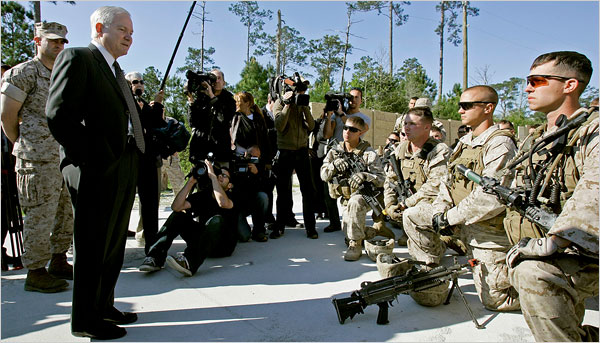
Mr. Gates’s comments on the release of the documents by the administration were the first since they were made public. He spoke on a visit to Marines training here for a deployment to Afghanistan, and he expressed apprehensions that the release of the information “might have a negative impact on our troops” and that the “disclosures could be used by Al Qaeda and our adversaries.”
Mr. Gates said he had argued that Central Intelligence Agency officers who were following legal guidelines for interrogation be protected. He said he was concerned “first and foremost” that protection be guaranteed for “C.I.A. officers who were involved in the interrogations — and who performed their duties in accordance with the legal guidance they had been given by the Justice Department.”
Gutsy move. Let’s translate the statement[s] above into a something more usable by giving the less political version that Gates doubtless wanted to say.
“Look. You and I both know that this is stupid. Whatever you might think of what was done, those involved should be protected. It was inevitable, which means that I am alone on the Cabinet. I did all that I could do, which is to argue for protecting the fidelity of our intelligence community and managing as best as possible the release of the information. They were hell bent on doing it, and it was unrealistic to think that I could stop it. Be glad you have me there – I am the lone voice of reason on the Cabinet.”
By the way, it appears as if Gates has recovered nicely from his broken arm.
Prev | List | Random | Next · Join Powered by RingSurf! |