Myths About Afghanistan
Victor Davis Hanson on whether Afghanistan is really the "graveyard of empires ..."
Ernie Pyle's timeless wartime columns ...
No July 4 hot dogs with the Iranian Mullahs ...
Mark Steyn, U.S. sclerotic and ineffectual, declining into societal dementia ...
Nicholas Schmidle asks some hard questions about Nawaz Sharif ...
The CIA's war against President Bush was motivated by ass covering, or by political
NSA Director Keith Alexander, a three-star general, is expected to earn a fourth star when he
Providing electronic devices for IEDs ...
Police watched from a distance and did not intervene ...
Been there, done that in the Middle East ...
Matt Sanchez - repealing DADT would be a disaster.
Too much U.S. largesse has created corruption in Afghan government.
Dan Riehl weighs in on language, thinking and security from terrorism ...
The U.S. is seeking to hire a merchant ship to deliver hundreds of tonnes of arms to Israel
Sharif brothers on Baitullah Mehsud's hit list.
No Georgian destruction of Tskhinvali, contrary to lying Russian claims.
Nuclear yield within six to twelve months.
McNeill ties length to Pakistan tribal region, likely to be protracted anyway.
Multinational force press release on Sadr City operations and seizure of weapons and munitions.
"We will fight them to the end."
War on terror not popular with Pakistani population.
U.S. presence expanding Southward in Iraq.
Its full steam ahead for Iran.
And SECDEF Gates continues to press this issue.
Pajamas Media exclusive: how your tax dollars fund terror.
Southwestern Baptist Theological Seminary Graduate executed in Afghanistan.
Nearly 1000 dead from harshest Afghan winter in 30 years.
Attacks in Baghdad down 80% according to Iraqi Army.
Lack of appropriate defense spending a grave situation.
Olmert claims Iran still on target to construct nuclear weapon.
Promoted to Army Vice Chief of Staff. Well deserved.
Must read on Israeli Army shame and lawyer happiness with war against Hezbollah.
Libyans joining jihad in increasing numbers.
How relevant will Maliki be to Iraq's future?
Maj. Gen. Gaskin: "The positive trends are permanent."
Abizaid questions whether Maliki can bring unity to Iraq.
From the Multinational Force, more on Operation Lion Pounce.
An important ally in Iraq has been assassinated.
Israel to show Chairman of Joint Chiefs of Staff nuclear intelligence on Iran.
Cabinet approves proposed agreement with U.S.
Prof. Kingsley Browne on his new book.
Major General Robert Scales: "Outcome is irreversible"
Mullen says military needs larger slice of GNP to modernize.
For siding with the U.S. against al Qaeda.
Terrorist poses as bride. Ugh!
Legislation in trouble.
Al Qaeda documents discovered near Syrian border.
Shameful people jeer disabled veterans in swimming pool.
Saudi jihadist in Iraq tells his personal story.
Concerning Iranian meddling and Quds.
Michael Yon breaks bread with General Petraeus.
Ralph Peters on the advancements in Iraq.
War between al Qaeda and Hezbollah.
Traumatic brain injury not recognized.
Ballistic Sensor Fused Munition.
High intensity electronic warfare.
Iranian weapons are a sign of continued Iranian meddling in Iraq.
U.S. forces in Iraq are using a high-resolution, thermal/infrared sensor system.
Washington Post profiles AQI (al Qaeda in Iraq, or al Qaeda in Mesopotamia).
Taiwan may not be as secure as we would like to think.
Be thankful your daughter isn't be raised in Basra.
Pastor discusses rules of engagement and sacrificial U.S. deaths.
In counterinsurgency (COIN), patience is a virtue. But violence has decreased so fast in
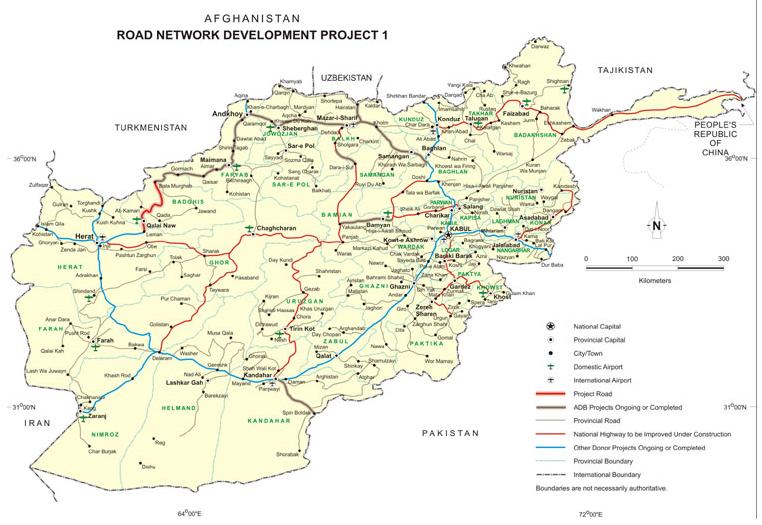
Afghanistan’s ring road, courtesy of the Asian Development Bank.
Roads, logistics and transit have long been a focus of The Captain’s Journal. Naturally, we’re interested to see the beginnings of one key element in the U.S. strategy, reclaiming the ring road.
Rocket-propelled grenades streaked through the fading light and exploded behind the US convoy patrolling in eastern Afghanistan. Muzzle flashes flared in the gloom as Taleban insurgents opened up with heavy machineguns and AK47s. Delta company was caught in an ambush.
Foul-mouthed soldiers swung their weapons towards a complex of mud-walled buildings 800 yards away. “Get some!” roared the gunner of an M19 grenade launcher. The thud of return fire from the Americans’ vehicle-mounted weapons began.
Soldiers inside their Humvees opened bullet-proof windows and slid their rifles through. Those on the right side of the convoy scrambled out and brought their weapons to bear on the sparks flashing in the distance. Red tracer flew towards the buildings.
“Three o’clock,” someone shouted. Grey smoke trails lingered in the air where the rocket-propelled grenades had exploded. Under orders to “shoot conservative”, combat veterans tried to calm adrenalin-pumped novices. “Take your time,” one shouted. “One burst every ten seconds.”
The slew of hot shell casings from the gunners’ turrets that had cascaded into the vehicles began to ease. A foot patrol cut around the insurgents’ flank as darkness fell, running hard through wheatfields, ducking every 50 yards. No one spoke. Everyone sucked in air.
Afghan National Police went with them as they pushed through the mud compounds. Breaking down doors by torchlight they found terrified women and children inside who said that they knew nothing. Some shielded their dignity by facing walls. The only man there of fighting age was blind.
Attack helicopters and F15 jets growled somewhere in the skies above and confirmation came through of two kills. The rest of the attackers had vanished. “They’re so much lighter than us,” 3rd Platoon’s commanding officer, Lieutenant Adam Novak, said. “They break faster.”
Part of the first ripple in the US troop surge to Afghanistan, Delta company and its sister units are securing a 67-mile stretch of the Kabul to Kandahar highway, the country’s main north-south road. Sixty per cent of Afghanistan’s population live within 30 miles (50km) of one of the country’s main highways, collectively known as the “ring road”.
“The single biggest measure the Afghan people have in their mind of whether or not there is security is their ability to travel with freedom,” Lieutenant-General Jim Dutton, Nato’s deputy commander in Afghanistan, told The Times. Reclaiming the ring road is a key plank of US and Nato strategy.
We have long recommended the securing of that bad stretch of what is otherwise called Highway 1, especially from Kandahar to Kabul. Logistics is a nightmare on this road, and many hired Afghanistan drivers have perished at the hands of the Taliban.
It was the very astute Philip Smucker who said “If Afghanistan is to ever be secure, it must first be paved.” We linked his interview in Backwards Counterinsurgency in Afghanistan, and if you haven’t listened, you have another chance to hear this important conversation.
While we have strongly recommended reclaiming the ring road for purposes of logistics, security and development, it is important to remember what “reclaiming” the road means. It doesn’t mean building it or paving it, although that is certainly included. It also means kinetic operations by infantry to find and kill the enemy.
If the Taliban are left alive and the roads are constructed, it only provides the Taliban with a means to rapidly travel from one place to another to collect their taxes and enforce their government. Roads are inanimate objects, and alone they cannot compete with killers such as the Taliban. Roads are at best one tool, and for this reason, The Captain’s Journal has recommended that more troops be sent to Afghanistan.
TCJ concurs with Philip concerning roads. TCJ also claims that until there is no safe haven for the Taliban, until his sanctuary has been turned against him, until the terrain in which he raises his largesse and recruits his fighters has become his death trap, Afghanistan will not be secure.
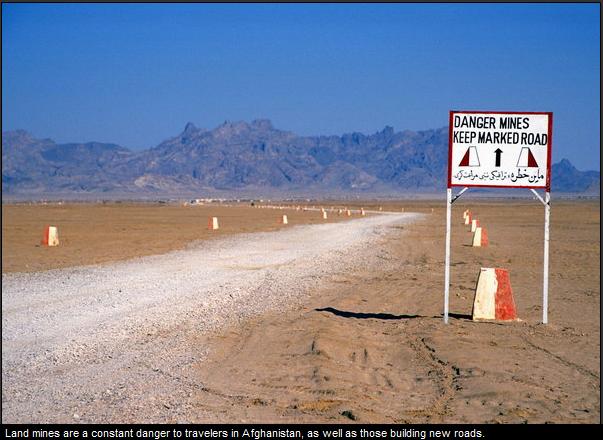
Mines and IEDs are a constant threat, but paving the roads means an immediate reduction in IEDs. Digging in pavement is harder than digging in dirt.
Prior:
Backwards Counterinsurgency in Afghanistan
McClatchy recently had an interesting report on the importance of roads in counterinsurgency. It’s lengthy but well worth the time.
Two hundred U.S. troops rumbled into a key Taliban stronghold Wednesday in a major operation to stop insurgents from infiltrating the Afghan capital from the south and to clear the way for the first sustained international aid effort in this remote valley.
Supported by about 200 Afghan soldiers and their French army trainers, the 200 U.S. soldiers encountered no resistance.
But the locals’ reactions to their arrival ranged from skepticism to hostility. “Down To America” dabbed in whitewash greeted the U.S. column as it entered the Jalrez Valley from the U.S. base in Maydan Shahr, the capital of Wardak province.
Icy-eyed villagers stared as towering MRAP armored trucks and other vehicles towing trailers, generators and guns, protected by two helicopter gunships and two A-10 “tank-buster” jets, plowed parts of the valley’s main track into knee-high furrows of dense mud. The convoy halted traffic for hours and churned slowly through the main bazaar twice, filling the crisp winter air with choking clouds of diesel fumes.
“Everything was OK before they came here,” Mohammad Sharif growled as he sat in his dingy confectionery shop glaring at the American vehicles stopped outside. “We don’t want them to come here. We haven’t needed them for 1,000 years. This is our country.”
U.S. officers contend that the valley, about 50 miles south of Kabul, is under firm Taliban control and that the guerrillas enjoy strong support among the district’s ethnic Pashtuns, who constitute 30 percent of the Jalrez District’s impoverished population of about 66,000.
“This is where key leaders of the Taliban are located,” said Lt. Tyjuan Campbell of Apache Company, 2nd Battalion, 82nd Infantry Regiment, 3rd Brigade Combat Team of the 10th Mountain Division.
U.S. and French officers said Taliban explosives experts produce roadside bombs and suicide vests in the valley. The insurgents also use the area to infiltrate Kabul and launch attacks, stealing through the mountains on narrow tracks and goat paths.
Campbell conceded that the U.S. force made no friends with its two-way, three-hour, fume-belching grind through the main bazaar’s narrow lane.
“I’m pretty sure they got quite upset. We rolled right through there and rolled right back again,” Campbell said as the sun set and the biting cold intensified.
The main force’s long column of vehicles was supposed to drive the 15 miles to the Jalrez Bazaar at around 40 mph. But a partially completed Chinese-built paved road gave way to a rutted, waterlogged track that forced the armored vehicles to slow to less than 10 mph at some points.
The convoy took four hours to reach the main bazaar, passing the abandoned, French-built agricultural center where it was supposed to establish a base.
Inside the bazaar, the U.S. trucks and Humvees idled for more than 45 minutes. Men crouched on the verges, and women wearing full-length burqas and cradling infants hurried by.
After the troops realized that they’d passed the agricultural center, the convoy had to turn around on the narrow track. The return journey took three hours.
Aziz Ahmad, one of several dozen drivers and passengers stalled by the convoy, at first expressed anger and resentment at the outsiders, complaining about the blockage and saying villagers “are afraid that fighting will now start here. They are scared.”
The situation looks bleak at this point. So what might be able to turn it around?
But Ahmad said many residents would reconsider their views if the Americans paved the track.
“If they pave the road, that is a foundation for Afghanistan,” he said. “Things will begin to change.”
So in addition to potentially being a game-changer with the sentiments of the population, do roads help the security situation? We’ve posed this question before, and the answer appears to be unequivocally that it does.
“I can’t tell you how important roads are,” said Colonel Pete Johnson, the commander of U.S. forces in southeast Afghanistan, where development lags central and northern areas and paved roads are minimal.
“If we pave roads, there’s almost an automatic shift of IEDs to other areas because it makes it so much more difficult for the enemy to emplace them … Roads here mean security,” he told Reuters in an interview last week.
So build them roads. But don’t leave, because the insurgents will take them over, use them for transit and checkpoints, and defeat their intended purpose. The insurgency must be defeated. Win the population in order to develop an avenue into the heart of the insurgents.
The next time you swear at the snow on the roads as you’re driving to work, remember this.
Unlike Iraq, Afghanistan is at a state of development where the construction of roads is a significant player in counterinsurgency due to the creation of avenues of movement, interdiction and access to the population. David Kilcullen recently wrote about this at the Small Wars Journal Blog. It is a detailed look into this aspect of counterinsurgency and well worth the time to study it, but only a small portion is reproduced below.
On the face of it, road-building appears to be a generally-recognized form of force projection and governance extension, hence the extreme frequency of its historical use by governments, colonial administrations, occupying powers, and counterinsurgency forces through history. It is also worth recognizing that there is little that is specifically American (or Afghan) about the engineering aspects of the approach described above.
But the effects accrue not just from the road itself, but rather from a conscious and well-developed strategy that uses the road as a tool, and seizes the opportunity created by its construction to generate security, economic, governance and political benefits. This is exactly what is happening in Kunar: the road is one component, albeit a key one, in a broader strategy that uses the road as an organizing framework around which to synchronize and coordinate a series of political-military effects. This is a conscious, developed strategy that was first put in place in 2005-6 and has been consistently executed since. Thus, the mere building of a road is not enough: it generates some, but not all of these effects, and may even be used to oppress or harm the population rather than benefit it. Road construction in many parts of the world has had negative security and political effects, especially when executed unthinkingly or in an un-coordinated fashion. What we are seeing here, in contrast, is a coordinated civil-military activity based on a political strategy of separating the insurgent from the people and connecting the people to the government. In short, this is a political maneuver with the road as a means to a political end.
The Captain’s Journal left the following short comment to this article.
Very interesting, and thanks for your thoughts. I especially like the idea of using roads for force projection (easier and quicker transit for forces, easier presence with the population, visibility, etc.), and in this way, roads seem to have become a force multiplier.
Of course, VBIEDs are an issue involved with roads that would not otherwise be if the roads weren’t there (which is certainly not an argument for not having the roads). I would like to know your thoughts on dealing with the problems such as VBIEDs that are unique only to roads. Also, in spite of the difficulty of emplacing roadside IEDs, they still do as reports indicate.
Following up on this concern, from a Reuters report, it makes a difference how the road is constructed.
Spend 30 minutes talking to a U.S. military officer in Afghanistan and chances are he or she will mention one factor as crucial to the stability of the country: roads.
Geographically challenging, with vast desert plains to the south and soaring mountains in the Hindu Kush to the north and east, Afghanistan is remarkably devoid of proper roads given its size and a population approaching 30 million.
There are just 34,000 km (21,000 miles) of useable roadway in the country, of which less than a quarter is paved, according to the CIA World Factbook. By comparison, there are about 10 million km of paved roads in the United States.
Better roads are essential not only for the economy — so that farmers and merchants can get produce to markets more easily and importers can bring vital foodstuffs into the landlocked country — but also for security, since police and the army can get more quickly to remote, unstable areas.
Paved roads also make it much harder for the Taliban to plant improvised explosive devices (IEDs) — nearly 750 of which detonated across Afghanistan last year, causing hundreds of deaths. Planting them on pot-holed, dirt tracks is easy.
“I can’t tell you how important roads are,” said Colonel Pete Johnson, the commander of U.S. forces in southeast Afghanistan, where development lags central and northern areas and paved roads are minimal.
“If we pave roads, there’s almost an automatic shift of IEDs to other areas because it makes it so much more difficult for the enemy to emplace them … Roads here mean security,” he told Reuters in an interview last week.
The Reuters report concludes with an assessment of the inefficiency of the process used to contract and build the roads, as well as lack of international funding. But the report on roads by Col. Johnson tells us that for the time being, dirt roads mean IEDs while paved roads mean a shift of tactics or forces elsewhere due to the difficulty of emplacing IEDs into pavement.
In the future we might expect the insurgents in Afghanistan to become more efficient at roadsidebombs like their counterparts in Iraq, but for now, UAVs, patrols, and other tactics will be used to find those who emplace the IEDs, which after all, is the root of the problem. The chase must continue.
Prev | List | Random | Next · Join Powered by RingSurf! |