Lt. Col. William F. Mullen who commands the 2nd Battalion, 6th Marine Regiment (currently at Forward Operating Base Reaper on the South side of Fallujah), gives us an exclusive look into Operation Alljah and what has been accomplished in Fallujah. His discussion is both informative and interesting, and points to modifications and adjustments to the template used in the Anbar Province. Every city and engagement has been a unique experience, but the adaptability of the United States Marine Corps has proven to be one of the most effective weapons in their arsenal.
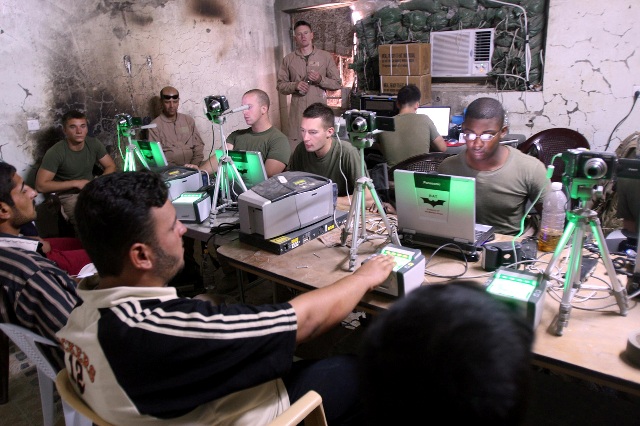
Marines take fingerprints, iris scans and other information from Iraqi citizens using the Biometrics Automated Toolset in an Iraqi Police precinct in Fallujah on July 19.
Interview with Lt. Col. William F. Mullen
TCJ: Lt. Col. Mullen, thanks for the chance to interview you on the hard work and accomplishments of 2nd Battalion, 6th Marines in Fallujah. Operation Alljah seems to have had multiple phases. For instance, the Multi-National Force issued press releases on June 5th, 7th, 8th, 9th and 10th on kinetic operations against the insurgency and terrorists. Can you describe this part of the operation for us? For instance, since the so-called Anbar Awakening came somewhat late to Fallujah compared to Ramadi, how did 2/6 identify the insurgents?
Lt. Col. Mullen: Well, to help clarify, many times MNF-W identifies attacks or kinetic events as happening in Fallujah, but they mean the Fallujah area. There has been a great deal going on in the smaller towns outside of the city to curtail enemy activities out there and keep them from trying to return to the city. We have had some small events in the city, but overall, it has been very quiet. The latest big event we had was on June 2nd when we conducted a raid with the police that killed 7 enemy, captured 8, found two truck bombs before they went off, IED making material and other enemy supplies. Three of the dead enemy had suicide vests on and they were killed before they could set off the vests. This was a great operation based off of intelligence that the police had gained. We have also been conducting quiet little cordons and searches on houses based off of more tips from the civilian population and are picking off the enemy one or two at a time. They never fight when we do this because we are too strong for them and this is having a serious demoralizing effect on the enemy. We had a serious sniper problem in the city when we first took over and it is gone for all intents and purposes now. We detained 11 suspected snipers and killed two. They now operate well away from the city. As for the awakening, that is more of a tribal thing. Tribes have little influence inside Fallujah because of how mixed up the population is. They are all solidly against AQI though, because they want nothing to do with their extremist agenda and are appalled by the tactics AQI is using. As just one example, in an area NE of the city, AQI herded 12 women and children, all relatives of a prominent area Sheik who had declared himself against AQI, into a building and blew it up on them killing them all. That is the type of rabid dog enemy we all face out here. They are cutting off their nose to spite their face and the average Iraqi wants nothing to do with them.
TCJ: It seems as if the police of Fallujah have managed to assist and work together in the pacification of Fallujah, with the Marines doing a lot of the heavy lifting in the way of combat operations in the initial stages of Operation Alljah. Can you describe the working relationship between the Marines and the police?
Lt. Col. Mullen: The relationship between us and the police is very good. At the start of ALLJAH, they were centrally located in the HQ in the middle of the city. They were afraid to go home in uniform, some never went home at all, IP houses were getting blown up or burned down, some would get assassinated on their front doorsteps, etc. When they went out to do a raid, they went out in force and scared to death. Now they are spread all over the city in precincts supported by over 1400 neighborhood watch personnel. They not only go home now, they do so in uniform proudly. They used to always wear masks over their face so they would not be recognized and targeted off duty – few do that now. They have a lot of logistical support issues, but we are working hard to iron them out and make them self sufficient. They are brave (at last count they had lost over 200 police since they were reestablished in mid 2005) and genuinely want to restore security to their city. They are well on their way. We know they have corruption issues – it is a cultural thing that is much more acceptable to them than it is to us – and they are infiltrated by the enemy, but all of these things are issues they are specifically working on. Given the track record of our own police departments, I’d say they are doing pretty well. We implemented a professional development program for them using actual American Police officers that have come over to train police here and it is starting to reap positive results. They have a long way to go, but are moving with a purpose in the right direction.
TCJ: Working with erstwhile insurgents to turn them against the insurgency and terrorists has been called a risky strategy by some, and of course, any strategy comes with risks. But it would seem that working with the insurgents and using their services against the very violence they at one time perpetrated is part of the genius of the approach. Can you describe how this has occurred in Fallujah?
Lt. Col. Mullen: We aren’t really doing that here in the city. I am sure that there are former insurgents in the police and neighborhood watch – which is why I tell my guys that we can never completely trust them – but we have not had a single instance where we took a known insurgent and turned him to our side. We continue to target them heavily and most have either been detained, or fled the city. The ones remaining spend a lot of time trying to keep from being detained instead of planning on how they will attack us. We keep the pressure on them to keep them off balance and on the run. That is having the best effect in the city.
TCJ: It appears that you have made signficant use of the concept of “gated communities” in Fallujah in order to bring security. I noted that there is also a temporary ban on vehicle traffic that will be lifted soon. Can you describe how the ban has helped and what the role of the gated communities has been? How successful has this tactic been?
Lt. Col. Mullen: The gated community idea was implemented because the enemy uses cars almost exclusively to conduct their attacks. The barriers emplaced allow the citizens of each precinct to choose who they want to come into their area, and makes it difficult for the enemy to move around and escape in a vehicle. The vehicle curfew was implemented by the Mayor and Police chief due to several suicide vehicle bomb attacks, one of which was particularly horrific. There was a funeral for an Iraqi that had been fighting AQI and AQI had a suicide bomber drive right into the funeral procession and blow himself up. 20 civilians were killed and 17 were injured. This was a watershed event here in Fallujah. We were not confident that a vehicle curfew could be implemented, but it has been, almost solely by the police and in conjunction with the barriers we have been emplacing, and it has resulted in a three-fold decrease in enemy attacks. The people do not like the barriers or the curfew, but they do like the security and indicate they are willing to put up with them to keep the security.
TCJ: To what extent have you utilized COPS (variously called Combat Outposts and Combat Operation Posts) as part of Operation Alljah versus the more traditional military doctrine of force protection?
Lt. Col. Mullen: We do use Combat Outposts, but in this case, we call them Joint Security Stations. We have Marines partnered with IP at every precinct HQ. Force Protection is a constant, so we make sure each site is protected against suicide bombers and sniper fire, but we also ensure that the HQ is accessible to people on foot. It is a difficult balance, but it is absolutely necessary. Being out amongst the population is the only way to finish this fight. Driving to work means you miss a lot. Also, at least initially, the police would only stay in the precincts if we were there with them. They were pretty intimidated. This is no longer the case. They know we have their back while they grow stronger by the day.
TCJ: It appears that the transition to nonkinetic operations was fairly stark. Press reports about combat operations stopped and press reports about construction of police precincts started. In a professional military academic climate that claims that standard counterinsurgency takes ten to twelve years, how did the Marines of 2/6 manage to pull this off?
Lt. Col. Mullen: We got the citizens of the city involved in providing their own security through the neighborhood watch system. We pay them a pittance of $50 a month (only a part time job as an extra set of eyeballs for the police – they are not police) and we authorize them to carry a weapon if they have one for their own protection. As I said above, the result has been a three-fold decrease in enemy attacks. We also give the people a serious reason to stay on this side of the fence – we call it the “What’s in it for me?” program. We have a heavy civil affairs emphasis that is changing the face of Fallujah. In addition to the essential infrastructure improvements noted above, we are hiring them to pick up rubble and garbage, to paint cement barriers and school walls with murals (negates graffiti) and we are putting them to work in every way we can think of so they can put food on the table for their families. Progress has been astounding and whenever we measure atmospherics (several times a week) all indications are that we are having a tremendous amount of success. We have tied all of this to the improvements in the security situation and we tell them that if they want it to continue, then the enemy has the be driven out completely and kept out. They understand and are providing a great deal more tips than they used to. The enemy has not been able to do much of anything of late and we just passed the three month mark without having a single casualty from this battalion as a result of enemy action. That is unheard of in Fallujah.
TCJ: In the accelerated environment in which the Marines work, how concerned should we be about the potential stand down of U.S. forces in Fallujah in 2008? How soon will the police be trained, funded, cohesive and able to work alone in the security of Fallujah?
Lt. Col. Mullen: The police are watching activity in the US as much as we are. They are getting better, but if we pull out early, it could have a serious detrimental effect. I think they will manage to remain in control, but it will not be pretty. They have a way of muddling through that makes us cringe, but it does work for them. We certainly need to finish what we started, but pulling out would not be an unmitigated disaster here in Fallujah. Neither the police nor the citizens want us to leave any time soon because they fully recognize what is happening around them and want it to continue.
TCJ: How badly has the lack of political reconciliation harmed the efforts to pacify the Anbar Province and in particular Fallujah? It seems that there is still much animosity between Fallujah and Baghdad.
Lt. Col. Mullen: I cannot comment too much on the political situation in Baghdad, but the people here do not like the Iraqi Government and blame them for all the shortcomings in fuel, food and essential services. I will say also though that things are rarely as bad as the Iraqi’s make them out to be. They are prone to serious over exaggeration and always want to blame someone else. It is never their fault. For example, fuel arrives in the city, but to make extra money, the truck drivers sell it to “free enterprise” folks that then sell it curbside from plastic jugs – it is known as black market fuel where we come from. They charge much more than normal and keep the fuel from getting to the gas stations and city government in enough amounts to keep them open and operating. They also tap into electrical and water lines illegally to get better service, all of which seriously degrades the overall service provided. The city government is working on these things, but they all contribute to the problems Fallujah is having, and the Fallujans blame it all on the “Iranians” who make up the current government. In the general opinion here, only Sunni can run a country properly, as they have until the past few years. You also have a hard time convincing them that they are a minority. The things they come up with really are amazing at times. It is only a semi-literate society though so word of mouth, despite how illogical or ridiculous the rumor, has a big impact – especially if it is along the lines of what they want to believe.
TCJ: Can you describe any actions by NGOs or U.S. forces to help the people of Fallujah with utilities (e.g., power and water)?
Lt. Col. Mullen: Our Civil Affairs, the US Army Corps of Engineers and USAID have all teamed up to restore basic infrastructure in the city of Fallujah. They have been trying to do this for several years now, but the security situation was not conducive to making much progress. Major projects stalled due to the lack of security and both electricity and water were becoming scarce in the city. Complaints were frequent and fully justified. All of this has been turned around due to Operation ALLJAH. All major projects have been restarted, the electricity and water services are being restored and people are very appreciative. As a recent example, one of our patrols was trying to get some atmospherics in one of the neighborhoods of Fallujah and could not find anyone out on the streets. This is normally a bad sign. They knocked on some doors and found that everyone was inside enjoying the air conditioning and satellite TV because they had reliable electricity. It isn’t on 24 hours a day (they never had this even before Saddam was toppled) but we are working towards that. Water is plentiful now also as you can see cars and sidewalks getting washed, vegetation getting watered, and children playing in the water from hoses.
TCJ: I have called the the counterinsurgency campaign by the Marines in the Anbar Province one of the greatest in history. I believe that it will be discussed and taught as part of advanced warfighting for years or even decades to come. How much attention has Operation Alljah received, and how do the Marines of 2/6 feel about their accomplishments?
Lt. Col. Mullen: I’d say that the jury is still out on the claim to be the greatest counterinsurgency campaign in history, especially because we cannot say that we have won it yet. It looks that way, but a lot can happen between now and when we leave. Even more can happen after we leave. These types of wars cannot be properly judged until many years later. If Iraq pulls itself together and rejoins the community of nations as a well respected and contributing member, then we have been successful. If it collapses in civil war or anarchy and we end up with a situation like there was in Afghanistan under the Taliban, then no matter how well 2/6 did, we will have failed overall. ALLJAH has gotten some attention at some pretty high levels as an example of something that could work in other places in Iraq and this is always good. As for how we feel, we are amazed by the progress and greatly encouraged by it. Whereas last year, the battalion returned from a difficult 7 month deployment where they lost 12 of their comrades and had many wounded with precious little evident progress to show for it, this time we have taken few casualties and the progress is incredible. All of the Marines and Sailors see it and are proud of what we have been able to do to date. They all comment on it when I talk to them and it is very encouraging. We have frequent high level visitors and they all comment on how well we have done here in Fallujah. It is obvious to all who see it in person.
Other Information
Prior at TCJ:
Other Milblogs:
Main Stream Media:
Military Links:
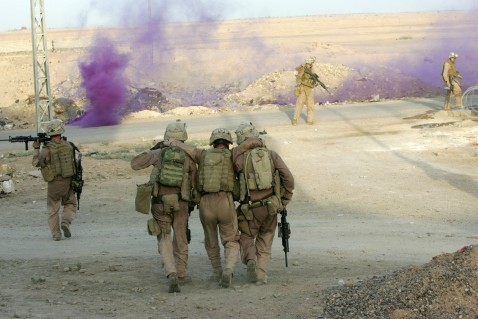
Combat action in Fallujah in June, 2007, AFP Photograph
Short List of Accomplishments
Here is a rundown of a few of the accomplishments of the 2/6 Marines in the past several months:
– Enemy attacks have gone from a high of 72 in April when we first took over, to only 21 last month
– We have discovered and destroyed 40 different enemy weapons caches
– We have captured 64 suspected enemy and taken them off the streets of Fallujah
– We have distributed close to 10,000 food bags (each feeds a family of 4 for 2-3 days) throughout the city
– We have made marked progress in restoring electricity, water and sewage services all ravaged by 4 years of fighting
– We have removed tons of trash and rubble from the streets
– We are sponsoring mural painting on school walls and cement barriers all over the city
– We are building soccer fields all over the city (their national team just won the Asia Cup and they all went nuts!) and are sponsoring teams and tournaments
– We are installing solar powered street lights along the main street






