Today for the first time the NRC went on record saying that the Fukushima Unit 4 Spent Fuel Pool was in deep trouble.
Mr Jaczko, who was briefing US politicians in Washington, said the NRC believed “there has been a hydrogen explosion in this unit due to an uncovering of the fuel in the spent fuel pool”.
“We believe that secondary containment has been destroyed and there is no water in the spent fuel pool. And we believe that radiation levels are extremely high, which could possibly impact the ability to take corrective measures.”
There has been some disputing going on between Japanese officials and the NRC, but apparently not enough to cloud the trouble, and the apparent plans to address it.
As U.S. and Japanese officials disagreed on how to characterize the seriousness of the nuclear crisis, police planned to use a water cannon truck — normally used for crowd control — to try to cool an overheated and possibly dry spent-fuel pool, one of an escalating series of malfunctions at the Daiichi plant in Fukushima prefecture, 150 miles north of Tokyo. Without cooling, the spent rods could emit radioactive material.
[ … ]
In Washington, U.S. Nuclear Regulatory Commission Chairman Gregory Jaczko said at a congressional hearing that all the water has evaporated from the spent fuel storage pool at the complex’s No. 4 reactor. Japanese officials have not confirmed that.
While not acknowledging that the Unit 4 SFP is a problem, they acknowledge plans to use a water cannon to get water into the pool.
As I said before boiloff, dryout and zirconium fires in the SFP pose a more significant risk than what is happening inside a hard containment.
Japan suspended operations to prevent the stricken Fukushima Dai-ichi nuclear plant from melting down Wednesday after a surge in radiation made it too dangerous for workers to remain at the facility.
Chief Cabinet Secretary Yukio Edano said work on dousing reactors with water was disrupted by the need to withdraw.
Foxnews is so far the only news media outlet reporting this. Thus far I have made my objections known to the paucity of good information coming from Japan, and the misinterpretation and mischaracterization of the little that is available by MSM outlets. It isn’t clear what this means. It could mean that that efforts to ensure core cooling are being abandoned, and this is bad, but not the same thing as abandoning the plant entirely. In the former case, we still have cores that have been partially rubblized and melted, fission products released, and partially contained within a hard containment, but attention still being paid to maintaining the integrity of the spent fuel pools. In the later case, this is very bad indeed. I had said earlier that I was actually more concerned about the radiological source term in the spent fuel pool than I was over the cores and containment.
This goes to show just how bad the situation is – no, not the situation with the reactors (which is bad enough), but the situation with the flow of good information.
It had previously been reported that there was a fire in the Spent Fuel Pool of the Unit 4 nuclear reactor. However, it wasn’t quite what it seemed.
Tokyo Electric Power Co. said that an oil leak in a cooling water pump at Unit 4 was the cause of a fire that burned for approximately 140 minutes. The fire was not in the spent fuel pool, as reported by several media outlets. Unit 4 was in a 105 – day – long maintenance outage at the time of the earthquake and there is no fuel in the reactor.
Near the plant entrance, which is somewhat removed from the building, radiation rose to 11.93 millisieverts per hour at 9 a.m. but was back down to 0.5964 millisieverts at 3:30 p.m.
Elevated radiation levels were also detected in northern Kanto and the greater Tokyo area, which is further south. Readings from 9 a.m. to 5 p.m. averaged 10 times higher than normal in some places, but still far below any level that would have an effect on the human body.
The No. 4 reactor had been shut down for a routine inspection, but the water temperature in the pool used to store spent fuel rods was rising. With the power now out and crews unable to enter the building, there is no way to know what is happening in the pool. If the temperature continues to rise, the rods could melt, threatening to release huge amounts of radioactive material.
From having performed the spent fuel characterization and shielding calculations, I know that the dose rate in a fuel pool building with the fuel uncovered by water would be as high as 50,000 rads/hr or even higher depending upon specific assumptions such as fuel burnup, decay time, enrichment, etc. That’s why most U.S. reactors have multiple (not just redundant, but multiple) means of makeup of borated water to the Spent Fuel Pool.
So the operators cannot get into the building to observe the conditions due to lack of habitability. If this fire is consuming oil, that’s one thing. If there is a Zirconium (cladding) fire due to loss of water over the fuel assemblies, then given the lack of a hard containment for the spent fuel building, I am actually more concerned about that than releases of radioactivity from the reactor buildings due to holdup, decay, sedimentation and plateout of fission products inside containment.
But the point is that there is still a dearth of good, high quality, technical information flowing our direction. Foxnews reported this morning that the dose (rate – although they didn’t understand that dose [rate] has units of time and didn’t report it as such) from radiation from the plant was the same immediately surrounding the plant and at 18 miles from the plant. Of course, this is physically impossible given that radiation decreases like sound and light with the inverse of the square of the distance from the source (1/R²).
There is a dearth of quality, technically correct information and commentary on the Japanese reactor accidents occurring at the Fukushima nuclear power plant. In fact, some of it is downright wrong. There is no hope of comprehensively reproducing a time line or of surveying all of the available news releases or reports. I’ll link some very good sites shortly that will assist you in studying the future commentaries and reports. Just to set the tone, if you are interested in one-and-a-half minute reading and tabloid hysteria, close this web page now. Go to the tabloids – or most MSM sites – or so-called news television (with their “nuclear expert” du jour). I won’t purvey hysteria or ignorant analysis. I’ll begin with things that can’t happen, and phrases and terms to avoid in your reading and viewing. We’ll move to a quick summary of what we know thus far about the accident(s), and close with an assessment of the consequences of this reactor accident for the future of Japan.
Perhaps the worst tabloid journalism thus far has come from Geraldo Rivera on Foxnews on Sunday evening. Thousands of souls had been swept into the sea, and Geraldo was discussing how “radiation was like that voodoo stuff – you can’t see it, and that’s what makes it scary!” The kind of hysteria extends to supposedly smart people like Charles Krauthammer, who said:
It’s a terrible potential. If you get a meltdown, of course, there is a catastrophe for the region. But also every 20 years we say let’s try again with nuclear energy, it’s clean energy — it doesn’t put stuff into the atmosphere. [Now] if you get a “China Syndrome” as in 1979 … it could put the nuclear [industry] out of business for decades.
The Daily Mail reports that “As fuel rods melt, they form an extremely hot molten pool at the bottom of the reactor that can melt through even the toughest of containment barriers.” To dispense with the myths, the China Syndrome was a movie. What happens in the analytical models, and also in actual reactor accidents like Three Mile Island (TMI) Unit 2, is that the corium, that mixture of melted fuel, cladding and other internal reactor components like control rods and guide tubes, forms in some of the channels, further blocking fluid flow. Eventually in an extreme reactor accident, much of the fuel shatters and becomes rubblized in the lower reactor vessel head. This is in fact what happened at TMI in large measure, along with some core melting.
It doesn’t require melted fuel to release fission products. Having written computer codes that model such releases, I can observe that much of the fission products are released in fuel heatup, and most releases occur prior to achieving fuel melt temperature, including most or all of the Noble Gases (Kr, Xe), much of the semi-volatiles (halogens) and some of the alkali metals (e.g., cesium). Don’t forget this point. This is important and I’ll come back to this later.
The corium isn’t modeled to melt through the lower vessel head except in the worst accidents where there is no coolant at all. This isn’t the case for the Fukushima reactors. Even in the event of complete breach of the lower vessel head, the corium doesn’t under any circumstances achieve melt-through of the lower basemat, which in some U.S. reactors is as much as 12 feet of concrete. The corium disperses and cools from the dispersal. There is no such thing as the China syndrome. That’s just a dumb ass movie. And reactors also don’t explode like nuclear weapons. Nuclear radiation isn’t voodoo, and we know how to achieve protection against it.
Now to what we know about the accident. When the tsunami occurred it disabled the offsite power to the plant. Emergency diesel generators automatically started, and they functioned for approximately one hour until they shut down due to tsunami-induced damage to their fuel supply. Power to the control valves in the reactor makeup operated until they lost battery backup. DC power from batteries was consumed after about eight hours of operation. The plant sustained a complete blackout (loss of all power), and it was at this point that fuel damage and Zirconium alloy (Zircalloy) – water interactions occurred, i.e., cladding oxidation. This is an exothermic reaction and produced more heat, adding to the fuel fission product decay (or residual) heat to be removed by the cooling system. It also produces hydrogen.
During some point in the past several days, hydrogen explosions occurred on Unit 1. In an attempt to prevent the hydrogen concentration from being above the explosive limit, releases were made from Unit 3. Ironically, it was likely a valve opening or some other electrical arc that caused the hydrogen explosion that occurred on Unit 3, further damaging not only Unit 3 but apparently also parts of Unit 2. Any hydrogen explosion that looks like this has already degraded a lot of nuclear fuel.
In spite of Russian experts who wax eloquent about how the world learned from the Chernobyl accident and how we’re better able to handle reactor accidents because of the Russian experience, the Japanese reactor accidents aren’t like Chernobyl, and it isn’t because we learned from the Russian design. I studied thousands of documents concerning Chernobyl and performed many calculations. I trained the DOE safety analysis engineers on the nuclear design characteristics of the RBMK-1000 reactor (not as a DOE employee).
The RBMK reactor design was loosely neutronically coupled, and had an overall positive power coefficient. That is, it was graphite-moderated, and since the water was a neutron poison rather than the moderator, the reactor was “over-moderated.” This means that upon a loss of coolant, the reactor experienced a power excursion. It had a positive void coefficient, leading to an increase in reactor power by a factor of 100 in less than 1 second. Furthermore, its containment structure was little more than a sheet metal “Butler Building.” The core was in flames and pouring fission products into the atmosphere. More than 30 souls perished attempting to mitigate the accident, and many more contracted cancer from the releases of radioactivity.
Despite what some of the more “conservative,” pro-nuclear “experts” have said on national TV, the Chernobyl accident was a catastrophe. I was in training with an engineer from Kiev not too many years ago, and he informed me that residents of Kiev still have to frisk their food with a GM detector and pancake probe prior to eating to ensure that they aren’t ingesting radioactivity.
So why was the RBMK reactor designed this way? For the production of weapons-grade fissile material. I have pictures of the Russians performing online refueling operations at the Chernobyl site to remove the weapons material. The Russians tried to combine commercial nuclear power with weapons production. The RBMK design is the result. U.S. reactors are designed by federal code with a negative overall power coefficient (GDC 11), which shuts the reactor down in a loss of coolant or fuel heatup.
The Fukushima reactor accidents aren’t Chernobyl because they have a hard containment design and a negative power coefficient like U.S. reactors. Unfortunately, that containment design is being breached periodically to release steam from the sea water that is flooding the core, and with the steam releases come radioactivity releases. As I said before, much of the release of fission products to the containment has likely already occurred (meaning that while it’s important to cool the core, its also the case that sedimentation, washout, plateout and other removal mechanisms are acting on the fission products (including radioactive decay).
We in the U.S. had our core melt event; it was TMI. There were essentially no releases of radioactivity and thus no health affects due to the hard containment design. The Fukushima reactor accidents are worse than TMI given the breach of containment, but with the evacuation that has already occurred, the health affects will be minimized.
The main cost now to TEPCO will be the cleanup and decommissioning of the damaged reactors, which likely have rubblized cores sitting in the reactor vessel. It will take a decade and tens of billions of dollars. Just as with the Takaimura criticality accident, we will probably see senior company officers bowing before the nation and asking forgiveness. This will probably spell the end of many careers, and the beginning of much soul searching over design and licensing basis seismic events, flood events and related design criteria.
There are many reports that have incorrect or incomplete information. The reports on exposure to the 7th fleet is remarkable for its lack of technical detail. We could perform a dose reconstitution with the available data, but we aren’t given any. There are incorrect and inconsistent units of radiation being reported, and there are technical facts gotten wrong. It’s best not to speculate on what we don’t know, and it’s best not to listen to the “experts” on television.
This is a serious reactor accident, one for the books. Nuclear engineers will be studying this accident for decades to come, and it will affect reactor regulation in both Japan and the U.S. But the Japanese worked remarkably efficiently to evacuate residents, and thus radiation exposure will be minimized. This was yeoman’s work given the state of transportation after the tsunami. The Japanese faced the perfect storm of problems, and they performed admirably.
But what this accident should not do is cause us to jettison the promising future of nuclear power because there might be some cesium uptake in Tuna in the Pacific. When nuclear workers receive regular body burden analysis to assess the radioactive content in their body, the technician can tell if they are hunters. “Do you hunt, sir? Yes, I hunt deer. Oh, that explains the Cs-137 spike I see.” The Cs-137 doesn’t come from commercial nuclear reactors. It comes from fallout from nuclear weapons testing during the 1950s and 1960s. We’ve been there and done that. It’s not a problem.
Only tabloid media could take a situation where thousands of souls were swept away in a tsunami and ignore that story for the real drama of a melted core (in which one soul has perished, and that from an industrial accident). We need to maintain our perspective, and the proper perspective isn’t to have nightmares of melt-throughs to China. We should leave that to the purveyors of hysteria.
Some good links (I will add to these later):
ANS Nuclear Cafe (for the best coverage and analysis of the Fukushima reactor accidents)
NUREG-1250, “Report on the Accident at the Chernobyl Nuclear Power Station.”
EPRI, NSAC-127, “Multidimensional Analysis of the Chernobyl Accident” (if you’re really interested in Chernobyl).
Do you recall what Tim Lynch said about battle space weight?
Many of their Marines are suffering chronic stress fractures, low back problems as well as hip problems caused by carrying loads in excess of 130 pounds daily. ”We’re fighting the Mothers of America” said one; if we lose a Marine and he was not wearing everything in the inventory to protect him that becomes the issue. Trying to explain that we have removed the body armor to reduce the chances of being shot is a losers game because you can’t produce data quantifying the reduction in gun shot wounds for troops who remain alert and are able to move fast due to a lighter load.
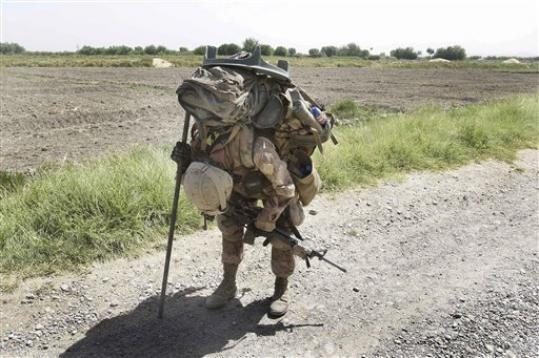
This Marine is carrying his backpack filled with food, hydration system, clothing, etc., and is also carrying ammunition, weapon, body armor, and other equipment. He is likely going “across the line” at 120 to 130 pounds. He is suffering in heat and with heavy battle space weight. For weight lifters like me, let’s put this in terms we can understand. This is like putting three York 45 pound plates in a backpack and humping it for ten or fifteen miles in 100+ degree Fahrenheit weather.
Battle space weight is a recurring theme at The Captain’s Journal, and will remain so. Money should be devoted to the weight reduction of SAPI plates in body armor and other low and even high hanging fruit. The weight of water is decided by God and cannot be altered.
Another salient point bears down on us. This is why women are not allowed in Marine infantry (or Army Special Forces), and why women suffered an inordinately high number of lower extremity injuries (leading to ineffective Russian units) when they deployed with the Russian Army in their losing campaign in Afghanistan. Just like God decides the weight of water, He also decides the physiques of men and women.
Soldiers and Marines in Iraq and Afghanistan routinely carry between 60 and 100 pounds of gear including body armor, weapons and batteries.
The heavy loads shouldered over months of duty contribute to the chronic pain suffered by soldiers like Spc. Joseph Chroniger, who deployed to Iraq in 2007.
Twenty-five years old, he has debilitating pain from a form of degenerative arthritis and bone spurs. “I mean my neck hurts every day. Every day,” he says. “You can’t concentrate on anything but that because it hurts that bad.”
Like many soldiers and Marines, Chroniger shouldered 70 to 80 pounds of gear daily.
A 2001 Army Science Board study recommended that no soldier carry more than 50 pounds for any length of time.
“We were doing three, four, five missions a night sometimes,” Chroniger says. “You’re jumping out. You’re running. I mean it hurts — it hurts.”
Muscle strain is usually a short-term condition that has always been prevalent among soldiers.
But after a decade of war, the number of acute injuries that have progressed to the level of chronic pain has grown significantly.
According to the Department of Veterans Affairs, veterans of the wars in Iraq and Afghanistan who retired with musculoskeletal conditions grew tenfold between 2003 and 2009.
Col. Stephen Bolt, chief of anesthesia at Madigan Army Medical Center in Tacoma, Wash., says the Army has started deploying physical therapists to serve with some infantry brigades in combat areas.
“The faster you can address some of those issues at the clinic level, the less likely you are to see those injuries progress to a true chronic-pain state that’s going to require them to be evacuated from theater and replaced by someone else,” Bolt says.
But that’s a relatively new concept.
Col. Diane Flynn, chief of pain medicine at Madigan, says chronic pain is complex and challenging for the patient and the physician.
“Primary care providers who provide most of the pain management to patients have had very limited tools in their toolbox,” she says. “And it’s medications for the most part and maybe physical therapy — but very little to offer in addition to that.”
In an effort to provide more options for pain management and lessen the dependence on prescription drugs, the Army is starting to incorporate other forms of treatment including yoga, meditation and acupuncture.
Deploying physical therapists is a great idea. But the best possible enhancement to warrior recovery hasn’t been floated, i.e., deployment of Chiropractors. Reduction of battle space weight is one avenue of approach to maintain healthy skeletal and soft tissue systems, but immediate medical amelioration is possibly the best effect for the dollar that could be spent. Chiropractors are our best bet.
On another front, we find repeated accounts of the duress that our warriors are under due to battle space weight, and this, interestingly enough, at the same time that we see silly and sophomoric advocacy for women in combat roles. But Former Spook reminds us that:
Almost 20 years ago, columnist Fred Reed published results of an Army study, comparing fitness levels among male and female soldiers. The data reaffirms that most women simply lack the upper body strength and endurance required by an Army infantryman, a Marine rifleman, or most special forces MOS’s.
The average female Army recruit is 4.8 inches shorter, 31.7 pounds lighter, has 37.4 fewer pounds of muscle, and 5.7 more pounds of fat than the average male recruit. She has only 55 percent of the upper-body strength and 72 percent of the lower-body strength… An Army study of 124 men and 186 women done in 1988 found that women are more than twice as likely to suffer leg injuries and nearly five times as likely to suffer fractures as men.
The Commission heard an abundance of expert testimony about the physical differences between men and women that can be summarized as follows:
Women’s aerobic capacity is significantly lower, meaning they cannot carry as much as far as fast as men, and they are more susceptible to fatigue.
In terms of physical capability, the upper five percent of women are at the level of the male median. The average 20-to-30 year-old woman has the same aerobic capacity as a 50 year-old man.
The same report also cited a West Point study from the early 90s which discovered that, in terms of fitness, the upper quintile of female cadets achieved scores equal to the lowest quintile of their male counterparts (emphasis ours).
So, what’s a chief diversity officer supposed to do (don’t laugh–the commission recommends creation of that very post, reporting directly to the SecDef). Water down the standards so more women will qualify for combat service, removing that “barrier” to reaching the flag ranks? Or create some sort of double-standard, allowing females to punch their resumes in the right places and continue their climb to the stars.
Good data and perspective, but he equivocates by saying:
No one disputes the benefits of more flag officers who are women or members of minority groups. But the real emphasis should be on demanding excellence from all who aspire to flag rank, and promoting those who meet–and exceed–a very high bar. Some of the “remedies” outlined in the Lyles report seem closer to social engineering, particularly when you introduce the notions of “measurement” and “metrics.”
So that no one is confused and to ensure that I’m not misinterpreted, and just to make sure that we know that Former Spook is incorrect in this first assertion, let me state unequivocally and without reservation: I do dispute the benefits of more flag officers who are women or members of minority groups.
Note that this is from someone who would vote for a certain black man for president of the U.S. before any white man I know (and my co-blogger agrees). I see no need to recruit the presumed “brightest” from Ivy League schools, and no one has offered me a compelling reason to believe that the principles of war and strategy and tactics in warfare are a function of race or gender, any more than, say, the sciences or engineering could benefit from a white, black, male or female presence. Anyone who believes something like that doesn’t understand the sciences or engineering (or warfare). That kind of thought is reserved for onlookers who want to do social engineering. It’s for the land of make-believe, the domain of people who spent too much time and money learning from effeminate professors in college classrooms.
And so too the notion that women can handle loads of 120 pounds on ten miles humps when male bodies are breaking down doing it. Long gone are the notions of winning hearts and minds by driving to the front in vehicles and drinking tea as a means to combat the insurgency. This is an infantryman’s war, and it means fighting.
Finally, just to make sure that you know the stakes, let me make one thing clear. If you claim that combat “roles” should be opened up to women but don’t clearly delineated that you mean infantryman (for the Marines that MOS 0311), you are hedging and not being honest. At least be honest with what you say. And finally, if you claim that the infantryman MOS should be opened up to women but exclude special operations forces, you are a liar.
Let me make it clear again. If you want to open the infantryman billet to women but exclude SOF (SEAL, Ranger, Green Beret, Army Combat Diver, Marine Scout Sniper, Force Recon), you are a liar. You are being disingenuous and dishonest, and it’s not even worth debating you. You don’t really even believe what you are saying. You want to believe that infantry is now only part of so-called “general purpose” forces, that they serve only as policemen in our new nation-building paradigm. Leave it to SOF to do the kinetics. But you know that this won’t last. Your paradigm is a pipe dream, and Afghanistan and Iraq have shown that.
So if you care to debate the issue I am open to such a debate. But let’s be clear that it doesn’t begin at opening “combat roles” to women (whatever combat roles means). The debate will be an honest one, which means that in order to be consistent and honest, you must advocate that all billets, including SOF, be opened to women. Otherwise, don’t even bother with the debate.
C. J. Chivers gives us a rundown of the current state of affairs in Afghanistan, and the money quotes follow.
Officially, Mr. Obama’s Afghan buildup shows signs of success, demonstrating both American military capabilities and the revival of a campaign that had been neglected for years. But in the rank and file, there has been little triumphalism as the administration’s plan has crested.
With the spring thaw approaching, officers and enlisted troops alike say they anticipate another bloody year. And as so-called surge units complete their tours, to be replaced by fresh battalions, many soldiers, now seasoned with Afghan experience, express doubts about the prospects of the larger campaign.
The United States military has the manpower and, thus far, the money to occupy the ground that its commanders order it to hold. But common questions in the field include these: Now what? How does the Pentagon translate presence into lasting success?
The answers reveal uncertainty. “You can keep trying all different kinds of tactics,” said one American colonel outside of this province. “We know how to do that. But if the strategic level isn’t working, you do end up wondering: How much does it matter? And how does this end?”
The strategic vision, roughly, is that American units are trying to diminish the Taliban’s sway over important areas while expanding and coaching Afghan government forces, to which these areas will be turned over in time.
But the colonel, a commander who asked that his name be withheld to protect him from retaliation, referred to “the great disconnect,” the gulf between the intense efforts of American small units at the tactical level and larger strategic trends.
The Taliban and the groups it collaborates with remain deeply rooted; the Afghan military and police remain lackluster and given to widespread drug use; the country’s borders remain porous; Kabul Bank, which processes government salaries, is wormy with fraud, and President Hamid Karzai’s government, by almost all accounts, remains weak, corrupt and erratically led.
And the Pakistani frontier remains a Taliban safe haven.
I agree with Chivers’ assessment that the U.S. has the troops to hold the ground that the commanders order it to hold. But as Chivers points out earlier in the article:
In and near places like this village in Ghazni Province, American units have pushed their counterinsurgency doctrine and rules for waging war into freshly contested areas of rural Afghanistan — even as their senior officers have decided to back out of other remote areas, like the Pech, Korangal and Nuristan valleys, once deemed priorities. In doing so, American infantry units have expanded a military footprint over lightly populated terrain from the Helmand and Arghandab River basins to the borders of the former Soviet Union, where the Taliban had been weak.
Here is a tip for future reading, study and, well, let’s be frank – wading through the misdirects that both the MSM and military PR sends your way. When you hear the reflexive, tired, worn out mantra that we are having difficulty defeating the Taliban and those forces aligned with AQ because Pakistan simply won’t go into their safe havens and root them out, this is a nothing but a magic trick, a sleight of hand, a smoke screen, a ruse. The issue is fake. It’s a well-designed farce.
Oh, to be sure, the U.S. would indeed like for the Pakistanis to go kill all of the Taliban, Tehrik-i-Taliban and AQ affiliated groups so that we don’t have to deal with them in Afghanistan. But we have the ideal chance to address the problem head on in the Pech Valley and other areas near the AfPak border – that Durand line that exists only as a figment of our imaginations. Essentially, much of the Hindu Kush is available for us to do the same thing we want Pakistan to do …
Note Chivers’ observation that the borders remain porous and that the Taliban still have safe haven. Thus, while U.S. troops can clear areas and hold them, commanders note that the Taliban are beginning to return to Sangin. The U.S. has enough troops to hold Sangin, but not enough to press the insurgency into their safe havens, find them and kill them. We have intentionally and knowingly opted out of chasing them into their safe havens. So the U.S. doesn’t have enough troops to do anything except play “whack-a-mole” counterinsurgency.
While U.S. troops maintain their tactical superiority over the insurgency, that’s not the same thing as a strategically cogent and compelling plan. We are holding terrain, some terrain – some physical terrain and some human terrain – and relinquishing other terrain. The insurgency is being squeezed from one place to another.
Recall that someone else discussed this as well? Take a few minutes and listen again to this interview of Lt. Col. Allen West (Ret) as he discusses the various options and why holding terrain won’t work. Tactical superiority and strategic malaise. Same as it’s always been in Afghanistan. And finally, our campaign is a model of the one conceived in Army Field Manual FM 3-24. This is expensive, long term, protracted duration nation-building by-the-book in the most logistically unsustainable and overall worst place on earth.
For six years, the Afghan government has held Abdul Jabar behind bars, separated from his father, a former Taliban judge, and his seven brothers, all Taliban fighters.
Being locked up for kidnapping, however, has not dulled Jabar’s love for the insurgents or hatred of the Afghan government. With so many Taliban supporters in Afghanistan’s largest prison, Jabar feels right at home.
“All of the prisoners support the Taliban. I also support the Taliban,” the 28-year-old said in a jailhouse interview inside Pol-e-Charki prison, on the outskirts of Kabul. “They will win the war in Afghanistan.”
The problems at Pol-e-Charki, with its 5,000 prisoners, point to a weakness in the American approach to detention in Afghanistan. Among those housed in Pol-e-Charki are hundreds of suspected insurgents captured by the United States and transferred to Afghan authority because an American-run prison, with a capacity of 1,350, has long been filled to capacity.
Support for the Taliban is almost universal in Pol-e-Charki prison, the largest in Afghanistan, inmates said in interviews. Inmates and Afghan officials describe the prison as a breeding ground for the insurgency, with prisoners maintaining close and regular contact with comrades outside. Last week, Afghan intelligence officials said that a 45-year-old prisoner, Talib Jan, had orchestrated the deadly bombing of a Kabul grocery store from his prison cell.
American military officials say they want to keep in custody the inmates deemed most dangerous and those who are thought to possess valuable intelligence. To address the problem, the United States is nearing completion of a project that will double to about 2,600 the number of beds at the American-run Parwan Detention Center, formerly known as Bagram prison.
But with U.S. Special Operations Forces capturing scores of prisoners each week in aggressive nighttime raids, the United States for now must choose between releasing many prisoners after a few hours and handing over others to Afghan authorities, despite what current and former Afghan officials say are real reasons for concern about the security and effectiveness of Pol-e-Charki.
Of the 3,000 people detained by the coalition between August and January, 32 percent were transferred to Afghan authorities for detention in facilities including Pol-e-Charki, and 4 percent went to the U.S.-run prison. More than half were released in the initial screening period.
“We are not de-Talibanizing them,” Afghanistan’s former intelligence chief, Amrullah Saleh, said in a recent interview about Pol-e-Charki. “We are further radicalizing them. We are giving them control of the prison.”
U.S. officials acknowledged the problems at Pol-e-Charki but said the facility used to be worse. Earlier in the war, the prison had a wing “completely controlled” by the Taliban, where guards could not enter and left food at the door, said a U.S. official in Kabul who works on prison issues. Inside, the Taliban trained and ran a madrassa.
As we have discussed before, to believe that imprisonment is assisting in the fight against the insurgency one must believe that prisons perform a rehabilitative role, and not only is there really no prima facie reason to propose such an idea, I see no evidence of it in the history of insurgencies and counterinsurgency operations.
For my doubters. Name me one insurgency which was defeated or even weakened by imprisonment (and no, don’t include the only example that comes to mind for you, Iraq, until you study previous posts on this issue). In your mind, travel the world from Malaya to Algeria. Why did this RAND study not include the word “prison” even once in 311 pages? Same for most other studies on the Algerian insurgency.
Not only are prisons not performing a rehabilitative role in Afghanistan, they are making the problem worse. I had previously observed that the 96-hour-catch-and-release program means that insurgents get back home before the week is out, making “detainment” irrelevant except to piss off the persons who have been detained.
Kill them or let them go (and preferably, kill them), but sending them to a catch-and-release program, or to be further radicalized, is counterproductive and wasteful of military resources. And it keeps special operations forces troopers busy rounding up folks to be radicalized and released. It doesn’t work to cut the head off of the insurgency. Followers will always find leaders if they want to be led. It must be marginalized from the bottom up by military operations. It must be costly enough that the no one wants to follow the Taliban leaders anymore. When leaders don’t have followers, the insurgency is over.
I have said it before, and will say it again. Prisons … do … not … work … in … counterinsurgency. In my daily digest of information, when I see entries like “Six Taliban fighters killed in Sangin,” or “Four Taliban killed in Pech Valley,” that’s meaningful. When I see entries that contain the words “Taliban fighters detained …,” I summarily ignore them. Not only does it not add anything to the campaign, it detracts from it and obfuscates what’s really important. This simple rule helps me to avoid reading most of the ISAF entries on military operations in Afghanistan.
The ISAF has released a statement on “repositioning” troops from the Pech Valley:
Coalition forces are repositioning from the Pech Valley to locations along Highway 7 to block insurgent infiltration along the Afghanistan-Pakistan border.
“Afghan forces will take the lead in the Pech Valley,” said German Army Gen. Josef Blotz, spokesman, International Security Assistance Force Headquarters, in Kabul, Afghanistan, Monday, during a weekly update.
Repositioning forces is a normal task for military operations as new strategies and counter-strategies are enacted to win the war. The repositioning of coalition forces also shows an increase in the abilities of Afghan National Security Forces.
“Afghan Security Forces are able to take responsibility of Pech Valley,” Blotz continued. “This is testimony to our confidence.” Blotz highlighted that while the numbers of ANSF have increased, their skill and abilities have also improved.
After years of fighting for control of a prominent valley in the rugged mountains of eastern Afghanistan, the United States military has begun to pull back most of its forces from ground it once insisted was central to the campaign against the Taliban and Al Qaeda.
The withdrawal from the Pech Valley, a remote region in Kunar Province, formally began on Feb. 15. The military projects that it will last about two months, part of a shift of Western forces to the province’s more populated areas. Afghan units will remain in the valley, a test of their military readiness.
While American officials say the withdrawal matches the latest counterinsurgency doctrine’s emphasis on protecting Afghan civilians, Afghan officials worry that the shift of troops amounts to an abandonment of territory where multiple insurgent groups are well established, an area that Afghans fear they may not be ready to defend on their own.
And it is an emotional issue for American troops, who fear that their service and sacrifices could be squandered. At least 103 American soldiers have died in or near the valley’s maze of steep gullies and soaring peaks, according to a count by The New York Times, and many times more have been wounded, often severely.
Military officials say they are sensitive to those perceptions. “People say, ‘You are coming out of the Pech’; I prefer to look at it as realigning to provide better security for the Afghan people,” said Maj. Gen. John F. Campbell, the commander for eastern Afghanistan. “I don’t want the impression we’re abandoning the Pech.”
Abandoning the Pech? Who said anything about abandoning the Pech? This is just a “repositioning” of assets. But wait. The ANSF, despite the high praise from the ISAF, doubts their ability to hold the Pech. They don’t appear too keen on the idea of going it alone in the Pech River Valley, and they shouldn’t be after watching the Taliban go after the outposts in Eastern Afghanistan such as at Wanat and Kamdesh.
And then there will be the investigations, maybe beginning something like this:
Flag officer A: So did we abandon the Pech Valley?
Flag Officer B: No sir, we repositioned to large population centers so that our operations comport with the doctrines of population-centric COIN.
Flag Officer A: So there isn’t any population in the Pech Valley?
Flag Officer B: Not nearly like in Kandahar, Jalalabad or Kabul.
Flag Officer A: So why did we leave the ANSF there if the population isn’t there?
Flag Officer B: Well, we thought it might be important to consider the fact that the insurgency would have safe haven in Pech and all along the Hindu Kush if we didn’t have troops there, and so we decided to …
Flag Officer A, interrupting: What do you mean insurgency and safe haven? I thought you said the doctrines of population-centric counterinsurgency informed your judgment? What difference does it make about the fighters if we protect the population? Isn’t that our doctrine now?
Flag Officer B: Well, yes sir, but … um … you see, we thought that, um …
And I would love to be a fly on the wall for the rest of that conversation. Can we put it on YouTube?
Nothing will sour the morale of combat troops faster then the realization that the commander at the top receives frequent visits from the Good Idea Fairy. Which is a good start point for explaining why General Stanley A McChrystal took to the pages of Foreign Policy last week to explain the unexplainable. The story starts with McChrystal’s observation that the SF tier 1 guys found al Qaeda difficult to collect, fix and target because they were so decentralized. So McChrystal made up his own “network” and his centralized, vertically integrated, fixed chain of command network beat the AQI with their horizontally integrated decentralized chain of command. I’m not buying that about Iraq but the focus of the article was how this genius system was implemented in Afghanistan by the regular military and what do you know the “mo better” network has since delivered us the current spate of good news about the Taliban getting tired of fighting.
The article linked above and all the other recent reports stress that the rift between the Taliban fighters and their leaders who are safely ensconced in Pakistan stems from the losses being inflicted on them in the Helmand and Kandahar Provinces. The pressure being brought to bear on the fighting Taliban has very little (if anything) to do with the nighttime high speed low drag tier 1 special forces raids designed to “decapitate” Taliban leadership. The whole decapitation strategy is suspect as numerous observers have noted over these many years of SOF raiding and I ask again if somehow a military adversary managed to “decapitate” our leadership would we be weaker or stronger? …
HVT raids do produce results but it seems to me that what has brought the fighting Taliban to their knees is hard fighting infantry who have moved in with the people and deprived the villains of maneuver room while killing ever increasing numbers of them using ROE completly different from the horseshit inflicted on them by McChrystal.
So let’s talk about this for a few minutes. Just occasionally we are enriched by someone who has both location and smarts – or shall we say, good judgment. Nir Rosen, who was always and remains a jerk, had location. He was also embedded with the Taliban. I wasn’t impressed, and said so. I thought he was a jerk then, and I was proven right. Whether I have good judgment is up to my readers, but I certainly don’t have location. Michael Yon now has location again, and he also has good judgment. Tim Lynch has both as well. If you really want to know not only what is going on in Afghanistan but how to interpret it, read Tim’s work. It’s that good. Really. Read Michael Yon, then read Tim Lynch. Between them you will usually find what you need to give clear perspective.
Tim expressed doubt that the tooth fairy ideas expounded by McChrystal worked in Iraq or Afghanistan like McChrystal claims. Let me be more blunt. He sees the world myopically. So the insurgent and counterinsurgent can operate according to swarm theory. They can engage in distributed operations where authority is pressed downward. So what? We already knew this. McChrystal seems to advocate the idea that it was the HVT raids that won the campaign in Iraq. How what he did with a few operators differed from what infantry did all over Iraq from 2004 – 2008 isn’t explained. And I know something of the hell the boys of 2-6 went through in Fallujah in 2007, and they did it without SOF operators. Didn’t need them, didn’t want them. They would have been in the way.
[Here I should VERY BRIEFLY share a story. My son was on post and a band of un-uniformed SOF troopers came through Fallujah on the way to Ramadi to pick up some bad guy, driving an unmarked vehicle, throwing dust as they drove, and they were stopped by my son. He told them, “If you ever, ever come through my AO again un-uniformed, and in an unmarked vehicle, driving like a bat out of hell, I will light you up like a f***ing Christmas tree, and then laugh about it as they pick up the body parts.” And the SOF troopers didn’t come through Fallujah again on 2-6’s watch.]
If my friend Gian Gentile casts doubt on the surge narrative, I cast doubt on the HVT narrative. Neither won the campaign in Iraq. Hard core infantry operations in the cities, villages and countryside of Iraq, along with all of the things discussed in McChrystal’s paper done by all of infantry and not just SOF, won the campaign. And finally, yes, along with Tim, I think that the micromanagement by McChrystal’s staff was horseshit. Plain and simple.
Tim goes on to discuss the tactics that won Iraq, and that will win in Afghanistan if we turn the troops loose.
A great example of this would be Naw Zad which is currently home to the headquarters of Charlie Company 1st Battalion 8th Marines. The rest of the battalion is handling Musa Quala which, like Marjah, was infested with Taliban but is now safe enough for the battalion commander to walk around the bazaar without body armor and helmet. The Captain at Naw Zad (and he’s there on his own because he’s that good) is surrounded by Taliban. He has an area of influence which he is constantly expanding and he does this with aggressive patrolling. He has the clearance to shoot 60mm mortars and run rotary wing CAS guns (Cobra or Apache gunships employing their guns only; rocket or Hellfires have to be cleared) without coordinating with his battalion COC. He has no problems at all with the current rules of engagement and has never been denied fires when he has asked for them.
Tim goes on to discuss issues of weight for the Marines.
I was able to spend a lot of time talking with the officers and men currently serving in Naw Zad and here is what they bitch about: They don’t like the weight they are forced to carry and strongly feel the use of body armor should be determined by the mission and enemy. Wearing it in blistering heat or while climbing the massive mountains is so physically debilitating that they have felt on several occasions that they were unable to defend themselves. Many of their Marines are suffering chronic stress fractures, low back problems as well as hip problems caused by carrying loads in excess of 130 pounds daily. ”We’re fighting the Mothers of America” said one; if we lose a Marine and he was not wearing everything in the inventory to protect him that becomes the issue. Trying to explain that we have removed the body armor to reduce the chances of being shot is a losers game because you can’t produce data quantifying the reduction in gun shot wounds for troops who remain alert and are able to move fast due to a lighter load.
I have mixed feelings on this, as my son’s life was saved by his ESAPI plate. But as readers know, I have griped about battlefield weight as well. Remember this Marine carrying a mortar plate along with the rest of his gear?
Whatever is done or can be done about battle space weight, Tim’s discussion about injuries is sure to be ignored by advocates of women in combat. I have pointed out before the difference between the Army mentality (mechanized infantry) versus Marines (foot borne infantry), but even this breaks down in places like Korengal where those Soldiers may as well have been Marines. But I have pointed out that the Russian campaign in Afghanistan was plagued by a huge number of lower extremity injuries to women, and if these injuries (including higher up into the whole body, i.e., hips) are happening to the most physically fit troops on earth right now in Afghanistan, does anyone really, seriously want to advocate the notion that women can do this with 130 pounds of gear? Did God not design men and women differently, and would we not want to celebrate this diversity rather than try to expunge it? What kind of man imagines gender-neutral physical features, and for what reason?
And speaking of Now Zad, make sure to catch Tim’s pictures documenting his time in Now Zad. He observes:
Fox company 2nd Battalion 7th Marines (Fox 2/7) arrived in Naw Zad to reinforce the Brits in late 2008 and were able to expand the security bubble but not by much. The Brits, Estonians and Marines fought side by side to expel the Taliban from this fertile valley but were hampered by restrictive ROE pushed down from on high by senior officers in Kabul who lacked common sense and experience at counterinsurgency warfare. The Marines and their allies lost a lot of men because they did not have the mass or firepower to do the job correctly. Way back then there was a lone voice in the blogsphere pleading with all who would listen to free up the combat power and let the Marines in Naw Zad fight. His name is Herschel Smith and his posts at the Captains Journal can be found here. It is worth your time to read them all.
This statement by Tim is, quite honestly, very moving for me. I’m a fairly rough and unemotional man, but I recall with significant emotion my time studying the boys in Now Zad, their living in what they termed hobbit holes, the multiple trauma doctors with them due to the massive loss of limbs and other traumas suffered by undermanned Marines, and so on, until I almost couldn’t take it any more. Tim gives us a picture of the Dahaneh pass, and I know that my good friend John Bernard lost his son near Dahaneh: “KIA (Dahaneh 08/14/09) and who is now safe and resting in the arms of our Lord and Savior Jesus Christ. I miss him!” I know that you do John. Many loved ones were lost near this AO while massive flotillas full of Marines were going from port to port as “force in readiness” for God only knows what.
Today, I accompanied members of Central Asia Development Group (CADG). We drove from the town of Tarin Kot to the violent village of Chora. A quick web search for Chora will reveal countless articles about the heavy fighting. We took an extremely dangerous stretch of road. We saw nary a soldier, though I am told many have died here. Leonard Grami, the Urozgan Provincial Manager for CADG, reckons well over a hundred troops and Afghans have died on this stretch in the last 14 months, including some last week and last night.
Somehow we made it to Chora and saw that the USAID project seems to be doing fine, but while the managers checked the work, Afghan authorities dumped the body of a Taliban killed last night in nearby in fighting. They dumped him at a “traffic circle” underneath what they call “the steeple.” Men and boys flocked to the body and were so tight around him that they must have been almost stepping on him. When we arrived, they pulled back for a moment, and I made a panorama of these dangerous men.
Make sure to stop by Michael’s place and tool around the panorama link combining multiple pictures Michael took. My initial thoughts are that if these men engage in such honorific behavior openly and in public for a dead insurgent, and if they admire the man and his work to this extent, then we are not winning this war. We haven’t marginalized the insurgency, or anywhere near it. A picture is worth a thousand words.



 14 years, 11 months ago