
Flushing out the British Narrative
BY Herschel Smith 16 years ago
Preliminary reading:
In the midst of the chaos in Basra at the moment with the British forces sitting at the Basra airport, it is necessary to construct a narrative for what happened and why. One problem is that not even all of the British commentators agree on that narrative.
Some Brits are saying that the current battle is just what we’ve been waiting for. It’s good that it has finally come and that the Iraqis are carrying it out.
The British military always knew the test would come and it has arrived with the offensive that Iraqi forces have launched in Basra against the Shi’ite militias and criminal gangs who have run too much of the city for too long. British-trained Iraqi units have been in action, directed by Nouri al-Maliki, the prime minister, in what is clearly a crucial encounter for the future of Iraq.
The object of the British exercise since 2003 has been to train Iraqi forces and hand control to them as soon as possible. If the strategy is seen to work then whatever follows this battle of Basra might fairly be regarded as the responsibility of the Iraqis themselves and the British will have taken a big step towards final withdrawal.
Maliki is taking a stand on his ability to exert central government authority over the increasingly lawless second city of Iraq. If the British seemed to acquiesce too easily in the slide into lawlessness in the four years they controlled Basra, a victory for Iraqi forces now would demonstrate the wisdom of being patient and letting the Iraqis run the country in their own way.
It would also be a powerful rejoinder to American mutterings that the British delude themselves into thinking their approach is sophisticated when it is simply permissive. This battle of Basra, say British military spokesmen, is what we have been working for.
Yet there is another narrative that is directly contradictory.
Rather than being – as the anti-war brigade claimed – a humiliating retreat, the tactical withdrawal from Saddam’s old summer palace on the banks of the Shatt al-Arab was undertaken on the basis that the continuing presence of British troops was exacerbating, rather than helping, the local security situation. The fiercely nationalistic Iraqis did not want outsiders telling them how to run their affairs.
Formal control of the city was returned to the Iraqis in a short ceremony at the air base last December, but much of Basra has remained under the control of a combination of radical Islamic militias and criminal gangs, which has made it virtually impossible for the Iraqi government in Baghdad to exercise its authority over the city.
The contradiction takes a second reading to understand, but once found out, creates an awkward state of affairs for the British commentators who are aping the British officers. In the first narrative, there was a fight waiting to happen, and it is best that the Iraqis are engaging it. In the second narrative, the violence is not a necessary state of affairs, but rather, is a direct function of the British presence in Basra. Therefore, the best policy is a “tactical withdrawal.”
It is difficult to imagine any respectable counterinsurgency strategy anywhere on earth and in any era where it is a positive or productive thing to allow an area to devolve into chaos over the course of four years. But there are Brits who are able to put aside pride and false narratives. Peter Oborne’s commentary is as hard hitting as any analysis we’ve seen.
British military history contains more than its fair share of glorious victories, but there have also been notable disasters. It has become horrifyingly clear that one of these is our involvement in southern Iraq, culminating in our soldiers’ exit from Basra Palace late last year.
At the time, the Government presented the withdrawal of British troops as a success. Gordon Brown assured us that they had done their job so well that it was safe to hand over to local forces.
It is difficult to tell whether the Prime Minister was deliberately lying, or whether – more likely – he was mistaken about what was going on. Either way, the truth was very different. Far from calmly handing over Basra to the new regime, we were driven out by Iranian-backed militias, leaving behind a state of murderous anarchy.
This became horrifically plain last week when widespread fighting broke out inside Basra. Iraq’s Prime Minister, Nouri Maliki, has ordered his army to try to regain control of the city. Meanwhile, Britain’s 4,000 troops, safely cocooned in Basra air base outside the town, are taking no part in what may well prove to be a crucial battle.
This is a humiliation. All this week, commentators used the state visit of the French President, Nicolas Sarkozy, to mock his country’s shamefully inadequate military involvement in Afghanistan – keeping their troops well out of harm’s way while the burden of fighting has been carried out by others.
But that has been the wretched fate of our 4,000 troops sitting idle in Basra air base, listening helplessly – and positioned a safe distance away – as mortars pound and machine-gun fire rattles in battles that are deciding the long-term future of Iraq.
Twelve years ago we were rightly censorious after Dutch troops sat on their hands while 7,000 Muslims were massacred during the Balkan War at Srebrenica.
Of course, it would be utterly wrong to accuse our soldiers of the miserable cowardice displayed on that infamous occasion by the Dutch. But their current impotence in southern Iraq as fighting rages nearby sits most uneasily with the exemplary British fighting tradition.
It needs to be said at once that no blame attaches itself to our soldiers, 176 of whom have given their lives in this ghastly conflict.
However, the same cannot be said of our politicians. Last September, the Prime Minister made a snap visit to Basra during which he revealed the decision to withdraw British forces …
Shamefully for Britain, the White House is now considering sending its own forces to sort the mess that the British have left behind. Last week, one White House official acidly remarked: “American blood is going to have to buy off the British failure in Basra.”
Already at the Basra air base, I can reveal, the British subsidiary of U.S. construction giant KBR is building four huge dining facilities – known to the American army as DFACs. These are capable of feeding 4,000 men and suggest that the U.S. Army is contemplating a massive deployment to southern Iraq – including a major presence inside Basra itself.
Oborne correctly refuses to lay the blame at the feet of the British enlisted men, and also correctly points out that the drawdown was precipitous. But he also fails to mention that the British commanders fabricated a ridiculous narrative while the politicians were playing political games. There is enough blame to go around, but creating narratives that deny the failure prevents learning and adaptation of British counterinsurgency doctrine.
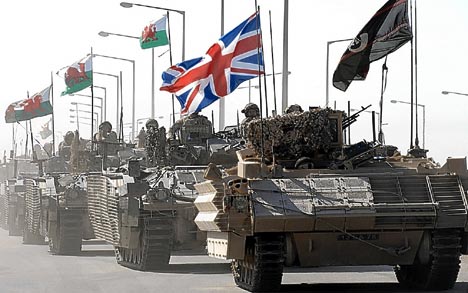
British retreating from Basra in 2007, courtesy of the Daily Mail.






Trackbacks & Pingbacks
Comments
RSS feed for comments on this post. TrackBack URL
Leave a comment